Poetic Forms & GenresPoetic Language and Poetic FormSarah Law Poetic Language and Poetic Form
Genre‘In literature genre refers to the classification into ‘types’ or ‘forms’ or ‘kinds’…How tightly or prescriptively genre can be defined has been a long-standing  argument in literary studies as theorists propose new criteria and different classifications.’(Wainwright, Poetry: the Basics)Sarah Law Poetic Language and Poetic Form
Epic, lyric, dramatic‘For the medium being the same, and the objects the same, the poet may imitate by narration - in which case he can either take another personality as Homer does, or speak in his own person, unchanged - or he may present all his characters as living and moving before us.’ (Aristotle, Poetics, c. 335 BC)Sarah Law Poetic Language and Poetic Form
DefinitionsEpic: concerned with narrative, long poemLyrical: concerned with states, incidents and moments, often in 1stpersonDramatic: verse as spoken, sung, or chanted in plays as part of a dialogue, voice of other character(s)Sarah Law Poetic Language and Poetic Form
Hierarchy of GenresThrough the Renaissance and much of the eighteenth century, the recognized genres were widely thought to be fixed literary types
a hierarchy ranging from epic and tragedy at the top to the pastoral, short lyric, epigram, and other types at the bottom
appropriate subject to the appropriate form and language was known as the concept of decorum
Neoclassical Genre TheorySarah Law Poetic Language and Poetic Form
Sarah Law Poetic Language and Poetic FormC18 onwards: confidence in the fixity and stability of genres gradually weakened. Early C19 onwards: the lyric poem became the most important poetic genre, replacing that of the epic and dramatic poem.Critics tended to use broader terms such as “sincerity,” “intensity,” “organic unity” which didn’t imply a particular literary genre.
Points to bear in mind...genres are always evolving and developingwe can bring our knowledge of poetic genres to a poem to see if these conventions have been employed, or omitted and subverted in some way. Sometimes a poet will evoke a whole tradition through referring to a particular poetic genre:Sarah Law Poetic Language and Poetic Form
Elegy (W.S. Merwin)Who would I show it toSarah Law Poetic Language and Poetic Form
Relationship of Genre to History & CultureEarly Epic or Heroic PoetryThe Medieval RomanceThe Elizabethan SonnetThe Neoclassical Verse ‘Essay’The Romantic OdeSarah Law Poetic Language and Poetic Form
Developing definitionsJust as genres change and develop throughout literary history, so do our ideas about the nature of literary genre itself.It is that capacity of the work to transgress boundaries that makes genres such protean and paradoxical conventions. The system is dynamic, multidimensional, constantly changing. (F & B)Sarah Law Poetic Language and Poetic Form
StructuralismAttention paid to all kinds of conventions and generic codes‘a desire to isolate codes, to name the various languages with and among which the text plays...’ (Jonathan Culler, Structuralist Poetics, 1975)SYNCHRONIC  occurring at one point in timeDIACHRONIC  evolving over time‘Literary Competence’Sarah Law Poetic Language and Poetic Form
Tzvetan TodorovPoetry in general does not exist, but variable conceptions of poetry exist and will continue to exist, not only from one period or country to another but also from one text to another (Genres in Discourse, 1990). Sarah Law Poetic Language and Poetic Form
FormForms (plural) relate to specific patterns or arrangements of meter, lines and rhymes.
Fixed Forms: set patterns, e.g. Sonnet, Limerick.
Traditional fixed forms such as the sonnet can also be a genre, because apart from the specific pattern, it also builds up various conventions of structure and content, which have a history. Sarah Law Poetic Language and Poetic Form
LimerickThere was a young woman from NorwayWho hung from her toes in the doorwayShe said to her beau‘Come over here JoeI think I’ve discovered one more way!’(attrib. Swinburne 1837)Sarah Law Poetic Language and Poetic Form
Poetic FormPoetic form (singular): everything that goes into a poem – the way the poem is structured.‘The form of a work is the principle that determines its organization’ (Abrams)the organization of the poem’s contents in order to generate specific meanings or effectsSarah Law Poetic Language and Poetic Form
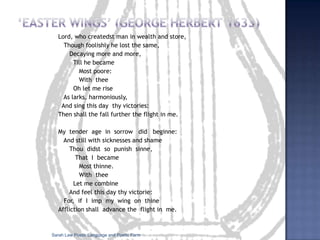
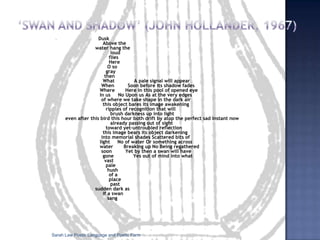
Formal devices specific to poetryThe poetic lineRhythm, rhyme stand out moreThe double pattern: looking at a poem’s formal structure together with its individual language and phrasingLook at the shape of the poem: visually patterned poetry is known as Emblem (traditional) or Concrete (modern) poetry.Sarah Law Poetic Language and Poetic Form
‘Easter Wings’ (George Herbert 1633)Lord, who createdst man in wealth and store,   Though foolishly he lost the same,      Decaying more and more,        Till he became           Most poore:           With  thee        Oh let me rise   As larks, harmoniously,  And sing this day  thy victories:Then shall the fall further the flight in me. My  tender  age  in  sorrow   did   beginne:   And still with sicknesses and shame      Thou  didst  so  punish  sinne,         That  I  became           Most thinne.           With  thee        Let me combine      And feel this day thy victorie:   For,  if  I  imp  my  wing  on  thineAffliction shall  advance the  flight in  me.Sarah Law Poetic Language and Poetic Form
‘Swan and Shadow’ (John Hollander, 1967)                            Dusk                         Above the                    water hang the                              loud                             flies                             Here                            O so                           gray                          then                         What             A pale signal will appear                        When         Soon before its shadow fades                       Where       Here in this pool of opened eye                       In us     No Upon us As at the very edges                        of where we take shape in the dark air                         this object bares its image awakening                           ripples of recognition that will                              brush darkness up into lighteven after this bird this hour both drift by atop the perfect sad instant now                              already passing out of sight                           toward yet-untroubled reflection                         this image bears its object darkening                        into memorial shades Scattered bits of                       light     No of water Or something across                       water       Breaking up No Being regathered                        soon         Yet by then a swan will have                         gone             Yes out of mind into what                          vast                           pale                            hush                             of a                             place                              past                    sudden dark as                         if a swan                            sangSarah Law Poetic Language and Poetic Form
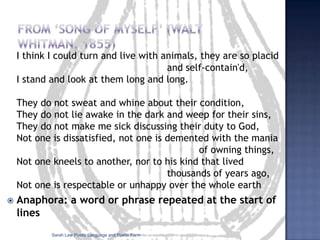
From ‘Song of Myself’ (Walt Whitman, 1855)I think I could turn and live with animals, they are so placid 					and self-contain'd, I stand and look at them long and long. They do not sweat and whine about their condition, They do not lie awake in the dark and weep for their sins, They do not make me sick discussing their duty to God, Not one is dissatisfied, not one is demented with the mania 						of owning things, Not one kneels to another, nor to his kind that lived 						thousands of years ago, Not one is respectable or unhappy over the whole earthAnaphora: a word or phrase repeated at the start of linesSarah Law Poetic Language and Poetic Form

Poetic language and poetic form

  • 1.
    Poetic Forms &GenresPoetic Language and Poetic FormSarah Law Poetic Language and Poetic Form
  • 2.
    Genre‘In literature genrerefers to the classification into ‘types’ or ‘forms’ or ‘kinds’…How tightly or prescriptively genre can be defined has been a long-standing argument in literary studies as theorists propose new criteria and different classifications.’(Wainwright, Poetry: the Basics)Sarah Law Poetic Language and Poetic Form
  • 3.
    Epic, lyric, dramatic‘Forthe medium being the same, and the objects the same, the poet may imitate by narration - in which case he can either take another personality as Homer does, or speak in his own person, unchanged - or he may present all his characters as living and moving before us.’ (Aristotle, Poetics, c. 335 BC)Sarah Law Poetic Language and Poetic Form
  • 4.
    DefinitionsEpic: concerned withnarrative, long poemLyrical: concerned with states, incidents and moments, often in 1stpersonDramatic: verse as spoken, sung, or chanted in plays as part of a dialogue, voice of other character(s)Sarah Law Poetic Language and Poetic Form
  • 5.
    Hierarchy of GenresThroughthe Renaissance and much of the eighteenth century, the recognized genres were widely thought to be fixed literary types
  • 6.
    a hierarchy rangingfrom epic and tragedy at the top to the pastoral, short lyric, epigram, and other types at the bottom
  • 7.
    appropriate subject tothe appropriate form and language was known as the concept of decorum
  • 8.
    Neoclassical Genre TheorySarahLaw Poetic Language and Poetic Form
  • 9.
    Sarah Law PoeticLanguage and Poetic FormC18 onwards: confidence in the fixity and stability of genres gradually weakened. Early C19 onwards: the lyric poem became the most important poetic genre, replacing that of the epic and dramatic poem.Critics tended to use broader terms such as “sincerity,” “intensity,” “organic unity” which didn’t imply a particular literary genre.
  • 10.
    Points to bearin mind...genres are always evolving and developingwe can bring our knowledge of poetic genres to a poem to see if these conventions have been employed, or omitted and subverted in some way. Sometimes a poet will evoke a whole tradition through referring to a particular poetic genre:Sarah Law Poetic Language and Poetic Form
  • 11.
    Elegy (W.S. Merwin)Whowould I show it toSarah Law Poetic Language and Poetic Form
  • 12.
    Relationship of Genreto History & CultureEarly Epic or Heroic PoetryThe Medieval RomanceThe Elizabethan SonnetThe Neoclassical Verse ‘Essay’The Romantic OdeSarah Law Poetic Language and Poetic Form
  • 13.
    Developing definitionsJust asgenres change and develop throughout literary history, so do our ideas about the nature of literary genre itself.It is that capacity of the work to transgress boundaries that makes genres such protean and paradoxical conventions. The system is dynamic, multidimensional, constantly changing. (F & B)Sarah Law Poetic Language and Poetic Form
  • 14.
    StructuralismAttention paid toall kinds of conventions and generic codes‘a desire to isolate codes, to name the various languages with and among which the text plays...’ (Jonathan Culler, Structuralist Poetics, 1975)SYNCHRONIC occurring at one point in timeDIACHRONIC evolving over time‘Literary Competence’Sarah Law Poetic Language and Poetic Form
  • 15.
    Tzvetan TodorovPoetry ingeneral does not exist, but variable conceptions of poetry exist and will continue to exist, not only from one period or country to another but also from one text to another (Genres in Discourse, 1990). Sarah Law Poetic Language and Poetic Form
  • 16.
    FormForms (plural) relateto specific patterns or arrangements of meter, lines and rhymes.
  • 17.
    Fixed Forms: setpatterns, e.g. Sonnet, Limerick.
  • 18.
    Traditional fixed formssuch as the sonnet can also be a genre, because apart from the specific pattern, it also builds up various conventions of structure and content, which have a history. Sarah Law Poetic Language and Poetic Form
  • 19.
    LimerickThere was ayoung woman from NorwayWho hung from her toes in the doorwayShe said to her beau‘Come over here JoeI think I’ve discovered one more way!’(attrib. Swinburne 1837)Sarah Law Poetic Language and Poetic Form
  • 20.
    Poetic FormPoetic form(singular): everything that goes into a poem – the way the poem is structured.‘The form of a work is the principle that determines its organization’ (Abrams)the organization of the poem’s contents in order to generate specific meanings or effectsSarah Law Poetic Language and Poetic Form
  • 21.
    Formal devices specificto poetryThe poetic lineRhythm, rhyme stand out moreThe double pattern: looking at a poem’s formal structure together with its individual language and phrasingLook at the shape of the poem: visually patterned poetry is known as Emblem (traditional) or Concrete (modern) poetry.Sarah Law Poetic Language and Poetic Form
  • 22.
    ‘Easter Wings’ (GeorgeHerbert 1633)Lord, who createdst man in wealth and store,   Though foolishly he lost the same,     Decaying more and more,      Till he became        Most poore:        With thee      Oh let me rise As larks, harmoniously, And sing this day  thy victories:Then shall the fall further the flight in me. My  tender  age  in  sorrow   did   beginne:   And still with sicknesses and shame     Thou  didst  so  punish  sinne,       That  I  became         Most thinne.         With  thee        Let me combine    And feel this day thy victorie:  For,  if  I  imp  my  wing  on  thineAffliction shall  advance the  flight in  me.Sarah Law Poetic Language and Poetic Form
  • 23.
    ‘Swan and Shadow’(John Hollander, 1967)                            Dusk                         Above the                    water hang the                              loud                             flies                             Here                            O so                           gray                          then                         What             A pale signal will appear                        When         Soon before its shadow fades                       Where       Here in this pool of opened eye                       In us     No Upon us As at the very edges                        of where we take shape in the dark air                         this object bares its image awakening                           ripples of recognition that will                              brush darkness up into lighteven after this bird this hour both drift by atop the perfect sad instant now                              already passing out of sight                           toward yet-untroubled reflection                         this image bears its object darkening                        into memorial shades Scattered bits of                       light     No of water Or something across                       water       Breaking up No Being regathered                        soon         Yet by then a swan will have                         gone             Yes out of mind into what                          vast                           pale                            hush                             of a                             place                              past                    sudden dark as                         if a swan                            sangSarah Law Poetic Language and Poetic Form
  • 24.
    From ‘Song ofMyself’ (Walt Whitman, 1855)I think I could turn and live with animals, they are so placid and self-contain'd, I stand and look at them long and long. They do not sweat and whine about their condition, They do not lie awake in the dark and weep for their sins, They do not make me sick discussing their duty to God, Not one is dissatisfied, not one is demented with the mania of owning things, Not one kneels to another, nor to his kind that lived thousands of years ago, Not one is respectable or unhappy over the whole earthAnaphora: a word or phrase repeated at the start of linesSarah Law Poetic Language and Poetic Form
  • 25.
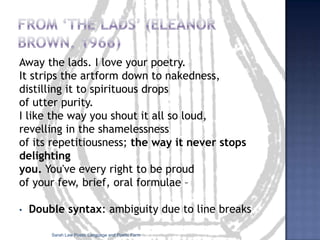
    From ‘The Lads’(Eleanor Brown, 1966)Away the lads. I love your poetry. It strips the artform down to nakedness, distilling it to spirituous drops of utter purity. I like the way you shout it all so loud, revelling in the shamelessness of its repetitiousness; the way it never stops delighting you. You've every right to be proud of your few, brief, oral formulae – Double syntax: ambiguity due to line breaksSarah Law Poetic Language and Poetic Form
  • 26.
    From ‘Paradise Lost’(Milton, 1667)…For soI formed them free, and free they must remain,Till they enthrall themselves: I else must changeTheir nature Double syntax on ‘change’Sarah Law Poetic Language and Poetic Form
  • 27.
    From ‘Tintern Abbey’(William Wordsworth, 1798)Therefore am I stillA lover of the meadows and the woods,And mountains; and of all that we beholdFrom this green earth; of all the mighty worldOf eye and ear – both what they half create,And what perceive…Sarah Law Poetic Language and Poetic Form
  • 28.
    Relationship of formto content? Possible answers include: (a) poetic form is an aesthetic container in which a poem's contents are delivered; it is a kind of ‘sweetener’ which makes the poem more pleasurable to read but isn’t intrinsic to the message or meaning of the poem itself;
  • 29.
    (b) poetic formechoes or reflects content/meaning but there is still a distinct division between the two aspects of poetry;
  • 30.
    (c) poetic formand content are organically interrelated. It’s difficult to talk about one aspect of the poem without acknowledging the work of the other.Sarah Law Poetic Language and Poetic Form
  • 31.
    Sarah Law PoeticLanguage and Poetic FormAll [poems] are verbal spaces, marked out deliberately, with deliberation, and for deliberation. The poet feels for a space that seems at one demanding and accommodating, whether given by tradition or made anew. It is a space marked for special attention... the deliberate space of the poem. (Wainwright, Poetry: The Basics)