The Victorian Experience
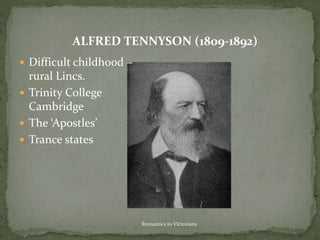
ALFRED TENNYSON (1809-1892)
Romantics to VIctorians
 Difficult childhood –
rural Lincs.
 Trinity College
Cambridge
 The ‘Apostles’
 Trance states
Romantics to VIctorians
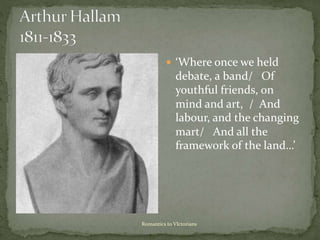
 ‘Where once we held
debate, a band/ Of
youthful friends, on
mind and art, / And
labour, and the changing
mart/ And all the
framework of the land…’
Romantics to VIctorians
 Published in 1850 and
dedicated to Arthur
Hallam – a college friend
 Started to write verses for
‘In Memoriam’ almost
straight after Hallam’s
death, but it was only later
that he assembled these
fragments into one long
poem.
 Queen Victoria: “Next to
the Bible, In Memoriam is
my comfort".
IN
MEMORIAM
A.H.H.
OBIT
MDCCCXXXIII
Romantics to VIctorians
 ‘the poetic rehearsal of a talking cure was a stricken
man’s first resort – and desperate expression of fidelity
– to the gift whose survival seemed at times, to keep
his fellowship with Hallam alive. But over the course of
ten years, then twenty and thirty more, Tennyson
learned to regard his affliction as representative of
losses and anxieties possessing broad Victorian
currency. Learning so to regard it…formed a crucial
step along the therapeutic path from alienation to
spokesmanship on which his own feet in the 1830s
were set.’
 (Herbert Tucker, ‘Tennyson’, the Cambridge Companion to English Poets)
 Is it in fact a series of poems, or one long structure?
 composed of 131 cantos or separate sections, each having between 12
and 144 lines each, plus an introduction and an epilogue. Most sections
are between 12 and 16 lines. Three main sections are divided by verses
about Christmas: 30, 78 and 100.
 The Epilogue is an epithalamion (also known as an epithalamium): a
poem or song in honour of a bride and groom. It refers to the marriage
of Tennyson’s sister.
 An Elegy?
 T.S. Eliot compares it to a diary: The lyrics 'have only the unity and
continuity of a diary, the concentrated diary of a man confessing
himself .’
Romantics to VIctorians
 Iambic tetrameter – ABBA rhyme scheme
But, for the unquiet heart and brain,
A use in measured language lies;
The sad mechanic exercise,
Like dull narcotics, numbing pain.
‘each stanza, no matter the sense of purpose with which
it embarks, ends haunted acoustically by the thought
with which it began’ (Sean Perry, Alfred Tennyson,
Northcote House, 2005, p. 136)
Romantics to VIctorians
 Tears of the widower, when he sees
A late-lost form that sleep reveals, And moves his
doubtful arms, and feels Her place is empty, fall like
these; (13)
 an early review in The Times complained about the
tone of ‘amatory tenderness. Surely this is a strange
mode of address to a man, even though he be dead.’
 ‘Tennyson moves between gender position, age, and
social status, refusing to be fixed or defined by the
usual systems of marking identity.’(Holly Furneaux, BL intro)
Romantics to VIctorians
 He is not here, but far away
The noise of life begins again
And ghastly thro’ the drizzling rain
On the bald street breaks the blank day (7)
Note the shock of the last line – a breaking and
stumbling in the rhythm
Romantics to VIctorians
 But thou art turn’d to something strange
And I have lost the links that bound
Thy changes, here upon the ground
No more partaker of thy change (40)
Tennyson develops ‘an interesting alternative to
Spiritualism … [by means of]… a long series of elegiac
lyrics in which the poet communes with his dead friend
[Hallam].’ (Daniel Brown,’Victorian Poetry and Science’ Cambridge Companion to
Victorian Poetry)
Romantics to VIctorians
 I have heard him thunder out
against an opponent of it, ‘If there
be a God who has made the earth
and put this hope and passion into
us, it must foreshadow the truth. If
it be not true, then no God, but a
mocking fiend, created us, and’
(growing crimson with excitement)
‘I’d shake my fist in his almighty
face, and tell him that I cursed him!
I’d sink my head tonight in a
chloroformed handkerchief and
have done with it all.’
 (from Tennyson: Interviews and
Recollections, (ed N Page,
Macmillan, 1983)
O yet we trust that somehow good
Will be the final goal of ill,
To Pangs of nature, sins of will,
Defects of doubt, and taints of blood;
That nothing walks with aimless feet…
(liv - 54)
Romantics to VIctorians
 A shifting concept of
nature. ‘Red in tooth and
claw’ (56)– the cruelty of
nature revealed by new
strands of scientific
thought.
 . ‘ I found Him not in
world or sun/ Or eagle’s
wing, or insect’s eye’
(CXXIV - 124).
Cf
While now we sang old songs
that peal'd
From knoll to knoll, where,
couch'd at ease,
The white kine glimmer'd,
and the trees
Laid their dark arms about the
field. (95 – pastoral tradition)
 Rupture with ‘Natural Theology’: ‘We have but faith,
we cannot know/ For knowledge is of things we see’ (I
M prologue)
 Although perceived as an heir to the great Romantic
poets such as Wordsworth, Tennyson was acutely
aware of new scientific discoveries. He was according
to his friend and contemporary, scientist T.H. Huxley,
‘the first poet since Lucretius [a Classical Roman
writer on nature] who has understood the drift of
science.’
Romantics to VIctorians
“So careful of the type?” but no.
From scarped cliff and quarried
stone
She cries “a thousand types are
gone:
I care for nothing, all shall go.
Thou makest thine appeal to me:
I bring to life, I bring to death:
The spirit does but mean the
breath:
I know no more.” (LV1-1-8 - 56)
Man, her last work, who seemed so fair
Such splendid purpose in his eyes,
Who rolled the psalm to wintry skies,
Who built him fanes of fruitless prayer,
…
No more? A monster then, a dream,
A discord. Dragons of the prime,
That tare each other in their slime,
Were mellow music matched with
him. (LVI)
Romantics to VIctorians
 Laplace argued that the
planets orbited in the same
plane and the same
direction because they had
been formed at the same
time, according to the laws
of physics and chemistry,
as the condensation of the
sun’s revolving gaseous
atmosphere
They say,
The solid earth whereon we tread
In tracts of fluent heat began,
And grew to seeming-random forms,
The seeming prey of cyclic storms,
Till at the last arose the man;
Who throve and branch'd from clime to
clime,
The herald of a higher race, (118)
Romantics to VIctorians
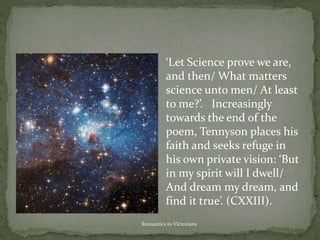
‘Let Science prove we are,
and then/ What matters
science unto men/ At least
to me?’. Increasingly
towards the end of the
poem, Tennyson places his
faith and seeks refuge in
his own private vision: ‘But
in my spirit will I dwell/
And dream my dream, and
find it true’. (CXXIII).
 Alan Sinfield finds the poem moving toward an
‘eventual satisfaction with time and existence in
general’ (The Language of Tennyson’s In Memoriam,
Oxford, 1971).
 Sean Perry disagrees: ‘The language of Tennyson’s
greatest elegies, and IM in particular, elude the
expectations of classical elegy, while continually
evoking their possibility’ (Alfred Tennyson, Northcote
House, 2005).
Romantics to VIctorians

Tennyson In Memoriam

  • 1.
  • 2.
    ALFRED TENNYSON (1809-1892) Romanticsto VIctorians  Difficult childhood – rural Lincs.  Trinity College Cambridge  The ‘Apostles’  Trance states
  • 3.
    Romantics to VIctorians ‘Where once we held debate, a band/ Of youthful friends, on mind and art, / And labour, and the changing mart/ And all the framework of the land…’
  • 4.
    Romantics to VIctorians Published in 1850 and dedicated to Arthur Hallam – a college friend  Started to write verses for ‘In Memoriam’ almost straight after Hallam’s death, but it was only later that he assembled these fragments into one long poem.  Queen Victoria: “Next to the Bible, In Memoriam is my comfort". IN MEMORIAM A.H.H. OBIT MDCCCXXXIII
  • 5.
    Romantics to VIctorians ‘the poetic rehearsal of a talking cure was a stricken man’s first resort – and desperate expression of fidelity – to the gift whose survival seemed at times, to keep his fellowship with Hallam alive. But over the course of ten years, then twenty and thirty more, Tennyson learned to regard his affliction as representative of losses and anxieties possessing broad Victorian currency. Learning so to regard it…formed a crucial step along the therapeutic path from alienation to spokesmanship on which his own feet in the 1830s were set.’  (Herbert Tucker, ‘Tennyson’, the Cambridge Companion to English Poets)
  • 6.
     Is itin fact a series of poems, or one long structure?  composed of 131 cantos or separate sections, each having between 12 and 144 lines each, plus an introduction and an epilogue. Most sections are between 12 and 16 lines. Three main sections are divided by verses about Christmas: 30, 78 and 100.  The Epilogue is an epithalamion (also known as an epithalamium): a poem or song in honour of a bride and groom. It refers to the marriage of Tennyson’s sister.  An Elegy?  T.S. Eliot compares it to a diary: The lyrics 'have only the unity and continuity of a diary, the concentrated diary of a man confessing himself .’ Romantics to VIctorians
  • 7.
     Iambic tetrameter– ABBA rhyme scheme But, for the unquiet heart and brain, A use in measured language lies; The sad mechanic exercise, Like dull narcotics, numbing pain. ‘each stanza, no matter the sense of purpose with which it embarks, ends haunted acoustically by the thought with which it began’ (Sean Perry, Alfred Tennyson, Northcote House, 2005, p. 136) Romantics to VIctorians
  • 8.
     Tears ofthe widower, when he sees A late-lost form that sleep reveals, And moves his doubtful arms, and feels Her place is empty, fall like these; (13)  an early review in The Times complained about the tone of ‘amatory tenderness. Surely this is a strange mode of address to a man, even though he be dead.’  ‘Tennyson moves between gender position, age, and social status, refusing to be fixed or defined by the usual systems of marking identity.’(Holly Furneaux, BL intro) Romantics to VIctorians
  • 9.
     He isnot here, but far away The noise of life begins again And ghastly thro’ the drizzling rain On the bald street breaks the blank day (7) Note the shock of the last line – a breaking and stumbling in the rhythm Romantics to VIctorians
  • 10.
     But thouart turn’d to something strange And I have lost the links that bound Thy changes, here upon the ground No more partaker of thy change (40) Tennyson develops ‘an interesting alternative to Spiritualism … [by means of]… a long series of elegiac lyrics in which the poet communes with his dead friend [Hallam].’ (Daniel Brown,’Victorian Poetry and Science’ Cambridge Companion to Victorian Poetry) Romantics to VIctorians
  • 11.
    Romantics to VIctorians I have heard him thunder out against an opponent of it, ‘If there be a God who has made the earth and put this hope and passion into us, it must foreshadow the truth. If it be not true, then no God, but a mocking fiend, created us, and’ (growing crimson with excitement) ‘I’d shake my fist in his almighty face, and tell him that I cursed him! I’d sink my head tonight in a chloroformed handkerchief and have done with it all.’  (from Tennyson: Interviews and Recollections, (ed N Page, Macmillan, 1983) O yet we trust that somehow good Will be the final goal of ill, To Pangs of nature, sins of will, Defects of doubt, and taints of blood; That nothing walks with aimless feet… (liv - 54)
  • 12.
    Romantics to VIctorians A shifting concept of nature. ‘Red in tooth and claw’ (56)– the cruelty of nature revealed by new strands of scientific thought.  . ‘ I found Him not in world or sun/ Or eagle’s wing, or insect’s eye’ (CXXIV - 124). Cf While now we sang old songs that peal'd From knoll to knoll, where, couch'd at ease, The white kine glimmer'd, and the trees Laid their dark arms about the field. (95 – pastoral tradition)
  • 13.
     Rupture with‘Natural Theology’: ‘We have but faith, we cannot know/ For knowledge is of things we see’ (I M prologue)  Although perceived as an heir to the great Romantic poets such as Wordsworth, Tennyson was acutely aware of new scientific discoveries. He was according to his friend and contemporary, scientist T.H. Huxley, ‘the first poet since Lucretius [a Classical Roman writer on nature] who has understood the drift of science.’ Romantics to VIctorians
  • 14.
    Romantics to VIctorians “Socareful of the type?” but no. From scarped cliff and quarried stone She cries “a thousand types are gone: I care for nothing, all shall go. Thou makest thine appeal to me: I bring to life, I bring to death: The spirit does but mean the breath: I know no more.” (LV1-1-8 - 56) Man, her last work, who seemed so fair Such splendid purpose in his eyes, Who rolled the psalm to wintry skies, Who built him fanes of fruitless prayer, … No more? A monster then, a dream, A discord. Dragons of the prime, That tare each other in their slime, Were mellow music matched with him. (LVI)
  • 15.
    Romantics to VIctorians Laplace argued that the planets orbited in the same plane and the same direction because they had been formed at the same time, according to the laws of physics and chemistry, as the condensation of the sun’s revolving gaseous atmosphere They say, The solid earth whereon we tread In tracts of fluent heat began, And grew to seeming-random forms, The seeming prey of cyclic storms, Till at the last arose the man; Who throve and branch'd from clime to clime, The herald of a higher race, (118)
  • 16.
    Romantics to VIctorians ‘LetScience prove we are, and then/ What matters science unto men/ At least to me?’. Increasingly towards the end of the poem, Tennyson places his faith and seeks refuge in his own private vision: ‘But in my spirit will I dwell/ And dream my dream, and find it true’. (CXXIII).
  • 17.
     Alan Sinfieldfinds the poem moving toward an ‘eventual satisfaction with time and existence in general’ (The Language of Tennyson’s In Memoriam, Oxford, 1971).  Sean Perry disagrees: ‘The language of Tennyson’s greatest elegies, and IM in particular, elude the expectations of classical elegy, while continually evoking their possibility’ (Alfred Tennyson, Northcote House, 2005). Romantics to VIctorians