Shall I compare thee to a summer’s day?            FORM – What
Thou art more lovely and more temperate.           kind of poem is
Rough winds do shake the darling buds of May,      this? How do you
And summer’s lease hath all too short a date.      know?
Sometime too hot the eye of heaven shines,
                                                   1.
And often is his gold complexion dimmed,
                                                   2.
                                                   3.
And every fair from fair sometime declines,
                                                   4.
By chance or nature’s changing course untrimmed;

But thy eternal summer shall not fade

Nor lose possession of that fair thou ow’st,

Nor shall death brag thou wander’st in his shade

When in eternal lines to time thou grow’st.

So long as men can breathe or eyes can see,

So long lives this, and this gives life to thee.
The Shakespearean Sonnet:
‘The Little Black Dress of Poetry’
Learning Objective:
AO2: Demonstrate detailed critical
understanding in analysing the ways in
which structure and form shape meaning.
A: Insightful and conceptual with extremely
detailed reference to texts.

B: Relevant and analytical with detailed
reference to text.

C: Appropriate and effective with worthwhile
reference to text.
Shakespearean Sonnet Form and Structure

_________
_________     Shall I compare thee to a summer’s day?

              Thou art more lovely and more temperate.

              Rough winds do shake the darling buds of May,

              And summer’s lease hath all too short a date.

              Sometime too hot the eye of heaven shines,

              And often is his gold complexion dimmed,

              And every fair from fair sometime declines,

              By chance or nature’s changing course untrimmed;
__________ But thy eternal summer shall not fade

              Nor lose possession of that fair thou ow’st,

              Nor shall death brag thou wander’st in his shade

              When in eternal lines to time thou grow’st.

              So long as men can breathe or eyes can see,

              So long lives this, and this gives life to thee.
      Lines
Shakespearean Sonnet Form and Structure                          Rhyme can also be:
                                                                 ABBA/ CDDC/ EFFE/ GG
Iambic
_________
pentameter
_________     Shall I compare thee to a summer’s day?            A

              Thou art more lovely and more temperate.           B

              Rough winds do shake the darling buds of May,      A     Quatrain

              And summer’s lease hath all too short a date.      B
                                                                                        octave
              Sometime too hot the eye of heaven shines,         C
              And often is his gold complexion dimmed,           D

              And every fair from fair sometime declines,        C     Quatrain

              By chance or nature’s changing course untrimmed; D
volta
__________ But thy eternal summer shall not fade                 E
                                                                 F
              Nor lose possession of that fair thou ow’st,              Quatrain
              Nor shall death brag thou wander’st in his shade
                                                                 E
                                                                                        sestet
              When in eternal lines to time thou grow’st.        F

              So long as men can breathe or eyes can see,        G
14 Lines!                                                        G      Couplet
              So long lives this, and this gives life to thee.
But that’s just a load of
  terminology? How do we make it:
 A: Insightful and conceptual with extremely
 detailed reference to texts.

 B: Relevant and analytical with detailed
 reference to text.

 C: Appropriate and effective with worthwhile
 reference to text.

We need to understand why a
writer would use a sonnet form and
how it effects a reader.
Conflict between Content and Form

Overwhelming/ Contradictory/ Confusing Emotion


                      VS


  Tight/ organised/ Rule-driven/ Pedantic Form
Fill in the grid on whether this sonnet meets the regular
  form and structure of a Shakespearean sonnet. Tick/
   cross initially. Choose at least five sections to find a
          detailed quote from and explain effect.


                               The Kaleidoscope
The Kaleidoscope – Douglas Dunn
  Is this
 typical     To climb these stairs again, bearing a tray,     Look closely at
imagery?     Might be to find you pillowed with your books,    this rhyme –
                                                              what’s unusual?
             Your inventories listing gowns and frocks
             As if preparing for a holiday.
                                                                How has the
             Or, turning from the landing, I might find        rhyme scheme
 Who is
watching     My presence watched through your kaleidoscope,    changed since
who? Is it   A symmetry of husbands, each redesigned            the previous
 typical?                                                        quatrain?
             In lovely forms of foresight, prayer and hope.
             I climb these stairs a dozen times a day
             And, by the open door, wait, looking in             What has
  What       At where you died. My hands become a tray        happened to the
changes at                                                    sentences here?
             Offering me, my flesh, my soul, my skin.
the volta?
             Grief wrongs us so. I stand, and wait, and cry
                                                                How many
             For the absurd forgiveness, not knowing why.     syllables are in
                                                                 this line?
The Kaleidoscope – Douglas Dunn
To climb these stairs again, bearing a tray,
Might be to find you pillowed with your books,
Your inventories listing gowns and frocks
As if preparing for a holiday.
Or, turning from the landing, I might find
My presence watched through your kaleidoscope,
A symmetry of husbands, each redesigned
In lovely forms of foresight, prayer and hope.
I climb these stairs a dozen times a day
And, by the open door, wait, looking in
At where you died. My hands become a tray
Offering me, my flesh, my soul, my skin.
Grief wrongs us so. I stand, and wait, and cry
For the absurd forgiveness, not knowing why.
What is the significance of
the title ‘The Kaleidoscope’?
 What is the relationship between the
  kaleidoscope and Dunn’s choice of an irregular
  sonnet as his form?
Choose your best comment on structure
    or form in the poem. Does it?
  A: Sophisticated and perceptive with
  extremely detailed reference to texts.

  B: Secure and systematic with detailed
  reference to text.

  C: Appropriate and effective with worthwhile
  reference to text.

 Remember the focus is on why a
 writer would use a sonnet form and
 how it effects a reader.
Your Turn!
In pairs, read your new sonnet in the pack...

Fill in the grid on structure and form –
   commenting on at least 4 moments.

In 20 minutes you will present your poem back
  to the class! Explaining how the poet uses
  form and structure to shape meaning.
Success Criteria

 A: Sophisticated and perceptive with
 extremely detailed reference to texts.

 B: Secure and systematic with detailed
 reference to text.

 C: Appropriate and effective with worthwhile
 reference to text.

Remember the focus is on why a
writer would use a sonnet form and
how it effects a reader.
Thomas Wyatt – I find no peace – c. 1520

I find no peace, and all my war is done.
I fear and hope, I burn and freeze like ice,
I fly above the wind, yet can I not arise,
And naught I have, and all the world I season.
That loosest nor locket, holdeth me in prison,
And holdeth me not, yet can I scape no wise,
Nor letteth me live, nor die at my device,
And yet of death it giveth me occasion.
Without eyen I see, and without tongue I plain,
I desire to perish, and yet I ask health,
I love another, and thus I hate myself,
I feed me in sorrow and laugh in all my pain,
Likewise displeaseth me both death and life,
And my delight is causer of this strife.
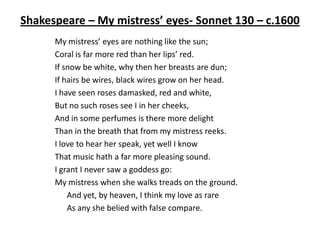
Shakespeare – My mistress’ eyes- Sonnet 130 – c.1600
      My mistress’ eyes are nothing like the sun;
      Coral is far more red than her lips’ red.
      If snow be white, why then her breasts are dun;
      If hairs be wires, black wires grow on her head.
      I have seen roses damasked, red and white,
      But no such roses see I in her cheeks,
      And in some perfumes is there more delight
      Than in the breath that from my mistress reeks.
      I love to hear her speak, yet well I know
      That music hath a far more pleasing sound.
      I grant I never saw a goddess go:
      My mistress when she walks treads on the ground.
          And yet, by heaven, I think my love as rare
          As any she belied with false compare.
John Keats – When I have fears - 1819.

 When I have fears that I may cease to be
 Before my pen has glean'd my teeming brain,
 Before high piled books, in charact'ry,
 Hold like rich garners the full-ripen'd grain;
 When I behold, upon the night's starr'd face,
 Huge cloudy symbols of a high romance,
 And think that I may never live to trace
 Their shadows, with the magic hand of chance;
 And when I feel, fair creature of an hour,
 That I shall never look upon thee more,
 Never have relish in the faery power
 Of unreflecting love!—then on the shore
 Of the wide world I stand alone, and think
 Till Love and Fame to Nothingness do sink.
Am I To Lose You? - Louise Bevington - 1881

 ‘Am I to lose you now?’ The words were light;
 You spoke them, hardly seeking a reply,
 That day I bid you quietly ‘Good-bye,’
 And sought to hide my soul away from sight.
 The question echoes, dear, through many a night,—
 My question, not your own—most wistfully;
 ‘Am I to lose him?’ asked my heart of me;
 ‘Am I to lose him now, and lose him quite?’


 And only you can tell me. Do you care
 That sometimes we in quietness should stand
 As fellow-solitudes, hand firm in hand,
 And thought with thought and hope with hope compare?
 What is your answer? Mine must ever be,
 ‘I greatly need your friendship: leave it me.’
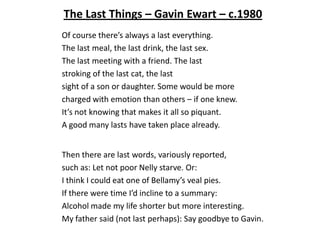
The Last Things – Gavin Ewart – c.1980
Of course there’s always a last everything.
The last meal, the last drink, the last sex.
The last meeting with a friend. The last
stroking of the last cat, the last
sight of a son or daughter. Some would be more
charged with emotion than others – if one knew.
It’s not knowing that makes it all so piquant.
A good many lasts have taken place already.


Then there are last words, variously reported,
such as: Let not poor Nelly starve. Or:
I think I could eat one of Bellamy’s veal pies.
If there were time I’d incline to a summary:
Alcohol made my life shorter but more interesting.
My father said (not last perhaps): Say goodbye to Gavin.
Homework: Due Thursday
Choose any 2 sonnets in this booklet (can be Kaleidoscope and the one you
   specialised in) and answer the following question.


   Read the two poems (Item A and Item B) carefully, bearing in mind that
   they were written at different times by different writers and are open to
   different interpretations.

   Compare the ways that the poets present unrequited love.

   In your answer you should consider the ways in which the poets use
   form, structure and language to present their thoughts and ideas. You
   should make relevant references to your wider reading in the poetry of
   love.
How to Answer
• This is an exam style question – try and compare
  the two poems in form/ structure/ language (I
  will be paying particular attention to form and
  structure in light of today’s lessons).
• I want you to spend no longer than 1 hour 30
  minutes writing (even that is longer than you will
  have in the exam: ideal time 50 minutes). Please
  handwrite your answers to practice exam
  technique. Spend the time planning your answer
  at this stage, not writing it.
Wider Reading Tips
Try and bring in brief references to your wider reading (it can be absolutely
    anything!). Potential examples from our reading...

• Victorian Literature: Tess of the D’urbervilles, John Clare’s nature sonnets,
  Rossetti or Browning’s poetry (and anything else you may have read!)
• A View From The Bridge: Eddie Carbone’s passion?
• Othello and Desdemona
• Romeo and Juliet – use of sonnets at meeting/ parodied love for Rosaline
• Novel pack (from last year!): Darcy’s proposal// Mr Elton’s proposal//
  Gatsby.
• Chaucer: Troilus and Criseyde, parody in Miller’s Tale
• GCSE Anthology
• Courtly Lover: Wyatt ‘They Flee From Me That Sometime did they seek’,
  Greensleeves
• And anything else you have ever read! Whatever books you like to read

Sonnets

  • 1.
    Shall I comparethee to a summer’s day? FORM – What Thou art more lovely and more temperate. kind of poem is Rough winds do shake the darling buds of May, this? How do you And summer’s lease hath all too short a date. know? Sometime too hot the eye of heaven shines, 1. And often is his gold complexion dimmed, 2. 3. And every fair from fair sometime declines, 4. By chance or nature’s changing course untrimmed; But thy eternal summer shall not fade Nor lose possession of that fair thou ow’st, Nor shall death brag thou wander’st in his shade When in eternal lines to time thou grow’st. So long as men can breathe or eyes can see, So long lives this, and this gives life to thee.
  • 2.
    The Shakespearean Sonnet: ‘TheLittle Black Dress of Poetry’ Learning Objective: AO2: Demonstrate detailed critical understanding in analysing the ways in which structure and form shape meaning. A: Insightful and conceptual with extremely detailed reference to texts. B: Relevant and analytical with detailed reference to text. C: Appropriate and effective with worthwhile reference to text.
  • 3.
    Shakespearean Sonnet Formand Structure _________ _________ Shall I compare thee to a summer’s day? Thou art more lovely and more temperate. Rough winds do shake the darling buds of May, And summer’s lease hath all too short a date. Sometime too hot the eye of heaven shines, And often is his gold complexion dimmed, And every fair from fair sometime declines, By chance or nature’s changing course untrimmed; __________ But thy eternal summer shall not fade Nor lose possession of that fair thou ow’st, Nor shall death brag thou wander’st in his shade When in eternal lines to time thou grow’st. So long as men can breathe or eyes can see, So long lives this, and this gives life to thee. Lines
  • 4.
    Shakespearean Sonnet Formand Structure Rhyme can also be: ABBA/ CDDC/ EFFE/ GG Iambic _________ pentameter _________ Shall I compare thee to a summer’s day? A Thou art more lovely and more temperate. B Rough winds do shake the darling buds of May, A Quatrain And summer’s lease hath all too short a date. B octave Sometime too hot the eye of heaven shines, C And often is his gold complexion dimmed, D And every fair from fair sometime declines, C Quatrain By chance or nature’s changing course untrimmed; D volta __________ But thy eternal summer shall not fade E F Nor lose possession of that fair thou ow’st, Quatrain Nor shall death brag thou wander’st in his shade E sestet When in eternal lines to time thou grow’st. F So long as men can breathe or eyes can see, G 14 Lines! G Couplet So long lives this, and this gives life to thee.
  • 5.
    But that’s justa load of terminology? How do we make it: A: Insightful and conceptual with extremely detailed reference to texts. B: Relevant and analytical with detailed reference to text. C: Appropriate and effective with worthwhile reference to text. We need to understand why a writer would use a sonnet form and how it effects a reader.
  • 15.
    Conflict between Contentand Form Overwhelming/ Contradictory/ Confusing Emotion VS Tight/ organised/ Rule-driven/ Pedantic Form
  • 16.
    Fill in thegrid on whether this sonnet meets the regular form and structure of a Shakespearean sonnet. Tick/ cross initially. Choose at least five sections to find a detailed quote from and explain effect. The Kaleidoscope
  • 17.
    The Kaleidoscope –Douglas Dunn Is this typical To climb these stairs again, bearing a tray, Look closely at imagery? Might be to find you pillowed with your books, this rhyme – what’s unusual? Your inventories listing gowns and frocks As if preparing for a holiday. How has the Or, turning from the landing, I might find rhyme scheme Who is watching My presence watched through your kaleidoscope, changed since who? Is it A symmetry of husbands, each redesigned the previous typical? quatrain? In lovely forms of foresight, prayer and hope. I climb these stairs a dozen times a day And, by the open door, wait, looking in What has What At where you died. My hands become a tray happened to the changes at sentences here? Offering me, my flesh, my soul, my skin. the volta? Grief wrongs us so. I stand, and wait, and cry How many For the absurd forgiveness, not knowing why. syllables are in this line?
  • 18.
    The Kaleidoscope –Douglas Dunn To climb these stairs again, bearing a tray, Might be to find you pillowed with your books, Your inventories listing gowns and frocks As if preparing for a holiday. Or, turning from the landing, I might find My presence watched through your kaleidoscope, A symmetry of husbands, each redesigned In lovely forms of foresight, prayer and hope. I climb these stairs a dozen times a day And, by the open door, wait, looking in At where you died. My hands become a tray Offering me, my flesh, my soul, my skin. Grief wrongs us so. I stand, and wait, and cry For the absurd forgiveness, not knowing why.
  • 19.
    What is thesignificance of the title ‘The Kaleidoscope’? What is the relationship between the kaleidoscope and Dunn’s choice of an irregular sonnet as his form?
  • 20.
    Choose your bestcomment on structure or form in the poem. Does it? A: Sophisticated and perceptive with extremely detailed reference to texts. B: Secure and systematic with detailed reference to text. C: Appropriate and effective with worthwhile reference to text. Remember the focus is on why a writer would use a sonnet form and how it effects a reader.
  • 21.
    Your Turn! In pairs,read your new sonnet in the pack... Fill in the grid on structure and form – commenting on at least 4 moments. In 20 minutes you will present your poem back to the class! Explaining how the poet uses form and structure to shape meaning.
  • 22.
    Success Criteria A:Sophisticated and perceptive with extremely detailed reference to texts. B: Secure and systematic with detailed reference to text. C: Appropriate and effective with worthwhile reference to text. Remember the focus is on why a writer would use a sonnet form and how it effects a reader.
  • 23.
    Thomas Wyatt –I find no peace – c. 1520 I find no peace, and all my war is done. I fear and hope, I burn and freeze like ice, I fly above the wind, yet can I not arise, And naught I have, and all the world I season. That loosest nor locket, holdeth me in prison, And holdeth me not, yet can I scape no wise, Nor letteth me live, nor die at my device, And yet of death it giveth me occasion. Without eyen I see, and without tongue I plain, I desire to perish, and yet I ask health, I love another, and thus I hate myself, I feed me in sorrow and laugh in all my pain, Likewise displeaseth me both death and life, And my delight is causer of this strife.
  • 24.
    Shakespeare – Mymistress’ eyes- Sonnet 130 – c.1600 My mistress’ eyes are nothing like the sun; Coral is far more red than her lips’ red. If snow be white, why then her breasts are dun; If hairs be wires, black wires grow on her head. I have seen roses damasked, red and white, But no such roses see I in her cheeks, And in some perfumes is there more delight Than in the breath that from my mistress reeks. I love to hear her speak, yet well I know That music hath a far more pleasing sound. I grant I never saw a goddess go: My mistress when she walks treads on the ground. And yet, by heaven, I think my love as rare As any she belied with false compare.
  • 25.
    John Keats –When I have fears - 1819. When I have fears that I may cease to be Before my pen has glean'd my teeming brain, Before high piled books, in charact'ry, Hold like rich garners the full-ripen'd grain; When I behold, upon the night's starr'd face, Huge cloudy symbols of a high romance, And think that I may never live to trace Their shadows, with the magic hand of chance; And when I feel, fair creature of an hour, That I shall never look upon thee more, Never have relish in the faery power Of unreflecting love!—then on the shore Of the wide world I stand alone, and think Till Love and Fame to Nothingness do sink.
  • 26.
    Am I ToLose You? - Louise Bevington - 1881 ‘Am I to lose you now?’ The words were light; You spoke them, hardly seeking a reply, That day I bid you quietly ‘Good-bye,’ And sought to hide my soul away from sight. The question echoes, dear, through many a night,— My question, not your own—most wistfully; ‘Am I to lose him?’ asked my heart of me; ‘Am I to lose him now, and lose him quite?’ And only you can tell me. Do you care That sometimes we in quietness should stand As fellow-solitudes, hand firm in hand, And thought with thought and hope with hope compare? What is your answer? Mine must ever be, ‘I greatly need your friendship: leave it me.’
  • 27.
    The Last Things– Gavin Ewart – c.1980 Of course there’s always a last everything. The last meal, the last drink, the last sex. The last meeting with a friend. The last stroking of the last cat, the last sight of a son or daughter. Some would be more charged with emotion than others – if one knew. It’s not knowing that makes it all so piquant. A good many lasts have taken place already. Then there are last words, variously reported, such as: Let not poor Nelly starve. Or: I think I could eat one of Bellamy’s veal pies. If there were time I’d incline to a summary: Alcohol made my life shorter but more interesting. My father said (not last perhaps): Say goodbye to Gavin.
  • 28.
    Homework: Due Thursday Chooseany 2 sonnets in this booklet (can be Kaleidoscope and the one you specialised in) and answer the following question. Read the two poems (Item A and Item B) carefully, bearing in mind that they were written at different times by different writers and are open to different interpretations. Compare the ways that the poets present unrequited love. In your answer you should consider the ways in which the poets use form, structure and language to present their thoughts and ideas. You should make relevant references to your wider reading in the poetry of love.
  • 29.
    How to Answer •This is an exam style question – try and compare the two poems in form/ structure/ language (I will be paying particular attention to form and structure in light of today’s lessons). • I want you to spend no longer than 1 hour 30 minutes writing (even that is longer than you will have in the exam: ideal time 50 minutes). Please handwrite your answers to practice exam technique. Spend the time planning your answer at this stage, not writing it.
  • 30.
    Wider Reading Tips Tryand bring in brief references to your wider reading (it can be absolutely anything!). Potential examples from our reading... • Victorian Literature: Tess of the D’urbervilles, John Clare’s nature sonnets, Rossetti or Browning’s poetry (and anything else you may have read!) • A View From The Bridge: Eddie Carbone’s passion? • Othello and Desdemona • Romeo and Juliet – use of sonnets at meeting/ parodied love for Rosaline • Novel pack (from last year!): Darcy’s proposal// Mr Elton’s proposal// Gatsby. • Chaucer: Troilus and Criseyde, parody in Miller’s Tale • GCSE Anthology • Courtly Lover: Wyatt ‘They Flee From Me That Sometime did they seek’, Greensleeves • And anything else you have ever read! Whatever books you like to read