The Victorian Experience
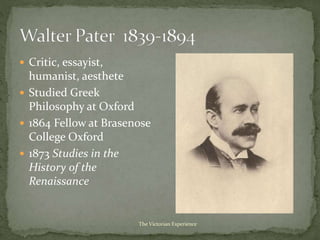
 Critic, essayist,
humanist, aesthete
 Studied Greek
Philosophy at Oxford
 1864 Fellow at Brasenose
College Oxford
 1873 Studies in the
History of the
Renaissance
The Victorian Experience
 widely regarded as the manifesto of aestheticism
 1860s: the Italian Renaissance was emerging as a new
subject for Victorian criticism
 15th & 16th century Italian culture was seen to embody
many qualities that Victorian thinkers wanted to
appropriate: classical scholarship, visual artistry, and
prizing of individualism captured in e.g. the
“genius” inventor or artist.
 A screen by which Victorian authors could explore
forbidden themes?
The Victorian Experience
 Quotes but undermines Matthew Arnold:
 ‘To see the object as in itself it really is,” has been justly
said to be the aim of all true criticism whatever; and in
aesthetic criticism the first step towards seeing one’s
object as it really is, is to know one’s own impression as
it really is, to discriminate it, to realise it distinctly. . . .
What is this song or picture, this engaging personality
presented in life or in a book, to me? ‘
The Victorian Experience
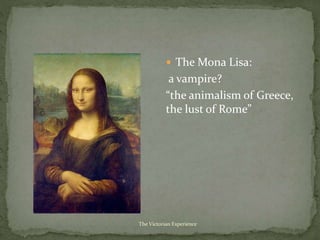
 The Mona Lisa:
a vampire?
“the animalism of Greece,
the lust of Rome”
The Victorian Experience
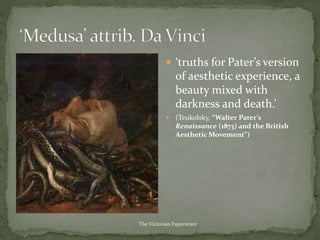
 ‘truths for Pater’s version
of aesthetic experience, a
beauty mixed with
darkness and death.’
 (Teukolsky, “Walter Pater’s
Renaissance (1873) and the British
Aesthetic Movement”)
The Victorian Experience
 Pater admits that he uses the term ‘Renaissance’ ‘in “a
much wider scope than was intended by those who
originally used it to denote that revival of classical
antiquity in the fifteenth century.”
 For him, the Renaissance is a distinctive “outbreak of
the human spirit” whose defining characteristics
include “the care for physical beauty, the worship of
the body, the breaking down of those limits which the
religious system of the middle ages imposed on the
heart and the imagination.”
The Victorian Experience
 As Margaret Oliphant notes, Pater imparts
sentiments that “never entered into the most advanced
imagination within two or three hundred years of
Botticelli’s time, and [were] as alien to the spirit of a
medieval Italian, as [they are] perfectly consistent with
that of a delicate Oxford don in the latter half of the
nineteenth century” (Blackwood’s Magazine, Nov. 1873).
 Pater responded to such criticisms by retitling the book in later
editions as The Renaissance: Studies in Art and Poetry.
The Victorian Experience
 ‘Greek sensuousness, therefore, does not fever the conscience: it
is shameless and childlike. Christian asceticism, on the other
hand, discrediting the slightest touch of sense, has from time to
time provoked into strong emphasis the contrast or antagonism
to itself, of the artistic life, with its inevitable sensuousness. — I
did but taste a little honey with the end of the rod that was in
mine hand, and lo! I must die. — It has sometimes seemed hard
to pursue that life without something of conscious disavowal of a
spiritual world; and this imparts to genuine artistic interests a
kind of intoxication. From this intoxication Winckelmann is
free: he fingers those pagan marbles with unsinged hands, with
no sense of shame or loss. That is to deal with the sensuous side
of art in the pagan manner. ‘
 a “homosexual counterdiscourse able to justify male love in ideal
or transcendental terms” (Linda Dowling,
The Victorian Experience
‘A counted number of pulses only is given to us of a
variegated, dramatic life. How may we see in them all that is
to be seen in them by the finest senses? How shall we pass
most swiftly from point to point, and be present always at the
focus where the greatest number of vital forces unite in their
purest energy?
To burn always with this hard, gemlike flame, to maintain
this ecstasy, is success in life. In a sense it might even be said
that our failure is to form habits: for, after all, habit is relative
to a stereotyped world, and meantime it is only the roughness
of the eye that makes any two persons, things, situations,
seem alike. While all melts under our feet, we may well catch
at any exquisite passion, or any contribution to knowledge
that seems by a lifted horizon to set the spirit free for a
moment, or any stirring of the senses, strange dyes, strange
colours, and curious odours, or work of the artist’s hands, or
the face of one’s friend’.
The Victorian Experience
 ‘I cannot disguise from myself that the concluding pages
adequately sum up the philosophy of the whole; and that
that philosophy is an assertion, that no fixed principles
either of religion or morality can be regarded as certain,
that the only thing worth living for is momentary
enjoyment and that probably or certainly the soul dissolves
at death into elements which are destined never to reunite.’
(John Wordsworth, chaplain of Brasenose College 1873)
 “Can you wonder that to young men who have imbibed this
teaching the Cross is an offence, and the notion of a
vocation to preach it an unintelligible craze?” (Bishop of
Oxford 1875)
The Victorian Experience
 Character of Mr Rose:
 “a pale creature, with large
moustache, looking out of the
window at the sunset… . [H]e
always speaks in an undertone,
and his two topics are self-
indulgence and art.” “What a
very odd man Mr. Rose is!” one
character exclaims, “He always
seems to talk of everybody as if
they had no clothes on”
The Victorian Experience
 H. Hutton : “perhaps too visibly laboured, [but]have
subtle touches of lovely colour, and a sweet, quiet
cadence, hardly amounting to rhythm, which are
distinguishable from those of poetry only in form”
(The Spectator, June 1873)
 Oscar Wilde called The Renaissance “the golden book
of spirit and sense, the holy writ of beauty.” -claimed to
travel with it everywhere .
 George Eliot ‘“quite poisonous in its false principles of
criticism and false conceptions of life.” (Letters, Nov
1873)
 T. S. Eliot criticized Pater for propounding “a theory of
ethics” in the guise of a theory of art (1930)The Victorian Experience
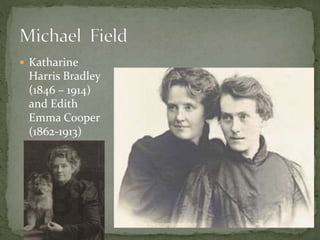
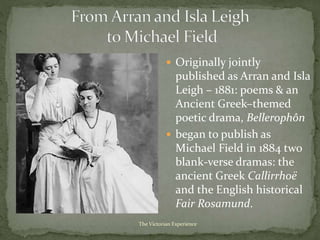
 Katharine
Harris Bradley
(1846 – 1914)
and Edith
Emma Cooper
(1862-1913)
The Victorian Experience
 Originally jointly
published as Arran and Isla
Leigh – 1881: poems & an
Ancient Greek–themed
poetic drama, Bellerophôn
 began to publish as
Michael Field in 1884 two
blank-verse dramas: the
ancient Greek Callirrhoë
and the English historical
Fair Rosamund.
The Victorian Experience
 Much of Field’s verse,
such as the collections
Long Ago (1889) and
Sight and Song (1892),
deals quite openly with
feminine sexuality and
erotic love between
women.
 Bradley to Havelock Ellis:
“We cross and interlace
like a company of
dancing summer flies; if
one begins a character,
his companion seizes
and possesses it; if one
conceives a scene or
situation, the other
corrects, completes, or
murderously cuts away.”
The Victorian Experience
 A Girl,
Her soul a deep-wave pearl
Dim, lucent of all lovely mysteries;
A face flowered for heart’s ease,
A brow’s grace soft as seas
Seen through faint forest-trees:
A mouth, the lips apart,
Like aspen-leaflets trembling in the breeze
From her tempestuous heart.
Such: and our souls so knit,
I leave a page half-writ —
The work begun
Will be to heaven’s conception done,
If she come to it.
The Victorian Experience
 “these men found it inscrutable, incomprehensible,
that two people could write poetry together.” (Bradley
of Thomas Hardy and Theodore Watts-Dunton)
 “Spinoza with his fine grasp of unity says: “If two
individuals of exactly the same nature are joined
together, they make up a single individual, doubly
stronger than each alone,” i.e., Edith and I make a
veritable Michael. “ (Bradley to Browning)
The Victorian Experience
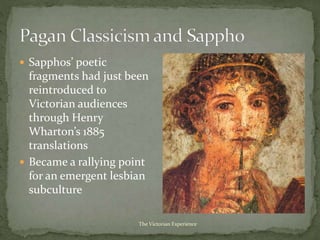
 Sapphos’ poetic
fragments had just been
reintroduced to
Victorian audiences
through Henry
Wharton’s 1885
translations
 Became a rallying point
for an emergent lesbian
subculture
The Victorian Experience
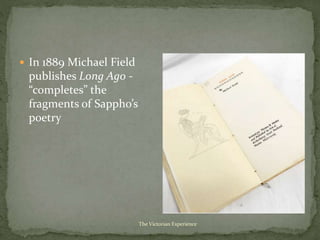
 In 1889 Michael Field
publishes Long Ago -
“completes” the
fragments of Sappho’s
poetry
The Victorian Experience
Although his prayer the Muses bless,
The poet doth require
That ye, in frolic gentleness,
Should stand beside his lyre.
Ne’er will he mortal ear delight,
Nor care-vex’d spirit ease;
Except he sing with ye in sight,
Rose-flushed among the trees.
The Victorian Experience
 “Bradley and Cooper appropriate Sappho as a
name simultaneously proper and improper, their
own and not their own”. Yopie Prinz, Victorian Sappho,
Princeton University Press, 1999
 “Field in fact anticipates the feminist, historicizing
scholar, the scholar who seeks representations of
women and gender in the fracturing mirror of past
texts in order to put the fragments together in her
own documents” (Hollie Laird, ‘Coupled Women of
letters’ in Women Coauthors, Illinois UP, 2000)
The Victorian Experience
 Historic, side-long, implicating eyes;
A smile of velvet's lustre on the cheek;
Calm lips the smile leads upward; hand that lies
Glowing and soft, the patience in its rest
Of cruelty that waits and does not seek
For prey; a dusky forehead and a breast
Where twilight touches ripeness amorously:
Behind her, crystal rocks, a sea and skies
Of evanescent blue on cloud and creek;
Landscape that shines suppressive of its zest
For those vicissitudes by which men die.
The Victorian Experience

Walter Pater and Michael Field

  • 1.
  • 2.
     Critic, essayist, humanist,aesthete  Studied Greek Philosophy at Oxford  1864 Fellow at Brasenose College Oxford  1873 Studies in the History of the Renaissance The Victorian Experience
  • 3.
     widely regardedas the manifesto of aestheticism  1860s: the Italian Renaissance was emerging as a new subject for Victorian criticism  15th & 16th century Italian culture was seen to embody many qualities that Victorian thinkers wanted to appropriate: classical scholarship, visual artistry, and prizing of individualism captured in e.g. the “genius” inventor or artist.  A screen by which Victorian authors could explore forbidden themes? The Victorian Experience
  • 4.
     Quotes butundermines Matthew Arnold:  ‘To see the object as in itself it really is,” has been justly said to be the aim of all true criticism whatever; and in aesthetic criticism the first step towards seeing one’s object as it really is, is to know one’s own impression as it really is, to discriminate it, to realise it distinctly. . . . What is this song or picture, this engaging personality presented in life or in a book, to me? ‘ The Victorian Experience
  • 5.
     The MonaLisa: a vampire? “the animalism of Greece, the lust of Rome” The Victorian Experience
  • 6.
     ‘truths forPater’s version of aesthetic experience, a beauty mixed with darkness and death.’  (Teukolsky, “Walter Pater’s Renaissance (1873) and the British Aesthetic Movement”) The Victorian Experience
  • 7.
     Pater admitsthat he uses the term ‘Renaissance’ ‘in “a much wider scope than was intended by those who originally used it to denote that revival of classical antiquity in the fifteenth century.”  For him, the Renaissance is a distinctive “outbreak of the human spirit” whose defining characteristics include “the care for physical beauty, the worship of the body, the breaking down of those limits which the religious system of the middle ages imposed on the heart and the imagination.” The Victorian Experience
  • 8.
     As MargaretOliphant notes, Pater imparts sentiments that “never entered into the most advanced imagination within two or three hundred years of Botticelli’s time, and [were] as alien to the spirit of a medieval Italian, as [they are] perfectly consistent with that of a delicate Oxford don in the latter half of the nineteenth century” (Blackwood’s Magazine, Nov. 1873).  Pater responded to such criticisms by retitling the book in later editions as The Renaissance: Studies in Art and Poetry. The Victorian Experience
  • 9.
     ‘Greek sensuousness,therefore, does not fever the conscience: it is shameless and childlike. Christian asceticism, on the other hand, discrediting the slightest touch of sense, has from time to time provoked into strong emphasis the contrast or antagonism to itself, of the artistic life, with its inevitable sensuousness. — I did but taste a little honey with the end of the rod that was in mine hand, and lo! I must die. — It has sometimes seemed hard to pursue that life without something of conscious disavowal of a spiritual world; and this imparts to genuine artistic interests a kind of intoxication. From this intoxication Winckelmann is free: he fingers those pagan marbles with unsinged hands, with no sense of shame or loss. That is to deal with the sensuous side of art in the pagan manner. ‘  a “homosexual counterdiscourse able to justify male love in ideal or transcendental terms” (Linda Dowling, The Victorian Experience
  • 10.
    ‘A counted numberof pulses only is given to us of a variegated, dramatic life. How may we see in them all that is to be seen in them by the finest senses? How shall we pass most swiftly from point to point, and be present always at the focus where the greatest number of vital forces unite in their purest energy? To burn always with this hard, gemlike flame, to maintain this ecstasy, is success in life. In a sense it might even be said that our failure is to form habits: for, after all, habit is relative to a stereotyped world, and meantime it is only the roughness of the eye that makes any two persons, things, situations, seem alike. While all melts under our feet, we may well catch at any exquisite passion, or any contribution to knowledge that seems by a lifted horizon to set the spirit free for a moment, or any stirring of the senses, strange dyes, strange colours, and curious odours, or work of the artist’s hands, or the face of one’s friend’. The Victorian Experience
  • 11.
     ‘I cannotdisguise from myself that the concluding pages adequately sum up the philosophy of the whole; and that that philosophy is an assertion, that no fixed principles either of religion or morality can be regarded as certain, that the only thing worth living for is momentary enjoyment and that probably or certainly the soul dissolves at death into elements which are destined never to reunite.’ (John Wordsworth, chaplain of Brasenose College 1873)  “Can you wonder that to young men who have imbibed this teaching the Cross is an offence, and the notion of a vocation to preach it an unintelligible craze?” (Bishop of Oxford 1875) The Victorian Experience
  • 12.
     Character ofMr Rose:  “a pale creature, with large moustache, looking out of the window at the sunset… . [H]e always speaks in an undertone, and his two topics are self- indulgence and art.” “What a very odd man Mr. Rose is!” one character exclaims, “He always seems to talk of everybody as if they had no clothes on” The Victorian Experience
  • 13.
     H. Hutton: “perhaps too visibly laboured, [but]have subtle touches of lovely colour, and a sweet, quiet cadence, hardly amounting to rhythm, which are distinguishable from those of poetry only in form” (The Spectator, June 1873)  Oscar Wilde called The Renaissance “the golden book of spirit and sense, the holy writ of beauty.” -claimed to travel with it everywhere .  George Eliot ‘“quite poisonous in its false principles of criticism and false conceptions of life.” (Letters, Nov 1873)  T. S. Eliot criticized Pater for propounding “a theory of ethics” in the guise of a theory of art (1930)The Victorian Experience
  • 14.
     Katharine Harris Bradley (1846– 1914) and Edith Emma Cooper (1862-1913) The Victorian Experience
  • 15.
     Originally jointly publishedas Arran and Isla Leigh – 1881: poems & an Ancient Greek–themed poetic drama, Bellerophôn  began to publish as Michael Field in 1884 two blank-verse dramas: the ancient Greek Callirrhoë and the English historical Fair Rosamund. The Victorian Experience
  • 16.
     Much ofField’s verse, such as the collections Long Ago (1889) and Sight and Song (1892), deals quite openly with feminine sexuality and erotic love between women.  Bradley to Havelock Ellis: “We cross and interlace like a company of dancing summer flies; if one begins a character, his companion seizes and possesses it; if one conceives a scene or situation, the other corrects, completes, or murderously cuts away.” The Victorian Experience
  • 17.
     A Girl, Hersoul a deep-wave pearl Dim, lucent of all lovely mysteries; A face flowered for heart’s ease, A brow’s grace soft as seas Seen through faint forest-trees: A mouth, the lips apart, Like aspen-leaflets trembling in the breeze From her tempestuous heart. Such: and our souls so knit, I leave a page half-writ — The work begun Will be to heaven’s conception done, If she come to it. The Victorian Experience
  • 18.
     “these menfound it inscrutable, incomprehensible, that two people could write poetry together.” (Bradley of Thomas Hardy and Theodore Watts-Dunton)  “Spinoza with his fine grasp of unity says: “If two individuals of exactly the same nature are joined together, they make up a single individual, doubly stronger than each alone,” i.e., Edith and I make a veritable Michael. “ (Bradley to Browning) The Victorian Experience
  • 19.
     Sapphos’ poetic fragmentshad just been reintroduced to Victorian audiences through Henry Wharton’s 1885 translations  Became a rallying point for an emergent lesbian subculture The Victorian Experience
  • 20.
     In 1889Michael Field publishes Long Ago - “completes” the fragments of Sappho’s poetry The Victorian Experience
  • 21.
    Although his prayerthe Muses bless, The poet doth require That ye, in frolic gentleness, Should stand beside his lyre. Ne’er will he mortal ear delight, Nor care-vex’d spirit ease; Except he sing with ye in sight, Rose-flushed among the trees. The Victorian Experience
  • 22.
     “Bradley andCooper appropriate Sappho as a name simultaneously proper and improper, their own and not their own”. Yopie Prinz, Victorian Sappho, Princeton University Press, 1999  “Field in fact anticipates the feminist, historicizing scholar, the scholar who seeks representations of women and gender in the fracturing mirror of past texts in order to put the fragments together in her own documents” (Hollie Laird, ‘Coupled Women of letters’ in Women Coauthors, Illinois UP, 2000) The Victorian Experience
  • 23.
     Historic, side-long,implicating eyes; A smile of velvet's lustre on the cheek; Calm lips the smile leads upward; hand that lies Glowing and soft, the patience in its rest Of cruelty that waits and does not seek For prey; a dusky forehead and a breast Where twilight touches ripeness amorously: Behind her, crystal rocks, a sea and skies Of evanescent blue on cloud and creek; Landscape that shines suppressive of its zest For those vicissitudes by which men die. The Victorian Experience

Editor's Notes

  • #7 http://www.branchcollective.org/?ps_articles=rachel-teukolsky-walter-paters-renaissance-1873-and-the-british-aesthetic-movement
  • #10 http://www.victorianweb.org/authors/pater/renaissance/9.html Linda Dowling, Hellenism and Homosexuality in Victorian Oxford,Cornell 1995
  • #13 W. H. Mallock as caricatured by Spy in Vanity Fair, December 30, 1882.
  • #14 T. S. Eliot in his 1930 essay on “Arnold and Pater” (Eliot, 1951):.
  • #17 https://www.poetryfoundation.org/features/articles/detail/69465
  • #23 The Curious Identity of Michael Field and its Implications for Humanities Research with the Semantic Web Susan Brown