66th FEFA Course (IFEC-03)At The University of PeshawarRozi Khan                                                       The Department of English, Govt. PG Jahanzeb College Swat.
In the name of Allah The Beneficent and Merciful.LET`S TEACH PROSERozi Khan                                                       The Department of English, Govt. PG Jahanzeb College Swat.
Objectives:
Introduction
Types
Prose-fiction
 Elements of prose-fiction
Teaching Strategies for Prose PROSERozi Khan                                                      The Department of English, Govt. PG Jahanzeb College Swat.
PROSE from Latin prosaoratio “straightforward discourse”
 written or spoken language in its ordinary form, without metrical structure
 written in full sentences, which then constitutes paragraphs
commonly used, in newspapers, magazines, encyclopedias, broadcasting, film, history, philosophy and many other forms of communicationRozi Khan                                                      The Department of English, Govt. PG Jahanzeb College Swat.
PROSE TYPESNon-FictionThis can also be called “informational” material.  It provides information that is factual.  Nothing is make-believe in these types of materials.  It has some practical utility. More specific examples of this genre would be . . .
Biographies:A true account of a person's life written, composed, or produced by another.
Autobiographies:The biography of a person written by that person.
Histories:A chronological  record of past events and developments, etc, Rozi Khan                                                      The Department of English, Govt. PG Jahanzeb College Swat.
PROSE TYPESFictionIt is partly or totally imaginatively contrived. However, authors can also choose to include factual information in a made-up story. It is often referred to as narrative prose-prose which tells a story. Its different types include;
Historical Fiction: The story takes the reader back to a particular time period where they learn about the everyday life of a person or group of persons.  The character may interact with actual historical characters, but usually, the main character is not based on a real person.Rozi Khan                                                      The Department of English, Govt. PG Jahanzeb College Swat.
 Realistic Fiction: The story usually presents a problem to be examined that could be from anybody’s life.  They may cover such topics as family situations, peer relationships, and cultural differences etc. Science Fiction: This is a type of modern fantasy.  It explores scientific fact and can pose ethical questions about current scientific trends and predictions.  The author focuses on the adventure of exploring the unknown and the wonder of discovering new worlds and people.Rozi Khan                                                      The Department of English, Govt. PG Jahanzeb College Swat.PROSE TYPES (Fiction Continued)
PROSE TYPES (Fiction Continued)Mystery:There are different types of mystery stories, but usually a crime has been committed and the reader wants to try to figure out “whodunit”.  There is usually a great deal of suspense and intrigue abounds.
Metafiction:It self-consciously and systematically draws attention to its status as an artifact in order to pose questions about the relationship between fiction and reality.Rozi Khan                                                      The Department of English, Govt. PG Jahanzeb College Swat.
PROSE TYPES (Fiction Continued)Romance: It represents a chivalric theme or relates improbable adventures of idealised characters in some remote or enchanted setting.
Short-Story: It is marked by relative shortness and density, organised into a plot and with some kind of denouement at the end. It can be read in a single sitting.Rozi Khan                                                      The Department of English, Govt. PG Jahanzeb College Swat.
Novel: It is an extended work of prose fiction which tells a story of considerable length.
It shows characters and their actions in what is recognizably everyday life. In novel unlike short-story characters and plot are fairly developed.
It has a number of sub-genres depending upon the content and the method of execution. PROSE TYPES (Fiction Continued)Rozi Khan                                                      The Department of English, Govt. PG Jahanzeb College Swat.
NarrativeANALYSIS OF NARRATIVE PROSETheorists are in agreement that there are at least two levels in a narrative text: something happens (What is told?) and this something is related in a certain way (How is it told?).
 In structuralist terminology  the WHATof the narrative is called story, the HOW is called discourse.Story (What is told?)Rozi Khan                                                      The Department of English, Govt. PG Jahanzeb College Swat.
NARRATIVE (Story)Story consists of events (things that happen) and so-called existents (characters and setting to whom and where things happen).
Events can be either brought about actively, in which case they are called actions (one character kills another) or they just happen naturally ( someone dies of a heart attack).
 Existents are the characters that make things happen or have things happen to them and setting, meaning the place or space where things happen.Rozi Khan                                                      The Department of English, Govt. PG Jahanzeb College Swat.
NARRATIVE (Story) Most stories involve a sequence of events rather than just one event. Manfred Jahn thus gives the following definition of story:
A sequence of events and actions involving characters. ‘Events’ generally include natural and non-natural happenings like floods or car accidents; ‘actions’ more specifically refers to willful acts by characters (M. Jahn 2002)Rozi Khan                                                      The Department of English, Govt. PG Jahanzeb College Swat.
NARRATIVE (Story)Space /SettingRozi Khan                                                      The Department of English, Govt. PG Jahanzeb College Swat.
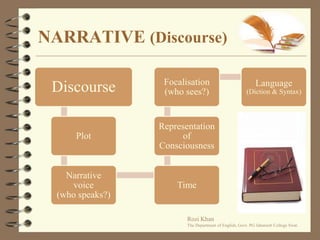
NARRATIVE (Discourse)It comprises various elements of transmission
 Elements of discourse determine our perception of the story (what “actually” happened).
 In the analysis of discourse we try to determine how certain effects are achieved.
The focus of analysis are questions such as:
What is the narrative situation?
Whose point of view is presented?
Which narrative modes are employed?
How are the thoughts of characters transmitted?
How is the chronology of events dealt with?
How is style used?Rozi Khan                                                      The Department of English, Govt. PG Jahanzeb College Swat.
NARRATIVE (Discourse)The analysis of the elements of discourse reveals how the reader is “manipulated” into forming certain views about the story.
Analysis of the elements of discourse include an analysis of plot, narrative voice, focalisation, theme, representation of consciousness, time, and the type of language used in a work of literature.Rozi Khan                                                      The Department of English, Govt. PG Jahanzeb College Swat.
NARRATIVE (Discourse)Rozi Khan                                                      The Department of English, Govt. PG Jahanzeb College Swat.
PLOTPlot is the literary element that describes the structure of a story.
 It is the story arc which holds all the events of a story in an orderly way.
 plot is the casual and logical structure which connects events~E.M. Forster`s Aspects of the novel 1927~Rozi Khan                                                      The Department of English, Govt. PG Jahanzeb College Swat.

Prose

  • 1.
    66th FEFA Course(IFEC-03)At The University of PeshawarRozi Khan The Department of English, Govt. PG Jahanzeb College Swat.
  • 2.
    In the nameof Allah The Beneficent and Merciful.LET`S TEACH PROSERozi Khan The Department of English, Govt. PG Jahanzeb College Swat.
  • 3.
  • 4.
  • 5.
  • 6.
  • 7.
    Elements ofprose-fiction
  • 8.
    Teaching Strategies forProse PROSERozi Khan The Department of English, Govt. PG Jahanzeb College Swat.
  • 9.
    PROSE from Latinprosaoratio “straightforward discourse”
  • 10.
    written orspoken language in its ordinary form, without metrical structure
  • 11.
    written infull sentences, which then constitutes paragraphs
  • 12.
    commonly used, innewspapers, magazines, encyclopedias, broadcasting, film, history, philosophy and many other forms of communicationRozi Khan The Department of English, Govt. PG Jahanzeb College Swat.
  • 13.
    PROSE TYPESNon-FictionThis canalso be called “informational” material. It provides information that is factual. Nothing is make-believe in these types of materials. It has some practical utility. More specific examples of this genre would be . . .
  • 14.
    Biographies:A true accountof a person's life written, composed, or produced by another.
  • 15.
    Autobiographies:The biography ofa person written by that person.
  • 16.
    Histories:A chronological record of past events and developments, etc, Rozi Khan The Department of English, Govt. PG Jahanzeb College Swat.
  • 17.
    PROSE TYPESFictionIt ispartly or totally imaginatively contrived. However, authors can also choose to include factual information in a made-up story. It is often referred to as narrative prose-prose which tells a story. Its different types include;
  • 18.
    Historical Fiction: Thestory takes the reader back to a particular time period where they learn about the everyday life of a person or group of persons. The character may interact with actual historical characters, but usually, the main character is not based on a real person.Rozi Khan The Department of English, Govt. PG Jahanzeb College Swat.
  • 19.
    Realistic Fiction:The story usually presents a problem to be examined that could be from anybody’s life. They may cover such topics as family situations, peer relationships, and cultural differences etc. Science Fiction: This is a type of modern fantasy. It explores scientific fact and can pose ethical questions about current scientific trends and predictions. The author focuses on the adventure of exploring the unknown and the wonder of discovering new worlds and people.Rozi Khan The Department of English, Govt. PG Jahanzeb College Swat.PROSE TYPES (Fiction Continued)
  • 20.
    PROSE TYPES (FictionContinued)Mystery:There are different types of mystery stories, but usually a crime has been committed and the reader wants to try to figure out “whodunit”. There is usually a great deal of suspense and intrigue abounds.
  • 21.
    Metafiction:It self-consciously andsystematically draws attention to its status as an artifact in order to pose questions about the relationship between fiction and reality.Rozi Khan The Department of English, Govt. PG Jahanzeb College Swat.
  • 22.
    PROSE TYPES (FictionContinued)Romance: It represents a chivalric theme or relates improbable adventures of idealised characters in some remote or enchanted setting.
  • 23.
    Short-Story: It ismarked by relative shortness and density, organised into a plot and with some kind of denouement at the end. It can be read in a single sitting.Rozi Khan The Department of English, Govt. PG Jahanzeb College Swat.
  • 24.
    Novel: It isan extended work of prose fiction which tells a story of considerable length.
  • 25.
    It shows charactersand their actions in what is recognizably everyday life. In novel unlike short-story characters and plot are fairly developed.
  • 26.
    It has anumber of sub-genres depending upon the content and the method of execution. PROSE TYPES (Fiction Continued)Rozi Khan The Department of English, Govt. PG Jahanzeb College Swat.
  • 27.
    NarrativeANALYSIS OF NARRATIVEPROSETheorists are in agreement that there are at least two levels in a narrative text: something happens (What is told?) and this something is related in a certain way (How is it told?).
  • 28.
    In structuralistterminology the WHATof the narrative is called story, the HOW is called discourse.Story (What is told?)Rozi Khan The Department of English, Govt. PG Jahanzeb College Swat.
  • 29.
    NARRATIVE (Story)Story consistsof events (things that happen) and so-called existents (characters and setting to whom and where things happen).
  • 30.
    Events can beeither brought about actively, in which case they are called actions (one character kills another) or they just happen naturally ( someone dies of a heart attack).
  • 31.
    Existents arethe characters that make things happen or have things happen to them and setting, meaning the place or space where things happen.Rozi Khan The Department of English, Govt. PG Jahanzeb College Swat.
  • 32.
    NARRATIVE (Story) Moststories involve a sequence of events rather than just one event. Manfred Jahn thus gives the following definition of story:
  • 33.
    A sequence ofevents and actions involving characters. ‘Events’ generally include natural and non-natural happenings like floods or car accidents; ‘actions’ more specifically refers to willful acts by characters (M. Jahn 2002)Rozi Khan The Department of English, Govt. PG Jahanzeb College Swat.
  • 34.
    NARRATIVE (Story)Space /SettingRoziKhan The Department of English, Govt. PG Jahanzeb College Swat.
  • 35.
    NARRATIVE (Discourse)It comprisesvarious elements of transmission
  • 36.
    Elements ofdiscourse determine our perception of the story (what “actually” happened).
  • 37.
    In theanalysis of discourse we try to determine how certain effects are achieved.
  • 38.
    The focus ofanalysis are questions such as:
  • 39.
    What is thenarrative situation?
  • 40.
    Whose point ofview is presented?
  • 41.
  • 42.
    How are thethoughts of characters transmitted?
  • 43.
    How is thechronology of events dealt with?
  • 44.
    How is styleused?Rozi Khan The Department of English, Govt. PG Jahanzeb College Swat.
  • 45.
    NARRATIVE (Discourse)The analysisof the elements of discourse reveals how the reader is “manipulated” into forming certain views about the story.
  • 46.
    Analysis of theelements of discourse include an analysis of plot, narrative voice, focalisation, theme, representation of consciousness, time, and the type of language used in a work of literature.Rozi Khan The Department of English, Govt. PG Jahanzeb College Swat.
  • 47.
    NARRATIVE (Discourse)Rozi Khan The Department of English, Govt. PG Jahanzeb College Swat.
  • 48.
    PLOTPlot is theliterary element that describes the structure of a story.
  • 49.
    It isthe story arc which holds all the events of a story in an orderly way.
  • 50.
    plot isthe casual and logical structure which connects events~E.M. Forster`s Aspects of the novel 1927~Rozi Khan The Department of English, Govt. PG Jahanzeb College Swat.