LEARNING COMPETENCIES
2. determinespecific forms and
conventions of poetry
HUMSS_CW/MP11/12c-f-7
3.use selected elements of poetry in short
exercises HUMSS_CW/MP11/12c-f-8
2
3.
LESSON OBJECTIVES
Learners areable to:
1. identify the major forms of poetry;
2. define the types of lyric poetry;
3. Differentiate the kinds of sonnet;
3
4.
THREE MOST COMMONTYPES OF
POETRY ACCORDING TO FORM ARE
1. lyric
2. dramatic and
3. narrative.
4
5.
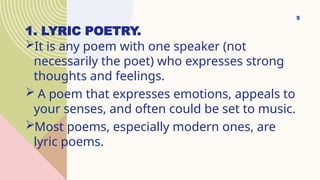
1. LYRIC POETRY.
Itis any poem with one speaker (not
necessarily the poet) who expresses strong
thoughts and feelings.
A poem that expresses emotions, appeals to
your senses, and often could be set to music.
Most poems, especially modern ones, are
lyric poems.
5
6.
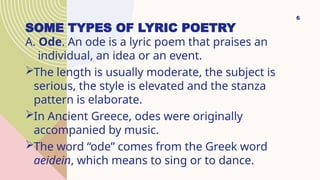
SOME TYPES OFLYRIC POETRY
A. Ode. An ode is a lyric poem that praises an
individual, an idea or an event.
The length is usually moderate, the subject is
serious, the style is elevated and the stanza
pattern is elaborate.
In Ancient Greece, odes were originally
accompanied by music.
The word “ode” comes from the Greek word
aeidein, which means to sing or to dance.
6
7.
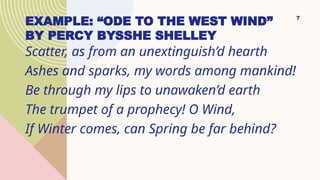
EXAMPLE: “ODE TOTHE WEST WIND”
BY PERCY BYSSHE SHELLEY
Scatter, as from an unextinguish’d hearth
Ashes and sparks, my words among mankind!
Be through my lips to unawaken’d earth
The trumpet of a prophecy! O Wind,
If Winter comes, can Spring be far behind?
7
8.
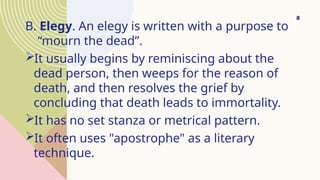
B. Elegy. Anelegy is written with a purpose to
“mourn the dead”.
It usually begins by reminiscing about the
dead person, then weeps for the reason of
death, and then resolves the grief by
concluding that death leads to immortality.
It has no set stanza or metrical pattern.
It often uses "apostrophe" as a literary
technique.
8
9.
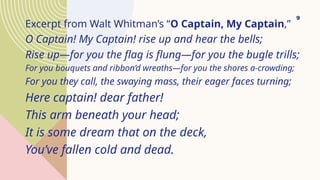
Excerpt from WaltWhitman’s “O Captain, My Captain,”
O Captain! My Captain! rise up and hear the bells;
Rise up—for you the flag is flung—for you the bugle trills;
For you bouquets and ribbon’d wreaths—for you the shores a-crowding;
For you they call, the swaying mass, their eager faces turning;
Here captain! dear father!
This arm beneath your head;
It is some dream that on the deck,
You’ve fallen cold and dead.
9
10.
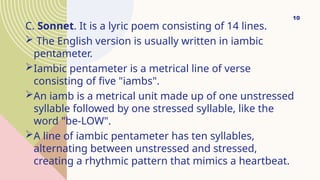
C. Sonnet. Itis a lyric poem consisting of 14 lines.
The English version is usually written in iambic
pentameter.
Iambic pentameter is a metrical line of verse
consisting of five "iambs".
An iamb is a metrical unit made up of one unstressed
syllable followed by one stressed syllable, like the
word "be-LOW".
A line of iambic pentameter has ten syllables,
alternating between unstressed and stressed,
creating a rhythmic pattern that mimics a heartbeat.
10
11.
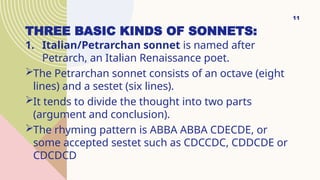
THREE BASIC KINDSOF SONNETS:
1. Italian/Petrarchan sonnet is named after
Petrarch, an Italian Renaissance poet.
The Petrarchan sonnet consists of an octave (eight
lines) and a sestet (six lines).
It tends to divide the thought into two parts
(argument and conclusion).
The rhyming pattern is ABBA ABBA CDECDE, or
some accepted sestet such as CDCCDC, CDDCDE or
CDCDCD
11
12.
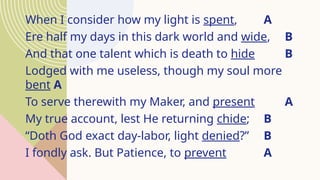
When I considerhow my light is spent, A
Ere half my days in this dark world and wide, B
And that one talent which is death to hide B
Lodged with me useless, though my soul more
bent A
To serve therewith my Maker, and present A
My true account, lest He returning chide; B
“Doth God exact day-labor, light denied?” B
I fondly ask. But Patience, to prevent A
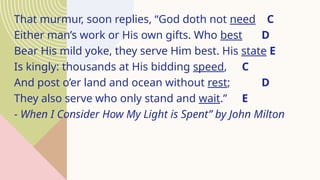
13.
That murmur, soonreplies, “God doth not need C
Either man’s work or His own gifts. Who best D
Bear His mild yoke, they serve Him best. His state E
Is kingly: thousands at His bidding speed, C
And post o’er land and ocean without rest; D
They also serve who only stand and wait.” E
- When I Consider How My Light is Spent” by John Milton
14.
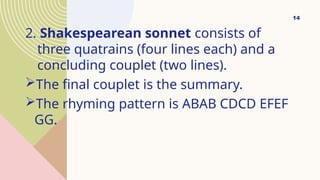
2. Shakespearean sonnetconsists of
three quatrains (four lines each) and a
concluding couplet (two lines).
The final couplet is the summary.
The rhyming pattern is ABAB CDCD EFEF
GG.
14
15.
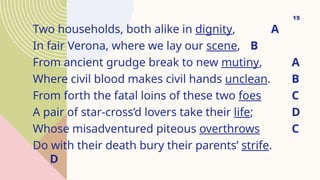
Two households, bothalike in dignity, A
In fair Verona, where we lay our scene, B
From ancient grudge break to new mutiny, A
Where civil blood makes civil hands unclean. B
From forth the fatal loins of these two foes C
A pair of star-cross’d lovers take their life; D
Whose misadventured piteous overthrows C
Do with their death bury their parents’ strife.
D
15
16.
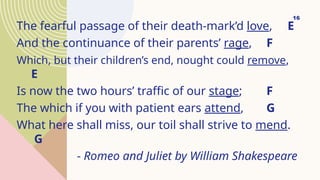
The fearful passageof their death-mark’d love, E
And the continuance of their parents’ rage, F
Which, but their children’s end, nought could remove,
E
Is now the two hours’ traffic of our stage; F
The which if you with patient ears attend, G
What here shall miss, our toil shall strive to mend.
G
- Romeo and Juliet by William Shakespeare
16
17.
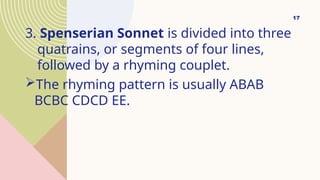
3. Spenserian Sonnetis divided into three
quatrains, or segments of four lines,
followed by a rhyming couplet.
The rhyming pattern is usually ABAB
BCBC CDCD EE.
17
18.
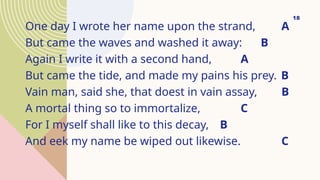
One day Iwrote her name upon the strand, A
But came the waves and washed it away: B
Again I write it with a second hand, A
But came the tide, and made my pains his prey. B
Vain man, said she, that doest in vain assay, B
A mortal thing so to immortalize, C
For I myself shall like to this decay, B
And eek my name be wiped out likewise. C
18
19.
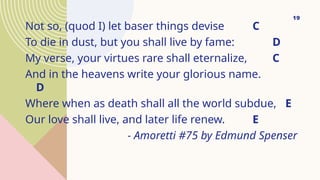
Not so, (quodI) let baser things devise C
To die in dust, but you shall live by fame: D
My verse, your virtues rare shall eternalize, C
And in the heavens write your glorious name.
D
Where when as death shall all the world subdue, E
Our love shall live, and later life renew. E
- Amoretti #75 by Edmund Spenser
19
20.
D. Song -is a lyric poem which is set to
music. All songs have a strong beat
created largely through the 3R’s: rhythm,
rhyme, and repetition.
E. Simple Lyric - is a short poem
expressing the poet’s thought, feeling, or
emotion.
20
21.
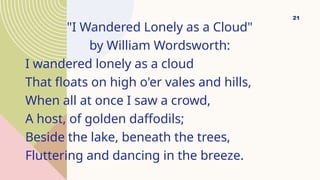
"I Wandered Lonelyas a Cloud"
by William Wordsworth:
I wandered lonely as a cloud
That floats on high o'er vales and hills,
When all at once I saw a crowd,
A host, of golden daffodils;
Beside the lake, beneath the trees,
Fluttering and dancing in the breeze.
21
22.
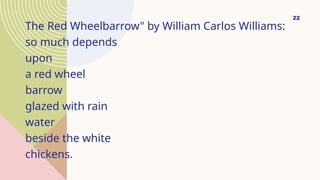
The Red Wheelbarrow"by William Carlos Williams:
so much depends
upon
a red wheel
barrow
glazed with rain
water
beside the white
chickens.
22
23.
FORMATIVE ASSESSMENT
1. Whatare the major types of poetry
according to form?
2. What are types of lyric poetry? Define
each
3. Differentiate the kinds of sonnet
23
24.
LEARNING OBJECTIVES
1. definethe types of dramatic
and narrative poetry;
2. read chorally the poem;
3. analyze the poem then
answer the questions
24
25.
2. DRAMATIC POETRY
apoem where the speaker is someone
other than the poet themselves.
A dramatic poem often includes
characters and dialogue.
A dramatic monologue is often from a
fictional character’s point of view.
25
26.
TYPES OF DRAMATICPOETRY
A. Dramatic Monologue - is a literary device that
is used when a character reveals his or her
innermost thoughts and feelings, those that
are hidden throughout the course of the story
line, through a poem or a speech.
A single character addresses a silent listener or
audience, revealing their personality, thoughts,
and motivations through their speech.
26
27.
EXAMPLE OF DRAMATICMONOLOGUE
• Robert Browning's "My Last Duchess," where the
Duke of Ferrara, while showing a painting of his
deceased wife, reveals his controlling, jealous, and
possibly murderous nature to an envoy.
• The Duke's monologue reveals his possessiveness,
his belief that his wife wasn't respectful enough of
him, and potentially, his role in her death. He
speaks of giving "commands" and how "all smiles
stopped together," implying he ordered her death.
27
28.
A notable exampleof a dramatic
monologue in Philippine literature is
“Waiting” by Ron Darwin.
It tells about the experiences of Isabel, an
OFW who works and in Canada with her
son, Miguel.
It touches on issues that involve the
Philippine diaspora and its effects on the
family.
28
29.
TYPES OF DRAMATICPOETRY
B. Soliloquy - is the act of speaking while
alone, especially when used as a theatrical
device that allows a character’s thoughts
and ideas to be conveyed to the audience.
A character speaks their innermost thoughts
and feelings aloud, often when alone on
stage, revealing their inner world to the
audience.
29
30.
EXAMPLE OF SOLILOQUY
•Hamlet's "To be, or not to be" soliloquy
from Shakespeare's play, where he
contemplates suicide.
• Macbeth's soliloquy before killing King
Duncan, where he wrestles with his
ambition and fear.
30
31.
A notable examplein Philippine literature is
"Mr. Marcos (A Soliloquy)" by Francis C.
Macansantos.
The poem features a dying junk dealer
reflecting on his poverty and his view of the
heavens from the Zamboanga wharf.
The poem's form allows the reader to delve
into the character's internal thoughts and
struggles as he confronts his mortality.
31
32.
C. Dialogue:
Conversation betweentwo or more characters,
which can be used to develop the plot, reveal
character, or create dramatic tension.
An example is the exchange between the Duke
and his guest in Robert Browning's "My Last
Duchess," where the Duke's words, though
seemingly polite, expose his controlling and
murderous nature.
32
33.
3. NARRATIVE POETRY
Itis a poem that tells a story.
Its structure resembles the plot line of a
story [i.e. the introduction of conflict and
characters, rising action, climax and the
denouement.
The most common types of narrative
poetry are ballad and epic.
33
34.
TYPES OF NARRATIVEPOETRY
A. Ballad. It is a narrative poem that has
a musical rhythm and can be sung.
A ballad is usually organized into
quatrains or cinquains, has a simple
rhythm structure, and tells the tales of
ordinary people.
34
35.
EXAMPLE: EXCERPT FROM“ANNABEL
LEE” BY EDGAR ALLAN POE
It was many and many a year ago,
In a kingdom by the sea,
That a maiden there lived whom you may
know
By the name of Annabel Lee;
And this maiden she lived with no other thought
Than to love and be loved by me
35
36.
Examples of FilipinoBallads:
Dandansoy: A Visayan folk song about leaving a loved one
behind.
Leron Leron Sinta: A traditional Tagalog folk song about a
love story, often depicted with bird imagery.
Sa Ngalan ng Pag-ibig (December Avenue): A modern
ballad that tells a story of unwavering love and
commitment.
"Ikaw" (Agatha Obar, performed by Brenan Espartinez): A
popular OPM ballad.
"Magbalik" (Callalily): A well-known OPM ballad according
to Spotify.
36
37.
B. Epic. Itis a long narrative poem in
elevated style recounting the deeds of a
legendary or historical hero.
Examples of epic include Iliad by Homer,
Beowulf, The Divine Comedy by Dante
Alighieri, Metamorphoses by Ovid and
many more.
Ilocano Biag ni Lam-ang, Hudhud hi Aliguyun
37
38.
C. Metrical Romance– it recounts the quest
undertaken by a single knight in order to gain a
lady’s favor.
Example:
"Florante at Laura" by Francisco Balagtas
The poem is written in dodecasyllabic verse (12
syllables per line).
It tells the story of Florante and Laura, two lovers
separated and facing trials in a fictional kingdom.
The poem incorporates elements of chivalry, romance,
and social commentary.
38
39.
D. Metrical Tale- is a simple, straightforward story in
verse.
These metrical tales are significant cultural artifacts that
preserve historical events, cultural beliefs, and moral
lessons for future generations.
Parang Sabil: A Tausug narrative song that tells stories of
Muslim heroes, often with a focus on their exploits and
the pursuit of death in battle.
Folk Songs and Chants: Many folk songs and chants, like
the ambahan of the Mangyans or the soliranin (Tagalog
rowing song), have narrative elements that tell stories of
daily life, work, and social interactions.
39
40.
FORMATIVE ASSESSMENT
1. Giveone type of dramatic poetry and
define
2. Give one type of narrative poetry and
define
40
41.
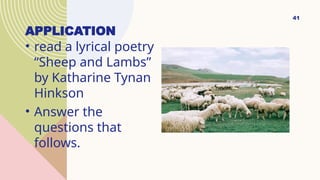
APPLICATION
• read alyrical poetry
“Sheep and Lambs”
by Katharine Tynan
Hinkson
• Answer the
questions that
follows.
41
42.
Questions:
1. The poetpassed some lambs on the road
and was reminded of our Lord. Can you
name one way in which the lambs
resembled Him? The one way in which
they did not?
2. Was the feeling left you one with sadness
or gladness? Determine the reasons why?
3. Which lines best express your mood?
42
43.
4. Can youguess the meaning from its use
in the poem, “Going meekly to die”?
Name three occasions on which you might
be said to have acted meekly.
Find out the dictionary meaning how words
gentle, mild, and meek differ.
5. What are the symbolisms that you can
see in the poem?
43
44.
6. What doyou call the stanza in the poem?
7. What is the metaphor use in the poem?
8. The speaker's thoughts turn to Jesus, often
referred to as the "Lamb of God”, what does it
imply?
9. What would the setting suggest?
10. The lambs are described as "weary and
crying," and their "weak human cry”, what
does it connect?
44
45.
11. What isthe juxtaposition in the poem?
12. What is theme of the poem?
13. What can you infer on the author or
writer in the poem?
14. What type of lyrical poetry is the Sheep
and Lamb?
15. What rhyme scheme is the poem?
45
46.
LEARNING OBJECTIVES
1. readsilently the poem;
2. list all the beautiful things
given in poem;
3. identify and list the sensory
images given in the poem.
46
47.
APPLICATION
Read the narrativepoetry “The Creation”
by James Weldon Johnson which is a
poetic retelling of the creation story from
Genesis.
After reading the narrative poetry,
answer the questions
47
48.
QUESTIONS FOR DISCUSSION
1.Is the poem based on fact?
2. To find out how closely the poet follows
the historical version, compare these lines
with the story found in the first book of
the Bible.
3. Cite the steps of creation based on the
poem by Johnson. Which ones do you
especially like? Why?
48
49.
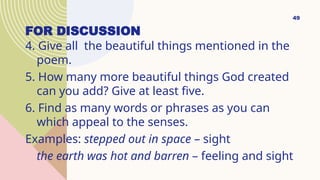
FOR DISCUSSION
4. Giveall the beautiful things mentioned in the
poem.
5. How many more beautiful things God created
can you add? Give at least five.
6. Find as many words or phrases as you can
which appeal to the senses.
Examples: stepped out in space – sight
the earth was hot and barren – feeling and sight
49
#7 From lines 66-70 of the ode
the speaker praises and celebrates the West Wind's power—it is destructive, chaotic—and yet such destruction is necessary for rebirth and renewal. the speaker so admires the wind that he wants to take, adopt, or absorb the West Wind's power's into his poetry.
#8 Apostrophe is a figure of speech where a speaker directly addresses someone or something that isn't present or capable of responding, like an absent person, an inanimate object, or an abstract idea.
#9 (written following the assassination of Abraham Lincoln)
#21 describes the speaker's experience of seeing a field of daffodils and the lasting joy it brings
#22 a free verse poem that uses simple imagery to evoke a sense of appreciation for everyday objects.
#28 First performed at the University of Columbia in Vancouver, Canada in November 2014.
Isabel, a Filipino woman in her early 40s, and Miguel, her 15-year old son – face the audience as they recite their monoloques.
#30 This soliloquy reveals Macbeth's internal struggle with his ambition and the potential consequences of his actions, highlighting his moral dilemma.
#35 A poem about a young woman's death and the narrator's enduring love for her.



![Lesson-3-ELEMENTS-OF-POETRY-According-to-Structure [Autosaved].pptx](https://cdn.slidesharecdn.com/ss_thumbnails/lesson-3-elements-of-poetry-according-to-structureautosaved-251006132553-d1983b2b-thumbnail.jpg?width=640&height=640&fit=bounds)


