
Poetry If It’s a Square…
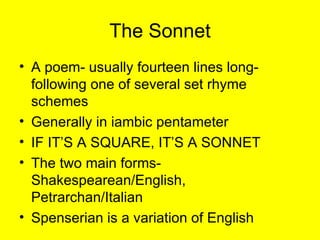
The Sonnet A poem- usually fourteen lines long- following one of several set rhyme schemes Generally in iambic pentameter IF IT’S A SQUARE, IT’S A SONNET The two main forms- Shakespearean/English, Petrarchan/Italian Spenserian is a variation of English
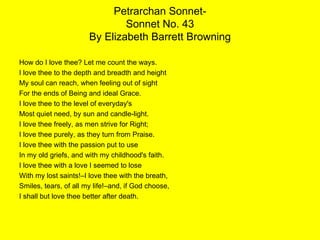
Petrarchan Sonnet- Sonnet No. 43 By Elizabeth Barrett Browning How do I love thee? Let me count the ways. I love thee to the depth and breadth and height My soul can reach, when feeling out of sight  For the ends of Being and ideal Grace. I love thee to the level of everyday's Most quiet need, by sun and candle-light. I love thee freely, as men strive for Right; I love thee purely, as they turn from Praise. I love thee with the passion put to use In my old griefs, and with my childhood's faith. I love thee with a love I seemed to lose With my lost saints!–I love thee with the breath, Smiles, tears, of all my life!–and, if God choose, I shall but love thee better after death.
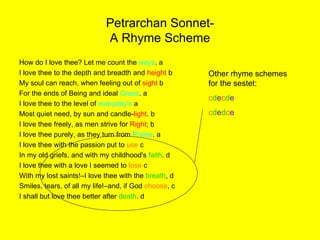
Petrarchan Sonnet- A Rhyme Scheme How do I love thee? Let me count the  ways . a I love thee to the depth and breadth and  height  b My soul can reach, when feeling out of  sight  b  For the ends of Being and ideal  Grace . a I love thee to the level of  everyday's  a Most quiet need, by sun and candle- light . b I love thee freely, as men strive for  Right ; b I love thee purely, as they turn from  Praise . a I love thee with the passion put to  use  c In my old griefs, and with my childhood's  faith . d I love thee with a love I seemed to  lose  c With my lost saints!–I love thee with the  breath , d Smiles, tears, of all my life!–and, if God  choose , c I shall but love thee better after  death . d Other rhyme schemes for the sestet: c d e c d e c d e d c e
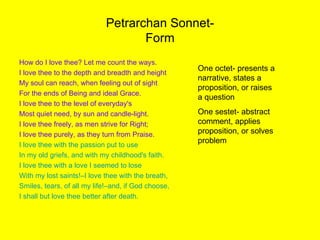
Petrarchan Sonnet- Form How do I love thee? Let me count the ways. I love thee to the depth and breadth and height My soul can reach, when feeling out of sight  For the ends of Being and ideal Grace. I love thee to the level of everyday's Most quiet need, by sun and candle-light. I love thee freely, as men strive for Right; I love thee purely, as they turn from Praise. I love thee with the passion put to use In my old griefs, and with my childhood's faith. I love thee with a love I seemed to lose With my lost saints!–I love thee with the breath, Smiles, tears, of all my life!–and, if God choose, I shall but love thee better after death. One octet- presents a narrative, states a proposition, or raises a question One sestet- abstract comment, applies proposition, or solves problem
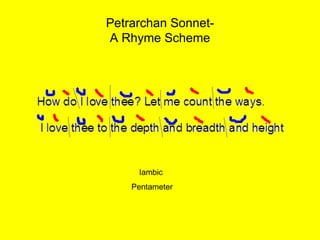
Petrarchan Sonnet- A Rhyme Scheme Iambic  Pentameter
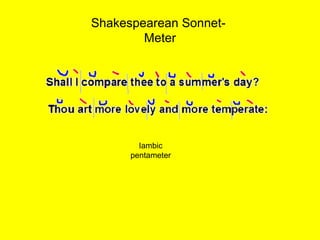
Shakespearean Sonnet-  Sonnet No. 118 By William Shakespeare Shall I compare thee to a summer's day? Thou art more lovely and more temperate: Rough winds do shake the darling buds of May, And summer's lease hath all too short a date: Sometime too hot the eye of heaven shines, And often is his gold complexion dimm'd; And every fair from fair sometime declines, By chance or nature's changing course untrimm'd; But thy eternal summer shall not fade Nor lose possession of that fair thou owest; Nor shall Death brag thou wander'st in his shade, When in eternal lines to time thou growest: So long as men can breathe or eyes can see, So long lives this and this gives life to thee.
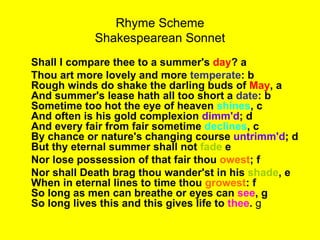
Rhyme Scheme Shakespearean Sonnet Shall I compare thee to a summer's  day ? a Thou art more lovely and more  temperate : b Rough winds do shake the darling buds of  May , a And summer's lease hath all too short a  date : b Sometime too hot the eye of heaven  shines , c And often is his gold complexion  dimm'd ; d And every fair from fair sometime  declines , c By chance or nature's changing course  untrimm'd ; d But thy eternal summer shall not  fade  e Nor lose possession of that fair thou  owest ; f Nor shall Death brag thou wander'st in his  shade , e When in eternal lines to time thou  growest : f So long as men can breathe or eyes can  see , g So long lives this and this gives life to  thee .  g
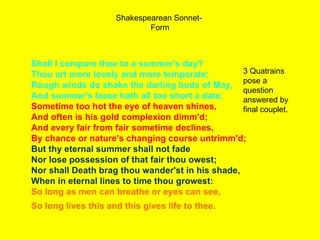
Shakespearean Sonnet-  Form Shall I compare thee to a summer's day? Thou art more lovely and more temperate: Rough winds do shake the darling buds of May, And summer's lease hath all too short a date: Sometime too hot the eye of heaven shines, And often is his gold complexion dimm'd; And every fair from fair sometime declines, By chance or nature's changing course untrimm'd; But thy eternal summer shall not fade Nor lose possession of that fair thou owest; Nor shall Death brag thou wander'st in his shade, When in eternal lines to time thou growest: So long as men can breathe or eyes can see, So long lives this and this gives life to thee.   3 Quatrains pose a question answered by final couplet.
Shakespearean Sonnet-  Meter Iambic pentameter
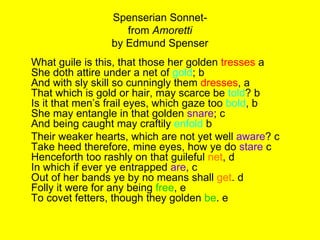
Spenserian Sonnet- from  Amoretti by Edmund Spenser What guile is this, that those her golden  tresses  a She doth attire under a net of  gold ; b And with sly skill so cunningly them  dresses , a That which is gold or hair, may scarce be  told ? b Is it that men’s frail eyes, which gaze too  bold , b She may entangle in that golden  snare ; c And being caught may craftily  enfold  b Their weaker hearts, which are not yet well  aware ? c Take heed therefore, mine eyes, how ye do  stare  c Henceforth too rashly on that guileful  net , d In which if ever ye entrapped  are , c Out of her bands ye by no means shall  get . d Folly it were for any being  free , e To covet fetters, though they golden  be . e
The History of the Sonnet Developed in Italy—Plutarch became the most famous sonnet writer (if you see a reference to Laura, it’s one of Petrarch’s) Introduced into England by Thomas Wyatt (translated some of Petrarch’s, wrote a few of his own) Shakespeare: the greatest writer of the modified (English) type Very few famous writers use the Spenserian form Famous English sonneteers: Sidney, Shakespeare, Milton, Wordsworth, Keats, D.G. Rossetti, Meredith, Auden, Geoffrey Hill Famous American sonnets by: Longfellow, Robinson, Frost< Cunnings, Berryman
An American Sonnet Divina Commedia No. 1 by Henry Wadsworth Longfellow Oft have I seen at some cathedral door A laborer, pausing in the dust and heat, Lay down his burden, and with reverent feet Enter, and cross himself, and on the floor Kneel to repeat his paternoster o'er; Far off the noises of the world retreat; The loud vociferations of the street Become an undistinguishable roar. So, as I enter here from day to day, And leave my burden at this minster gate, Kneeling in prayer, and not ashamed to pray, The tumult of the time disconsolate To inarticulate murmurs dies away, While the eternal ages watch and wait.

The sonnet

  • 1.
    Poetry If It’sa Square…
  • 2.
    The Sonnet Apoem- usually fourteen lines long- following one of several set rhyme schemes Generally in iambic pentameter IF IT’S A SQUARE, IT’S A SONNET The two main forms- Shakespearean/English, Petrarchan/Italian Spenserian is a variation of English
  • 3.
    Petrarchan Sonnet- SonnetNo. 43 By Elizabeth Barrett Browning How do I love thee? Let me count the ways. I love thee to the depth and breadth and height My soul can reach, when feeling out of sight  For the ends of Being and ideal Grace. I love thee to the level of everyday's Most quiet need, by sun and candle-light. I love thee freely, as men strive for Right; I love thee purely, as they turn from Praise. I love thee with the passion put to use In my old griefs, and with my childhood's faith. I love thee with a love I seemed to lose With my lost saints!–I love thee with the breath, Smiles, tears, of all my life!–and, if God choose, I shall but love thee better after death.
  • 4.
    Petrarchan Sonnet- ARhyme Scheme How do I love thee? Let me count the ways . a I love thee to the depth and breadth and height b My soul can reach, when feeling out of sight b  For the ends of Being and ideal Grace . a I love thee to the level of everyday's a Most quiet need, by sun and candle- light . b I love thee freely, as men strive for Right ; b I love thee purely, as they turn from Praise . a I love thee with the passion put to use c In my old griefs, and with my childhood's faith . d I love thee with a love I seemed to lose c With my lost saints!–I love thee with the breath , d Smiles, tears, of all my life!–and, if God choose , c I shall but love thee better after death . d Other rhyme schemes for the sestet: c d e c d e c d e d c e
  • 5.
    Petrarchan Sonnet- FormHow do I love thee? Let me count the ways. I love thee to the depth and breadth and height My soul can reach, when feeling out of sight  For the ends of Being and ideal Grace. I love thee to the level of everyday's Most quiet need, by sun and candle-light. I love thee freely, as men strive for Right; I love thee purely, as they turn from Praise. I love thee with the passion put to use In my old griefs, and with my childhood's faith. I love thee with a love I seemed to lose With my lost saints!–I love thee with the breath, Smiles, tears, of all my life!–and, if God choose, I shall but love thee better after death. One octet- presents a narrative, states a proposition, or raises a question One sestet- abstract comment, applies proposition, or solves problem
  • 6.
    Petrarchan Sonnet- ARhyme Scheme Iambic Pentameter
  • 7.
    Shakespearean Sonnet- Sonnet No. 118 By William Shakespeare Shall I compare thee to a summer's day? Thou art more lovely and more temperate: Rough winds do shake the darling buds of May, And summer's lease hath all too short a date: Sometime too hot the eye of heaven shines, And often is his gold complexion dimm'd; And every fair from fair sometime declines, By chance or nature's changing course untrimm'd; But thy eternal summer shall not fade Nor lose possession of that fair thou owest; Nor shall Death brag thou wander'st in his shade, When in eternal lines to time thou growest: So long as men can breathe or eyes can see, So long lives this and this gives life to thee.
  • 8.
    Rhyme Scheme ShakespeareanSonnet Shall I compare thee to a summer's day ? a Thou art more lovely and more temperate : b Rough winds do shake the darling buds of May , a And summer's lease hath all too short a date : b Sometime too hot the eye of heaven shines , c And often is his gold complexion dimm'd ; d And every fair from fair sometime declines , c By chance or nature's changing course untrimm'd ; d But thy eternal summer shall not fade e Nor lose possession of that fair thou owest ; f Nor shall Death brag thou wander'st in his shade , e When in eternal lines to time thou growest : f So long as men can breathe or eyes can see , g So long lives this and this gives life to thee . g
  • 9.
    Shakespearean Sonnet- Form Shall I compare thee to a summer's day? Thou art more lovely and more temperate: Rough winds do shake the darling buds of May, And summer's lease hath all too short a date: Sometime too hot the eye of heaven shines, And often is his gold complexion dimm'd; And every fair from fair sometime declines, By chance or nature's changing course untrimm'd; But thy eternal summer shall not fade Nor lose possession of that fair thou owest; Nor shall Death brag thou wander'st in his shade, When in eternal lines to time thou growest: So long as men can breathe or eyes can see, So long lives this and this gives life to thee. 3 Quatrains pose a question answered by final couplet.
  • 10.
    Shakespearean Sonnet- Meter Iambic pentameter
  • 11.
    Spenserian Sonnet- from Amoretti by Edmund Spenser What guile is this, that those her golden tresses a She doth attire under a net of gold ; b And with sly skill so cunningly them dresses , a That which is gold or hair, may scarce be told ? b Is it that men’s frail eyes, which gaze too bold , b She may entangle in that golden snare ; c And being caught may craftily enfold b Their weaker hearts, which are not yet well aware ? c Take heed therefore, mine eyes, how ye do stare c Henceforth too rashly on that guileful net , d In which if ever ye entrapped are , c Out of her bands ye by no means shall get . d Folly it were for any being free , e To covet fetters, though they golden be . e
  • 12.
    The History ofthe Sonnet Developed in Italy—Plutarch became the most famous sonnet writer (if you see a reference to Laura, it’s one of Petrarch’s) Introduced into England by Thomas Wyatt (translated some of Petrarch’s, wrote a few of his own) Shakespeare: the greatest writer of the modified (English) type Very few famous writers use the Spenserian form Famous English sonneteers: Sidney, Shakespeare, Milton, Wordsworth, Keats, D.G. Rossetti, Meredith, Auden, Geoffrey Hill Famous American sonnets by: Longfellow, Robinson, Frost< Cunnings, Berryman
  • 13.
    An American SonnetDivina Commedia No. 1 by Henry Wadsworth Longfellow Oft have I seen at some cathedral door A laborer, pausing in the dust and heat, Lay down his burden, and with reverent feet Enter, and cross himself, and on the floor Kneel to repeat his paternoster o'er; Far off the noises of the world retreat; The loud vociferations of the street Become an undistinguishable roar. So, as I enter here from day to day, And leave my burden at this minster gate, Kneeling in prayer, and not ashamed to pray, The tumult of the time disconsolate To inarticulate murmurs dies away, While the eternal ages watch and wait.