The Ballad
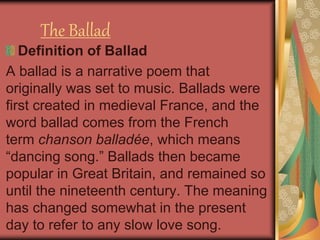
Definition of Ballad
A ballad is a narrative poem that
originally was set to music. Ballads were
first created in medieval France, and the
word ballad comes from the French
term chanson balladée, which means
“dancing song.” Ballads then became
popular in Great Britain, and remained so
until the nineteenth century. The meaning
has changed somewhat in the present
day to refer to any slow love song.
Feature Of A Ballad
A BALLAD has these features:
1- A simple narrative.
2- A few major characters.
3- A strong rhythm and rhyme.
4- A repeated section called a REFRAIN.
5- Division into verses.
6- Nouns to identify characters and settings.
7- Verbs to describe actions.
8- Adjectives to describe nouns.
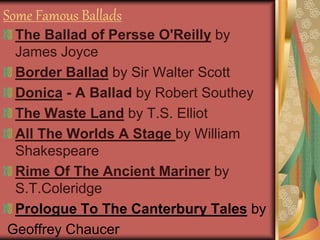
Some Famous Ballads
The Ballad of Persse O'Reilly by
James Joyce
Border Ballad by Sir Walter Scott
Donica - A Ballad by Robert Southey
The Waste Land by T.S. Elliot
All The Worlds A Stage by William
Shakespeare
Rime Of The Ancient Mariner by
S.T.Coleridge
Prologue To The Canterbury Tales by
Geoffrey Chaucer
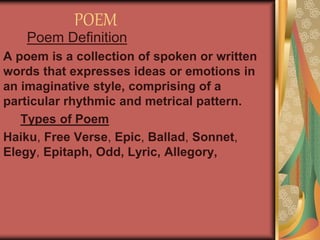
POEM
Poem Definition
A poem is a collection of spoken or written
words that expresses ideas or emotions in
an imaginative style, comprising of a
particular rhythmic and metrical pattern.
Types of Poem
Haiku, Free Verse, Epic, Ballad, Sonnet,
Elegy, Epitaph, Odd, Lyric, Allegory,
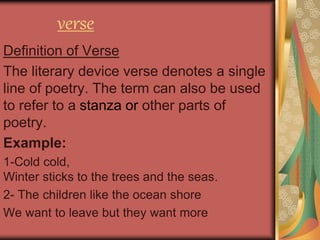
verse
Definition of Verse
The literary device verse denotes a single
line of poetry. The term can also be used
to refer to a stanza or other parts of
poetry.
Example:
1-Cold cold,
Winter sticks to the trees and the seas.
2- The children like the ocean shore
We want to leave but they want more
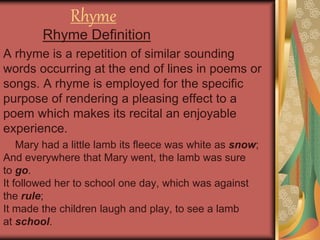
Rhyme
Rhyme Definition
A rhyme is a repetition of similar sounding
words occurring at the end of lines in poems or
songs. A rhyme is employed for the specific
purpose of rendering a pleasing effect to a
poem which makes its recital an enjoyable
experience.
Mary had a little lamb its fleece was white as snow;
And everywhere that Mary went, the lamb was sure
to go.
It followed her to school one day, which was against
the rule;
It made the children laugh and play, to see a lamb
at school.
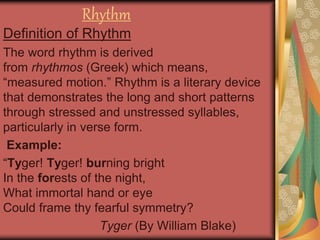
Rhythm
Definition of Rhythm
The word rhythm is derived
from rhythmos (Greek) which means,
“measured motion.” Rhythm is a literary device
that demonstrates the long and short patterns
through stressed and unstressed syllables,
particularly in verse form.
Example:
“Tyger! Tyger! burning bright
In the forests of the night,
What immortal hand or eye
Could frame thy fearful symmetry?
Tyger (By William Blake)
Examples of Rhythm
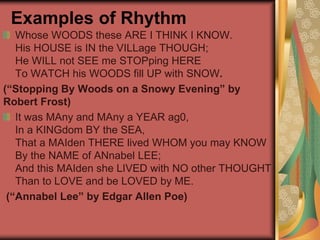
Whose WOODS these ARE I THINK I KNOW.
His HOUSE is IN the VILLage THOUGH;
He WILL not SEE me STOPping HERE
To WATCH his WOODS fill UP with SNOW.
(“Stopping By Woods on a Snowy Evening” by
Robert Frost)
It was MAny and MAny a YEAR ag0,
In a KINGdom BY the SEA,
That a MAIden THERE lived WHOM you may KNOW
By the NAME of ANnabel LEE;
And this MAIden she LIVED with NO other THOUGHT
Than to LOVE and be LOVED by ME.
(“Annabel Lee” by Edgar Allen Poe)
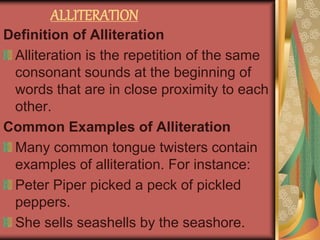
ALLITERATION
Definition of Alliteration
Alliteration is the repetition of the same
consonant sounds at the beginning of
words that are in close proximity to each
other.
Common Examples of Alliteration
Many common tongue twisters contain
examples of alliteration. For instance:
Peter Piper picked a peck of pickled
peppers.
She sells seashells by the seashore.
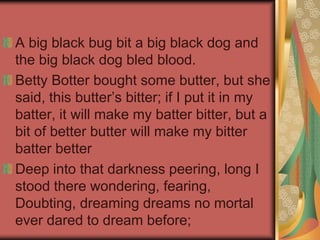
A big black bug bit a big black dog and
the big black dog bled blood.
Betty Botter bought some butter, but she
said, this butter’s bitter; if I put it in my
batter, it will make my batter bitter, but a
bit of better butter will make my bitter
batter better
Deep into that darkness peering, long I
stood there wondering, fearing,
Doubting, dreaming dreams no mortal
ever dared to dream before;

The ballads

  • 2.
    The Ballad Definition ofBallad A ballad is a narrative poem that originally was set to music. Ballads were first created in medieval France, and the word ballad comes from the French term chanson balladée, which means “dancing song.” Ballads then became popular in Great Britain, and remained so until the nineteenth century. The meaning has changed somewhat in the present day to refer to any slow love song.
  • 3.
    Feature Of ABallad A BALLAD has these features: 1- A simple narrative. 2- A few major characters. 3- A strong rhythm and rhyme. 4- A repeated section called a REFRAIN. 5- Division into verses. 6- Nouns to identify characters and settings. 7- Verbs to describe actions. 8- Adjectives to describe nouns.
  • 4.
    Some Famous Ballads TheBallad of Persse O'Reilly by James Joyce Border Ballad by Sir Walter Scott Donica - A Ballad by Robert Southey The Waste Land by T.S. Elliot All The Worlds A Stage by William Shakespeare Rime Of The Ancient Mariner by S.T.Coleridge Prologue To The Canterbury Tales by Geoffrey Chaucer
  • 5.
    POEM Poem Definition A poemis a collection of spoken or written words that expresses ideas or emotions in an imaginative style, comprising of a particular rhythmic and metrical pattern. Types of Poem Haiku, Free Verse, Epic, Ballad, Sonnet, Elegy, Epitaph, Odd, Lyric, Allegory,
  • 6.
    verse Definition of Verse Theliterary device verse denotes a single line of poetry. The term can also be used to refer to a stanza or other parts of poetry. Example: 1-Cold cold, Winter sticks to the trees and the seas. 2- The children like the ocean shore We want to leave but they want more
  • 7.
    Rhyme Rhyme Definition A rhymeis a repetition of similar sounding words occurring at the end of lines in poems or songs. A rhyme is employed for the specific purpose of rendering a pleasing effect to a poem which makes its recital an enjoyable experience. Mary had a little lamb its fleece was white as snow; And everywhere that Mary went, the lamb was sure to go. It followed her to school one day, which was against the rule; It made the children laugh and play, to see a lamb at school.
  • 8.
    Rhythm Definition of Rhythm Theword rhythm is derived from rhythmos (Greek) which means, “measured motion.” Rhythm is a literary device that demonstrates the long and short patterns through stressed and unstressed syllables, particularly in verse form. Example: “Tyger! Tyger! burning bright In the forests of the night, What immortal hand or eye Could frame thy fearful symmetry? Tyger (By William Blake)
  • 9.
    Examples of Rhythm WhoseWOODS these ARE I THINK I KNOW. His HOUSE is IN the VILLage THOUGH; He WILL not SEE me STOPping HERE To WATCH his WOODS fill UP with SNOW. (“Stopping By Woods on a Snowy Evening” by Robert Frost) It was MAny and MAny a YEAR ag0, In a KINGdom BY the SEA, That a MAIden THERE lived WHOM you may KNOW By the NAME of ANnabel LEE; And this MAIden she LIVED with NO other THOUGHT Than to LOVE and be LOVED by ME. (“Annabel Lee” by Edgar Allen Poe)
  • 10.
    ALLITERATION Definition of Alliteration Alliterationis the repetition of the same consonant sounds at the beginning of words that are in close proximity to each other. Common Examples of Alliteration Many common tongue twisters contain examples of alliteration. For instance: Peter Piper picked a peck of pickled peppers. She sells seashells by the seashore.
  • 11.
    A big blackbug bit a big black dog and the big black dog bled blood. Betty Botter bought some butter, but she said, this butter’s bitter; if I put it in my batter, it will make my batter bitter, but a bit of better butter will make my bitter batter better Deep into that darkness peering, long I stood there wondering, fearing, Doubting, dreaming dreams no mortal ever dared to dream before;