Chapter 4
Conflict in Multi-ethnic
Societies
CASE STUDY OF NORTHERN IRELAND
Adapted from Adeline Fam, adefam
Chapter
Breakdown
Introduction on Northern Ireland and Conflict
4.1
Causes of Conflict in Northern Ireland
4.2
Consequences of Conflict in Northern Ireland
In the case-study of N. Ireland, you will be looking at
another example of conflicts between two groups of
people
Introduction
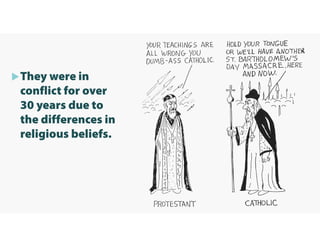
They were in
conflict for over
30 years due to
the differences in
religious beliefs.
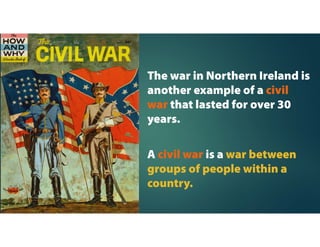
The war in Northern Ireland is
another example of a civil
war that lasted for over 30
years.
A civil war is a war between
groups of people within a
country.
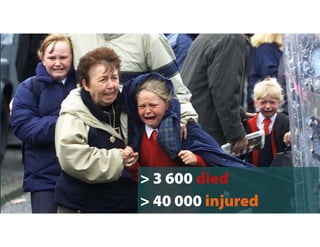
> 3 600 died
> 40 000 injured
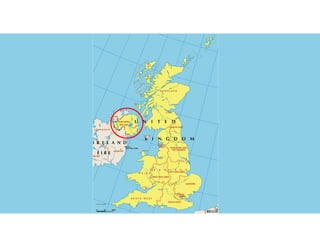
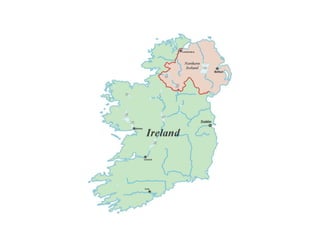
Where is
Northern Ireland?
History of
Northern Ireland
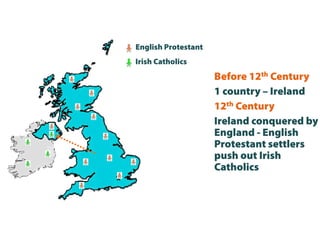
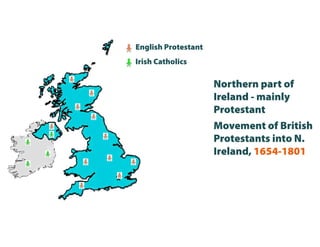
Before 12th Century
1 country – Ireland
12th Century
Ireland conquered by
England - English
Protestant settlers
push out Irish
Catholics
English Protestant
Irish Catholics
Northern part of
Ireland - mainly
Protestant
Movement of British
Protestants into N.
Ireland, 1654-1801
English Protestant
Irish Catholics
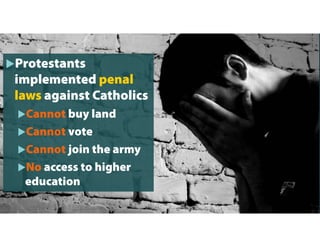
Protestants
implemented penal
laws against Catholics
Cannot buy land
Cannot vote
Cannot join the army
No access to higher
education
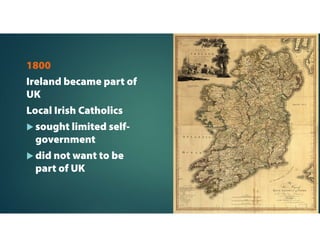
1800
Ireland became part of
UK
Local Irish Catholics
 sought limited self-
government
 did not want to be
part of UK
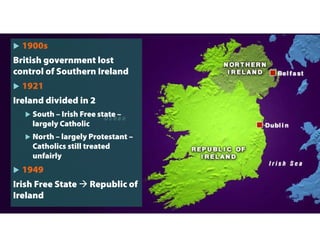
 1900s
British government lost
control of Southern Ireland
 1921
Ireland divided in 2
 South – Irish Free state –
largely Catholic
 North – largely Protestant –
Catholics still treated
unfairly
 1949
Irish Free State  Republic of
Ireland
Key Traits of
Northern Ireland
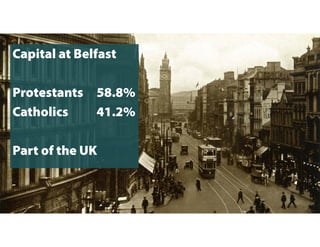
Capital at Belfast
Protestants 58.8%
Catholics 41.2%
Part of the UK
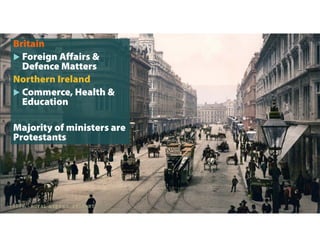
Britain
 Foreign Affairs &
Defence Matters
Northern Ireland
 Commerce, Health &
Education
Majority of ministers are
Protestants
Conflict in
Northern Ireland
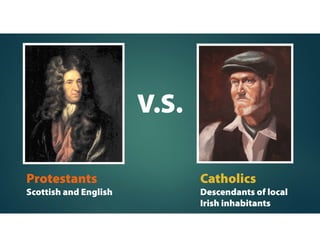
V.S.
Protestants
Scottish and English
Catholics
Descendants of local
Irish inhabitants
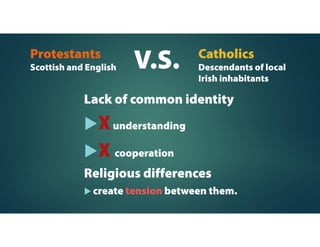
Lack of common identity
Xunderstanding
X cooperation
Religious differences
 create tension between them.
V.S.Protestants
Scottish and English
Catholics
Descendants of local
Irish inhabitants
Causes of Conflict in
Northern Ireland
1. Divided Loyalties
2. Unequal allocation of housing
3. Unequal employment opportunities
4. Lack of voting rights
5. Lack of opportunities for social
interaction
Divided
Loyalties
The Difference in
Political
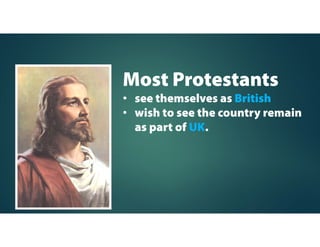
Most Protestants
• see themselves as British
• wish to see the country remain
as part of UK.
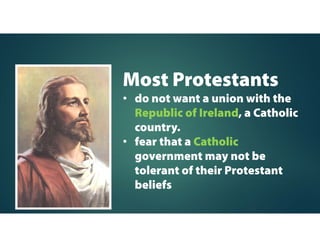
Most Protestants
• do not want a union with the
Republic of Ireland, a Catholic
country.
• fear that a Catholic
government may not be
tolerant of their Protestant
beliefs
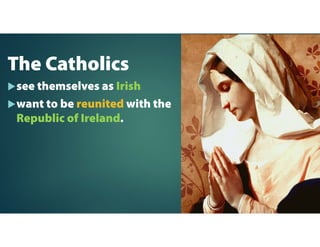
The Catholics
see themselves as Irish
want to be reunited with the
Republic of Ireland.
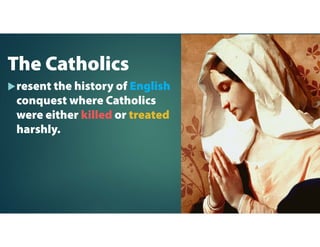
The Catholics
resent the history of English
conquest where Catholics
were either killed or treated
harshly.
This loyalty to
different countries makes
the Protestants and
Catholics intolerant
of each other.
Unequal
Allocation
of Housing
Unfair Allocation of
Public Housing
by
The City Councils
(largely Protestants)
The Catholics find
the allocation of
public housing by
the government
to be unfair.
Very often, the large
Catholics families in
need of housing
have to wait a long
time to get the
house.
In some towns, more
houses would be
given to the
Protestants than the
Catholics.
Unequal
Employment
Opportunities
More difficult for
Catholics in N.
Ireland to find
jobs, especially in
the government
sector.
Catholics
Same
Qualification
Unequal
Opportunities
Lack
of Voting Rights
Before 1969, voting
rights was an issue
between the
Protestants and the
Catholic.
At that time, only
those who owned
houses and
businesses were
entitled to vote in the
local government
elections.
Each household is
entitled 2 votes while
companies were
entitled to more
votes depending on
their size. Since many
companies were
owned by the richer
Protestants, they
ended up with more
votes.
UNFAIR!
Poorer
Catholics
Everyone is entitled to one vote as long as
he/ she is a British citizen above 18 years
old.
He/ she has to be born in N. Ireland or has
lived in the UK for 7 years.
Since 1969
Lack
of Opportunities for
Social Interactions
In the education
system of N.
Ireland, the
Protestants and
Catholics do not
study together in
the same
schools.
In the education
system of N. Ireland,
Protestants attend
the fully-funded
public schools while
the Catholics attend
the private schools.
The private schools
for the Catholics are
partly funded by the
government.
Since the 17th century,
the Protestants and
Catholics have been
living in separate
residential areas.
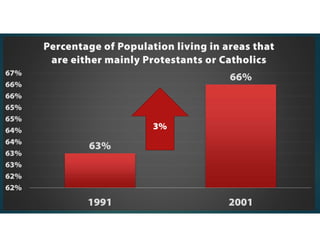
63%
66%
62%
62%
63%
63%
64%
64%
65%
65%
66%
66%
67%
1991 2001
Percentage of Population living in areas that
are either mainly Protestants or Catholics
3%
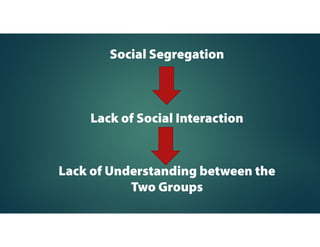
Social Segregation
Lack of Social Interaction
Lack of Understanding between the
Two Groups
How
Conflicts
Violence
lead to
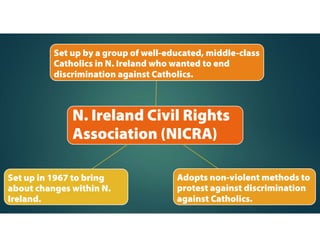
N. Ireland Civil Rights
Association (NICRA)
Set up by a group of well-educated, middle-class
Catholics in N. Ireland who wanted to end
discrimination against Catholics.
Adopts non-violent methods to
protest against discrimination
against Catholics.
Set up in 1967 to bring
about changes within N.
Ireland.
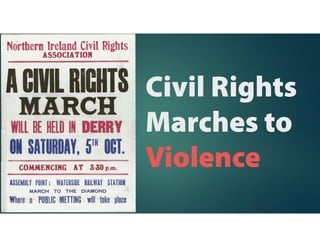
Civil Rights
Marches to
Violence
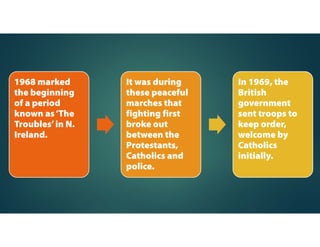
1968 marked
the beginning
of a period
known as‘The
Troubles’in N.
Ireland.
It was during
these peaceful
marches that
fighting first
broke out
between the
Protestants,
Catholics and
police.
In 1969, the
British
government
sent troops to
keep order,
welcome by
Catholics
initially.
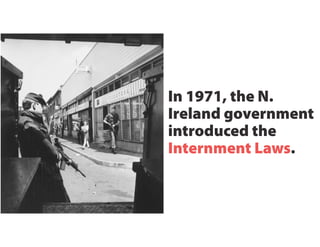
In 1971, the N.
Ireland government
introduced the
Internment Laws.
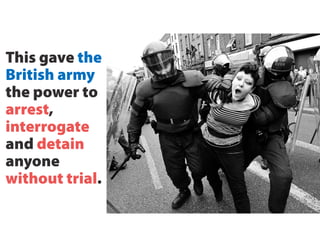
This gave the
British army
the power to
arrest,
interrogate
and detain
anyone
without trial.
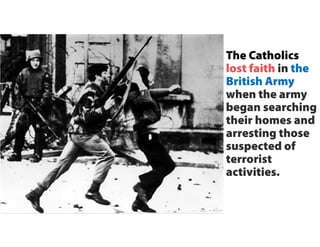
The Catholics
lost faith in the
British Army
when the army
began searching
their homes and
arresting those
suspected of
terrorist
activities.
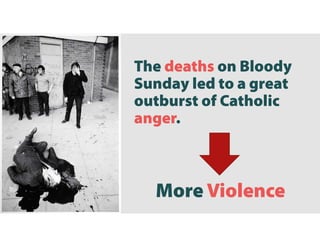
Sunday
30th January 1972
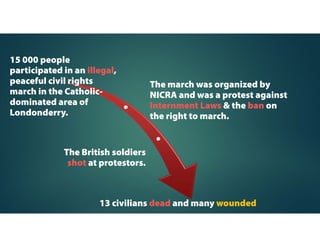
15 000 people
participated in an illegal,
peaceful civil rights
march in the Catholic-
dominated area of
Londonderry.
The march was organized by
NICRA and was a protest against
Internment Laws & the ban on
the right to march.
The British soldiers
shot at protestors.
13 civilians dead and many wounded
The deaths on Bloody
Sunday led to a great
outburst of Catholic
anger.
More Violence
After 1972, the country saw more
violence between Protestants, Catholics
and British Army.
Catholic homes & businesses were
targeted by Protestants & British army.
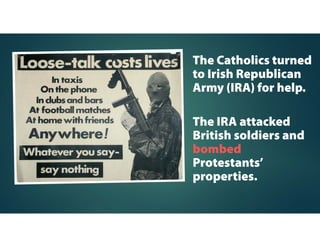
The Catholics turned
to Irish Republican
Army (IRA) for help.
The IRA attacked
British soldiers and
bombed
Protestants’
properties.
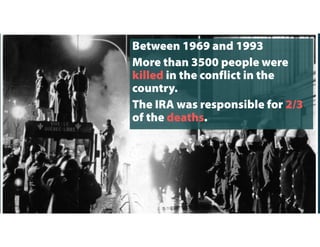
Between 1969 and 1993
More than 3500 people were
killed in the conflict in the
country.
The IRA was responsible for 2/3
of the deaths.
Consequences of Conflict
in
Northern Ireland
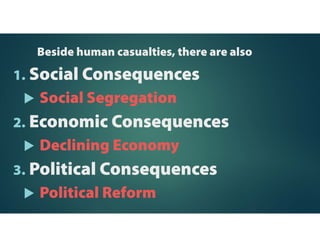
Beside human casualties, there are also
1. Social Consequences
 Social Segregation
2. Economic Consequences
 Declining Economy
3. Political Consequences
 Political Reform
Social
Consequences:
Social Segregation
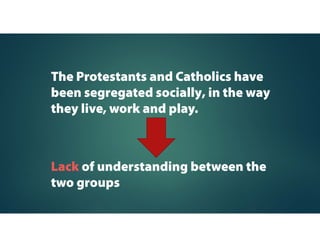
The Protestants and Catholics have
been segregated socially, in the way
they live, work and play.
Lack of understanding between the
two groups
In the education
system of N. Ireland,
Protestants attend
the fully-funded
public schools while
the Catholics attend
the private schools.
Since the 17th century,
the Protestants and
Catholics have been
living in separate
residential areas.
63%
66%
62%
62%
63%
63%
64%
64%
65%
65%
66%
66%
67%
1991 2001
Percentage of Population living in areas that
are either mainly Protestants or Catholics
3%
Social Segregation
Lack of Social Interaction
Lack of Understanding between the
Two Groups
Economic
Consequences:
Declining Economy
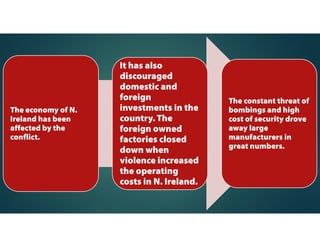
The economy of N.
Ireland has been
affected by the
conflict.
It has also
discouraged
domestic and
foreign
investments in the
country. The
foreign owned
factories closed
down when
violence increased
the operating
costs in N. Ireland.
The constant threat of
bombings and high
cost of security drove
away large
manufacturers in
great numbers.
Result
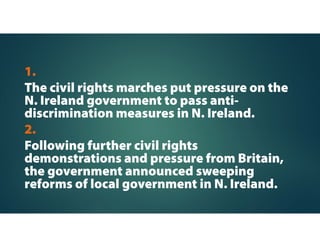
1.
The civil rights marches put pressure on the
N. Ireland government to pass anti-
discrimination measures in N. Ireland.
2.
Following further civil rights
demonstrations and pressure from Britain,
the government announced sweeping
reforms of local government in N. Ireland.
Political
Consequences:
Political Reform
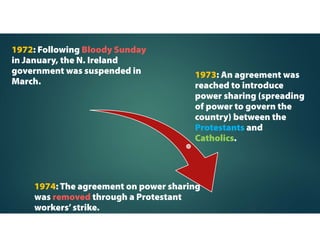
1972: Following Bloody Sunday
in January, the N. Ireland
government was suspended in
March.
1973: An agreement was
reached to introduce
power sharing (spreading
of power to govern the
country) between the
Protestants and
Catholics.
1974: The agreement on power sharing
was removed through a Protestant
workers’strike.
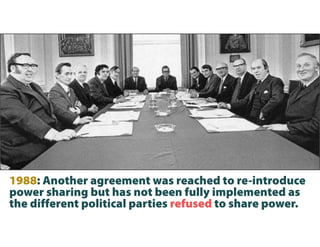
1988: Another agreement was reached to re-introduce
power sharing but has not been fully implemented as
the different political parties refused to share power.
Hope
for
Peace
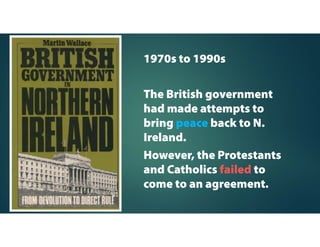
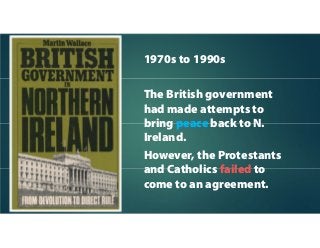
1970s to 1990s
The British government
had made attempts to
bring peace back to N.
Ireland.
However, the Protestants
and Catholics failed to
come to an agreement.
In the late 1990s
The British government, the government of
the Irish Republic of Ireland and Northern
Ireland community leaders actively discussed
the Northern Ireland peace process.
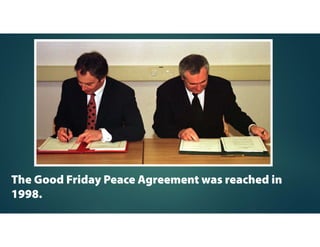
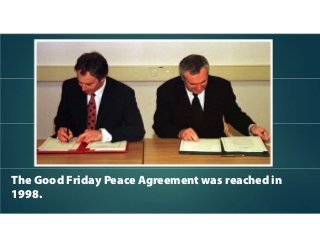
The Good Friday Peace Agreement was reached in
1998.
the peace agreement
was
unsuccessful.
However,
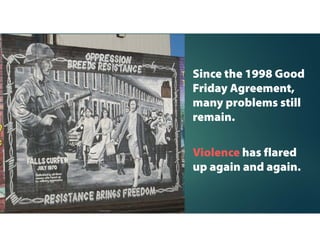
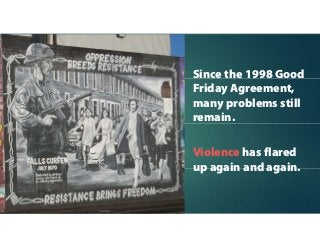
Since the 1998 Good
Friday Agreement,
many problems still
remain.
Violence has flared
up again and again.
However, steps towards arms
decommissioning and increased
sensitivity are positive developments.
It seems clear that the majority of
people are ready to take on the
challenge in return for peace.
However,

Chapter 4: Northern Ireland - Causes and Impacts