Checks and Balances
The
 Judicial
 Branch
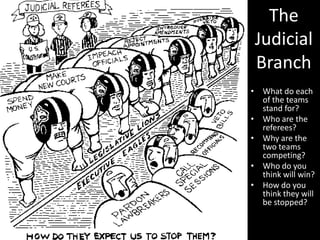
• What do each
  of the teams
  stand for?
• Who are the
  referees?
• Why are the
  two teams
  competing?
• Who do you
  think will win?
• How do you
  think they will
  be stopped?
True or false?

• It’s OK to disobey a Supreme Court ruling.
• The Supreme Court can overturn an act of
  Congress.
• The Supreme Court can declare a Presidential
  action unconstitutional.
• The Supreme Court can remove the President
  from office.
• Supreme Court justices are expected to show
  their liberal or conservative views while making
  decisions on the bench.
Conducted by Princeton Survey Research Associates
International for the Annenberg Public Policy Center. The
survey polled 1,500 adults aged 18 years and older was
conducted in 2005. The margin of error = +/- 3 %.

True or False
1. True or False -- 38% of the people surveyed said it’s “Okay to
ignore Supreme Court ruling”
2. True or False --55% says the US Supreme Court can declare
an act of Congress unconstitutional
3. True or False -- 64% of the public says it Distrusts the
Supreme Court a great deal or a fair amount
4. True or False --- 75% says a judge’s ruling is influenced by
his or her personal political views to an large extent
5. True or False --- Of the people surveyed 28% of the people
said the three branches were the: Executive branch, the
president, presidency, the White House
U.S. Judiciary
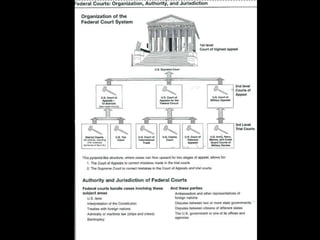
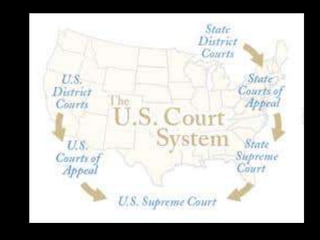
• Parallel system of state and federal courts
  – State courts – powers come from state
    constitutions and laws
  – Federal courts – Supreme Court and lower courts
    whose powers come from the Constitution and
    federal laws
Jurisdiction
• the authority of the courts to hear certain
  cases and interpret the law
Jurisdiction
• State courts have jurisdiction over cases involving state
  laws
• Federal courts have jurisdiction over cases involving
  federal law
   – US laws, treaties, interpretations of the Constitution
   – Cases where the following are involved:
       •   Ambassadors or other representatives of foreign governments
       •   Two or more state governments
       •   The US government of one of its offices or agencies
       •   Citizens who are residents of more than one state
       •   Citizens who are residents of the same state but claim land grants in
           other states
Jurisdiction
• Concurrent - Both the federal and state courts
  have jurisdiction
  – Ex. A case where citizens of different states in a
    dispute over more than $75,000
• Original – trial courts (ie. District courts)
• Appellate – when people lose a case in a trial
  court and wish to appeal the decision (ex.
  District court to appeals court)
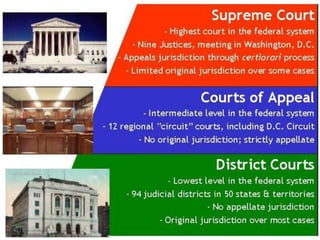
The United States Supreme Court
            “The Court of Last Resort”
 Highest court in the land and the
  ONLY one established by Article
  III of U.S. Constitution.
 Term: First Monday October- late
  June
 Nine Justices
 No trials or juries
 Each side gets 30 minutes to
  argue their case before the
  Justices. A case goes before the
  court if four justices agree to hear
  it. This is called the “rule of four”.
The United States Supreme Court
 Annual Salary: associate justices $213,900; chief justice
  $223,500. Constitution prohibits Congress from reducing pay
  for incumbent justices. A justice may retire and earn his or her
  final salary for life, plus cost of living increases.
 Court is ruled by seniority. The Chief Justice is considered the
  most senior member of the Court, regardless of length of
  service. Associate Justices are ranked by the length of service.
 During Court sessions, justices sit according to seniority, with
  Chief Justice in center, and Associate Justices on alternating
  sides, with the most senior Associate Justice on the Chief
  Justice's immediate right, and the most junior Associate
  Justice seated on the left farthest away from the Chief Justice.
 Each justice is also a "circuit justice" and is assigned to
  oversee one or more federal judicial circuits.
The United States Supreme Court
 Primarily an appellate court; has original jurisdiction over
  small number of cases.

 Three “routes” to the U.S. Supreme Court:
1) original jurisdiction over cases involving disputes
   between states (least common- one-two cases per term).
2) cases on appeal from circuit courts- a party files a petition
    (cert) and justices determine if they will hear it (most
    common route).
3) appeals from state supreme courts- generally on
   Constitutional issues.
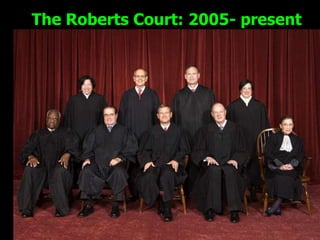
The Roberts Court: 2005- present
SCOTUS v. POTUS
• Judicial activism v. Judicial restraint
Should the supreme court decide
      controversial issues?
United States Courts of Appeals
• Hears appeals from the district courts located within its
  circuit, as well as appeals from decisions of federal
  administrative agencies.

• Have strictly appellate jurisdiction- handling appeals from
  U.S. District Courts and are the intermediate appellate courts
  in the federal system.

• Considered most powerful and influential courts in the
  federal system. The Courts of Appeals serve as the final
  arbiter on most federal cases and set legal precedent in
  regions that cover millions of people (because the Supreme Court
  chooses to hear fewer than 100 of the more than 10,000 cases filed with
  it annually).

• The Courts of Appeals have strong policy influence on U.S.
  law.
United States Court of Appeals
 Court of appeals decisions establish binding precedents.
  Other federal courts in same circuit must follow the appeals
  court's guidance in similar cases, regardless of whether the
  trial judge thinks the case should be decided differently.

 Do not handle jury trials- only handle cases where party
  argues that district court judge made an error in handling
  their case.

 Currently 179 Judges on U.S. Courts of Appeals authorized
  by Congress and Article III of the Constitution. Judges are
  nominated by the president and then confirmed by the
  Senate.

 Judges have lifetime tenure and earn an annual salary of
  $184,500.
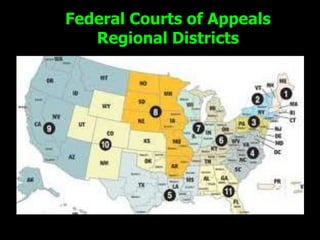
Federal Courts of Appeals
   Regional Districts
United States District Courts
 Lowest level of courts in federal system. 94 United States
  district courts with least one judicial district for each state, the
  District of Columbia, and Puerto Rico.
 Serve as general trial courts of the U.S. federal court system and handle
  both civil and criminal cases. They have no appellate jurisdiction and
  have original jurisdiction over most cases and can conduct jury trials.
  There is one bankruptcy court associated with each U.S. district court.

 Part of the “inferior” courts established by Congress. There is no
  constitutional requirement that there be any district courts.
  Number of judges in each district court and structure of the
  judicial system are set by Congress and usually based on
  population.

 The President appoints federal district judges whose role is
  to decide questions of law and fact.
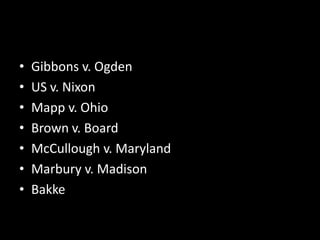
•   Gibbons v. Ogden
•   US v. Nixon
•   Mapp v. Ohio
•   Brown v. Board
•   McCullough v. Maryland
•   Marbury v. Madison
•   Bakke
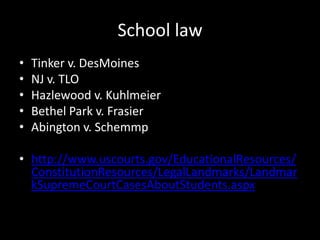
School law
•   Tinker v. DesMoines
•   NJ v. TLO
•   Hazlewood v. Kuhlmeier
•   Bethel Park v. Frasier
•   Abington v. Schemmp

• http://www.uscourts.gov/EducationalResources/
  ConstitutionResources/LegalLandmarks/Landmar
  kSupremeCourtCasesAboutStudents.aspx

Judicial Branch Intro

  • 1.
  • 2.
    The Judicial Branch •What do each of the teams stand for? • Who are the referees? • Why are the two teams competing? • Who do you think will win? • How do you think they will be stopped?
  • 3.
    True or false? •It’s OK to disobey a Supreme Court ruling. • The Supreme Court can overturn an act of Congress. • The Supreme Court can declare a Presidential action unconstitutional. • The Supreme Court can remove the President from office. • Supreme Court justices are expected to show their liberal or conservative views while making decisions on the bench.
  • 4.
    Conducted by PrincetonSurvey Research Associates International for the Annenberg Public Policy Center. The survey polled 1,500 adults aged 18 years and older was conducted in 2005. The margin of error = +/- 3 %. True or False 1. True or False -- 38% of the people surveyed said it’s “Okay to ignore Supreme Court ruling” 2. True or False --55% says the US Supreme Court can declare an act of Congress unconstitutional 3. True or False -- 64% of the public says it Distrusts the Supreme Court a great deal or a fair amount 4. True or False --- 75% says a judge’s ruling is influenced by his or her personal political views to an large extent 5. True or False --- Of the people surveyed 28% of the people said the three branches were the: Executive branch, the president, presidency, the White House
  • 5.
    U.S. Judiciary • Parallelsystem of state and federal courts – State courts – powers come from state constitutions and laws – Federal courts – Supreme Court and lower courts whose powers come from the Constitution and federal laws
  • 6.
    Jurisdiction • the authorityof the courts to hear certain cases and interpret the law
  • 8.
    Jurisdiction • State courtshave jurisdiction over cases involving state laws • Federal courts have jurisdiction over cases involving federal law – US laws, treaties, interpretations of the Constitution – Cases where the following are involved: • Ambassadors or other representatives of foreign governments • Two or more state governments • The US government of one of its offices or agencies • Citizens who are residents of more than one state • Citizens who are residents of the same state but claim land grants in other states
  • 11.
    Jurisdiction • Concurrent -Both the federal and state courts have jurisdiction – Ex. A case where citizens of different states in a dispute over more than $75,000 • Original – trial courts (ie. District courts) • Appellate – when people lose a case in a trial court and wish to appeal the decision (ex. District court to appeals court)
  • 12.
    The United StatesSupreme Court “The Court of Last Resort”  Highest court in the land and the ONLY one established by Article III of U.S. Constitution.  Term: First Monday October- late June  Nine Justices  No trials or juries  Each side gets 30 minutes to argue their case before the Justices. A case goes before the court if four justices agree to hear it. This is called the “rule of four”.
  • 13.
    The United StatesSupreme Court  Annual Salary: associate justices $213,900; chief justice $223,500. Constitution prohibits Congress from reducing pay for incumbent justices. A justice may retire and earn his or her final salary for life, plus cost of living increases.  Court is ruled by seniority. The Chief Justice is considered the most senior member of the Court, regardless of length of service. Associate Justices are ranked by the length of service.  During Court sessions, justices sit according to seniority, with Chief Justice in center, and Associate Justices on alternating sides, with the most senior Associate Justice on the Chief Justice's immediate right, and the most junior Associate Justice seated on the left farthest away from the Chief Justice.  Each justice is also a "circuit justice" and is assigned to oversee one or more federal judicial circuits.
  • 14.
    The United StatesSupreme Court  Primarily an appellate court; has original jurisdiction over small number of cases.  Three “routes” to the U.S. Supreme Court: 1) original jurisdiction over cases involving disputes between states (least common- one-two cases per term). 2) cases on appeal from circuit courts- a party files a petition (cert) and justices determine if they will hear it (most common route). 3) appeals from state supreme courts- generally on Constitutional issues.
  • 15.
    The Roberts Court:2005- present
  • 16.
    SCOTUS v. POTUS •Judicial activism v. Judicial restraint
  • 17.
    Should the supremecourt decide controversial issues?
  • 18.
    United States Courtsof Appeals • Hears appeals from the district courts located within its circuit, as well as appeals from decisions of federal administrative agencies. • Have strictly appellate jurisdiction- handling appeals from U.S. District Courts and are the intermediate appellate courts in the federal system. • Considered most powerful and influential courts in the federal system. The Courts of Appeals serve as the final arbiter on most federal cases and set legal precedent in regions that cover millions of people (because the Supreme Court chooses to hear fewer than 100 of the more than 10,000 cases filed with it annually). • The Courts of Appeals have strong policy influence on U.S. law.
  • 19.
    United States Courtof Appeals  Court of appeals decisions establish binding precedents. Other federal courts in same circuit must follow the appeals court's guidance in similar cases, regardless of whether the trial judge thinks the case should be decided differently.  Do not handle jury trials- only handle cases where party argues that district court judge made an error in handling their case.  Currently 179 Judges on U.S. Courts of Appeals authorized by Congress and Article III of the Constitution. Judges are nominated by the president and then confirmed by the Senate.  Judges have lifetime tenure and earn an annual salary of $184,500.
  • 20.
    Federal Courts ofAppeals Regional Districts
  • 21.
    United States DistrictCourts  Lowest level of courts in federal system. 94 United States district courts with least one judicial district for each state, the District of Columbia, and Puerto Rico.  Serve as general trial courts of the U.S. federal court system and handle both civil and criminal cases. They have no appellate jurisdiction and have original jurisdiction over most cases and can conduct jury trials. There is one bankruptcy court associated with each U.S. district court.  Part of the “inferior” courts established by Congress. There is no constitutional requirement that there be any district courts. Number of judges in each district court and structure of the judicial system are set by Congress and usually based on population.  The President appoints federal district judges whose role is to decide questions of law and fact.
  • 22.
    Gibbons v. Ogden • US v. Nixon • Mapp v. Ohio • Brown v. Board • McCullough v. Maryland • Marbury v. Madison • Bakke
  • 23.
    School law • Tinker v. DesMoines • NJ v. TLO • Hazlewood v. Kuhlmeier • Bethel Park v. Frasier • Abington v. Schemmp • http://www.uscourts.gov/EducationalResources/ ConstitutionResources/LegalLandmarks/Landmar kSupremeCourtCasesAboutStudents.aspx

Editor's Notes

  • #13 sur-shee-uh-rair-ee certiorari