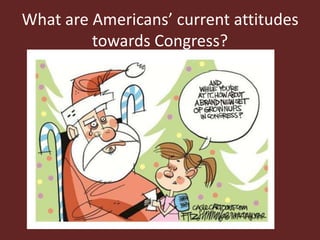
What are Americans’ current attitudes
towards Congress?
Pre Class
Select 2 quotes about Congress and answer the
following questions in your notebook.
1. What does the quote mean?
2. What does the author seem to think about
Congress (ie. What is his or her bias?)
3. What does the quote show us about how
Congress works?
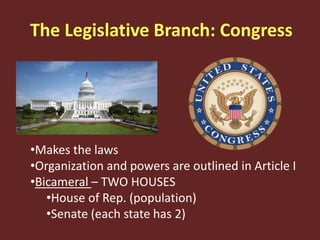
The Legislative Branch: Congress
•Makes the laws
•Organization and powers are outlined in Article I
•Bicameral – TWO HOUSES
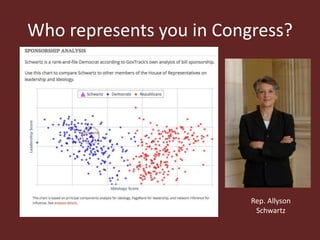
•House of Rep. (population)
•Senate (each state has 2)
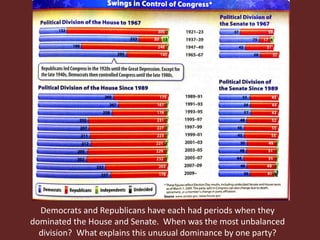
General Organization
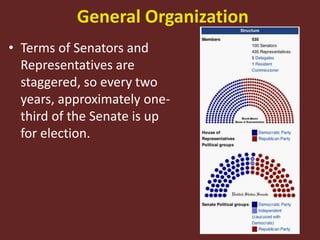
• Terms of Senators and
Representatives are
staggered, so every two
years, approximately one-
third of the Senate is up
for election.
General Organization
While it's theoretically possible to have total turnover in the
House every two years and in the Senate every six years,
actual turnover is much less, since most incumbents seek
re-election, and their historical likelihood of winning
subsequent elections exceeds 90%.
General Organization
• Checks and balances was built within the legislative
branch with two separate chambers.
• A term of Congress is divided into two "sessions", one for
each year. Congress is occasionally called into an extra or
special session.
• A new session begins on January 3 each year unless
Congress decides differently.
• The Constitution requires Congress meet at least once
each year and forbids either house from meeting outside
the Capitol.
General Organization
• Joint Sessions of Congress occur on special
occasions that require a concurrent resolution
from both House and Senate.
• Sessions include counting electoral votes and the
president's State of the Union address.
• Joint Sessions and Joint Meetings are traditionally
presided over by the Speaker of the House except
when counting presidential electoral votes when
the vice president presides.
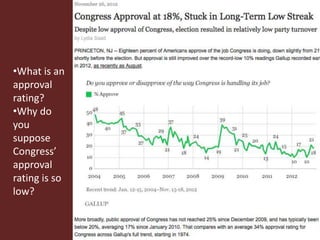
•What is an
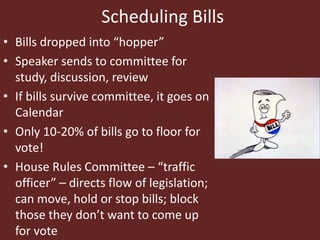
approval
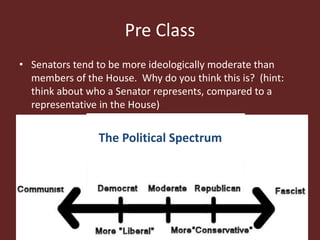
rating?
•Why do
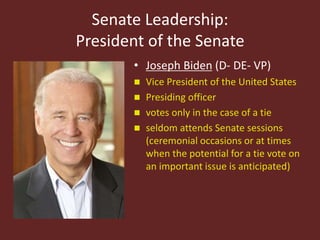
you
suppose
Congress’
approval
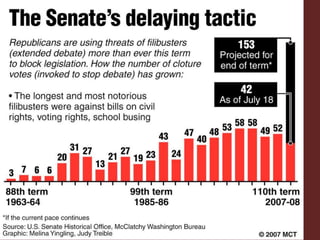
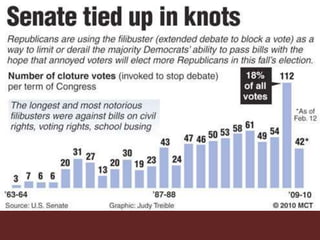
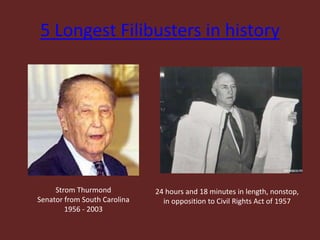
rating is so
low?
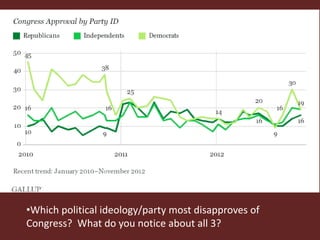
•Which political ideology/party most disapproves of
Congress? What do you notice about all 3?
How representative of US is the
representative branch of government?
Who’s in Congress?
Demographics – selected population
characteristics as used in government,
marketing, or other research; commonly used
demographics include race, age, level of
education, gender, political affiliation and
occupation.
Discussion Questions
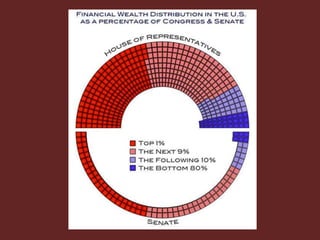
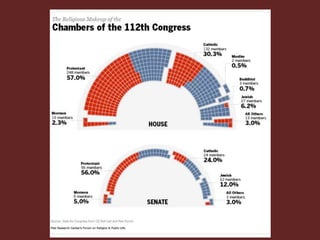
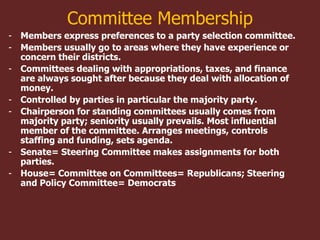
• Based on the demographic data provided,
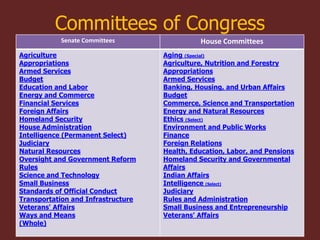
what generalizations can we make about the
111th Congress?
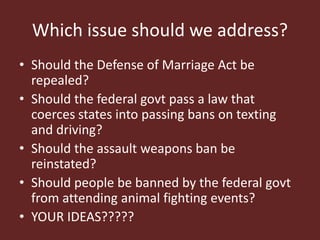
• How representative is the representative
branch?
• Does it matter if member of Congress match
up demographically with the general
population? Defend your answer.
Who represents you in Congress?
Rep. Allyson
Schwartz
Gridlock in Congress – a good thing?
• Compare the separation of powers in the U.S.
presidential system to the parliamentary
system in the United Kingdom.
• In what ways is a president different from a
prime minister?
• Explain how “gridlock” is good for people
living in a democracy according to Associate
Justice Scalia?
Democrats and Republicans have each had periods when they
dominated the House and Senate. When was the most unbalanced
division? What explains this unusual dominance by one party?
House Basics
• 25 years old
• Resident of US for 7 years
• Legal resident of their state
• All 435 run every 2 years
• 90% are reelected
Representation in the House
• Census – population count that takes place every
10 years
• States’ populations determine how many
representatives they have in the House
• 1929 - # of Rep. capped at 435
• Redistricting - The process of setting up new
district lines after reapportionment has been
completed
– State legislatures are in charge; often they create
districts that work to their political advantage
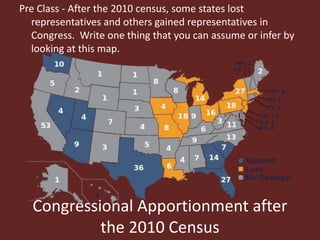
Congressional Apportionment after
the 2010 Census
Pre Class - After the 2010 census, some states lost
representatives and others gained representatives in
Congress. Write one thing that you can assume or infer by
looking at this map.
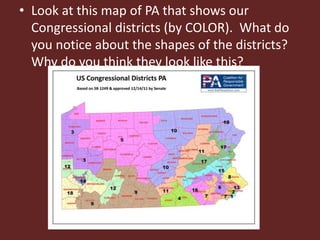
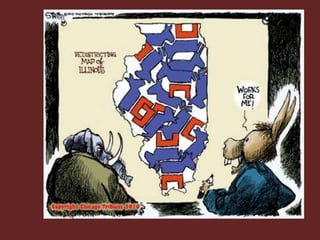
• Look at this map of PA that shows our
Congressional districts (by COLOR). What do
you notice about the shapes of the districts?
Why do you think they look like this?
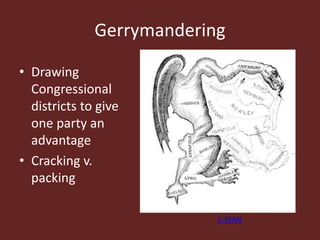
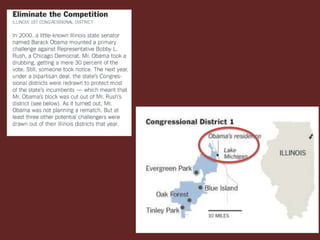
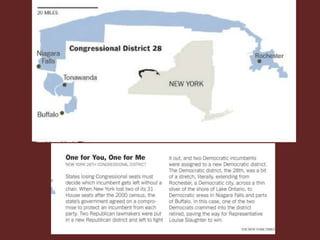
Gerrymandering
• Drawing
Congressional
districts to give
one party an
advantage
• Cracking v.
packing
C-SPAN
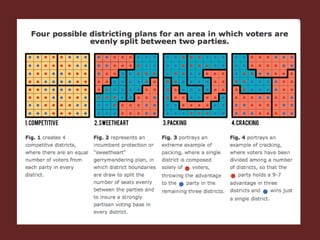
Packing & Cracking
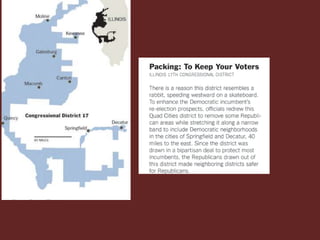
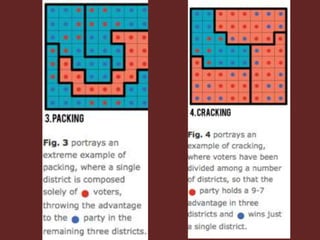
• Packing – means drawing the lines so they
include as many of the opposing party’s voters
as possible
• crowding the opposition into one district makes the
remaining districts safe for the majority party
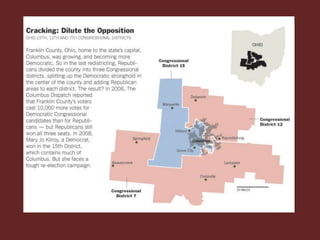
• Cracking – dividing an opponent’s voters into
other districts to weaken the opponent’s voter
base
Pre Class
• What is gerrymandering?
• What are the two main strategies used when
legislatures redraw maps to their advantage?
The Supreme Court has said…
• Federal courts decide conflicts over district
boundaries
• “one-person, one-vote” rule – a vote in one
district is to be worth as much as a vote in
another district
• Districts must be compact, contiguous (adjoining)
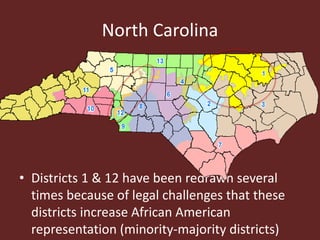
North Carolina
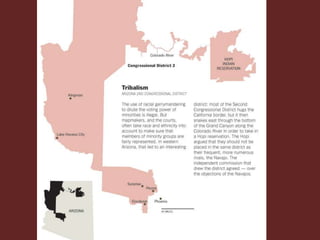
• Districts 1 & 12 have been redrawn several
times because of legal challenges that these
districts increase African American
representation (minority-majority districts)
Redistricting Song
• Why should the populations of Congressional
districts be roughly the same?
• What are kidnapping and hijacking?
• Should state legislatures have the
responsibility for redistricting in their state?
What might be a better way of conducting
redistricting?
• Packing: redrawing a district to pack in as many of one type
of voters
• Cracking: redrawing a district to break up concentrated
areas of one type of other.
• Kidnapping: redrawing the district line around an
incumbent’s neighborhood to place it in a new district with
the opposition party is in the majority. They will be voted
out of office because they don’t have the support they
once had in their old district.
• Hijacking: redrawing the district line to include two (or
more) incumbents from the same party. Only one can win
and the opposition party has one less representative to
worry about.
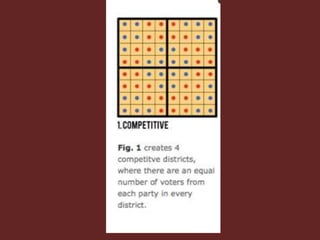
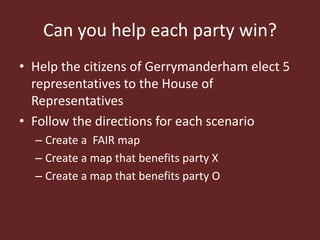
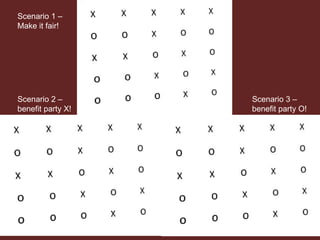
Can you help each party win?
• Help the citizens of Gerrymanderham elect 5
representatives to the House of
Representatives
• Follow the directions for each scenario
– Create a FAIR map
– Create a map that benefits party X
– Create a map that benefits party O
Scenario 1 –
Make it fair!
Scenario 3 –
benefit party O!
Scenario 2 –
benefit party X!
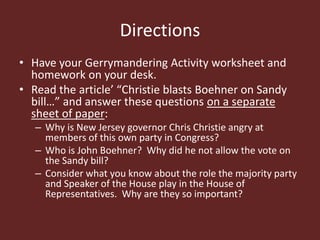
Directions
• Have your Gerrymandering Activity worksheet and
homework on your desk.
• Read the article’ “Christie blasts Boehner on Sandy
bill…” and answer these questions on a separate
sheet of paper:
– Why is New Jersey governor Chris Christie angry at
members of this own party in Congress?
– Who is John Boehner? Why did he not allow the vote on
the Sandy bill?
– Consider what you know about the role the majority party
and Speaker of the House play in the House of
Representatives. Why are they so important?
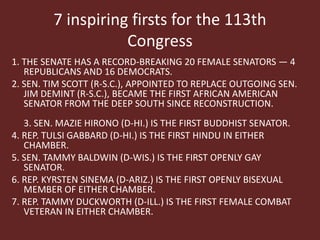
7 inspiring firsts for the 113th
Congress
1. THE SENATE HAS A RECORD-BREAKING 20 FEMALE SENATORS — 4
REPUBLICANS AND 16 DEMOCRATS.
2. SEN. TIM SCOTT (R-S.C.), APPOINTED TO REPLACE OUTGOING SEN.
JIM DEMINT (R-S.C.), BECAME THE FIRST AFRICAN AMERICAN
SENATOR FROM THE DEEP SOUTH SINCE RECONSTRUCTION.
3. SEN. MAZIE HIRONO (D-HI.) IS THE FIRST BUDDHIST SENATOR.
4. REP. TULSI GABBARD (D-HI.) IS THE FIRST HINDU IN EITHER
CHAMBER.
5. SEN. TAMMY BALDWIN (D-WIS.) IS THE FIRST OPENLY GAY
SENATOR.
6. REP. KYRSTEN SINEMA (D-ARIZ.) IS THE FIRST OPENLY BISEXUAL
MEMBER OF EITHER CHAMBER.
7. REP. TAMMY DUCKWORTH (D-ILL.) IS THE FIRST FEMALE COMBAT
VETERAN IN EITHER CHAMBER.
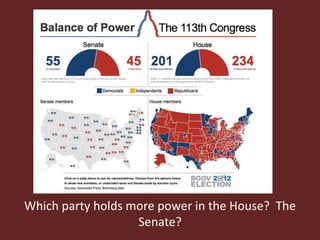
Which party holds more power in the House? The
Senate?
House Rules & Committee Work
• Control actions of individual reps (ie. Speaking
time)
– Purpose: move legislation through quickly once it
reaches the floor
• Members have more power than Senators
• Committees
– House is LARGE! Work happens in small groups
– Reps specialize in issues & serve on committees
important to their constituents
Why does party matter?
• Majority party selects leaders, controls the
flow of legislation (bills), appointments
committee chairs
• After 94 election many conservative Dems
switched to Rs & made changes to rules
– House more accountable, more power to Speaker,
fewer committees & staff
Goals of House Leadership
• Organize/unify party members
• Schedule work
• Make sure members are present for key
votes
• Distribute/collect info
• Keep House in touch with President
• Influence lawmakers to support party’s
position
Speaker of the House
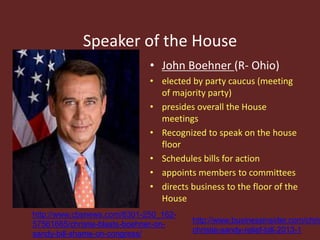
• John Boehner (R- Ohio)
• elected by party caucus (meeting
of majority party)
• presides overall the House
meetings
• Recognized to speak on the house
floor
• Schedules bills for action
• appoints members to committees
• directs business to the floor of the
House
http://www.cbsnews.com/8301-250_162-
57561665/christie-blasts-boehner-on-
sandy-bill-shame-on-congress/
http://www.businessinsider.com/chris
christie-sandy-relief-bill-2013-1
House Majority Leader
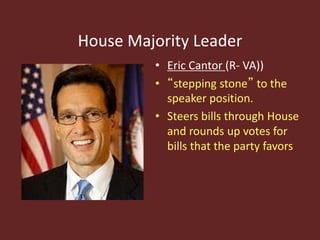
• Eric Cantor (R- VA))
• “stepping stone” to the
speaker position.
• Steers bills through House
and rounds up votes for
bills that the party favors
Majority & Minority Whips
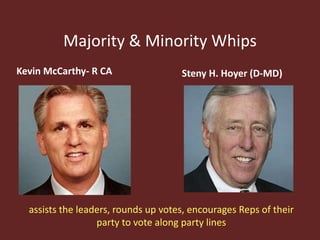
Steny H. Hoyer (D-MD)Kevin McCarthy- R CA
assists the leaders, rounds up votes, encourages Reps of their
party to vote along party lines
What about the minority party?
• Elects their own leaders but does NOT have
power over scheduling work!
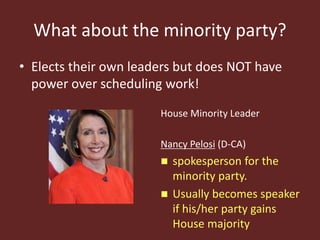
House Minority Leader
Nancy Pelosi (D-CA)
 spokesperson for the
minority party.
 Usually becomes speaker
if his/her party gains
House majority
Scheduling Bills
• Bills dropped into “hopper”
• Speaker sends to committee for
study, discussion, review
• If bills survive committee, it goes on
Calendar
• Only 10-20% of bills go to floor for
vote!
• House Rules Committee – “traffic
officer” – directs flow of legislation;
can move, hold or stop bills; block
those they don’t want to come up
for vote
Pre Class
• Senators tend to be more ideologically moderate than
members of the House. Why do you think this is? (hint:
think about who a Senator represents, compared to a
representative in the House)
The Political Spectrum
Senate Basics
• At least 30 years old
• A citizen of the US for 9 years
• Reside in the state they represent when they seek
election
• 100 Senators; serve 6 year terms
• Terms are staggered so 1/3 is up for re-election ever
2 years
**Senators tend to be more ideologically moderate
than members of the House because they represent
the entire state, and must appeal to a broader base
of voters.
Senate Leadership:
President of the Senate
• Joseph Biden (D- DE- VP)
 Vice President of the United States
 Presiding officer
 votes only in the case of a tie
 seldom attends Senate sessions
(ceremonial occasions or at times
when the potential for a tie vote on
an important issue is anticipated)
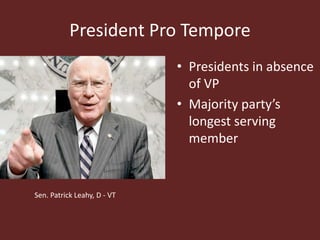
President Pro Tempore
• Presidents in absence
of VP
• Majority party’s
longest serving
member
Sen. Patrick Leahy, D - VT
Senate Leadership:
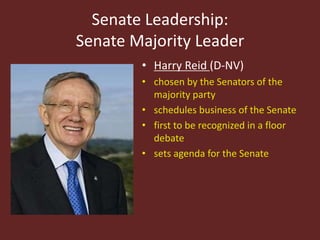
Senate Majority Leader
• Harry Reid (D-NV)
• chosen by the Senators of the
majority party
• schedules business of the Senate
• first to be recognized in a floor
debate
• sets agenda for the Senate
Senate Leadership:
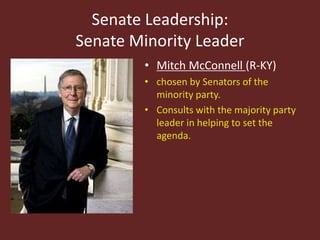
Senate Minority Leader
• Mitch McConnell (R-KY)
• chosen by Senators of the
minority party.
• Consults with the majority party
leader in helping to set the
agenda.
Law Making
• No rules committee (like House)
• Leaders control flow of bills to floor
• Sen. motion unanimously to vote on a bill from
the calendar
• Filibuster – to extend debate to prevent a bill
from coming to a vote
– Can only be stopped with a vote for cloture – limits
the debate by allowing each senator only one hour;
requires 60 Sen vote – nearly IMPOSSIBLE!
5 Longest Filibusters in history
Strom Thurmond
Senator from South Carolina
1956 - 2003
24 hours and 18 minutes in length, nonstop,
in opposition to Civil Rights Act of 1957
Mr. Smith Goes to Washington
Differences between the House and
the Senate
•Why does Mr. Oleszek suggest that our system is “slow moving”?
Why does he say this is a good thing?
•What is a bicameral congress?
•What are some of the major differences in operation of the House
and Senate? According to Mr. Oleszek, what is the House specifically
“geared” to do?
•What is meant by “reach across the aisle”?
•Why does Mr. Oleszek state that the Senate is a “minority rule
institution”? Which 3 things may constitute a minority in the Senate?
Which “awesome” power does every Senator wield, regardless of
rank or party? How does this power serve as a “source of
compromise”?
•What is a “super-majority”? Why does Mr. Oleszek suggest that a
“super majority” is tough to achieve in the current political climate?
What is “rule 22”?
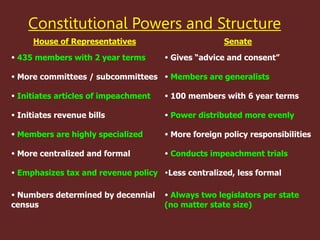
Constitutional Powers and Structure
House of Representatives
 435 members with 2 year terms
 More committees / subcommittees
 Initiates articles of impeachment
 Initiates revenue bills
 Members are highly specialized
 More centralized and formal
 Emphasizes tax and revenue policy
 Numbers determined by decennial
census
Senate
 Gives “advice and consent”
 Members are generalists
 100 members with 6 year terms
 Power distributed more evenly
 More foreign policy responsibilities
 Conducts impeachment trials
Less centralized, less formal
 Always two legislators per state
(no matter state size)
“Congress in session is Congress on
public exhibition, whilst Congress in its
committee-rooms is Congress at
work.” – Woodrow Wilson
Congress and the
Committees System
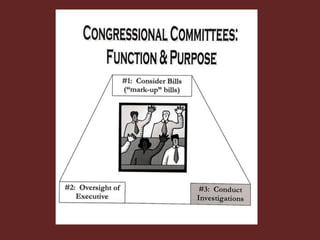
Committee System Basics
1) Allows for the division of labor so Congress can
consider a vast number of bills each year.
110th Congress Bills= House: 7,336 & Senate: 3,741
2) Members develop specialization- gain expertise in
specific areas (do not have to depend on
professional staff and executive agencies for
background information).
3) Subcommittees share specific tasks with the
“parent” committee. Subcommittees are
responsible to, and work within the guidelines
established by, the parent committee.
Senate: 21 committees, over 65 subcommittees
• House: 20 committees, over 100 subcommittees
There are 4 joint committees between both houses of
Congress
Four Types of Committees
• Standing Committees:
- permanent subject matter committees
- have legislative jurisdiction
- consider bills and issues
- recommend measures for consideration.
- oversight responsibility of agencies,
programs, and activities within
jurisdictions.
- oldest standing committee = House
Ways and Means Committee (1802)
Four Types of Committees
• Select (Special) Committees:
- formed for specific purpose;
temporary
- conduct investigations, studies, and,
consider measures.
- examine emerging issues that don’t fit
within existing standing committee
jurisdictions.
- handle some oversight or
“housekeeping” responsibilities.
Four Types of Committees
Joint Committees:
- Permanent
- include members of House and Senate.
- Four joint committees: Economic, Library, Printing,
Taxation.
- conduct studies or perform housekeeping tasks
rather than consider measures.
Conference Committees:
- temporary
- include House and Senate negotiators
- created to resolve differences between versions of
similar House and Senate bills.
Committee Membership
- Members express preferences to a party selection committee.
- Members usually go to areas where they have experience or
concern their districts.
- Committees dealing with appropriations, taxes, and finance
are always sought after because they deal with allocation of
money.
- Controlled by parties in particular the majority party.
- Chairperson for standing committees usually comes from
majority party; seniority usually prevails. Most influential
member of the committee. Arranges meetings, controls
staffing and funding, sets agenda.
- Senate= Steering Committee makes assignments for both
parties.
- House= Committee on Committees= Republicans; Steering
and Policy Committee= Democrats
Committees of Congress
Senate Committees House Committees
Agriculture
Appropriations
Armed Services
Budget
Education and Labor
Energy and Commerce
Financial Services
Foreign Affairs
Homeland Security
House Administration
Intelligence (Permanent Select)
Judiciary
Natural Resources
Oversight and Government Reform
Rules
Science and Technology
Small Business
Standards of Official Conduct
Transportation and Infrastructure
Veterans' Affairs
Ways and Means
(Whole)
Aging (Special)
Agriculture, Nutrition and Forestry
Appropriations
Armed Services
Banking, Housing, and Urban Affairs
Budget
Commerce, Science and Transportation
Energy and Natural Resources
Ethics (Select)
Environment and Public Works
Finance
Foreign Relations
Health, Education, Labor, and Pensions
Homeland Security and Governmental
Affairs
Indian Affairs
Intelligence (Select)
Judiciary
Rules and Administration
Small Business and Entrepreneurship
Veterans' Affairs
Congressional Committee
Hearing
Which issue should we address?
• Should the Defense of Marriage Act be
repealed?
• Should the federal govt pass a law that
coerces states into passing bans on texting
and driving?
• Should the assault weapons ban be
reinstated?
• Should people be banned by the federal govt
from attending animal fighting events?
• YOUR IDEAS?????
Congress Vocab
• 1. Pigeonholed- when congressional committees that deal with new bills introduced in the
United States congress decide to ignore a new bill, never make it out of committee
• 2. Marked up- refers to the process by which a U.S. congressional committee or state
legislative session debates, amends, and rewrites proposed legislation.
• 3. Closed rule- “gag rule” strict limits on debates and forbids amendments from the floor,
except those from committees, members have little choice but to vote for or against
• 4. Open rule- permits amendments and has less strict time limits, allowing input from other
members
• 5. Committee chairmen- most important person shaping the agenda, chosen usually by
seniority, voted by members of the house with a secret ballot
• 6. Caucuses with Congress- members of congress joins specific groups that share their same
interests or points of view. More than 70 groups, their goal is to shape the agenda of
Congress
• 7. Incumbency- The incumbent, in politics is the holder of a political office. It is a person who
already holds political office. 95% of incumbents win reelection
• Voters typically know incumbents well and have strong opinions about their performance.
• Challengers are less familiar and invariably fall short on straightforward comparisons of
experience and (in the presidential arena) command of foreign policy.
4 Factors that Influence Congress

Ch. 5 - Congress Basics

  • 1.
    What are Americans’current attitudes towards Congress?
  • 2.
    Pre Class Select 2quotes about Congress and answer the following questions in your notebook. 1. What does the quote mean? 2. What does the author seem to think about Congress (ie. What is his or her bias?) 3. What does the quote show us about how Congress works?
  • 3.
    The Legislative Branch:Congress •Makes the laws •Organization and powers are outlined in Article I •Bicameral – TWO HOUSES •House of Rep. (population) •Senate (each state has 2)
  • 4.
    General Organization • Termsof Senators and Representatives are staggered, so every two years, approximately one- third of the Senate is up for election.
  • 5.
    General Organization While it'stheoretically possible to have total turnover in the House every two years and in the Senate every six years, actual turnover is much less, since most incumbents seek re-election, and their historical likelihood of winning subsequent elections exceeds 90%.
  • 6.
    General Organization • Checksand balances was built within the legislative branch with two separate chambers. • A term of Congress is divided into two "sessions", one for each year. Congress is occasionally called into an extra or special session. • A new session begins on January 3 each year unless Congress decides differently. • The Constitution requires Congress meet at least once each year and forbids either house from meeting outside the Capitol.
  • 7.
    General Organization • JointSessions of Congress occur on special occasions that require a concurrent resolution from both House and Senate. • Sessions include counting electoral votes and the president's State of the Union address. • Joint Sessions and Joint Meetings are traditionally presided over by the Speaker of the House except when counting presidential electoral votes when the vice president presides.
  • 8.
    •What is an approval rating? •Whydo you suppose Congress’ approval rating is so low?
  • 9.
    •Which political ideology/partymost disapproves of Congress? What do you notice about all 3?
  • 10.
    How representative ofUS is the representative branch of government? Who’s in Congress? Demographics – selected population characteristics as used in government, marketing, or other research; commonly used demographics include race, age, level of education, gender, political affiliation and occupation.
  • 13.
    Discussion Questions • Basedon the demographic data provided, what generalizations can we make about the 111th Congress? • How representative is the representative branch? • Does it matter if member of Congress match up demographically with the general population? Defend your answer.
  • 14.
    Who represents youin Congress? Rep. Allyson Schwartz
  • 15.
    Gridlock in Congress– a good thing? • Compare the separation of powers in the U.S. presidential system to the parliamentary system in the United Kingdom. • In what ways is a president different from a prime minister? • Explain how “gridlock” is good for people living in a democracy according to Associate Justice Scalia?
  • 16.
    Democrats and Republicanshave each had periods when they dominated the House and Senate. When was the most unbalanced division? What explains this unusual dominance by one party?
  • 17.
    House Basics • 25years old • Resident of US for 7 years • Legal resident of their state • All 435 run every 2 years • 90% are reelected
  • 18.
    Representation in theHouse • Census – population count that takes place every 10 years • States’ populations determine how many representatives they have in the House • 1929 - # of Rep. capped at 435 • Redistricting - The process of setting up new district lines after reapportionment has been completed – State legislatures are in charge; often they create districts that work to their political advantage
  • 19.
    Congressional Apportionment after the2010 Census Pre Class - After the 2010 census, some states lost representatives and others gained representatives in Congress. Write one thing that you can assume or infer by looking at this map.
  • 20.
    • Look atthis map of PA that shows our Congressional districts (by COLOR). What do you notice about the shapes of the districts? Why do you think they look like this?
  • 22.
    Gerrymandering • Drawing Congressional districts togive one party an advantage • Cracking v. packing C-SPAN
  • 24.
    Packing & Cracking •Packing – means drawing the lines so they include as many of the opposing party’s voters as possible • crowding the opposition into one district makes the remaining districts safe for the majority party • Cracking – dividing an opponent’s voters into other districts to weaken the opponent’s voter base
  • 25.
    Pre Class • Whatis gerrymandering? • What are the two main strategies used when legislatures redraw maps to their advantage?
  • 33.
    The Supreme Courthas said… • Federal courts decide conflicts over district boundaries • “one-person, one-vote” rule – a vote in one district is to be worth as much as a vote in another district • Districts must be compact, contiguous (adjoining)
  • 34.
    North Carolina • Districts1 & 12 have been redrawn several times because of legal challenges that these districts increase African American representation (minority-majority districts)
  • 36.
    Redistricting Song • Whyshould the populations of Congressional districts be roughly the same? • What are kidnapping and hijacking? • Should state legislatures have the responsibility for redistricting in their state? What might be a better way of conducting redistricting?
  • 37.
    • Packing: redrawinga district to pack in as many of one type of voters • Cracking: redrawing a district to break up concentrated areas of one type of other. • Kidnapping: redrawing the district line around an incumbent’s neighborhood to place it in a new district with the opposition party is in the majority. They will be voted out of office because they don’t have the support they once had in their old district. • Hijacking: redrawing the district line to include two (or more) incumbents from the same party. Only one can win and the opposition party has one less representative to worry about.
  • 38.
    Can you helpeach party win? • Help the citizens of Gerrymanderham elect 5 representatives to the House of Representatives • Follow the directions for each scenario – Create a FAIR map – Create a map that benefits party X – Create a map that benefits party O
  • 39.
    Scenario 1 – Makeit fair! Scenario 3 – benefit party O! Scenario 2 – benefit party X!
  • 40.
    Directions • Have yourGerrymandering Activity worksheet and homework on your desk. • Read the article’ “Christie blasts Boehner on Sandy bill…” and answer these questions on a separate sheet of paper: – Why is New Jersey governor Chris Christie angry at members of this own party in Congress? – Who is John Boehner? Why did he not allow the vote on the Sandy bill? – Consider what you know about the role the majority party and Speaker of the House play in the House of Representatives. Why are they so important?
  • 42.
    7 inspiring firstsfor the 113th Congress 1. THE SENATE HAS A RECORD-BREAKING 20 FEMALE SENATORS — 4 REPUBLICANS AND 16 DEMOCRATS. 2. SEN. TIM SCOTT (R-S.C.), APPOINTED TO REPLACE OUTGOING SEN. JIM DEMINT (R-S.C.), BECAME THE FIRST AFRICAN AMERICAN SENATOR FROM THE DEEP SOUTH SINCE RECONSTRUCTION. 3. SEN. MAZIE HIRONO (D-HI.) IS THE FIRST BUDDHIST SENATOR. 4. REP. TULSI GABBARD (D-HI.) IS THE FIRST HINDU IN EITHER CHAMBER. 5. SEN. TAMMY BALDWIN (D-WIS.) IS THE FIRST OPENLY GAY SENATOR. 6. REP. KYRSTEN SINEMA (D-ARIZ.) IS THE FIRST OPENLY BISEXUAL MEMBER OF EITHER CHAMBER. 7. REP. TAMMY DUCKWORTH (D-ILL.) IS THE FIRST FEMALE COMBAT VETERAN IN EITHER CHAMBER.
  • 43.
    Which party holdsmore power in the House? The Senate?
  • 44.
    House Rules &Committee Work • Control actions of individual reps (ie. Speaking time) – Purpose: move legislation through quickly once it reaches the floor • Members have more power than Senators • Committees – House is LARGE! Work happens in small groups – Reps specialize in issues & serve on committees important to their constituents
  • 45.
    Why does partymatter? • Majority party selects leaders, controls the flow of legislation (bills), appointments committee chairs • After 94 election many conservative Dems switched to Rs & made changes to rules – House more accountable, more power to Speaker, fewer committees & staff
  • 46.
    Goals of HouseLeadership • Organize/unify party members • Schedule work • Make sure members are present for key votes • Distribute/collect info • Keep House in touch with President • Influence lawmakers to support party’s position
  • 47.
    Speaker of theHouse • John Boehner (R- Ohio) • elected by party caucus (meeting of majority party) • presides overall the House meetings • Recognized to speak on the house floor • Schedules bills for action • appoints members to committees • directs business to the floor of the House http://www.cbsnews.com/8301-250_162- 57561665/christie-blasts-boehner-on- sandy-bill-shame-on-congress/ http://www.businessinsider.com/chris christie-sandy-relief-bill-2013-1
  • 48.
    House Majority Leader •Eric Cantor (R- VA)) • “stepping stone” to the speaker position. • Steers bills through House and rounds up votes for bills that the party favors
  • 49.
    Majority & MinorityWhips Steny H. Hoyer (D-MD)Kevin McCarthy- R CA assists the leaders, rounds up votes, encourages Reps of their party to vote along party lines
  • 50.
    What about theminority party? • Elects their own leaders but does NOT have power over scheduling work! House Minority Leader Nancy Pelosi (D-CA)  spokesperson for the minority party.  Usually becomes speaker if his/her party gains House majority
  • 51.
    Scheduling Bills • Billsdropped into “hopper” • Speaker sends to committee for study, discussion, review • If bills survive committee, it goes on Calendar • Only 10-20% of bills go to floor for vote! • House Rules Committee – “traffic officer” – directs flow of legislation; can move, hold or stop bills; block those they don’t want to come up for vote
  • 52.
    Pre Class • Senatorstend to be more ideologically moderate than members of the House. Why do you think this is? (hint: think about who a Senator represents, compared to a representative in the House) The Political Spectrum
  • 53.
    Senate Basics • Atleast 30 years old • A citizen of the US for 9 years • Reside in the state they represent when they seek election • 100 Senators; serve 6 year terms • Terms are staggered so 1/3 is up for re-election ever 2 years **Senators tend to be more ideologically moderate than members of the House because they represent the entire state, and must appeal to a broader base of voters.
  • 54.
    Senate Leadership: President ofthe Senate • Joseph Biden (D- DE- VP)  Vice President of the United States  Presiding officer  votes only in the case of a tie  seldom attends Senate sessions (ceremonial occasions or at times when the potential for a tie vote on an important issue is anticipated)
  • 55.
    President Pro Tempore •Presidents in absence of VP • Majority party’s longest serving member Sen. Patrick Leahy, D - VT
  • 56.
    Senate Leadership: Senate MajorityLeader • Harry Reid (D-NV) • chosen by the Senators of the majority party • schedules business of the Senate • first to be recognized in a floor debate • sets agenda for the Senate
  • 57.
    Senate Leadership: Senate MinorityLeader • Mitch McConnell (R-KY) • chosen by Senators of the minority party. • Consults with the majority party leader in helping to set the agenda.
  • 58.
    Law Making • Norules committee (like House) • Leaders control flow of bills to floor • Sen. motion unanimously to vote on a bill from the calendar • Filibuster – to extend debate to prevent a bill from coming to a vote – Can only be stopped with a vote for cloture – limits the debate by allowing each senator only one hour; requires 60 Sen vote – nearly IMPOSSIBLE!
  • 61.
    5 Longest Filibustersin history Strom Thurmond Senator from South Carolina 1956 - 2003 24 hours and 18 minutes in length, nonstop, in opposition to Civil Rights Act of 1957
  • 62.
    Mr. Smith Goesto Washington
  • 63.
    Differences between theHouse and the Senate •Why does Mr. Oleszek suggest that our system is “slow moving”? Why does he say this is a good thing? •What is a bicameral congress? •What are some of the major differences in operation of the House and Senate? According to Mr. Oleszek, what is the House specifically “geared” to do? •What is meant by “reach across the aisle”? •Why does Mr. Oleszek state that the Senate is a “minority rule institution”? Which 3 things may constitute a minority in the Senate? Which “awesome” power does every Senator wield, regardless of rank or party? How does this power serve as a “source of compromise”? •What is a “super-majority”? Why does Mr. Oleszek suggest that a “super majority” is tough to achieve in the current political climate? What is “rule 22”?
  • 64.
    Constitutional Powers andStructure House of Representatives  435 members with 2 year terms  More committees / subcommittees  Initiates articles of impeachment  Initiates revenue bills  Members are highly specialized  More centralized and formal  Emphasizes tax and revenue policy  Numbers determined by decennial census Senate  Gives “advice and consent”  Members are generalists  100 members with 6 year terms  Power distributed more evenly  More foreign policy responsibilities  Conducts impeachment trials Less centralized, less formal  Always two legislators per state (no matter state size)
  • 65.
    “Congress in sessionis Congress on public exhibition, whilst Congress in its committee-rooms is Congress at work.” – Woodrow Wilson
  • 67.
  • 68.
    Committee System Basics 1)Allows for the division of labor so Congress can consider a vast number of bills each year. 110th Congress Bills= House: 7,336 & Senate: 3,741 2) Members develop specialization- gain expertise in specific areas (do not have to depend on professional staff and executive agencies for background information). 3) Subcommittees share specific tasks with the “parent” committee. Subcommittees are responsible to, and work within the guidelines established by, the parent committee. Senate: 21 committees, over 65 subcommittees • House: 20 committees, over 100 subcommittees There are 4 joint committees between both houses of Congress
  • 69.
    Four Types ofCommittees • Standing Committees: - permanent subject matter committees - have legislative jurisdiction - consider bills and issues - recommend measures for consideration. - oversight responsibility of agencies, programs, and activities within jurisdictions. - oldest standing committee = House Ways and Means Committee (1802)
  • 70.
    Four Types ofCommittees • Select (Special) Committees: - formed for specific purpose; temporary - conduct investigations, studies, and, consider measures. - examine emerging issues that don’t fit within existing standing committee jurisdictions. - handle some oversight or “housekeeping” responsibilities.
  • 71.
    Four Types ofCommittees Joint Committees: - Permanent - include members of House and Senate. - Four joint committees: Economic, Library, Printing, Taxation. - conduct studies or perform housekeeping tasks rather than consider measures. Conference Committees: - temporary - include House and Senate negotiators - created to resolve differences between versions of similar House and Senate bills.
  • 72.
    Committee Membership - Membersexpress preferences to a party selection committee. - Members usually go to areas where they have experience or concern their districts. - Committees dealing with appropriations, taxes, and finance are always sought after because they deal with allocation of money. - Controlled by parties in particular the majority party. - Chairperson for standing committees usually comes from majority party; seniority usually prevails. Most influential member of the committee. Arranges meetings, controls staffing and funding, sets agenda. - Senate= Steering Committee makes assignments for both parties. - House= Committee on Committees= Republicans; Steering and Policy Committee= Democrats
  • 73.
    Committees of Congress SenateCommittees House Committees Agriculture Appropriations Armed Services Budget Education and Labor Energy and Commerce Financial Services Foreign Affairs Homeland Security House Administration Intelligence (Permanent Select) Judiciary Natural Resources Oversight and Government Reform Rules Science and Technology Small Business Standards of Official Conduct Transportation and Infrastructure Veterans' Affairs Ways and Means (Whole) Aging (Special) Agriculture, Nutrition and Forestry Appropriations Armed Services Banking, Housing, and Urban Affairs Budget Commerce, Science and Transportation Energy and Natural Resources Ethics (Select) Environment and Public Works Finance Foreign Relations Health, Education, Labor, and Pensions Homeland Security and Governmental Affairs Indian Affairs Intelligence (Select) Judiciary Rules and Administration Small Business and Entrepreneurship Veterans' Affairs
  • 74.
  • 75.
    Which issue shouldwe address? • Should the Defense of Marriage Act be repealed? • Should the federal govt pass a law that coerces states into passing bans on texting and driving? • Should the assault weapons ban be reinstated? • Should people be banned by the federal govt from attending animal fighting events? • YOUR IDEAS?????
  • 76.
    Congress Vocab • 1.Pigeonholed- when congressional committees that deal with new bills introduced in the United States congress decide to ignore a new bill, never make it out of committee • 2. Marked up- refers to the process by which a U.S. congressional committee or state legislative session debates, amends, and rewrites proposed legislation. • 3. Closed rule- “gag rule” strict limits on debates and forbids amendments from the floor, except those from committees, members have little choice but to vote for or against • 4. Open rule- permits amendments and has less strict time limits, allowing input from other members • 5. Committee chairmen- most important person shaping the agenda, chosen usually by seniority, voted by members of the house with a secret ballot • 6. Caucuses with Congress- members of congress joins specific groups that share their same interests or points of view. More than 70 groups, their goal is to shape the agenda of Congress • 7. Incumbency- The incumbent, in politics is the holder of a political office. It is a person who already holds political office. 95% of incumbents win reelection • Voters typically know incumbents well and have strong opinions about their performance. • Challengers are less familiar and invariably fall short on straightforward comparisons of experience and (in the presidential arena) command of foreign policy.
  • 77.
    4 Factors thatInfluence Congress

Editor's Notes

  • #23 The term is a portmanteau word formed from the surname of Massachusetts Governor Elbridge Gerry and the salamander shape of the district he approved, which appeared in an 1812 cartoon. Gerrymandering can take on many forms.
  • #28 Packing concentrates members of a group in a single district, thereby allowing the other party to win the remainder of the districts. Cracking splits a bloc among multiple districts, so as to dilute their impact and to prevent them from constituting a majority.
  • #34 14th amendment's equal protection clause requires that the seats in the Alabama state legislature be apportioned on a population basis
  • #35 The district was re-established after the 1990 United States Census, when North Carolina gained a district. It was drawn in 1992[2] as one of two black majority (minority-majority) districts. With 64 percent African-American residents, it stretched from Gastonia to Durham. It was very long and so thin at some points that it was no wider than a highway lane, as it followed Interstate 85 almost exactly,[3][4] and was criticized as a gerrymandered district. when created in the 1990s, it was one of two minority-majority Congressional districts in the state. The Wall Street Journal called the district "political pornography." The United States Supreme Court ruled in Shaw v. Reno, 509 U.S. 630 (1993) that a racial gerrymander may, in some circumstances, violate the Equal Protection Clause, although redistricting may be used to create minority-majority districts where none exist at present and to correct historical discrimination.[5] Subsequently, the district was redrawn several times and was adjudicated in the Supreme Court on two further occasions.[6] The version created after the 2000 census was approved by the US Supreme Court in Hunt v. Cromartie. The current version, based on the 2010 census, has a small plurality of whites. Its current representative is Democrat Melvin Watt, who has represented the district since its re-establishment in 1993.
  • #64 House – designed to allow a majority to win – 218