for today's discussion,
        go to:
 http://todaysmeet.com/ashapush
Was the primary threat from the Soviet Union
 military or ideological?
Was it right for the Truman administration to
 frame the US - Soviet relationship in the late
 '40s as "us vs. them"?
Was Truman right to fire MacArthur when and
 how he did?
a.   What would have happened if MacArthur had gotten his
     way and expanded the conflict with the Chinese?
Who was to blame for the Cold War?
Demobilization - Economic anxieties

•   falling GNP
•   rising prices (end of price controls)
•   labor troubles - Taft-Hartley (“slave labor
    law”) passed by R Congress
    –  Outlawed “closed shop”
    –  Unions liable for damages
    –  Govt could step in an ask for injunction
    –  Leaders took noncommunist oath
•   GI Bill (Servicemen's Readjustment Act)
•   loans for college, homes, farms, businesses
Truman & Eisenhower


    America’s economy post-WWII
      Truman’s domestic policy
Eisenhower’s domestic & foreign policy
Economic Boom 1950-70
•   defense spending (begins with Korea)
•   cheap energy (oil from M.E.)
•   higher productivity
     o   efficient machinery & increase in education
•   economic shift out of agriculture
o   Middle class doubles
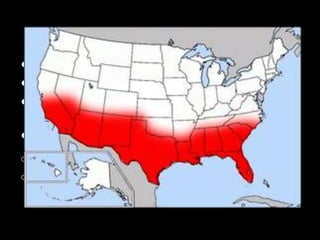
o   Migration to the Sunbelt
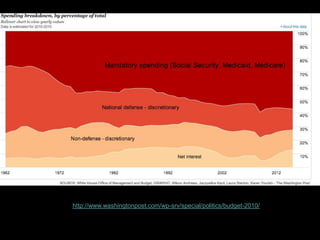
http://www.washingtonpost.com/wp-srv/special/politics/budget-2010/
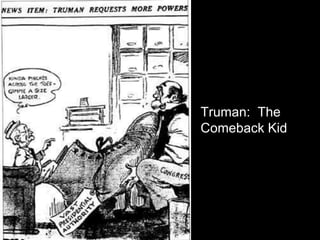
Truman: The
Comeback Kid
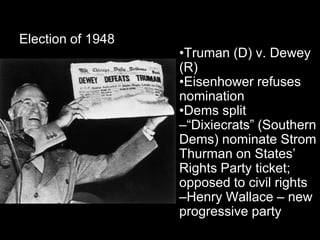
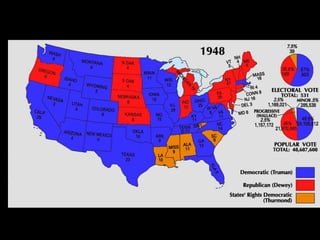
Election of 1948
                   •Truman (D) v. Dewey
                   (R)
                   •Eisenhower refuses
                   nomination
                   •Dems split
                   –“Dixiecrats” (Southern
                   Dems) nominate Strom
                   Thurman on States’
                   Rights Party ticket;
                   opposed to civil rights
                   –Henry Wallace – new
                   progressive party
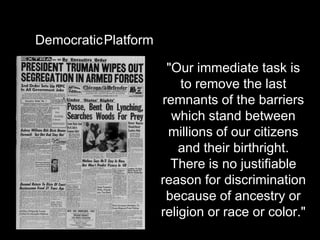
DemocraticPlatform

                      "Our immediate task is
                         to remove the last
                     remnants of the barriers
                       which stand between
                      millions of our citizens
                         and their birthright.
                       There is no justifiable
                     reason for discrimination
                      because of ancestry or
                     religion or race or color."
Truman’s Second Term

Truman wins 2nd term; 5th term for New Deal Coalition;
Dems win Congress
liberalism - still a force in American politics

                       “Fair Deal”
–Improved housing**
–Universal healthcare
–Full employment
–Higher minimum wage**
–Price supports for farmers
–Extending Social Security**
–Civil rights – integrated the armed forces

Opposed by conservative R’s and D’s
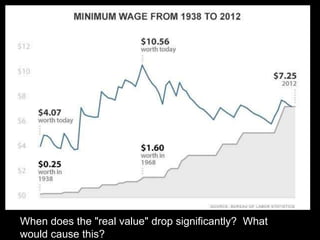
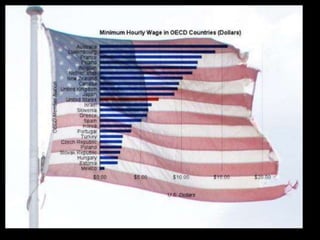
When does the "real value" drop significantly? What
would cause this?
Obama SOTU clip - $9.00 minimum
wage
•   The grey line shows the minimum wage, unadjusted for inflation, whereas

•
    the blue line shows you what it would be worth in 2012.
    When President Franklin D. Roosevelt first created the minimum wage in
    1938, it was 25 cents. Truman got it raised from 40 - 75 cents. Adjusted

•
    for inflation, that would be worth $4.07 today.
    The minimum wage had its lowest buying power in 1948, when it was
    worth about $3.81 in today's dollars. It had its highest buying power in

•
    1968, when it was worth about $10.56.
    At $7.25 in 2012, our current minimum wage is in the middle of those two

•
    extremes.
    President Obama's proposal to raise the minimum wage to $9 would put it
    back to a value last seen in the early 1980s.
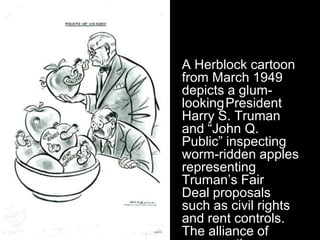
A Herblock cartoon
from March 1949
depicts a glum-
looking President
Harry S. Truman
and “John Q.
Public” inspecting
worm-ridden apples
representing
Truman’s Fair
Deal proposals
such as civil rights
and rent controls.
The alliance of
Objectives

•Outline the Eisenhower-Dulles approach to the
Cold War and the nuclear arms race with the
Soviet Union.
•Define the basic principles of Eisenhower’s
foreign policy in Vietnam, the Middle East, and
Cuba.
•Describe the practice of “Eisenhower
Republicanism” in the 1950s, including
domestic consequences of the Cold War.
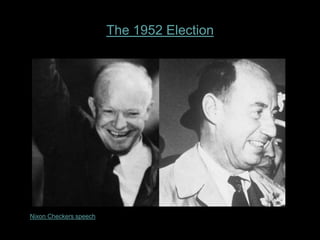
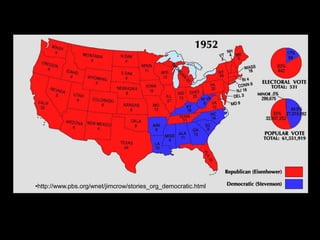
The 1952 Election


Nixon Checkers speech
http://www.pbs.org/wnet/jimcrow/stories_org_democratic.html


      •http://www.pbs.org/wnet/jimcrow/stories_org_democratic.html
•As the first Republican president in 2 decades,
what challenges do you think Eisenhower faced
when entering office?

•How do you think Ike’s experience as military
commander (supreme Allied Commander
Europe, army chief of staff, then NATO
supreme commander) impacted his views on
foreign policy?
“Should any political party attempt
          to abolish Social Security,
    unemployment insurance, and
 “Should any political party attempt to abolish Social Security, unemployment
 insurance, and eliminate labor and farm programs, you would not hear of that party
 again in our political history”~ Ike
eliminate labor and farm programs,
   you would not hear of that party
 again in our political history”~ Ike
Ike’s “Dynamic Conservatism”

•Small government
•Guard US from “creeping socialism”
•Put brakes on military build up & balance
the budget
•Curbed TVA
•Condemned polio vaccine at “Socialized
medicine”
“Unscrambling the eggs” fried
             by New and Fair Dealers
Operation Wetback – illegal imm. hurt undercut
bracero program
   – 1 million illegal imm. deported in 54

Native American Policy
  – cancel tribal preservation policies in “Indian New
     Deal”
  – “terminate” tribes as legal entities
  – Dawes Severalty Act 1887 – assimilation
  – NA resisted – policy abandoned in 61

**realized he had to cement New Deal reforms for the
survival of his party – Social Security, unemployment,
labor, farm programs, etc.
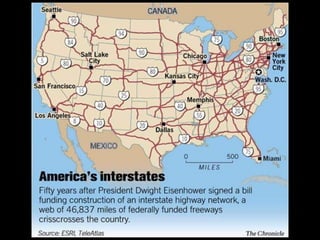
One Upping the NewDeal

•Interstate Highway Act 56
•Construction jobs
•Sped suburbanization
•Positives
      • Benefits trucking, automobile, oil and
        travel industries
•Negatives
      • robbed RR of business, air quality,
        energy consumption, city centers
        devastated by competing commercial
        suburbs
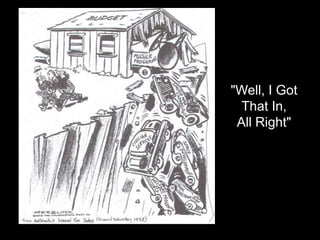
"Well, I Got
                                                         That In,
                                                        All Right"


Source: Herblock, the Washington Post, January 1958.
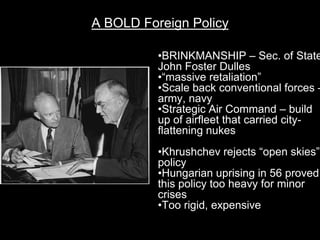
A BOLD Foreign Policy

          •BRINKMANSHIP – Sec. of State
          John Foster Dulles
          •“massive retaliation”
          •Scale back conventional forces –
          army, navy
          •Strategic Air Command – build
          up of airfleet that carried city-
          flattening nukes
          •Khrushchev rejects “open skies”
          policy
          •Hungarian uprising in 56 proved
          this policy too heavy for minor
          crises
          •Too rigid, expensive
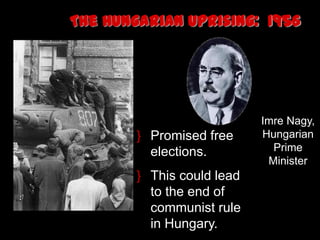
The Hungarian Uprising: 1956


                            Imre Nagy,
        } Promised free     Hungarian
          elections.          Prime
                             Minister
        } This could lead
          to the end of
          communist rule
          in Hungary.
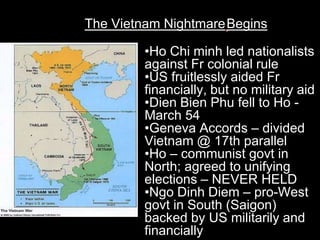
The Vietnam NightmareBegins

        •Ho Chi minh led nationalists
        against Fr colonial rule
        •US fruitlessly aided Fr
        financially, but no military aid
        •Dien Bien Phu fell to Ho -
        March 54
        •Geneva Accords – divided
        Vietnam @ 17th parallel
        •Ho – communist govt in
        North; agreed to unifying
        elections – NEVER HELD
        •Ngo Dinh Diem – pro-West
        govt in South (Saigon)
        backed by US militarily and
        financially
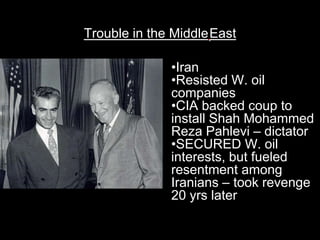
Trouble in the MiddleEast

              •Iran
              •Resisted W. oil
              companies
              •CIA backed coup to
              install Shah Mohammed
              Reza Pahlevi – dictator
              •SECURED W. oil
              interests, but fueled
              resentment among
              Iranians – took revenge
              20 yrs later
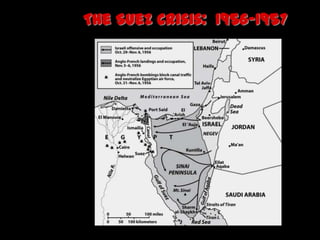
Suez Crisis
•US withdrew aid to build dam on Nile
•Nasser nationalizes Suez Canal (US and Br
stockholders) – threatened W. oil supplies
•Fr, GB, and Israel attack Egypt – Oct. 56
•US refused to release emergency oil supplies
to allies
•Fr & GB withdrew – UN called in to stabilize
**Turning Point – US = net oil importer, no
longer possessed “oil weapon;” OPEC formed –
Saudi Arabia, Iraq, Kuwait, Iran, Venezuela
The Suez Crisis: 1956-1957
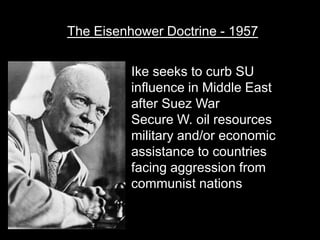
The Eisenhower Doctrine - 1957


          Ike seeks to curb SU
          influence in Middle East
          after Suez War
          Secure W. oil resources
          military and/or economic
          assistance to countries
          facing aggression from
          communist nations
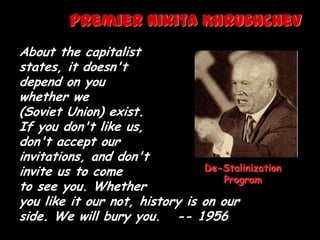
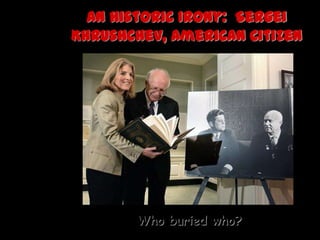
Premier Nikita Khrushchev
About the capitalist
states, it doesn't
depend on you
whether we
(Soviet Union) exist.
If you don't like us,
don't accept our
invitations, and don't
invite us to come               De-Stalinization
                                    Program
to see you. Whether
you like it our not, history is on our
side. We will bury you. -- 1956
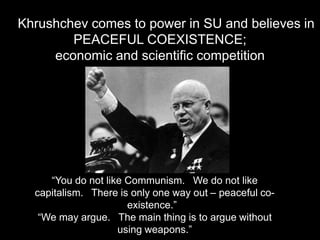
Nikita   Khrushchev comes to power in SU and believes in
                 PEACEFUL COEXISTENCE;
              economic and scientific competition


              “You do not like Communism. We do not like
           capitalism. There is only one way out – peaceful co-
                               existence.”
            “We may argue. The main thing is to argue without
                             using weapons.”
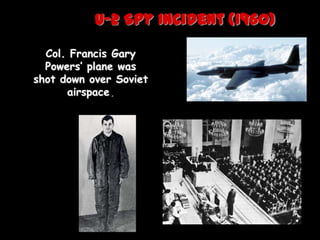
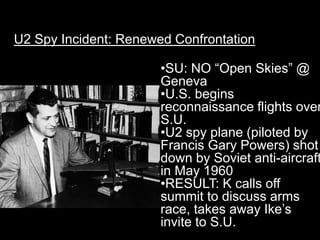
U2 Spy Incident: Renewed Confrontation

                       •SU: NO “Open Skies” @
                       Geneva
                       •U.S. begins
                       reconnaissance flights over
                       S.U.
                       •U2 spy plane (piloted by
                       Francis Gary Powers) shot
                       down by Soviet anti-aircraft
                       in May 1960
                       •RESULT: K calls off
                       summit to discuss arms
                       race, takes away Ike’s
                       invite to S.U.
Castro’s Cuba
•LA resented US aid to Europe, intervention in
LA affairs, and support of dictators
•US supported Batista in exchange for
encouraging US investments
•59 – Castro’s revolution
–Seized US property
–Aligned w/ Moscow
•Monroe Doctrine?? Domino effect?
•Ike: Org. of American States, $500 in aid to LA
– too little too late!
U-2 Spy Incident (1960)

  Col. Francis Gary
  Powers’ plane was
shot down over Soviet
      airspace.
An Historic Irony: Sergei
Khrushchev, American Citizen


        Who buried who?

Truman & Eisenhower

  • 1.
    for today's discussion, go to: http://todaysmeet.com/ashapush
  • 2.
    Was the primarythreat from the Soviet Union military or ideological?
  • 3.
    Was it rightfor the Truman administration to frame the US - Soviet relationship in the late '40s as "us vs. them"?
  • 4.
    Was Truman rightto fire MacArthur when and how he did? a. What would have happened if MacArthur had gotten his way and expanded the conflict with the Chinese?
  • 5.
    Who was toblame for the Cold War?
  • 6.
    Demobilization - Economicanxieties • falling GNP • rising prices (end of price controls) • labor troubles - Taft-Hartley (“slave labor law”) passed by R Congress – Outlawed “closed shop” – Unions liable for damages – Govt could step in an ask for injunction – Leaders took noncommunist oath • GI Bill (Servicemen's Readjustment Act) • loans for college, homes, farms, businesses
  • 7.
    Truman & Eisenhower America’s economy post-WWII Truman’s domestic policy Eisenhower’s domestic & foreign policy
  • 8.
    Economic Boom 1950-70 • defense spending (begins with Korea) • cheap energy (oil from M.E.) • higher productivity o efficient machinery & increase in education • economic shift out of agriculture o Middle class doubles o Migration to the Sunbelt
  • 9.
  • 10.
  • 11.
    Election of 1948 •Truman (D) v. Dewey (R) •Eisenhower refuses nomination •Dems split –“Dixiecrats” (Southern Dems) nominate Strom Thurman on States’ Rights Party ticket; opposed to civil rights –Henry Wallace – new progressive party
  • 12.
    DemocraticPlatform "Our immediate task is to remove the last remnants of the barriers which stand between millions of our citizens and their birthright. There is no justifiable reason for discrimination because of ancestry or religion or race or color."
  • 14.
    Truman’s Second Term Trumanwins 2nd term; 5th term for New Deal Coalition; Dems win Congress liberalism - still a force in American politics “Fair Deal” –Improved housing** –Universal healthcare –Full employment –Higher minimum wage** –Price supports for farmers –Extending Social Security** –Civil rights – integrated the armed forces Opposed by conservative R’s and D’s
  • 15.
    When does the"real value" drop significantly? What would cause this?
  • 16.
    Obama SOTU clip- $9.00 minimum wage • The grey line shows the minimum wage, unadjusted for inflation, whereas • the blue line shows you what it would be worth in 2012. When President Franklin D. Roosevelt first created the minimum wage in 1938, it was 25 cents. Truman got it raised from 40 - 75 cents. Adjusted • for inflation, that would be worth $4.07 today. The minimum wage had its lowest buying power in 1948, when it was worth about $3.81 in today's dollars. It had its highest buying power in • 1968, when it was worth about $10.56. At $7.25 in 2012, our current minimum wage is in the middle of those two • extremes. President Obama's proposal to raise the minimum wage to $9 would put it back to a value last seen in the early 1980s.
  • 18.
    A Herblock cartoon fromMarch 1949 depicts a glum- looking President Harry S. Truman and “John Q. Public” inspecting worm-ridden apples representing Truman’s Fair Deal proposals such as civil rights and rent controls. The alliance of
  • 19.
    Objectives •Outline the Eisenhower-Dullesapproach to the Cold War and the nuclear arms race with the Soviet Union. •Define the basic principles of Eisenhower’s foreign policy in Vietnam, the Middle East, and Cuba. •Describe the practice of “Eisenhower Republicanism” in the 1950s, including domestic consequences of the Cold War.
  • 20.
    The 1952 Election NixonCheckers speech
  • 21.
    http://www.pbs.org/wnet/jimcrow/stories_org_democratic.html •http://www.pbs.org/wnet/jimcrow/stories_org_democratic.html
  • 22.
    •As the firstRepublican president in 2 decades, what challenges do you think Eisenhower faced when entering office? •How do you think Ike’s experience as military commander (supreme Allied Commander Europe, army chief of staff, then NATO supreme commander) impacted his views on foreign policy?
  • 23.
    “Should any politicalparty attempt to abolish Social Security, unemployment insurance, and “Should any political party attempt to abolish Social Security, unemployment insurance, and eliminate labor and farm programs, you would not hear of that party again in our political history”~ Ike eliminate labor and farm programs, you would not hear of that party again in our political history”~ Ike
  • 24.
    Ike’s “Dynamic Conservatism” •Smallgovernment •Guard US from “creeping socialism” •Put brakes on military build up & balance the budget •Curbed TVA •Condemned polio vaccine at “Socialized medicine”
  • 25.
    “Unscrambling the eggs”fried by New and Fair Dealers Operation Wetback – illegal imm. hurt undercut bracero program – 1 million illegal imm. deported in 54 Native American Policy – cancel tribal preservation policies in “Indian New Deal” – “terminate” tribes as legal entities – Dawes Severalty Act 1887 – assimilation – NA resisted – policy abandoned in 61 **realized he had to cement New Deal reforms for the survival of his party – Social Security, unemployment, labor, farm programs, etc.
  • 27.
    One Upping theNewDeal •Interstate Highway Act 56 •Construction jobs •Sped suburbanization •Positives • Benefits trucking, automobile, oil and travel industries •Negatives • robbed RR of business, air quality, energy consumption, city centers devastated by competing commercial suburbs
  • 28.
    "Well, I Got That In, All Right" Source: Herblock, the Washington Post, January 1958.
  • 29.
    A BOLD ForeignPolicy •BRINKMANSHIP – Sec. of State John Foster Dulles •“massive retaliation” •Scale back conventional forces – army, navy •Strategic Air Command – build up of airfleet that carried city- flattening nukes •Khrushchev rejects “open skies” policy •Hungarian uprising in 56 proved this policy too heavy for minor crises •Too rigid, expensive
  • 30.
    The Hungarian Uprising:1956 Imre Nagy, } Promised free Hungarian elections. Prime Minister } This could lead to the end of communist rule in Hungary.
  • 31.
    The Vietnam NightmareBegins •Ho Chi minh led nationalists against Fr colonial rule •US fruitlessly aided Fr financially, but no military aid •Dien Bien Phu fell to Ho - March 54 •Geneva Accords – divided Vietnam @ 17th parallel •Ho – communist govt in North; agreed to unifying elections – NEVER HELD •Ngo Dinh Diem – pro-West govt in South (Saigon) backed by US militarily and financially
  • 32.
    Trouble in theMiddleEast •Iran •Resisted W. oil companies •CIA backed coup to install Shah Mohammed Reza Pahlevi – dictator •SECURED W. oil interests, but fueled resentment among Iranians – took revenge 20 yrs later
  • 33.
    Suez Crisis •US withdrewaid to build dam on Nile •Nasser nationalizes Suez Canal (US and Br stockholders) – threatened W. oil supplies •Fr, GB, and Israel attack Egypt – Oct. 56 •US refused to release emergency oil supplies to allies •Fr & GB withdrew – UN called in to stabilize **Turning Point – US = net oil importer, no longer possessed “oil weapon;” OPEC formed – Saudi Arabia, Iraq, Kuwait, Iran, Venezuela
  • 34.
  • 35.
    The Eisenhower Doctrine- 1957 Ike seeks to curb SU influence in Middle East after Suez War Secure W. oil resources military and/or economic assistance to countries facing aggression from communist nations
  • 36.
    Premier Nikita Khrushchev Aboutthe capitalist states, it doesn't depend on you whether we (Soviet Union) exist. If you don't like us, don't accept our invitations, and don't invite us to come De-Stalinization Program to see you. Whether you like it our not, history is on our side. We will bury you. -- 1956
  • 37.
    Nikita Khrushchev comes to power in SU and believes in PEACEFUL COEXISTENCE; economic and scientific competition “You do not like Communism. We do not like capitalism. There is only one way out – peaceful co- existence.” “We may argue. The main thing is to argue without using weapons.”
  • 38.
    U2 Spy Incident:Renewed Confrontation •SU: NO “Open Skies” @ Geneva •U.S. begins reconnaissance flights over S.U. •U2 spy plane (piloted by Francis Gary Powers) shot down by Soviet anti-aircraft in May 1960 •RESULT: K calls off summit to discuss arms race, takes away Ike’s invite to S.U.
  • 39.
    Castro’s Cuba •LA resentedUS aid to Europe, intervention in LA affairs, and support of dictators •US supported Batista in exchange for encouraging US investments •59 – Castro’s revolution –Seized US property –Aligned w/ Moscow •Monroe Doctrine?? Domino effect? •Ike: Org. of American States, $500 in aid to LA – too little too late!
  • 40.
    U-2 Spy Incident(1960) Col. Francis Gary Powers’ plane was shot down over Soviet airspace.
  • 41.
    An Historic Irony:Sergei Khrushchev, American Citizen Who buried who?