DEVELOPING LEARNING MATERIALS
FOR ESP
Harsono, Y.M. 2007. Developing Leraning Materials For Specific Purpose. TEFLIN Journal, Volume 18, Number 2, August 2007
Materials Development
Definition and Its forms
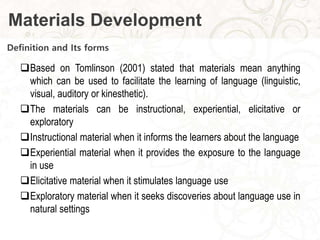
Based on Tomlinson (2001) stated that materials mean anything
which can be used to facilitate the learning of language (linguistic,
visual, auditory or kinesthetic).
The materials can be instructional, experiential, elicitative or
exploratory
Instructional material when it informs the learners about the language
Experiential material when it provides the exposure to the language
in use
Elicitative material when it stimulates language use
Exploratory material when it seeks discoveries about language use in
natural settings
The Scope Materials Development
1. Materials Development as A Field of Study
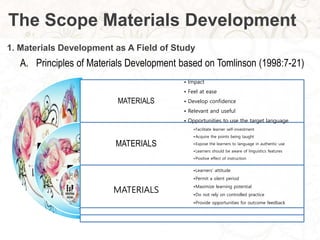
A. Principles of Materials Development based on Tomlinson (1998:7-21)
MATERIALS
MATERIALS
MATERIALS
• Impact
• Feel at ease
• Develop confidence
• Relevant and useful
• Opportunities to use the target language
•Facilitate learner self-investment
•Acquire the points being taught
•Expose the learners to language in authentic use
•Learners should be aware of linguistics features
•Positive effect of instruction
•Learners’ attitude
•Permit a silent period
•Maximize learning potential
•Do not rely on controlled practice
•Provide opportunities for outcome feedback
The Scope Materials Development
1. Materials Development as A Field of Study
A. Materials Development Procedures
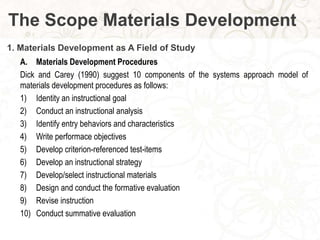
Dick and Carey (1990) suggest 10 components of the systems approach model of
materials development procedures as follows:
1) Identity an instructional goal
2) Conduct an instructional analysis
3) Identify entry behaviors and characteristics
4) Write performace objectives
5) Develop criterion-referenced test-items
6) Develop an instructional strategy
7) Develop/select instructional materials
8) Design and conduct the formative evaluation
9) Revise instruction
10) Conduct summative evaluation
The Scope Materials Development
1. Materials Development as A Practical Undertaking
A. Materials Development Procedures
It can be developed by evaluating learning materials, adapting, supplementing and
creating own materials (Pinter, 2006)
 Evaluating means the teachers evaluate and select the materials in the
textbooks according to how appropriate they seem for the given context
 Adapting means the teachers adapt the teaching materials in the textbooks
from the authentic texts
 Supplementing means the teachers cover the weakness of the materials in the
available textbooks which does not match with the syllabus/curriculum or
objectives of the teaching learning process
 Creating own materials means the teachers develop their own materials based
on teaching objectives, instructional goals, students’ needs and topic-based
planning
DEVELOPING LEARNING
MATERIALS FOR
SPECIFIC PURPOSES
There are two major steps to develop
learning materials.
A teacher has to learn the learners’
needs especially syllabus, choose
the item by one item from the
syllabus one by one and then
develop the materials
A teacher has to develop the
learning materials according to the
nature of learning materials and
the principles as well as the
procedure of developing the
learning materials
QUESTION: what is the best learning materials for ESP ? Or How to
develop learning materials for ESP?
ANSWER
1. The best learning materials of ESP should be based
on the learners’ needs and the nature of the learning
materials and the principles as well as the procedure
of developing the learning materials
2. The way how to develop learning materials can be
done by teachers with following or applying the
principles and procedures of language teaching
materials including set up their teaching objectives
and syllabus, adapting and supplementing the existing
materials, and or creating their own materials
REFERNCES
Dick, W. and Carey, L. 1990. The Systematic Design of Instruction. Third Edition. Tallahassee: Harper Collins Pu
blishers.
Harsono, Y.M. 2007. Developing Leraning Materials For Specific Purpose. TEFLIN Journal, Volume 18, Number
2, August 2007
Pinter, A. 2006. Teaching Young Language Learners. Oxford: Oxford University Press.
Tomlinson, B. 1998. In Tomlinson, B. (Ed), Materials Development in Language Teaching. Cambridge University
Press.
Tomlinson, B. 2001. Materials Development. In Carter, R. and Nunan, D. (Eds), The Cambridge Guide to Teachin
g English to Speakers of Other Languages. Cambridge: Cambridge University Press.

Ppt materials for ESP

  • 1.
    DEVELOPING LEARNING MATERIALS FORESP Harsono, Y.M. 2007. Developing Leraning Materials For Specific Purpose. TEFLIN Journal, Volume 18, Number 2, August 2007
  • 2.
    Materials Development Definition andIts forms Based on Tomlinson (2001) stated that materials mean anything which can be used to facilitate the learning of language (linguistic, visual, auditory or kinesthetic). The materials can be instructional, experiential, elicitative or exploratory Instructional material when it informs the learners about the language Experiential material when it provides the exposure to the language in use Elicitative material when it stimulates language use Exploratory material when it seeks discoveries about language use in natural settings
  • 3.
    The Scope MaterialsDevelopment 1. Materials Development as A Field of Study A. Principles of Materials Development based on Tomlinson (1998:7-21) MATERIALS MATERIALS MATERIALS • Impact • Feel at ease • Develop confidence • Relevant and useful • Opportunities to use the target language •Facilitate learner self-investment •Acquire the points being taught •Expose the learners to language in authentic use •Learners should be aware of linguistics features •Positive effect of instruction •Learners’ attitude •Permit a silent period •Maximize learning potential •Do not rely on controlled practice •Provide opportunities for outcome feedback
  • 4.
    The Scope MaterialsDevelopment 1. Materials Development as A Field of Study A. Materials Development Procedures Dick and Carey (1990) suggest 10 components of the systems approach model of materials development procedures as follows: 1) Identity an instructional goal 2) Conduct an instructional analysis 3) Identify entry behaviors and characteristics 4) Write performace objectives 5) Develop criterion-referenced test-items 6) Develop an instructional strategy 7) Develop/select instructional materials 8) Design and conduct the formative evaluation 9) Revise instruction 10) Conduct summative evaluation
  • 5.
    The Scope MaterialsDevelopment 1. Materials Development as A Practical Undertaking A. Materials Development Procedures It can be developed by evaluating learning materials, adapting, supplementing and creating own materials (Pinter, 2006)  Evaluating means the teachers evaluate and select the materials in the textbooks according to how appropriate they seem for the given context  Adapting means the teachers adapt the teaching materials in the textbooks from the authentic texts  Supplementing means the teachers cover the weakness of the materials in the available textbooks which does not match with the syllabus/curriculum or objectives of the teaching learning process  Creating own materials means the teachers develop their own materials based on teaching objectives, instructional goals, students’ needs and topic-based planning
  • 6.
    DEVELOPING LEARNING MATERIALS FOR SPECIFICPURPOSES There are two major steps to develop learning materials. A teacher has to learn the learners’ needs especially syllabus, choose the item by one item from the syllabus one by one and then develop the materials A teacher has to develop the learning materials according to the nature of learning materials and the principles as well as the procedure of developing the learning materials
  • 7.
    QUESTION: what isthe best learning materials for ESP ? Or How to develop learning materials for ESP? ANSWER 1. The best learning materials of ESP should be based on the learners’ needs and the nature of the learning materials and the principles as well as the procedure of developing the learning materials 2. The way how to develop learning materials can be done by teachers with following or applying the principles and procedures of language teaching materials including set up their teaching objectives and syllabus, adapting and supplementing the existing materials, and or creating their own materials
  • 8.
    REFERNCES Dick, W. andCarey, L. 1990. The Systematic Design of Instruction. Third Edition. Tallahassee: Harper Collins Pu blishers. Harsono, Y.M. 2007. Developing Leraning Materials For Specific Purpose. TEFLIN Journal, Volume 18, Number 2, August 2007 Pinter, A. 2006. Teaching Young Language Learners. Oxford: Oxford University Press. Tomlinson, B. 1998. In Tomlinson, B. (Ed), Materials Development in Language Teaching. Cambridge University Press. Tomlinson, B. 2001. Materials Development. In Carter, R. and Nunan, D. (Eds), The Cambridge Guide to Teachin g English to Speakers of Other Languages. Cambridge: Cambridge University Press.