The document discusses the role of textbooks and materials in English language teaching. It addresses both the advantages and disadvantages of using textbooks in the classroom. Some key points made include:
- Textbooks are widely used but also debated in the ELT field due to issues around how well they guide learning and represent language/culture.
- Advantages of textbooks include helping students measure progress, being time/cost effective for teachers, and supporting less experienced instructors.
- Disadvantages include textbooks sometimes being too rigid or reflecting author biases, and unnatural language models.
- Effective adaptation of materials is important to achieve congruence between variables like objectives, students' needs, and teaching style. Teachers should analyze when and how
Examines the significance, advantages, and limitations of textbooks in English Language Teaching (ELT). Discusses their potential, relevance to learners, and cultural implications.
Focuses on the necessity of adapting materials for effective teaching. Discusses strategies for alignment with learners' needs, grammar coverage, and appropriate content.Summarizes the key findings about material adaptation and emphasizes the importance of matching materials to teachers' and students' needs. Thanks and references provided.
“ Managing Strategiesand Materials to Improve the ELT Classroom” Beatriz Peña Dix [email_address]
2.
ELT materials (textbooks)play a very important role in many language classrooms but in recent years there has been a lot of debate throughout the ELT profession on the actual role of materials in teaching English as a Second/Foreign Language (TESL/TEFL).
3.
ISSUES TO REFLECTPotential and the limitations of materials for 'guiding' students through the learning process and curriculum Needs and preferences of teachers who are using textbooks Textbook design and practicality Textbook methodological validity The role of textbooks in innovation The authenticity of materials in terms of their representation of language, and the appropriateness of gender, representation, subject matter, and cultural components .
4.
As Hutchinson andTorres (1994) suggest: "The textbook is an almost universal element of [English language] teaching. Millions of copies are sold every year, and numerous aid projects have been set up to produce them in [various]countries…No teaching-learning situation, it seems, is complete until it has its relevant textbook. " (p.315).
5.
ADVANTAGES Haycroft (1998): The primary advantages of using textbooks is that they are psychologically essential for students since their progress and achievement can be measured concretely when we use them. Sheldon (1988): Students often harbor expectations about using a textbook in their particular language classroom and program and believe that published materials have more credibility than teacher-generated or "in-house" materials.
6.
O'Neill (1982): Textbooks are generally sensitive to students' needs, even if they are not designed specifically for them, they are efficient in terms of time and money, and they can and should allow for adaptation and improvisation. O'Neill, 1982; Sheldon, 1988: Textbooks yield a respectable return on investment, are relatively inexpensive and involve low lesson preparation time, whereas teacher-generated materials can be time, cost and quality defective. In this way, textbooks can reduce potential occupational overload and allow teachers the opportunity to spend their time undertaking more worthwhile pursuits . ADVANTAGES
7.
ADVANTAGES Cunningsworth (1995): Textbooks are an effective resource for self-directed learning, an effective resource for presentation material, a source of ideas and activities, a reference source for students, a syllabus where they reflect pre-determined learning objectives, and support for less experienced teachers who have yet to gain in confidence. O'Neill, 1982; Williams, 1983; Kitao & Kitao, 1997: Although some theorists have alluded to the inherent danger of the inexperienced teacher who may use a textbook as a pedagogic crutch, such an overreliance may actually have the opposite effect of saving students from a teacher's deficiencies.
8.
ADVANTAGES Hutchinson andTorres (1994): Textbooks may play a pivotal role in innovation. They can support teachers through potentially disturbing and threatening change processes, demonstrate new and/or untried methodologies, introduce change gradually, and create scaffolding upon which teachers can build a more creative methodology of their own.
9.
ADVANTAGES Gray (2000): English language textbooks are actuallyambassadorial cultural artifacts and that students should not only critically engage their textbooks but also view them as more than mere linguistic objects. Learners will improve their language skills by using their textbooks as useful instruments for provoking discussion, cultural debate, and a two-way flow of information.
10.
Disadvantages Allwright (1982): Textbooks are too inflexible and generally reflect the pedagogic,psychological, and linguistic preferences and biases of their authors. Porreca (1984), Florent and Walter (1989), Clarke and Clarke (1990), Carrell and Korwitz (1994), and Renner (1997): Many EFL/ESL textbooks still contain rampant examples of gender bias, sexism, and stereotyping.
11.
Disadvantages Prodromou(1988) and Alptekin (1993): The target language culture as a vehicle for teaching the language in textbooks and suggest that it is not really possible to teach a language without embedding it in its cultural base. Brazil, Coulthard, and Johns, 1980; Levis, 1999: Many scripted textbook language models and dialogues are unnatural and inappropriate for communicative or cooperative language teaching because they do not adequately prepare students for the language structures, grammar, idioms, vocabulary and conversational rules, routines and strategies that they will have to use in the real-world.
12.
ADAPTING MATERIALS BRIDGING MAKING OBJECTIVES MEET REQUIREMENTS MATCHING PURPOSE MAXIMAZING APPROPRIACY LOOKING FOR “CONGRUENCE”
13.
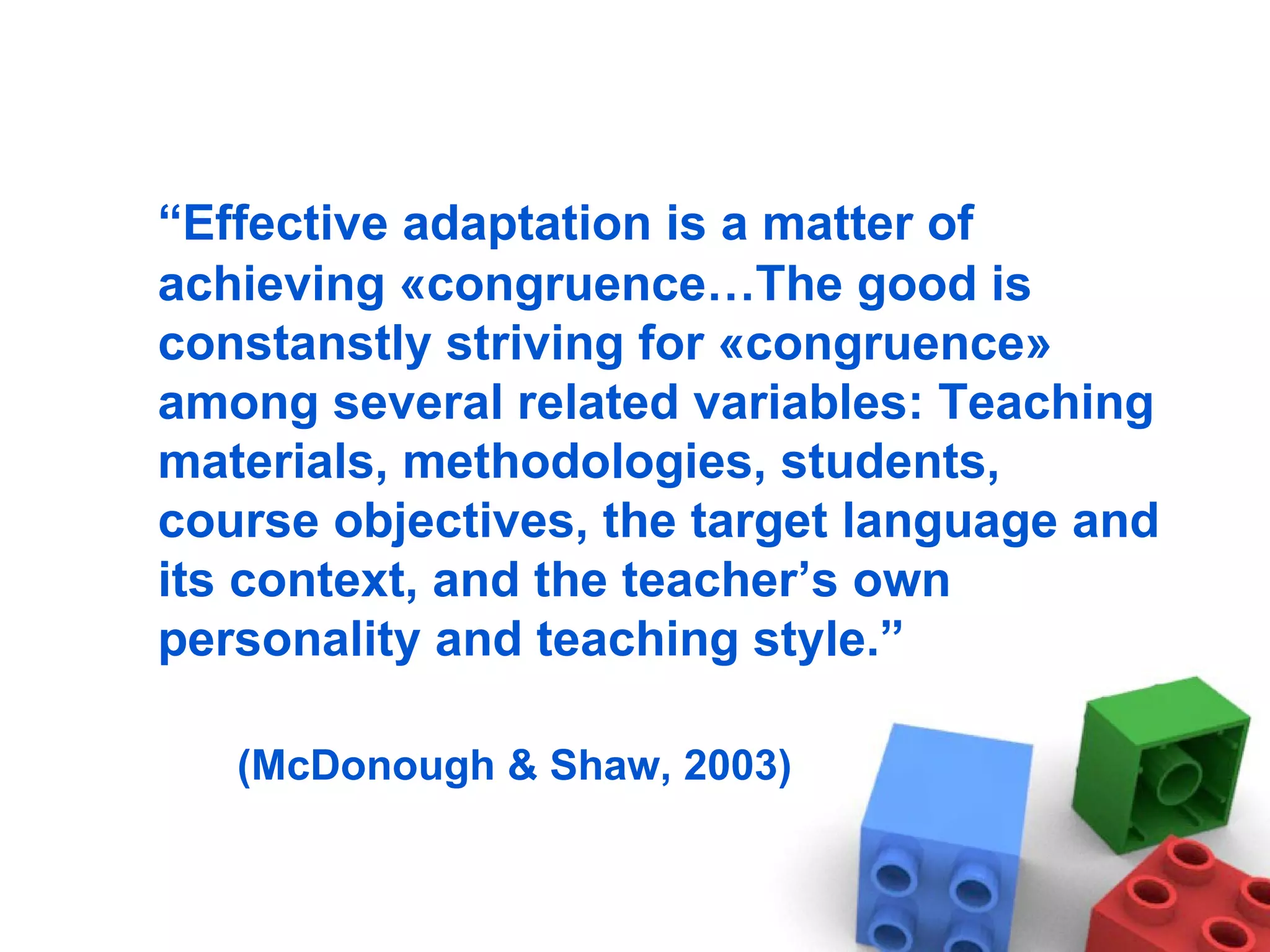
“ Effective adaptationis a matter of achieving « congruence …The good is constanstly striving for « congruence » among several related variables: Teaching materials, methodologies, students, course objectives, the target language and its context, and the teacher’s own personality and teaching style.” (McDonough & Shaw, 2003)
14.
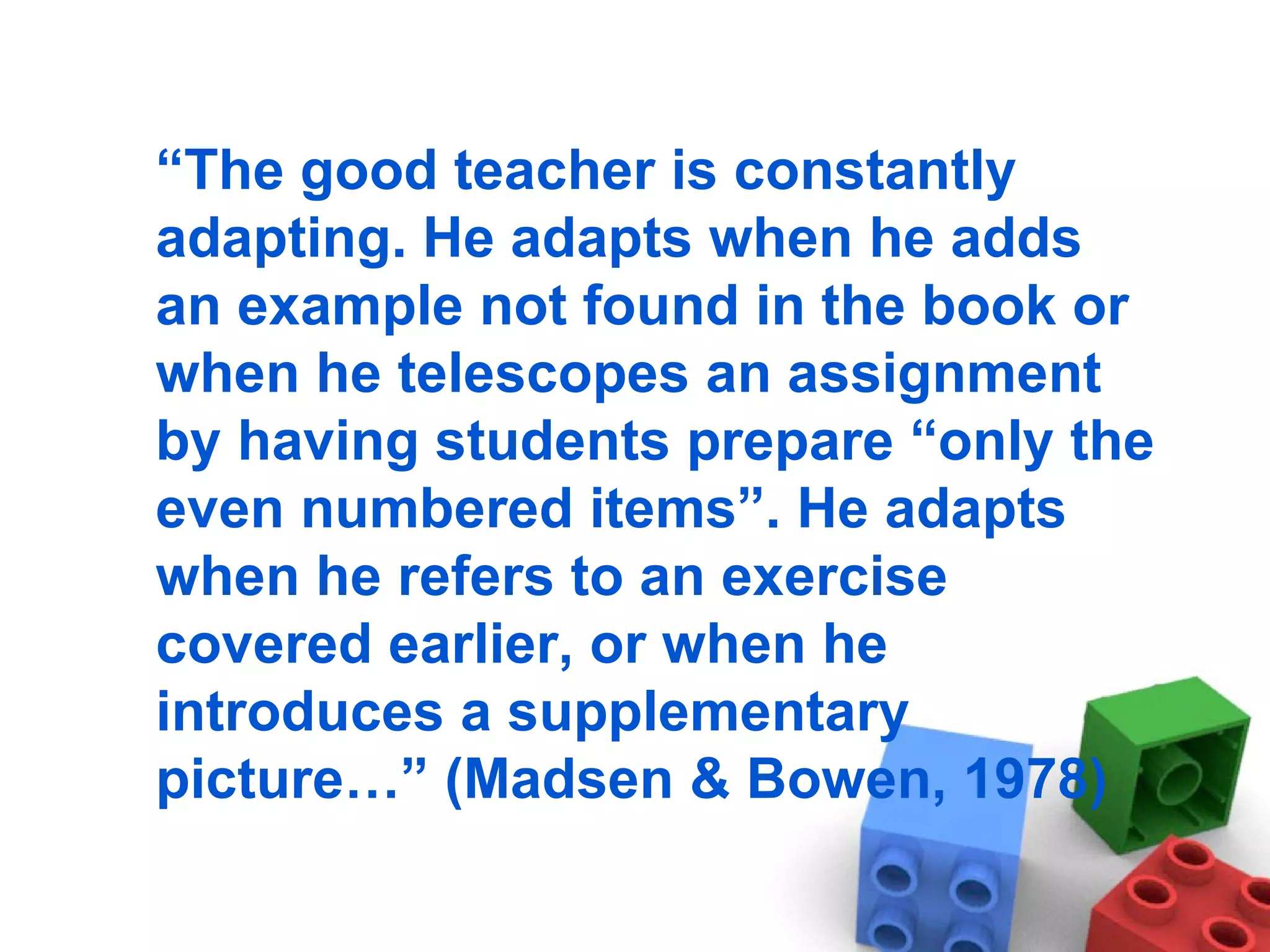
“ The goodteacher is constantly adapting. He adapts when he adds an example not found in the book or when he telescopes an assignment by having students prepare “only the even numbered items”. He adapts when he refers to an exercise covered earlier, or when he introduces a supplementary picture…” (Madsen & Bowen, 1978)
15.
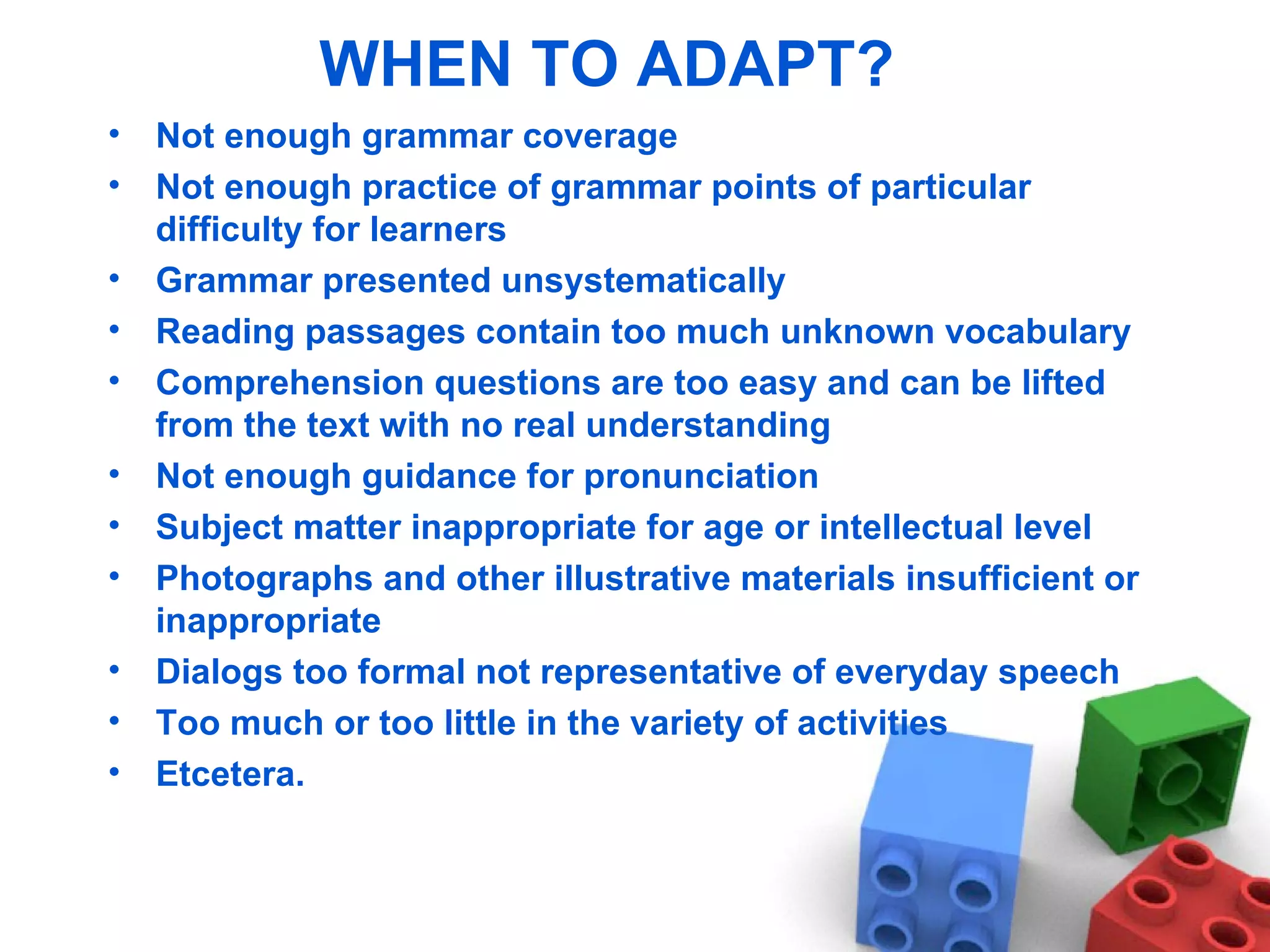
WHEN TO ADAPT?Not enough grammar coverage Not enough practice of grammar points of particular difficulty for learners Grammar presented unsystematically Reading passages contain too much unknown vocabulary Comprehension questions are too easy and can be lifted from the text with no real understanding Not enough guidance for pronunciation Subject matter inappropriate for age or intellectual level Photographs and other illustrative materials insufficient or inappropriate Dialogs too formal not representative of everyday speech Too much or too little in the variety of activities Etcetera.
16.
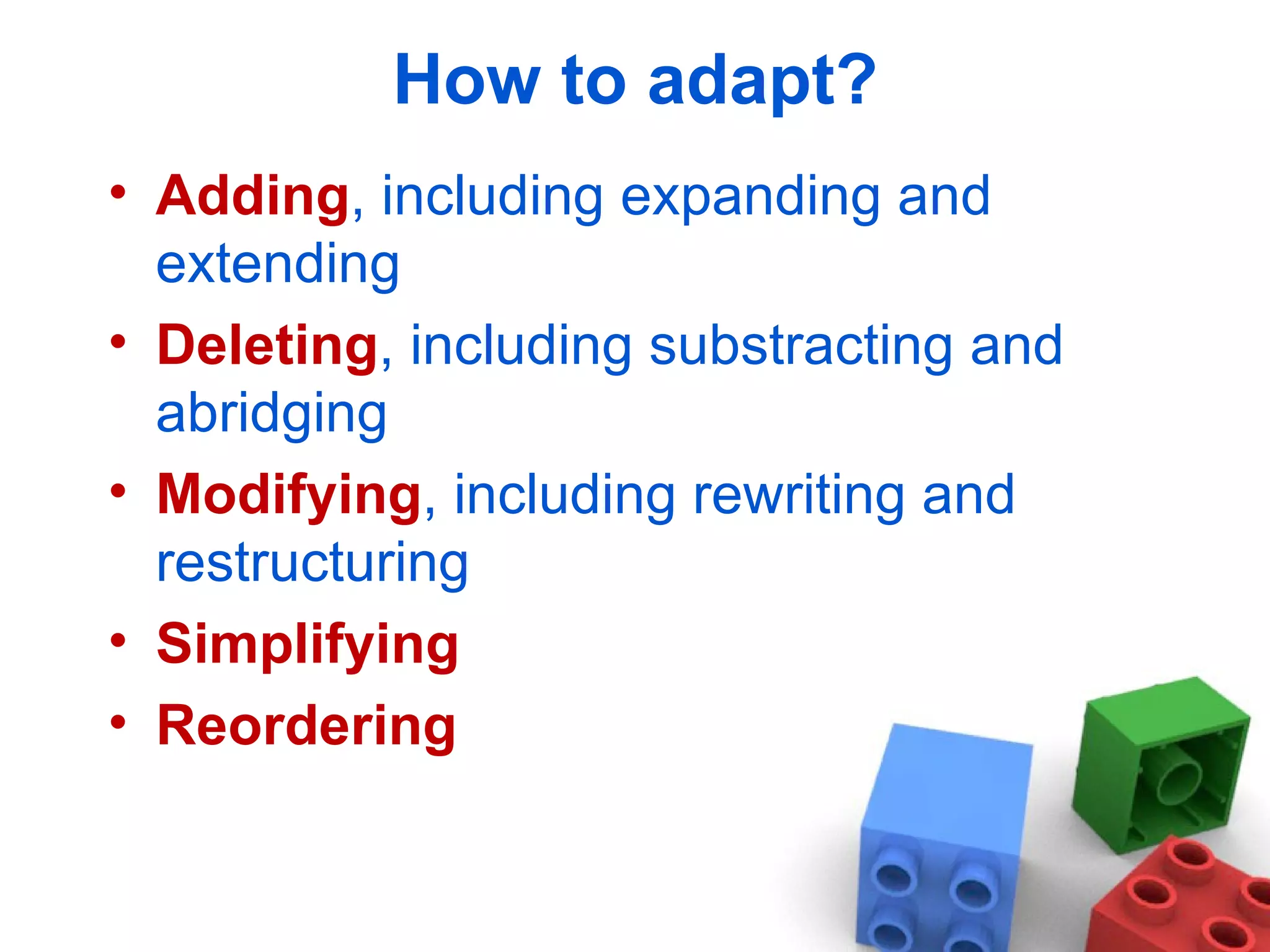
How to adapt?Adding , including expanding and extending Deleting , including substracting and abridging Modifying , including rewriting and restructuring Simplifying Reordering
17.
Adding , includingexpanding and extending Deleting , including substracting and abridging Modifying , including rewriting and restructuring Simplifying Reordering Analyze the strategies of adapting materials. Which of those strategies do you apply the most? What is the criteria for using them?
18.
On you!! Imaginea lesson plan for beginners (A1) based on the sample materials Adapt the lesson/ unit by using any of the strategies of material adaptation: Adding , including expanding and extending Deleting , including substracting and abridging Modifying , including rewriting and restructuring Simplifying Reordering
19.
Conclusions There is no “perfect” suitable material. Good materials permit teacher’s adaptation, creativity and innovation. Teachers must be aware of matching materials to course needs. Materials need to be relevated from time. Course goals and abjectives must meet materials’ goals and objectives.
REFERENCES Allwright, R.1982. 'What Do We Want Teaching Materials For?' ELT Journal. Volume 36/1. Cunningsworth, A 1995. Choosing Your Coursebook . Heinemann. Kitao, K. and S. Kitao. 1997. 'Selecting and Developing Teaching/Learning Materials.' The Internet TESL Journal.Vol. IV, No.4. Web-Site: Http://www.aitech.ac.jp/-iteslj/Articles/Kitao-Materials.html . McDonough, J. and C. Shaw. 2003. Materials and Methods in ELT: A Teacher's Guide :Wiley Blackwell O'Neill, R. 1982. 'Why Use Textbooks?'. ELT Journal. Volume 36/2.
![“ Managing Strategies and Materials to Improve the ELT Classroom” Beatriz Peña Dix [email_address]](https://image.slidesharecdn.com/materialadaptation-110806185415-phpapp02/75/Material-adaptation-1-2048.jpg)
![As Hutchinson and Torres (1994) suggest: "The textbook is an almost universal element of [English language] teaching. Millions of copies are sold every year, and numerous aid projects have been set up to produce them in [various]countries…No teaching-learning situation, it seems, is complete until it has its relevant textbook. " (p.315).](https://image.slidesharecdn.com/materialadaptation-110806185415-phpapp02/75/Material-adaptation-4-2048.jpg)