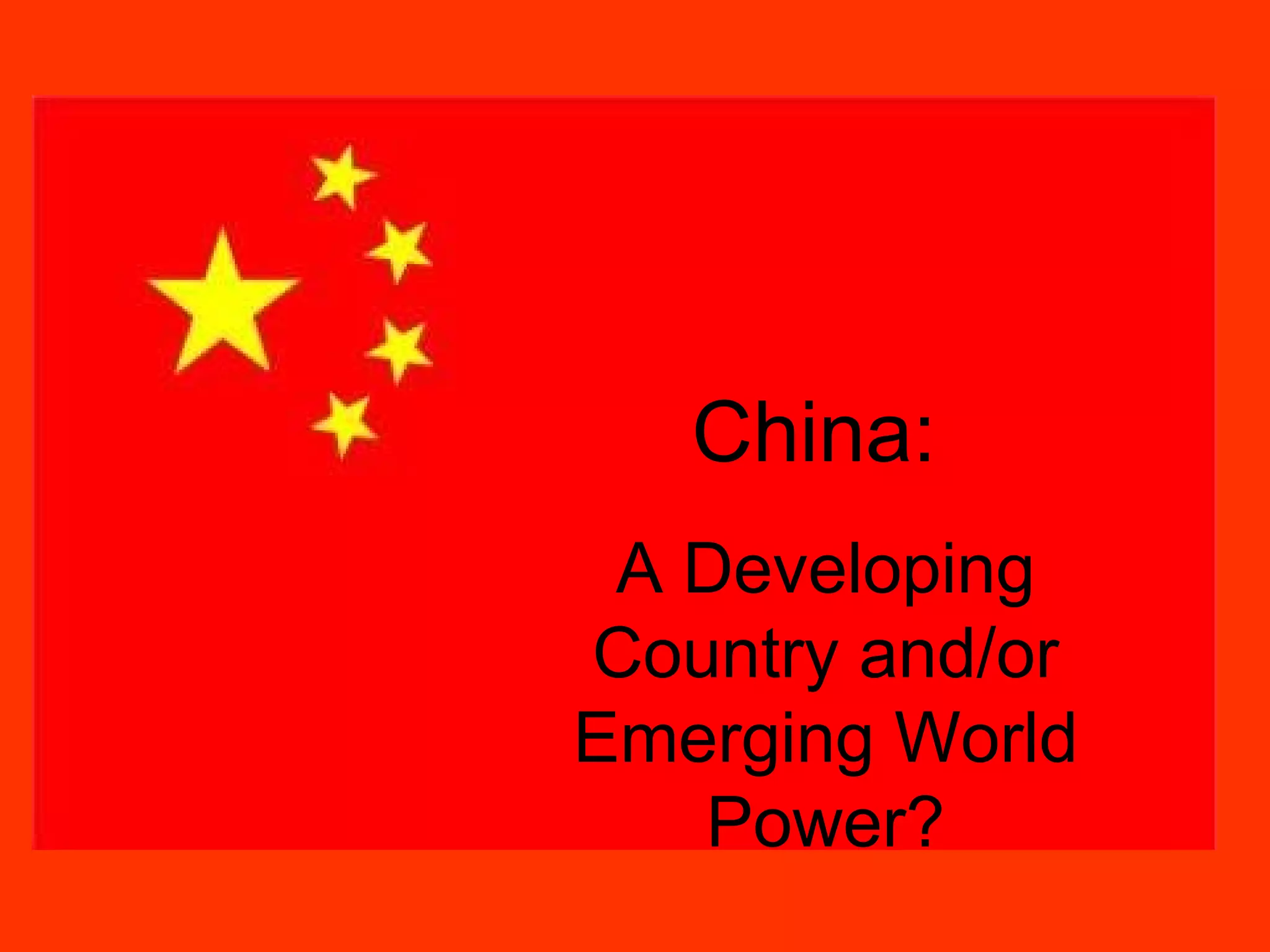
China in the Red China:  A Developing Country and/or Emerging World Power?
Chronology Opium War (1839-1842); China defeated by Britain Treaty of Nanking, example of the Unequal treaties; different treatment for foreigners; trading concessions China defeated in war against Japan in 1894-1895 Boxer Rebellion (1899-1901); concentrated in northern China where European powers had begun to demand territorial, rail, and mining concessions; originally against the dynasty but then were used a a tool to remove foreign powers from China Attacked foreign compounds; missionaries also targeted Navies from other countries arrive (e.g. Japan, Russia, GB, US) to put down the rebellion Atrocities also committed by the Eight-Nation Alliance
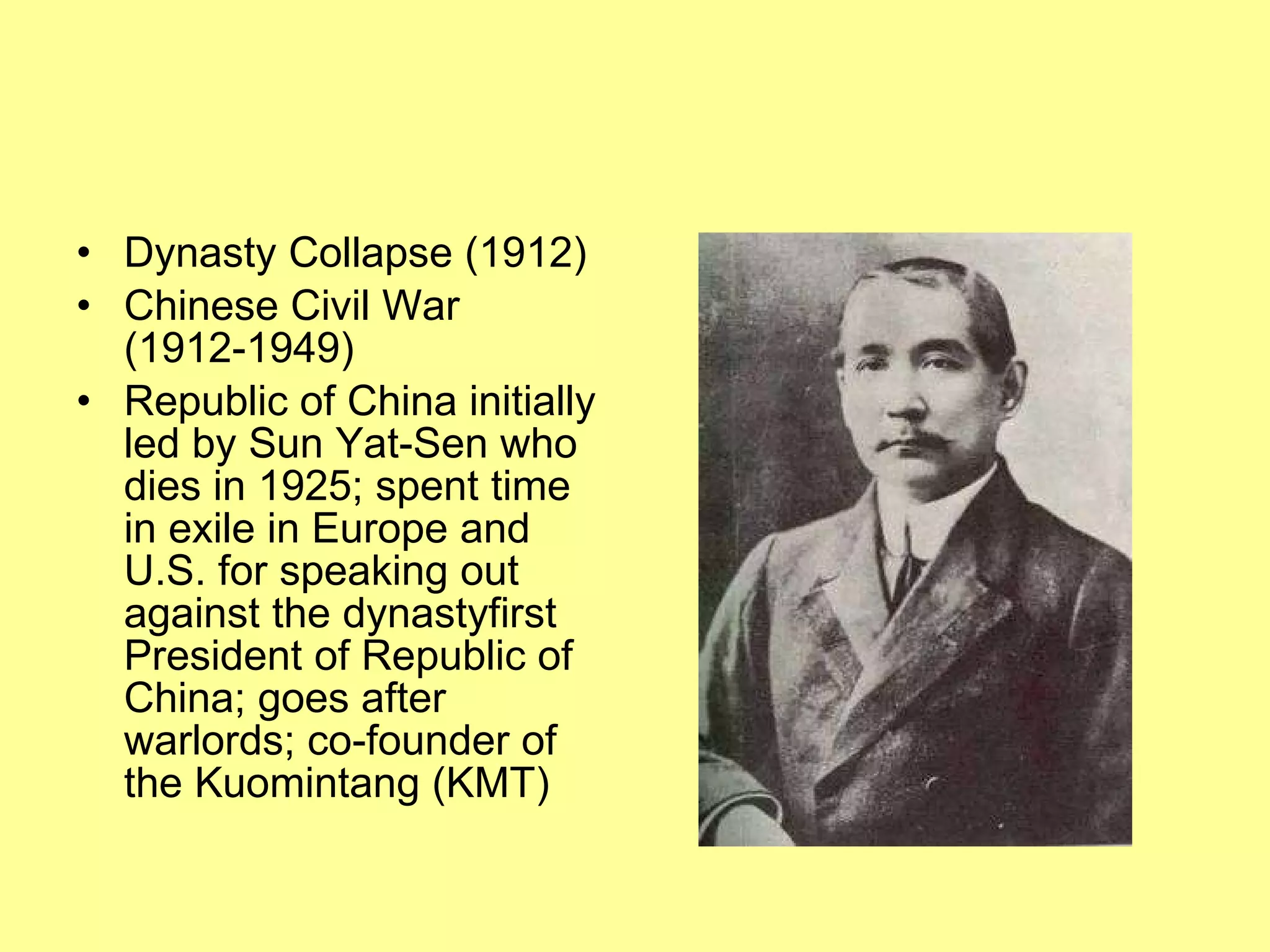
Dynasty Collapse (1912) Chinese Civil War (1912-1949) Republic of China initially led by Sun Yat-Sen who dies in 1925; spent time in exile in Europe and U.S. for speaking out against the dynastyfirst President of Republic of China; goes after warlords; co-founder of the Kuomintang (KMT)
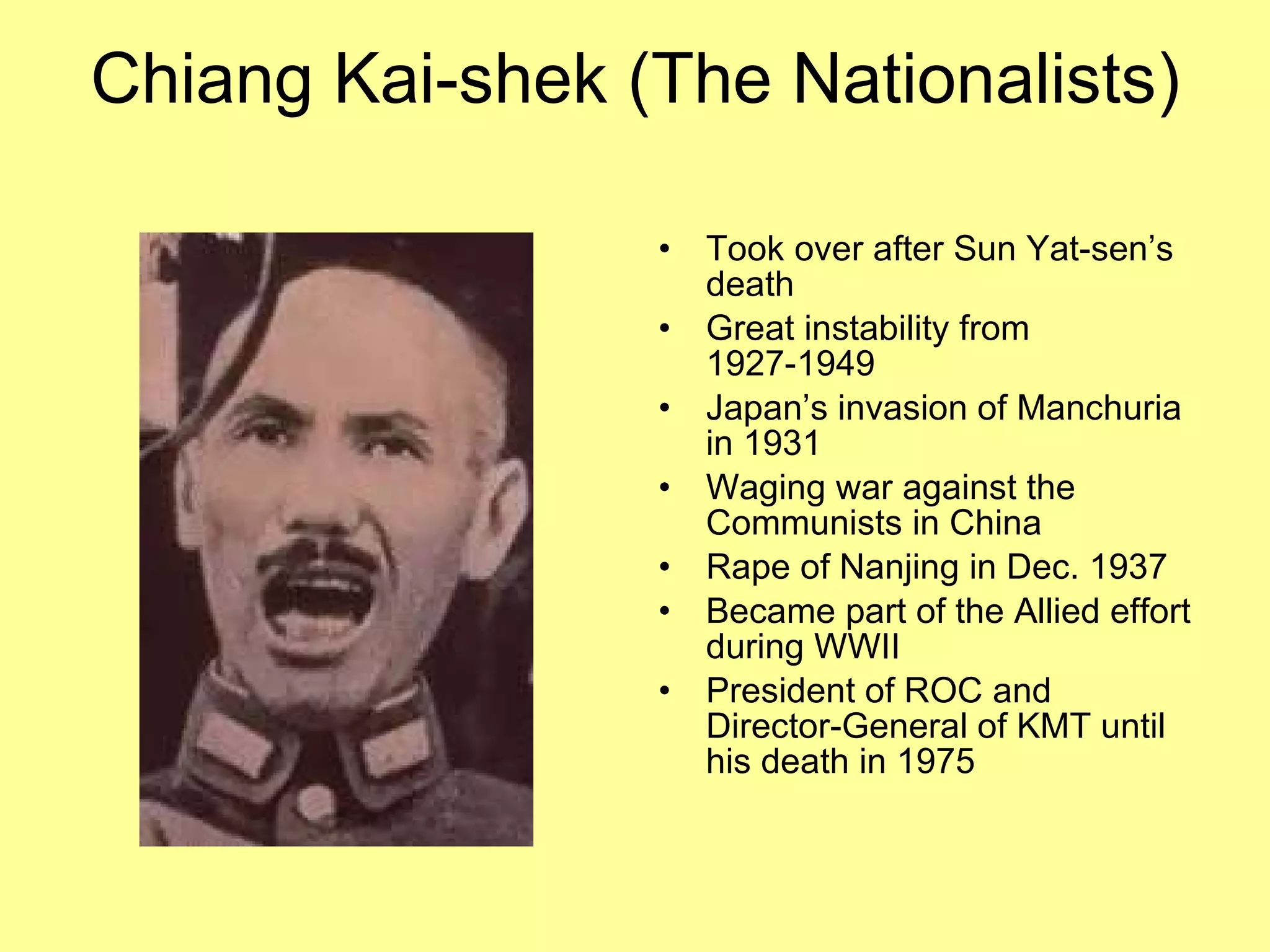
Chiang Kai-shek (The Nationalists) Took over after Sun Yat-sen’s death Great instability from 1927-1949 Japan’s invasion of Manchuria in 1931 Waging war against the Communists in China Rape of Nanjing in Dec. 1937 Became part of the Allied effort during WWII President of ROC and Director-General of KMT until his death in 1975
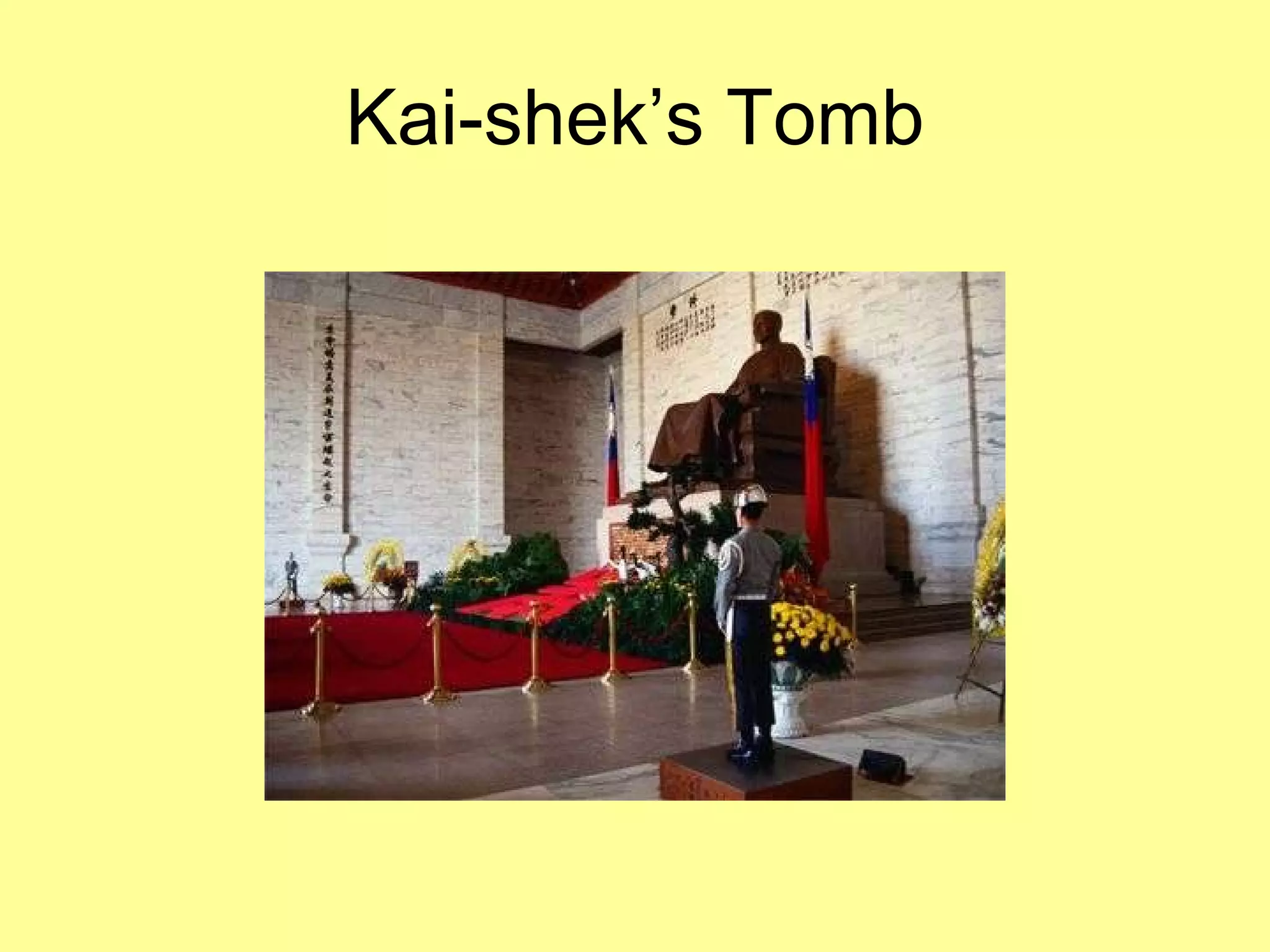
Kai-shek’s Tomb
Mao Zedong (The Communists)
Mao’s life Born in 1893 to a peasant family Studies in Beijing Came to violent Marxism gradually; saw the Bolshevik revolution as a model Revolution could not be steered by the Nationalists Established ‘soviet’ areas under the control of the CPC in the rural areas Chaing Kai-shek determined to eliminate the communists which leads to the Long March in 1934 (retreat by Communists to northwest of China) While WWII went on, Mao also led forces against the Japanese After WWII was over, war between the Nationalists and Communists continued and the People’s Republic of China declared on October 1, 1949 Kai-shek flees to Taiwan (Formosa) and established the ROC
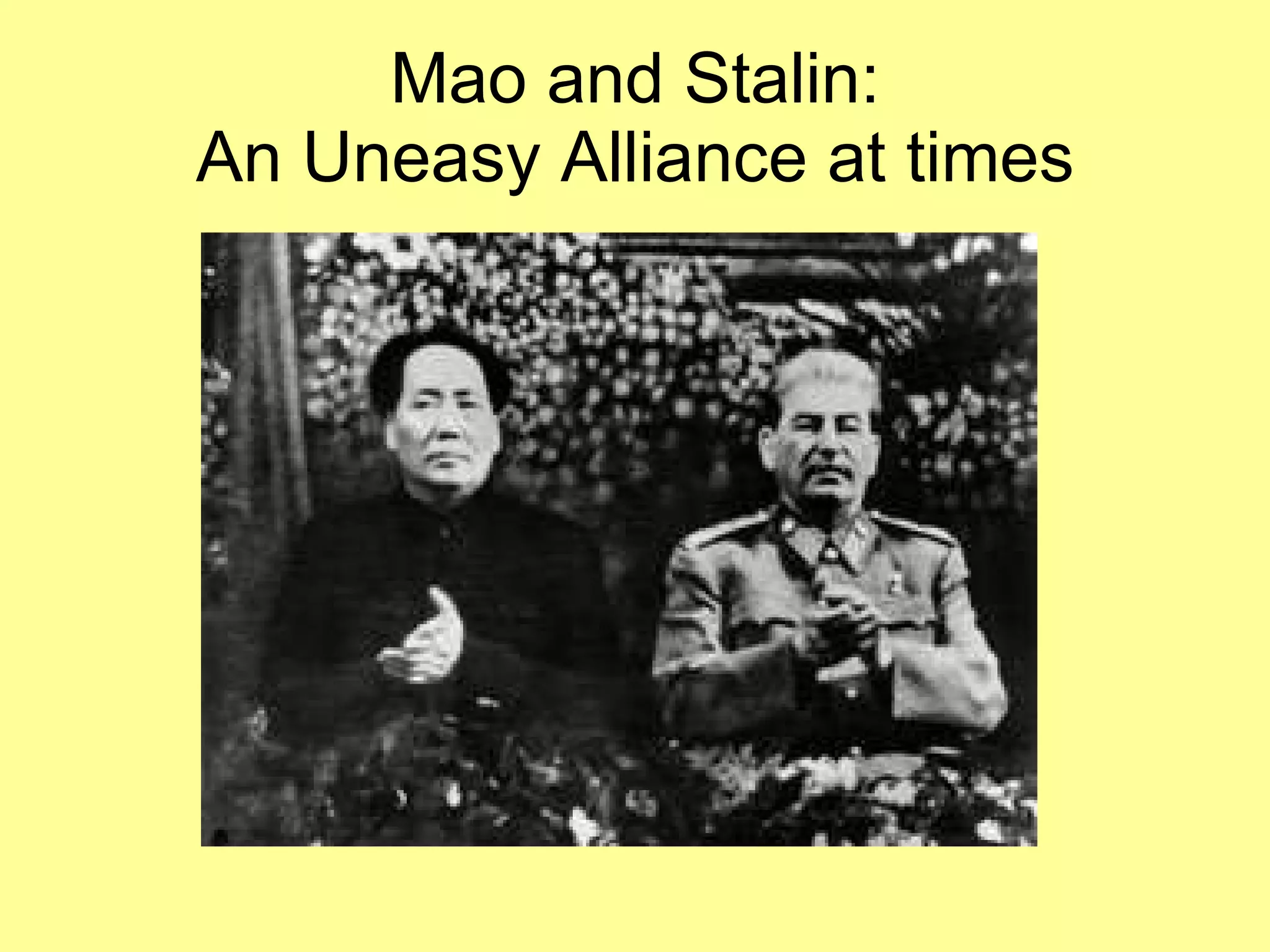
Mao and Stalin: An Uneasy Alliance at times
Korean War (1950-1953) The Hundred Flowers Campaign (1957) Great Leap Forward (1958-1960); 20-30 million dead mainly from starvation China explodes atomic bomb in 1964 Great Proletarian Cultural Revolution (1966-1976); tens of thousands sent to reeducation camps, near anarchy in many areas of China; unleashed Marxist-Leninist-Mao Zedong Thought
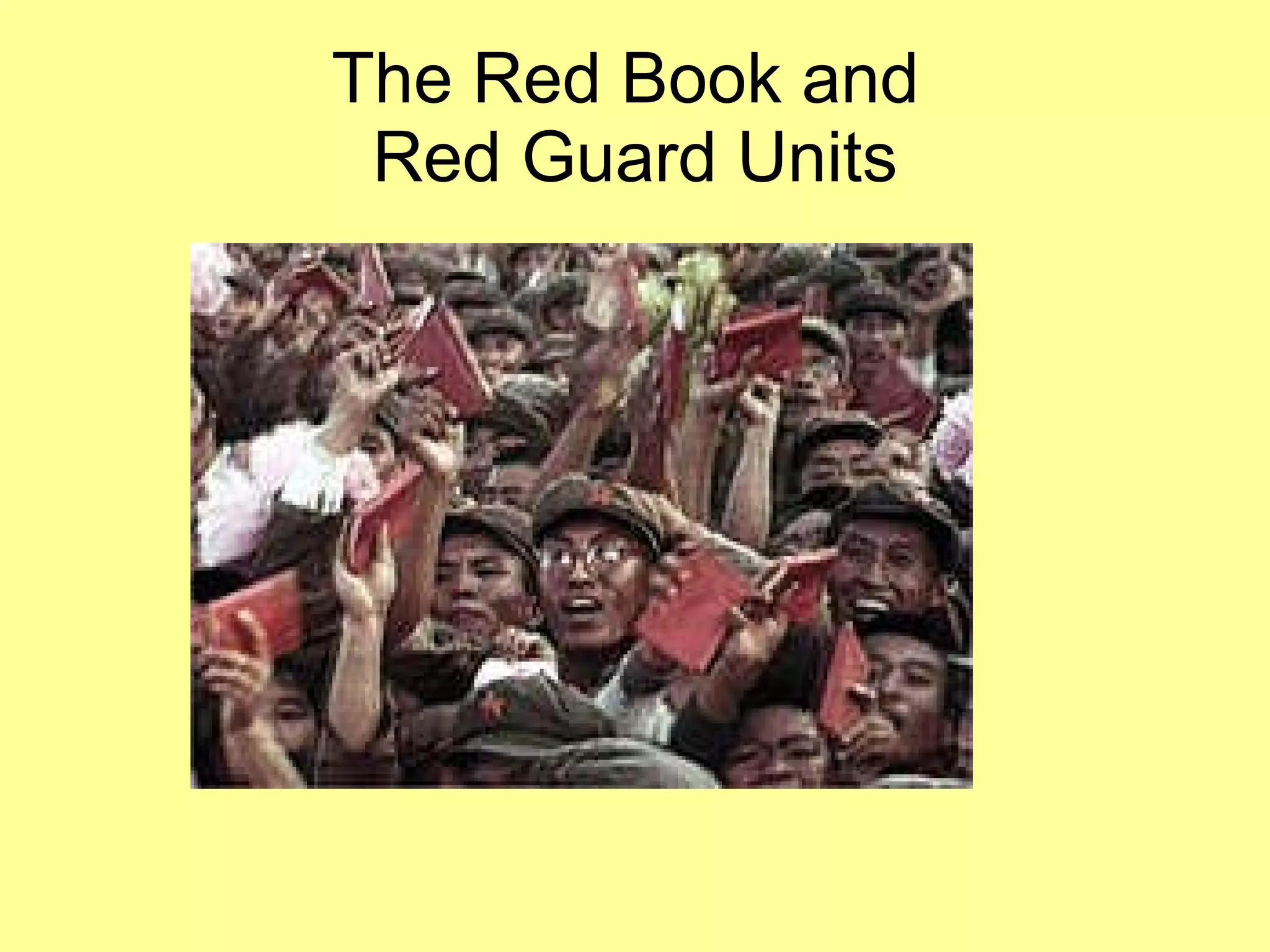
The Red Book and  Red Guard Units
Justification Although the bourgeoisie has been overthrown, it is still trying to use the old ideas, culture, customs, and habits of the exploiting classes to corrupt the masses, capture their minds, and endeavor to stage a comeback.  The proletariat must do just the opposite: It must meet head-on every challenge of the bourgeoisie in the ideological field and use the new ideas, culture, customs, and habits of the proletariat to change the mental outlook of the whole of society.  At present, our objective is to struggle against and crush those persons in authority who are taking the capitalist road, to criticize and repudiate the reactionary bourgeois academic "authorities" and the ideology of the bourgeoisie and all other exploiting classes and to transform education, literature and art, and all other parts of the superstructure that do not correspond to the socialist economic base, so as to facilitate the consolidation and development of the socialist system.
Chinese poster saying: "Shatter the old world / Establish a new world." Classical example of the Red art from the early Cultural Revolution. A worker (or possibly Red Guard) crushes the crucifix, Buddha and classical Chinese texts with his hammer; 1967
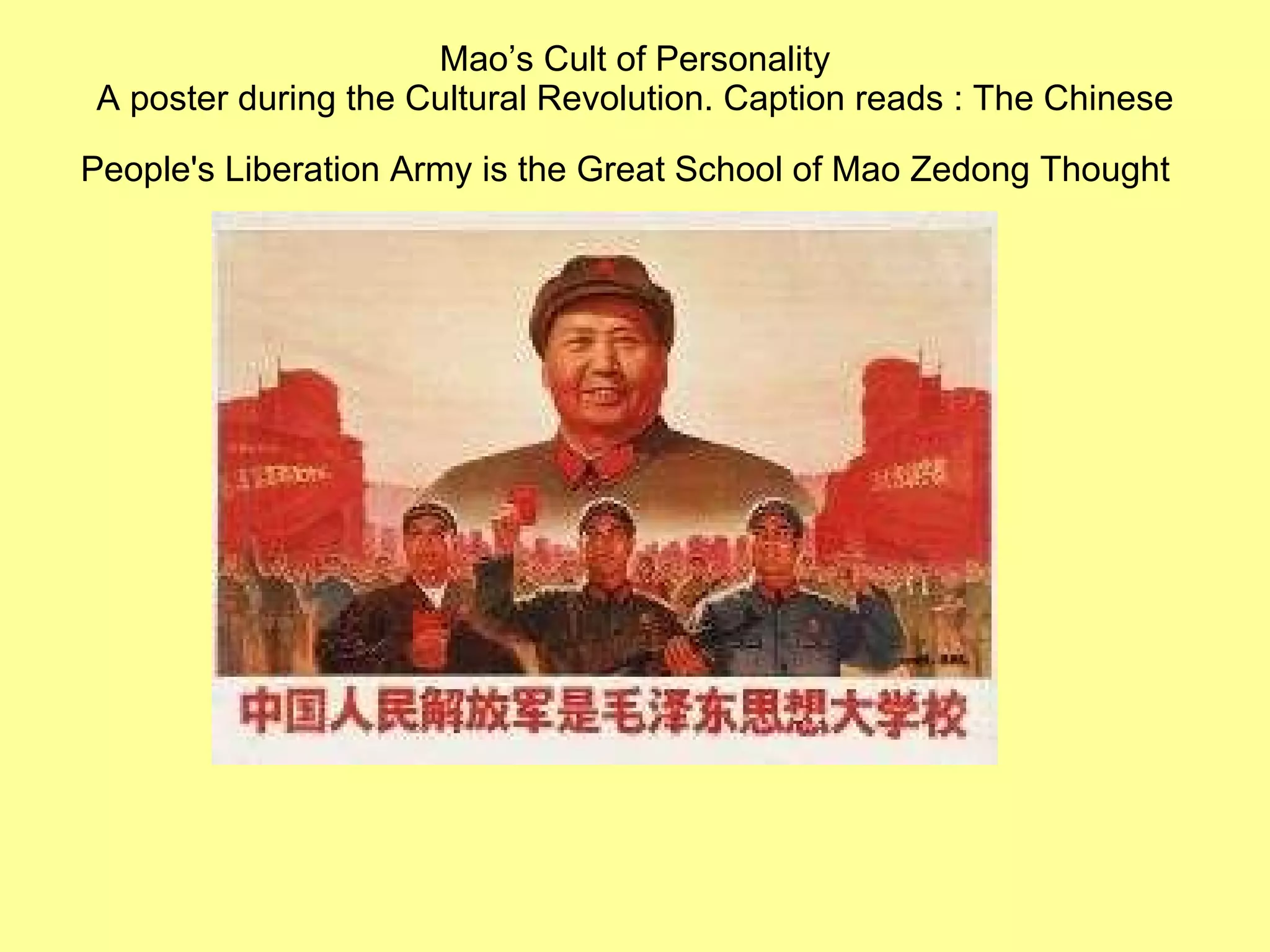
Mao’s Cult of Personality A poster during the Cultural Revolution. Caption reads : The Chinese People's Liberation Army is the Great School of Mao Zedong Thought
A government poster calling for the "Immediate overthrow of the [anti-Communist]" Gang of Four; one included Mao’s widow; show trial; eventually released Communist China (PRC) takes over permanent seat at UNSC in 1971 from Taiwan Nixon visits China in 1972 Gang of Four trials in 1976 Mao dies in 1976, power struggle Deng Xiaoping emerges on top
Nixon meeting Mao  Policy of Triangulation under Kissinger
The Great Transformation Under Deng Xiaoping (1978-1997) Denounced Mao’s excesses Had been purged by Mao It doesn’t matter if the cat is black or white, so long as it catches mice To get rich is glorious
The Goddess of Democracy
May/June 1989: Tiananmen Square
Important Factors to Understand May 4 observance (Unfair terms of Treaty of Versailles) Rising inflation Democracy walls permitted  Death of Hu Yaobang during a heated conversation between hard-liners and soft-liners Winds of change in Eastern Europe
Zhao Ziyang “I have come too late.”
Since the massacre… More focus on urban development to the detriment of rural development Increasing income inequality….the deal as long as the economy keeps growing, people won’t want to agitate for political change Leaders still in jail. Some escaped to the other countries Zhao Ziyang’s memoirs released in 2009  China blocked Facebook, Twitter  days before June 4, 2009 (20 th  anniversary)
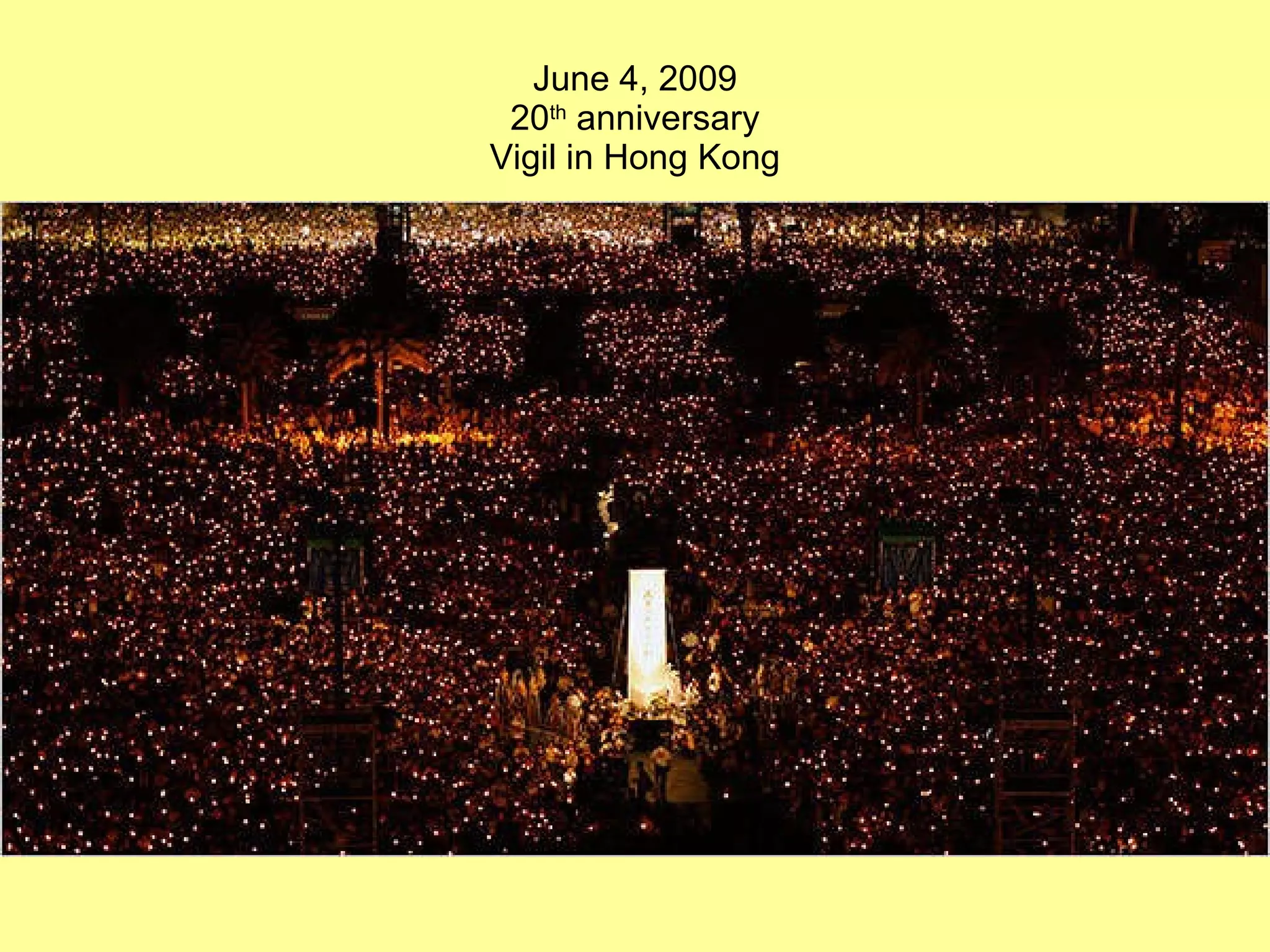
June 4, 2009 20 th  anniversary Vigil in Hong Kong
Jiang Zemin and President Bush Jiang’s Theory of the “Three Represents”
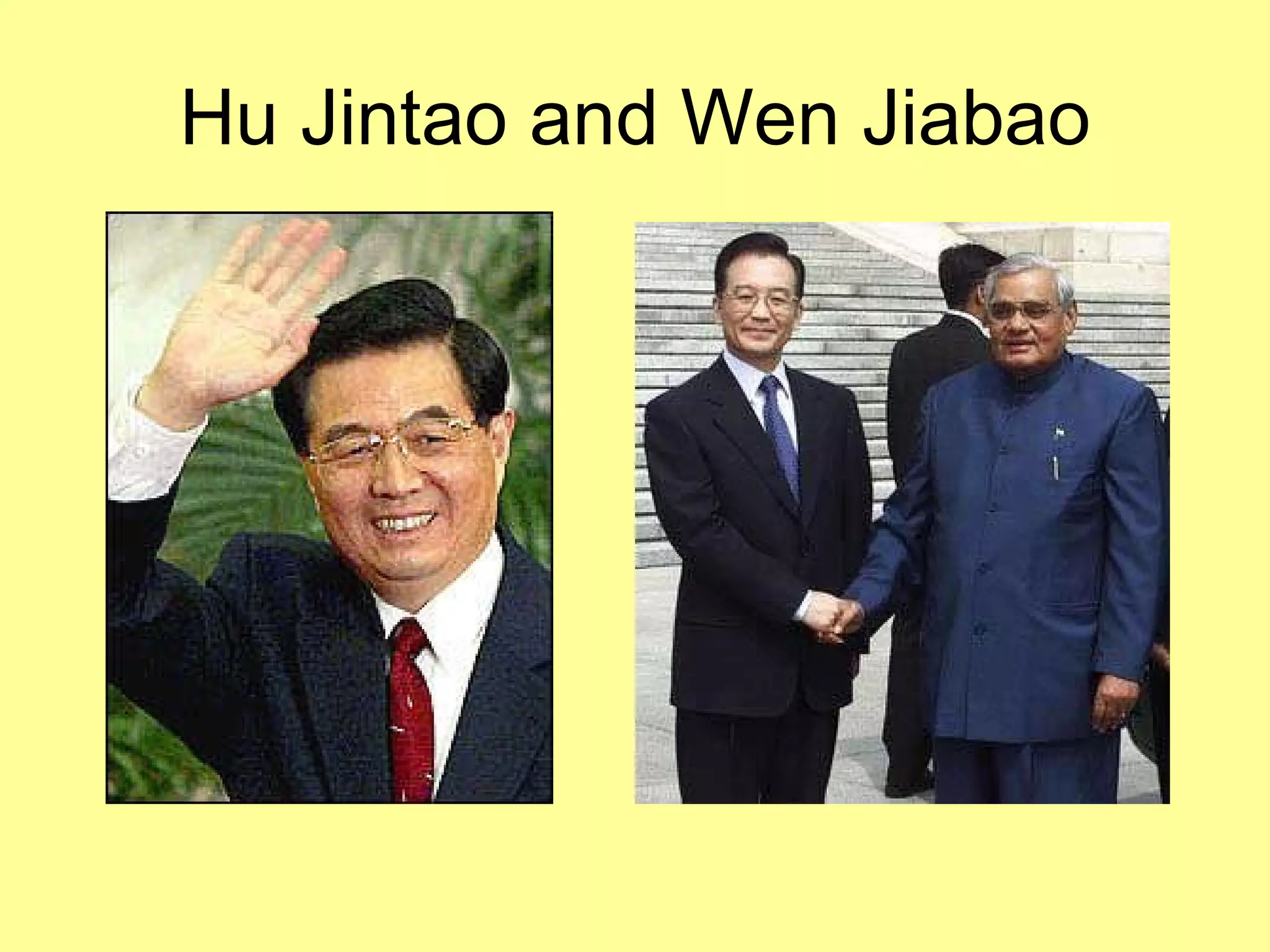
Hu Jintao and Wen Jiabao
Who is Hu? Hu was selected by Deng to come after Jiang Jiang reluctantly let goes of power over military Highly unlikely that Hu is a closet liberal Hu has referred to Western style democracy as a blind alley for China How to deal with North Korea and Taiwan- will talk in depth about this.  Talks repeatedly of China’s ‘peaceful rise’ Next president in China will emerge in 2012
China Today $8 Trillion GDP $6,600 GDP per capita 91% Literacy rate 43% urbanized population Gini coefficient is 0.42 By 2040, China will produce 40% of Global GDP World's largest army 200 nuclear weapons
Issues  to Discuss Trade Surplus with the US/China’s Economy Human Rights Violations (Falung Gong, Tibet, Xinjiang province against the Uighurs; lack of religious freedom) SARS outbreak 2003/Ongoing AIDS crisis Olympics in 2008 Crisis over Taiwan/Taiwan’s status Dispute over Hong Kong’s Future China’s assistance with N. Korea and six-party talks The Peaceful Rise of China?  Biggest threat to US hegemony in the 21 st  century? The oil factor? Survival of the Chinese Communist Party- corruption purges, increasing income inequality throughout China
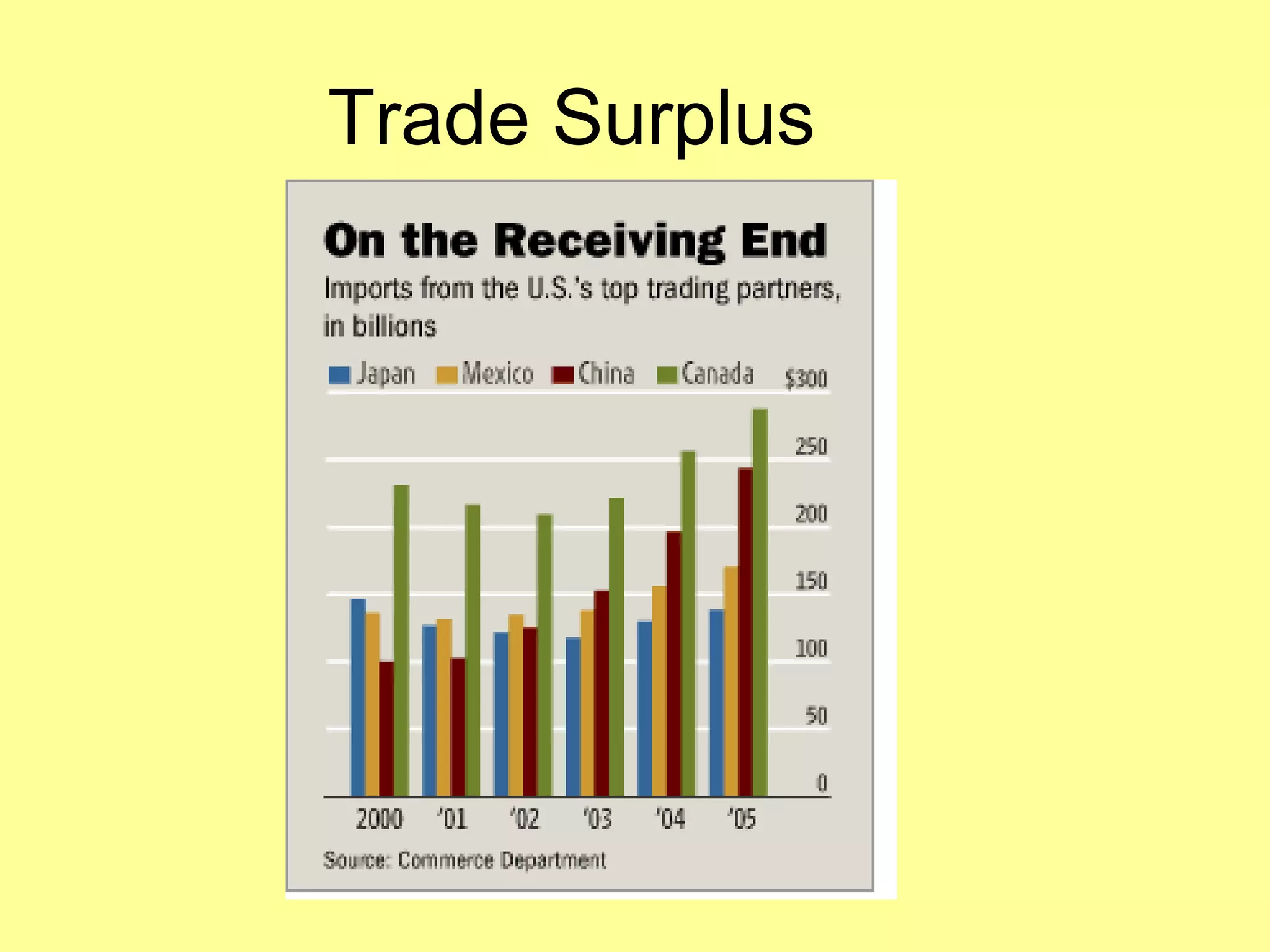
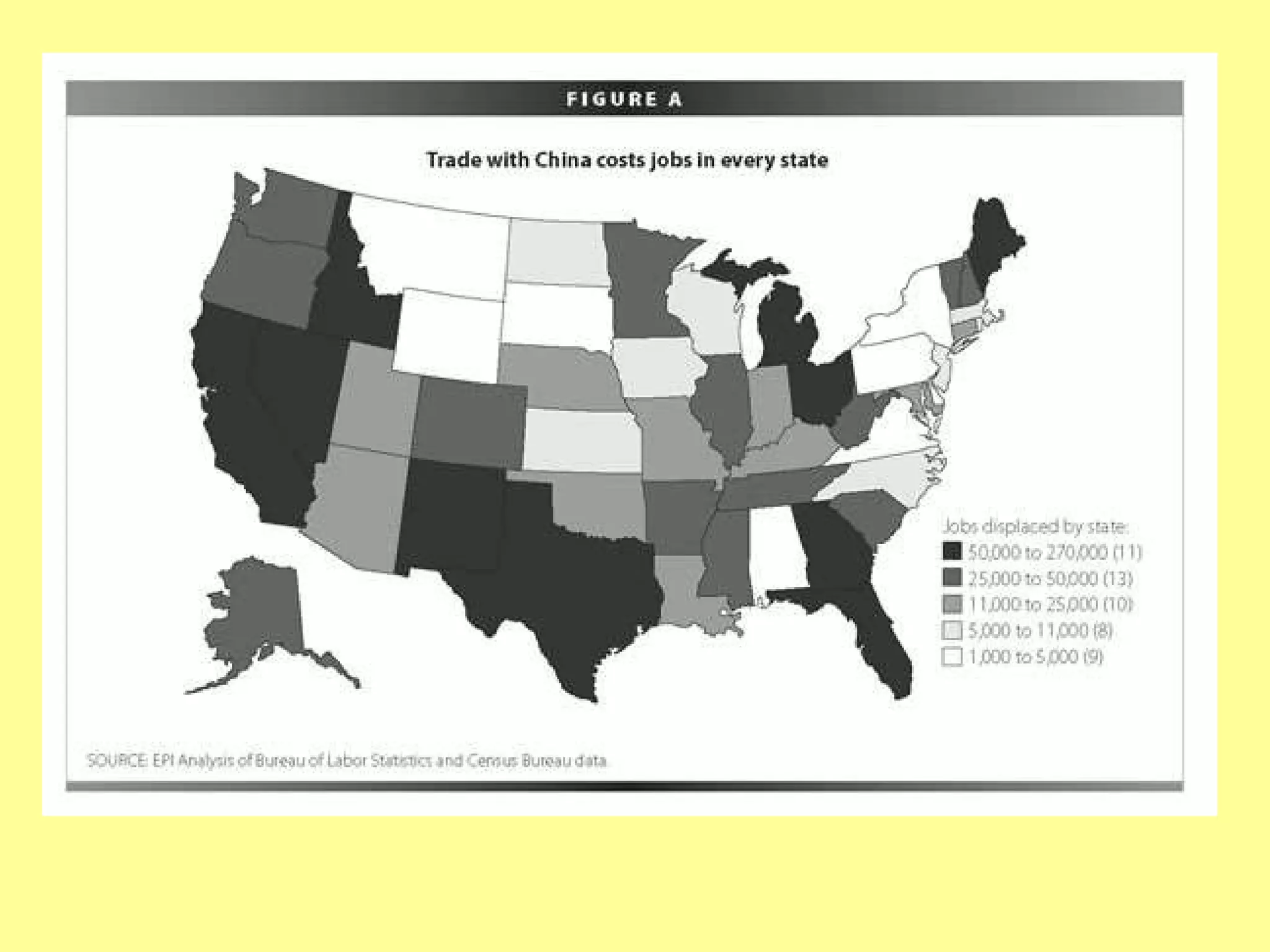
Trade Surplus
Trade deficit
 
In 2007, the US and China accounted for 30% of the world’s GDP In 2008, bilateral trade stood at $409 billion. Chinese exports to the US amount to 8% of China’s GDP. At the end of 2008, China held $700 billion in reserve of U.S. treasury notes.
Is the trade deficit an issue we should be concerned about? How does this affect Americans’ pocketbooks? The Wal-mart price China as the biggest consumer of many products now including cement and steel China’s holding of U.S. dollars in reserve Are China and the U.S. economically interdependent?
China and the  Economic Downturn 20 million jobs lost since 2008 but 200 million lifted out of poverty since the 1980s Calls for another revaluation of the currency In 2008, China sold $338 billion worth of goods to  American consumers and businesses In 2008, American businesses sold $71 billion to the Chinese
As so the fates of the two economic giants are intricately tied together… On stabilizing the financial crisis On global climate change The issue of currency manipulation, the yuan Dumping of Chinese made products on U.S. markets
 
Human Rights Concerns: Falun Gong Banned in China as Subversive Organization
Tibetan “Flag” Tibet has been fought over for many decades Buddhist religion introduced in 7 th  century Dalai Lama has led a govt in exile in India since 1951 Read PRC’s offical website on its policy about Tibet; it is an interesting read.
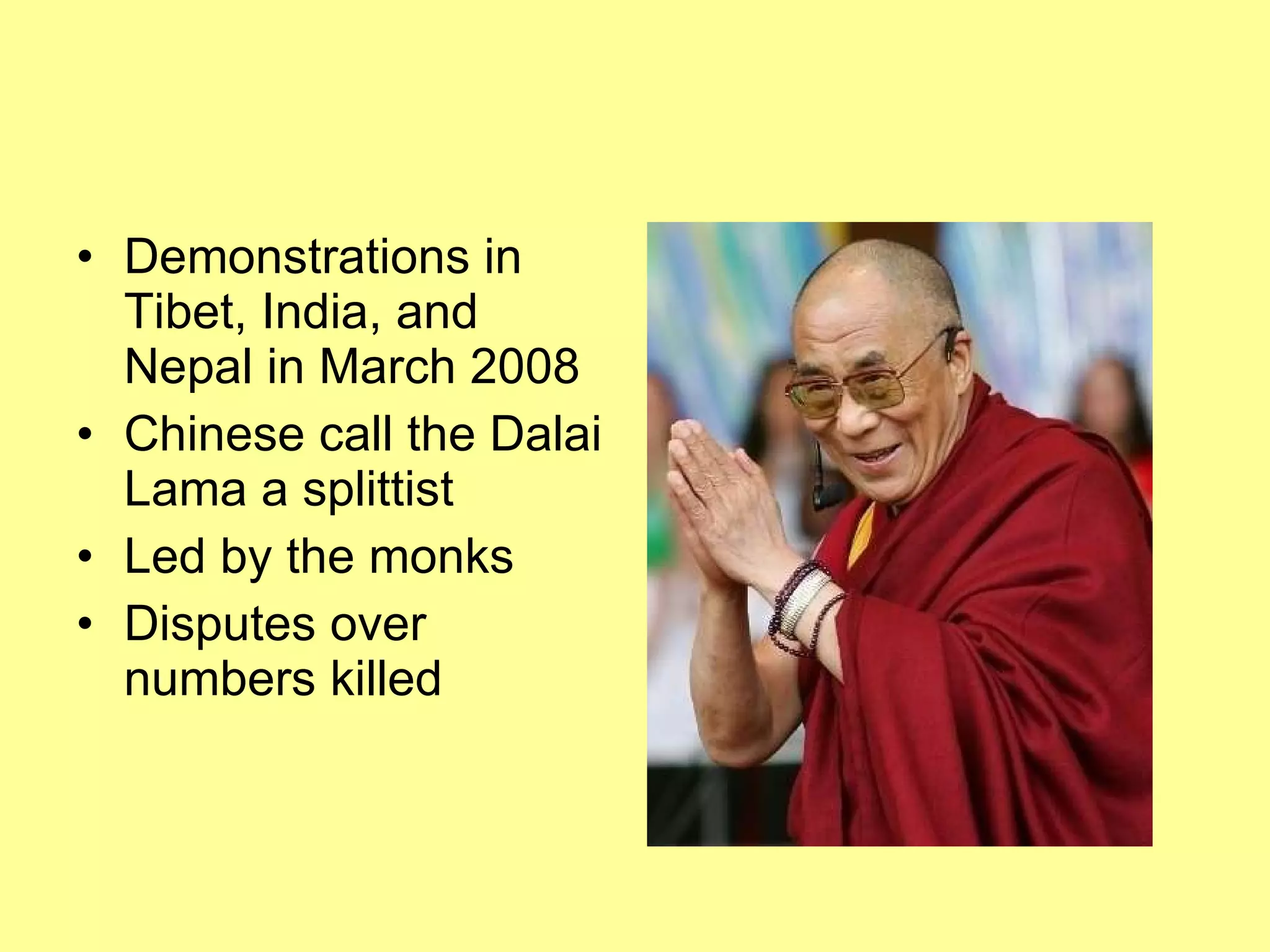
Demonstrations in Tibet, India, and Nepal in March 2008 Chinese call the Dalai Lama a splittist Led by the monks Disputes over numbers killed
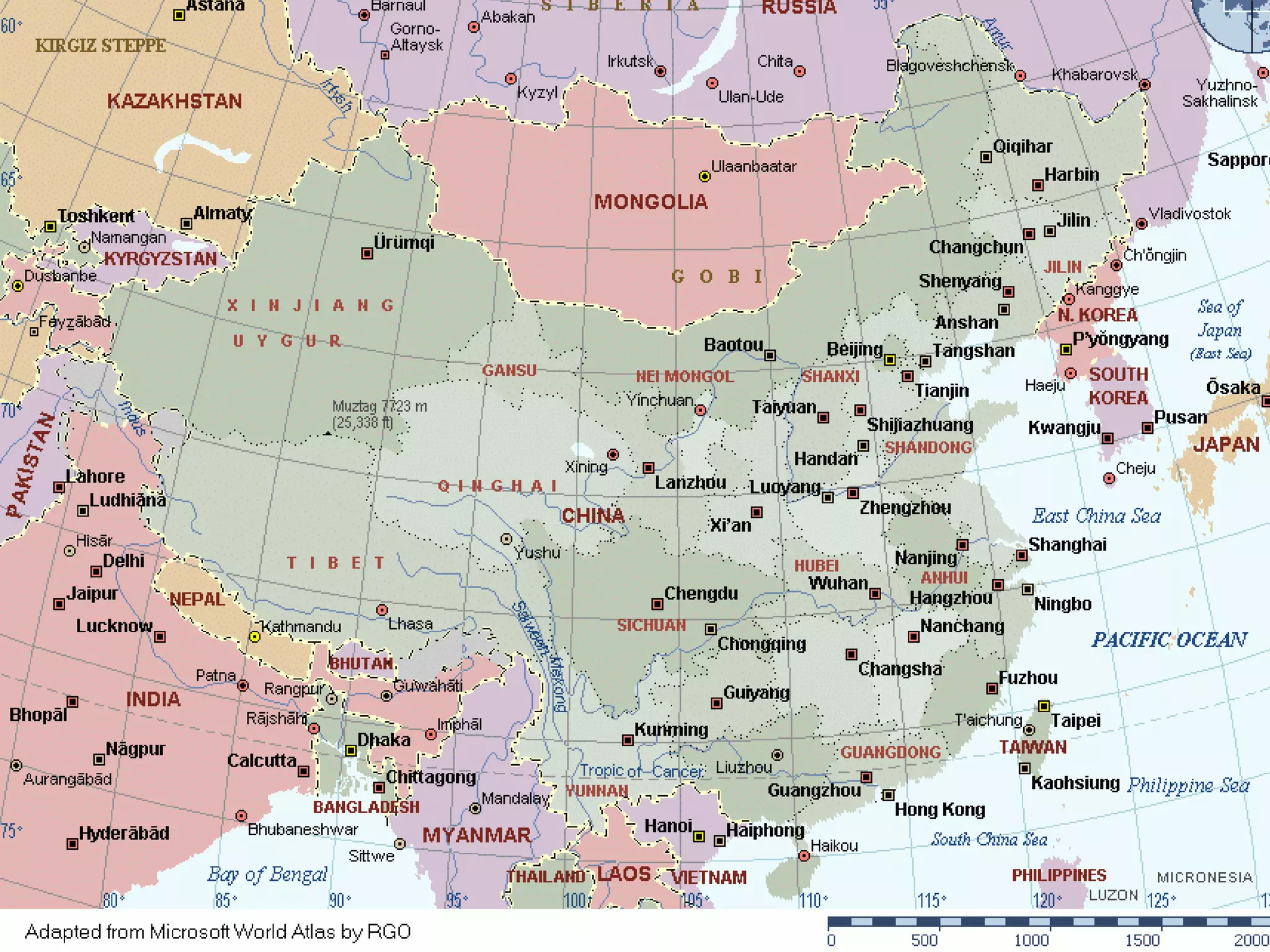
Uyghur people; one of China’s 56 officially recognized minorities and prohibited flag of the East Turkestan movement
October 2008 A U.S. federal judge ordered the Bush administration to release 17 Uighur detainees at  Guantánamo Bay  by the end of the week, the first such ruling in nearly seven years of legal disputes over the administration’s detention policies. Some sent to U.S. friendly island nations
Unrest in Xinjiang Province  July 2009 Rival protesters took to the streets again, defying Chinese government efforts to lock down this regional capital of 2.3 million people and other places across its western desert region after bloody clashes between Muslim  Uighurs  and security forces that were mostly Han Chinese. The fighting left at least 156 people dead and more than 1,000 wounded, according to the state news agency
Han Chinese men armed with sticks walked towards a Uighur neighborhood.
 
SARS Hits China
AIDS in China
AIDS in China January 2006 The new estimate, conducted with the World Health Organization and the United Nations AIDS program, lowered the country's estimated number of H.I.V. and AIDS cases to 650,000 from the official figure of 840,000 released by the government in 2003.  Many experts and AIDS workers have long believed that China has at least 1.5 million cases, possibly far more, and some expressed skepticism that the new figure was any more reliable than past estimates.
Some doctors in Henan Province, a center of the blood selling operation, estimated that more than a million people had been infected in that province alone.  The 2003 study estimated that the blood program had infected 199,000 people.  By comparison, the new study estimates that only 55,000 former blood donors are infected with H.I.V.
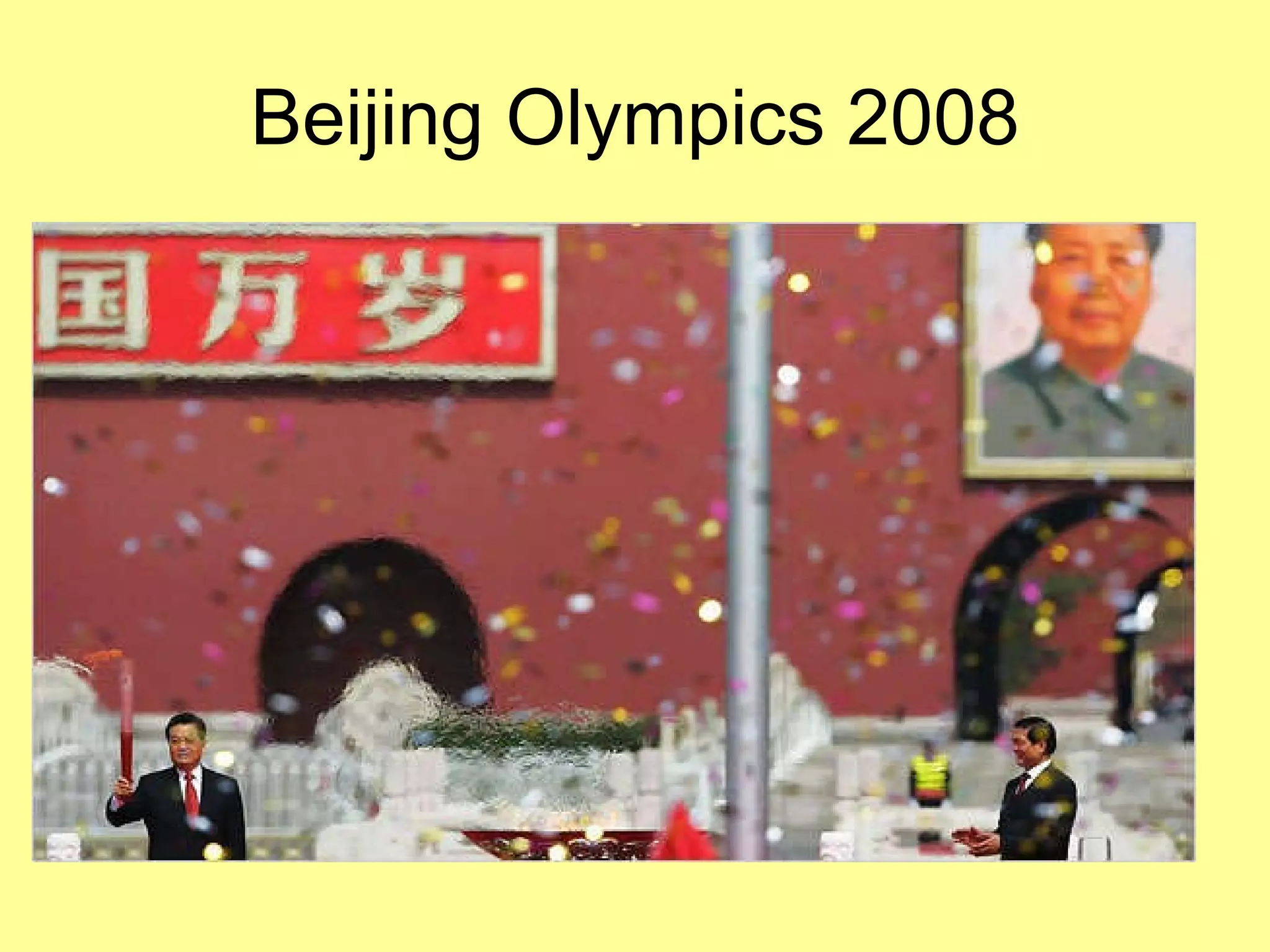
Beijing Olympics 2008
Issues related to the Olympics China’s debut to the world as a great power Protests about the recent crackdown on protests in the Autonomous Region of Tibet in March 2008, led by Monks Accuse the Dalai Lama of being a splittist Pollution issue Mia Farrow has dubbed it the “genocide Olympics” (see Sudan): Steven Spielberg resigned as the artistic director Corruption Displacement of the poor to build the venues
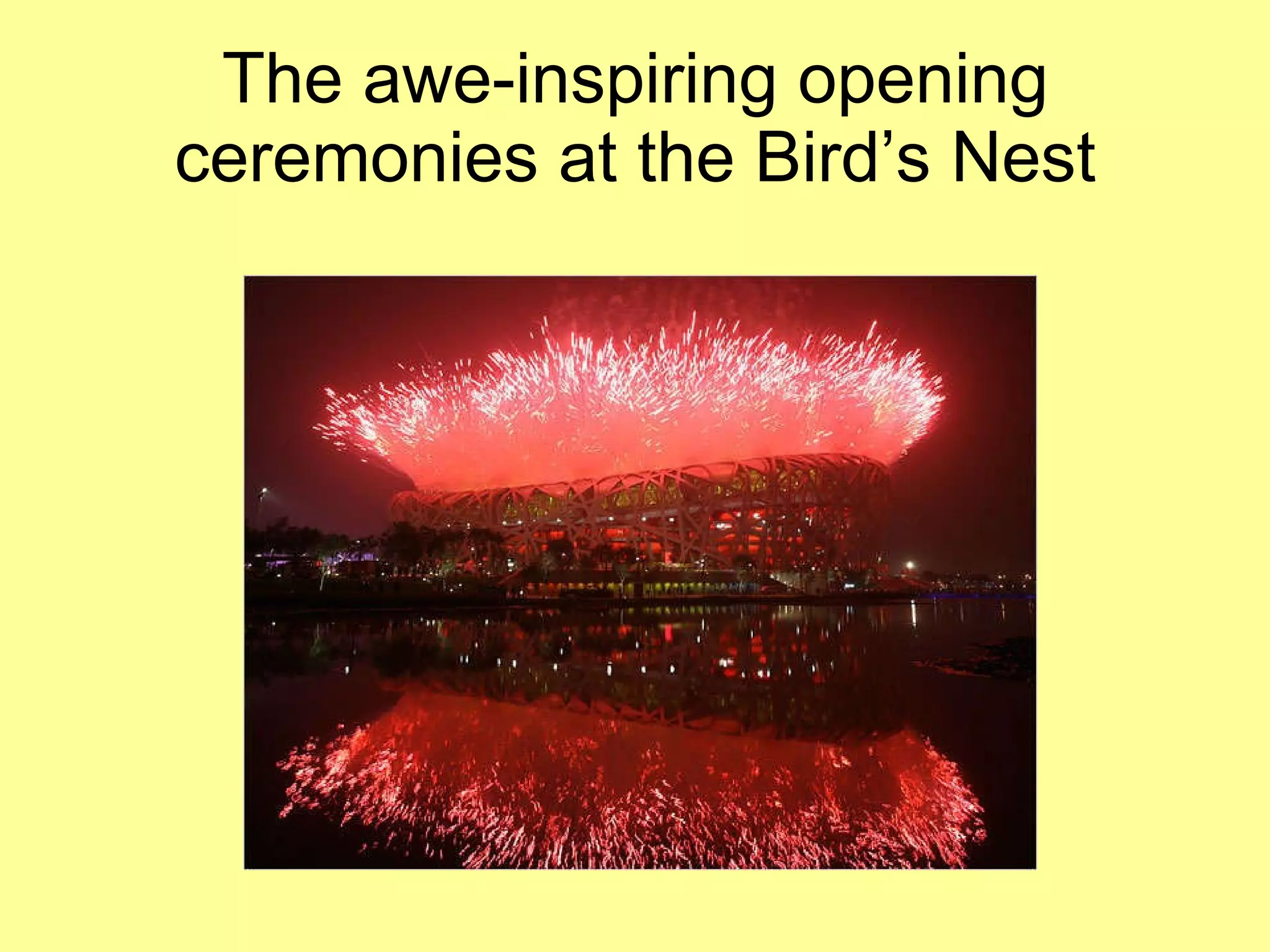
The awe-inspiring opening ceremonies at the Bird’s Nest
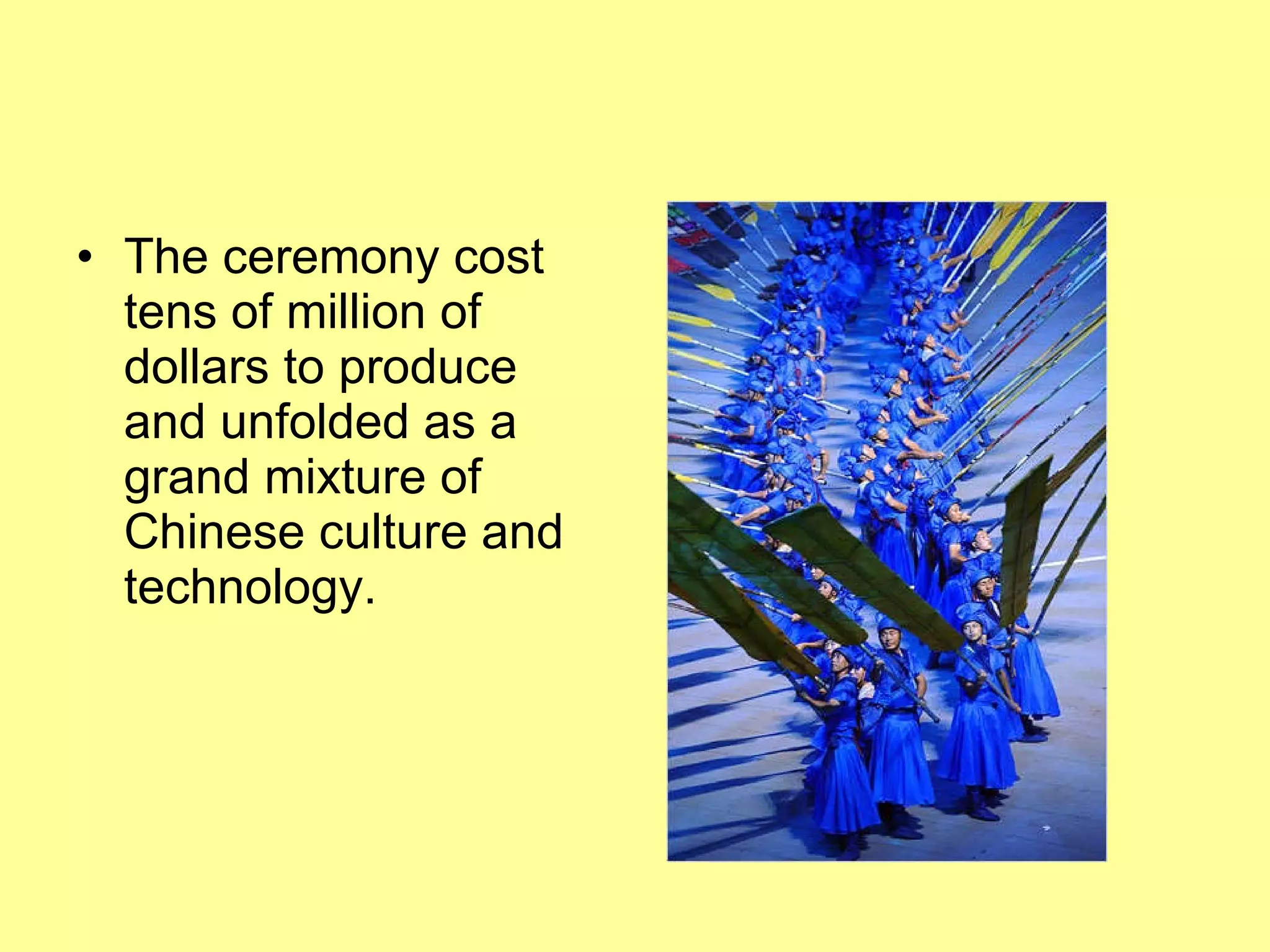
The ceremony cost tens of million of dollars to produce and unfolded as a grand mixture of Chinese culture and technology.
The ceremony was filled with signature Chinese touches like the use of masses of people, working in unison into a grand spectacle centered on traditional Chinese history, music, dance and art.
Taiwan’s status PRC views Taiwan as renegade province KMT has a stranglehold on politics until Kai-shek’s death in 1975 and then beyond Taiwan only officially recognized by approx. 20 countries which get a lot of aid from Taiwan U.S. does not have an official embassy in Taiwan but sells Taiwan a lot of military hardware U.S- Taiwanese Relations Act (1979) Policy of strategic ambiguity
Protests Continue Former President Chen Shui-Bian of the Democratic Progressive Party                                   
Protests over Taiwan’s Election
A crowd estimated at more than 500,000 passed around a balloon symbolizing peace in Taipei in late March 2005.
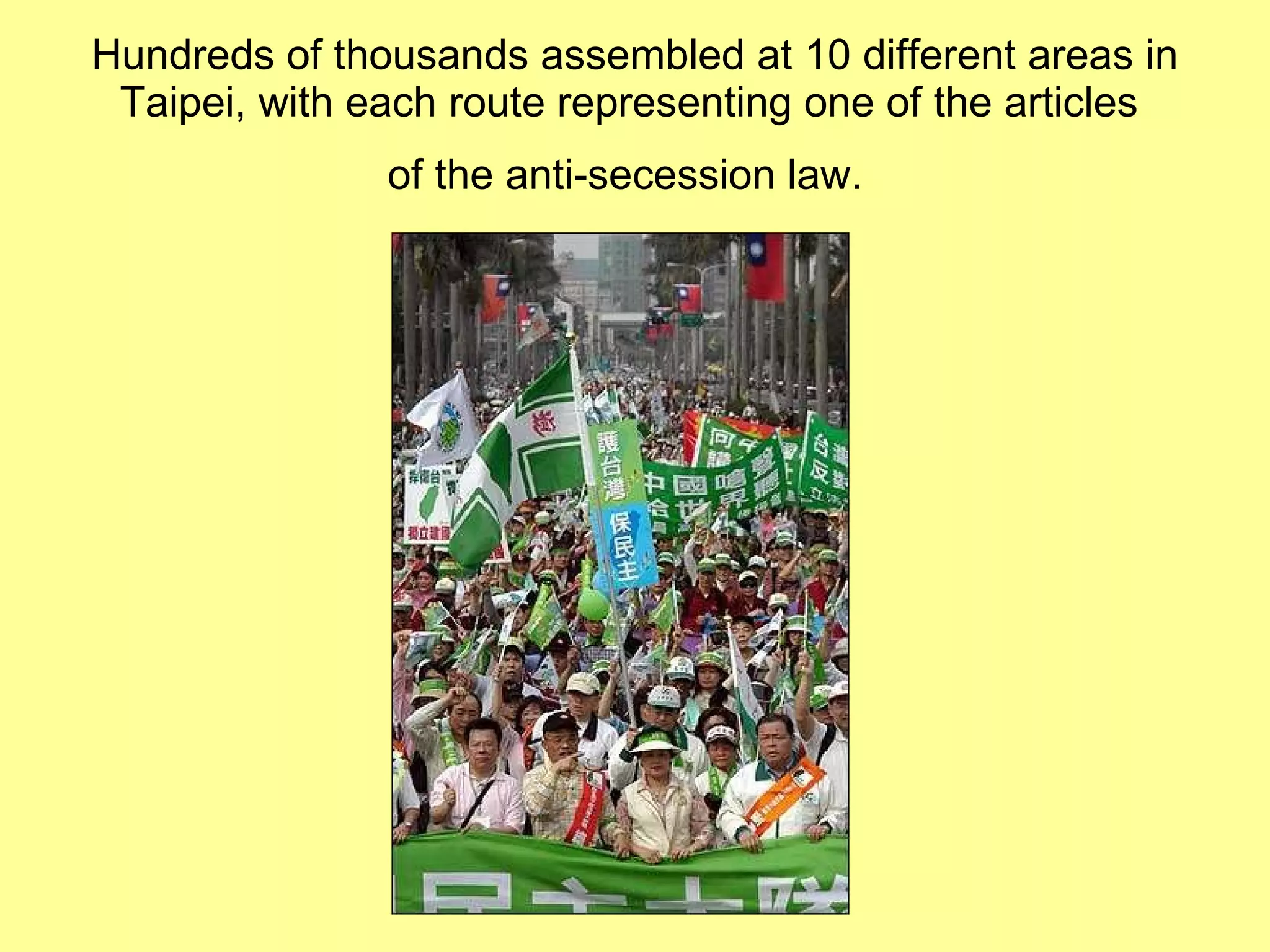
Hundreds of thousands assembled at 10 different areas in Taipei, with each route representing one of the articles  of the anti-secession law.
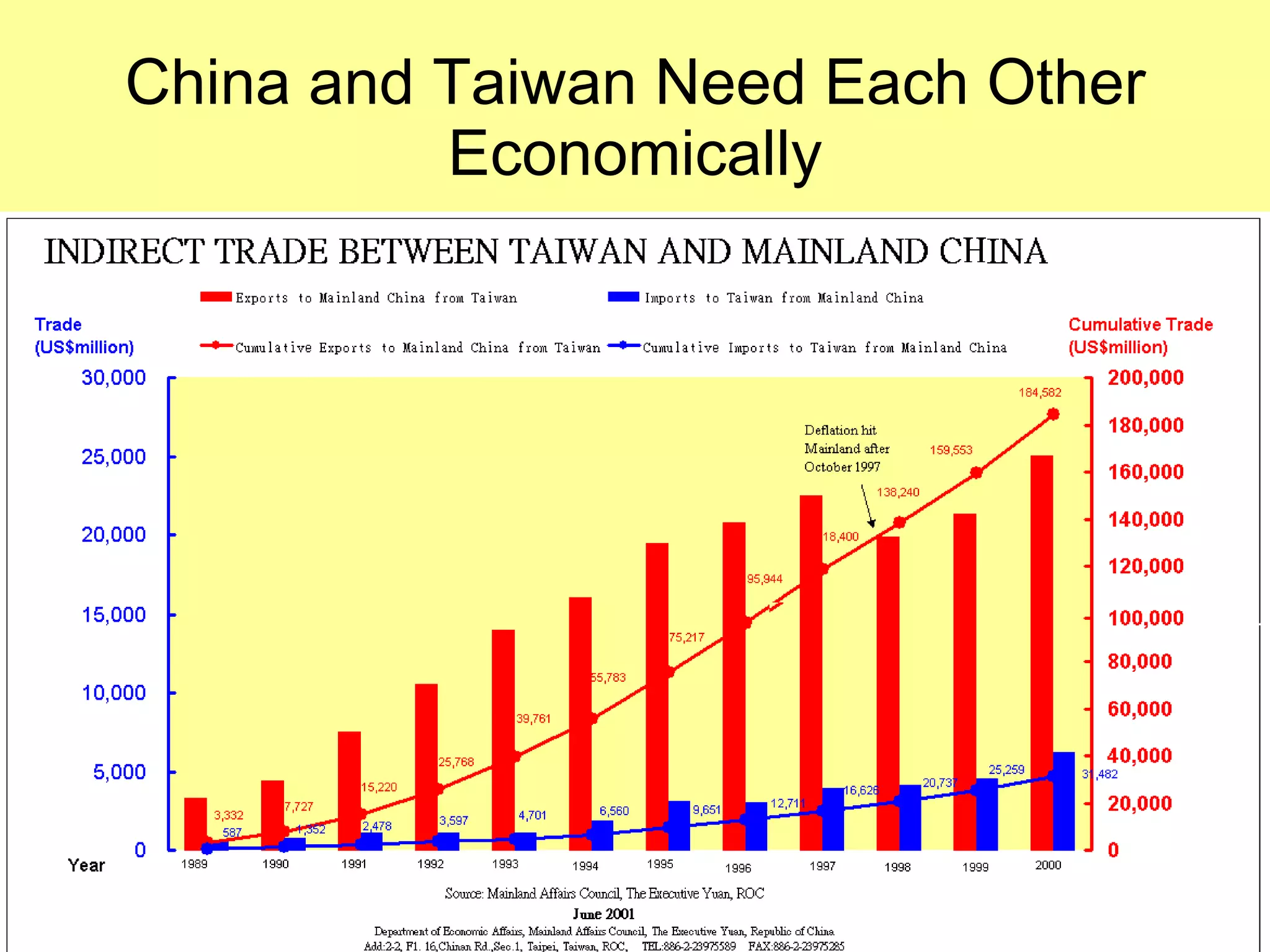
China and Taiwan Need Each Other Economically
 
January 2008 The opposition Kuomintang (Nationalist) party won a landslide victory in parliamentary elections in Taiwan. President  Chen Shui-bian , who has antagonized China with his efforts to forge a national identity for the self-governing island, resigned as chairman of the governing Democratic Progressive Party to take responsibility for the loss.
The outcome was widely interpreted as a clear repudiation of Mr. Chen’s controversial policies aimed at shifting Taiwan toward independence. His plan to hold a referendum at the time of the election for president in March 2008 on a bid by the island to join the  United Nations  under the name of Taiwan rather than its formal name, the Republic of China, predictably angered Beijing. It also drew unusually blunt criticism from the United States, Taiwan’s most important military and political ally.
Taiwan’s Presidential Elections March 2008 Both candidates, Ma Ying-jeou  (roughly pronounced Ma ING-gee-oh)  and Frank Hsieh, want closer ties with Beijing, differing only in how quickly and to what degree they would strengthen relations.  By calling for closer economic cooperation with China and rejecting any notions of separatism, they are repudiating the tough nationalist policies of the departing president,  Chen Shui-bian , whose confrontational stance has angered officials in Beijing and  Washington  and has stirred anxiety among many Taiwanese.
Mr. Ma, a  Harvard -educated lawyer, is favored in polls over the D.P.P candidate, despite Mr. Chen’s active  campaigning.  Mr. Ma’s party, the Kuomintang (KMT), governed Taiwan for 51 years, often with an iron grip, before Mr. Chen was elected in 2000.  The Kuomintang’s revival this year is rooted in widespread disenchantment with Mr. Chen, whose party took power on a wave of optimism.
And the winner is… Mr. Ma (pictured on the left)
June 2008 Representatives of China and  Taiwan  agreed in a meeting to establish permanent offices in each other’s capital to help coordinate discussions about closer relations. The two sides are discussing how to increase charter flights between China and Taiwan
Former President Chen and wife have been convicted of embezzlement; other issues Taiwan and China are on the best terms ever in years
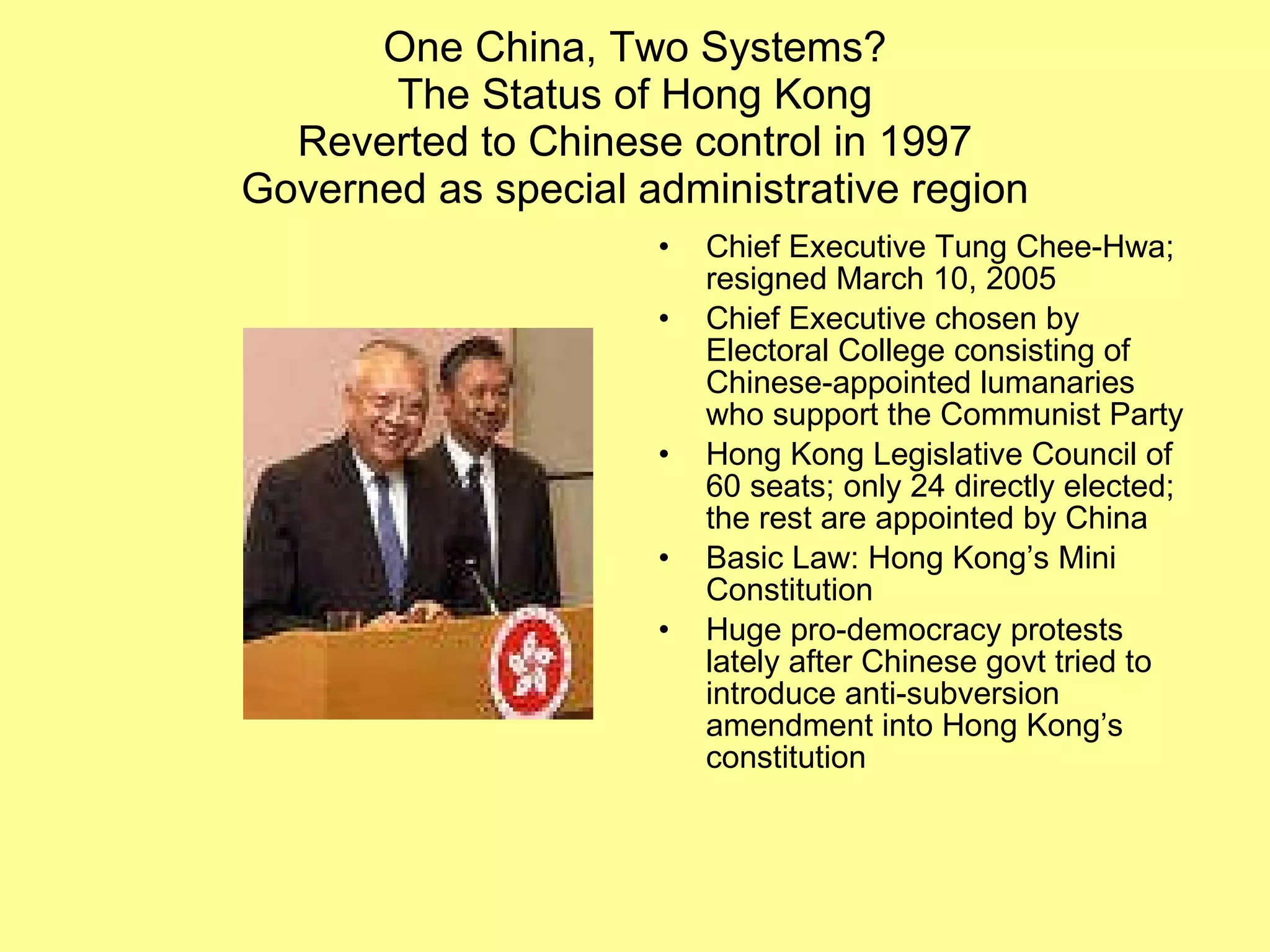
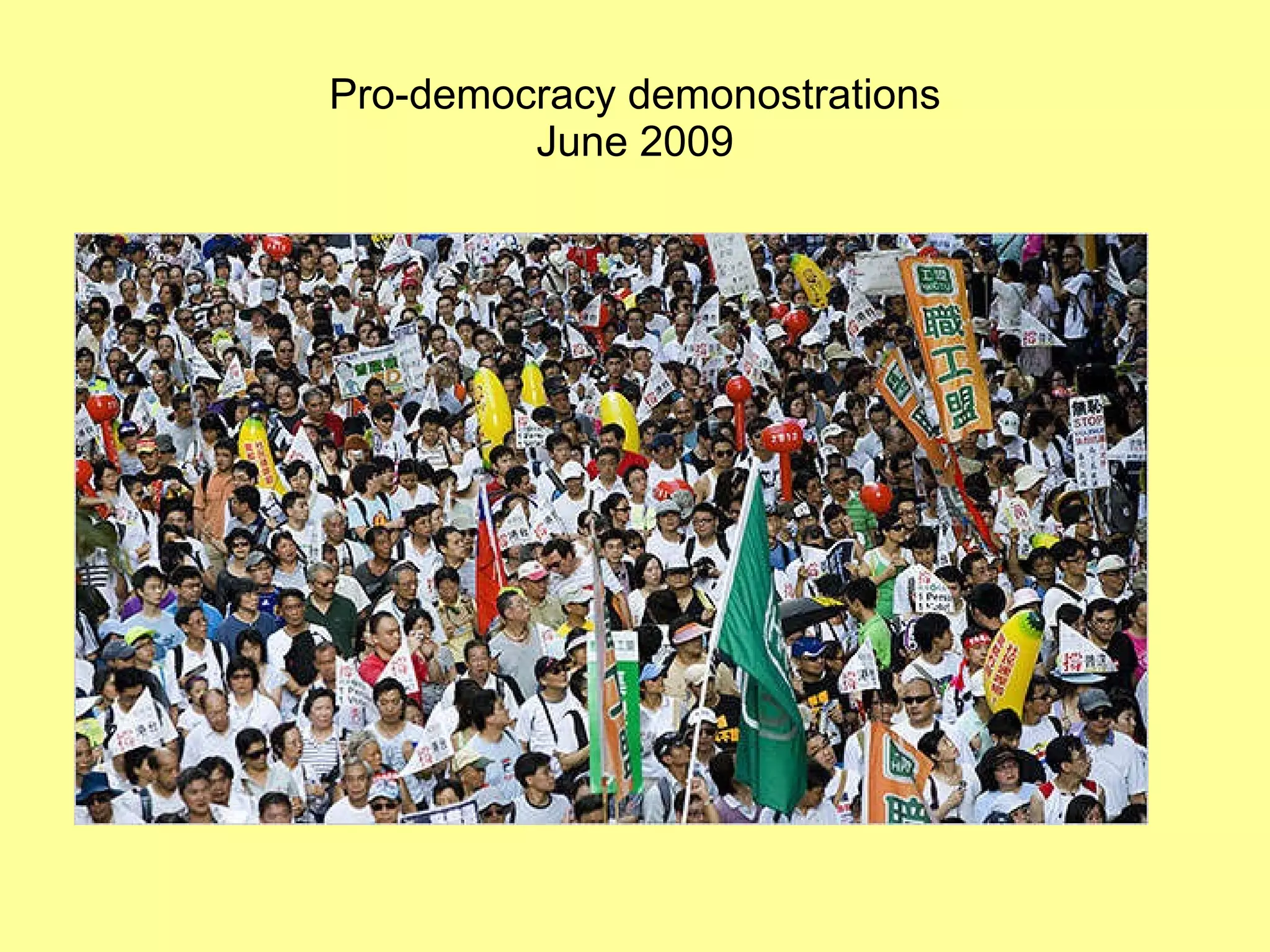
One China, Two Systems? The Status of Hong Kong Reverted to Chinese control in 1997 Governed as special administrative region Chief Executive Tung Chee-Hwa; resigned March 10, 2005 Chief Executive chosen by Electoral College consisting of Chinese-appointed lumanaries who support the Communist Party Hong Kong Legislative Council of 60 seats; only 24 directly elected; the rest are appointed by China Basic Law: Hong Kong’s Mini Constitution Huge pro-democracy protests lately after Chinese govt tried to introduce anti-subversion amendment into Hong Kong’s constitution
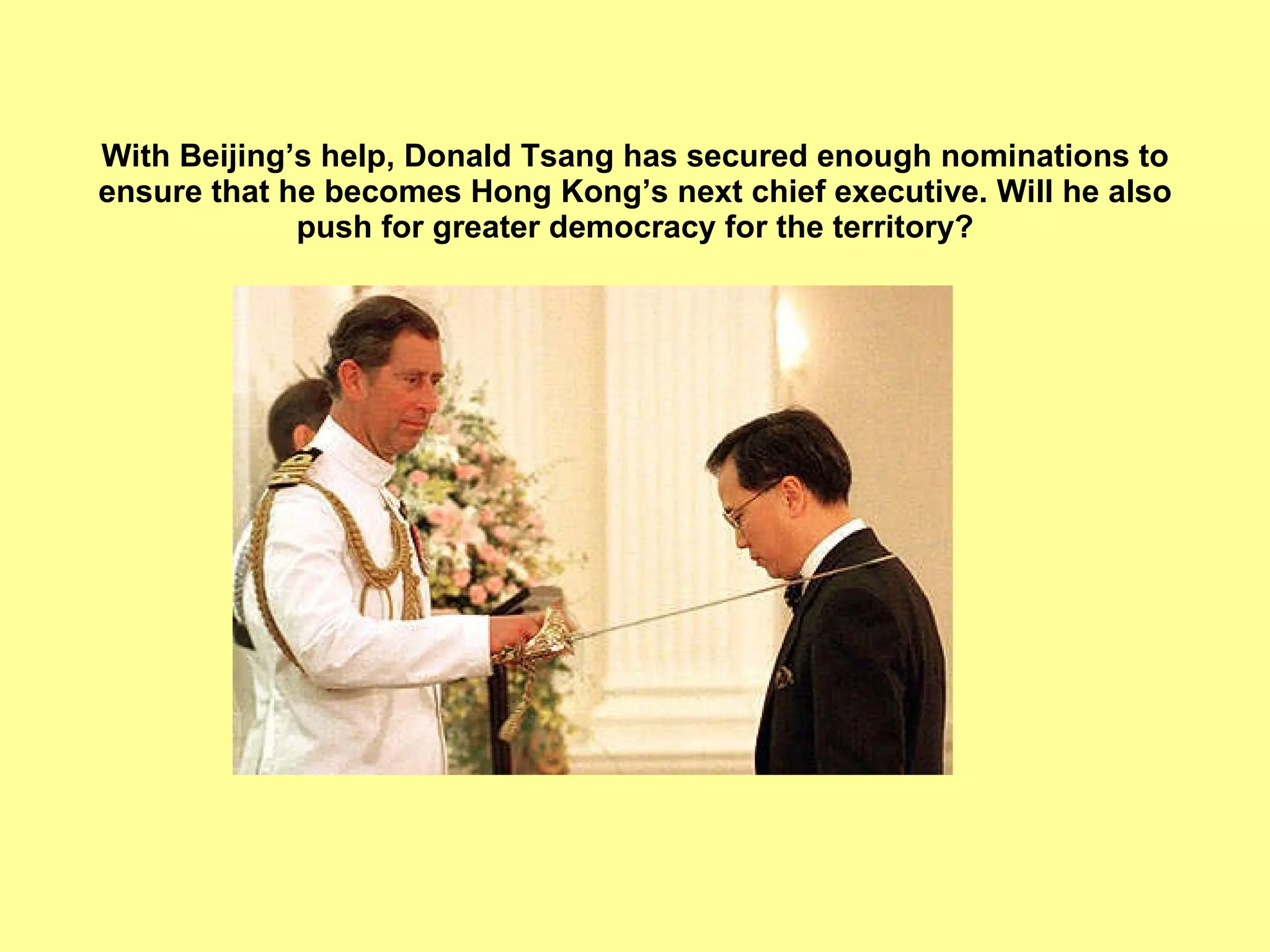
Hong Kong’s Situation Acting Chief Executive of Hong Kong Donald Tsang, a former colonial civil servant who was knighted for service to the British Crown Donald Tsang won the “elections” in June 2005 An 800 person election committee elected Donald Tsang; the election committee is packed with pro-Beijing appointees; Tsang received 710 nominations Served out the remaining two years of predecessor’s term, and ‘ran’ again in 2007 because he didn’t alienate Beijing
With Beijing’s help, Donald Tsang has secured enough nominations to ensure that he becomes Hong Kong’s next chief executive. Will he also push for greater democracy for the territory?
Pro-democracy demonostrations June 2009
The immediacy of democracy demands here has faded somewhat as Beijing officials have ruled out direct elections for the chief executive until 2017 and the legislature until 2020. A committee of 800 people, most with connections to Beijing, chooses the chief executive here, who must then be appointed by leaders in Beijing before taking office. Half the legislature is chosen by the public and half by a variety of interest groups, including banks, chambers of commerce, trade unions and lawyers.
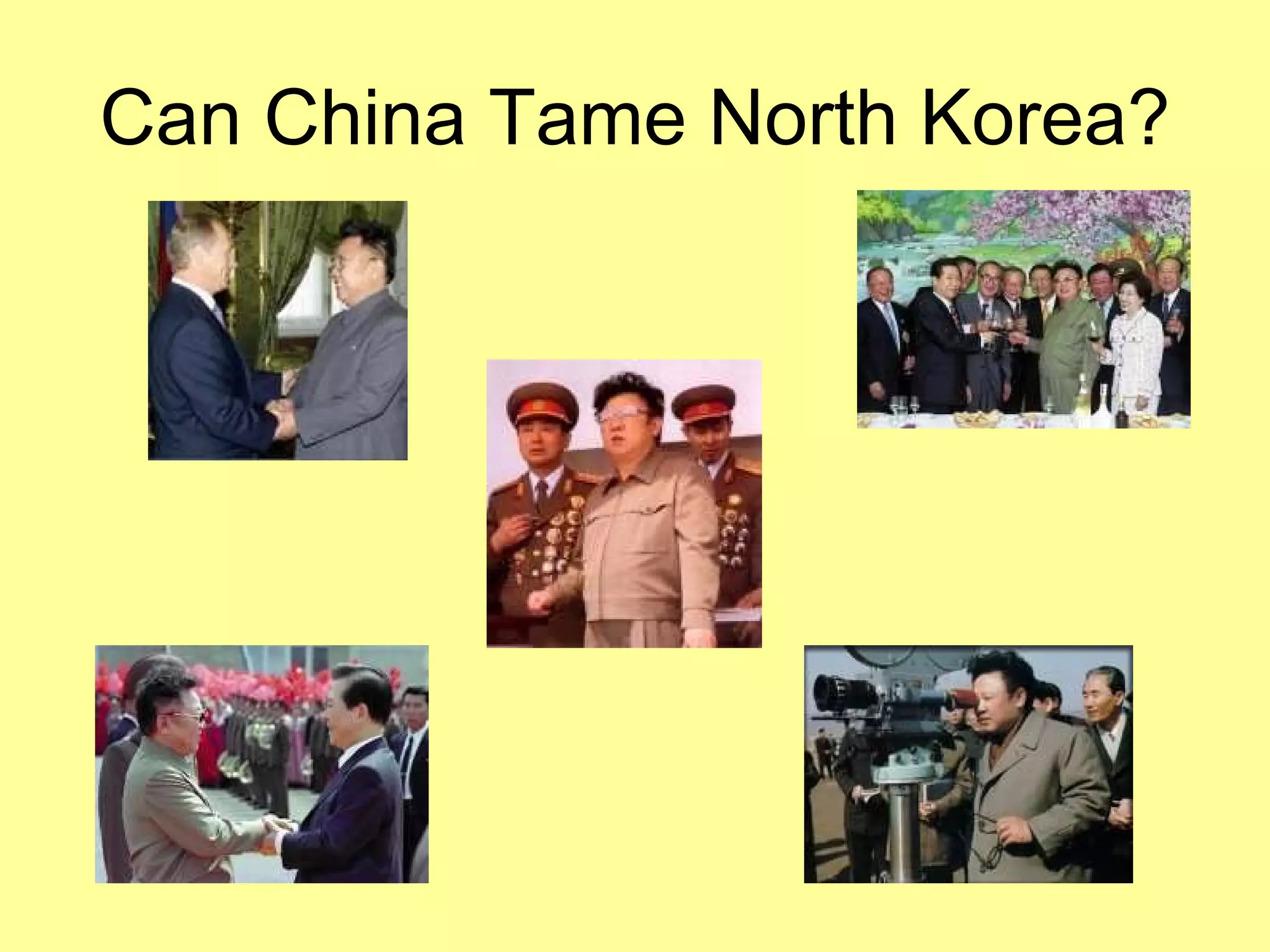
Can China Tame North Korea?
What has China’s role been in the six-party talks? What does China not want to see a nuclear armed  N. Korea? North Korea has between 8-10 nuclear weapons China voted in favor of UNSC resolution in October 2006 after N. Korea’s nuclear tests but has said it will not enforce interdiction China condemned the sinking of the South Korean warship in spring 2010 by North Korea
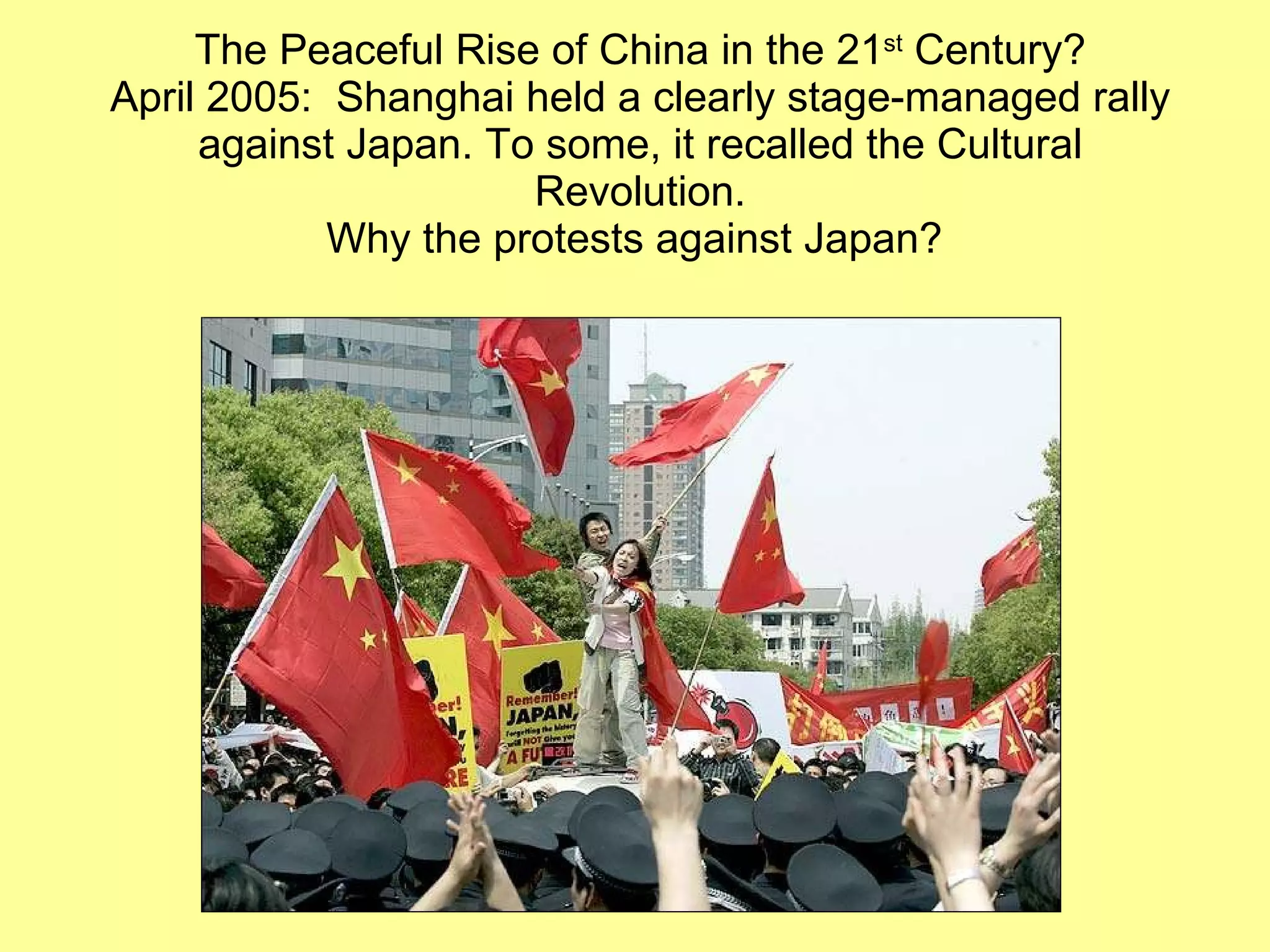
The Peaceful Rise of China in the 21 st  Century? April 2005:  Shanghai held a clearly stage-managed rally against Japan. To some, it recalled the Cultural Revolution. Why the protests against Japan?
 
The growth in the Chinese automobile market is causing a surge in oil imports; the Energy Department estimates that China's demand will more than double, to 14.2 million barrels a day, by 2025.  More than two-thirds of that will be imported, the department estimated last year.  The United States currently imports about 60 percent of its daily 20 million barrels.
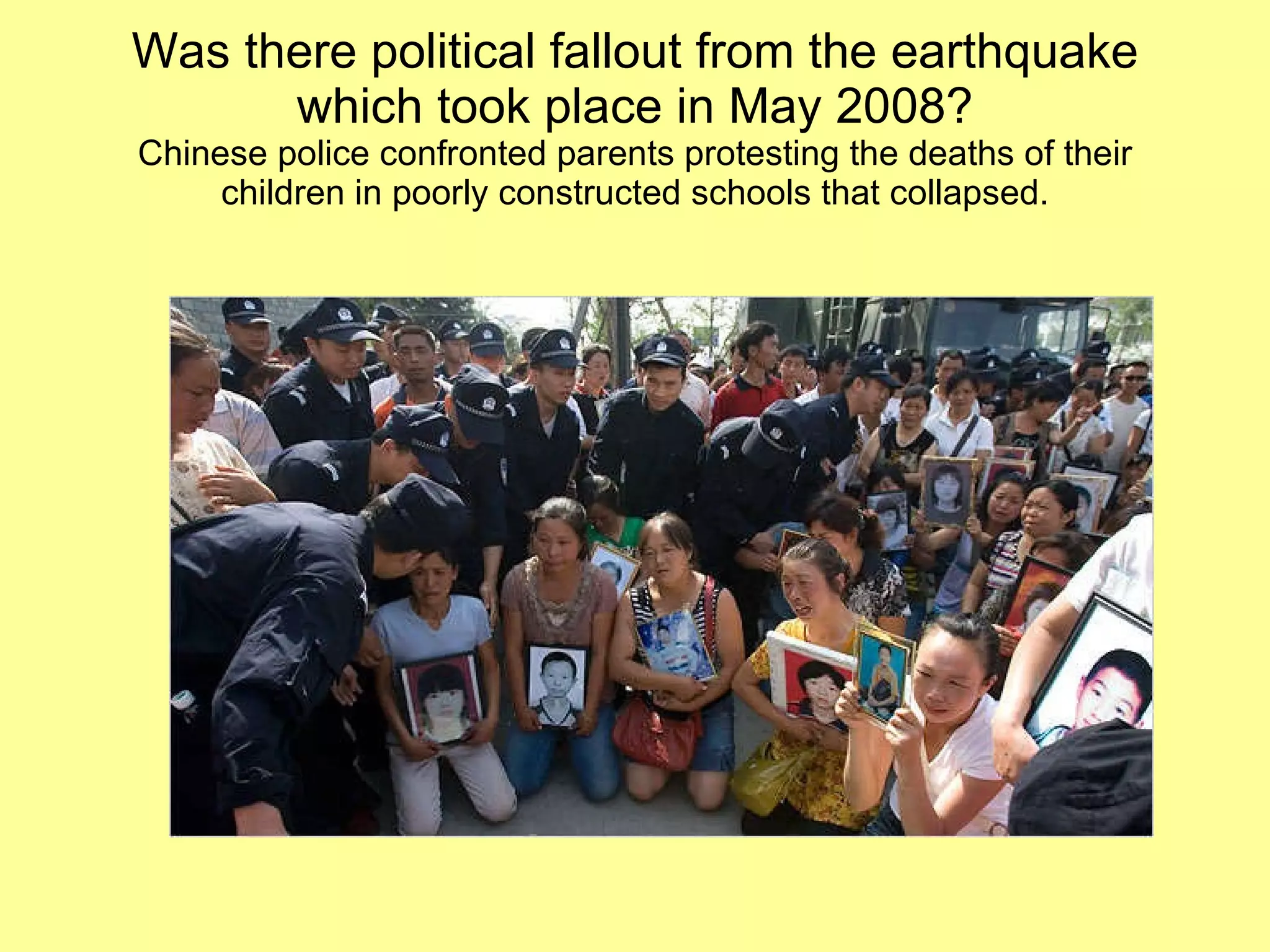
Was there political fallout from the earthquake which took place in May 2008? Chinese police confronted parents protesting the deaths of their children in poorly constructed schools that collapsed.
Across the hardest hit areas parents have been demanding investigations into why so many schools collapsed across the region even as, in many cases, surrounding buildings remained standing.  About 10,000 schoolchildren were estimated to have been killed in the earthquake  Govt has said that those parents who lost their only child can try to have another one.
Future tension for U.S.-Sino Relations? China’s oil deals with countries like Sudan and Venezuela Sent a man into space; a new arms race and the overall military capability Increasing income inequality could lead to civil war in the worst case scenario- villagers are protesting against corrupt CPC officials
Obama visited China  November 2009 Clip of Obama at a youth town hall meeting in Shanghai http://www.youtube.com/watch?v=J9zytXNgKMs Google issue Trade/currency manipulation Sell of weapons to Taiwan Dali Lama Iran North Korea
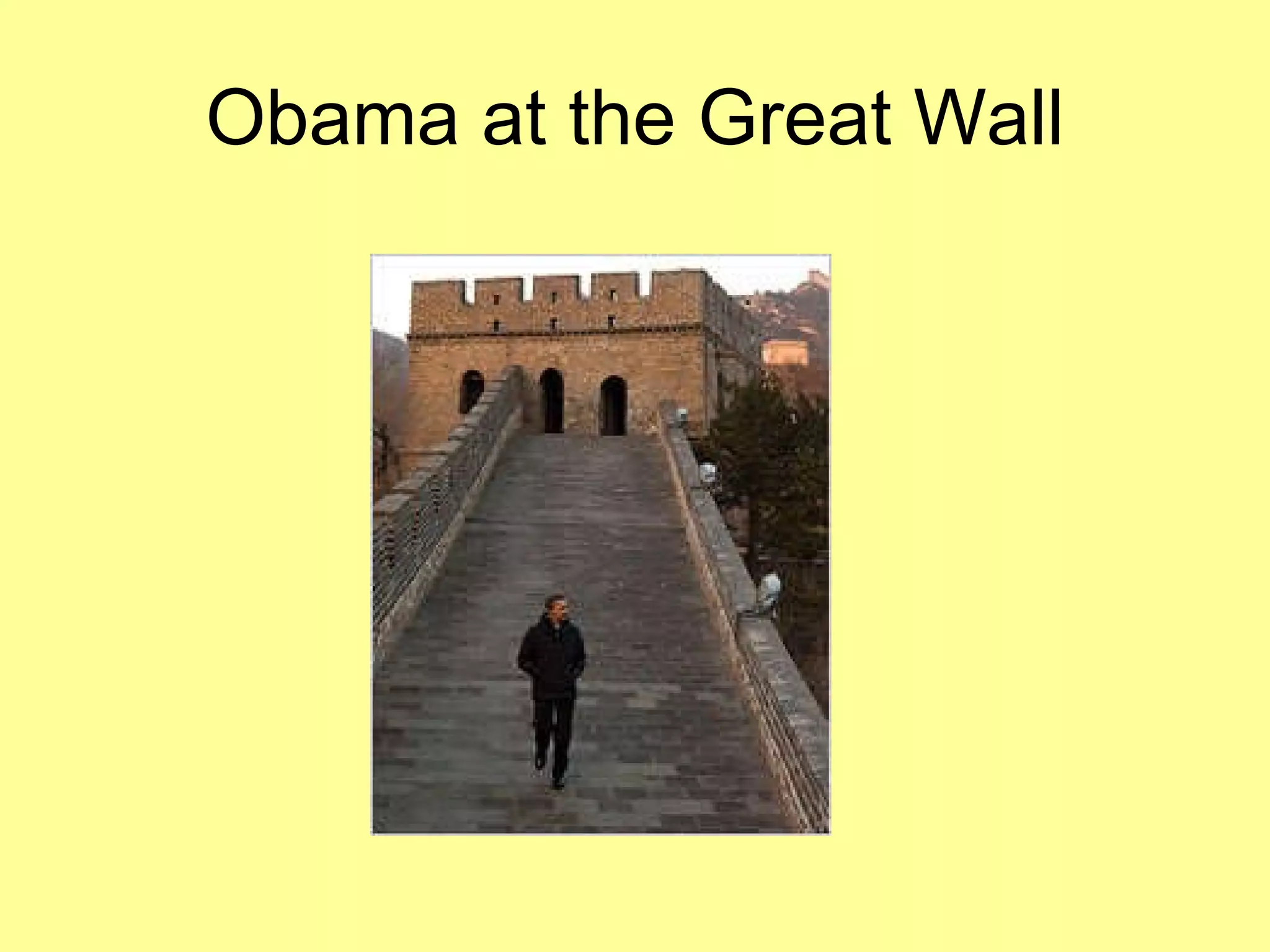
Obama at the Great Wall
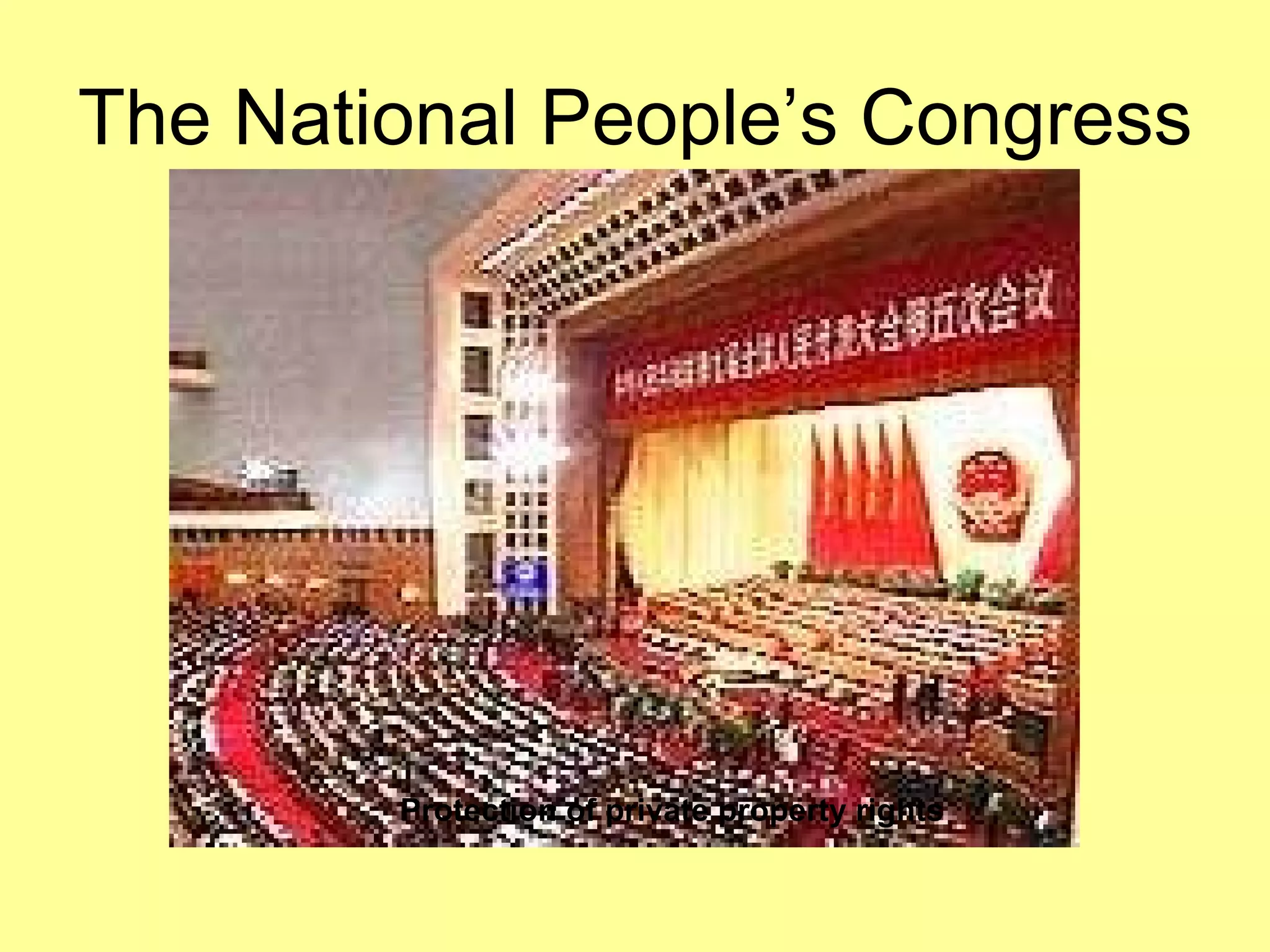
Organs of Chinese Government National People’s Congress- 3000 delegates means it cannot be a functioning legislative body NPC delegates elected for five year terms by province level congresses Meet two weeks for a plenary session; totally pro forma Formal powers such as amending the constitution, passing and amending legislation, approving economic plans, formally ‘appoints’ the President, VP, Premier, Vice Premiers, and other cabinet ministers
The National People’s Congress Protection of private property rights
Every five years there is a massive National Party Congress meeting; this is where changes in leadership are announced Last NPC was in 2007, next one in 2012 Standing Committee: 150 members; living in Beijing throughout the year, constitute a working legislative assembly  State Council: where the bulk of legislation is written; head of State Council is the Premier
Central Committee: Chinese political elite; collection of several hundred mot powerful; ministers in central bureaucracy and provincial party leaders Politburo: selected by Central Committee; comprised of 24-30 leaders Politburo Standing Committee: the most elite circle: 9 individuals
At the 17 th  Party Congress in the fall of 2007 The Communist Party announced a new leadership lineup that anoints two future leaders of the country and modestly enhances the authority of President Hu Jintao The reshuffle promotes four officials to the nine-man Politburo Standing Committee, the country’s top ruling body, including two provincial leaders expected to inherit the posts of party general secretary and prime minister in five years’ time. Next leader expected to be announced in 2012
At the Communist Party Congress in Beijing, where delegates voted during closing ceremonies.
Discipline Inspection Commission: enforces standards of party conduct; investigates charges of corruption; expels members from the CPC People’s Liberation Army: over 2 million men under arms; not modernized, but making progress China has announced that the military budget for 2011 is about $92 billion, up 12.7 percent from 2010. 180-240 nuclear weapons Want to have an aircraft carrier soon Cyber-warfare capacity Defensive security posture according to official statements Redline of Taiwan

China fall 2011

  • 1.
    China in theRed China: A Developing Country and/or Emerging World Power?
  • 2.
    Chronology Opium War(1839-1842); China defeated by Britain Treaty of Nanking, example of the Unequal treaties; different treatment for foreigners; trading concessions China defeated in war against Japan in 1894-1895 Boxer Rebellion (1899-1901); concentrated in northern China where European powers had begun to demand territorial, rail, and mining concessions; originally against the dynasty but then were used a a tool to remove foreign powers from China Attacked foreign compounds; missionaries also targeted Navies from other countries arrive (e.g. Japan, Russia, GB, US) to put down the rebellion Atrocities also committed by the Eight-Nation Alliance
  • 3.
    Dynasty Collapse (1912)Chinese Civil War (1912-1949) Republic of China initially led by Sun Yat-Sen who dies in 1925; spent time in exile in Europe and U.S. for speaking out against the dynastyfirst President of Republic of China; goes after warlords; co-founder of the Kuomintang (KMT)
  • 4.
    Chiang Kai-shek (TheNationalists) Took over after Sun Yat-sen’s death Great instability from 1927-1949 Japan’s invasion of Manchuria in 1931 Waging war against the Communists in China Rape of Nanjing in Dec. 1937 Became part of the Allied effort during WWII President of ROC and Director-General of KMT until his death in 1975
  • 5.
  • 6.
    Mao Zedong (TheCommunists)
  • 7.
    Mao’s life Bornin 1893 to a peasant family Studies in Beijing Came to violent Marxism gradually; saw the Bolshevik revolution as a model Revolution could not be steered by the Nationalists Established ‘soviet’ areas under the control of the CPC in the rural areas Chaing Kai-shek determined to eliminate the communists which leads to the Long March in 1934 (retreat by Communists to northwest of China) While WWII went on, Mao also led forces against the Japanese After WWII was over, war between the Nationalists and Communists continued and the People’s Republic of China declared on October 1, 1949 Kai-shek flees to Taiwan (Formosa) and established the ROC
  • 8.
    Mao and Stalin:An Uneasy Alliance at times
  • 9.
    Korean War (1950-1953)The Hundred Flowers Campaign (1957) Great Leap Forward (1958-1960); 20-30 million dead mainly from starvation China explodes atomic bomb in 1964 Great Proletarian Cultural Revolution (1966-1976); tens of thousands sent to reeducation camps, near anarchy in many areas of China; unleashed Marxist-Leninist-Mao Zedong Thought
  • 10.
    The Red Bookand Red Guard Units
  • 11.
    Justification Although thebourgeoisie has been overthrown, it is still trying to use the old ideas, culture, customs, and habits of the exploiting classes to corrupt the masses, capture their minds, and endeavor to stage a comeback. The proletariat must do just the opposite: It must meet head-on every challenge of the bourgeoisie in the ideological field and use the new ideas, culture, customs, and habits of the proletariat to change the mental outlook of the whole of society. At present, our objective is to struggle against and crush those persons in authority who are taking the capitalist road, to criticize and repudiate the reactionary bourgeois academic "authorities" and the ideology of the bourgeoisie and all other exploiting classes and to transform education, literature and art, and all other parts of the superstructure that do not correspond to the socialist economic base, so as to facilitate the consolidation and development of the socialist system.
  • 12.
    Chinese poster saying:"Shatter the old world / Establish a new world." Classical example of the Red art from the early Cultural Revolution. A worker (or possibly Red Guard) crushes the crucifix, Buddha and classical Chinese texts with his hammer; 1967
  • 13.
    Mao’s Cult ofPersonality A poster during the Cultural Revolution. Caption reads : The Chinese People's Liberation Army is the Great School of Mao Zedong Thought
  • 14.
    A government postercalling for the "Immediate overthrow of the [anti-Communist]" Gang of Four; one included Mao’s widow; show trial; eventually released Communist China (PRC) takes over permanent seat at UNSC in 1971 from Taiwan Nixon visits China in 1972 Gang of Four trials in 1976 Mao dies in 1976, power struggle Deng Xiaoping emerges on top
  • 15.
    Nixon meeting Mao Policy of Triangulation under Kissinger
  • 16.
    The Great TransformationUnder Deng Xiaoping (1978-1997) Denounced Mao’s excesses Had been purged by Mao It doesn’t matter if the cat is black or white, so long as it catches mice To get rich is glorious
  • 17.
    The Goddess ofDemocracy
  • 18.
  • 19.
    Important Factors toUnderstand May 4 observance (Unfair terms of Treaty of Versailles) Rising inflation Democracy walls permitted Death of Hu Yaobang during a heated conversation between hard-liners and soft-liners Winds of change in Eastern Europe
  • 20.
    Zhao Ziyang “Ihave come too late.”
  • 21.
    Since the massacre…More focus on urban development to the detriment of rural development Increasing income inequality….the deal as long as the economy keeps growing, people won’t want to agitate for political change Leaders still in jail. Some escaped to the other countries Zhao Ziyang’s memoirs released in 2009 China blocked Facebook, Twitter days before June 4, 2009 (20 th anniversary)
  • 22.
    June 4, 200920 th anniversary Vigil in Hong Kong
  • 23.
    Jiang Zemin andPresident Bush Jiang’s Theory of the “Three Represents”
  • 24.
    Hu Jintao andWen Jiabao
  • 25.
    Who is Hu?Hu was selected by Deng to come after Jiang Jiang reluctantly let goes of power over military Highly unlikely that Hu is a closet liberal Hu has referred to Western style democracy as a blind alley for China How to deal with North Korea and Taiwan- will talk in depth about this. Talks repeatedly of China’s ‘peaceful rise’ Next president in China will emerge in 2012
  • 26.
    China Today $8Trillion GDP $6,600 GDP per capita 91% Literacy rate 43% urbanized population Gini coefficient is 0.42 By 2040, China will produce 40% of Global GDP World's largest army 200 nuclear weapons
  • 27.
    Issues toDiscuss Trade Surplus with the US/China’s Economy Human Rights Violations (Falung Gong, Tibet, Xinjiang province against the Uighurs; lack of religious freedom) SARS outbreak 2003/Ongoing AIDS crisis Olympics in 2008 Crisis over Taiwan/Taiwan’s status Dispute over Hong Kong’s Future China’s assistance with N. Korea and six-party talks The Peaceful Rise of China? Biggest threat to US hegemony in the 21 st century? The oil factor? Survival of the Chinese Communist Party- corruption purges, increasing income inequality throughout China
  • 28.
  • 29.
  • 30.
  • 31.
    In 2007, theUS and China accounted for 30% of the world’s GDP In 2008, bilateral trade stood at $409 billion. Chinese exports to the US amount to 8% of China’s GDP. At the end of 2008, China held $700 billion in reserve of U.S. treasury notes.
  • 32.
    Is the tradedeficit an issue we should be concerned about? How does this affect Americans’ pocketbooks? The Wal-mart price China as the biggest consumer of many products now including cement and steel China’s holding of U.S. dollars in reserve Are China and the U.S. economically interdependent?
  • 33.
    China and the Economic Downturn 20 million jobs lost since 2008 but 200 million lifted out of poverty since the 1980s Calls for another revaluation of the currency In 2008, China sold $338 billion worth of goods to American consumers and businesses In 2008, American businesses sold $71 billion to the Chinese
  • 34.
    As so thefates of the two economic giants are intricately tied together… On stabilizing the financial crisis On global climate change The issue of currency manipulation, the yuan Dumping of Chinese made products on U.S. markets
  • 35.
  • 36.
    Human Rights Concerns:Falun Gong Banned in China as Subversive Organization
  • 37.
    Tibetan “Flag” Tibethas been fought over for many decades Buddhist religion introduced in 7 th century Dalai Lama has led a govt in exile in India since 1951 Read PRC’s offical website on its policy about Tibet; it is an interesting read.
  • 38.
    Demonstrations in Tibet,India, and Nepal in March 2008 Chinese call the Dalai Lama a splittist Led by the monks Disputes over numbers killed
  • 39.
    Uyghur people; oneof China’s 56 officially recognized minorities and prohibited flag of the East Turkestan movement
  • 40.
    October 2008 AU.S. federal judge ordered the Bush administration to release 17 Uighur detainees at Guantánamo Bay by the end of the week, the first such ruling in nearly seven years of legal disputes over the administration’s detention policies. Some sent to U.S. friendly island nations
  • 41.
    Unrest in XinjiangProvince July 2009 Rival protesters took to the streets again, defying Chinese government efforts to lock down this regional capital of 2.3 million people and other places across its western desert region after bloody clashes between Muslim Uighurs and security forces that were mostly Han Chinese. The fighting left at least 156 people dead and more than 1,000 wounded, according to the state news agency
  • 42.
    Han Chinese menarmed with sticks walked towards a Uighur neighborhood.
  • 43.
  • 44.
  • 45.
  • 46.
    AIDS in ChinaJanuary 2006 The new estimate, conducted with the World Health Organization and the United Nations AIDS program, lowered the country's estimated number of H.I.V. and AIDS cases to 650,000 from the official figure of 840,000 released by the government in 2003. Many experts and AIDS workers have long believed that China has at least 1.5 million cases, possibly far more, and some expressed skepticism that the new figure was any more reliable than past estimates.
  • 47.
    Some doctors inHenan Province, a center of the blood selling operation, estimated that more than a million people had been infected in that province alone. The 2003 study estimated that the blood program had infected 199,000 people. By comparison, the new study estimates that only 55,000 former blood donors are infected with H.I.V.
  • 48.
  • 49.
    Issues related tothe Olympics China’s debut to the world as a great power Protests about the recent crackdown on protests in the Autonomous Region of Tibet in March 2008, led by Monks Accuse the Dalai Lama of being a splittist Pollution issue Mia Farrow has dubbed it the “genocide Olympics” (see Sudan): Steven Spielberg resigned as the artistic director Corruption Displacement of the poor to build the venues
  • 50.
    The awe-inspiring openingceremonies at the Bird’s Nest
  • 51.
    The ceremony costtens of million of dollars to produce and unfolded as a grand mixture of Chinese culture and technology.
  • 52.
    The ceremony wasfilled with signature Chinese touches like the use of masses of people, working in unison into a grand spectacle centered on traditional Chinese history, music, dance and art.
  • 53.
    Taiwan’s status PRCviews Taiwan as renegade province KMT has a stranglehold on politics until Kai-shek’s death in 1975 and then beyond Taiwan only officially recognized by approx. 20 countries which get a lot of aid from Taiwan U.S. does not have an official embassy in Taiwan but sells Taiwan a lot of military hardware U.S- Taiwanese Relations Act (1979) Policy of strategic ambiguity
  • 54.
    Protests Continue FormerPresident Chen Shui-Bian of the Democratic Progressive Party                                   
  • 55.
  • 56.
    A crowd estimatedat more than 500,000 passed around a balloon symbolizing peace in Taipei in late March 2005.
  • 57.
    Hundreds of thousandsassembled at 10 different areas in Taipei, with each route representing one of the articles of the anti-secession law.
  • 58.
    China and TaiwanNeed Each Other Economically
  • 59.
  • 60.
    January 2008 Theopposition Kuomintang (Nationalist) party won a landslide victory in parliamentary elections in Taiwan. President Chen Shui-bian , who has antagonized China with his efforts to forge a national identity for the self-governing island, resigned as chairman of the governing Democratic Progressive Party to take responsibility for the loss.
  • 61.
    The outcome waswidely interpreted as a clear repudiation of Mr. Chen’s controversial policies aimed at shifting Taiwan toward independence. His plan to hold a referendum at the time of the election for president in March 2008 on a bid by the island to join the United Nations under the name of Taiwan rather than its formal name, the Republic of China, predictably angered Beijing. It also drew unusually blunt criticism from the United States, Taiwan’s most important military and political ally.
  • 62.
    Taiwan’s Presidential ElectionsMarch 2008 Both candidates, Ma Ying-jeou (roughly pronounced Ma ING-gee-oh) and Frank Hsieh, want closer ties with Beijing, differing only in how quickly and to what degree they would strengthen relations. By calling for closer economic cooperation with China and rejecting any notions of separatism, they are repudiating the tough nationalist policies of the departing president, Chen Shui-bian , whose confrontational stance has angered officials in Beijing and Washington and has stirred anxiety among many Taiwanese.
  • 63.
    Mr. Ma, a Harvard -educated lawyer, is favored in polls over the D.P.P candidate, despite Mr. Chen’s active campaigning. Mr. Ma’s party, the Kuomintang (KMT), governed Taiwan for 51 years, often with an iron grip, before Mr. Chen was elected in 2000. The Kuomintang’s revival this year is rooted in widespread disenchantment with Mr. Chen, whose party took power on a wave of optimism.
  • 64.
    And the winneris… Mr. Ma (pictured on the left)
  • 65.
    June 2008 Representativesof China and Taiwan agreed in a meeting to establish permanent offices in each other’s capital to help coordinate discussions about closer relations. The two sides are discussing how to increase charter flights between China and Taiwan
  • 66.
    Former President Chenand wife have been convicted of embezzlement; other issues Taiwan and China are on the best terms ever in years
  • 67.
    One China, TwoSystems? The Status of Hong Kong Reverted to Chinese control in 1997 Governed as special administrative region Chief Executive Tung Chee-Hwa; resigned March 10, 2005 Chief Executive chosen by Electoral College consisting of Chinese-appointed lumanaries who support the Communist Party Hong Kong Legislative Council of 60 seats; only 24 directly elected; the rest are appointed by China Basic Law: Hong Kong’s Mini Constitution Huge pro-democracy protests lately after Chinese govt tried to introduce anti-subversion amendment into Hong Kong’s constitution
  • 68.
    Hong Kong’s SituationActing Chief Executive of Hong Kong Donald Tsang, a former colonial civil servant who was knighted for service to the British Crown Donald Tsang won the “elections” in June 2005 An 800 person election committee elected Donald Tsang; the election committee is packed with pro-Beijing appointees; Tsang received 710 nominations Served out the remaining two years of predecessor’s term, and ‘ran’ again in 2007 because he didn’t alienate Beijing
  • 69.
    With Beijing’s help,Donald Tsang has secured enough nominations to ensure that he becomes Hong Kong’s next chief executive. Will he also push for greater democracy for the territory?
  • 70.
  • 71.
    The immediacy ofdemocracy demands here has faded somewhat as Beijing officials have ruled out direct elections for the chief executive until 2017 and the legislature until 2020. A committee of 800 people, most with connections to Beijing, chooses the chief executive here, who must then be appointed by leaders in Beijing before taking office. Half the legislature is chosen by the public and half by a variety of interest groups, including banks, chambers of commerce, trade unions and lawyers.
  • 72.
    Can China TameNorth Korea?
  • 73.
    What has China’srole been in the six-party talks? What does China not want to see a nuclear armed N. Korea? North Korea has between 8-10 nuclear weapons China voted in favor of UNSC resolution in October 2006 after N. Korea’s nuclear tests but has said it will not enforce interdiction China condemned the sinking of the South Korean warship in spring 2010 by North Korea
  • 74.
    The Peaceful Riseof China in the 21 st Century? April 2005: Shanghai held a clearly stage-managed rally against Japan. To some, it recalled the Cultural Revolution. Why the protests against Japan?
  • 75.
  • 76.
    The growth inthe Chinese automobile market is causing a surge in oil imports; the Energy Department estimates that China's demand will more than double, to 14.2 million barrels a day, by 2025. More than two-thirds of that will be imported, the department estimated last year. The United States currently imports about 60 percent of its daily 20 million barrels.
  • 77.
    Was there politicalfallout from the earthquake which took place in May 2008? Chinese police confronted parents protesting the deaths of their children in poorly constructed schools that collapsed.
  • 78.
    Across the hardesthit areas parents have been demanding investigations into why so many schools collapsed across the region even as, in many cases, surrounding buildings remained standing. About 10,000 schoolchildren were estimated to have been killed in the earthquake Govt has said that those parents who lost their only child can try to have another one.
  • 79.
    Future tension forU.S.-Sino Relations? China’s oil deals with countries like Sudan and Venezuela Sent a man into space; a new arms race and the overall military capability Increasing income inequality could lead to civil war in the worst case scenario- villagers are protesting against corrupt CPC officials
  • 80.
    Obama visited China November 2009 Clip of Obama at a youth town hall meeting in Shanghai http://www.youtube.com/watch?v=J9zytXNgKMs Google issue Trade/currency manipulation Sell of weapons to Taiwan Dali Lama Iran North Korea
  • 81.
    Obama at theGreat Wall
  • 82.
    Organs of ChineseGovernment National People’s Congress- 3000 delegates means it cannot be a functioning legislative body NPC delegates elected for five year terms by province level congresses Meet two weeks for a plenary session; totally pro forma Formal powers such as amending the constitution, passing and amending legislation, approving economic plans, formally ‘appoints’ the President, VP, Premier, Vice Premiers, and other cabinet ministers
  • 83.
    The National People’sCongress Protection of private property rights
  • 84.
    Every five yearsthere is a massive National Party Congress meeting; this is where changes in leadership are announced Last NPC was in 2007, next one in 2012 Standing Committee: 150 members; living in Beijing throughout the year, constitute a working legislative assembly State Council: where the bulk of legislation is written; head of State Council is the Premier
  • 85.
    Central Committee: Chinesepolitical elite; collection of several hundred mot powerful; ministers in central bureaucracy and provincial party leaders Politburo: selected by Central Committee; comprised of 24-30 leaders Politburo Standing Committee: the most elite circle: 9 individuals
  • 86.
    At the 17th Party Congress in the fall of 2007 The Communist Party announced a new leadership lineup that anoints two future leaders of the country and modestly enhances the authority of President Hu Jintao The reshuffle promotes four officials to the nine-man Politburo Standing Committee, the country’s top ruling body, including two provincial leaders expected to inherit the posts of party general secretary and prime minister in five years’ time. Next leader expected to be announced in 2012
  • 87.
    At the CommunistParty Congress in Beijing, where delegates voted during closing ceremonies.
  • 88.
    Discipline Inspection Commission:enforces standards of party conduct; investigates charges of corruption; expels members from the CPC People’s Liberation Army: over 2 million men under arms; not modernized, but making progress China has announced that the military budget for 2011 is about $92 billion, up 12.7 percent from 2010. 180-240 nuclear weapons Want to have an aircraft carrier soon Cyber-warfare capacity Defensive security posture according to official statements Redline of Taiwan