1
Copyright © 2006 The McGraw-Hill Companies Inc. Permission Required for Reproduction or Display.
PowerPoint Presentation Materials
For Instructor’s Online Learning Center
Traditions and Encounters
A Global Perspective on the Past
3rd
Edition
Jerry H. Bentley
Herbert F. Ziegler
PowerPoint Presentations Prepared by Henry Abramson
2
Copyright © 2006 The McGraw-Hill Companies Inc. Permission Required for Reproduction or Display.
Chapter 1
Before History
3
Copyright © 2006 The McGraw-Hill Companies Inc. Permission Required for Reproduction or Display.
Forming the Complex Society
 Basic development:
 Hunting and Foraging
 Agriculture
 Complex Society
 Key issue: surplus capital
 Major development of first complex societies
3500 BCE – 500 BCE
4
Copyright © 2006 The McGraw-Hill Companies Inc. Permission Required for Reproduction or Display.
Prehistory
 What is “history”?
 Documentation
 Written records
 Archaeological discovery
 Requisite human presence (or “natural” history)
5
Copyright © 2006 The McGraw-Hill Companies Inc. Permission Required for Reproduction or Display.
Development of Hominids
 Animals adapt themselves to environment
 Hominids adapt environment to themselves
 Use of tools
 Language
 Complex cooperative social structures
6
Copyright © 2006 The McGraw-Hill Companies Inc. Permission Required for Reproduction or Display.
Australopithecus
 Discovery of skeleton AL-288-1, north of Addis Ababa,
Ethiopia
 Nicknamed “Lucy”
 40% of SWF, 4’6”, 55lb., bipedal Brain 500 cc (modern
human: 1400 cc), limited speech but opposable digit
 Estimated date of death: 3.5 million years ago
7
Copyright © 2006 The McGraw-Hill Companies Inc. Permission Required for Reproduction or Display.
Later Hominids
 Homo Erectus, “upright man”
 Larger brain capacity (1000 cc), improved tool use,
control of fire
 Homo Sapiens, “wise man” Homo Sapiens Sapiens, “very
wise man” (most of us)
 Largest brain, esp. frontal regions
 most sophisticated tools and social organization
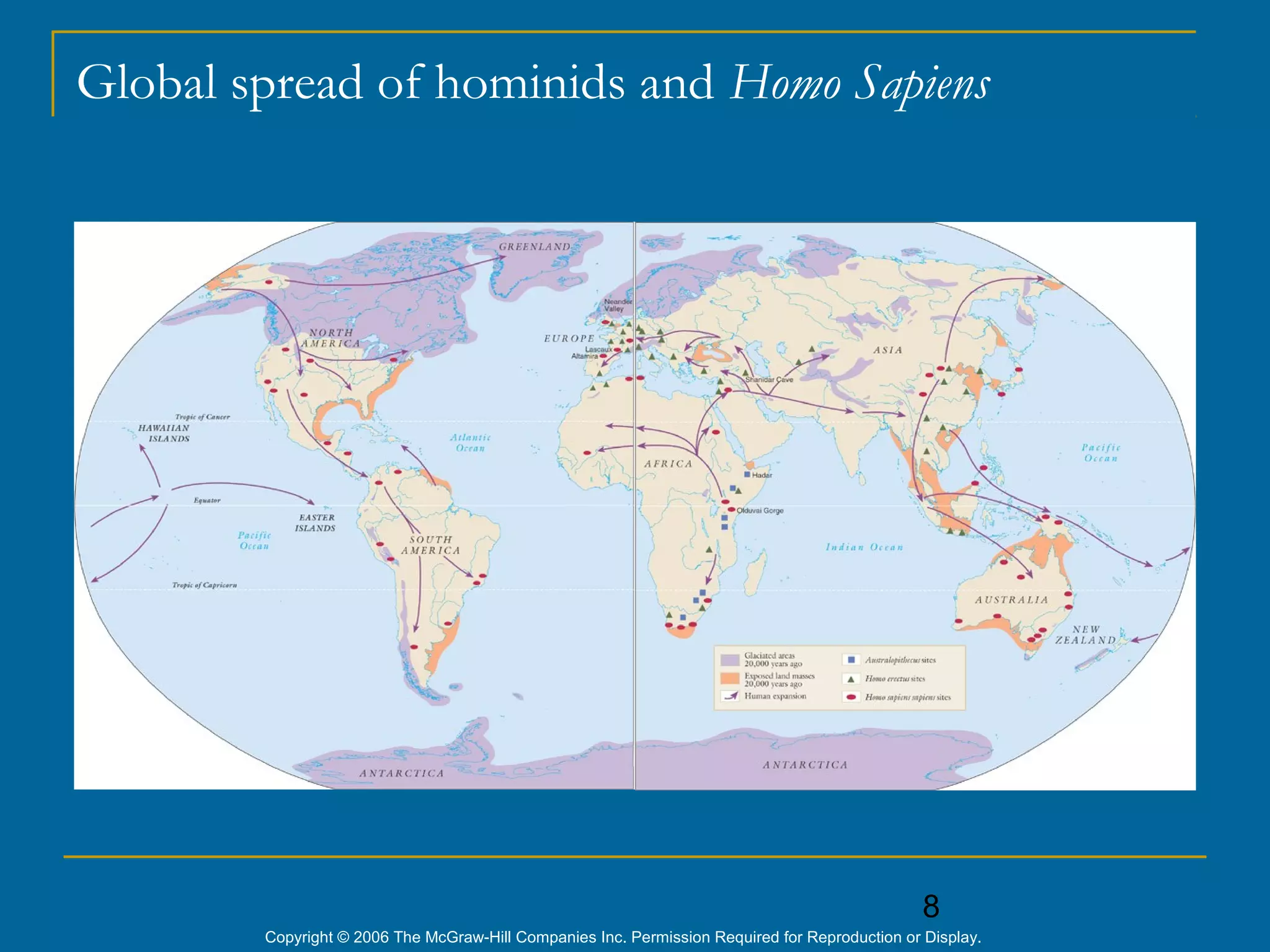
 Migrations of Homo Erectus and Homo Sapiens
8
Copyright © 2006 The McGraw-Hill Companies Inc. Permission Required for Reproduction or Display.
Global spread of hominids and Homo Sapiens
9
Copyright © 2006 The McGraw-Hill Companies Inc. Permission Required for Reproduction or Display.
The Natural Environment
 By 13,000 BCE Homo sapiens in every
inhabitable part of the world
 Archaeological finds:
 Sophisticated tools
 Choppers, scrapers, axes, knives, bows, arrows
 Cave and hutlike dwellings
 Use of fire, animal skins
 Hunted several mammal species to extinction
 Climactic change may have accelerated process
10
Copyright © 2006 The McGraw-Hill Companies Inc. Permission Required for Reproduction or Display.
Paleolithic Era (“Old Stone Age”)
 Evidence:
 Archaeological finds
 Extrapolation from modern hunter-gatherer societies
 Nomadic existence precludes advanced
civilization
 Groups of 30-50
 Division of labor along gender lines
11
Copyright © 2006 The McGraw-Hill Companies Inc. Permission Required for Reproduction or Display.
Relative Social Equality
 Nomadic culture precludes accumulation of land-
based wealth
 More likely determinants of status: age, hunting skill,
fertility, charisma
 Possible gender equality related to food
production
 Men: protein from hunting
 Women: plant gethering
12
Copyright © 2006 The McGraw-Hill Companies Inc. Permission Required for Reproduction or Display.
Big Game Hunting
 Evidence of intelligent coordination of hunting
expeditions
 Development of weaponry
 Animal-skin disguises
 Stampeding tactics
 Lighting of fires, etc. to drive game into kill zones
 Requires planning, communication
13
Copyright © 2006 The McGraw-Hill Companies Inc. Permission Required for Reproduction or Display.
Paleolithic Settlements
 Natufian society
 Modern Israel and Jordan
 Wild wheat, herding
 Jomon society
 Japan
 Wild buckwheat, fishing
 Chinook society
 Pacific Northwest
 Berries, acorns, salmon runs
 Groups of 1000 or more
14
Copyright © 2006 The McGraw-Hill Companies Inc. Permission Required for Reproduction or Display.
Neandertal Peoples
 Neander valley, western Germany
 Also found in Africa, east Asia
 Evidence of spirituality: ritual burial
15
Copyright © 2006 The McGraw-Hill Companies Inc. Permission Required for Reproduction or Display.
Cro-magnon Peoples
 Physically similar to modern humans
 Greater capacity for speech?
 Homo sapiens sapiens
 Increased variety of tools
 Adornments, decorative furniture, cave paintings
 “Venus” figurines
 Cave paintings
16
Copyright © 2006 The McGraw-Hill Companies Inc. Permission Required for Reproduction or Display.
Neolithic Era (“New Stone Age”)
 Distinction in tool production
 Chipped vs. polished
 Men: herding animals rather than hunting
 Women: nurtured vegetation rather than foraging
 Spread of Agriculture
 Slash-and-and burn techniques
 Exhaustion of soil promotes migration
 Transport of crops from one region to another
17
Copyright © 2006 The McGraw-Hill Companies Inc. Permission Required for Reproduction or Display.
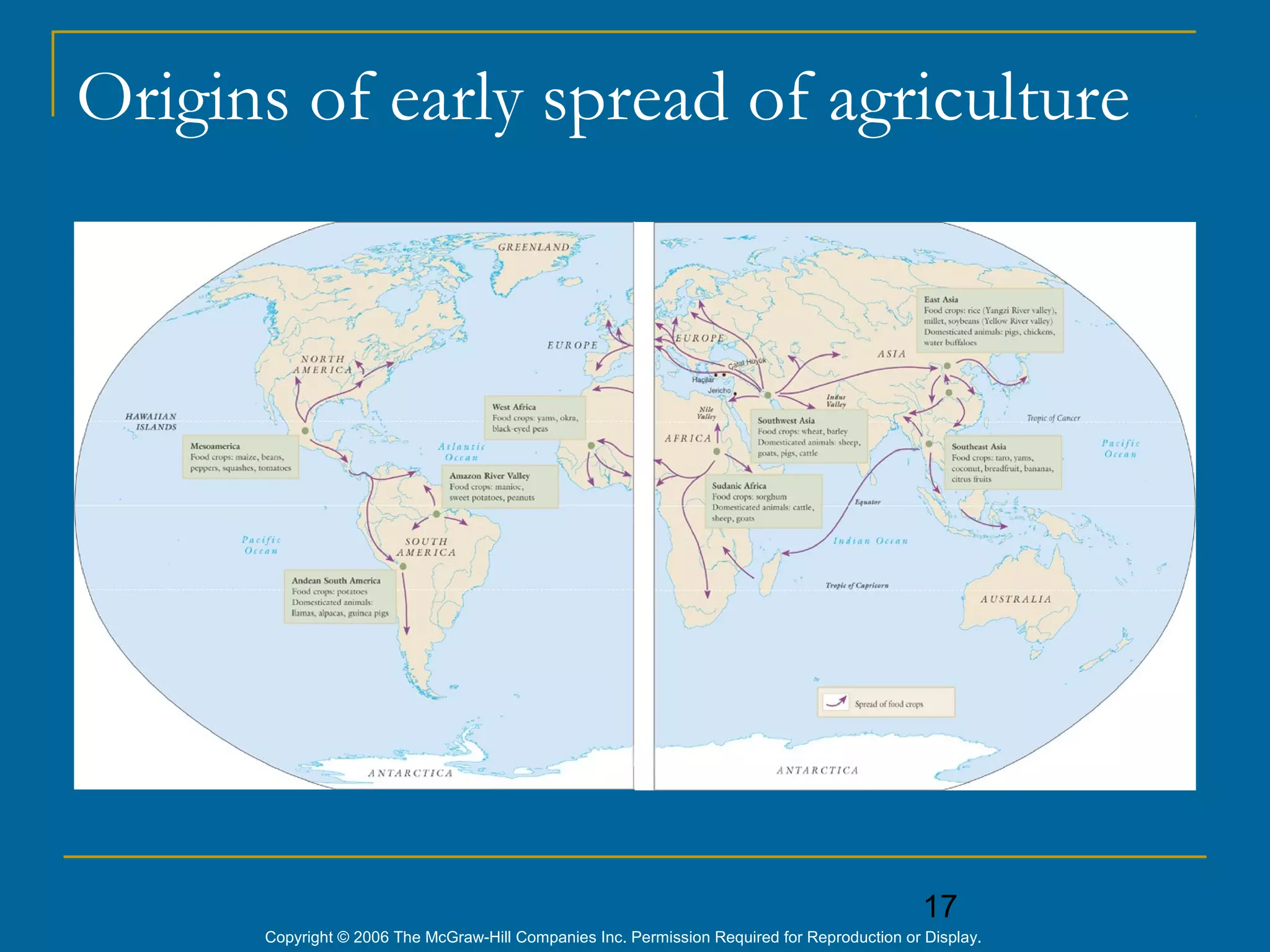
Origins of early spread of agriculture
18
Copyright © 2006 The McGraw-Hill Companies Inc. Permission Required for Reproduction or Display.
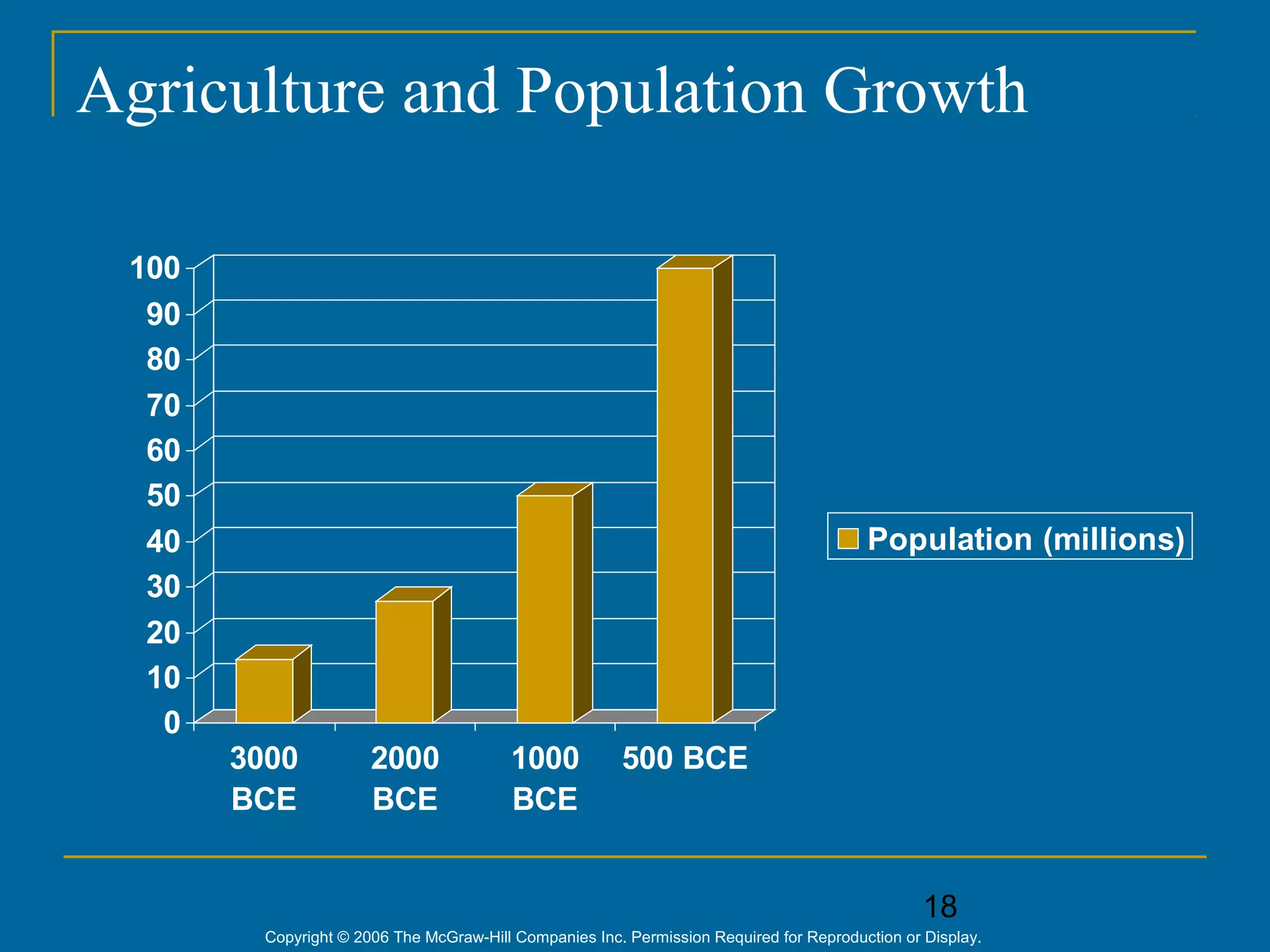
Agriculture and Population Growth
0
10
20
30
40
50
60
70
80
90
100
3000
BCE
2000
BCE
1000
BCE
500 BCE
Population (millions)
19
Copyright © 2006 The McGraw-Hill Companies Inc. Permission Required for Reproduction or Display.
Surplus Food and
the Specialization of Labor
 Emergence of villages and towns
 Discoveries at Çatal Hüyük, Turkey, occupied
7250-5400 BCE
 Tremendous range of manufactured products
 Pottery, Jewelry, Textiles, Copper tools
 Development of crafts
20
Copyright © 2006 The McGraw-Hill Companies Inc. Permission Required for Reproduction or Display.
Social Distinctions
 Accumulation of landed wealth initiates
development of social classes
 Archaeological evidence in variety of household
decorations, goods buried with deceased members of
society at Çatal Hüyük
21
Copyright © 2006 The McGraw-Hill Companies Inc. Permission Required for Reproduction or Display.
Religious Values
 Elements of natural environment essential for
functioning
 Archaeological evidence of religious worship:
thousands of clay figurines, drawings on pots, tool
decorations, other ritual objects
 Fertility: Venus figurines
22
Copyright © 2006 The McGraw-Hill Companies Inc. Permission Required for Reproduction or Display.
Beginnings of Urbanization
 Jericho: concentration of wealth, building a wall
 Craft specialization
 Social stratification
 Governance
 Cultural workers

01 bentley3

  • 1.
    1 Copyright © 2006The McGraw-Hill Companies Inc. Permission Required for Reproduction or Display. PowerPoint Presentation Materials For Instructor’s Online Learning Center Traditions and Encounters A Global Perspective on the Past 3rd Edition Jerry H. Bentley Herbert F. Ziegler PowerPoint Presentations Prepared by Henry Abramson
  • 2.
    2 Copyright © 2006The McGraw-Hill Companies Inc. Permission Required for Reproduction or Display. Chapter 1 Before History
  • 3.
    3 Copyright © 2006The McGraw-Hill Companies Inc. Permission Required for Reproduction or Display. Forming the Complex Society  Basic development:  Hunting and Foraging  Agriculture  Complex Society  Key issue: surplus capital  Major development of first complex societies 3500 BCE – 500 BCE
  • 4.
    4 Copyright © 2006The McGraw-Hill Companies Inc. Permission Required for Reproduction or Display. Prehistory  What is “history”?  Documentation  Written records  Archaeological discovery  Requisite human presence (or “natural” history)
  • 5.
    5 Copyright © 2006The McGraw-Hill Companies Inc. Permission Required for Reproduction or Display. Development of Hominids  Animals adapt themselves to environment  Hominids adapt environment to themselves  Use of tools  Language  Complex cooperative social structures
  • 6.
    6 Copyright © 2006The McGraw-Hill Companies Inc. Permission Required for Reproduction or Display. Australopithecus  Discovery of skeleton AL-288-1, north of Addis Ababa, Ethiopia  Nicknamed “Lucy”  40% of SWF, 4’6”, 55lb., bipedal Brain 500 cc (modern human: 1400 cc), limited speech but opposable digit  Estimated date of death: 3.5 million years ago
  • 7.
    7 Copyright © 2006The McGraw-Hill Companies Inc. Permission Required for Reproduction or Display. Later Hominids  Homo Erectus, “upright man”  Larger brain capacity (1000 cc), improved tool use, control of fire  Homo Sapiens, “wise man” Homo Sapiens Sapiens, “very wise man” (most of us)  Largest brain, esp. frontal regions  most sophisticated tools and social organization  Migrations of Homo Erectus and Homo Sapiens
  • 8.
    8 Copyright © 2006The McGraw-Hill Companies Inc. Permission Required for Reproduction or Display. Global spread of hominids and Homo Sapiens
  • 9.
    9 Copyright © 2006The McGraw-Hill Companies Inc. Permission Required for Reproduction or Display. The Natural Environment  By 13,000 BCE Homo sapiens in every inhabitable part of the world  Archaeological finds:  Sophisticated tools  Choppers, scrapers, axes, knives, bows, arrows  Cave and hutlike dwellings  Use of fire, animal skins  Hunted several mammal species to extinction  Climactic change may have accelerated process
  • 10.
    10 Copyright © 2006The McGraw-Hill Companies Inc. Permission Required for Reproduction or Display. Paleolithic Era (“Old Stone Age”)  Evidence:  Archaeological finds  Extrapolation from modern hunter-gatherer societies  Nomadic existence precludes advanced civilization  Groups of 30-50  Division of labor along gender lines
  • 11.
    11 Copyright © 2006The McGraw-Hill Companies Inc. Permission Required for Reproduction or Display. Relative Social Equality  Nomadic culture precludes accumulation of land- based wealth  More likely determinants of status: age, hunting skill, fertility, charisma  Possible gender equality related to food production  Men: protein from hunting  Women: plant gethering
  • 12.
    12 Copyright © 2006The McGraw-Hill Companies Inc. Permission Required for Reproduction or Display. Big Game Hunting  Evidence of intelligent coordination of hunting expeditions  Development of weaponry  Animal-skin disguises  Stampeding tactics  Lighting of fires, etc. to drive game into kill zones  Requires planning, communication
  • 13.
    13 Copyright © 2006The McGraw-Hill Companies Inc. Permission Required for Reproduction or Display. Paleolithic Settlements  Natufian society  Modern Israel and Jordan  Wild wheat, herding  Jomon society  Japan  Wild buckwheat, fishing  Chinook society  Pacific Northwest  Berries, acorns, salmon runs  Groups of 1000 or more
  • 14.
    14 Copyright © 2006The McGraw-Hill Companies Inc. Permission Required for Reproduction or Display. Neandertal Peoples  Neander valley, western Germany  Also found in Africa, east Asia  Evidence of spirituality: ritual burial
  • 15.
    15 Copyright © 2006The McGraw-Hill Companies Inc. Permission Required for Reproduction or Display. Cro-magnon Peoples  Physically similar to modern humans  Greater capacity for speech?  Homo sapiens sapiens  Increased variety of tools  Adornments, decorative furniture, cave paintings  “Venus” figurines  Cave paintings
  • 16.
    16 Copyright © 2006The McGraw-Hill Companies Inc. Permission Required for Reproduction or Display. Neolithic Era (“New Stone Age”)  Distinction in tool production  Chipped vs. polished  Men: herding animals rather than hunting  Women: nurtured vegetation rather than foraging  Spread of Agriculture  Slash-and-and burn techniques  Exhaustion of soil promotes migration  Transport of crops from one region to another
  • 17.
    17 Copyright © 2006The McGraw-Hill Companies Inc. Permission Required for Reproduction or Display. Origins of early spread of agriculture
  • 18.
    18 Copyright © 2006The McGraw-Hill Companies Inc. Permission Required for Reproduction or Display. Agriculture and Population Growth 0 10 20 30 40 50 60 70 80 90 100 3000 BCE 2000 BCE 1000 BCE 500 BCE Population (millions)
  • 19.
    19 Copyright © 2006The McGraw-Hill Companies Inc. Permission Required for Reproduction or Display. Surplus Food and the Specialization of Labor  Emergence of villages and towns  Discoveries at Çatal Hüyük, Turkey, occupied 7250-5400 BCE  Tremendous range of manufactured products  Pottery, Jewelry, Textiles, Copper tools  Development of crafts
  • 20.
    20 Copyright © 2006The McGraw-Hill Companies Inc. Permission Required for Reproduction or Display. Social Distinctions  Accumulation of landed wealth initiates development of social classes  Archaeological evidence in variety of household decorations, goods buried with deceased members of society at Çatal Hüyük
  • 21.
    21 Copyright © 2006The McGraw-Hill Companies Inc. Permission Required for Reproduction or Display. Religious Values  Elements of natural environment essential for functioning  Archaeological evidence of religious worship: thousands of clay figurines, drawings on pots, tool decorations, other ritual objects  Fertility: Venus figurines
  • 22.
    22 Copyright © 2006The McGraw-Hill Companies Inc. Permission Required for Reproduction or Display. Beginnings of Urbanization  Jericho: concentration of wealth, building a wall  Craft specialization  Social stratification  Governance  Cultural workers

Editor's Notes

  • #6 Skeleton of Lucy, www.bbc.co.uk/.../ chronology/contentpage1.shtml
  • #7 Reconstruction of Lucy: www.bbc.co.uk /.../ chronology/contentpage1.shtml
  • #14 Natufian burial w/dog www.sdnhm.org /exhibits/ dogs/ facts.html
  • #17 sanat.bilkent.edu.tr / imot/neolithic/RMO52-27.html
  • #23 Photo of jericho walls www.bobmay.info / may132003jericho.htm