1914 – Present
20th century and Beyond
Periodization: Why 1914?
Major Themes
 World Conflict – Decline of Empire
 Decolonization and Nationalism
 Cold War Conflicts
 Social Reforms
 Globalization
 Environmental Issues
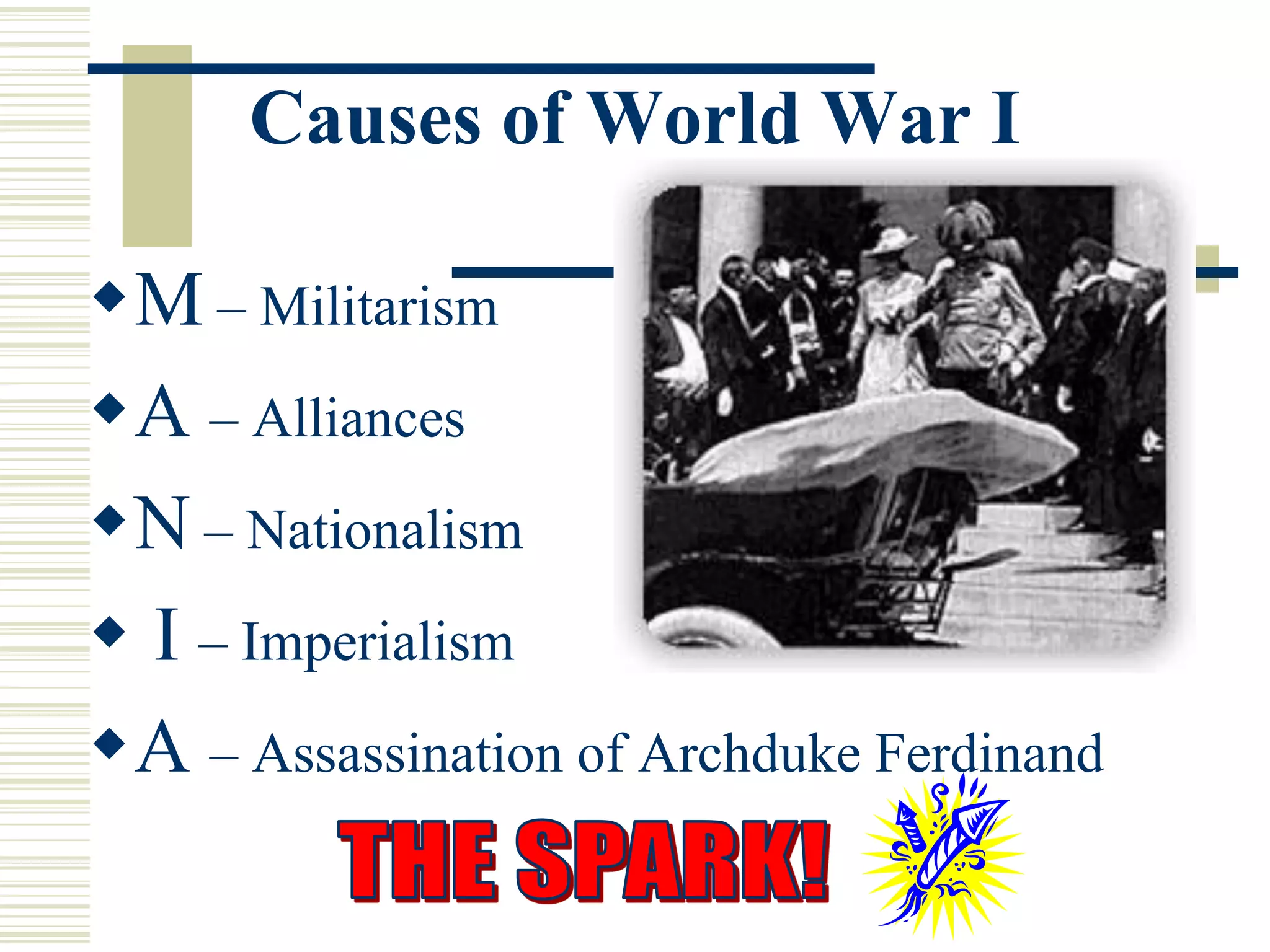
Causes of World War I
M – Militarism
A – Alliances
N – Nationalism
 I – Imperialism
A – Assassination of Archduke Ferdinand
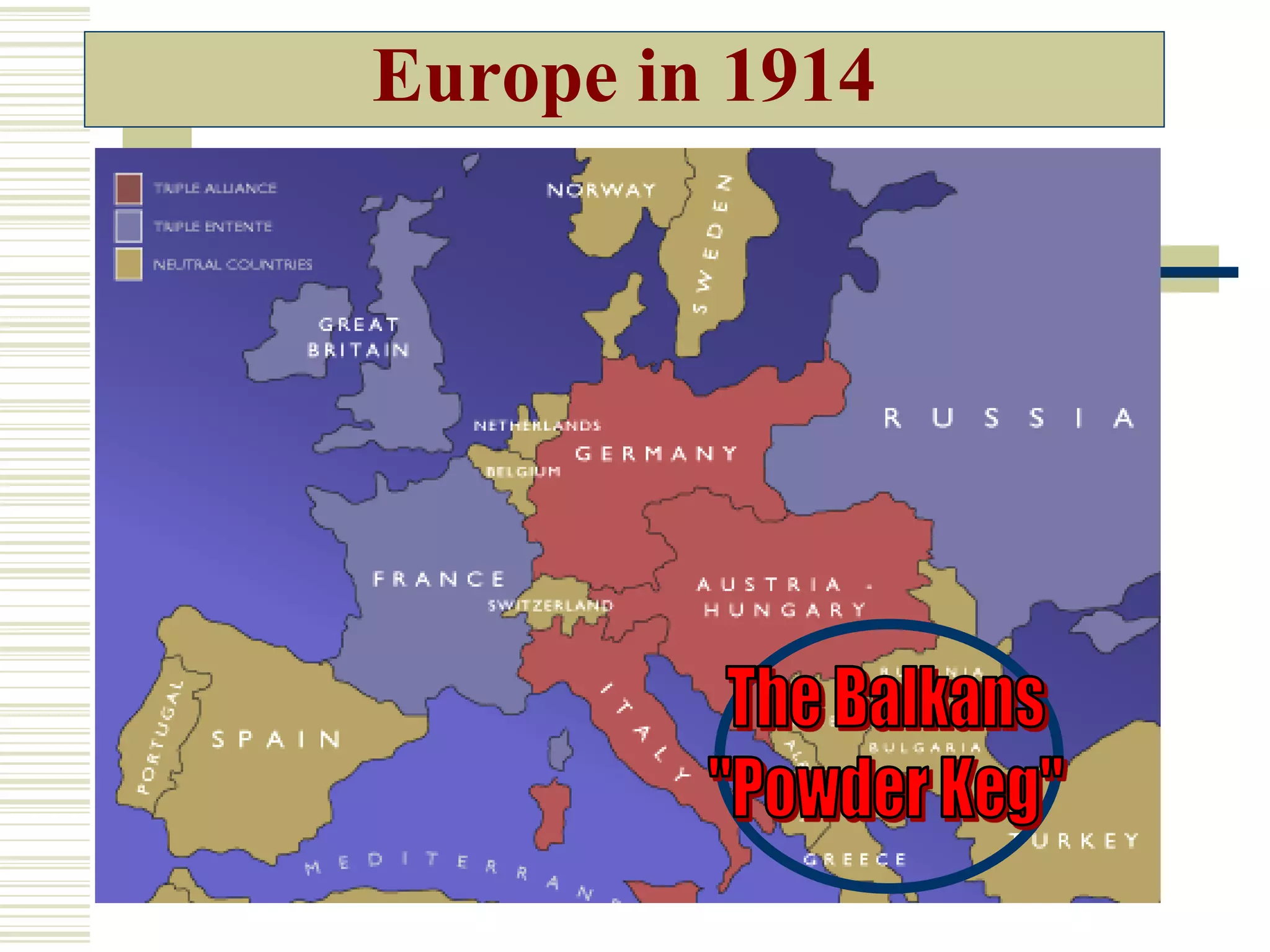
Europe in 1914
World War I
 Promises of self-determination
 Use of colonial soldiers
 Machine guns, submarines, planes, tanks,
trench warfare = major death and destruction
 Financial strain on empire
 Treaty of Versailles
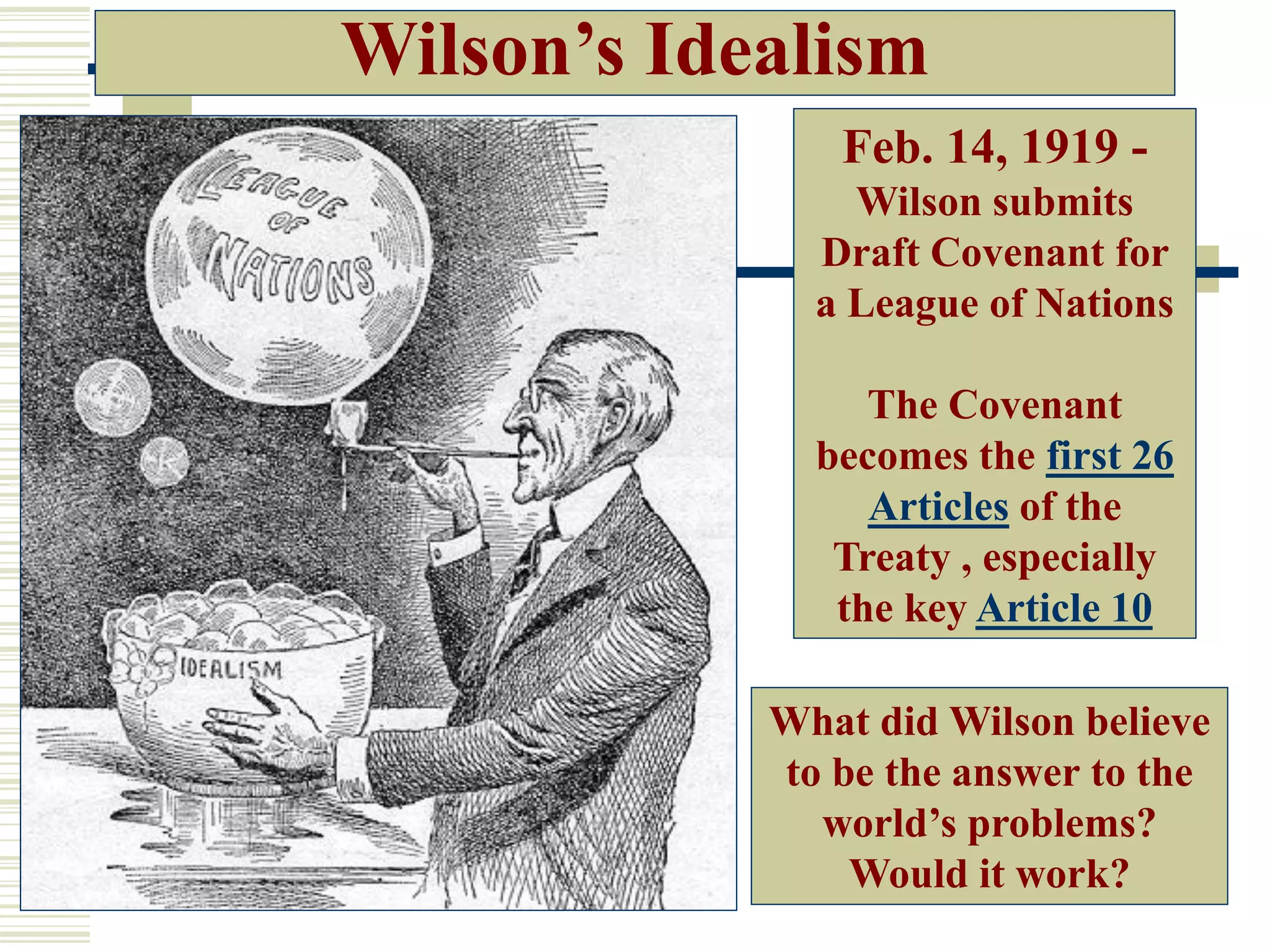
Feb. 14, 1919 -
Wilson submits
Draft Covenant for
a League of Nations
The Covenant
becomes the first 26
Articles of the
Treaty , especially
the key Article 10
What did Wilson believe
to be the answer to the
world’s problems?
Would it work?
Wilson’s Idealism
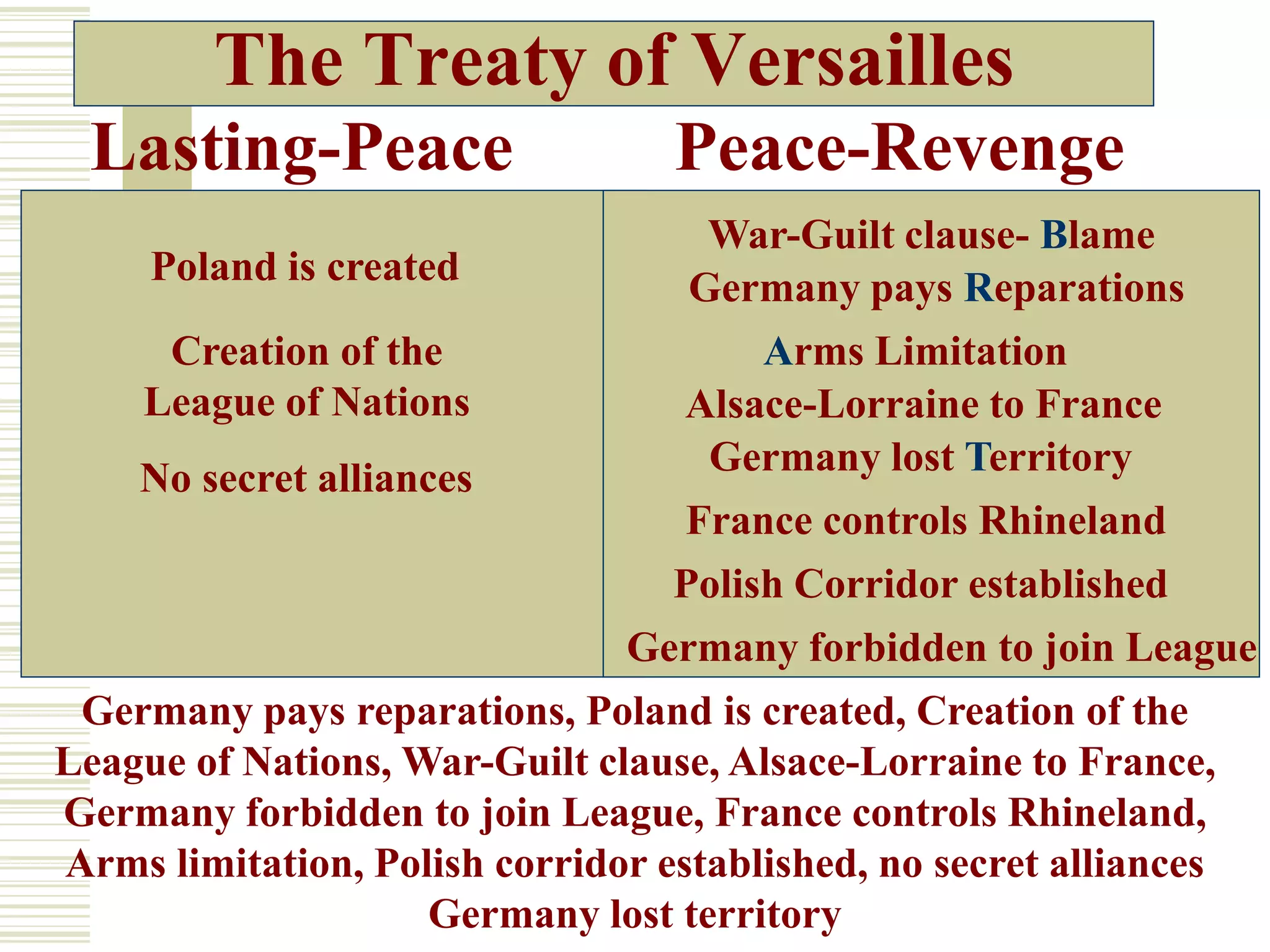
The Treaty of Versailles
Lasting-Peace Peace-Revenge
Germany pays reparations, Poland is created, Creation of the
League of Nations, War-Guilt clause, Alsace-Lorraine to France,
Germany forbidden to join League, France controls Rhineland,
Arms limitation, Polish corridor established, no secret alliances
Germany lost territory
Arms LimitationCreation of the
League of Nations
Polish Corridor established
France controls Rhineland
Poland is created
War-Guilt clause- Blame
Germany pays Reparations
Germany lost Territory
Germany forbidden to join League
No secret alliances
Alsace-Lorraine to France
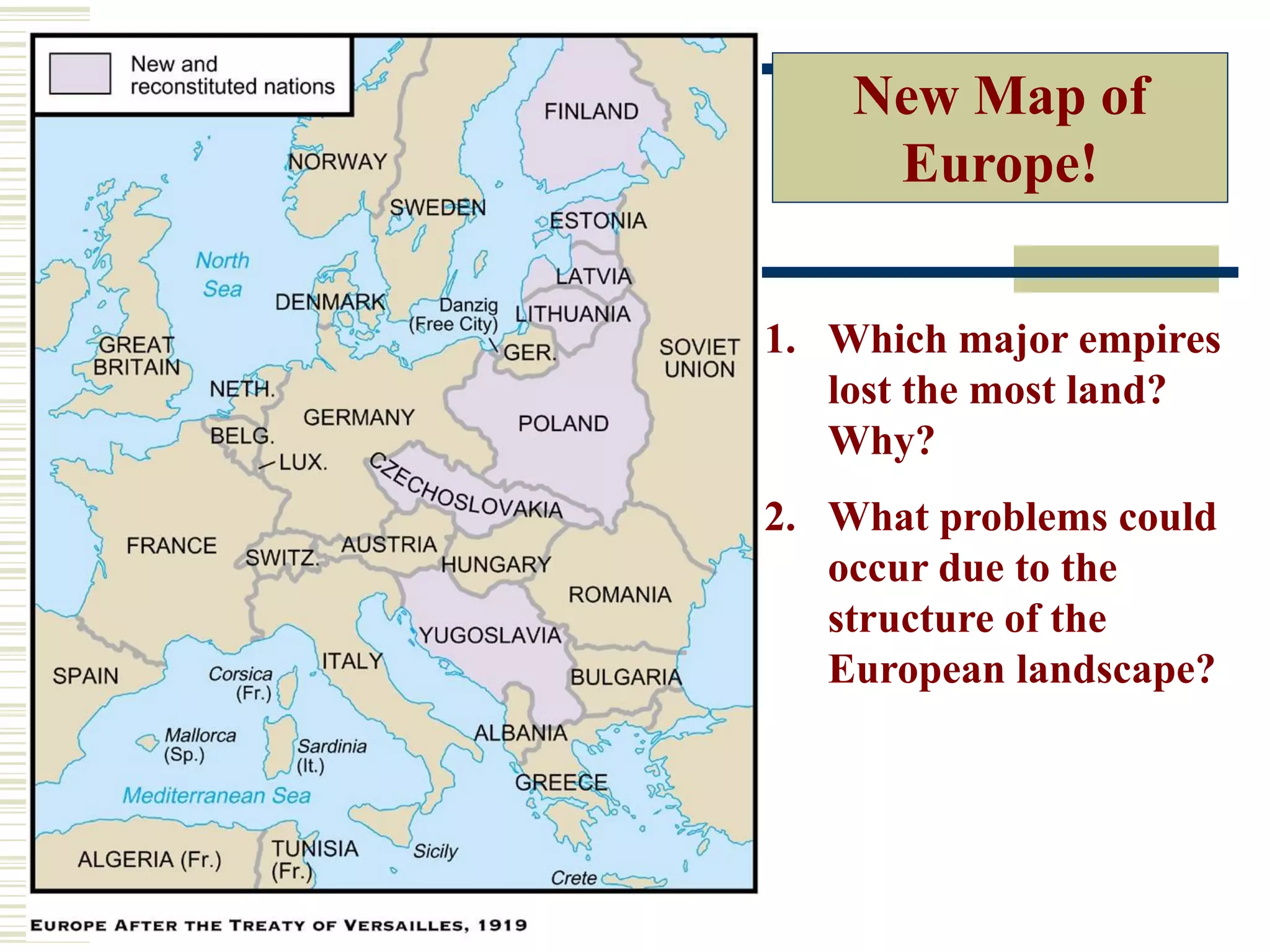
New Map of
Europe!
1. Which major empires
lost the most land?
Why?
2. What problems could
occur due to the
structure of the
European landscape?
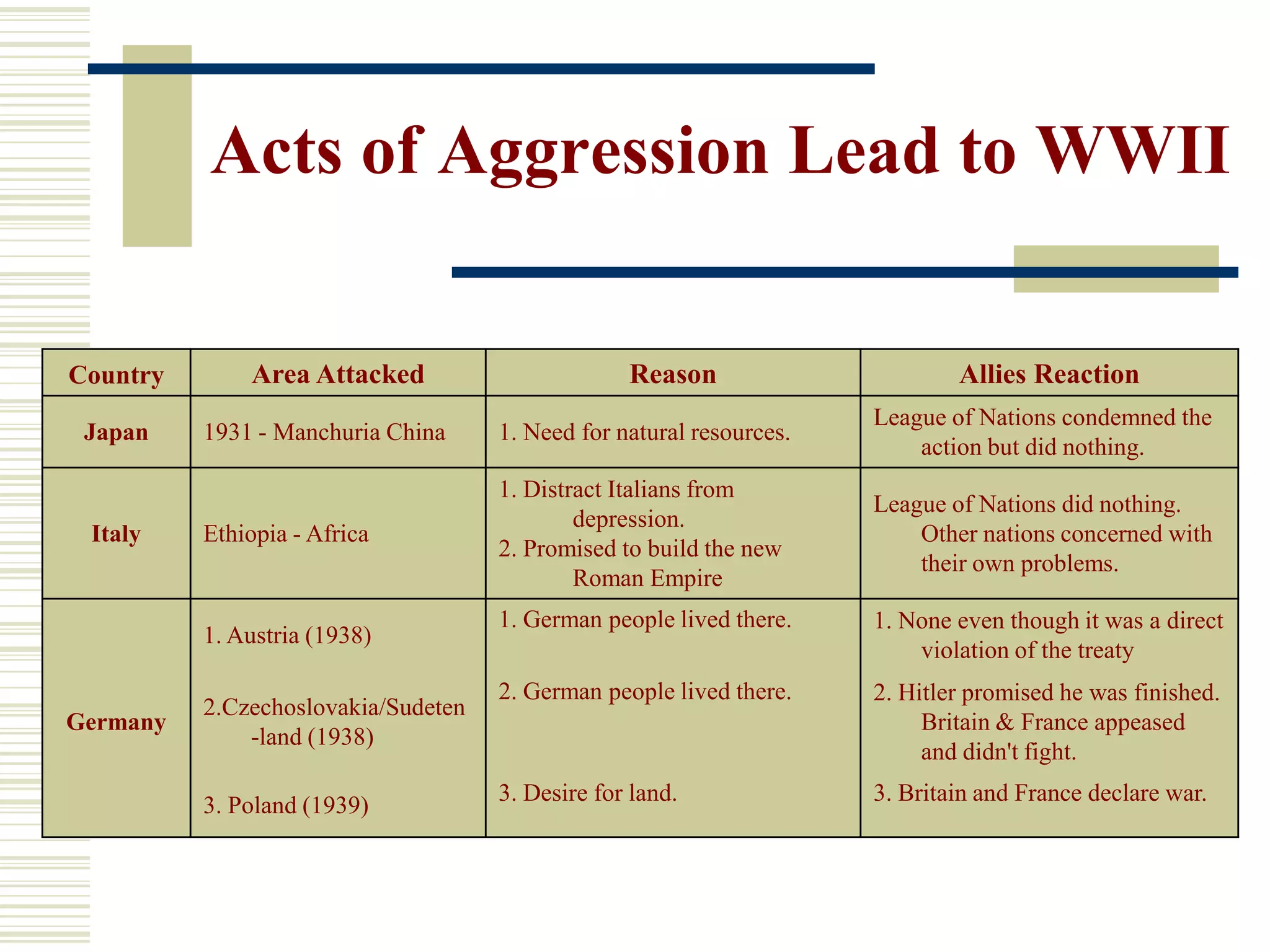
Acts of Aggression Lead to WWII
Country Area Attacked Reason Allies Reaction
Japan 1931 - Manchuria China 1. Need for natural resources.
League of Nations condemned the
action but did nothing.
Italy Ethiopia - Africa
1. Distract Italians from
depression.
2. Promised to build the new
Roman Empire
League of Nations did nothing.
Other nations concerned with
their own problems.
1. Austria (1938)
1. German people lived there. 1. None even though it was a direct
violation of the treaty
Germany
2.Czechoslovakia/Sudeten
-land (1938)
2. German people lived there. 2. Hitler promised he was finished.
Britain & France appeased
and didn't fight.
3. Poland (1939)
3. Desire for land. 3. Britain and France declare war.
AXIS POWER
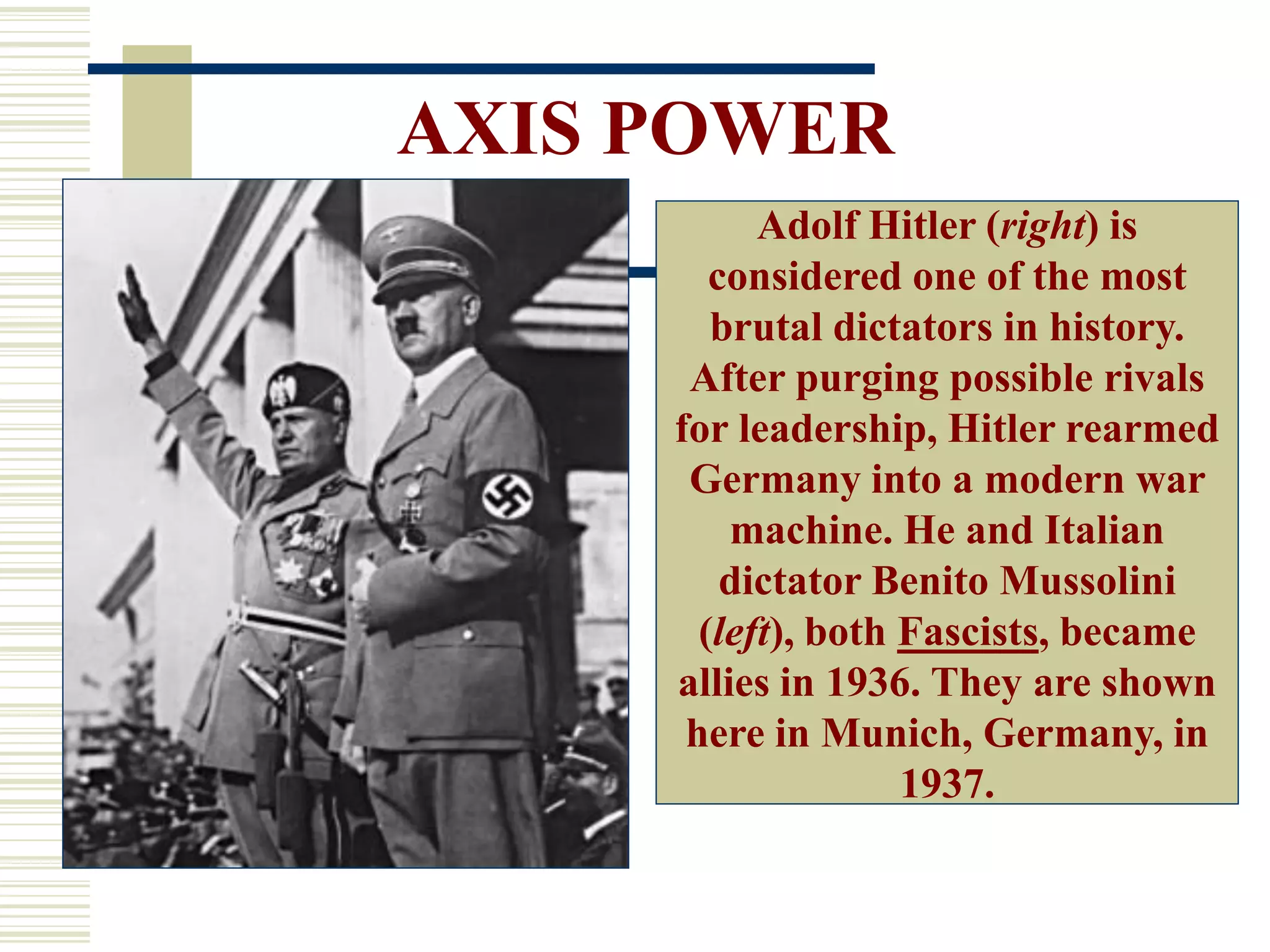
Adolf Hitler (right) is
considered one of the most
brutal dictators in history.
After purging possible rivals
for leadership, Hitler rearmed
Germany into a modern war
machine. He and Italian
dictator Benito Mussolini
(left), both Fascists, became
allies in 1936. They are shown
here in Munich, Germany, in
1937.
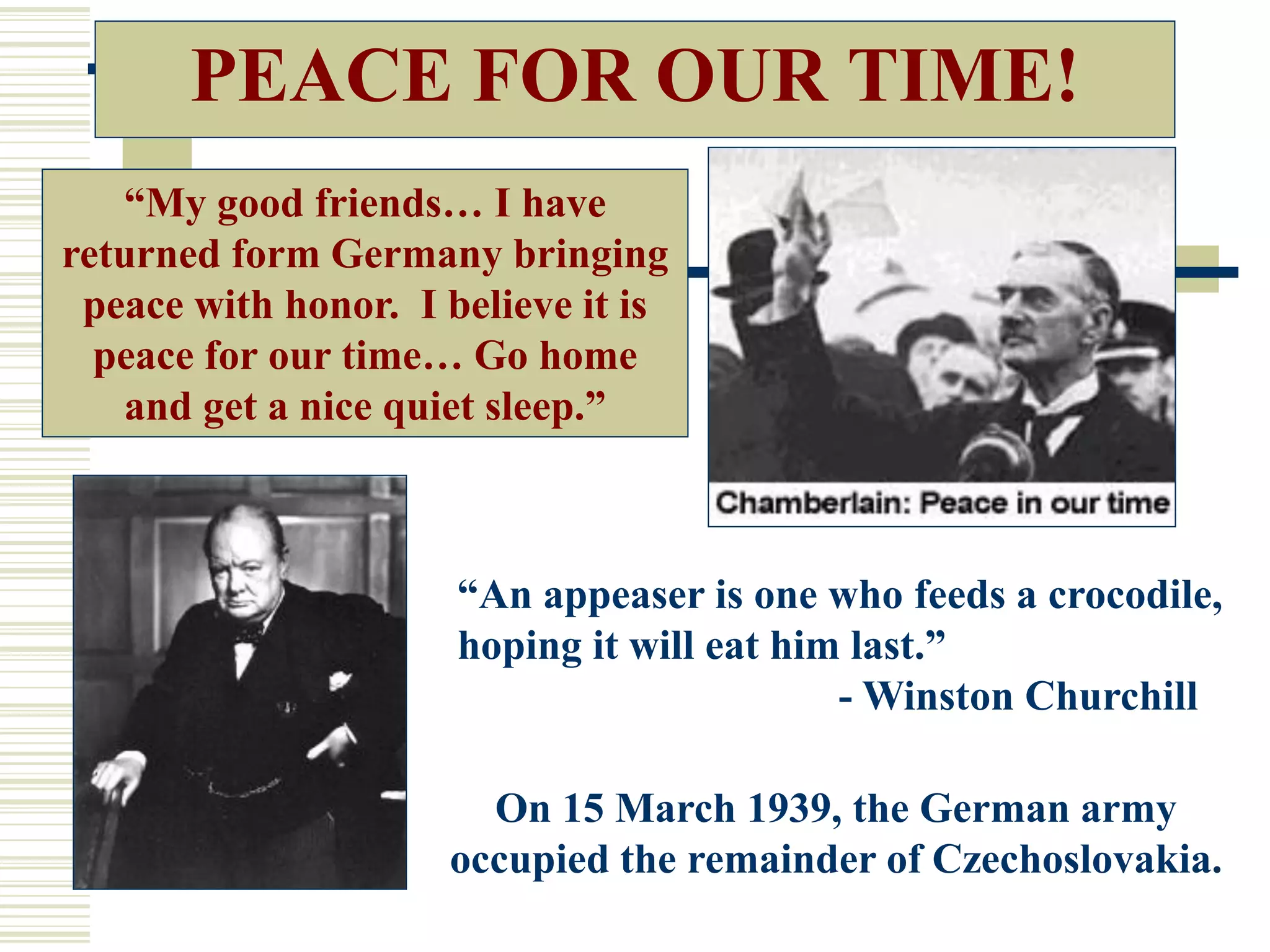
PEACE FOR OUR TIME!
“An appeaser is one who feeds a crocodile,
hoping it will eat him last.”
- Winston Churchill
On 15 March 1939, the German army
occupied the remainder of Czechoslovakia.
“My good friends… I have
returned form Germany bringing
peace with honor. I believe it is
peace for our time… Go home
and get a nice quiet sleep.”
World War II
 Increased nationalist uprisings following WWI and
as a result of the global depression
 Costs of empire
 US support of anti-colonial liberation movements
 Atlantic Charter (1941) “right of all people to
choose the form of government under which they
live”
 Soviets condemned colonialism
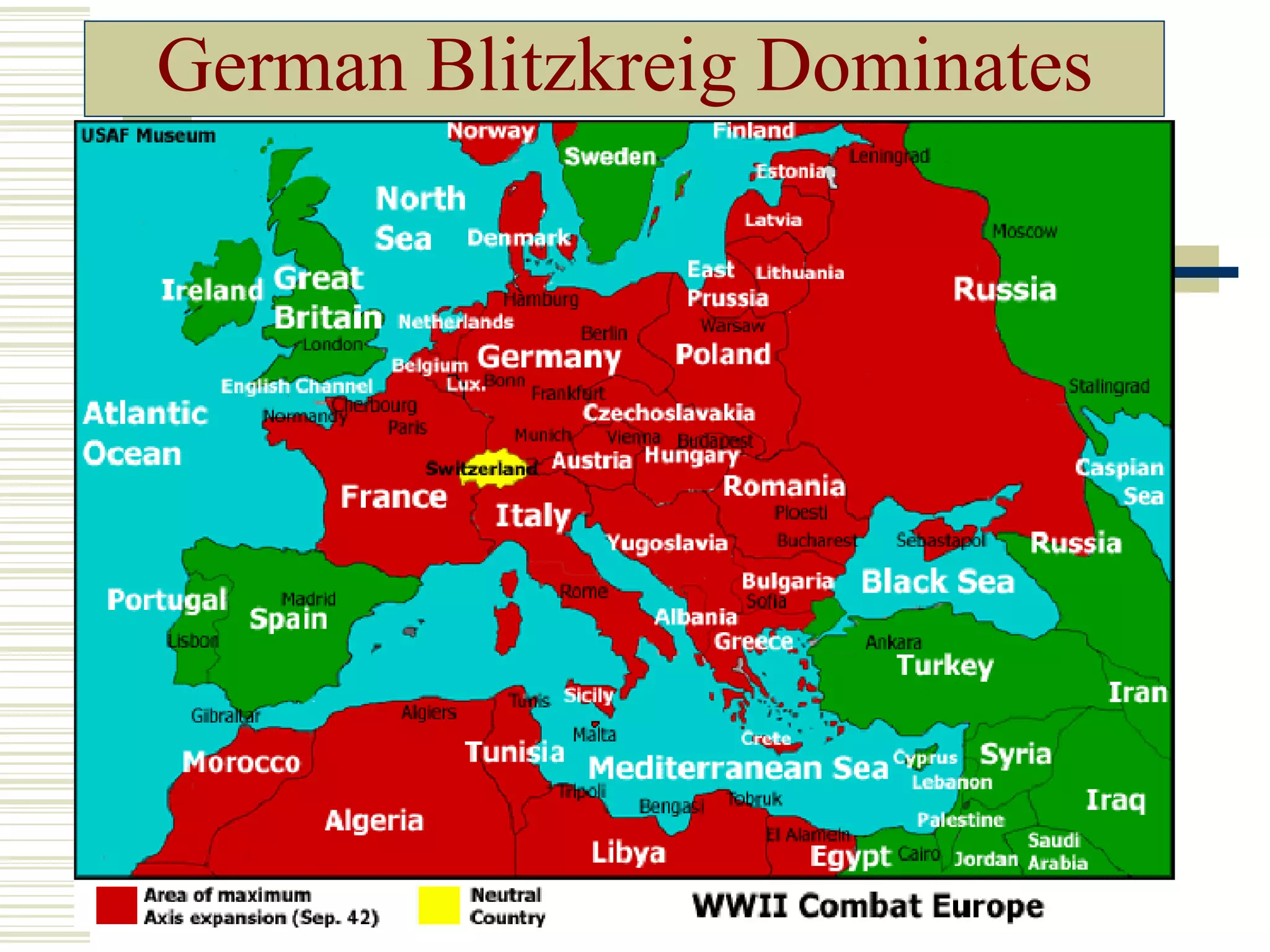
German Blitzkreig Dominates
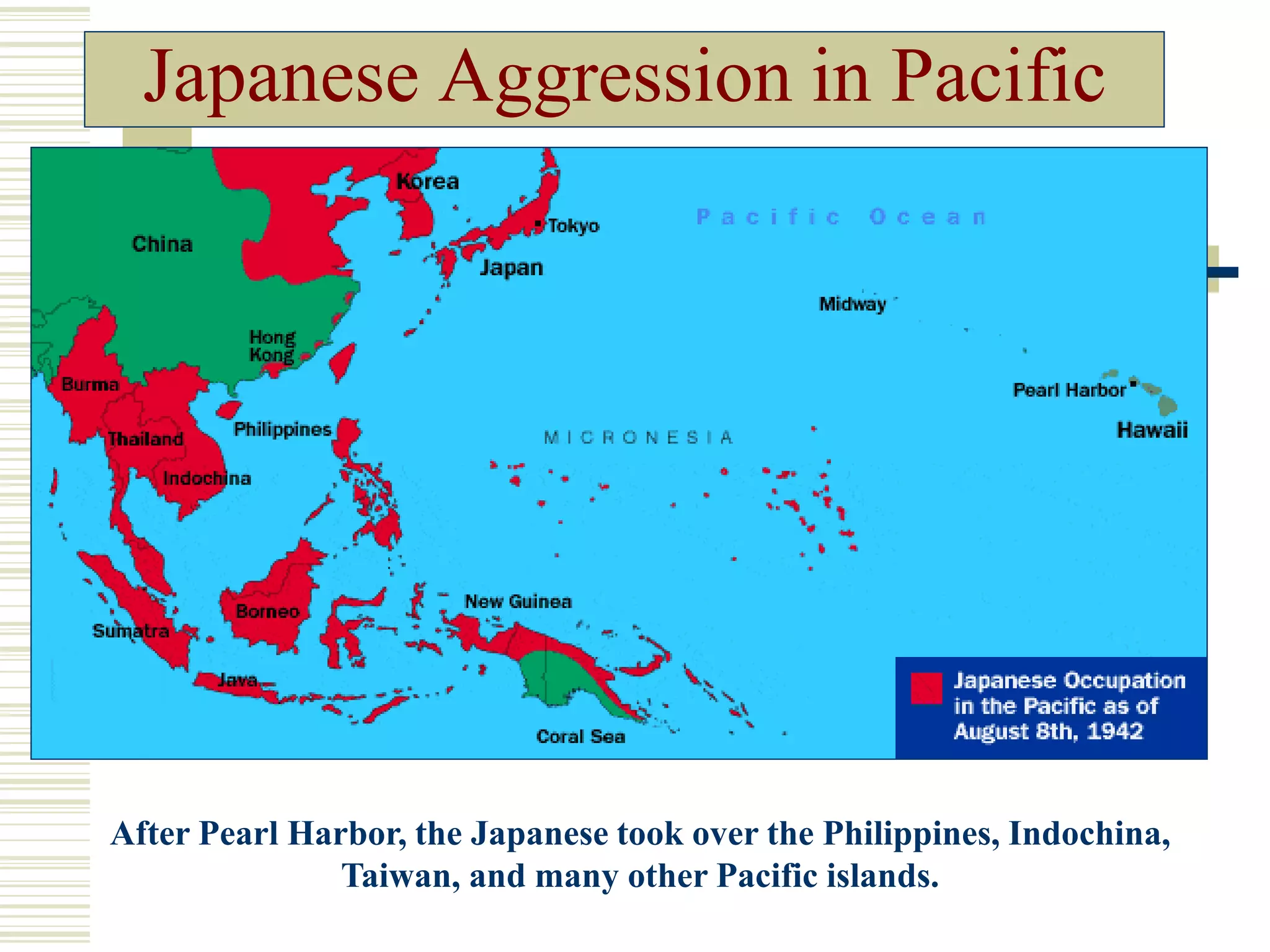
Japanese Aggression in Pacific
After Pearl Harbor, the Japanese took over the Philippines, Indochina,
Taiwan, and many other Pacific islands.
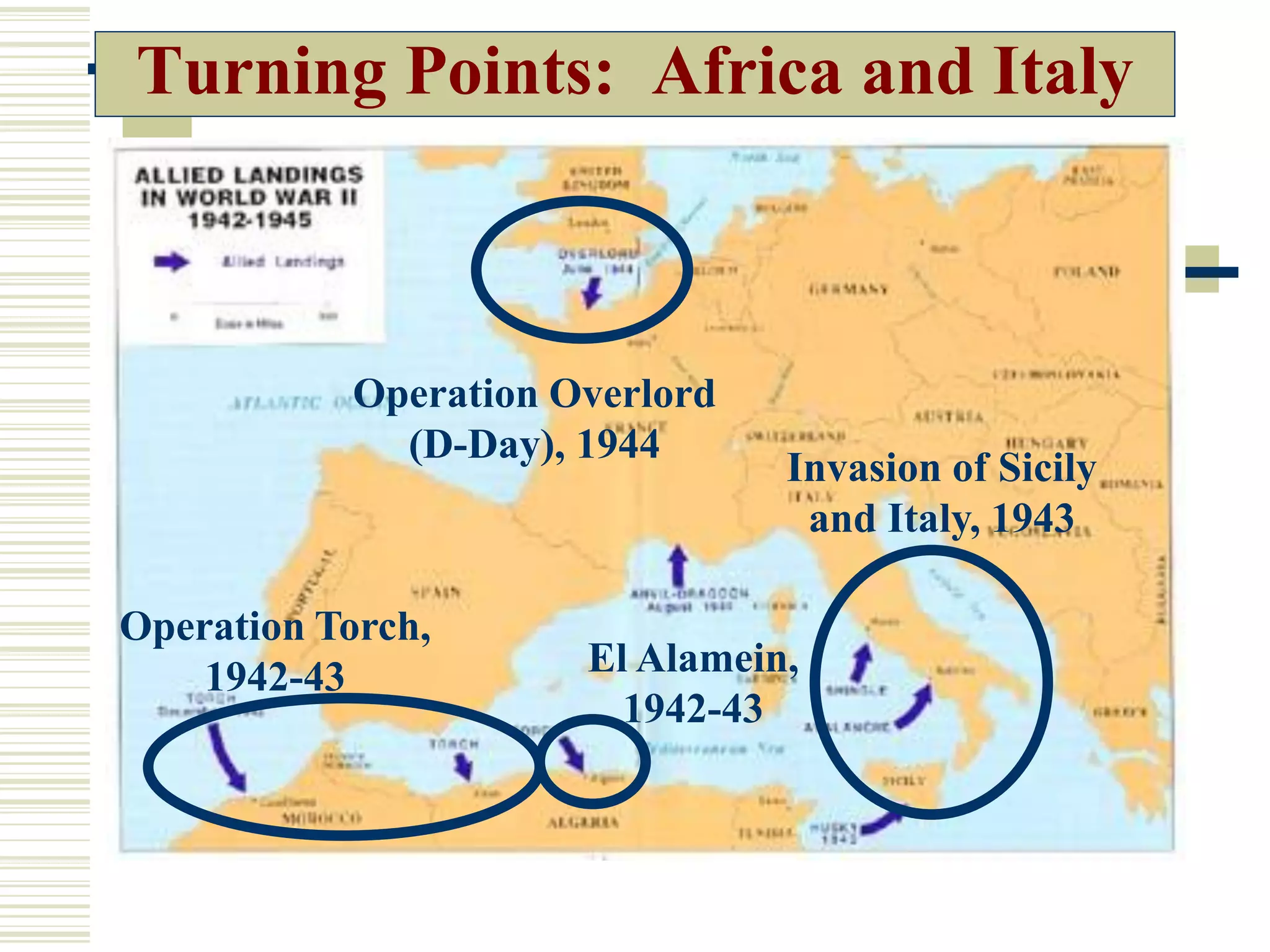
Turning Points: Africa and Italy
Operation Torch,
1942-43 El Alamein,
1942-43
Invasion of Sicily
and Italy, 1943
Operation Overlord
(D-Day), 1944
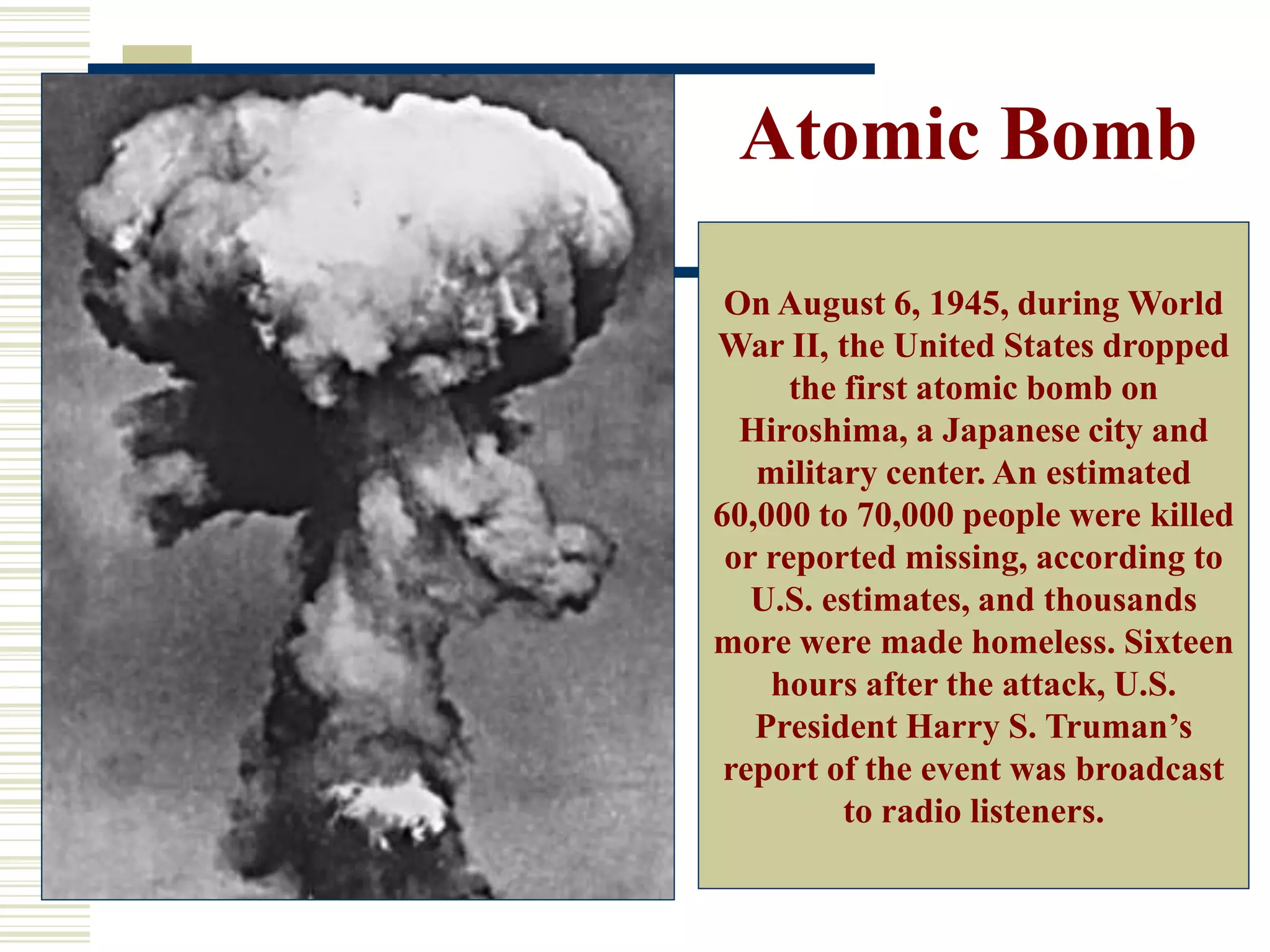
Atomic Bomb
On August 6, 1945, during World
War II, the United States dropped
the first atomic bomb on
Hiroshima, a Japanese city and
military center. An estimated
60,000 to 70,000 people were killed
or reported missing, according to
U.S. estimates, and thousands
more were made homeless. Sixteen
hours after the attack, U.S.
President Harry S. Truman’s
report of the event was broadcast
to radio listeners.
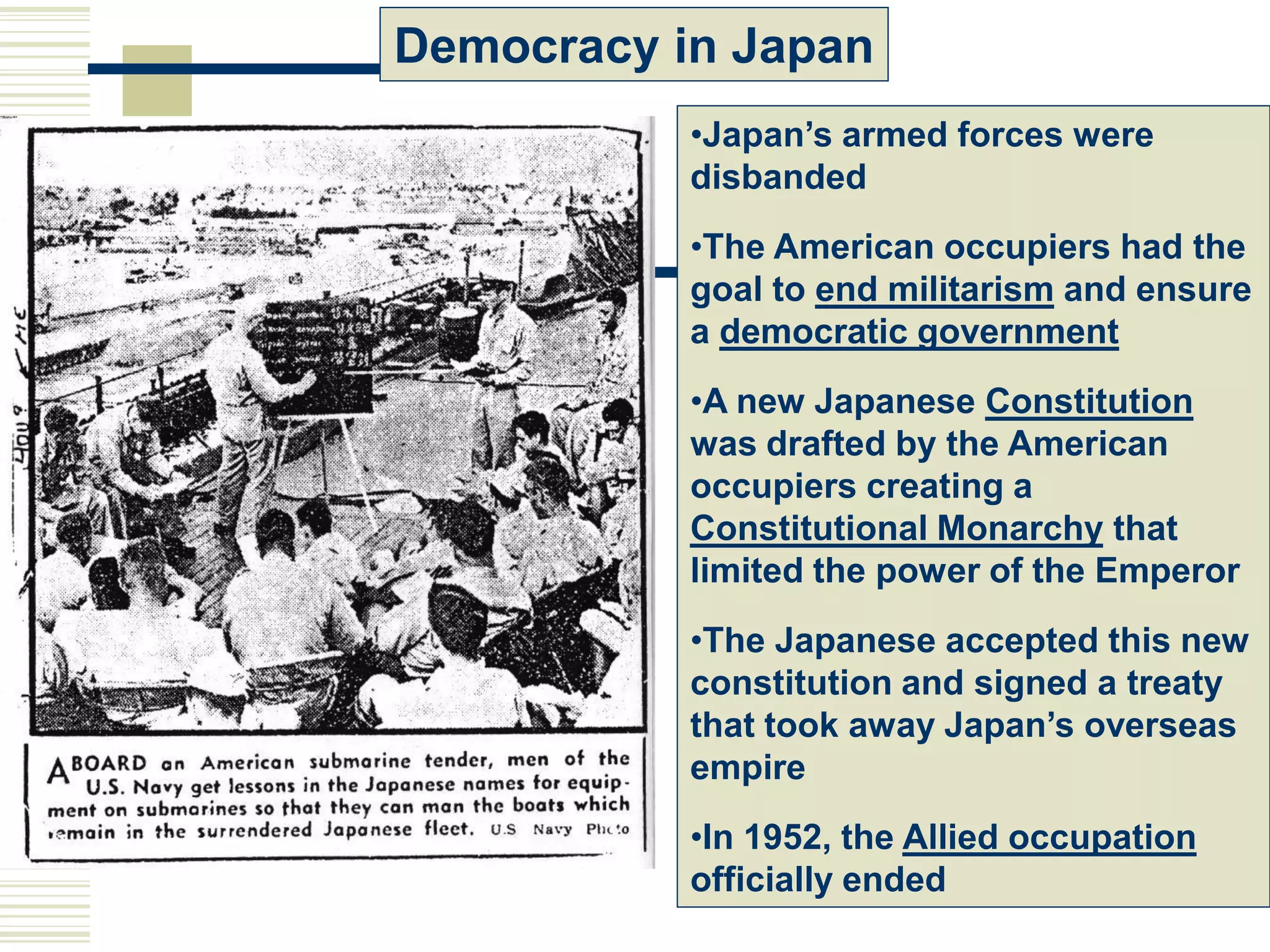
Democracy in Japan
•Japan’s armed forces were
disbanded
•The American occupiers had the
goal to end militarism and ensure
a democratic government
•A new Japanese Constitution
was drafted by the American
occupiers creating a
Constitutional Monarchy that
limited the power of the Emperor
•The Japanese accepted this new
constitution and signed a treaty
that took away Japan’s overseas
empire
•In 1952, the Allied occupation
officially ended
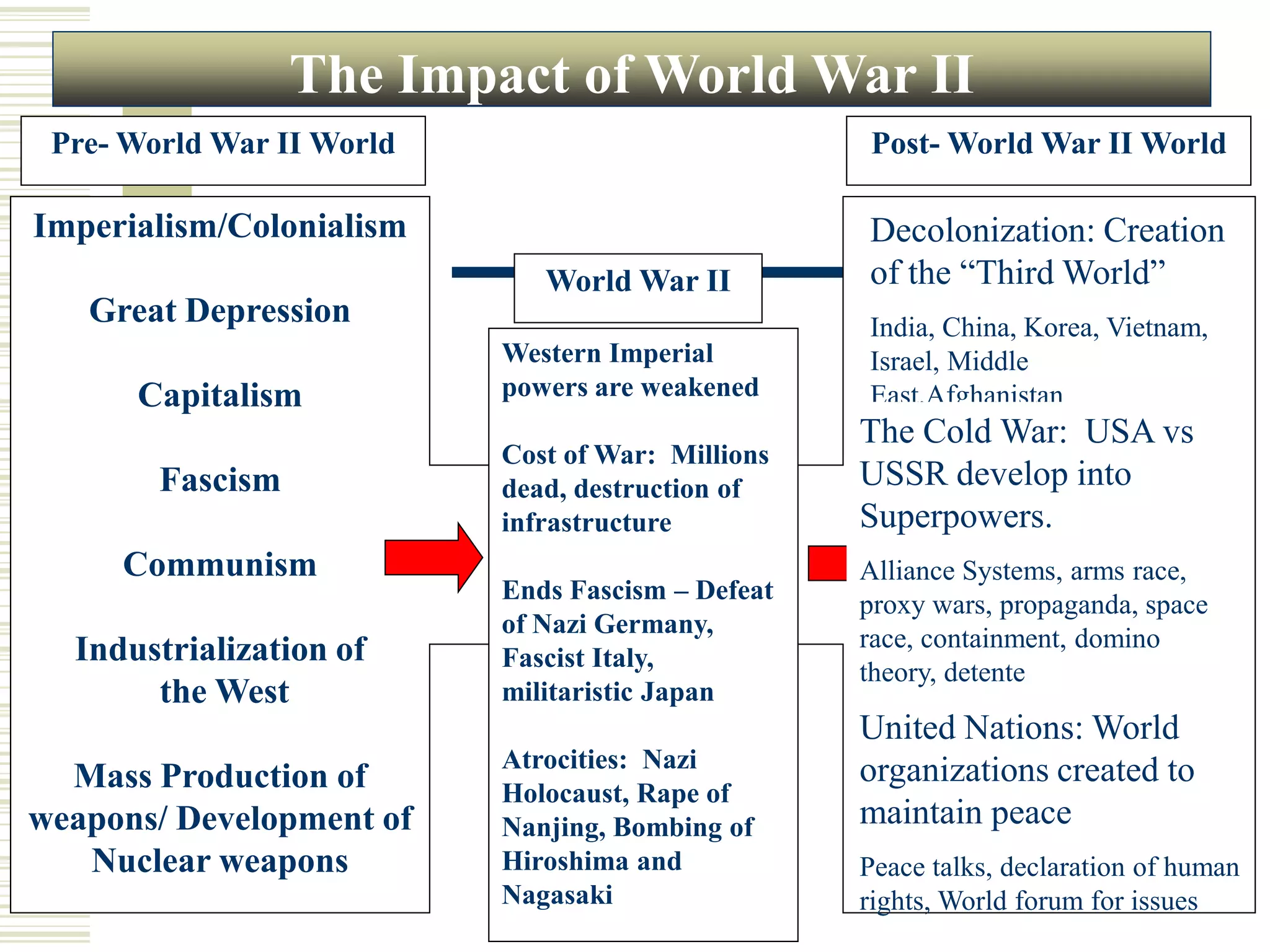
Imperialism/Colonialism
Great Depression
Capitalism
Fascism
Communism
Industrialization of
the West
Mass Production of
weapons/ Development of
Nuclear weapons
Western Imperial
powers are weakened
Cost of War: Millions
dead, destruction of
infrastructure
Ends Fascism – Defeat
of Nazi Germany,
Fascist Italy,
militaristic Japan
Atrocities: Nazi
Holocaust, Rape of
Nanjing, Bombing of
Hiroshima and
Nagasaki
Pre- World War II World
World War II
Post- World War II World
The Impact of World War II
Decolonization: Creation
of the “Third World”
India, China, Korea, Vietnam,
Israel, Middle
East,Afghanistan
The Cold War: USA vs
USSR develop into
Superpowers.
Alliance Systems, arms race,
proxy wars, propaganda, space
race, containment, domino
theory, detente
United Nations: World
organizations created to
maintain peace
Peace talks, declaration of human
rights, World forum for issues
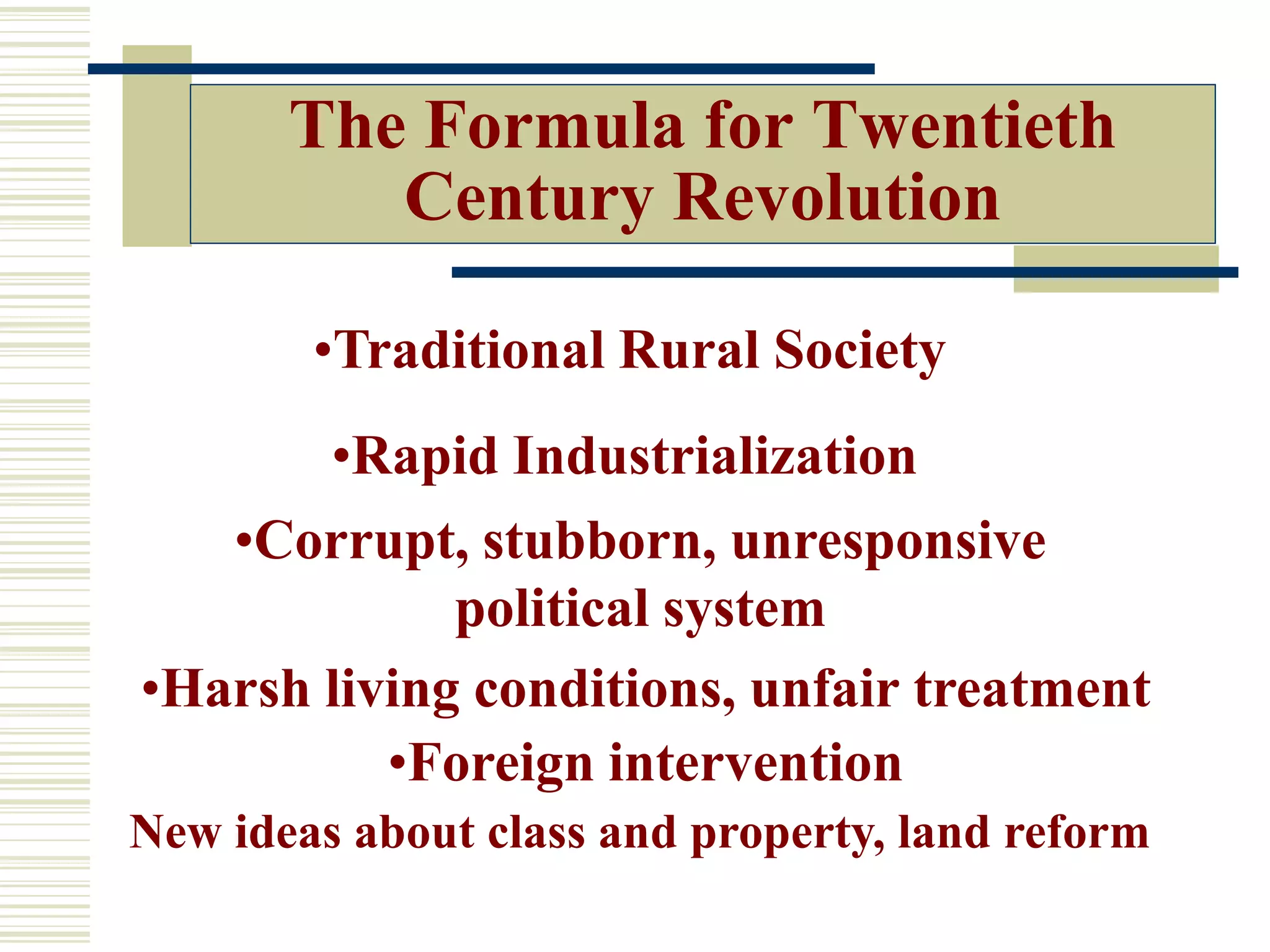
The Formula for Twentieth
Century Revolution
•Traditional Rural Society
•Rapid Industrialization
•Corrupt, stubborn, unresponsive
political system
•Harsh living conditions, unfair treatment
•Foreign intervention
New ideas about class and property, land reform
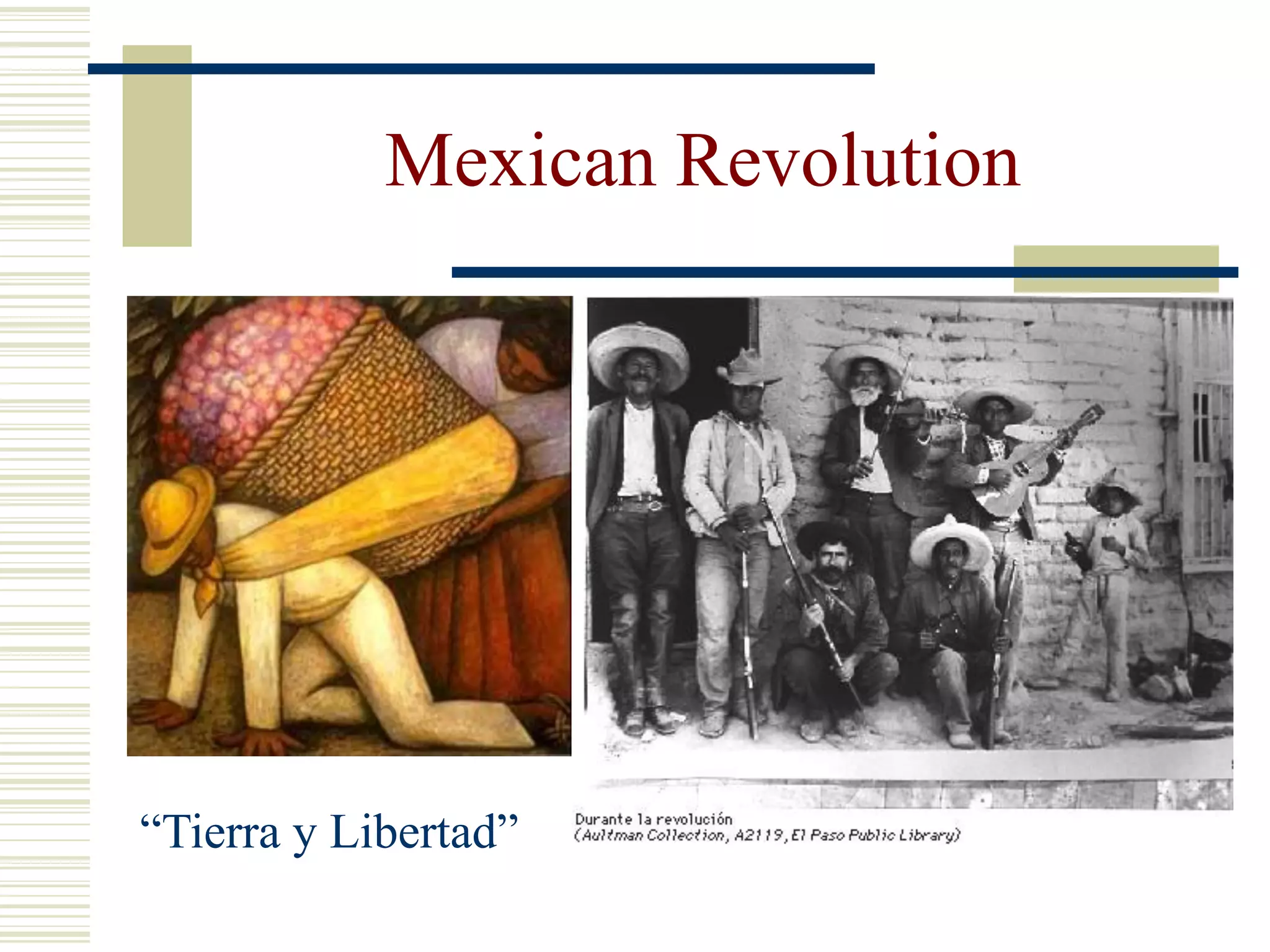
Mexican Revolution
“Tierra y Libertad”
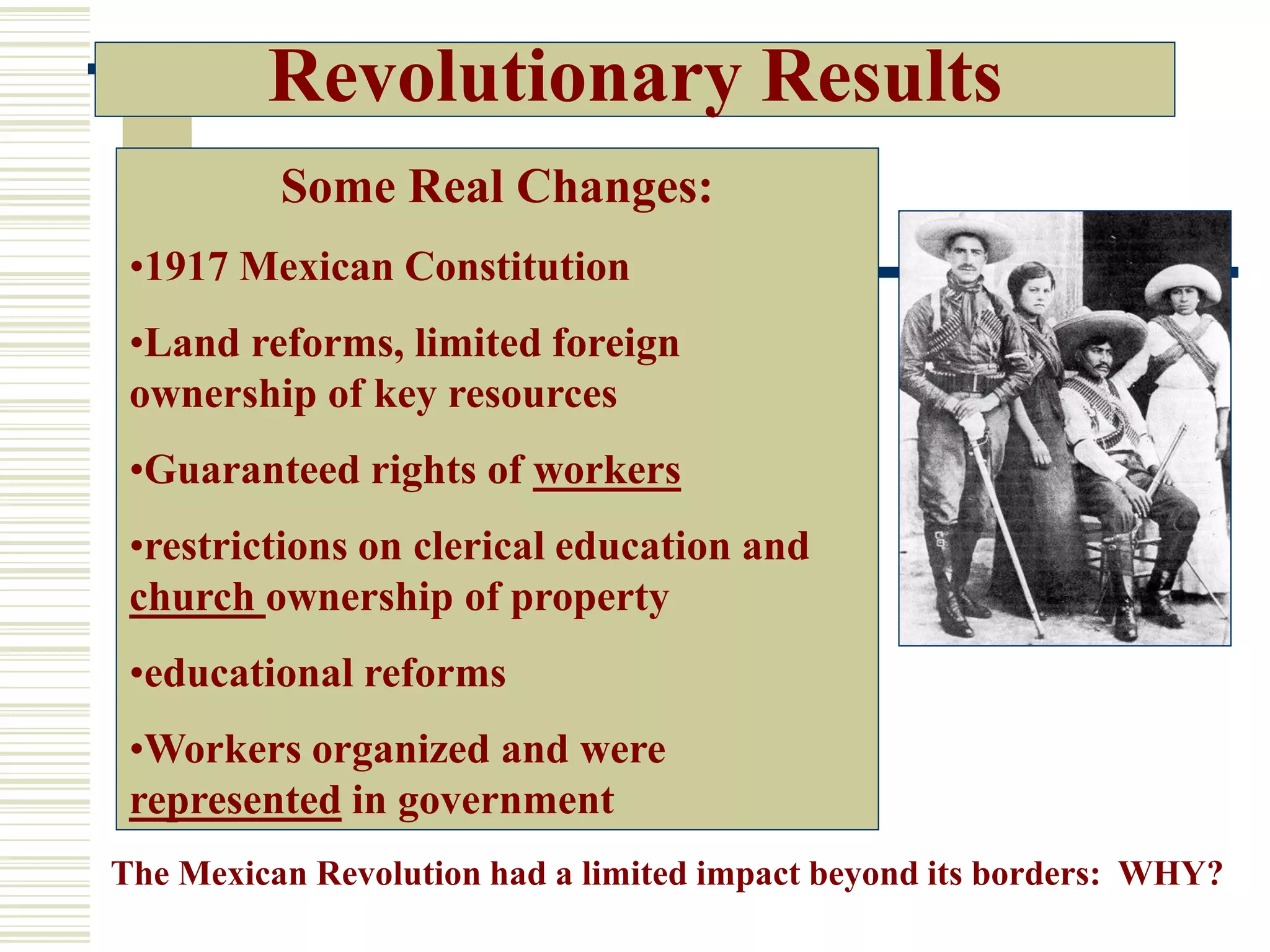
Revolutionary Results
Some Real Changes:
•1917 Mexican Constitution
•Land reforms, limited foreign
ownership of key resources
•Guaranteed rights of workers
•restrictions on clerical education and
church ownership of property
•educational reforms
•Workers organized and were
represented in government
The Mexican Revolution had a limited impact beyond its borders: WHY?
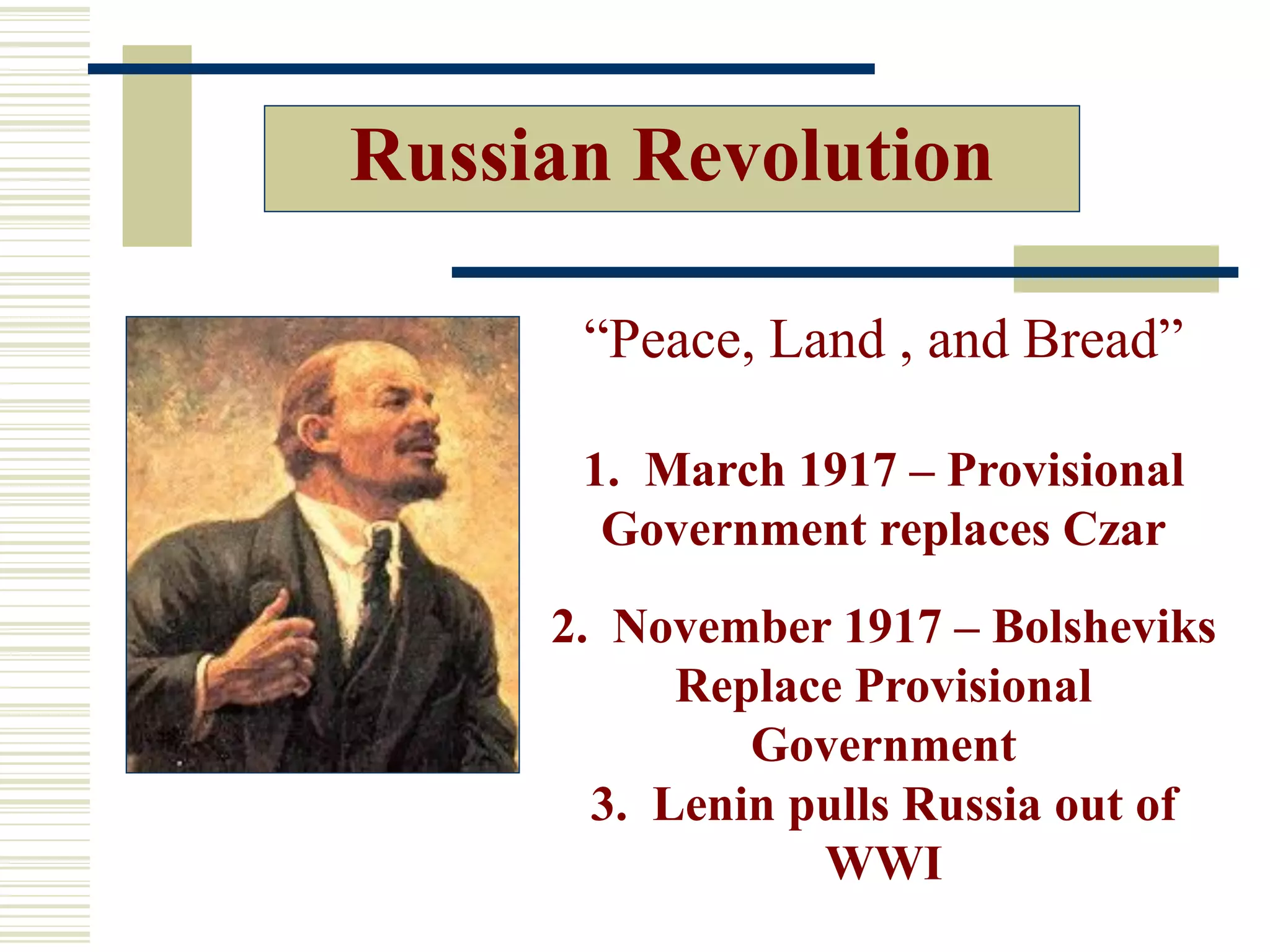
Russian Revolution
“Peace, Land , and Bread”
1. March 1917 – Provisional
Government replaces Czar
2. November 1917 – Bolsheviks
Replace Provisional
Government
3. Lenin pulls Russia out of
WWI
Results
•USSR becomes the first Communist nation
•Created a new political, economic and cultural
structure without internal challenge
•Authoritarian Rule
•Supported socialist movements
around the world
•1923 – New constitution created a federal
system of socialist republics
•Capital is moved to Moscow
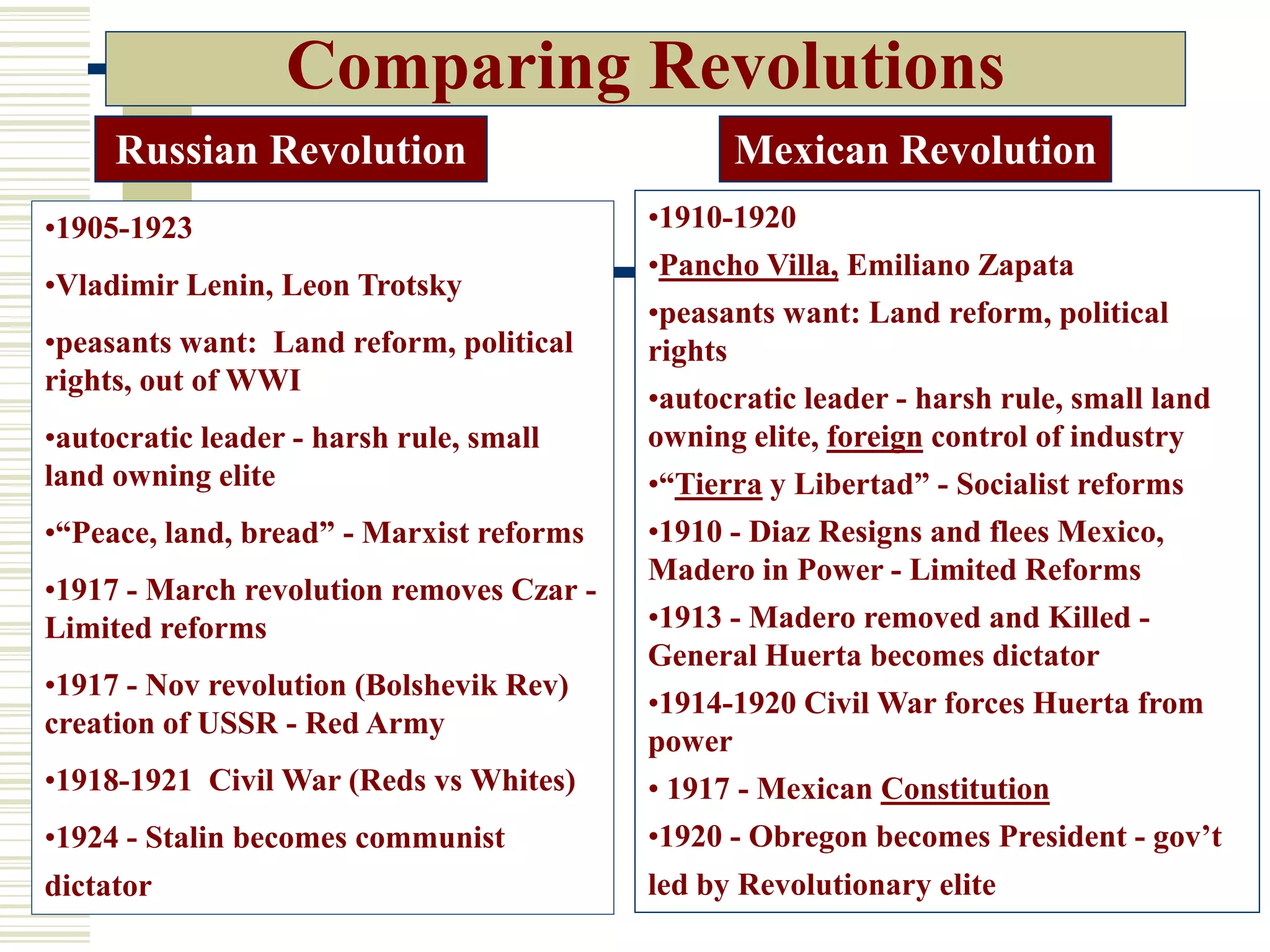
Comparing Revolutions
Russian Revolution
•1905-1923
•Vladimir Lenin, Leon Trotsky
•peasants want: Land reform, political
rights, out of WWI
•autocratic leader - harsh rule, small
land owning elite
•“Peace, land, bread” - Marxist reforms
•1917 - March revolution removes Czar -
Limited reforms
•1917 - Nov revolution (Bolshevik Rev)
creation of USSR - Red Army
•1918-1921 Civil War (Reds vs Whites)
•1924 - Stalin becomes communist
dictator
Mexican Revolution
•1910-1920
•Pancho Villa, Emiliano Zapata
•peasants want: Land reform, political
rights
•autocratic leader - harsh rule, small land
owning elite, foreign control of industry
•“Tierra y Libertad” - Socialist reforms
•1910 - Diaz Resigns and flees Mexico,
Madero in Power - Limited Reforms
•1913 - Madero removed and Killed -
General Huerta becomes dictator
•1914-1920 Civil War forces Huerta from
power
• 1917 - Mexican Constitution
•1920 - Obregon becomes President - gov’t
led by Revolutionary elite
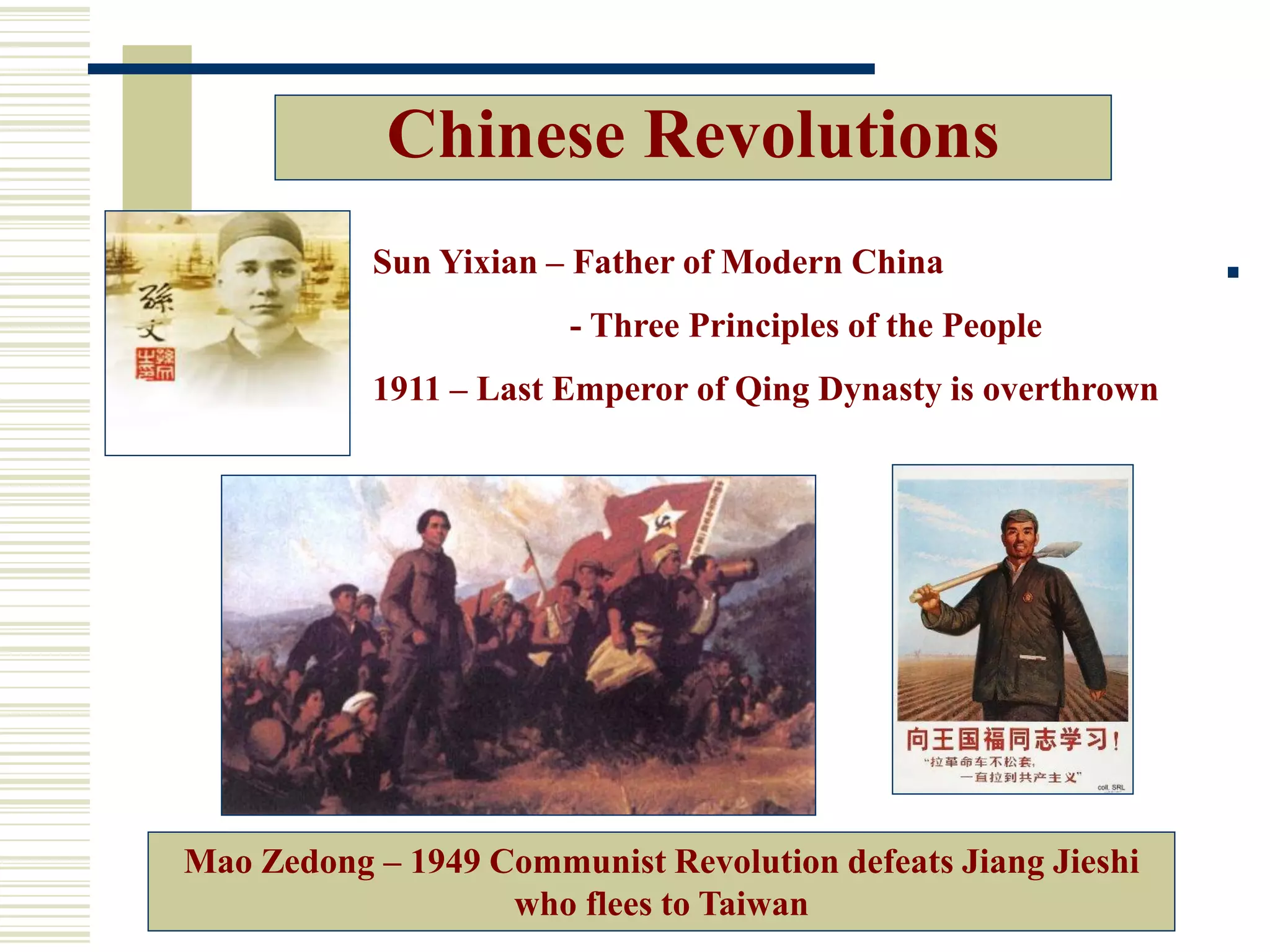
Chinese Revolutions
Sun Yixian – Father of Modern China
- Three Principles of the People
1911 – Last Emperor of Qing Dynasty is overthrown
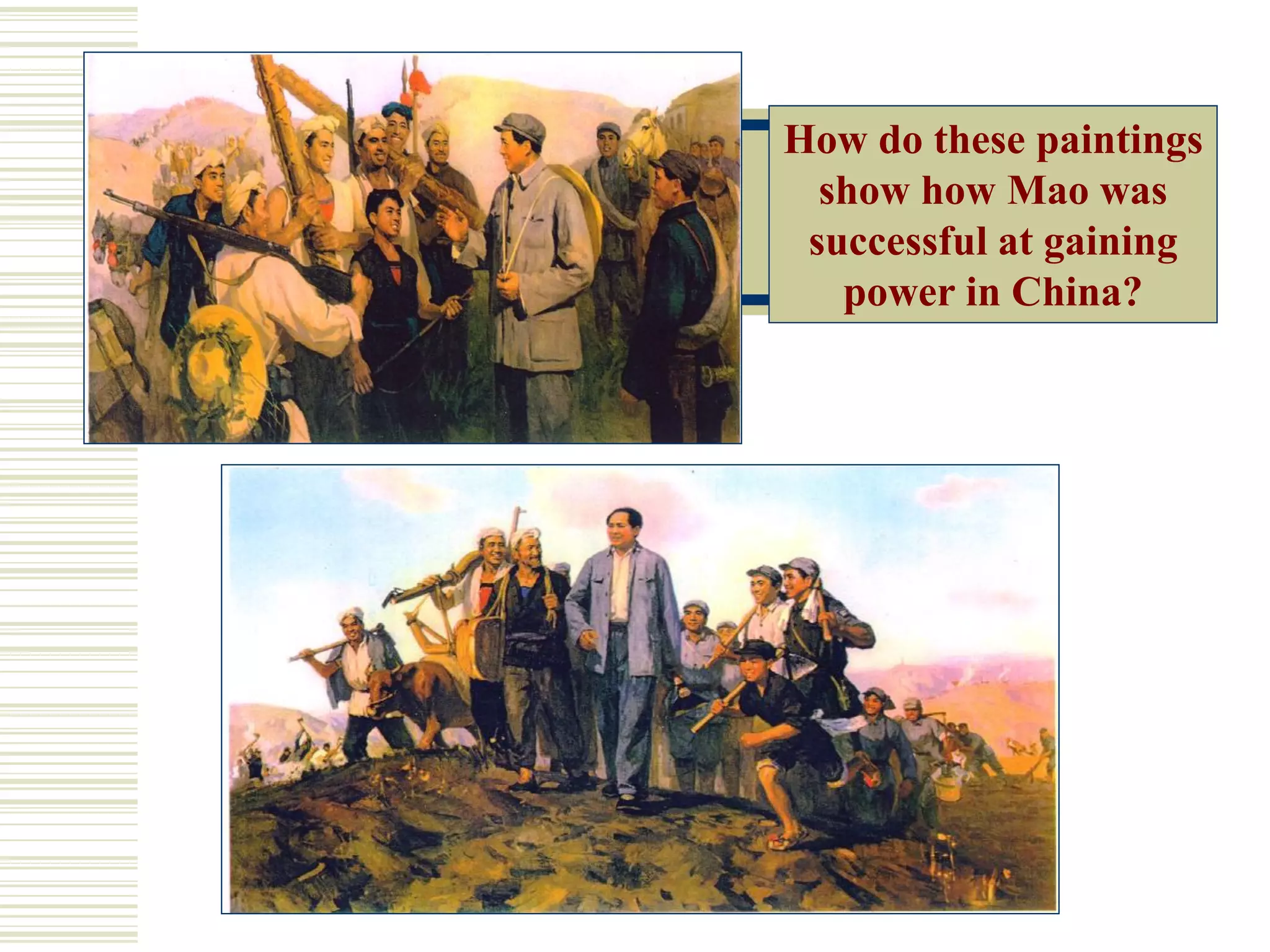
Mao Zedong – 1949 Communist Revolution defeats Jiang Jieshi
who flees to Taiwan
How do these paintings
show how Mao was
successful at gaining
power in China?
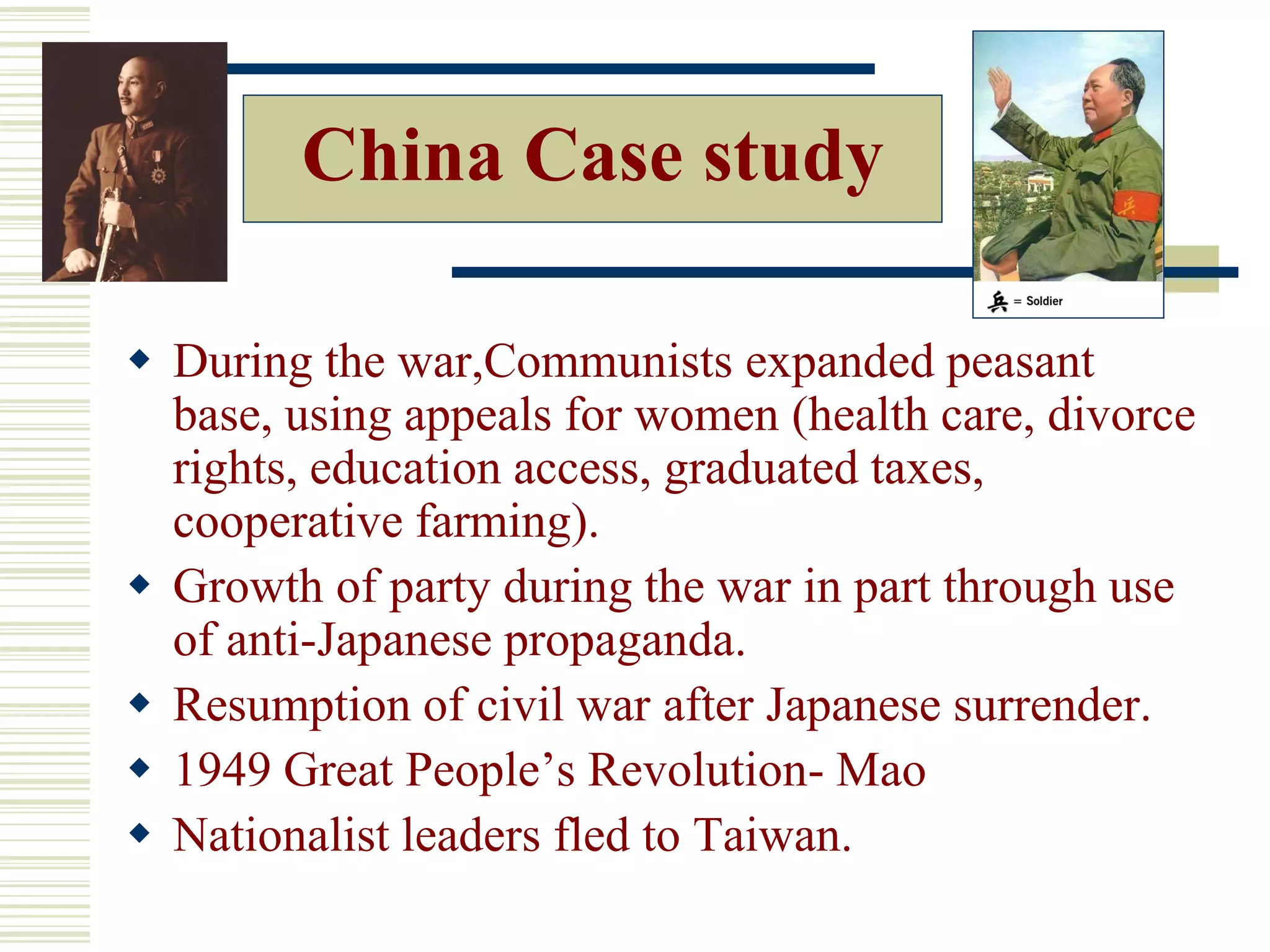
China Case study
 During the war,Communists expanded peasant
base, using appeals for women (health care, divorce
rights, education access, graduated taxes,
cooperative farming).
 Growth of party during the war in part through use
of anti-Japanese propaganda.
 Resumption of civil war after Japanese surrender.
 1949 Great People’s Revolution- Mao
 Nationalist leaders fled to Taiwan.
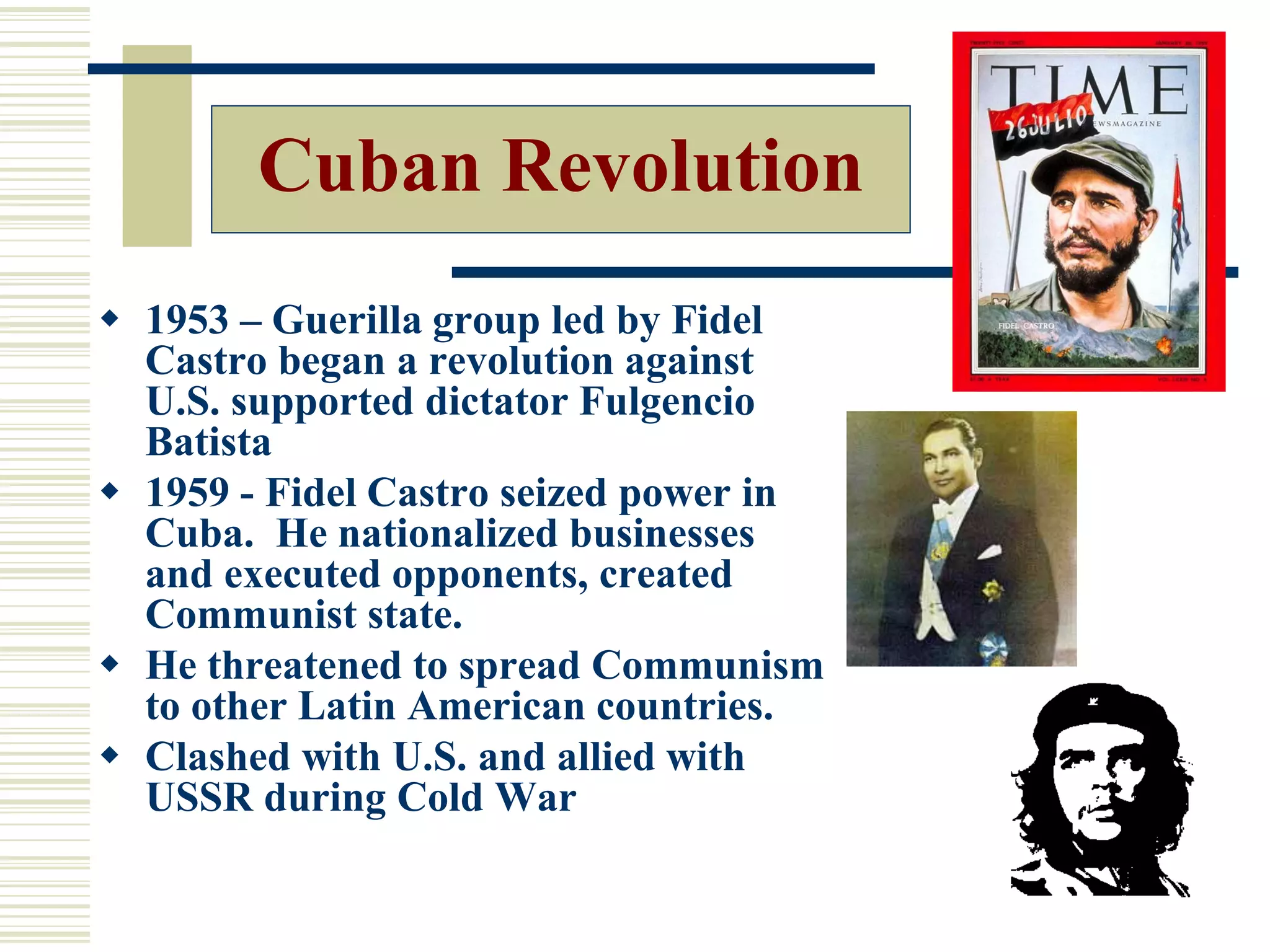
 1953 – Guerilla group led by Fidel
Castro began a revolution against
U.S. supported dictator Fulgencio
Batista
 1959 - Fidel Castro seized power in
Cuba. He nationalized businesses
and executed opponents, created
Communist state.
 He threatened to spread Communism
to other Latin American countries.
 Clashed with U.S. and allied with
USSR during Cold War
Cuban Revolution
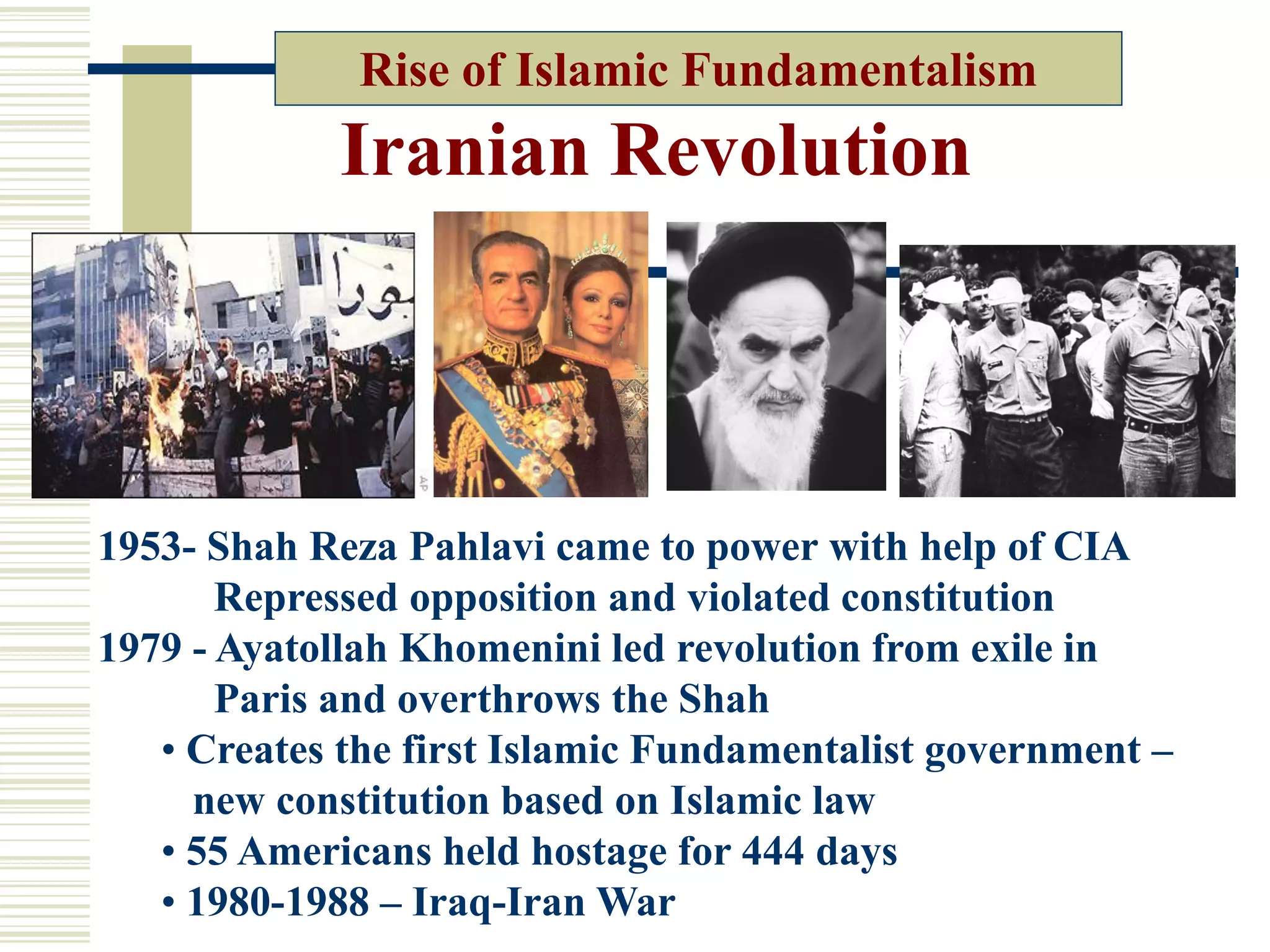
Iranian Revolution
Rise of Islamic Fundamentalism
1953- Shah Reza Pahlavi came to power with help of CIA
Repressed opposition and violated constitution
1979 - Ayatollah Khomenini led revolution from exile in
Paris and overthrows the Shah
• Creates the first Islamic Fundamentalist government –
new constitution based on Islamic law
• 55 Americans held hostage for 444 days
• 1980-1988 – Iraq-Iran War
Process of Decolonization and
Nation- Building
 Surge of anti-colonial nationalism after 1945.
Leaders used lessons in mass politicization and
mass mobilization of 1920’s and 1930’s.
 Three patterns:
1. Violent Revolutions and Civil War (China, Algeria,
Vietnam, Palestine)
2. Non-Violent, negotiated independence (India, Ghana
Turkey)
3. Both violent and non-violent methods (Kenya,
Egypt, South Africa)
Decolonization in the Middle East-
Palestine and Israel
 Zionism
 1917 Balfour Declaration
 Immigration of Jews to Palestine
 European Holocaust
 Increase of migration
 1947- end of British mandate of Palestine and failed
UN partition solution
 1948 establishment of Israel
 Regional conflicts->
Violent Movements
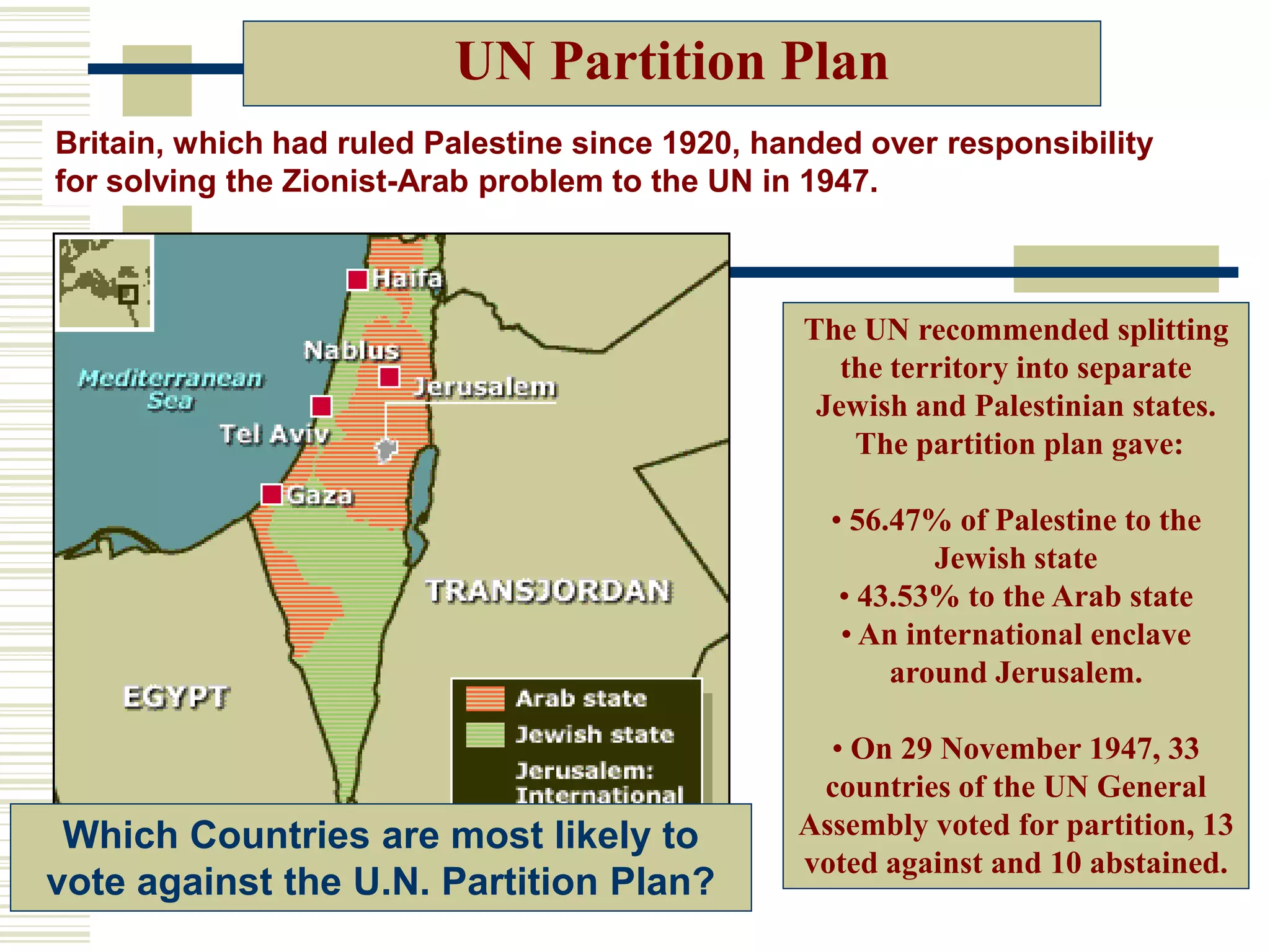
UN Partition Plan
Britain, which had ruled Palestine since 1920, handed over responsibility
for solving the Zionist-Arab problem to the UN in 1947.
The UN recommended splitting
the territory into separate
Jewish and Palestinian states.
The partition plan gave:
• 56.47% of Palestine to the
Jewish state
• 43.53% to the Arab state
• An international enclave
around Jerusalem.
• On 29 November 1947, 33
countries of the UN General
Assembly voted for partition, 13
voted against and 10 abstained.
Which Countries are most likely to
vote against the U.N. Partition Plan?
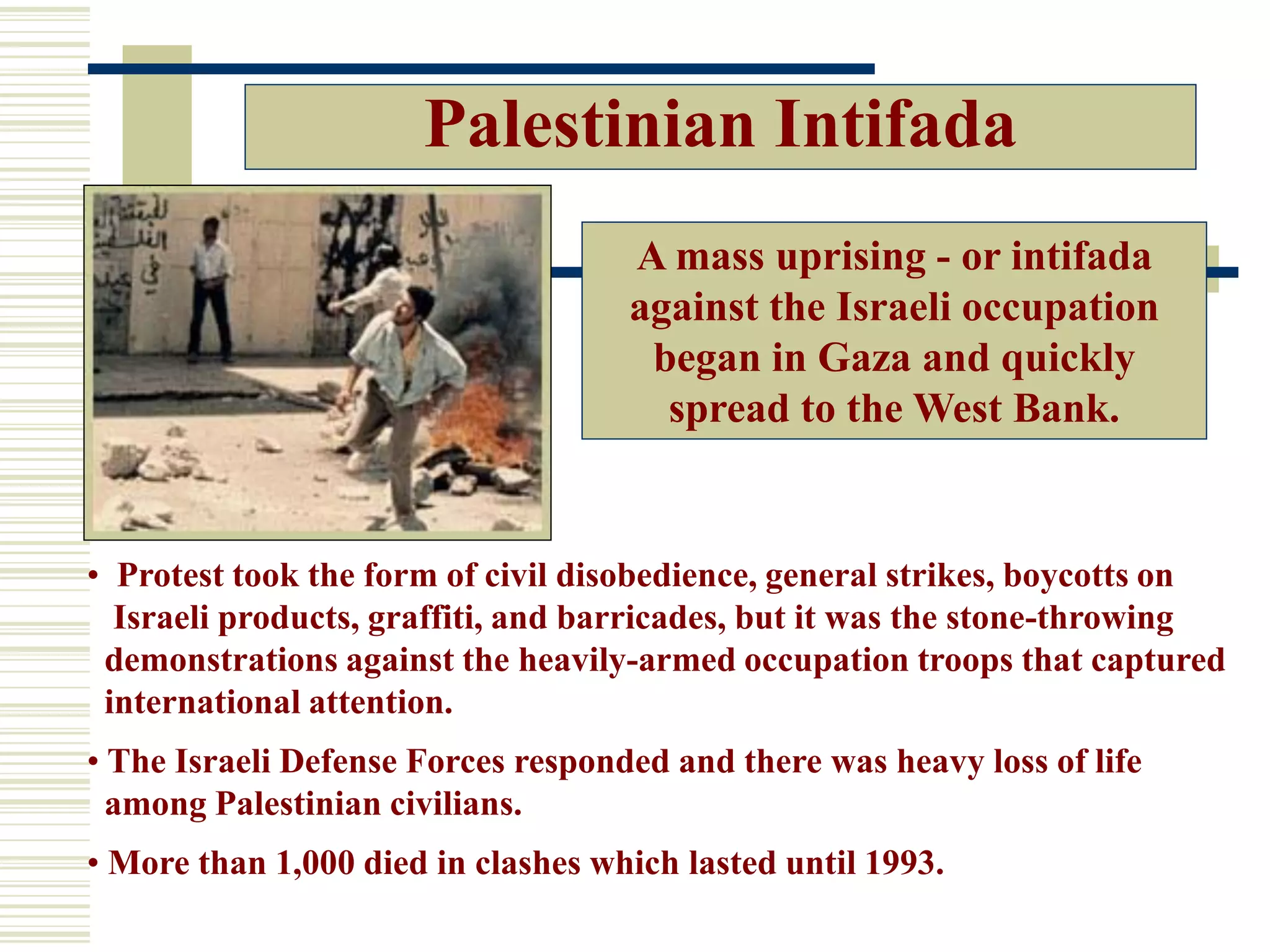
Palestinian Intifada
• Protest took the form of civil disobedience, general strikes, boycotts on
Israeli products, graffiti, and barricades, but it was the stone-throwing
demonstrations against the heavily-armed occupation troops that captured
international attention.
• The Israeli Defense Forces responded and there was heavy loss of life
among Palestinian civilians.
• More than 1,000 died in clashes which lasted until 1993.
A mass uprising - or intifada
against the Israeli occupation
began in Gaza and quickly
spread to the West Bank.
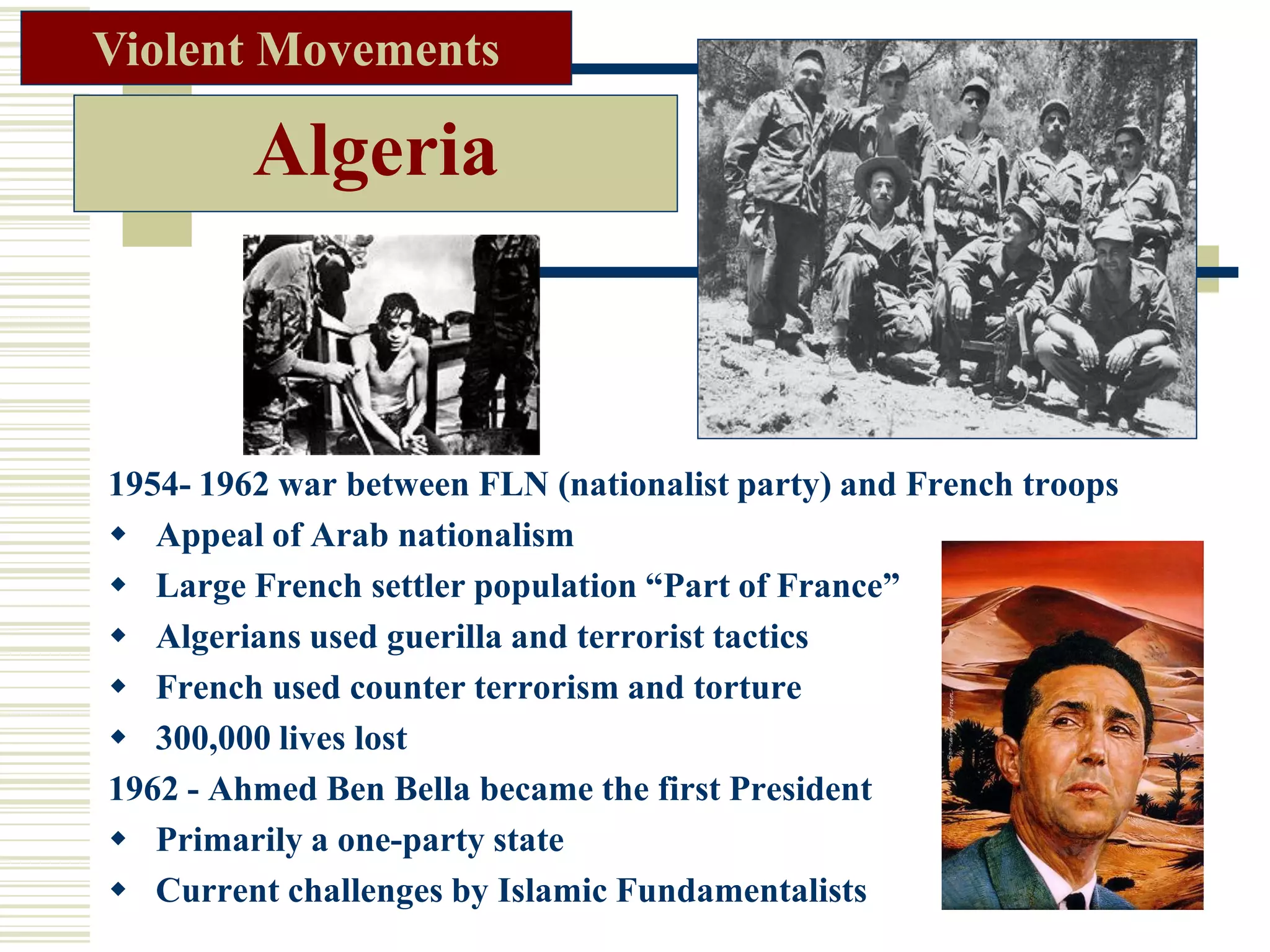
Algeria
1954- 1962 war between FLN (nationalist party) and French troops
 Appeal of Arab nationalism
 Large French settler population “Part of France”
 Algerians used guerilla and terrorist tactics
 French used counter terrorism and torture
 300,000 lives lost
1962 - Ahmed Ben Bella became the first President
 Primarily a one-party state
 Current challenges by Islamic Fundamentalists
Violent Movements
India: History of the Movement
 Indian National Congress - 1885. (Elite group not
mass movement)
 Growth of Indian national identity- presented
grievances to the British.
 Congress party attracted mass following.
 Gandhi and Congress leadership tried to prevent
mass peasant uprising (as was happening in China)
by keeping power centered on middle class leaders.
Non-Violent Movements
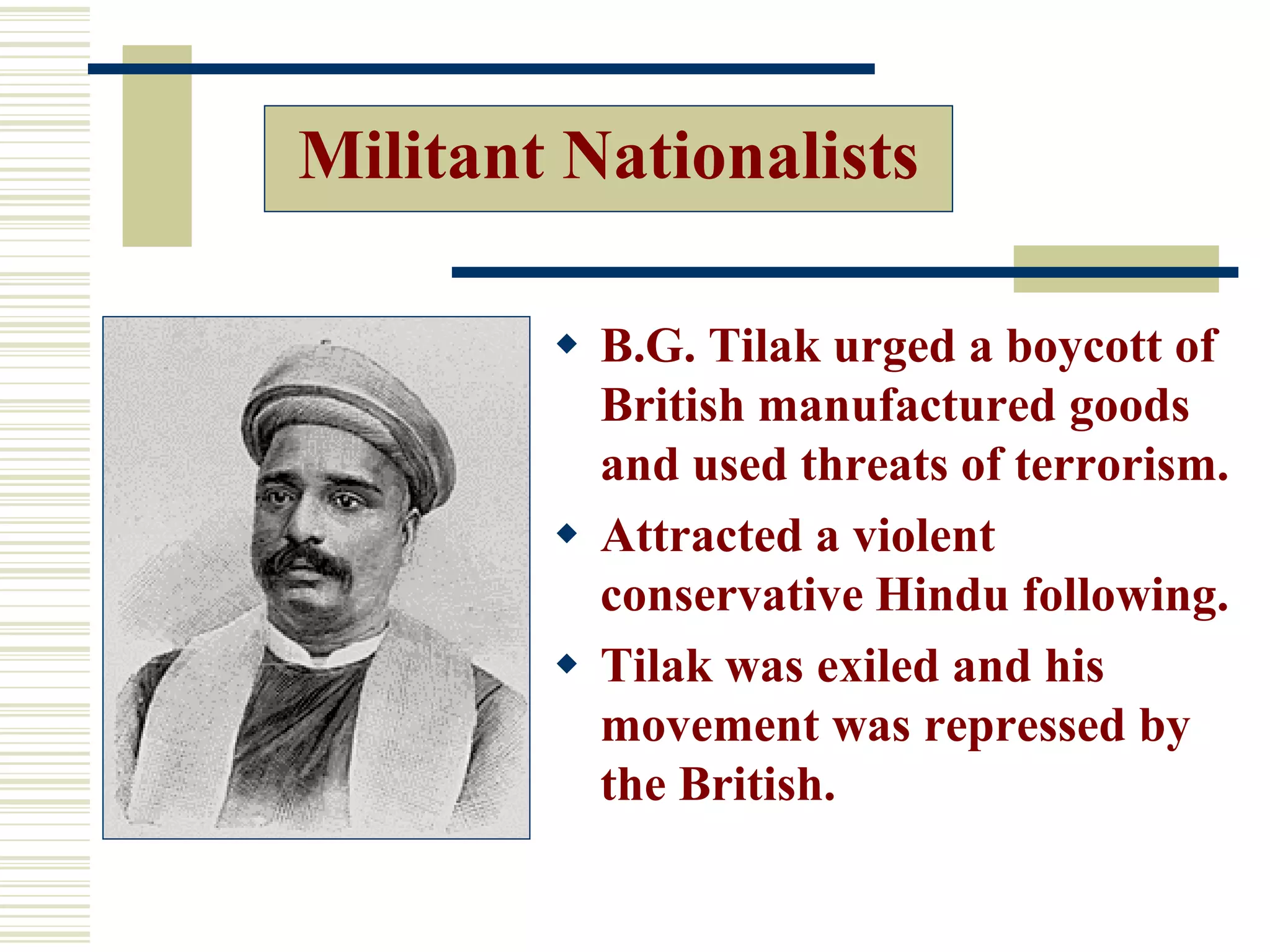
Militant Nationalists
 B.G. Tilak urged a boycott of
British manufactured goods
and used threats of terrorism.
 Attracted a violent
conservative Hindu following.
 Tilak was exiled and his
movement was repressed by
the British.
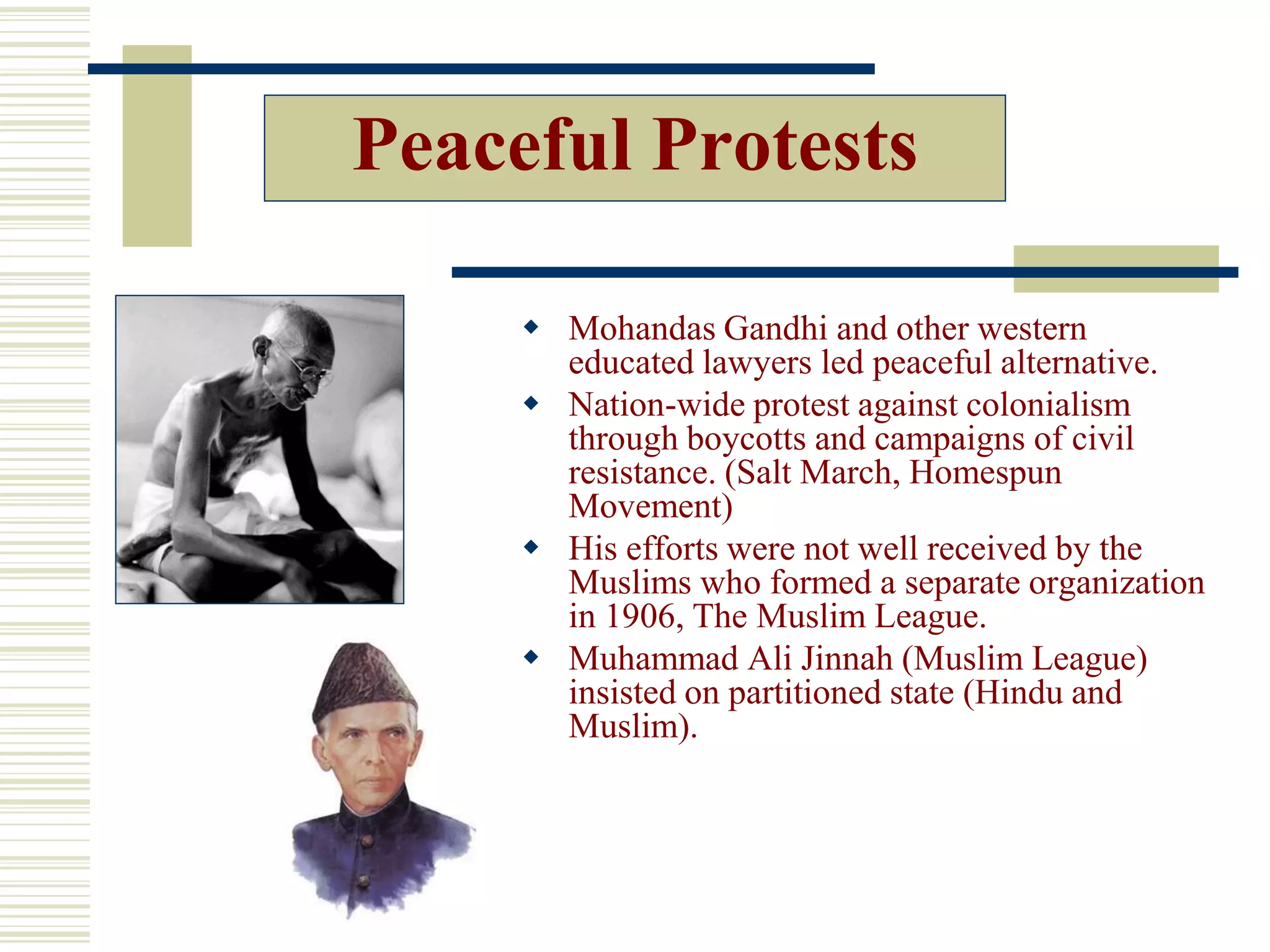
Peaceful Protests
 Mohandas Gandhi and other western
educated lawyers led peaceful alternative.
 Nation-wide protest against colonialism
through boycotts and campaigns of civil
resistance. (Salt March, Homespun
Movement)
 His efforts were not well received by the
Muslims who formed a separate organization
in 1906, The Muslim League.
 Muhammad Ali Jinnah (Muslim League)
insisted on partitioned state (Hindu and
Muslim).
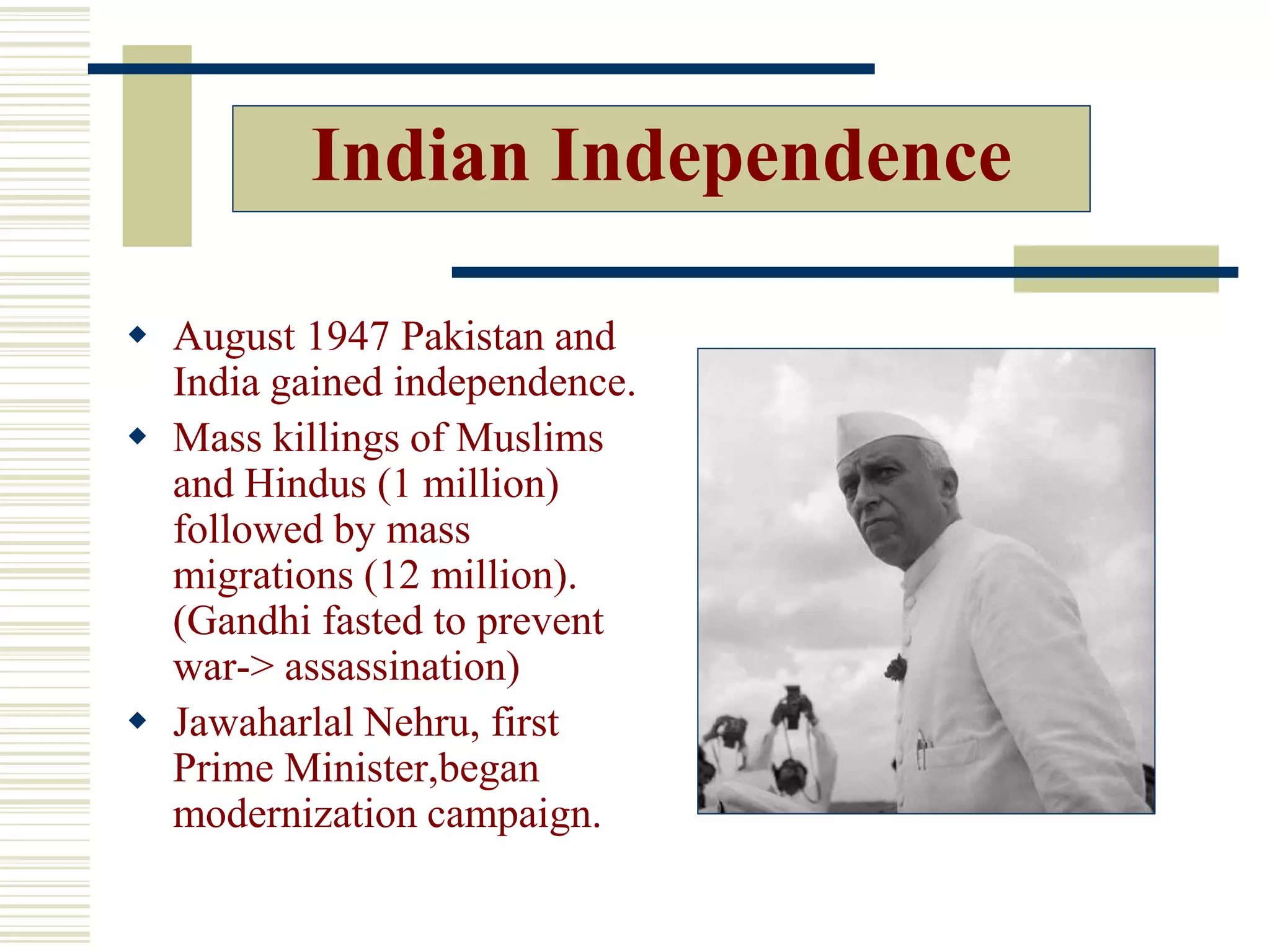
Indian Independence
 August 1947 Pakistan and
India gained independence.
 Mass killings of Muslims
and Hindus (1 million)
followed by mass
migrations (12 million).
(Gandhi fasted to prevent
war-> assassination)
 Jawaharlal Nehru, first
Prime Minister,began
modernization campaign.
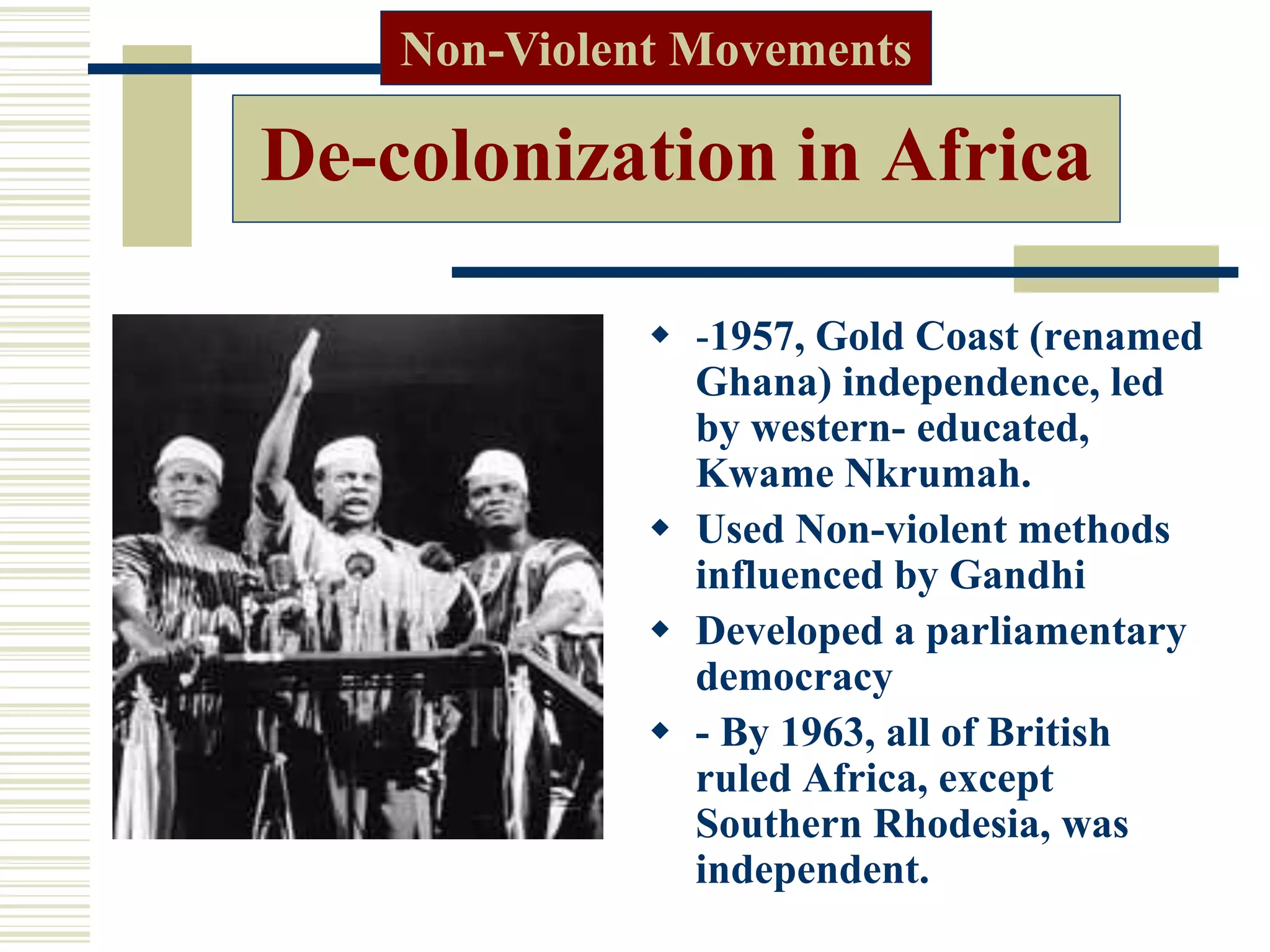
De-colonization in Africa
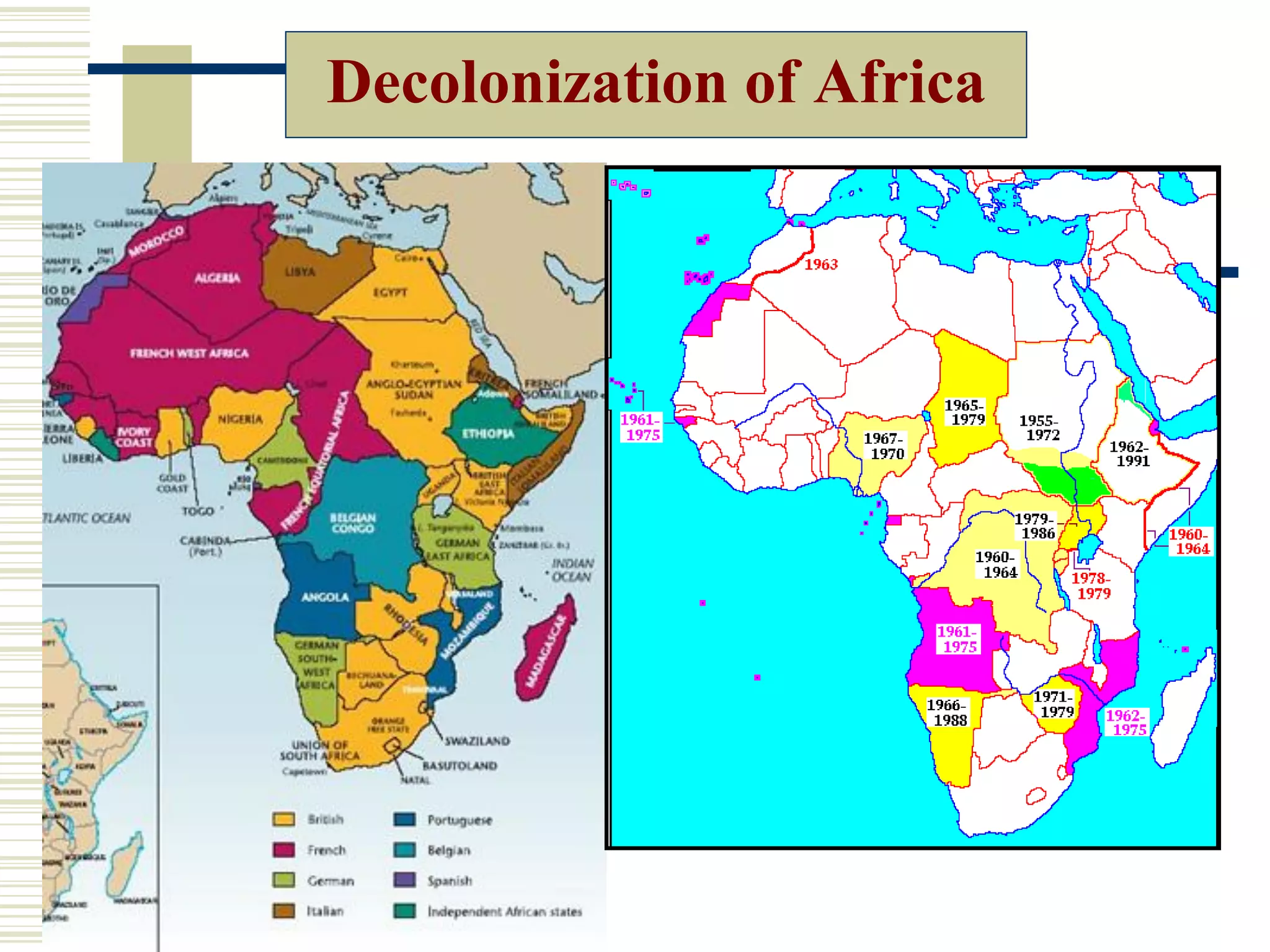
 -1957, Gold Coast (renamed
Ghana) independence, led
by western- educated,
Kwame Nkrumah.
 Used Non-violent methods
influenced by Gandhi
 Developed a parliamentary
democracy
 - By 1963, all of British
ruled Africa, except
Southern Rhodesia, was
independent.
Non-Violent Movements
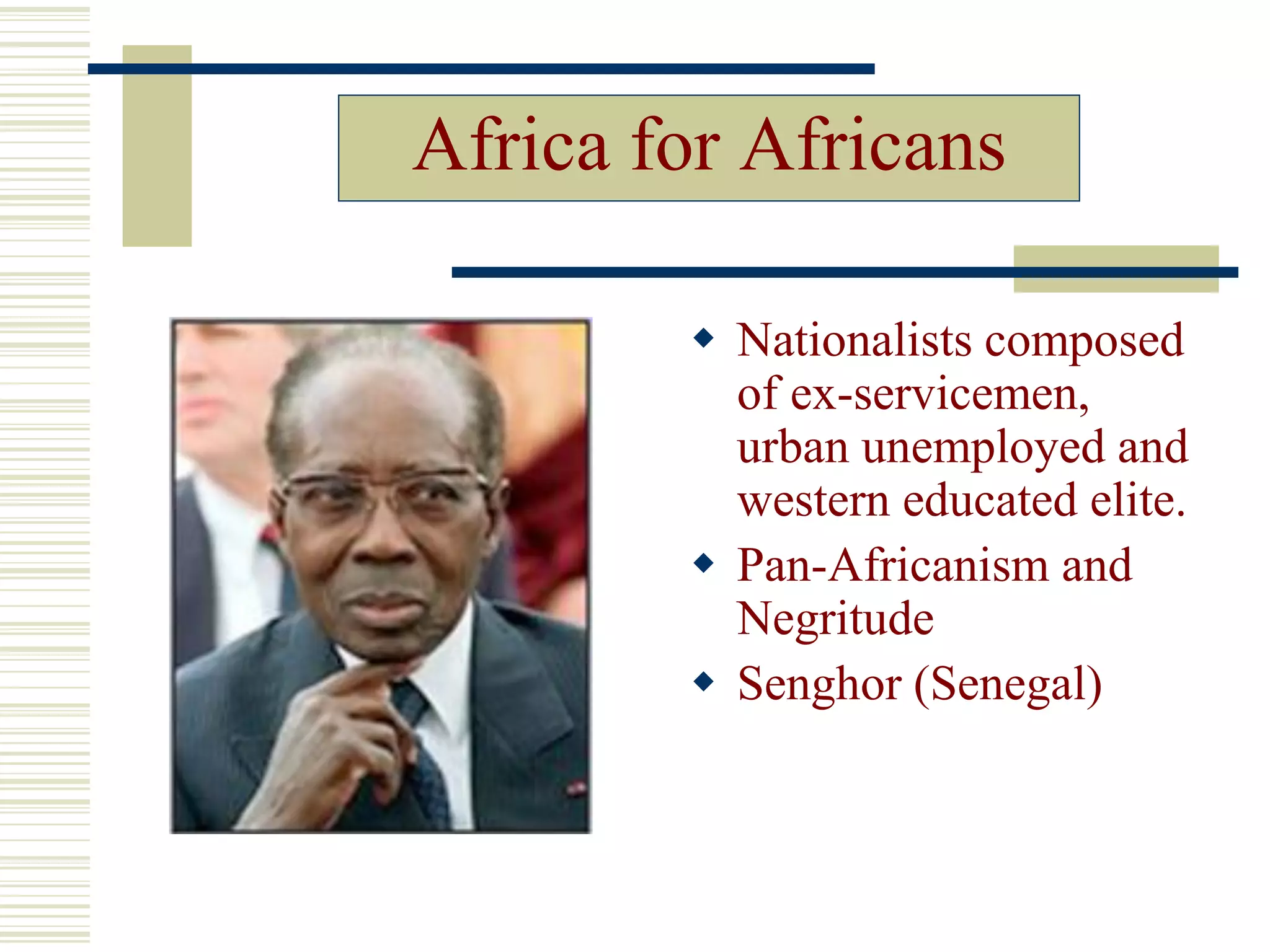
Africa for Africans
 Nationalists composed
of ex-servicemen,
urban unemployed and
western educated elite.
 Pan-Africanism and
Negritude
 Senghor (Senegal)
Decolonization of Africa
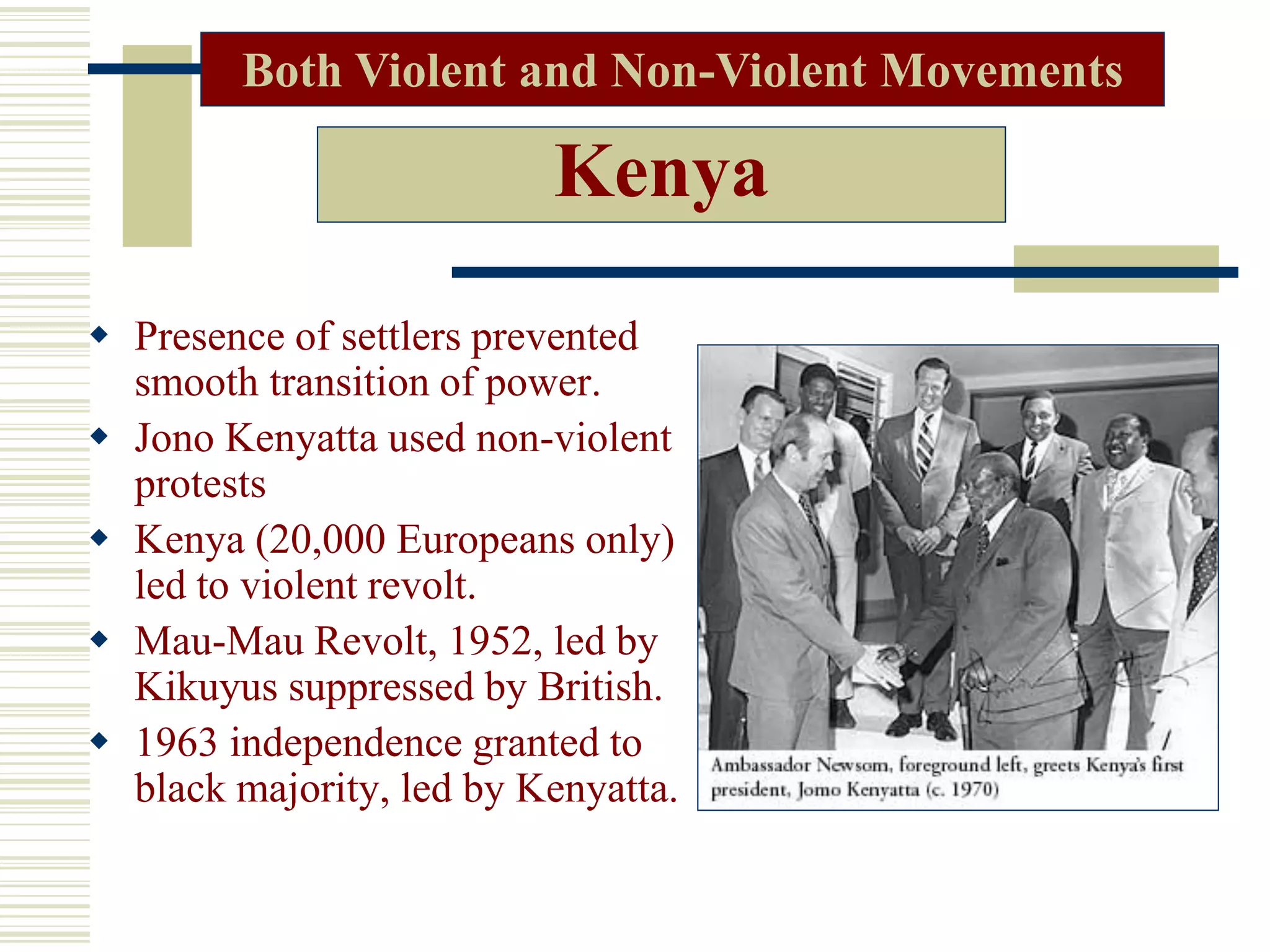
Kenya
 Presence of settlers prevented
smooth transition of power.
 Jono Kenyatta used non-violent
protests
 Kenya (20,000 Europeans only)
led to violent revolt.
 Mau-Mau Revolt, 1952, led by
Kikuyus suppressed by British.
 1963 independence granted to
black majority, led by Kenyatta.
Both Violent and Non-Violent Movements
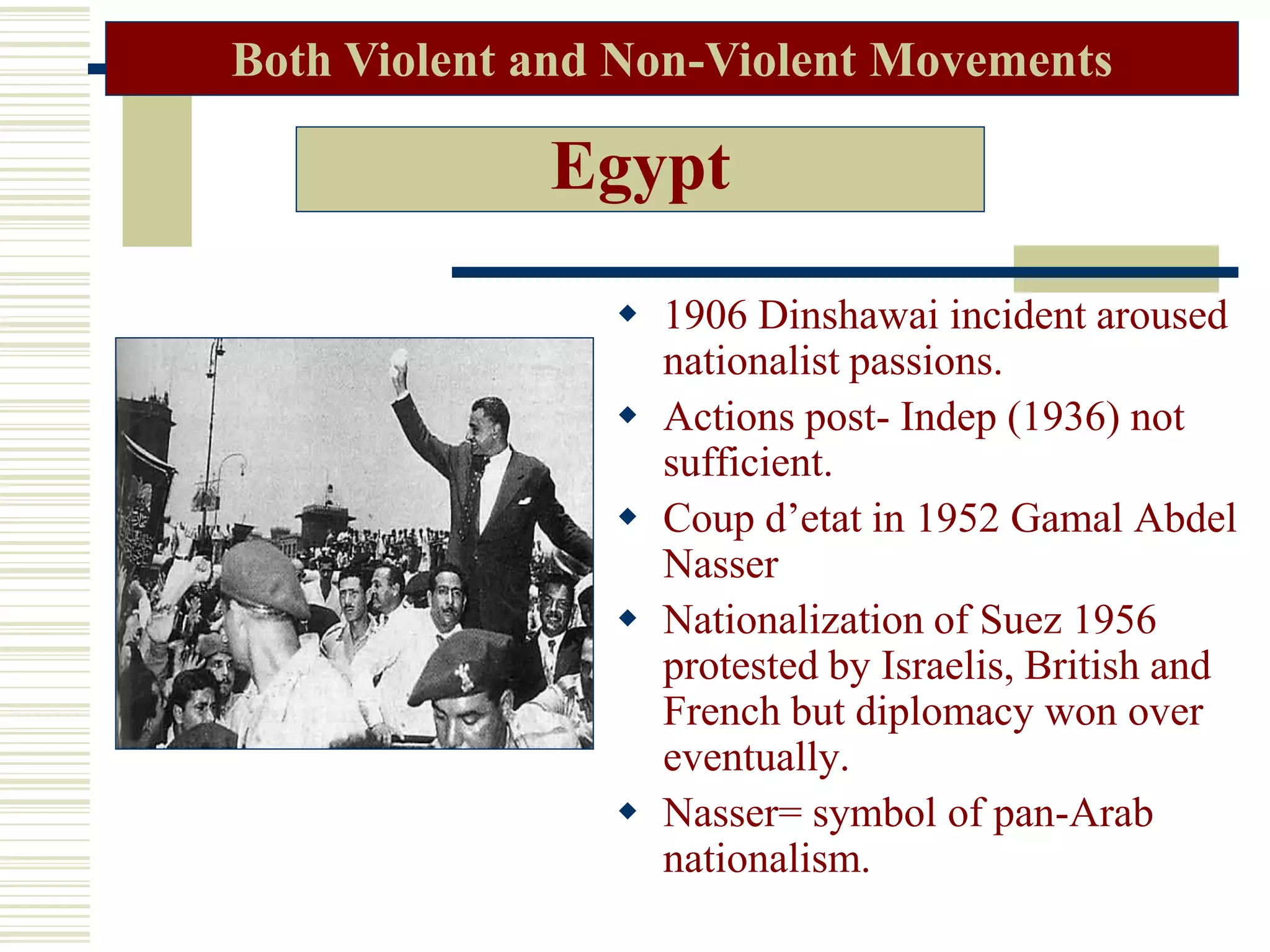
Egypt
 1906 Dinshawai incident aroused
nationalist passions.
 Actions post- Indep (1936) not
sufficient.
 Coup d’etat in 1952 Gamal Abdel
Nasser
 Nationalization of Suez 1956
protested by Israelis, British and
French but diplomacy won over
eventually.
 Nasser= symbol of pan-Arab
nationalism.
Both Violent and Non-Violent Movements
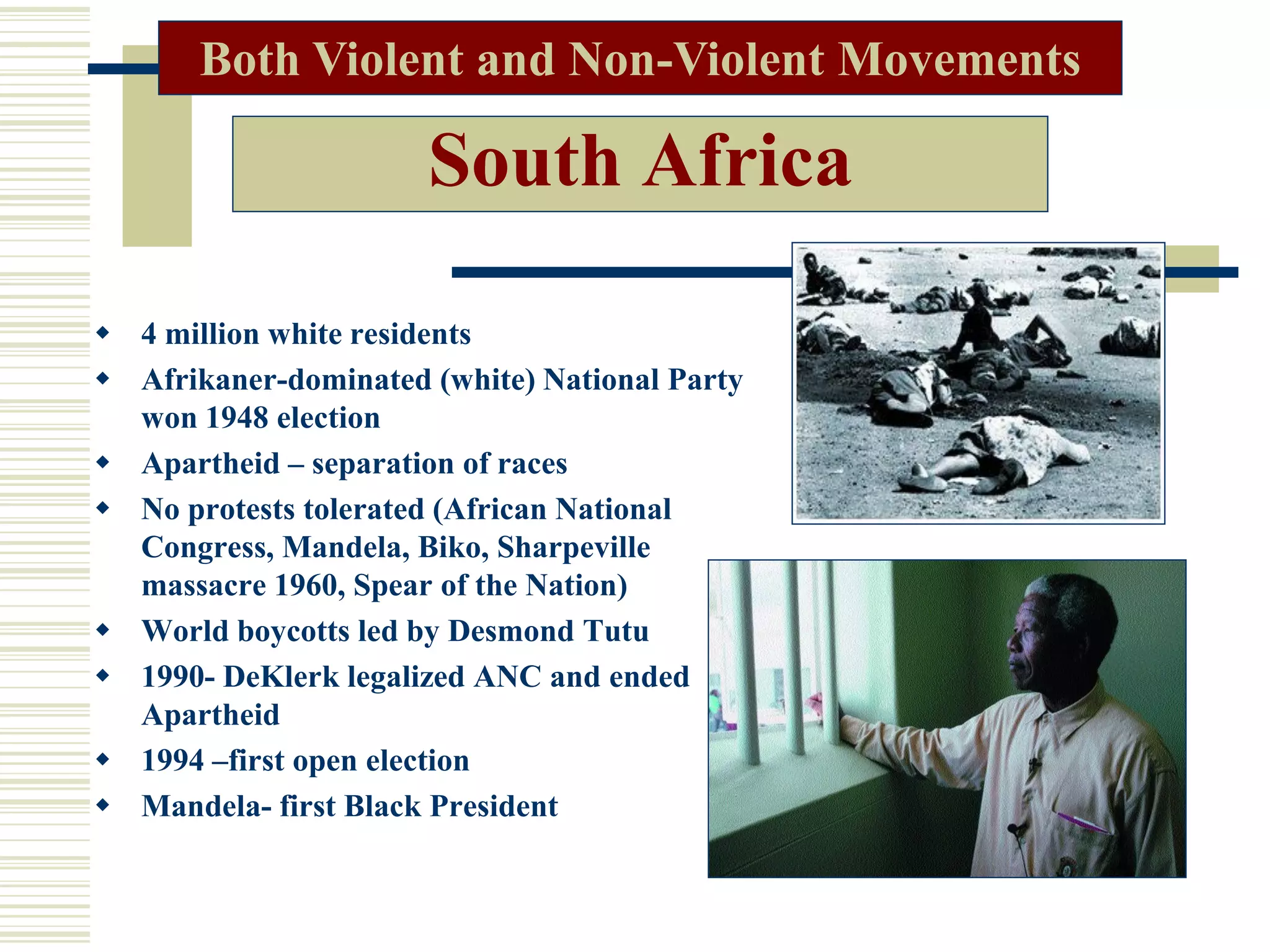
South Africa
 4 million white residents
 Afrikaner-dominated (white) National Party
won 1948 election
 Apartheid – separation of races
 No protests tolerated (African National
Congress, Mandela, Biko, Sharpeville
massacre 1960, Spear of the Nation)
 World boycotts led by Desmond Tutu
 1990- DeKlerk legalized ANC and ended
Apartheid
 1994 –first open election
 Mandela- first Black President
Both Violent and Non-Violent Movements
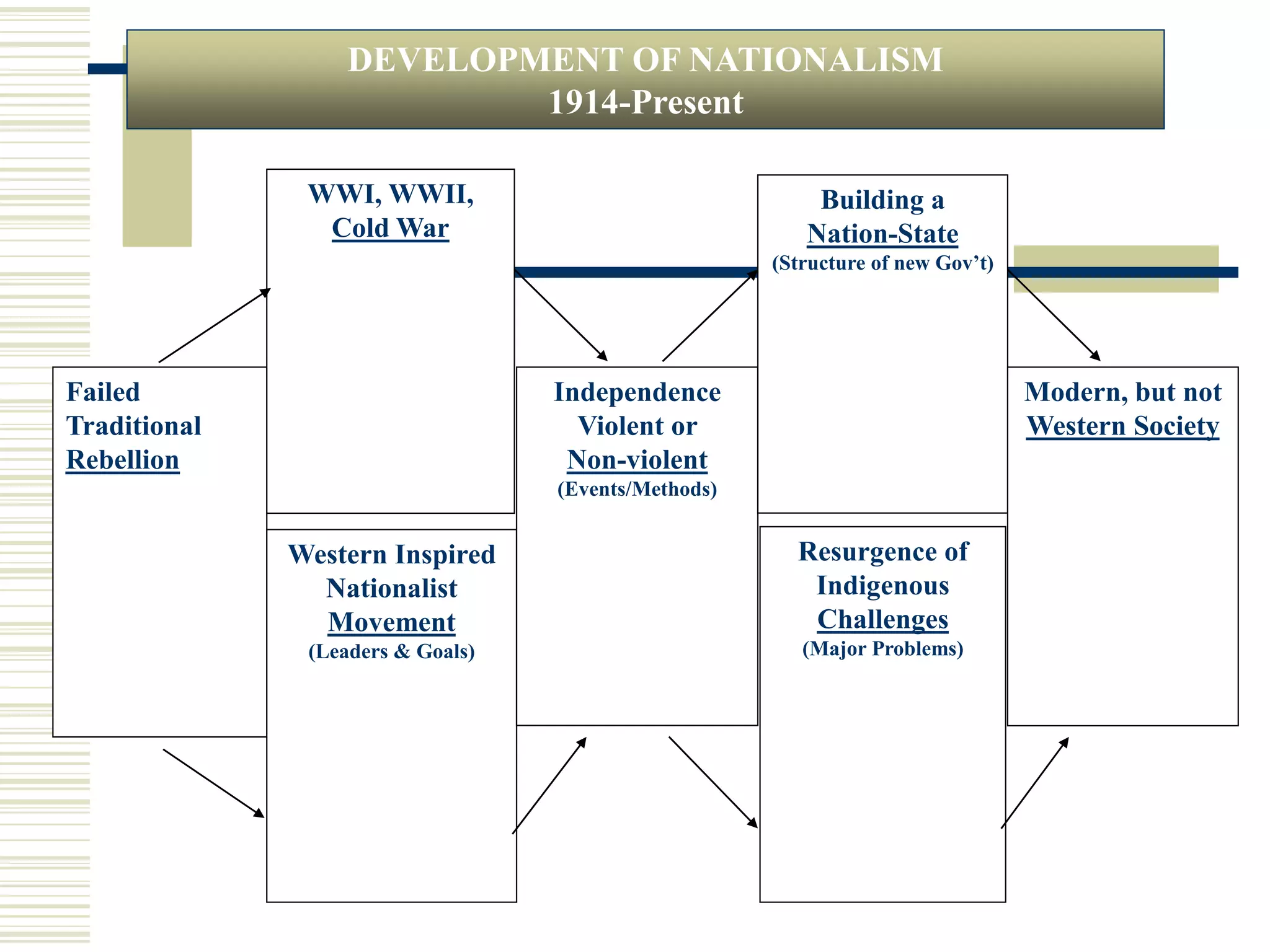
Failed
Traditional
Rebellion
Western Inspired
Nationalist
Movement
(Leaders & Goals)
WWI, WWII,
Cold War
Independence
Violent or
Non-violent
(Events/Methods)
Resurgence of
Indigenous
Challenges
(Major Problems)
Building a
Nation-State
(Structure of new Gov’t)
Modern, but not
Western Society
DEVELOPMENT OF NATIONALISM
1914-Present
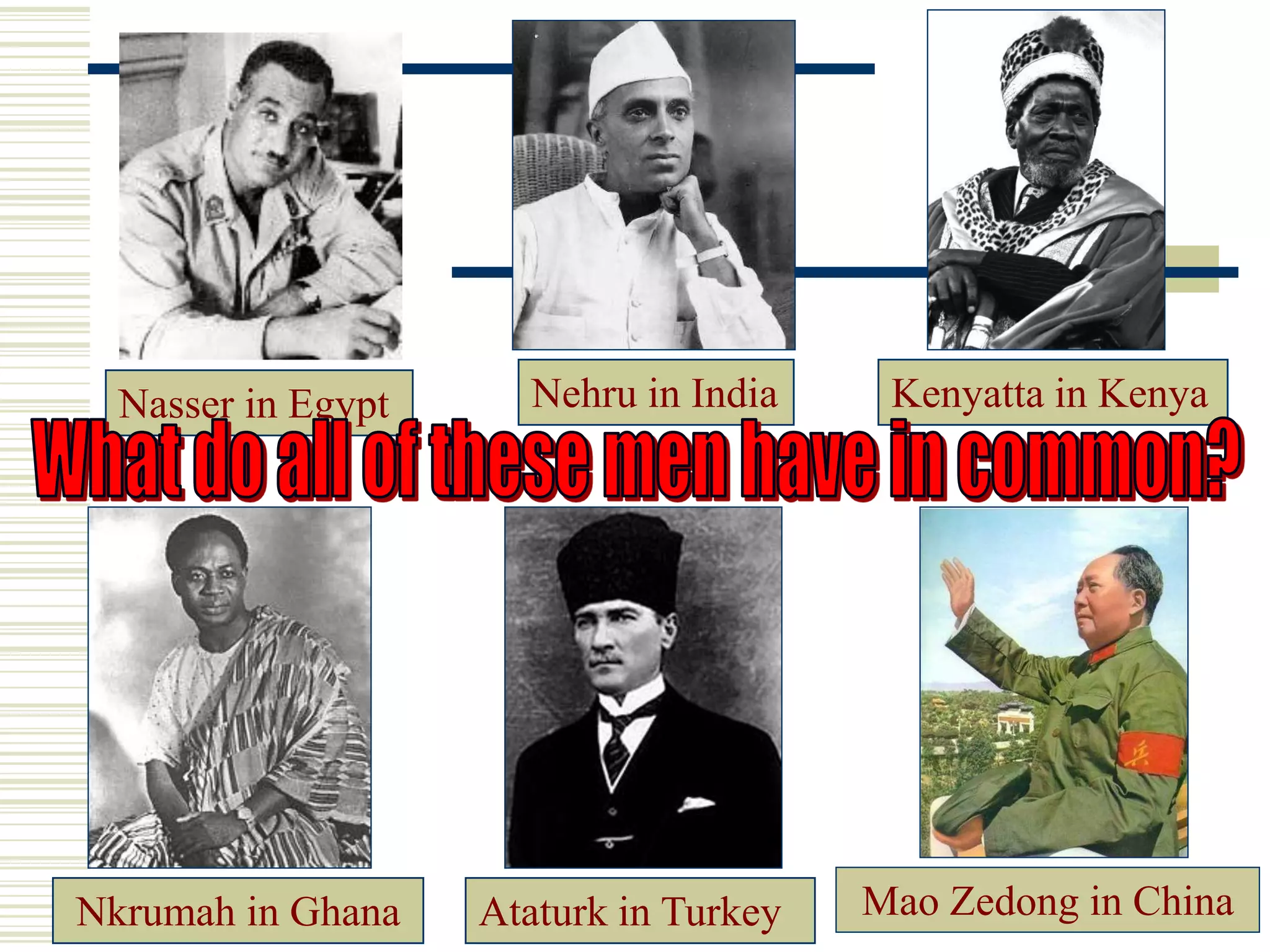
Nasser in Egypt
Ataturk in TurkeyNkrumah in Ghana
Nehru in India Kenyatta in Kenya
Mao Zedong in China
Challenges of Independence
 Ethnic disputes
 Dependent economies
 Growing debt
 Cultural dependence on
west-> religious revivalism
as backlash
 Widespread social unrest
 Military responses to
restore order
 Population growth
 Resource depletion
 Lack of middle class in
some locales
 Education deficit and later,
brain drain.
 Neo-colonialism through
economic debt.
Conclusions
 Decolonization was sometimes a violent process-
dependent in large part on how many settlers had
come to the colony.
 In many parts of world, decolonization was not
revolutionary. Power passed from one class of
elites to another. Little economic and social reform
occurred.
 Significant challenges faced independent nations.
 Western economic dominance of the global trade
system continued unabated. WHY?
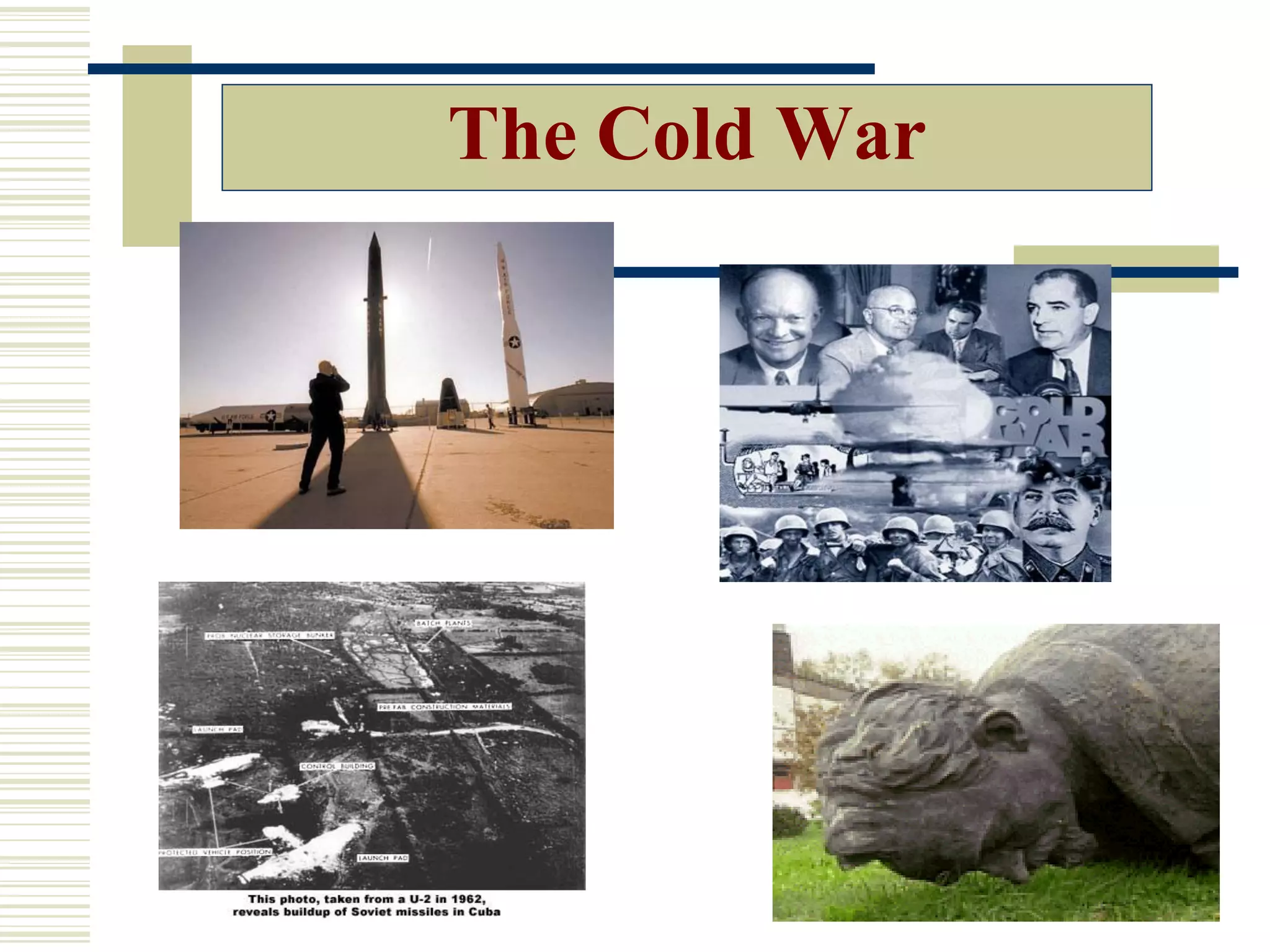
The Cold War
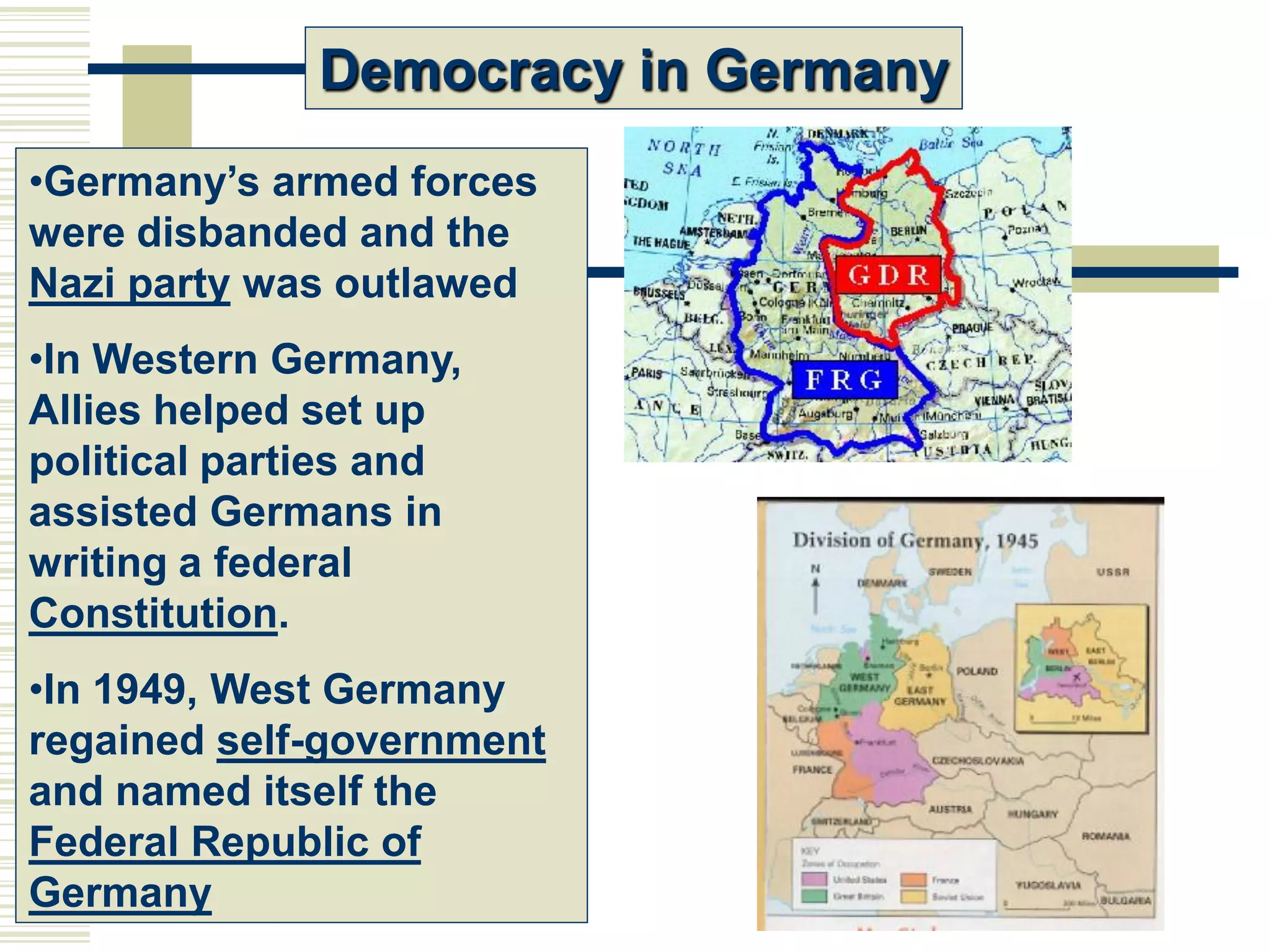
Democracy in Germany
•Germany’s armed forces
were disbanded and the
Nazi party was outlawed
•In Western Germany,
Allies helped set up
political parties and
assisted Germans in
writing a federal
Constitution.
•In 1949, West Germany
regained self-government
and named itself the
Federal Republic of
Germany
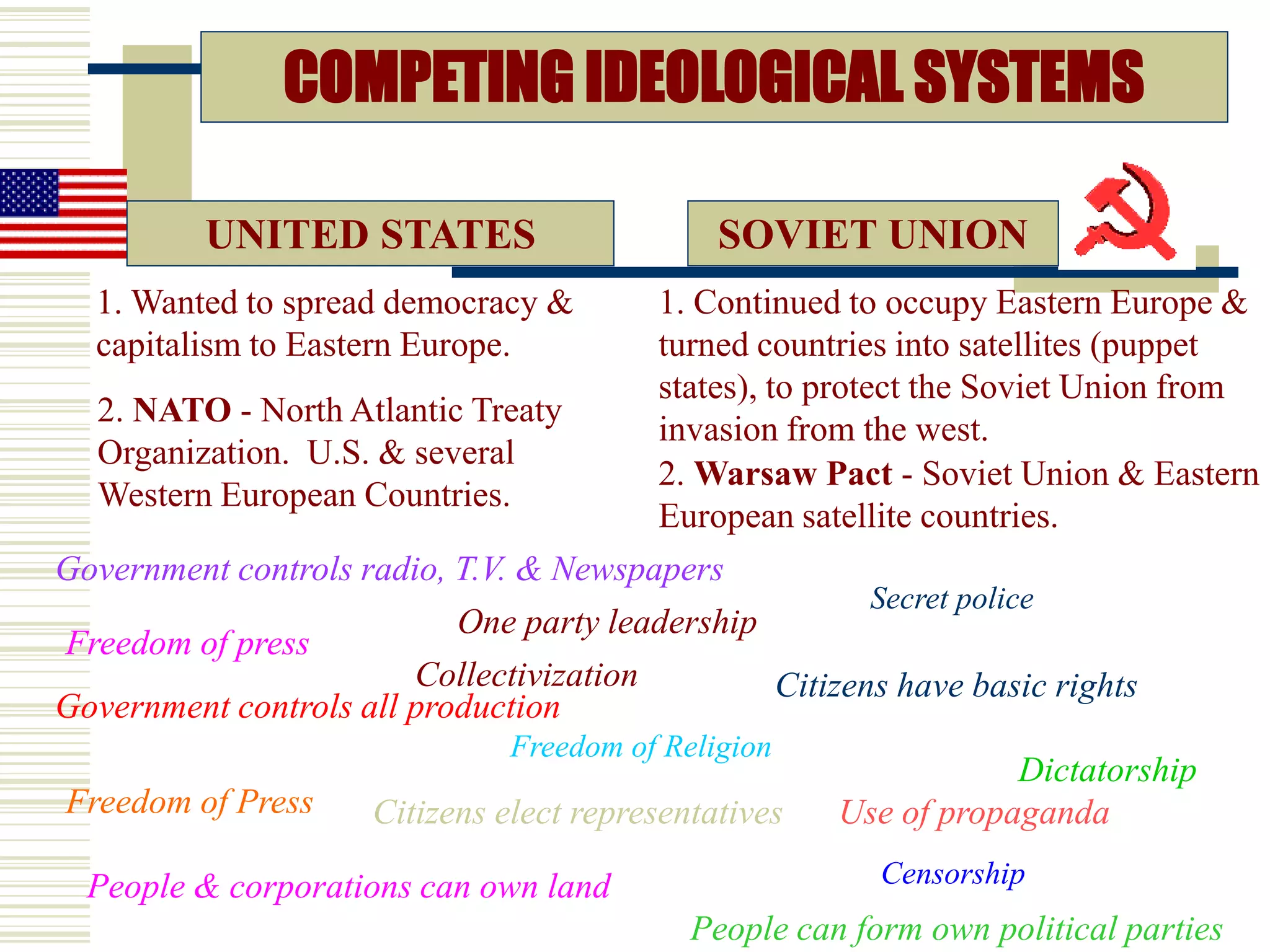
COMPETING IDEOLOGICAL SYSTEMS
1. Wanted to spread democracy &
capitalism to Eastern Europe.
VS.
1. Continued to occupy Eastern Europe &
turned countries into satellites (puppet
states), to protect the Soviet Union from
invasion from the west.
2. NATO - North Atlantic Treaty
Organization. U.S. & several
Western European Countries.
2. Warsaw Pact - Soviet Union & Eastern
European satellite countries.
SOVIET UNIONUNITED STATES
One party leadership
Citizens have basic rights
Citizens elect representatives
People & corporations can own land
Government controls all production
Censorship
Secret police
Government controls radio, T.V. & Newspapers
Dictatorship
Freedom of Press
Freedom of press
Freedom of Religion
People can form own political parties
Use of propaganda
Collectivization
U.S. POLICIES
2. TRUMAN DOCTRINE - Monetary support given by U.S. to countries that
resisted Communism.
3. MARSHALL PLAN- Post WWII assistance program, in which, the
U.S. would provide, food, machines, and other materials to any country that
needed it.
1. CONTAINMENT - Policy directed at blocking Soviet influence and
preventing the expansion of Communism.
SOVIET RESPONSE
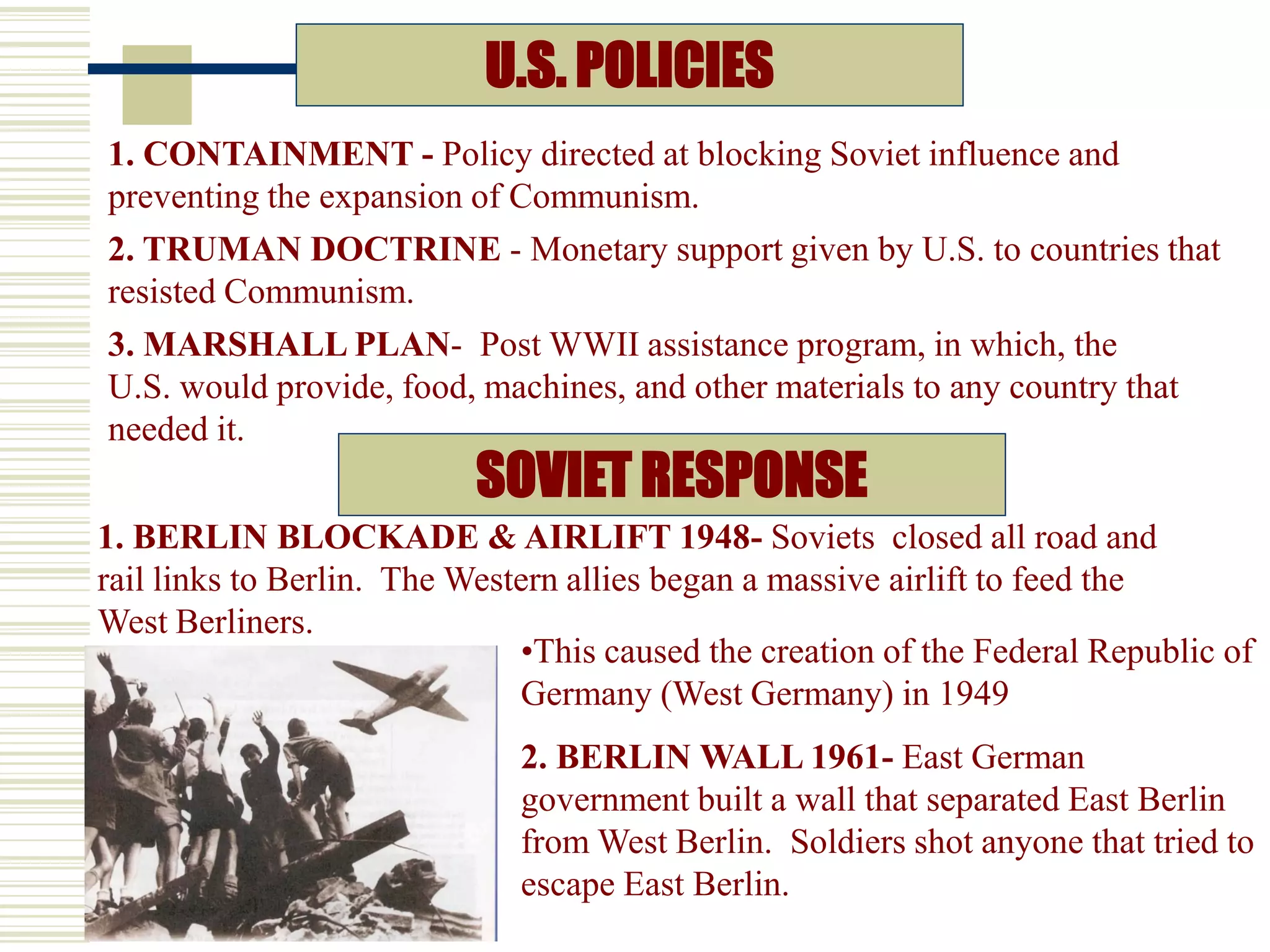
1. BERLIN BLOCKADE & AIRLIFT 1948- Soviets closed all road and
rail links to Berlin. The Western allies began a massive airlift to feed the
West Berliners.
•This caused the creation of the Federal Republic of
Germany (West Germany) in 1949
2. BERLIN WALL 1961- East German
government built a wall that separated East Berlin
from West Berlin. Soldiers shot anyone that tried to
escape East Berlin.
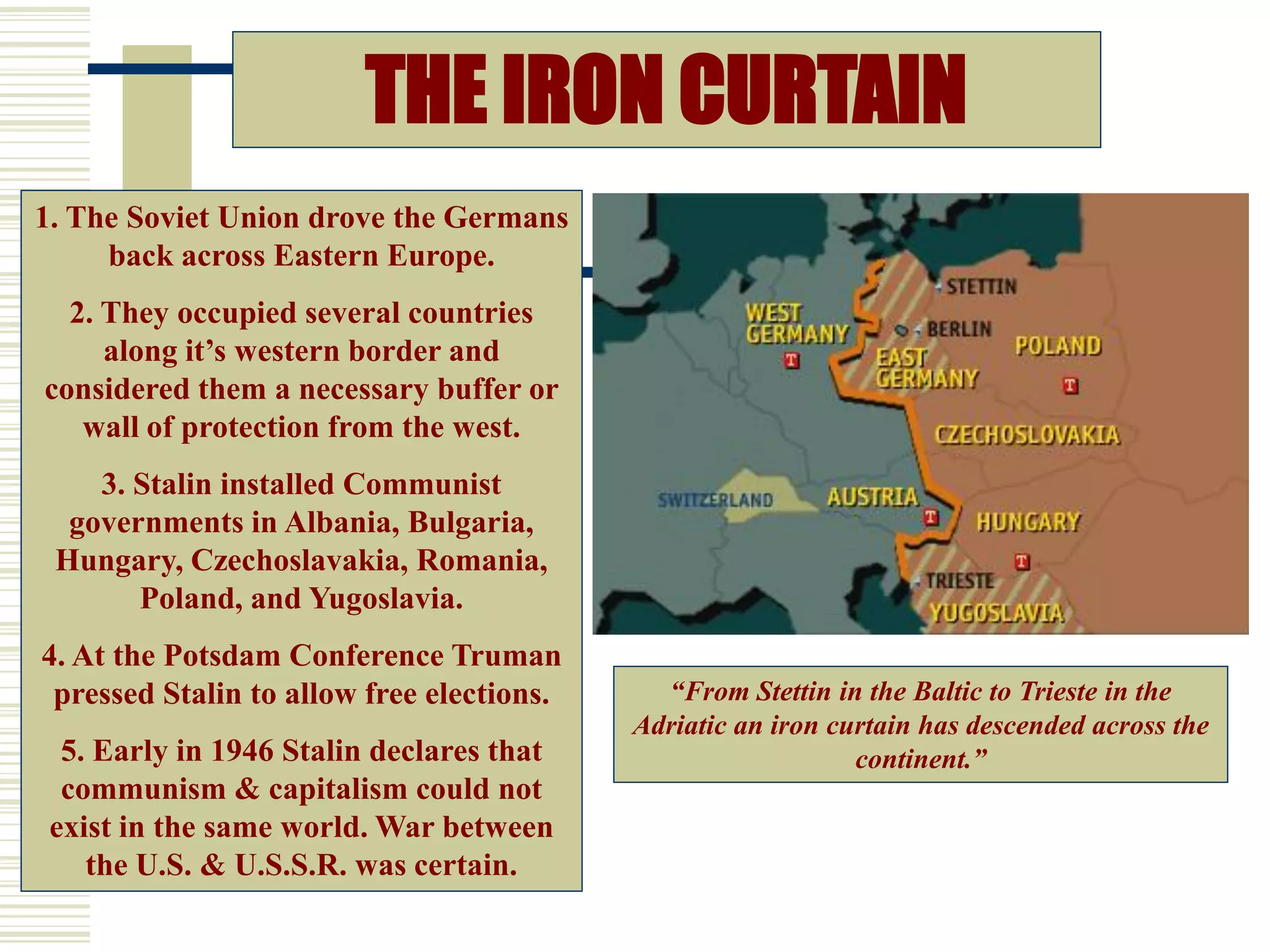
THE IRON CURTAIN
“From Stettin in the Baltic to Trieste in the
Adriatic an iron curtain has descended across the
continent.”
1. The Soviet Union drove the Germans
back across Eastern Europe.
2. They occupied several countries
along it’s western border and
considered them a necessary buffer or
wall of protection from the west.
3. Stalin installed Communist
governments in Albania, Bulgaria,
Hungary, Czechoslavakia, Romania,
Poland, and Yugoslavia.
4. At the Potsdam Conference Truman
pressed Stalin to allow free elections.
5. Early in 1946 Stalin declares that
communism & capitalism could not
exist in the same world. War between
the U.S. & U.S.S.R. was certain. March 5, 1946
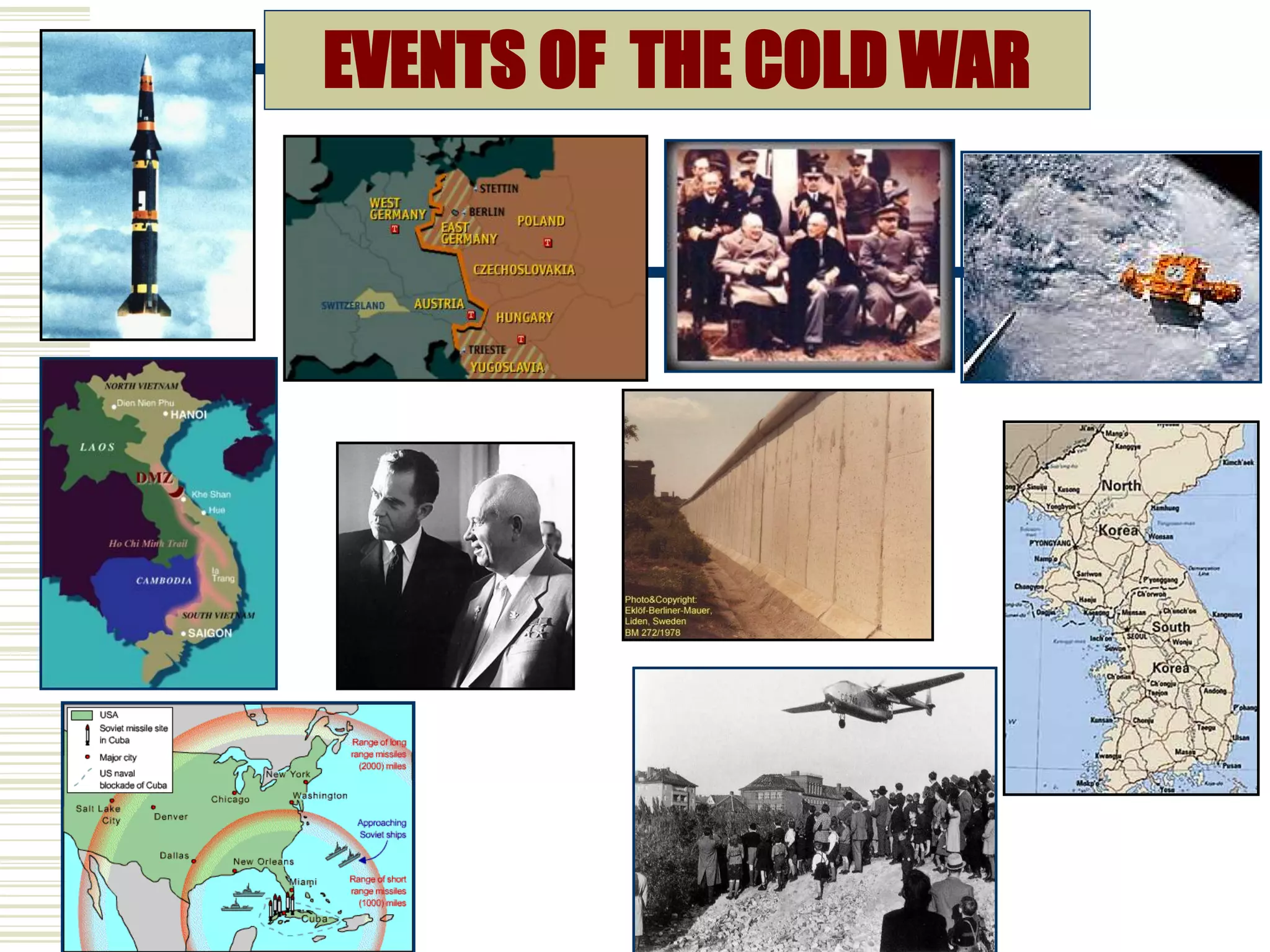
EVENTS OF THE COLD WAR
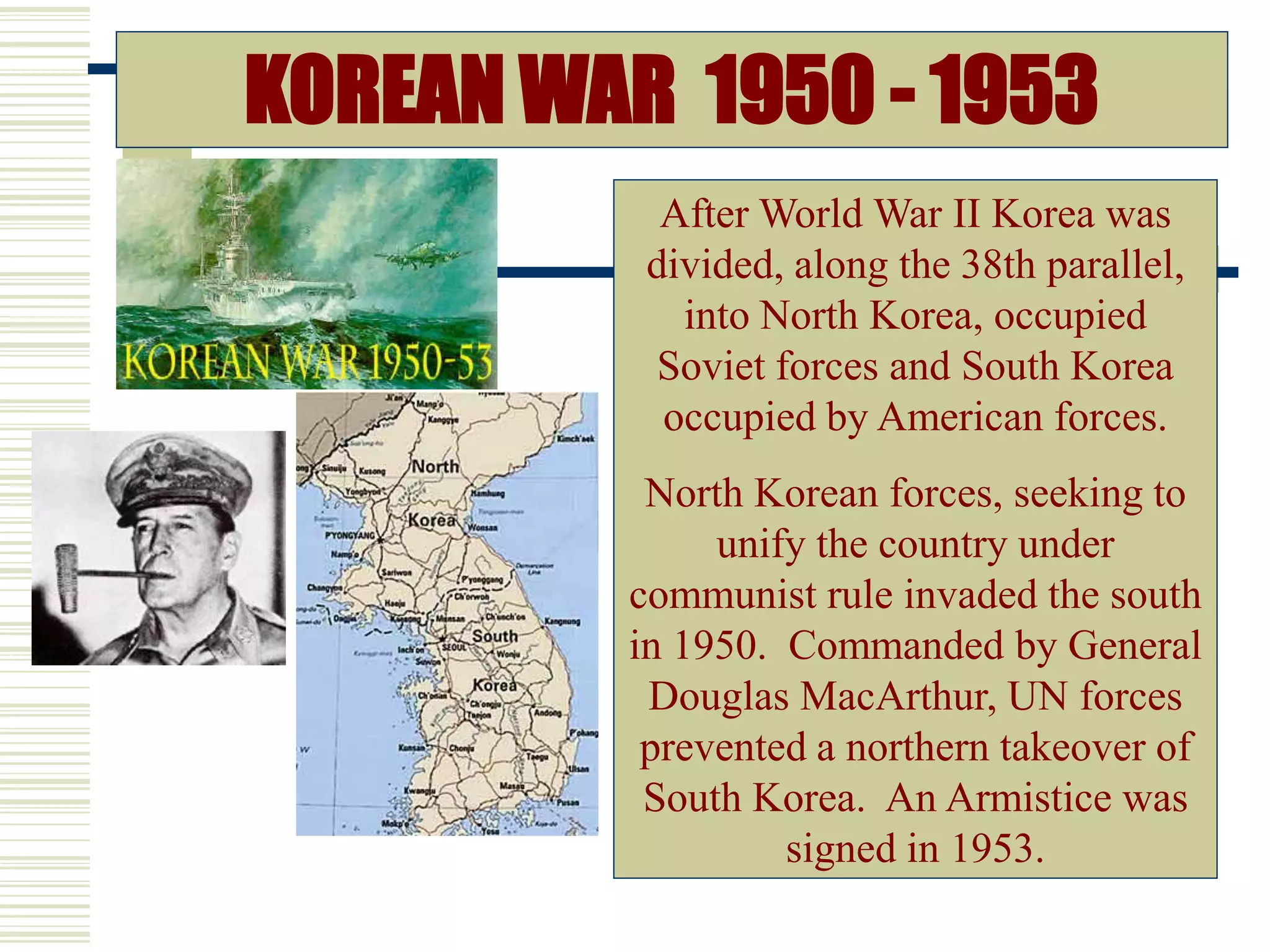
KOREAN WAR 1950 - 1953
After World War II Korea was
divided, along the 38th parallel,
into North Korea, occupied
Soviet forces and South Korea
occupied by American forces.
North Korean forces, seeking to
unify the country under
communist rule invaded the south
in 1950. Commanded by General
Douglas MacArthur, UN forces
prevented a northern takeover of
South Korea. An Armistice was
signed in 1953.
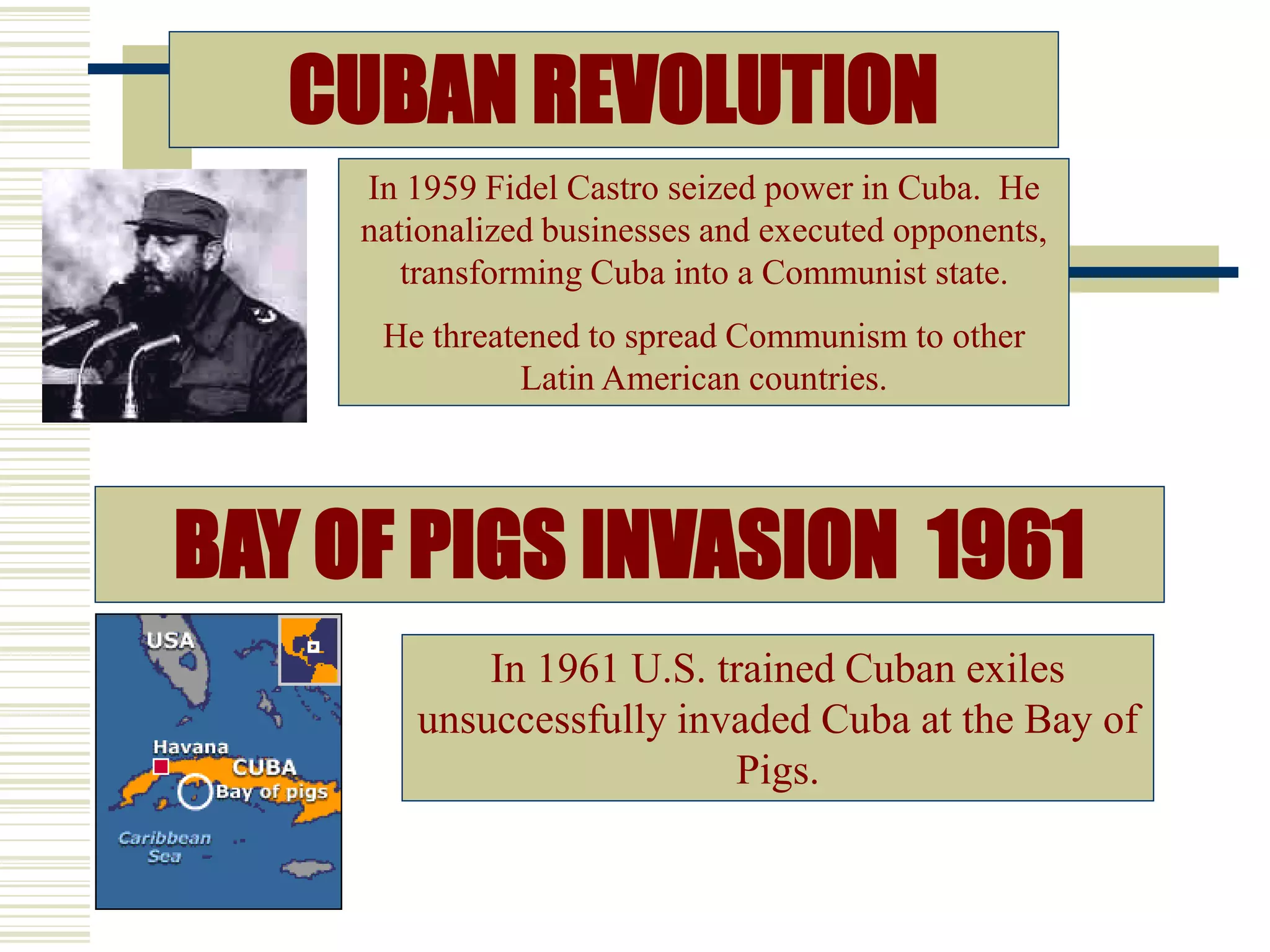
CUBAN REVOLUTION
BAY OF PIGS INVASION 1961
In 1959 Fidel Castro seized power in Cuba. He
nationalized businesses and executed opponents,
transforming Cuba into a Communist state.
He threatened to spread Communism to other
Latin American countries.
In 1961 U.S. trained Cuban exiles
unsuccessfully invaded Cuba at the Bay of
Pigs.
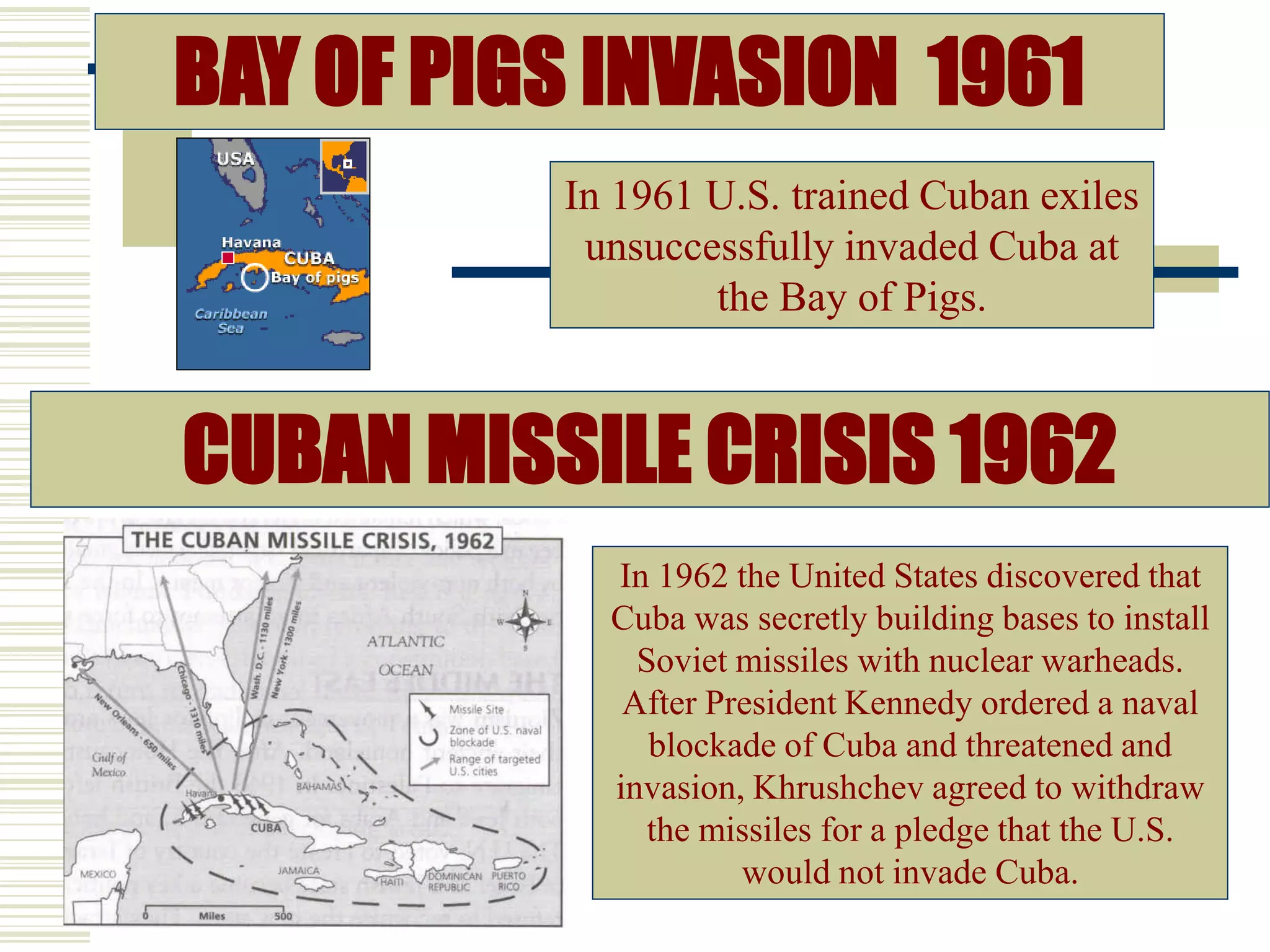
CUBAN MISSILE CRISIS 1962
In 1962 the United States discovered that
Cuba was secretly building bases to install
Soviet missiles with nuclear warheads.
After President Kennedy ordered a naval
blockade of Cuba and threatened and
invasion, Khrushchev agreed to withdraw
the missiles for a pledge that the U.S.
would not invade Cuba.
BAY OF PIGS INVASION 1961
In 1961 U.S. trained Cuban exiles
unsuccessfully invaded Cuba at
the Bay of Pigs.
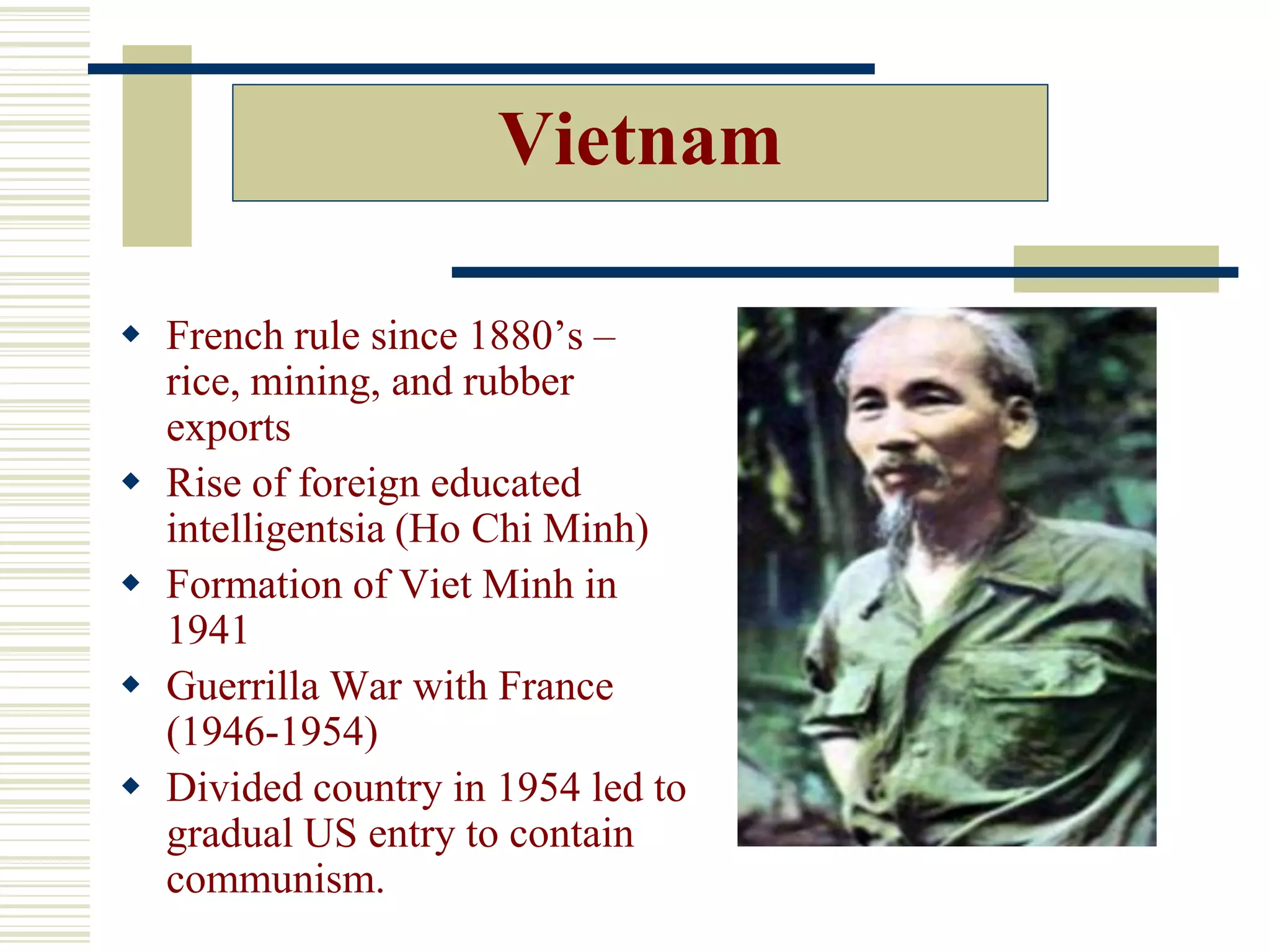
Vietnam
 French rule since 1880’s –
rice, mining, and rubber
exports
 Rise of foreign educated
intelligentsia (Ho Chi Minh)
 Formation of Viet Minh in
1941
 Guerrilla War with France
(1946-1954)
 Divided country in 1954 led to
gradual US entry to contain
communism.
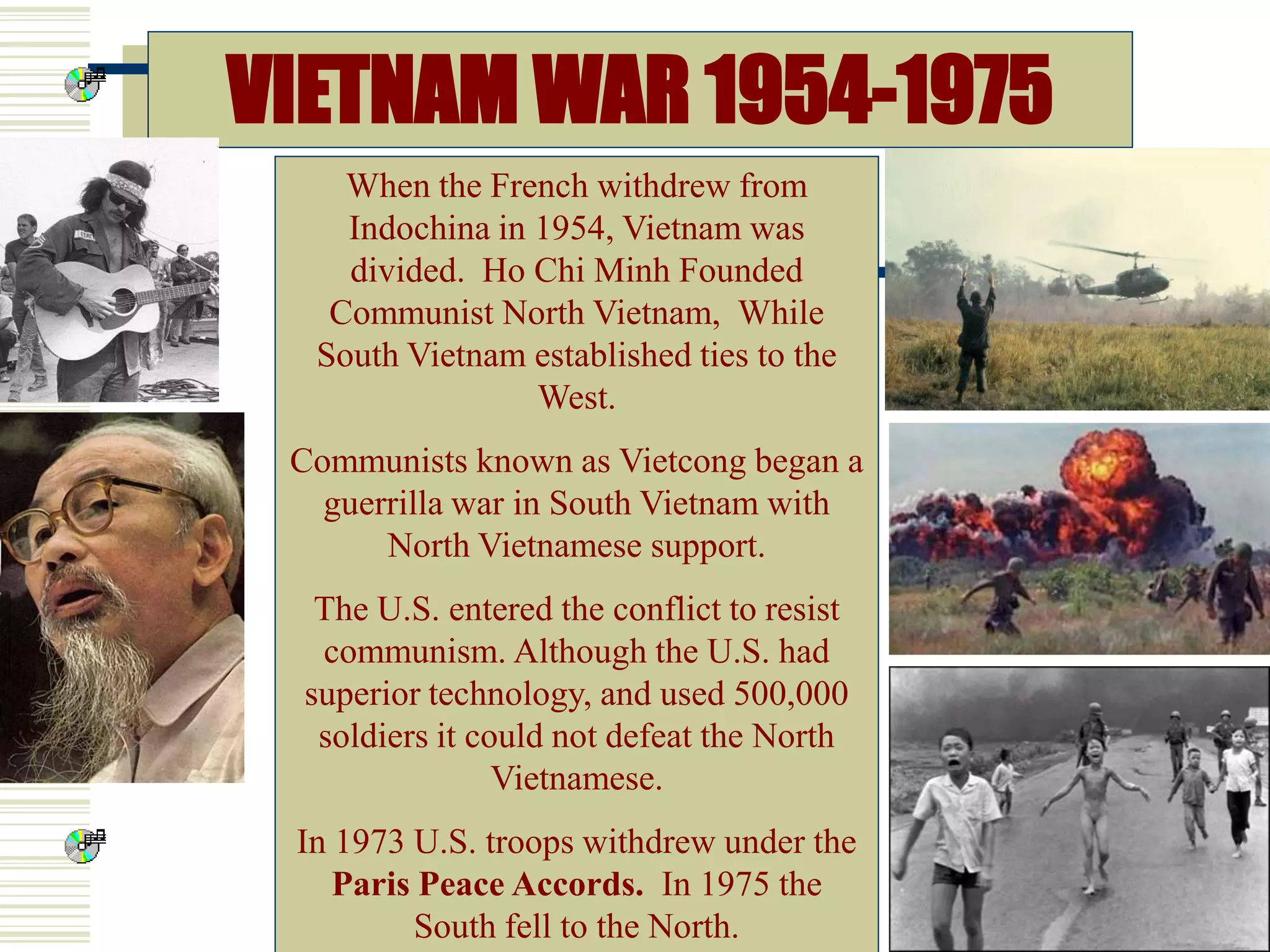
VIETNAM WAR 1954-1975
When the French withdrew from
Indochina in 1954, Vietnam was
divided. Ho Chi Minh Founded
Communist North Vietnam, While
South Vietnam established ties to the
West.
Communists known as Vietcong began a
guerrilla war in South Vietnam with
North Vietnamese support.
The U.S. entered the conflict to resist
communism. Although the U.S. had
superior technology, and used 500,000
soldiers it could not defeat the North
Vietnamese.
In 1973 U.S. troops withdrew under the
Paris Peace Accords. In 1975 the
South fell to the North.
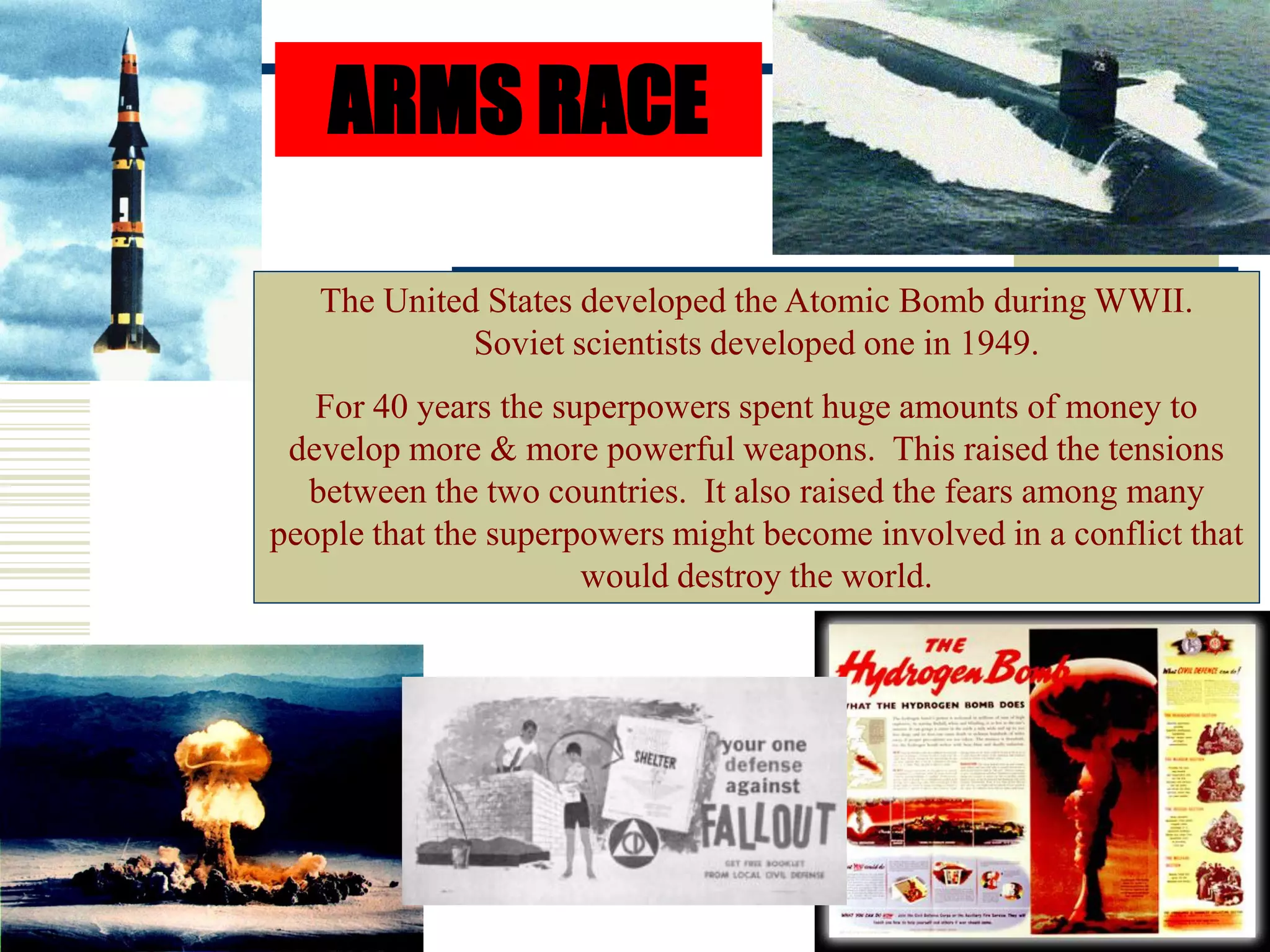
ARMS RACE
The United States developed the Atomic Bomb during WWII.
Soviet scientists developed one in 1949.
For 40 years the superpowers spent huge amounts of money to
develop more & more powerful weapons. This raised the tensions
between the two countries. It also raised the fears among many
people that the superpowers might become involved in a conflict that
would destroy the world.
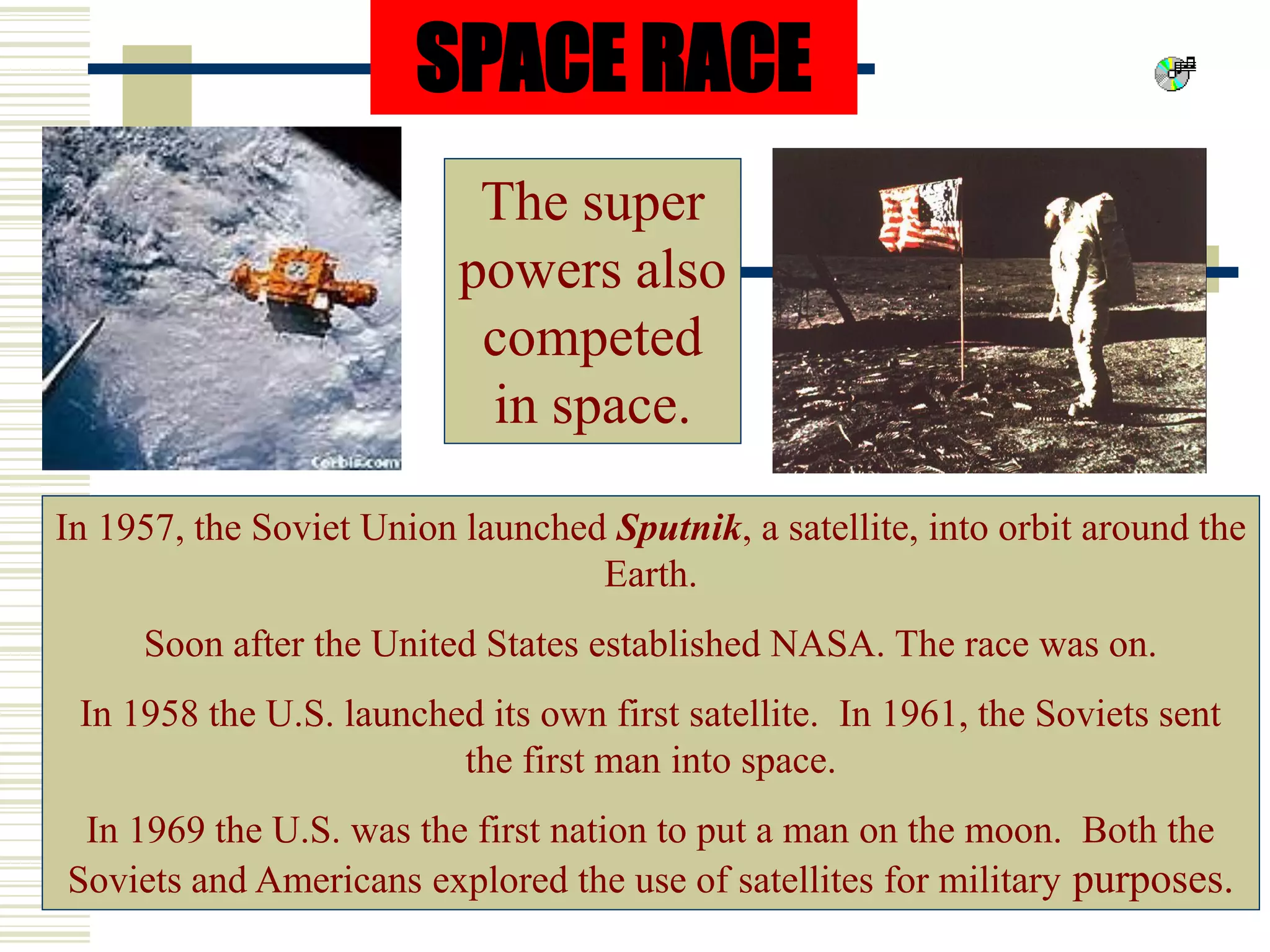
SPACE RACE
The super
powers also
competed
in space.
In 1957, the Soviet Union launched Sputnik, a satellite, into orbit around the
Earth.
Soon after the United States established NASA. The race was on.
In 1958 the U.S. launched its own first satellite. In 1961, the Soviets sent
the first man into space.
In 1969 the U.S. was the first nation to put a man on the moon. Both the
Soviets and Americans explored the use of satellites for military purposes.
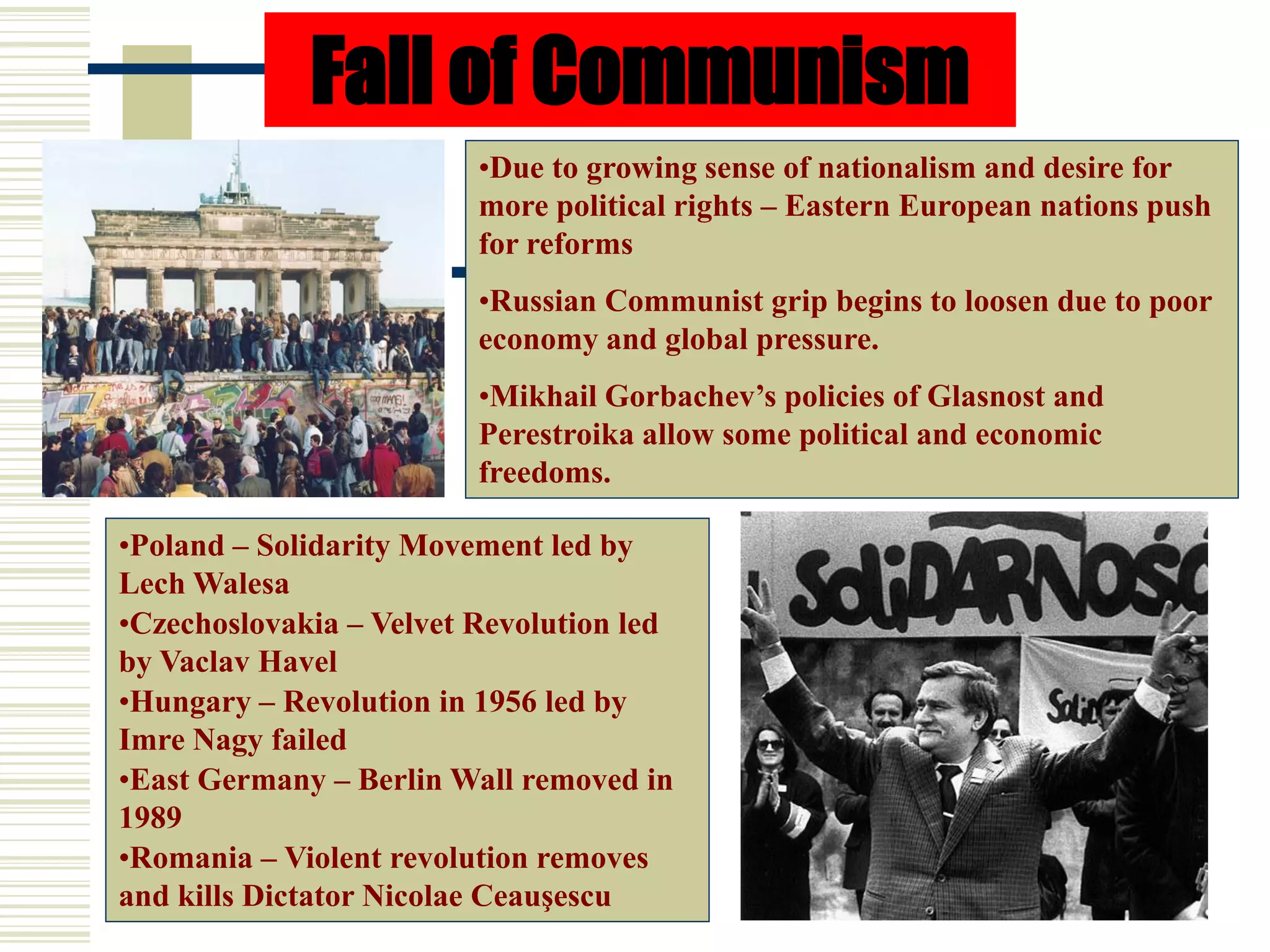
Fall of Communism
•Due to growing sense of nationalism and desire for
more political rights – Eastern European nations push
for reforms
•Russian Communist grip begins to loosen due to poor
economy and global pressure.
•Mikhail Gorbachev’s policies of Glasnost and
Perestroika allow some political and economic
freedoms.
•Poland – Solidarity Movement led by
Lech Walesa
•Czechoslovakia – Velvet Revolution led
by Vaclav Havel
•Hungary – Revolution in 1956 led by
Imre Nagy failed
•East Germany – Berlin Wall removed in
1989
•Romania – Violent revolution removes
and kills Dictator Nicolae Ceauşescu
Fall of Communism
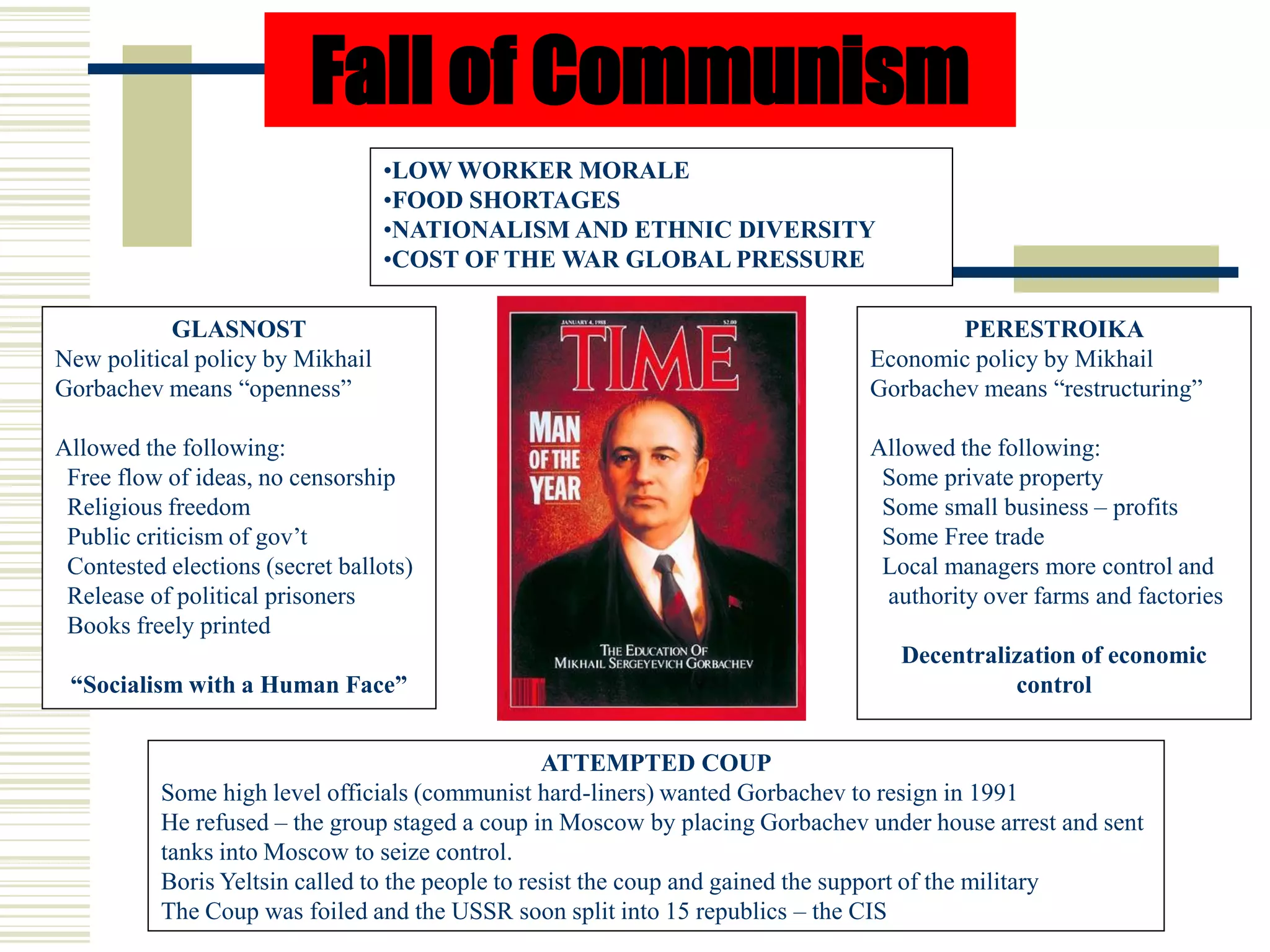
•LOW WORKER MORALE
•FOOD SHORTAGES
•NATIONALISM AND ETHNIC DIVERSITY
•COST OF THE WAR GLOBAL PRESSURE
GLASNOST
New political policy by Mikhail
Gorbachev means “openness”
Allowed the following:
Free flow of ideas, no censorship
Religious freedom
Public criticism of gov’t
Contested elections (secret ballots)
Release of political prisoners
Books freely printed
“Socialism with a Human Face”
PERESTROIKA
Economic policy by Mikhail
Gorbachev means “restructuring”
Allowed the following:
Some private property
Some small business – profits
Some Free trade
Local managers more control and
authority over farms and factories
Decentralization of economic
control
ATTEMPTED COUP
Some high level officials (communist hard-liners) wanted Gorbachev to resign in 1991
He refused – the group staged a coup in Moscow by placing Gorbachev under house arrest and sent
tanks into Moscow to seize control.
Boris Yeltsin called to the people to resist the coup and gained the support of the military
The Coup was foiled and the USSR soon split into 15 republics – the CIS
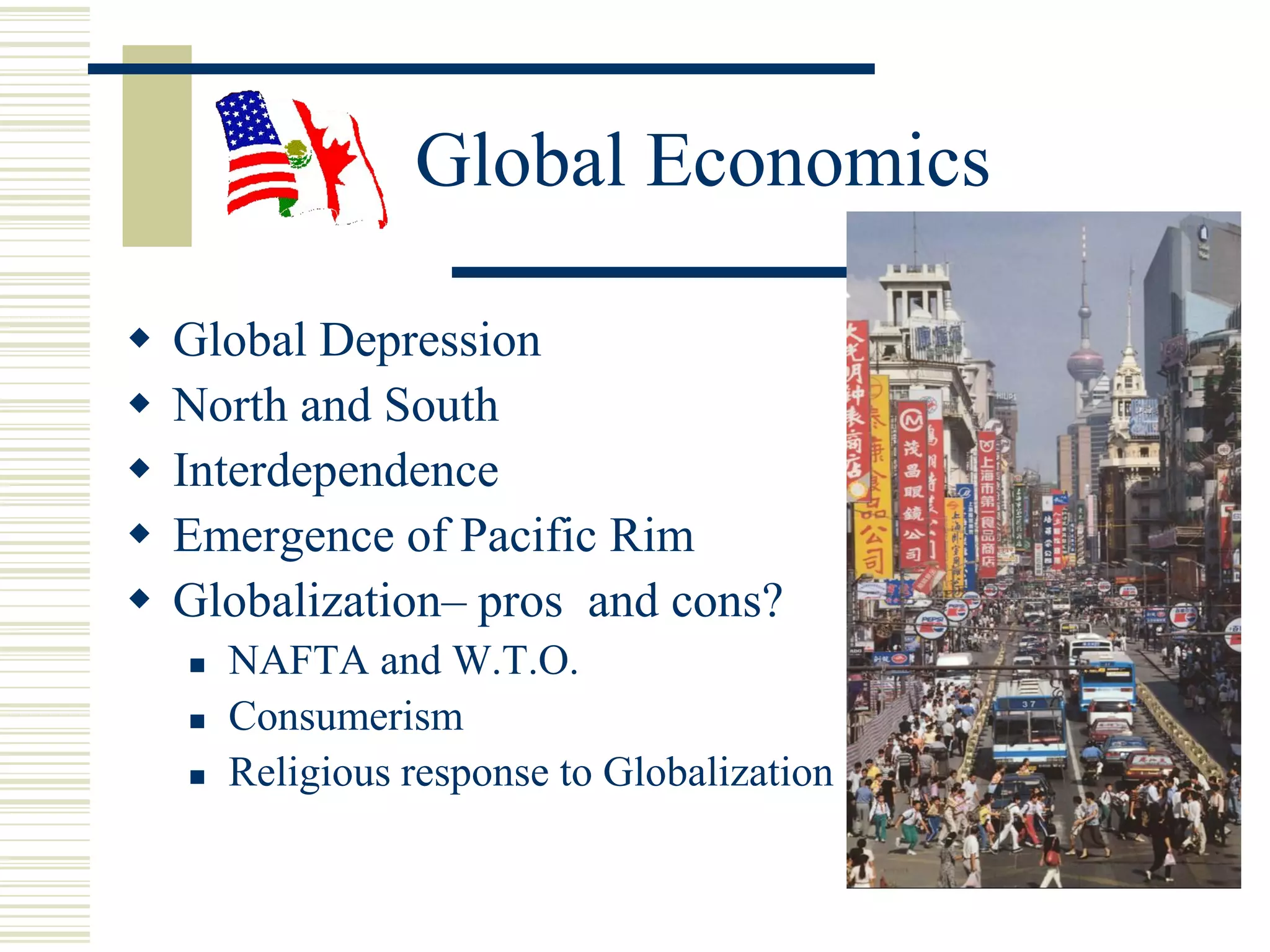
Global Economics
 Global Depression
 North and South
 Interdependence
 Emergence of Pacific Rim
 Globalization– pros and cons?
 NAFTA and W.T.O.
 Consumerism
 Religious response to Globalization
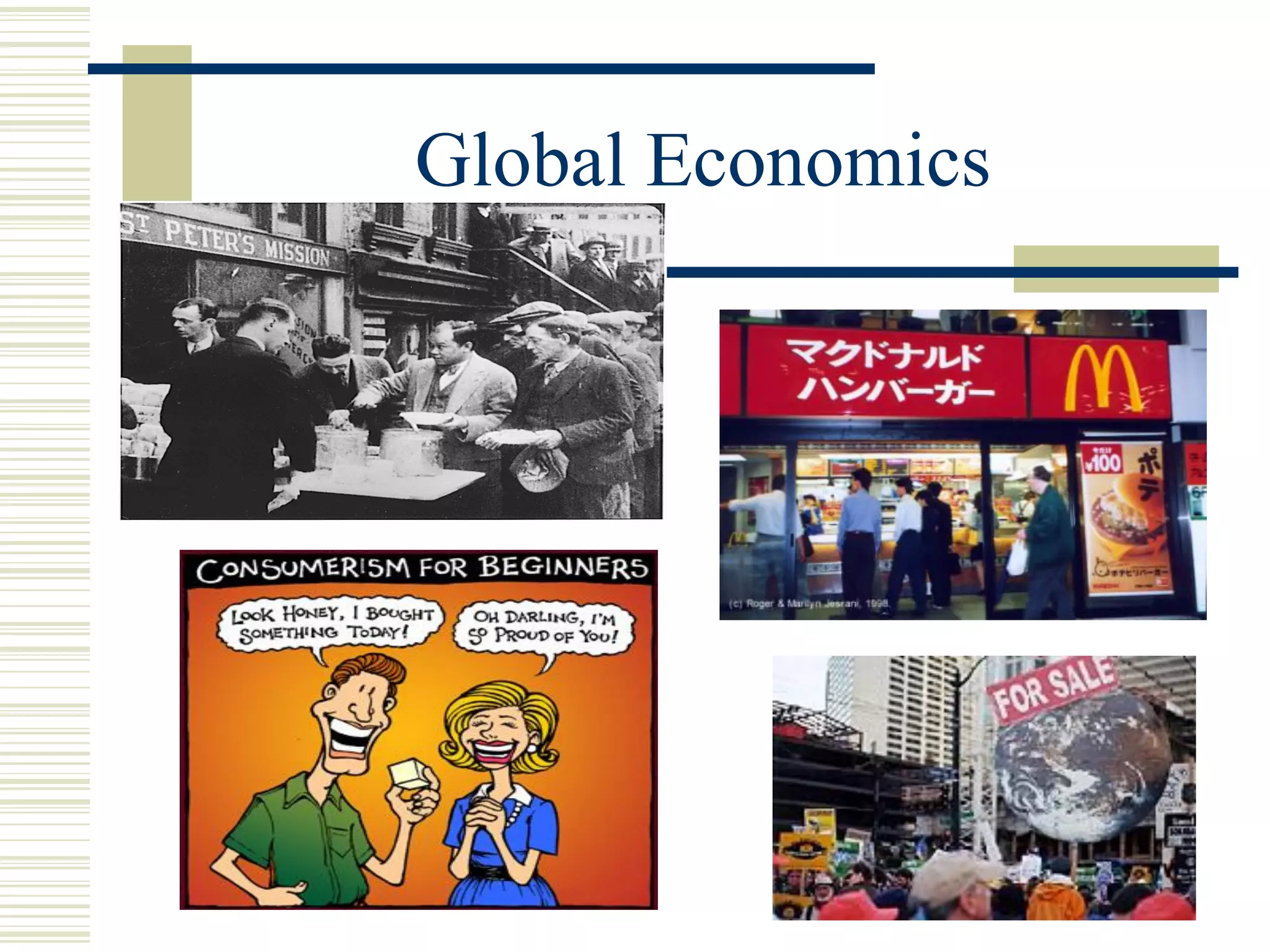
Global Economics
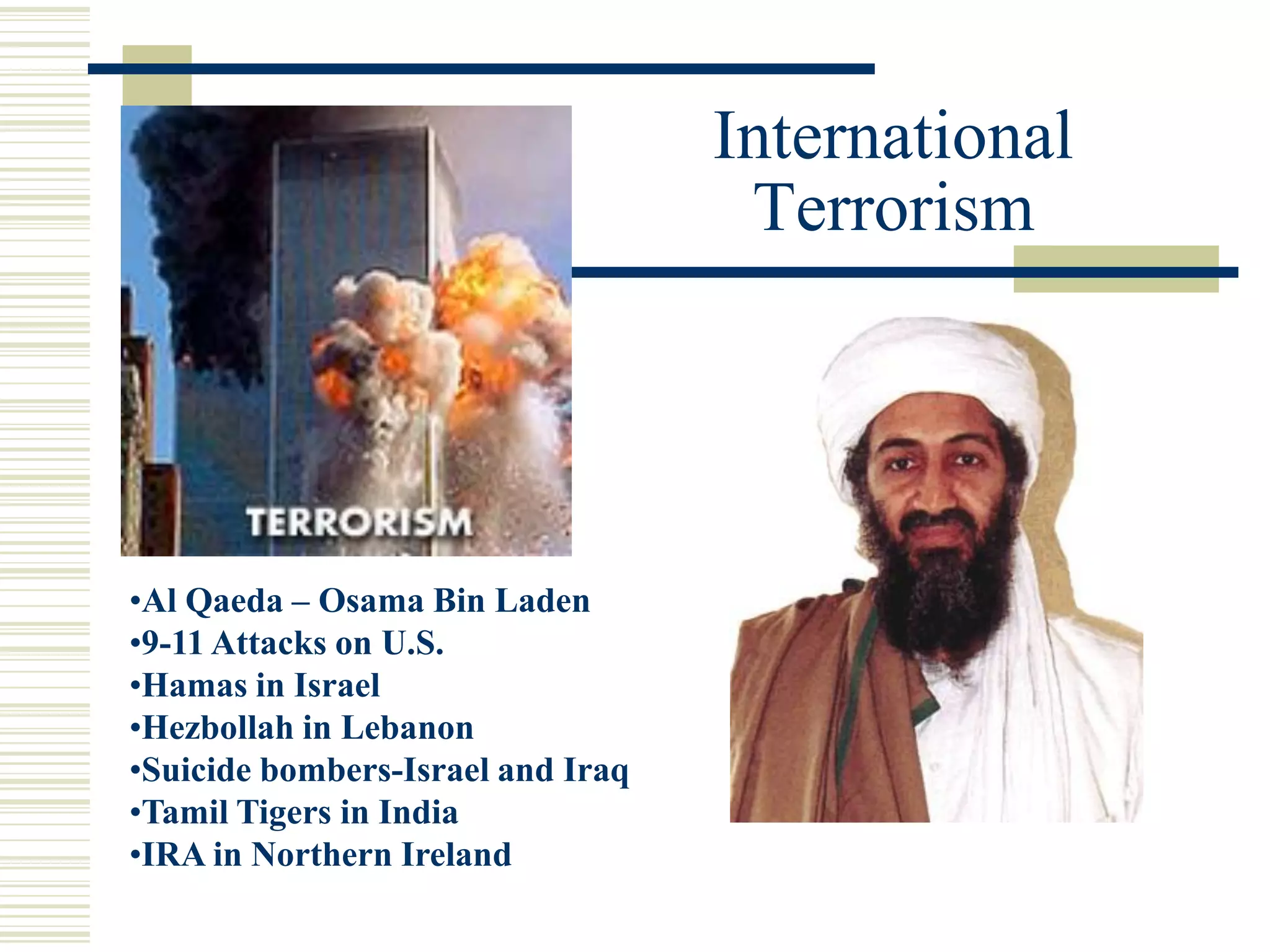
International
Terrorism
•Al Qaeda – Osama Bin Laden
•9-11 Attacks on U.S.
•Hamas in Israel
•Hezbollah in Lebanon
•Suicide bombers-Israel and Iraq
•Tamil Tigers in India
•IRA in Northern Ireland
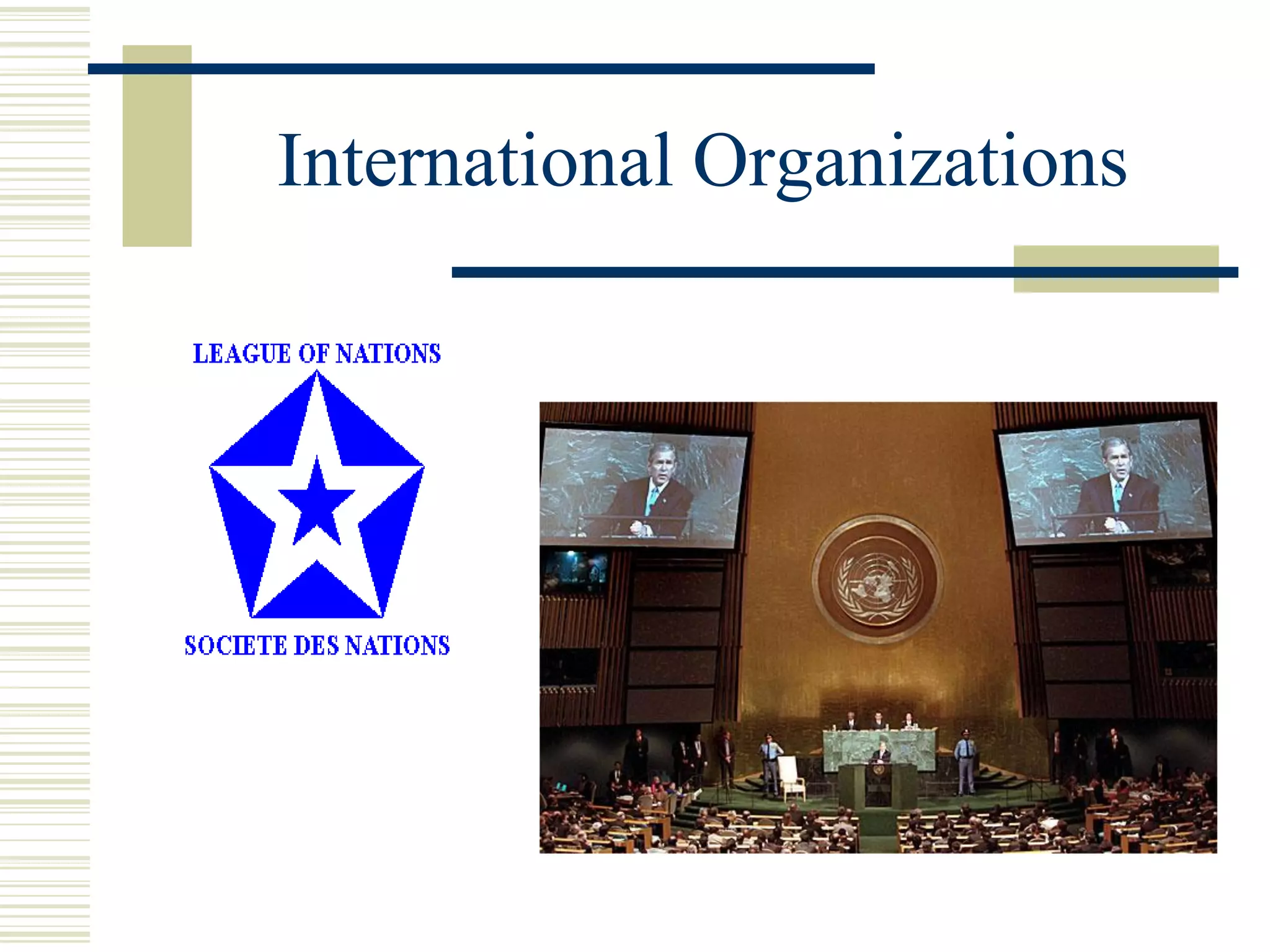
International Organizations
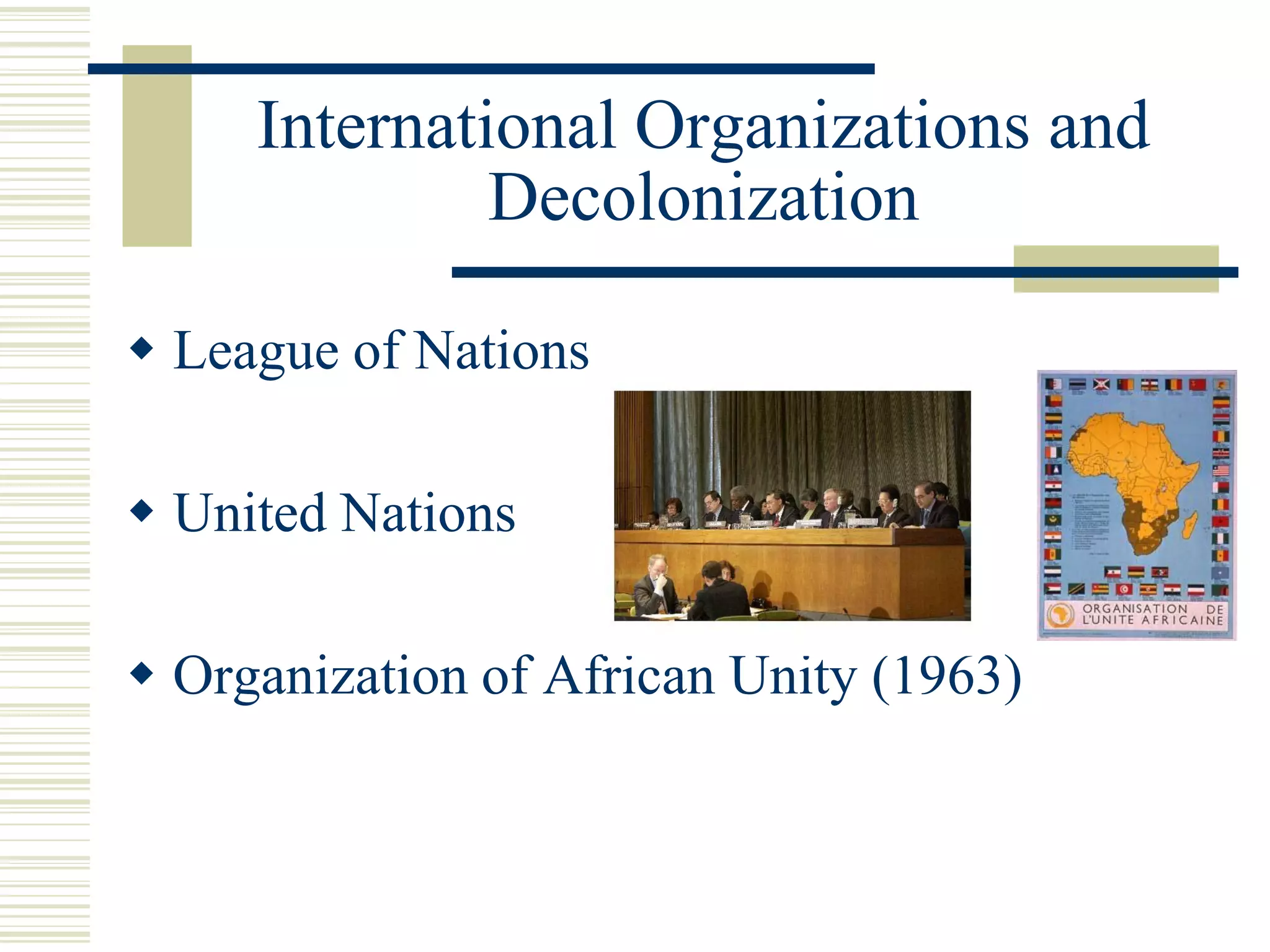
International Organizations and
Decolonization
 League of Nations
 United Nations
 Organization of African Unity (1963)
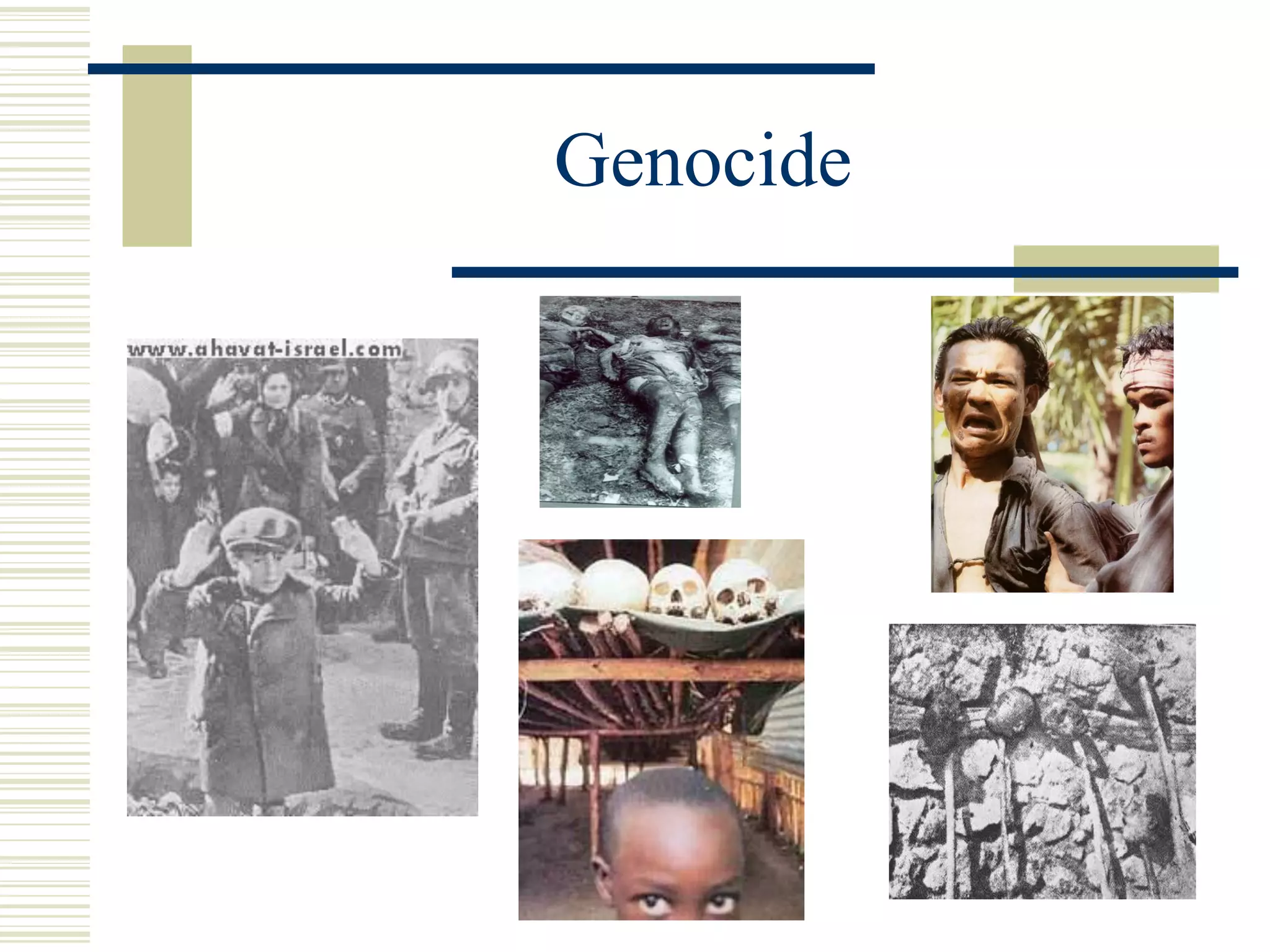
Human Rights
 Universal Declaration of Human Rights 1948
 Genocide Convention, 1948
 Armenian 1918
 Jewish Holocaust 1930’s- 1940’s
 Cambodia- Pol Pot 1975- 1979
 Rwanda, 1994
 Child Labor, Soldiers, Slavery
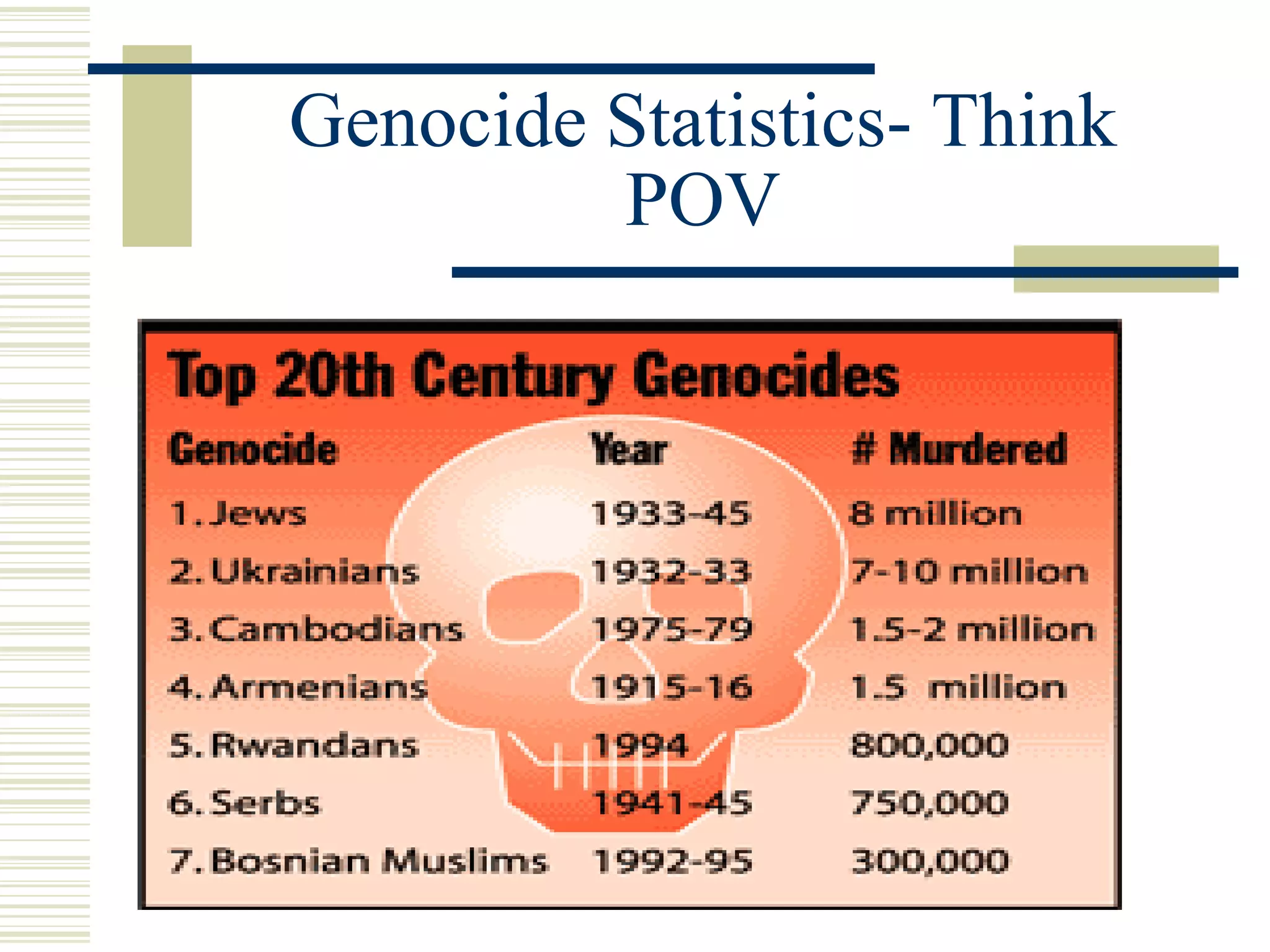
Genocide Statistics- Think
POV
Genocide
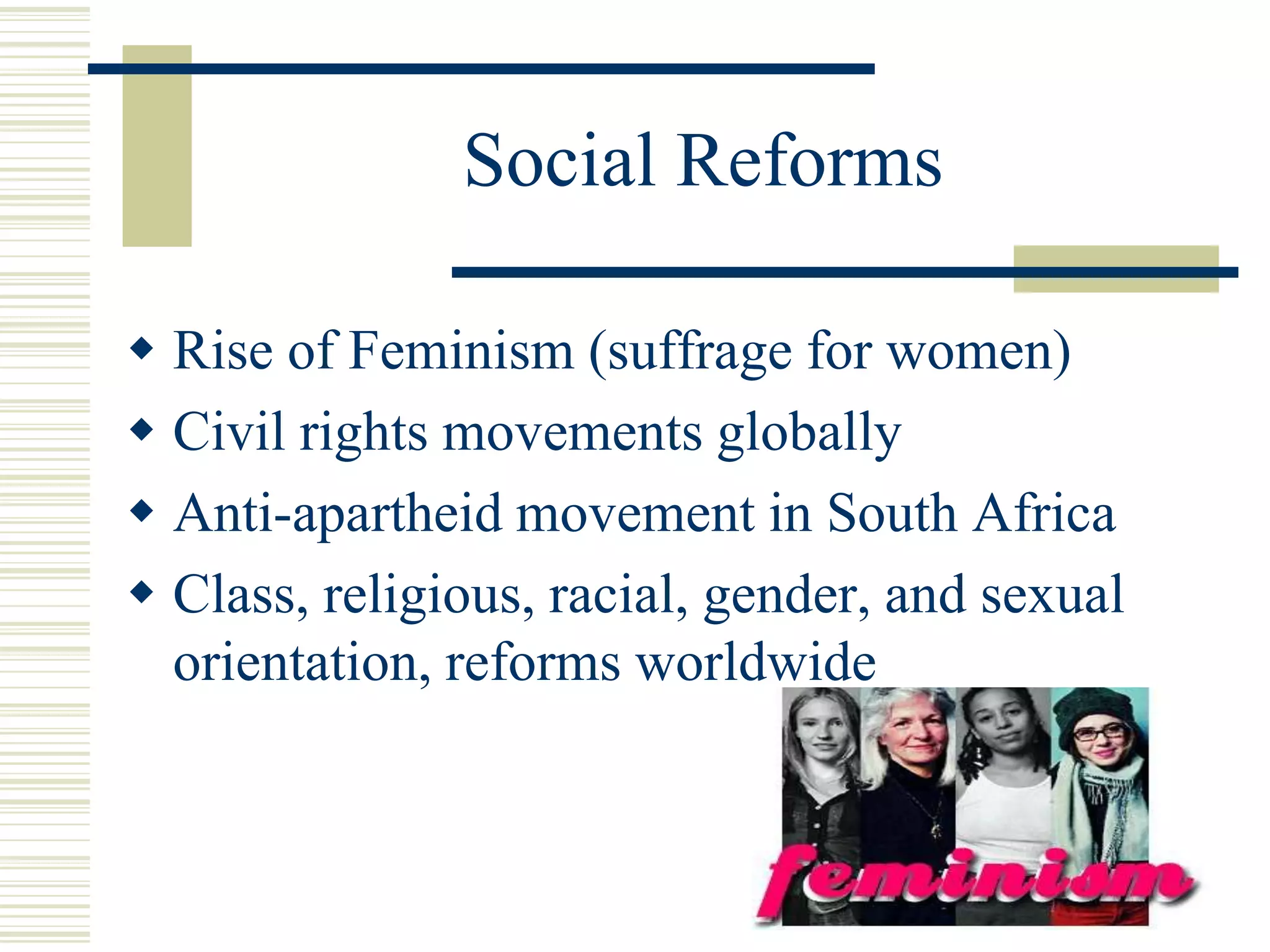
Social Reforms
 Rise of Feminism (suffrage for women)
 Civil rights movements globally
 Anti-apartheid movement in South Africa
 Class, religious, racial, gender, and sexual
orientation, reforms worldwide
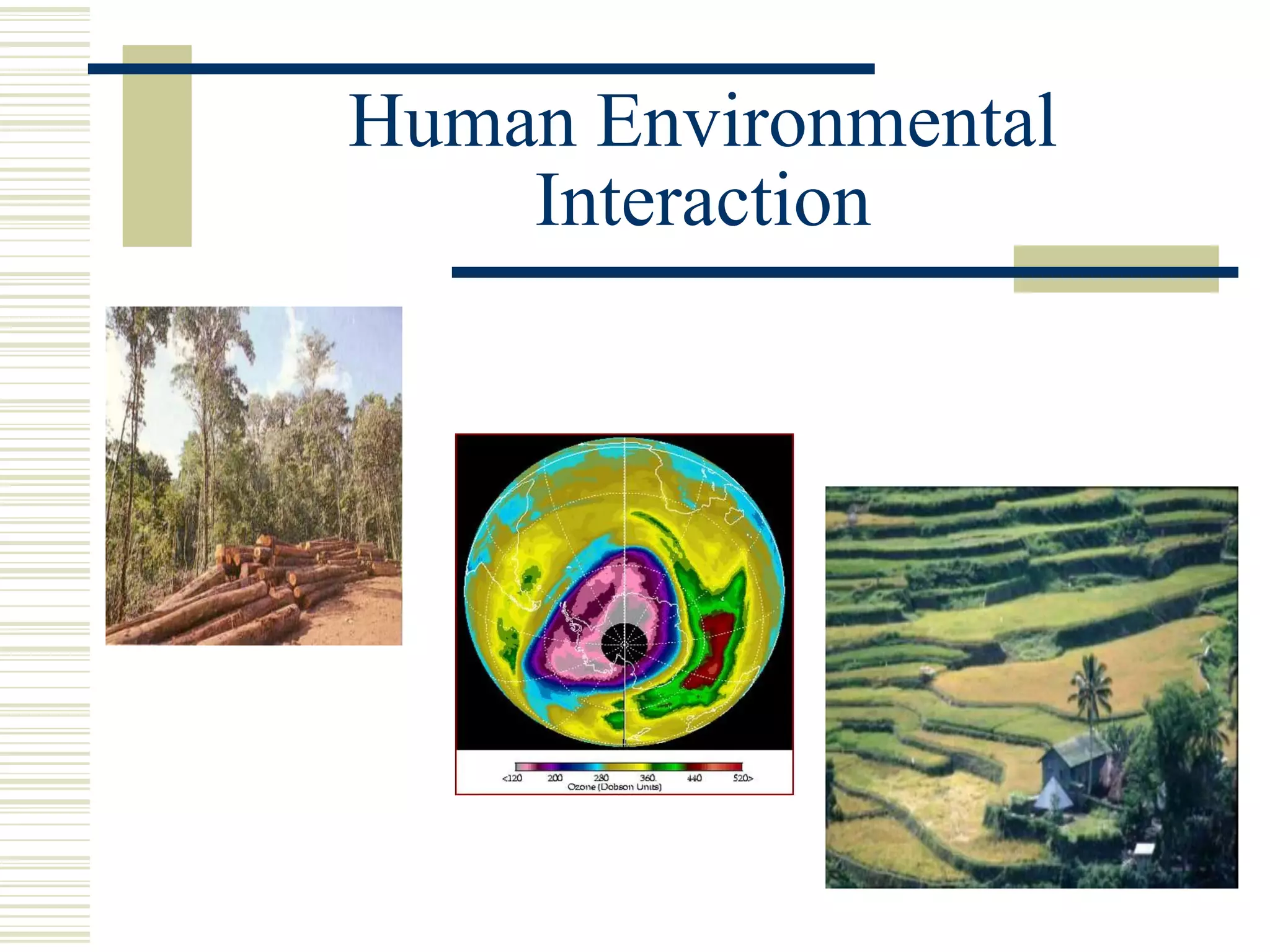
Human Environmental
Interaction
 Continued Urbanization
 Green Revolution
 Deforestation
 Ozone depletion
 Global environmental efforts
Human Environmental
Interaction
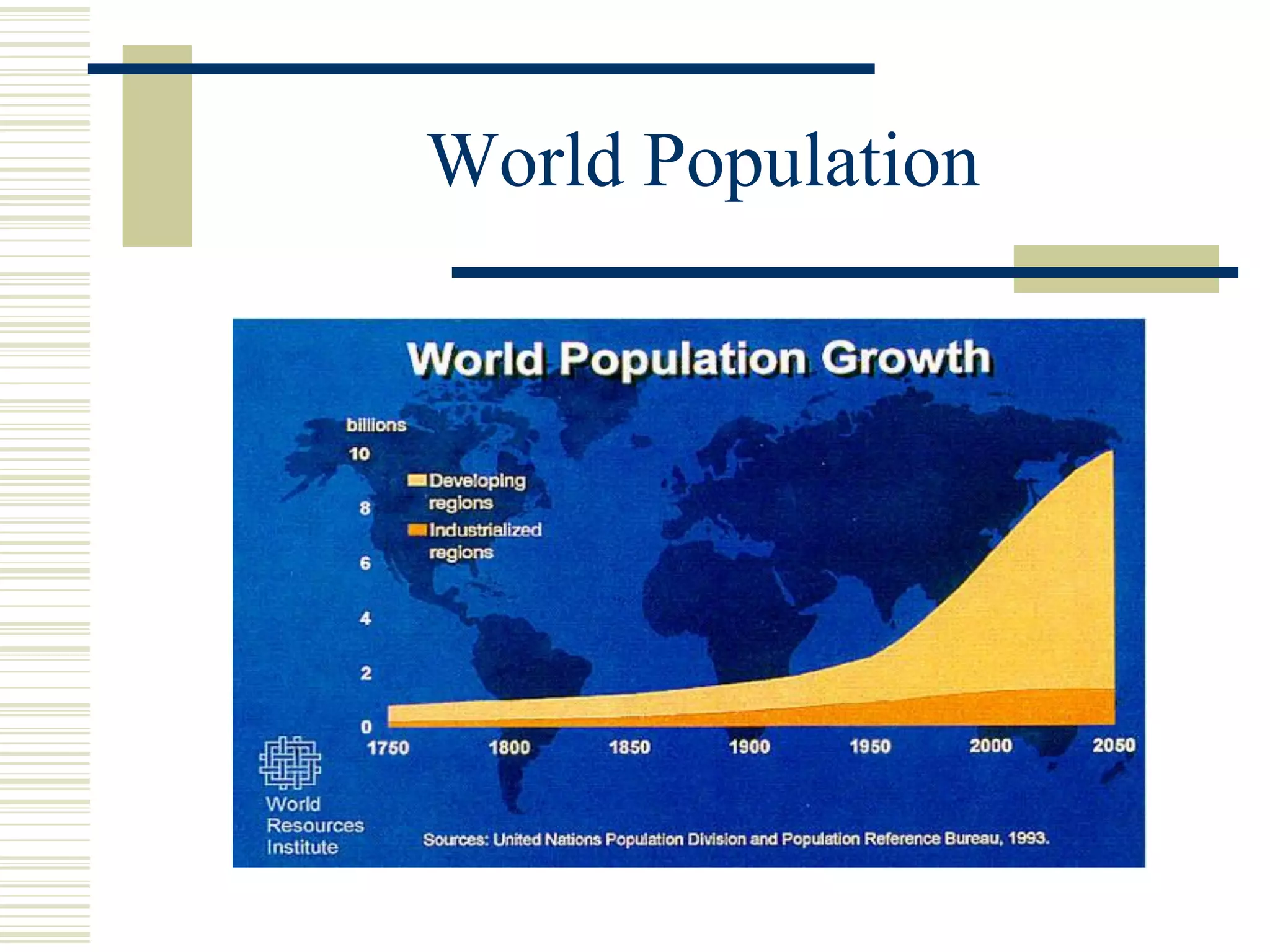
World Population

Unit 5 review

  • 1.
    1914 – Present 20thcentury and Beyond Periodization: Why 1914? Major Themes  World Conflict – Decline of Empire  Decolonization and Nationalism  Cold War Conflicts  Social Reforms  Globalization  Environmental Issues
  • 2.
    Causes of WorldWar I M – Militarism A – Alliances N – Nationalism  I – Imperialism A – Assassination of Archduke Ferdinand
  • 3.
  • 4.
    World War I Promises of self-determination  Use of colonial soldiers  Machine guns, submarines, planes, tanks, trench warfare = major death and destruction  Financial strain on empire  Treaty of Versailles
  • 5.
    Feb. 14, 1919- Wilson submits Draft Covenant for a League of Nations The Covenant becomes the first 26 Articles of the Treaty , especially the key Article 10 What did Wilson believe to be the answer to the world’s problems? Would it work? Wilson’s Idealism
  • 6.
    The Treaty ofVersailles Lasting-Peace Peace-Revenge Germany pays reparations, Poland is created, Creation of the League of Nations, War-Guilt clause, Alsace-Lorraine to France, Germany forbidden to join League, France controls Rhineland, Arms limitation, Polish corridor established, no secret alliances Germany lost territory Arms LimitationCreation of the League of Nations Polish Corridor established France controls Rhineland Poland is created War-Guilt clause- Blame Germany pays Reparations Germany lost Territory Germany forbidden to join League No secret alliances Alsace-Lorraine to France
  • 7.
    New Map of Europe! 1.Which major empires lost the most land? Why? 2. What problems could occur due to the structure of the European landscape?
  • 8.
    Acts of AggressionLead to WWII Country Area Attacked Reason Allies Reaction Japan 1931 - Manchuria China 1. Need for natural resources. League of Nations condemned the action but did nothing. Italy Ethiopia - Africa 1. Distract Italians from depression. 2. Promised to build the new Roman Empire League of Nations did nothing. Other nations concerned with their own problems. 1. Austria (1938) 1. German people lived there. 1. None even though it was a direct violation of the treaty Germany 2.Czechoslovakia/Sudeten -land (1938) 2. German people lived there. 2. Hitler promised he was finished. Britain & France appeased and didn't fight. 3. Poland (1939) 3. Desire for land. 3. Britain and France declare war.
  • 9.
    AXIS POWER Adolf Hitler(right) is considered one of the most brutal dictators in history. After purging possible rivals for leadership, Hitler rearmed Germany into a modern war machine. He and Italian dictator Benito Mussolini (left), both Fascists, became allies in 1936. They are shown here in Munich, Germany, in 1937.
  • 10.
    PEACE FOR OURTIME! “An appeaser is one who feeds a crocodile, hoping it will eat him last.” - Winston Churchill On 15 March 1939, the German army occupied the remainder of Czechoslovakia. “My good friends… I have returned form Germany bringing peace with honor. I believe it is peace for our time… Go home and get a nice quiet sleep.”
  • 11.
    World War II Increased nationalist uprisings following WWI and as a result of the global depression  Costs of empire  US support of anti-colonial liberation movements  Atlantic Charter (1941) “right of all people to choose the form of government under which they live”  Soviets condemned colonialism
  • 12.
  • 13.
    Japanese Aggression inPacific After Pearl Harbor, the Japanese took over the Philippines, Indochina, Taiwan, and many other Pacific islands.
  • 14.
    Turning Points: Africaand Italy Operation Torch, 1942-43 El Alamein, 1942-43 Invasion of Sicily and Italy, 1943 Operation Overlord (D-Day), 1944
  • 15.
    Atomic Bomb On August6, 1945, during World War II, the United States dropped the first atomic bomb on Hiroshima, a Japanese city and military center. An estimated 60,000 to 70,000 people were killed or reported missing, according to U.S. estimates, and thousands more were made homeless. Sixteen hours after the attack, U.S. President Harry S. Truman’s report of the event was broadcast to radio listeners.
  • 16.
    Democracy in Japan •Japan’sarmed forces were disbanded •The American occupiers had the goal to end militarism and ensure a democratic government •A new Japanese Constitution was drafted by the American occupiers creating a Constitutional Monarchy that limited the power of the Emperor •The Japanese accepted this new constitution and signed a treaty that took away Japan’s overseas empire •In 1952, the Allied occupation officially ended
  • 17.
    Imperialism/Colonialism Great Depression Capitalism Fascism Communism Industrialization of theWest Mass Production of weapons/ Development of Nuclear weapons Western Imperial powers are weakened Cost of War: Millions dead, destruction of infrastructure Ends Fascism – Defeat of Nazi Germany, Fascist Italy, militaristic Japan Atrocities: Nazi Holocaust, Rape of Nanjing, Bombing of Hiroshima and Nagasaki Pre- World War II World World War II Post- World War II World The Impact of World War II Decolonization: Creation of the “Third World” India, China, Korea, Vietnam, Israel, Middle East,Afghanistan The Cold War: USA vs USSR develop into Superpowers. Alliance Systems, arms race, proxy wars, propaganda, space race, containment, domino theory, detente United Nations: World organizations created to maintain peace Peace talks, declaration of human rights, World forum for issues
  • 18.
    The Formula forTwentieth Century Revolution •Traditional Rural Society •Rapid Industrialization •Corrupt, stubborn, unresponsive political system •Harsh living conditions, unfair treatment •Foreign intervention New ideas about class and property, land reform
  • 19.
  • 20.
    Revolutionary Results Some RealChanges: •1917 Mexican Constitution •Land reforms, limited foreign ownership of key resources •Guaranteed rights of workers •restrictions on clerical education and church ownership of property •educational reforms •Workers organized and were represented in government The Mexican Revolution had a limited impact beyond its borders: WHY?
  • 21.
    Russian Revolution “Peace, Land, and Bread” 1. March 1917 – Provisional Government replaces Czar 2. November 1917 – Bolsheviks Replace Provisional Government 3. Lenin pulls Russia out of WWI
  • 22.
    Results •USSR becomes thefirst Communist nation •Created a new political, economic and cultural structure without internal challenge •Authoritarian Rule •Supported socialist movements around the world •1923 – New constitution created a federal system of socialist republics •Capital is moved to Moscow
  • 23.
    Comparing Revolutions Russian Revolution •1905-1923 •VladimirLenin, Leon Trotsky •peasants want: Land reform, political rights, out of WWI •autocratic leader - harsh rule, small land owning elite •“Peace, land, bread” - Marxist reforms •1917 - March revolution removes Czar - Limited reforms •1917 - Nov revolution (Bolshevik Rev) creation of USSR - Red Army •1918-1921 Civil War (Reds vs Whites) •1924 - Stalin becomes communist dictator Mexican Revolution •1910-1920 •Pancho Villa, Emiliano Zapata •peasants want: Land reform, political rights •autocratic leader - harsh rule, small land owning elite, foreign control of industry •“Tierra y Libertad” - Socialist reforms •1910 - Diaz Resigns and flees Mexico, Madero in Power - Limited Reforms •1913 - Madero removed and Killed - General Huerta becomes dictator •1914-1920 Civil War forces Huerta from power • 1917 - Mexican Constitution •1920 - Obregon becomes President - gov’t led by Revolutionary elite
  • 24.
    Chinese Revolutions Sun Yixian– Father of Modern China - Three Principles of the People 1911 – Last Emperor of Qing Dynasty is overthrown Mao Zedong – 1949 Communist Revolution defeats Jiang Jieshi who flees to Taiwan
  • 25.
    How do thesepaintings show how Mao was successful at gaining power in China?
  • 26.
    China Case study During the war,Communists expanded peasant base, using appeals for women (health care, divorce rights, education access, graduated taxes, cooperative farming).  Growth of party during the war in part through use of anti-Japanese propaganda.  Resumption of civil war after Japanese surrender.  1949 Great People’s Revolution- Mao  Nationalist leaders fled to Taiwan.
  • 27.
     1953 –Guerilla group led by Fidel Castro began a revolution against U.S. supported dictator Fulgencio Batista  1959 - Fidel Castro seized power in Cuba. He nationalized businesses and executed opponents, created Communist state.  He threatened to spread Communism to other Latin American countries.  Clashed with U.S. and allied with USSR during Cold War Cuban Revolution
  • 28.
    Iranian Revolution Rise ofIslamic Fundamentalism 1953- Shah Reza Pahlavi came to power with help of CIA Repressed opposition and violated constitution 1979 - Ayatollah Khomenini led revolution from exile in Paris and overthrows the Shah • Creates the first Islamic Fundamentalist government – new constitution based on Islamic law • 55 Americans held hostage for 444 days • 1980-1988 – Iraq-Iran War
  • 29.
    Process of Decolonizationand Nation- Building  Surge of anti-colonial nationalism after 1945. Leaders used lessons in mass politicization and mass mobilization of 1920’s and 1930’s.  Three patterns: 1. Violent Revolutions and Civil War (China, Algeria, Vietnam, Palestine) 2. Non-Violent, negotiated independence (India, Ghana Turkey) 3. Both violent and non-violent methods (Kenya, Egypt, South Africa)
  • 30.
    Decolonization in theMiddle East- Palestine and Israel  Zionism  1917 Balfour Declaration  Immigration of Jews to Palestine  European Holocaust  Increase of migration  1947- end of British mandate of Palestine and failed UN partition solution  1948 establishment of Israel  Regional conflicts-> Violent Movements
  • 31.
    UN Partition Plan Britain,which had ruled Palestine since 1920, handed over responsibility for solving the Zionist-Arab problem to the UN in 1947. The UN recommended splitting the territory into separate Jewish and Palestinian states. The partition plan gave: • 56.47% of Palestine to the Jewish state • 43.53% to the Arab state • An international enclave around Jerusalem. • On 29 November 1947, 33 countries of the UN General Assembly voted for partition, 13 voted against and 10 abstained. Which Countries are most likely to vote against the U.N. Partition Plan?
  • 32.
    Palestinian Intifada • Protesttook the form of civil disobedience, general strikes, boycotts on Israeli products, graffiti, and barricades, but it was the stone-throwing demonstrations against the heavily-armed occupation troops that captured international attention. • The Israeli Defense Forces responded and there was heavy loss of life among Palestinian civilians. • More than 1,000 died in clashes which lasted until 1993. A mass uprising - or intifada against the Israeli occupation began in Gaza and quickly spread to the West Bank.
  • 33.
    Algeria 1954- 1962 warbetween FLN (nationalist party) and French troops  Appeal of Arab nationalism  Large French settler population “Part of France”  Algerians used guerilla and terrorist tactics  French used counter terrorism and torture  300,000 lives lost 1962 - Ahmed Ben Bella became the first President  Primarily a one-party state  Current challenges by Islamic Fundamentalists Violent Movements
  • 34.
    India: History ofthe Movement  Indian National Congress - 1885. (Elite group not mass movement)  Growth of Indian national identity- presented grievances to the British.  Congress party attracted mass following.  Gandhi and Congress leadership tried to prevent mass peasant uprising (as was happening in China) by keeping power centered on middle class leaders. Non-Violent Movements
  • 35.
    Militant Nationalists  B.G.Tilak urged a boycott of British manufactured goods and used threats of terrorism.  Attracted a violent conservative Hindu following.  Tilak was exiled and his movement was repressed by the British.
  • 36.
    Peaceful Protests  MohandasGandhi and other western educated lawyers led peaceful alternative.  Nation-wide protest against colonialism through boycotts and campaigns of civil resistance. (Salt March, Homespun Movement)  His efforts were not well received by the Muslims who formed a separate organization in 1906, The Muslim League.  Muhammad Ali Jinnah (Muslim League) insisted on partitioned state (Hindu and Muslim).
  • 37.
    Indian Independence  August1947 Pakistan and India gained independence.  Mass killings of Muslims and Hindus (1 million) followed by mass migrations (12 million). (Gandhi fasted to prevent war-> assassination)  Jawaharlal Nehru, first Prime Minister,began modernization campaign.
  • 38.
    De-colonization in Africa -1957, Gold Coast (renamed Ghana) independence, led by western- educated, Kwame Nkrumah.  Used Non-violent methods influenced by Gandhi  Developed a parliamentary democracy  - By 1963, all of British ruled Africa, except Southern Rhodesia, was independent. Non-Violent Movements
  • 39.
    Africa for Africans Nationalists composed of ex-servicemen, urban unemployed and western educated elite.  Pan-Africanism and Negritude  Senghor (Senegal)
  • 40.
  • 41.
    Kenya  Presence ofsettlers prevented smooth transition of power.  Jono Kenyatta used non-violent protests  Kenya (20,000 Europeans only) led to violent revolt.  Mau-Mau Revolt, 1952, led by Kikuyus suppressed by British.  1963 independence granted to black majority, led by Kenyatta. Both Violent and Non-Violent Movements
  • 42.
    Egypt  1906 Dinshawaiincident aroused nationalist passions.  Actions post- Indep (1936) not sufficient.  Coup d’etat in 1952 Gamal Abdel Nasser  Nationalization of Suez 1956 protested by Israelis, British and French but diplomacy won over eventually.  Nasser= symbol of pan-Arab nationalism. Both Violent and Non-Violent Movements
  • 43.
    South Africa  4million white residents  Afrikaner-dominated (white) National Party won 1948 election  Apartheid – separation of races  No protests tolerated (African National Congress, Mandela, Biko, Sharpeville massacre 1960, Spear of the Nation)  World boycotts led by Desmond Tutu  1990- DeKlerk legalized ANC and ended Apartheid  1994 –first open election  Mandela- first Black President Both Violent and Non-Violent Movements
  • 44.
    Failed Traditional Rebellion Western Inspired Nationalist Movement (Leaders &Goals) WWI, WWII, Cold War Independence Violent or Non-violent (Events/Methods) Resurgence of Indigenous Challenges (Major Problems) Building a Nation-State (Structure of new Gov’t) Modern, but not Western Society DEVELOPMENT OF NATIONALISM 1914-Present
  • 45.
    Nasser in Egypt Ataturkin TurkeyNkrumah in Ghana Nehru in India Kenyatta in Kenya Mao Zedong in China
  • 48.
    Challenges of Independence Ethnic disputes  Dependent economies  Growing debt  Cultural dependence on west-> religious revivalism as backlash  Widespread social unrest  Military responses to restore order  Population growth  Resource depletion  Lack of middle class in some locales  Education deficit and later, brain drain.  Neo-colonialism through economic debt.
  • 49.
    Conclusions  Decolonization wassometimes a violent process- dependent in large part on how many settlers had come to the colony.  In many parts of world, decolonization was not revolutionary. Power passed from one class of elites to another. Little economic and social reform occurred.  Significant challenges faced independent nations.  Western economic dominance of the global trade system continued unabated. WHY?
  • 50.
  • 51.
    Democracy in Germany •Germany’sarmed forces were disbanded and the Nazi party was outlawed •In Western Germany, Allies helped set up political parties and assisted Germans in writing a federal Constitution. •In 1949, West Germany regained self-government and named itself the Federal Republic of Germany
  • 52.
    COMPETING IDEOLOGICAL SYSTEMS 1.Wanted to spread democracy & capitalism to Eastern Europe. VS. 1. Continued to occupy Eastern Europe & turned countries into satellites (puppet states), to protect the Soviet Union from invasion from the west. 2. NATO - North Atlantic Treaty Organization. U.S. & several Western European Countries. 2. Warsaw Pact - Soviet Union & Eastern European satellite countries. SOVIET UNIONUNITED STATES One party leadership Citizens have basic rights Citizens elect representatives People & corporations can own land Government controls all production Censorship Secret police Government controls radio, T.V. & Newspapers Dictatorship Freedom of Press Freedom of press Freedom of Religion People can form own political parties Use of propaganda Collectivization
  • 53.
    U.S. POLICIES 2. TRUMANDOCTRINE - Monetary support given by U.S. to countries that resisted Communism. 3. MARSHALL PLAN- Post WWII assistance program, in which, the U.S. would provide, food, machines, and other materials to any country that needed it. 1. CONTAINMENT - Policy directed at blocking Soviet influence and preventing the expansion of Communism. SOVIET RESPONSE 1. BERLIN BLOCKADE & AIRLIFT 1948- Soviets closed all road and rail links to Berlin. The Western allies began a massive airlift to feed the West Berliners. •This caused the creation of the Federal Republic of Germany (West Germany) in 1949 2. BERLIN WALL 1961- East German government built a wall that separated East Berlin from West Berlin. Soldiers shot anyone that tried to escape East Berlin.
  • 54.
    THE IRON CURTAIN “FromStettin in the Baltic to Trieste in the Adriatic an iron curtain has descended across the continent.” 1. The Soviet Union drove the Germans back across Eastern Europe. 2. They occupied several countries along it’s western border and considered them a necessary buffer or wall of protection from the west. 3. Stalin installed Communist governments in Albania, Bulgaria, Hungary, Czechoslavakia, Romania, Poland, and Yugoslavia. 4. At the Potsdam Conference Truman pressed Stalin to allow free elections. 5. Early in 1946 Stalin declares that communism & capitalism could not exist in the same world. War between the U.S. & U.S.S.R. was certain. March 5, 1946
  • 55.
    EVENTS OF THECOLD WAR
  • 56.
    KOREAN WAR 1950- 1953 After World War II Korea was divided, along the 38th parallel, into North Korea, occupied Soviet forces and South Korea occupied by American forces. North Korean forces, seeking to unify the country under communist rule invaded the south in 1950. Commanded by General Douglas MacArthur, UN forces prevented a northern takeover of South Korea. An Armistice was signed in 1953.
  • 57.
    CUBAN REVOLUTION BAY OFPIGS INVASION 1961 In 1959 Fidel Castro seized power in Cuba. He nationalized businesses and executed opponents, transforming Cuba into a Communist state. He threatened to spread Communism to other Latin American countries. In 1961 U.S. trained Cuban exiles unsuccessfully invaded Cuba at the Bay of Pigs.
  • 58.
    CUBAN MISSILE CRISIS1962 In 1962 the United States discovered that Cuba was secretly building bases to install Soviet missiles with nuclear warheads. After President Kennedy ordered a naval blockade of Cuba and threatened and invasion, Khrushchev agreed to withdraw the missiles for a pledge that the U.S. would not invade Cuba. BAY OF PIGS INVASION 1961 In 1961 U.S. trained Cuban exiles unsuccessfully invaded Cuba at the Bay of Pigs.
  • 59.
    Vietnam  French rulesince 1880’s – rice, mining, and rubber exports  Rise of foreign educated intelligentsia (Ho Chi Minh)  Formation of Viet Minh in 1941  Guerrilla War with France (1946-1954)  Divided country in 1954 led to gradual US entry to contain communism.
  • 60.
    VIETNAM WAR 1954-1975 Whenthe French withdrew from Indochina in 1954, Vietnam was divided. Ho Chi Minh Founded Communist North Vietnam, While South Vietnam established ties to the West. Communists known as Vietcong began a guerrilla war in South Vietnam with North Vietnamese support. The U.S. entered the conflict to resist communism. Although the U.S. had superior technology, and used 500,000 soldiers it could not defeat the North Vietnamese. In 1973 U.S. troops withdrew under the Paris Peace Accords. In 1975 the South fell to the North.
  • 61.
    ARMS RACE The UnitedStates developed the Atomic Bomb during WWII. Soviet scientists developed one in 1949. For 40 years the superpowers spent huge amounts of money to develop more & more powerful weapons. This raised the tensions between the two countries. It also raised the fears among many people that the superpowers might become involved in a conflict that would destroy the world.
  • 62.
    SPACE RACE The super powersalso competed in space. In 1957, the Soviet Union launched Sputnik, a satellite, into orbit around the Earth. Soon after the United States established NASA. The race was on. In 1958 the U.S. launched its own first satellite. In 1961, the Soviets sent the first man into space. In 1969 the U.S. was the first nation to put a man on the moon. Both the Soviets and Americans explored the use of satellites for military purposes.
  • 63.
    Fall of Communism •Dueto growing sense of nationalism and desire for more political rights – Eastern European nations push for reforms •Russian Communist grip begins to loosen due to poor economy and global pressure. •Mikhail Gorbachev’s policies of Glasnost and Perestroika allow some political and economic freedoms. •Poland – Solidarity Movement led by Lech Walesa •Czechoslovakia – Velvet Revolution led by Vaclav Havel •Hungary – Revolution in 1956 led by Imre Nagy failed •East Germany – Berlin Wall removed in 1989 •Romania – Violent revolution removes and kills Dictator Nicolae Ceauşescu
  • 64.
    Fall of Communism •LOWWORKER MORALE •FOOD SHORTAGES •NATIONALISM AND ETHNIC DIVERSITY •COST OF THE WAR GLOBAL PRESSURE GLASNOST New political policy by Mikhail Gorbachev means “openness” Allowed the following: Free flow of ideas, no censorship Religious freedom Public criticism of gov’t Contested elections (secret ballots) Release of political prisoners Books freely printed “Socialism with a Human Face” PERESTROIKA Economic policy by Mikhail Gorbachev means “restructuring” Allowed the following: Some private property Some small business – profits Some Free trade Local managers more control and authority over farms and factories Decentralization of economic control ATTEMPTED COUP Some high level officials (communist hard-liners) wanted Gorbachev to resign in 1991 He refused – the group staged a coup in Moscow by placing Gorbachev under house arrest and sent tanks into Moscow to seize control. Boris Yeltsin called to the people to resist the coup and gained the support of the military The Coup was foiled and the USSR soon split into 15 republics – the CIS
  • 65.
    Global Economics  GlobalDepression  North and South  Interdependence  Emergence of Pacific Rim  Globalization– pros and cons?  NAFTA and W.T.O.  Consumerism  Religious response to Globalization
  • 66.
  • 67.
    International Terrorism •Al Qaeda –Osama Bin Laden •9-11 Attacks on U.S. •Hamas in Israel •Hezbollah in Lebanon •Suicide bombers-Israel and Iraq •Tamil Tigers in India •IRA in Northern Ireland
  • 68.
  • 69.
    International Organizations and Decolonization League of Nations  United Nations  Organization of African Unity (1963)
  • 70.
    Human Rights  UniversalDeclaration of Human Rights 1948  Genocide Convention, 1948  Armenian 1918  Jewish Holocaust 1930’s- 1940’s  Cambodia- Pol Pot 1975- 1979  Rwanda, 1994  Child Labor, Soldiers, Slavery
  • 71.
  • 72.
  • 73.
    Social Reforms  Riseof Feminism (suffrage for women)  Civil rights movements globally  Anti-apartheid movement in South Africa  Class, religious, racial, gender, and sexual orientation, reforms worldwide
  • 74.
    Human Environmental Interaction  ContinuedUrbanization  Green Revolution  Deforestation  Ozone depletion  Global environmental efforts
  • 75.
  • 76.