
Managing Sustainable Enterprise

                     GCSE 7508
             Griffith Business School
  Asia Pacific Centre for Sustainable Enterprise
                    January 2013

                Jeremy Williams
         jeremy.williams@griffith.edu.au

               @jeremybwilliams
               @TheGreenMBA

       facebook.com/profjeremybwilliams
             jeremybwilliams.net
Session 2:


The Responsibility of Business
A word or two from the forefather
                     of modern capitalism
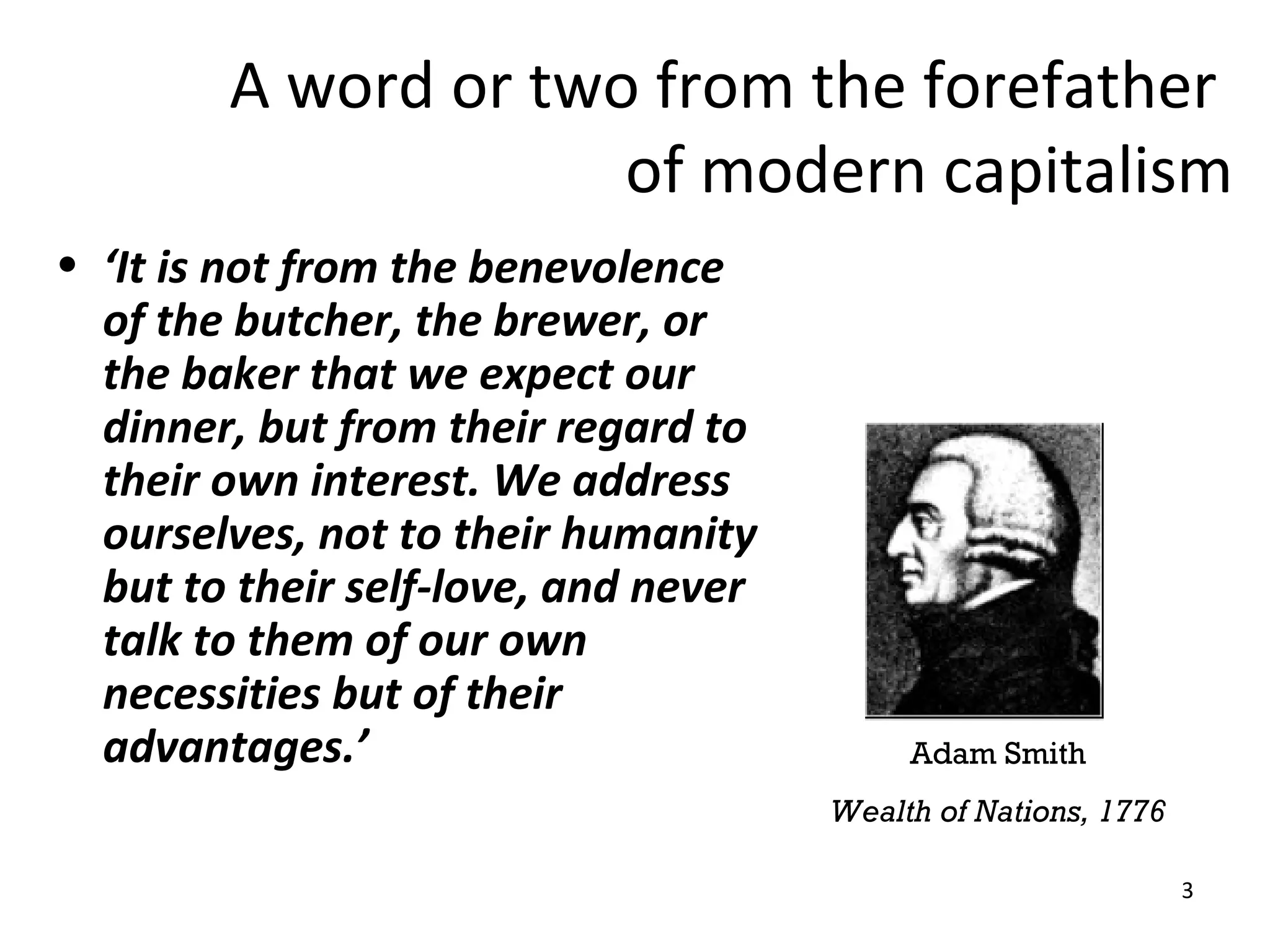
• ‘It is not from the benevolence
  of the butcher, the brewer, or
  the baker that we expect our
  dinner, but from their regard to
  their own interest. We address
  ourselves, not to their humanity
  but to their self-love, and never
  talk to them of our own
  necessities but of their
  advantages.’                             Adam Smith
                                      Wealth of Nations, 1776

                                                                3
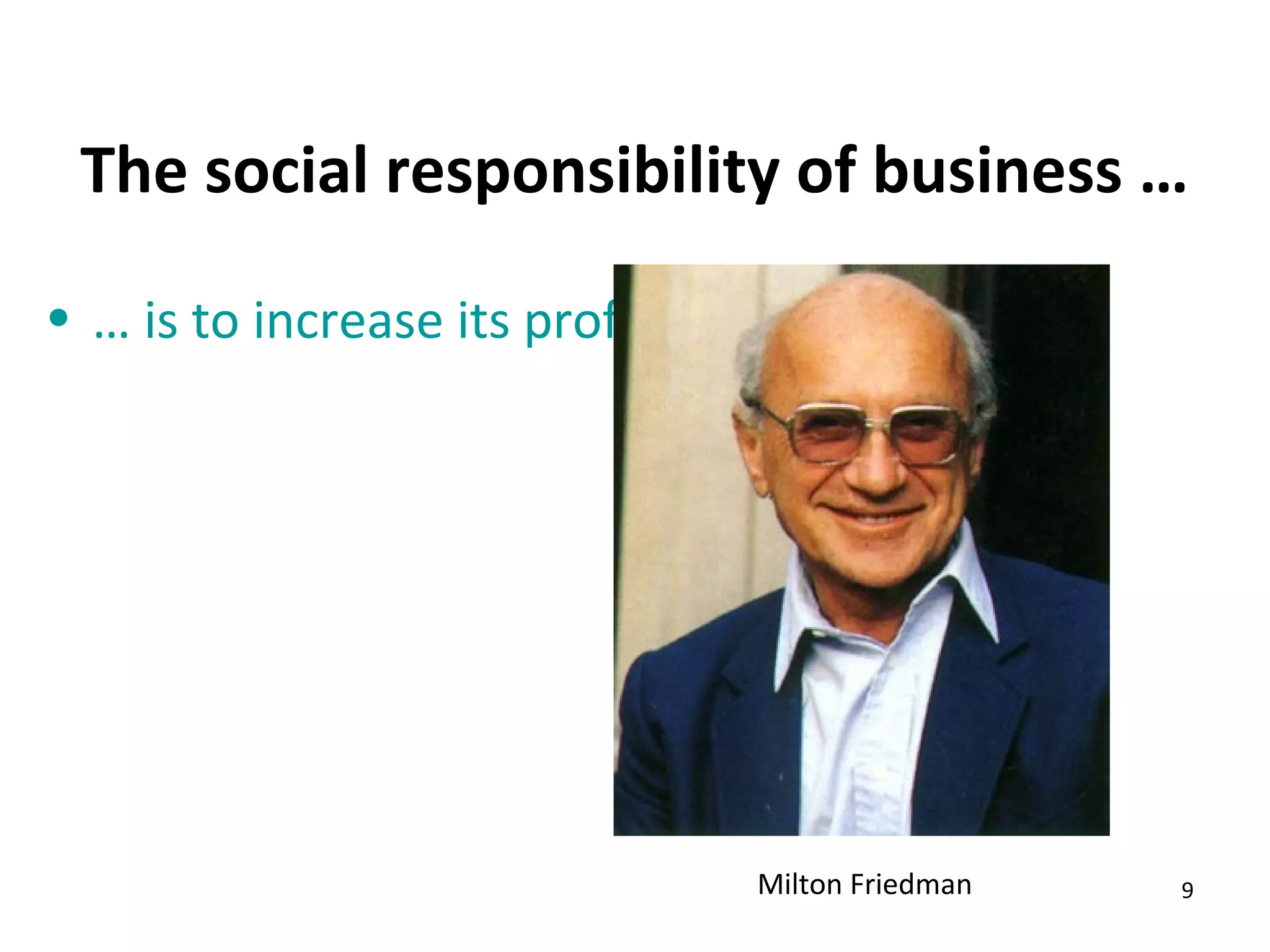
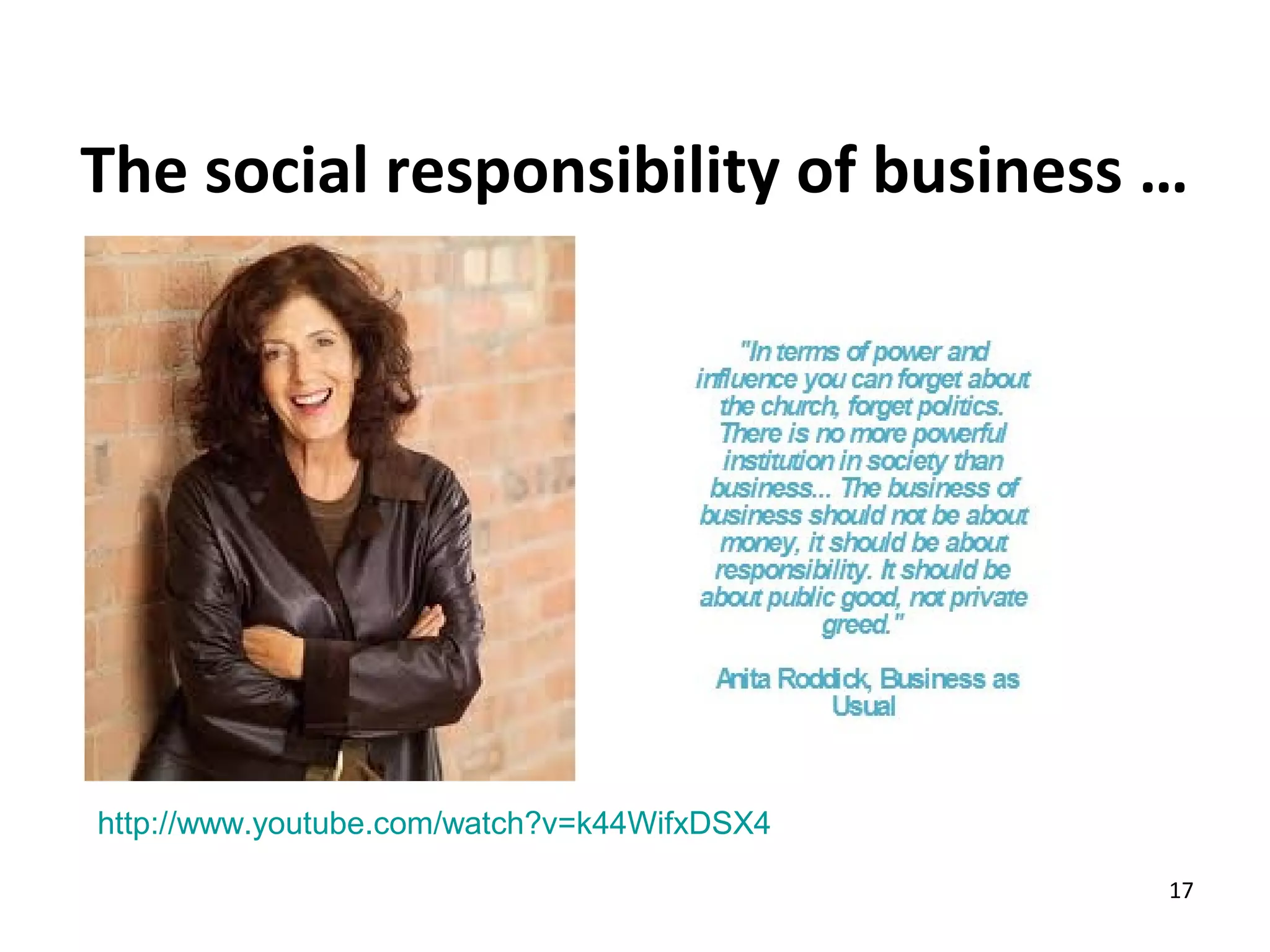
The social responsibility of business …

• … is to increase its profits


                                 Milton Friedman   9
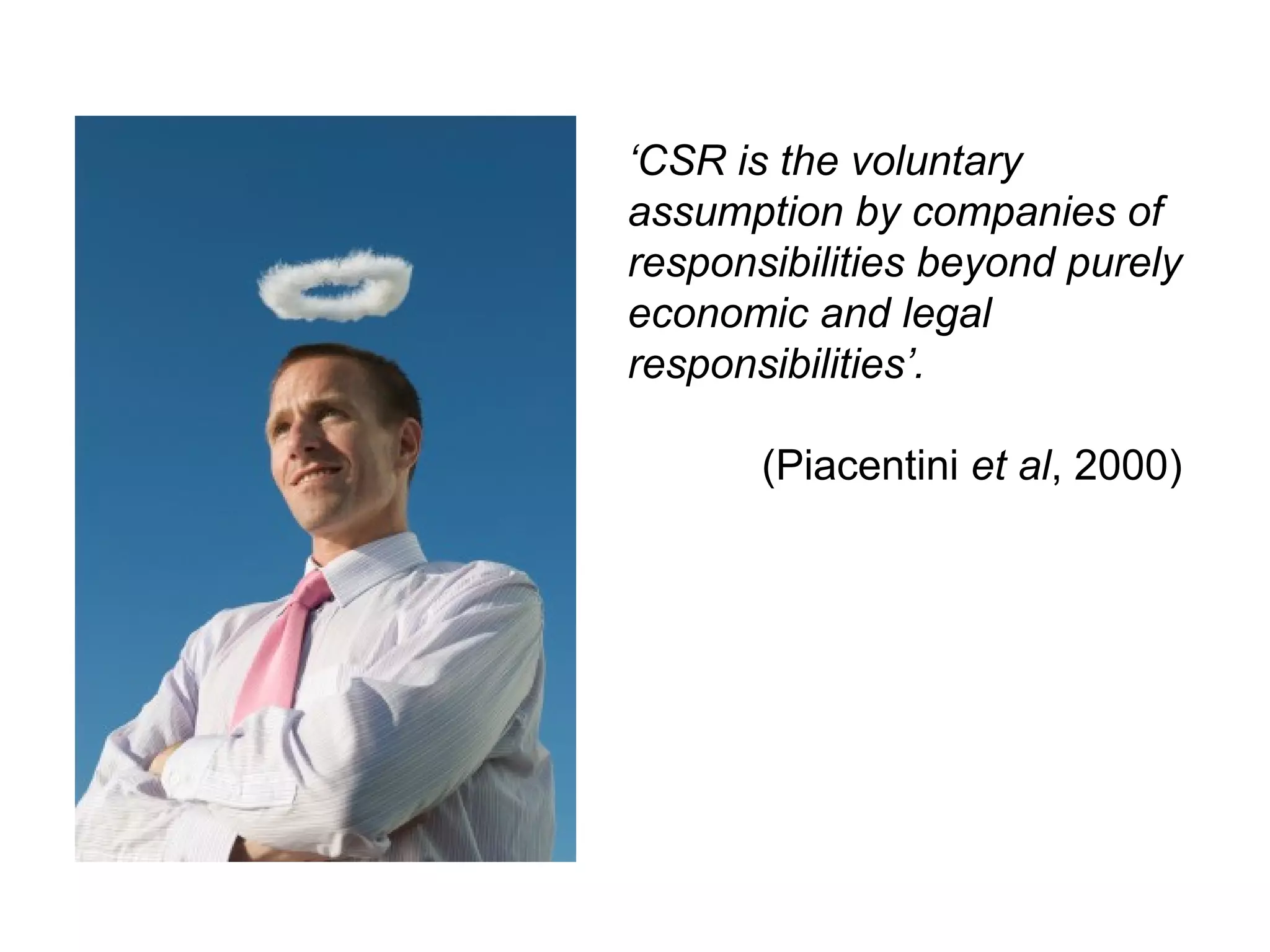
‘CSR is the voluntary
assumption by companies of
responsibilities beyond purely
economic and legal
responsibilities’.

       (Piacentini et al, 2000)
• ‘Corporate social responsibility can be
  defined as a principle stating that
  corporations should be accountable for
  the effects of any of their actions on their
  community and environment’.

                        (Frederick et al, 1992)
• ‘Corporate social responsibility is
  achieving commercial success in ways
  that honour ethical values and respect
  people, communities and the natural
  environment’.

   (Business for Social Responsibility, 2003)
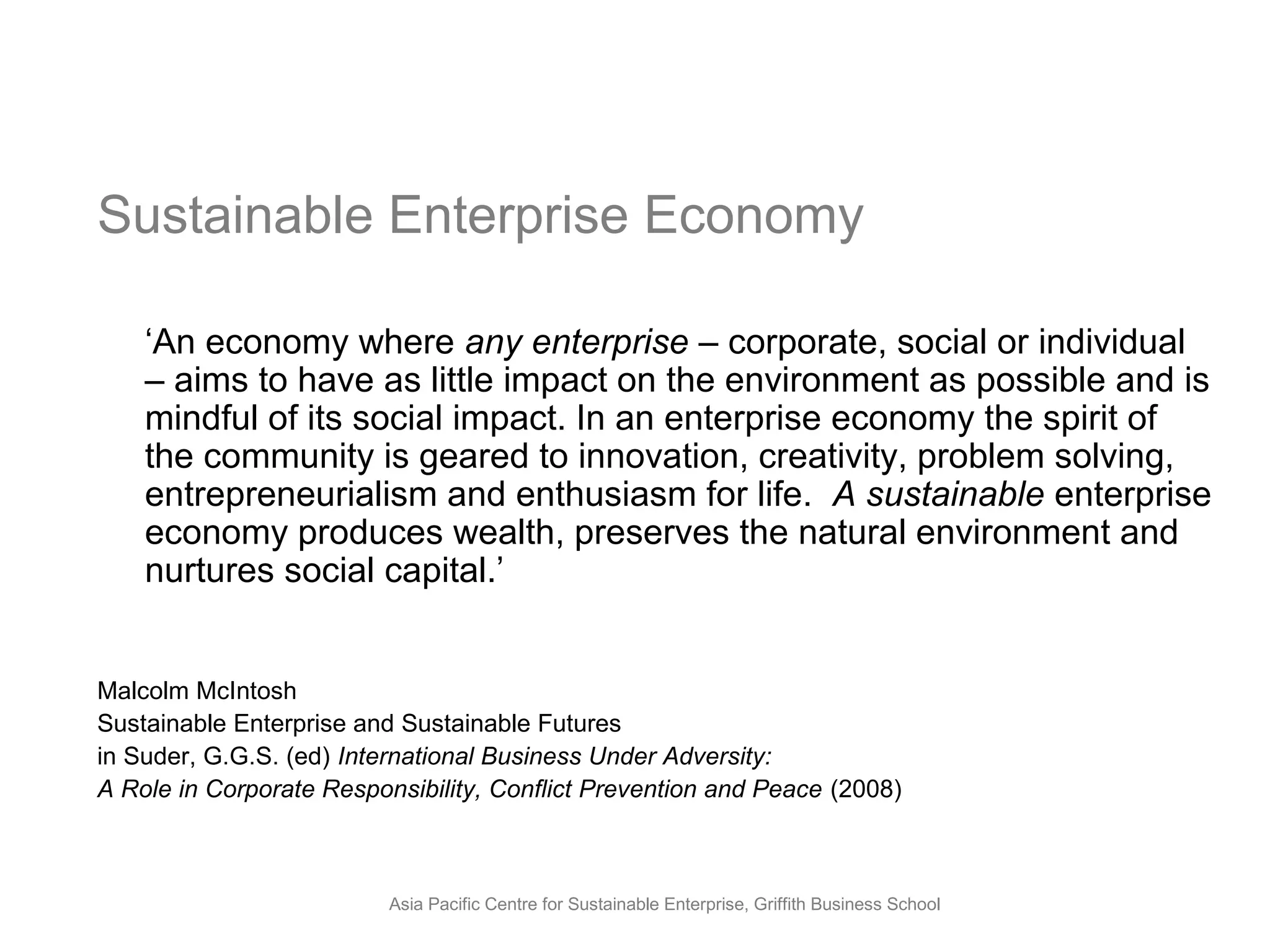
Sustainable Enterprise Economy

    ‘An economy where any enterprise – corporate, social or individual
    – aims to have as little impact on the environment as possible and is
    mindful of its social impact. In an enterprise economy the spirit of
    the community is geared to innovation, creativity, problem solving,
    entrepreneurialism and enthusiasm for life. A sustainable enterprise
    economy produces wealth, preserves the natural environment and
    nurtures social capital.’


Malcolm McIntosh
Sustainable Enterprise and Sustainable Futures
in Suder, G.G.S. (ed) International Business Under Adversity:
A Role in Corporate Responsibility, Conflict Prevention and Peace (2008)


                          Asia Pacific Centre for Sustainable Enterprise, Griffith Business School
The social responsibility of business …


http://www.youtube.com/watch?v=k44WifxDSX4

                                             17
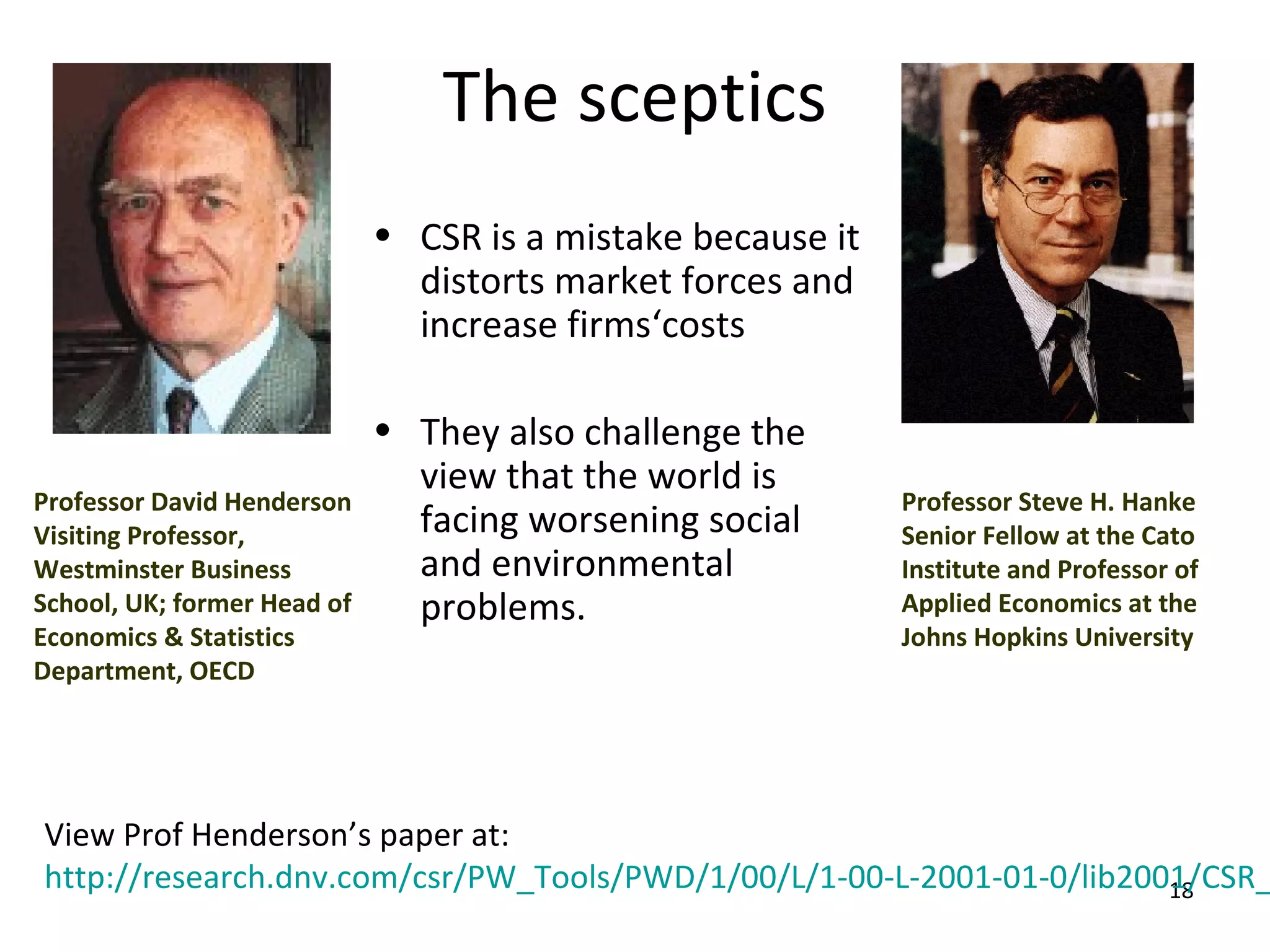
The sceptics
                             • CSR is a mistake because it
                               distorts market forces and
                               increase firms‘costs

                             • They also challenge the
                               view that the world is
Professor David Henderson                                    Professor Steve H. Hanke
Visiting Professor,            facing worsening social       Senior Fellow at the Cato
Westminster Business           and environmental             Institute and Professor of
School, UK; former Head of     problems.                     Applied Economics at the
Economics & Statistics                                       Johns Hopkins University
Department, OECD


View Prof Henderson’s paper at:
http://research.dnv.com/csr/PW_Tools/PWD/1/00/L/1-00-L-2001-01-0/lib2001/CSR_
                                                                       18
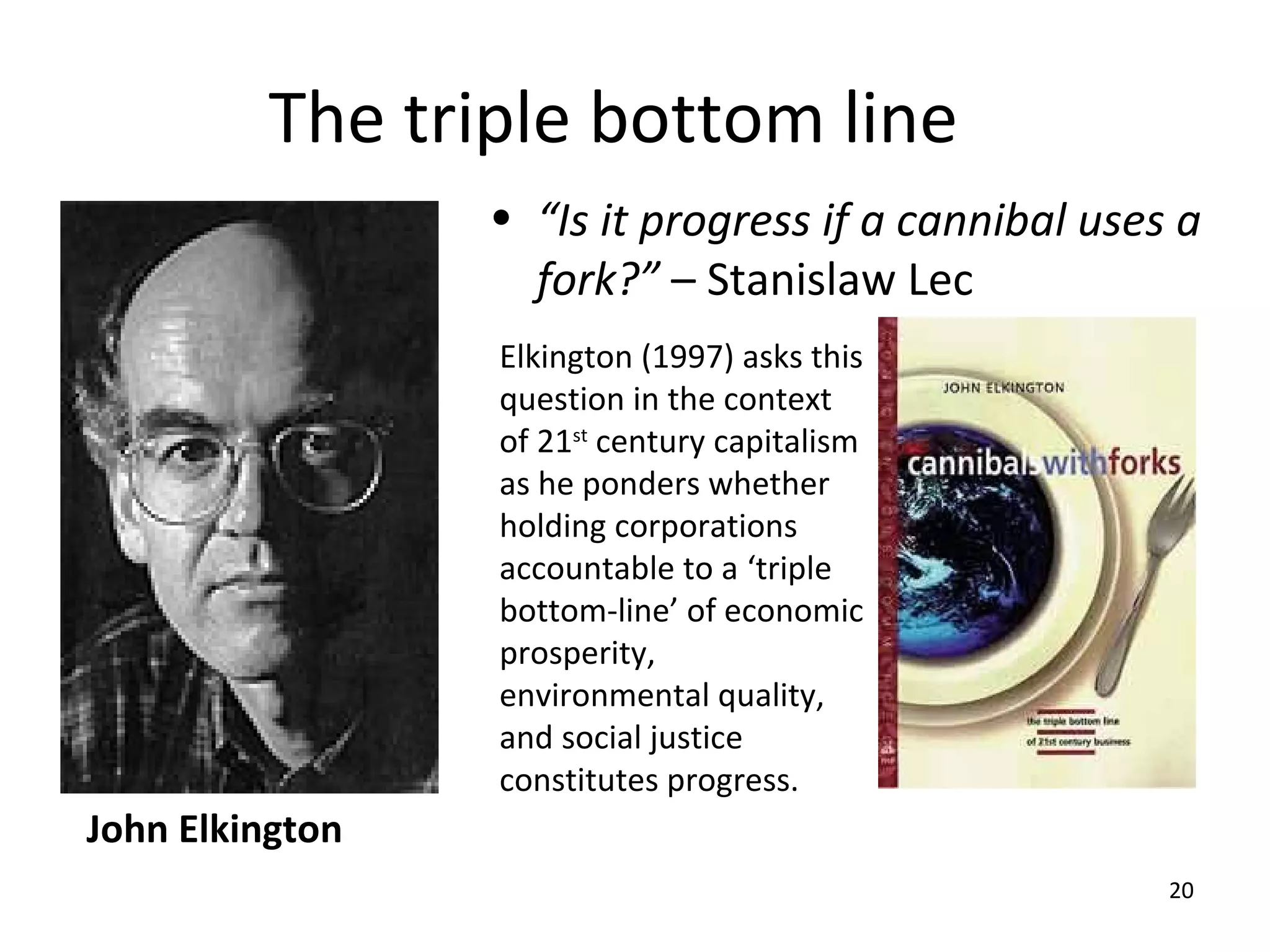
The triple bottom line
                 • “Is it progress if a cannibal uses a
                   fork?” – Stanislaw Lec
                 Elkington (1997) asks this
                 question in the context
                 of 21st century capitalism
                 as he ponders whether
                 holding corporations
                 accountable to a ‘triple
                 bottom-line’ of economic
                 prosperity,
                 environmental quality,
                 and social justice
                 constitutes progress.
John Elkington
                                                     20
Transparency, accountability, reporting

• In practical terms, corporate accountability now amounts
  to more than maximising shareholder profit

• For proactive and successful companies, it is about
  maximising stakeholder value – a different goal with a
  broader set of beneficiaries

• Inevitably, this involves the recognition of a triple bottom
  line that focuses on people and the planet as well as
  profit.

                                                                 21
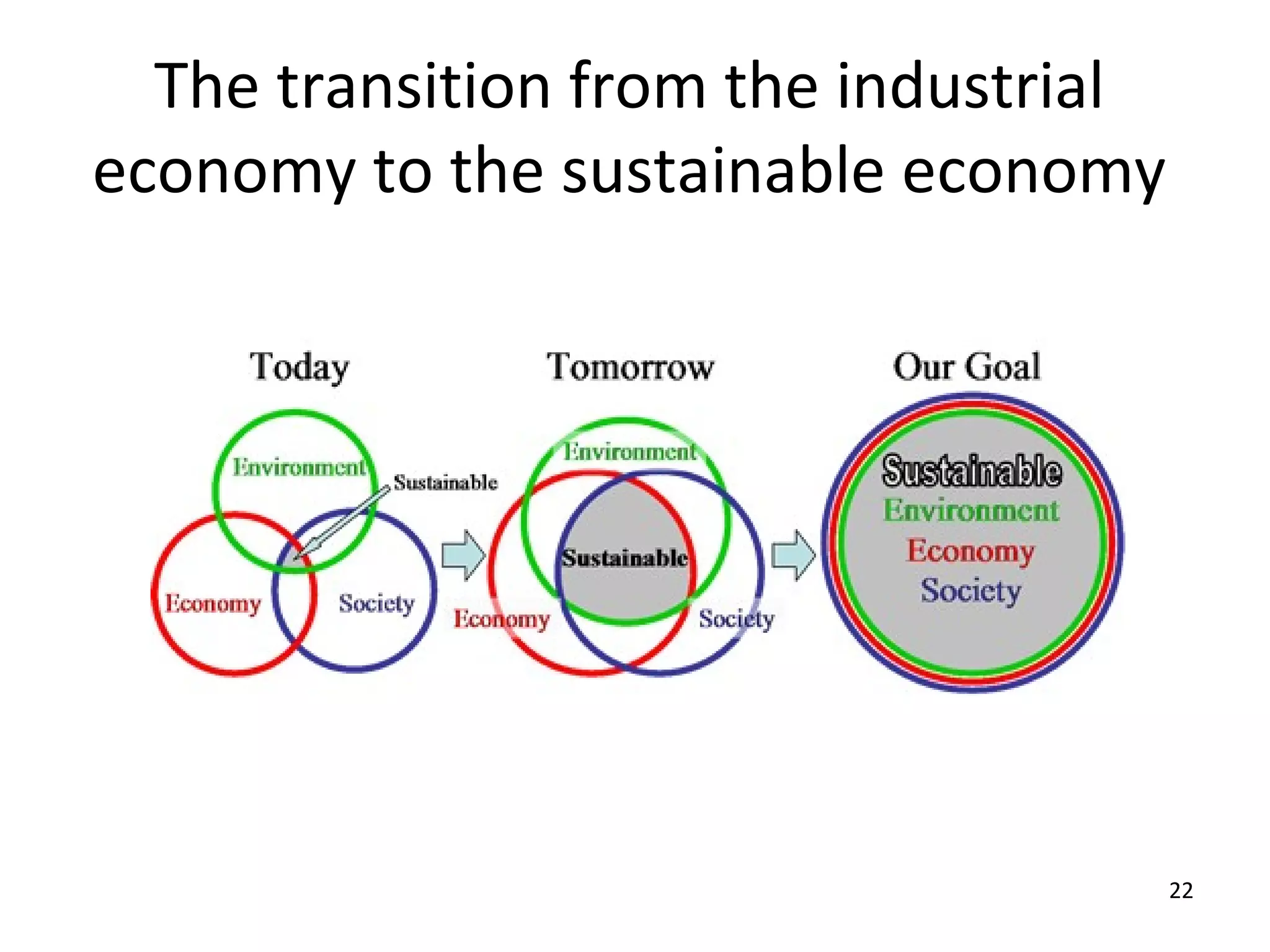
The transition from the industrial
economy to the sustainable economy


                                       22
‘Responsible’ business?
• BP and Shell issue CSR reports, but oil is to remain dominant
  source of energy through to 2050

• BAE has announced it has a new range of environment-
  friendly weapons, including ‘lead free’ bullets, rockets with
  reduced toxins and grenades that produce less smoke

• BAT issues a Sustainability Report, but still contributes to the
  premature death of millions of people


                                                                     25
The Four Basic Principles of Corporate Citizenship

Organisations should be able to:

1. Articulate their role, scope and purpose;

2. Understand their social and environmental impact
as well as their financial performance;

3. Be transparent and accountable;

4. Be in compliance.

Corporate Citizenship (1998 & 2003) McIntosh et al.
‘Corporate citizenship, like individual citizenship, is
an idea which has both practical and ethical
dimensions. A key feature of citizenship is that it
involves a mutually reinforcing relationship between
individuals and communities’.

Corporate Citizenship
McIntosh, Leipziger, Jones and Coleman (1998)
‘Citizenship is defined as the rights and duties of a
member of a country. Companies, as independent
legal entities, are members of countries and can be
thought of corporate citizens with legal rights and
duties. All companies, therefore, are corporate
citizens, but their citizenship performance varies just
as it does for an individual citizen. But citizenship is
more than a legal term, it is a political term – ‘active
commitment, responsibility, making a difference’
(Drucker 1993).

Perspectives on Corporate Citizenship
Andriof and McIntosh (2001)
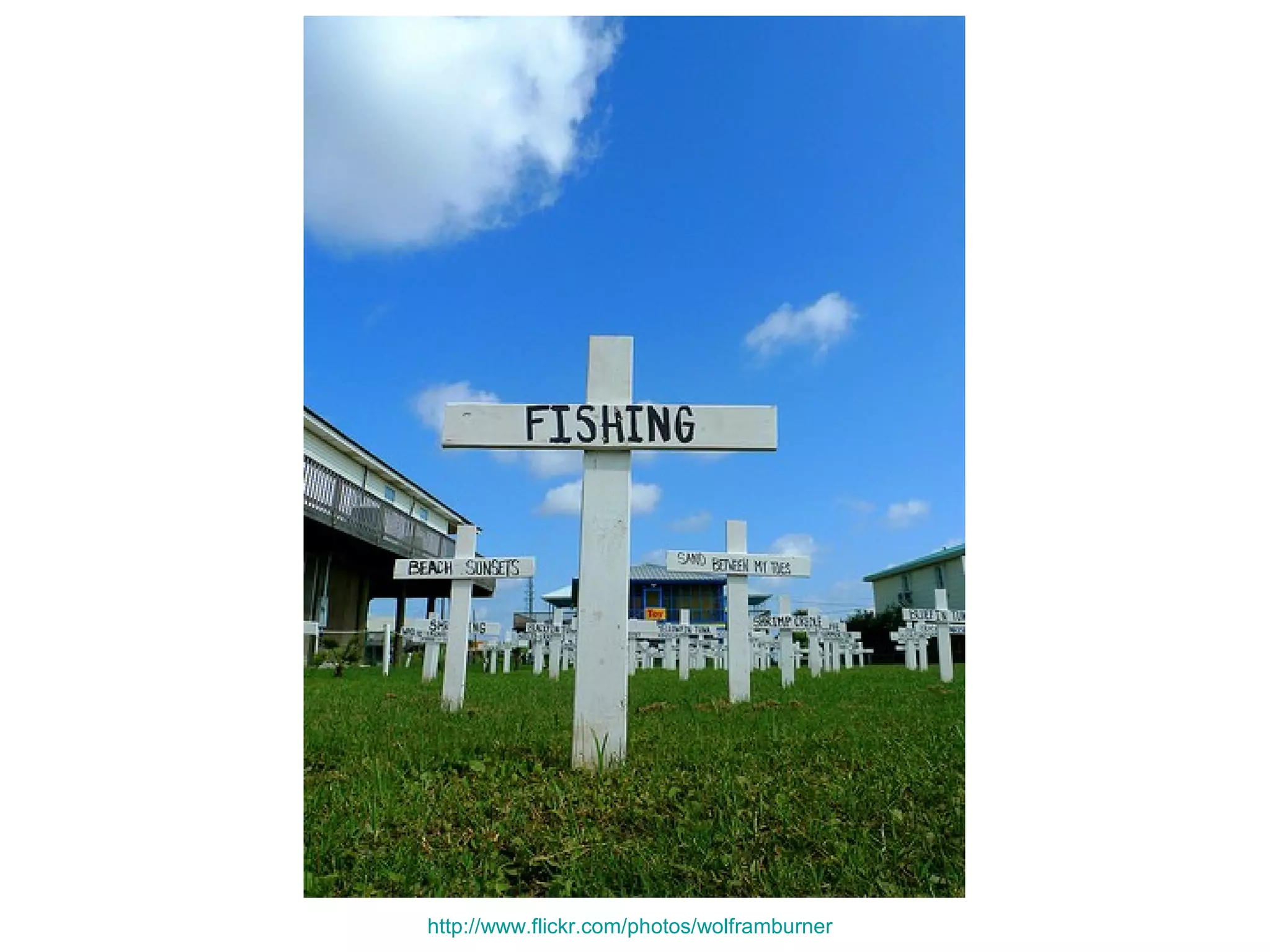
http://www.flickr.com/photos/wolframburner
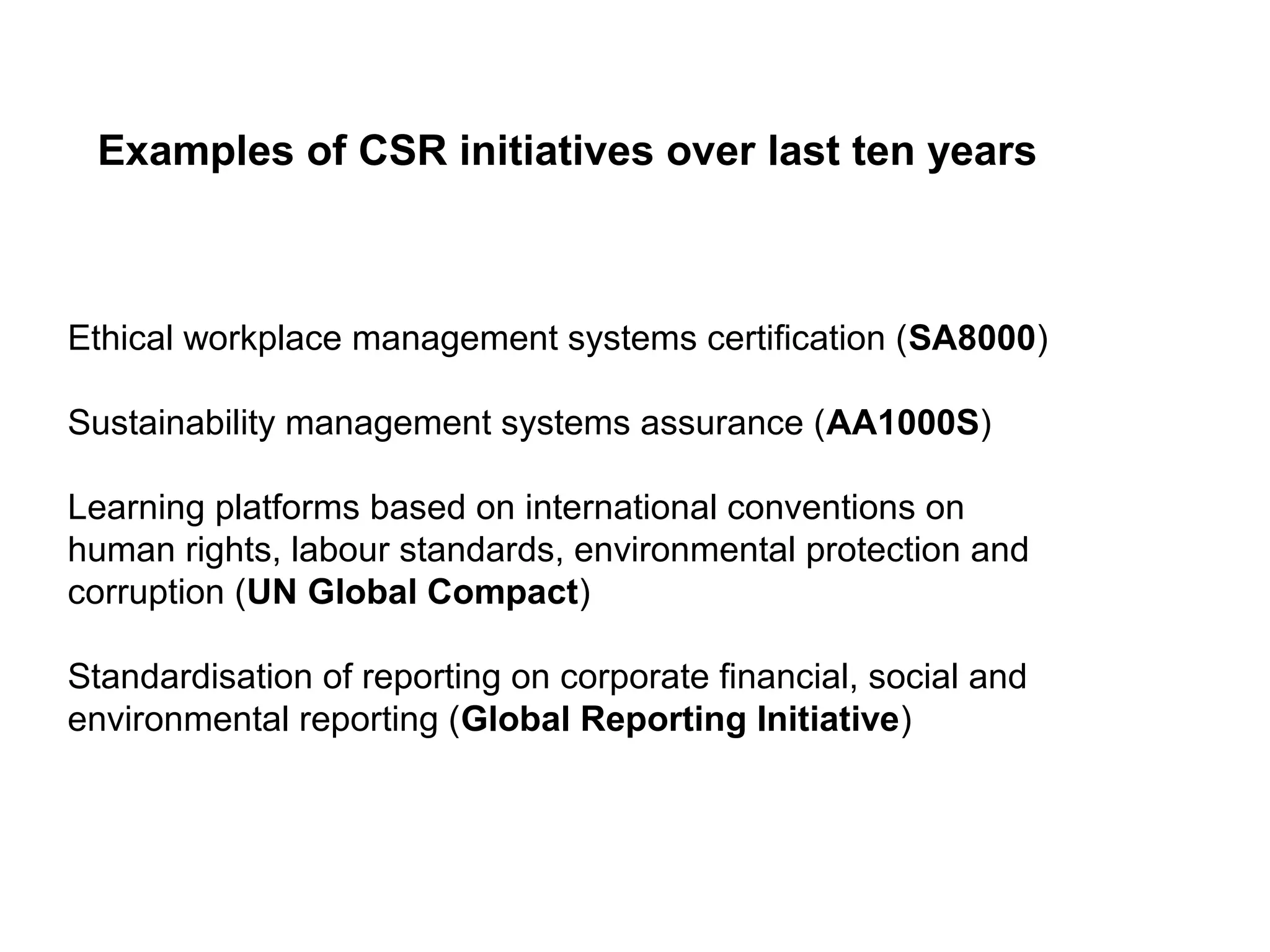
Examples of CSR initiatives over last ten years


Ethical workplace management systems certification (SA8000)

Sustainability management systems assurance (AA1000S)

Learning platforms based on international conventions on
human rights, labour standards, environmental protection and
corruption (UN Global Compact)

Standardisation of reporting on corporate financial, social and
environmental reporting (Global Reporting Initiative)
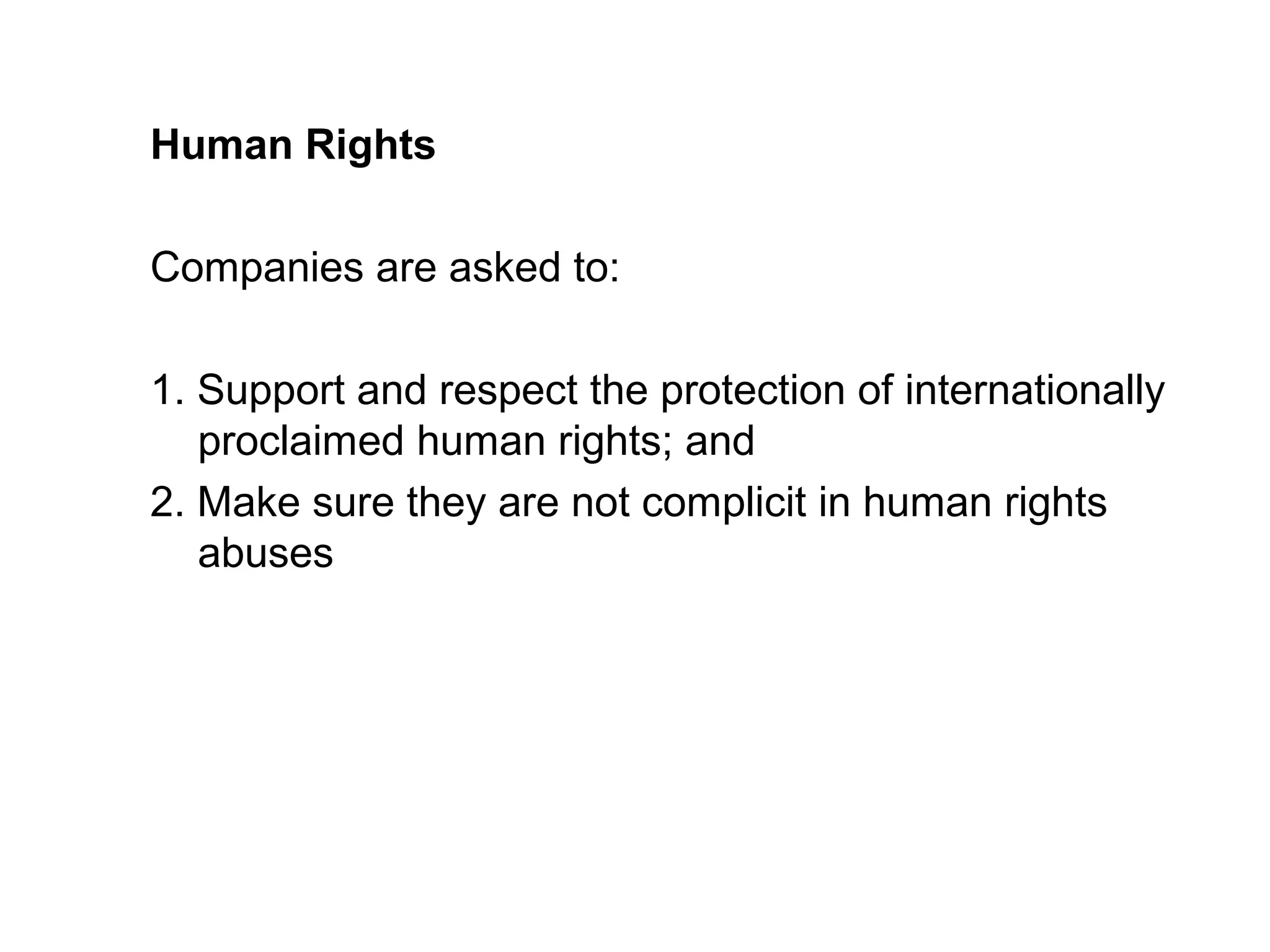
The UN Global Compact
            www.unglobalcompact.org.au

  The Global Compact asks companies to embrace,
support and enact, within their sphere of influence, a set
  of core values in the areas of human rights, labour
    standards, the environment, and anti-corruption
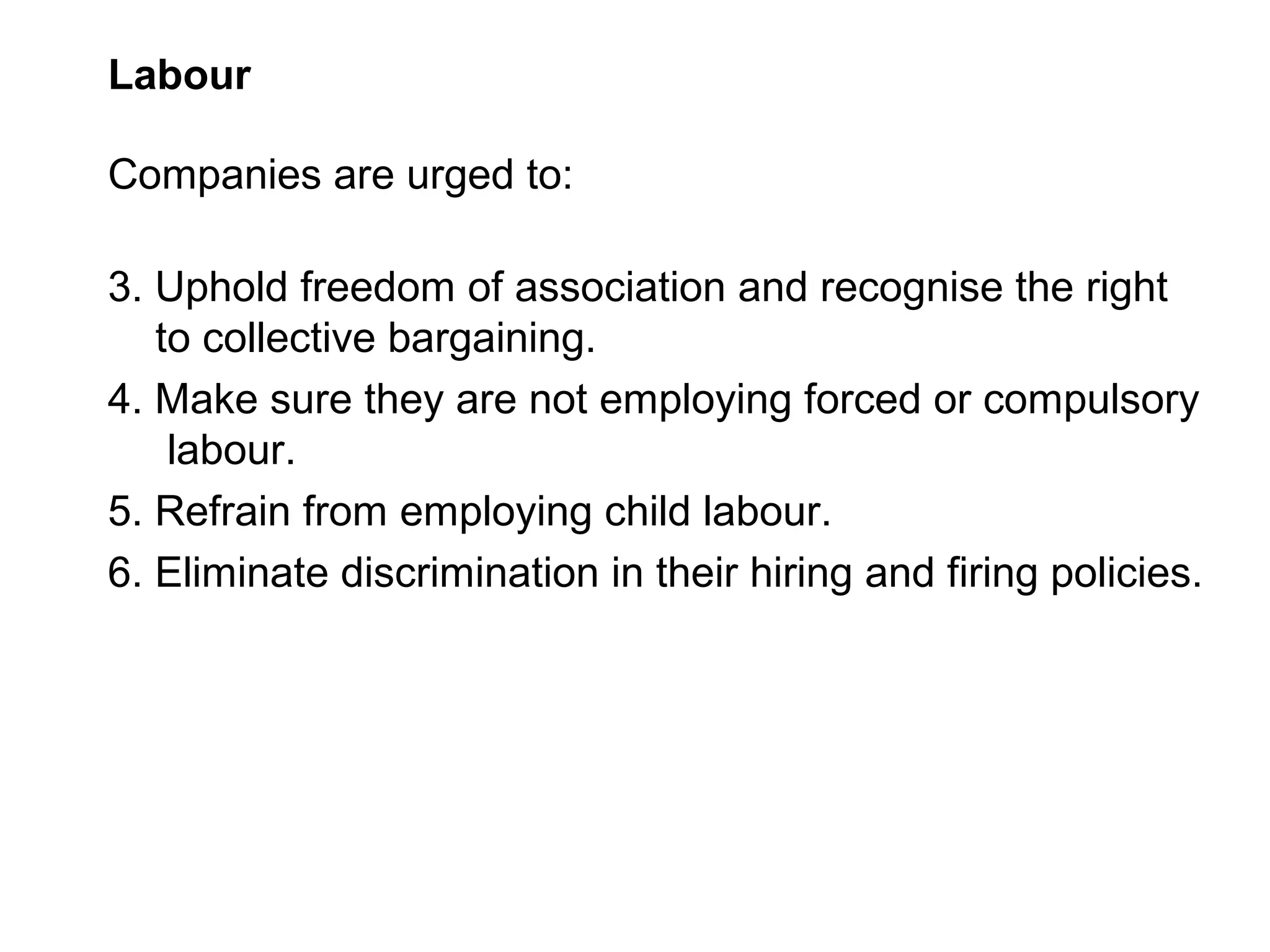
Human Rights

Companies are asked to:

1. Support and respect the protection of internationally
   proclaimed human rights; and
2. Make sure they are not complicit in human rights
   abuses
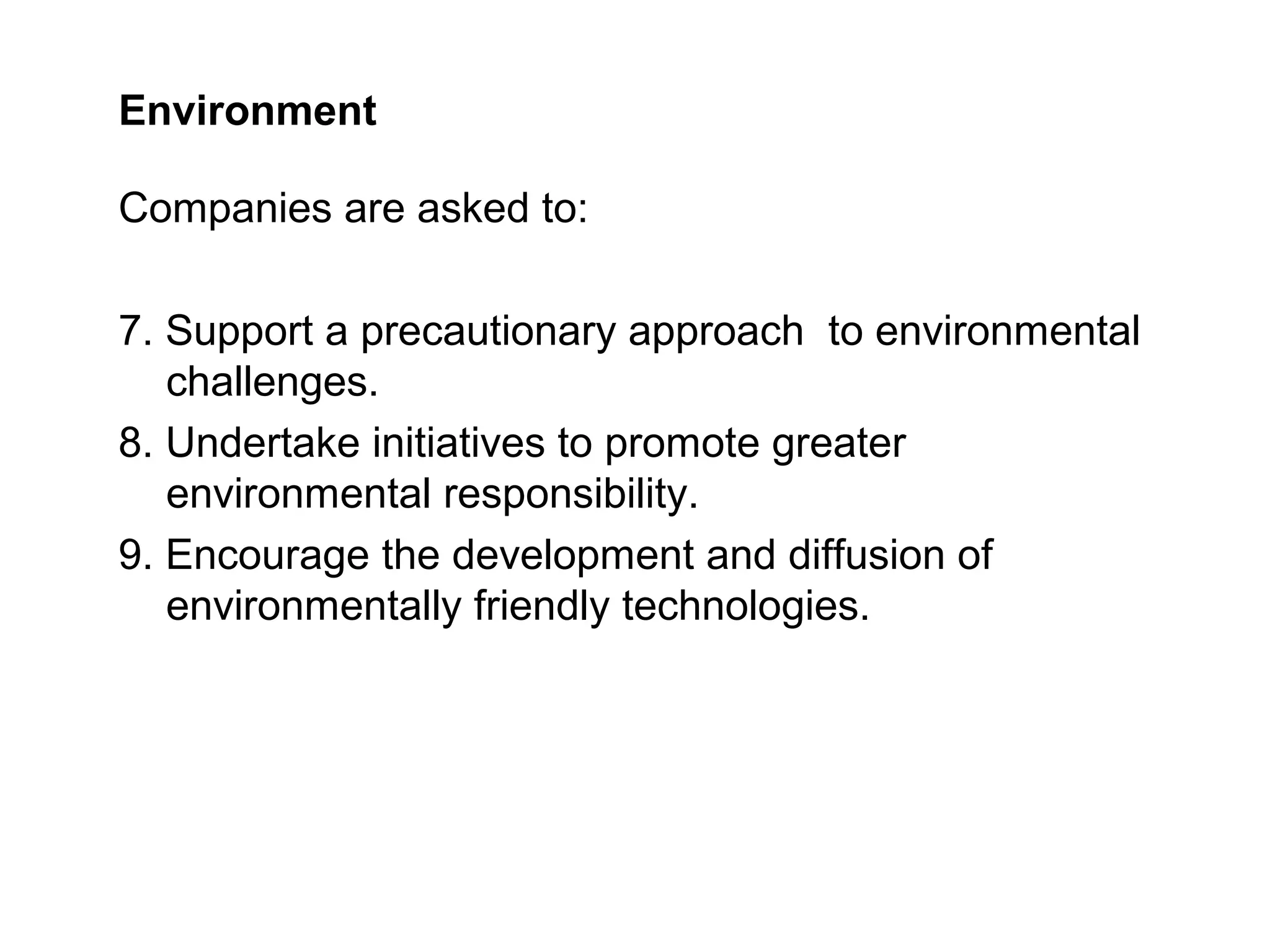
Labour

Companies are urged to:

3. Uphold freedom of association and recognise the right
   to collective bargaining.
4. Make sure they are not employing forced or compulsory
    labour.
5. Refrain from employing child labour.
6. Eliminate discrimination in their hiring and firing policies.
Environment

Companies are asked to:

7. Support a precautionary approach to environmental
   challenges.
8. Undertake initiatives to promote greater
   environmental responsibility.
9. Encourage the development and diffusion of
   environmentally friendly technologies.
Anti-Corruption

10. Businesses should work against all forms of
  corruption, including extortion and bribery.
The Global Compact’s ten principles in the areas of
human rights, labour, the environment and anti-
corruption enjoy universal consensus and are derived
from:

The Universal Declaration of Human Rights

The International Labour Organization's Declaration on Fundam


The Rio Declaration on Environment and Development

The United Nations Convention Against Corruption
‘The Global Compact has explicitly adopted a learning
 approach to inducing corporate change, as opposed
 to a regulatory approach; and it comprises a network
   form of organization, as opposed to the traditional
             hierarchic/ bureaucratic form’.


           John Ruggie - UN & Harvard (2000)
• The leader in the quest to develop internationally
  accepted standards for triple bottom line reporting is the
  Global Reporting Initiative (GRI)
  http://www.globalreporting.org/

• 1st draft of reporting guidelines (G1) was piloted by 21
  companies during 1999-2000; 2nd version of the
  guidelines (G2) was released in 2002; Version 3 (G3) came
  out in 2006

• Since this time, more than 1500 companies worldwide
  have used the guidelines, making it the de facto global
  standard for reporting
                                                               41
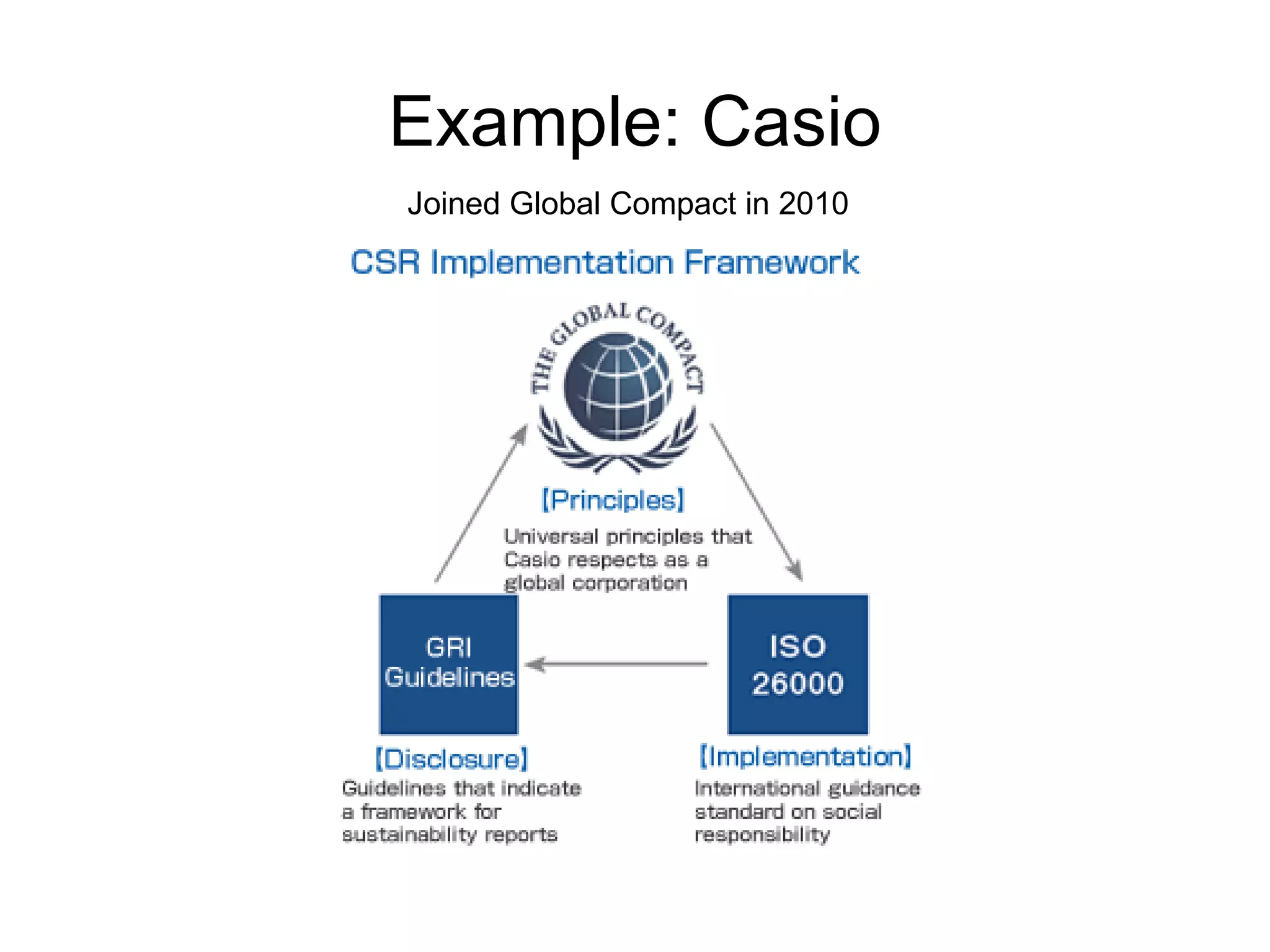
Example: Casio
Joined Global Compact in 2010
Case Study:

“The good, the bad, and the ugly”


                                    43
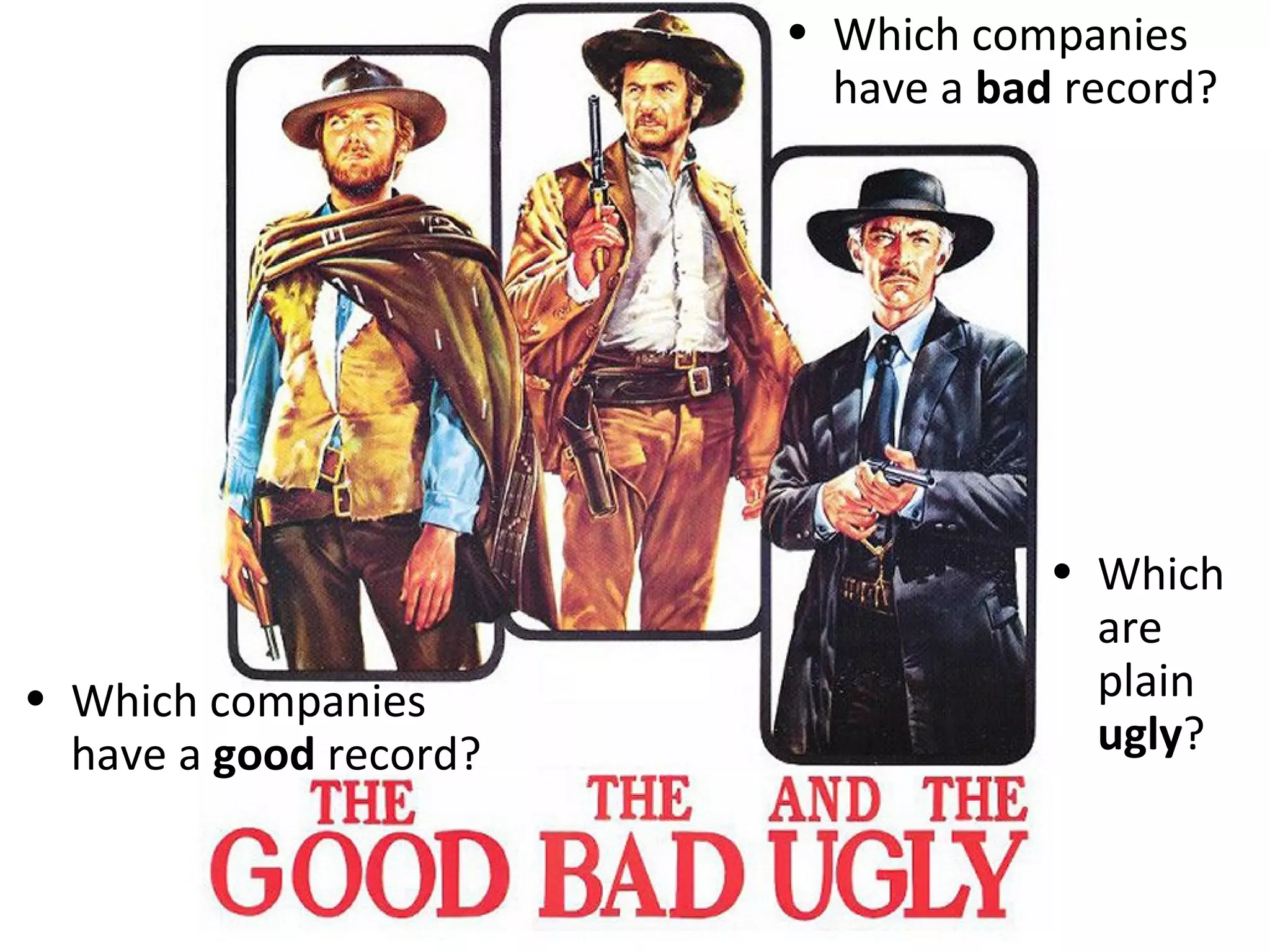
• Which companies
                          have a bad record?


                                    • Which
                                      are
• Which companies                     plain
  have a good record?                 ugly?


                                         44
Consider, the evolution of CSR
• A company that views CSR to be of key strategic
  importance

• A company that had reputational problems is trying to
  rehabilitate itself

• A company that has little or no interest in CSR


                                                          45
Some discussion points …
• The affordability of CSR in a highly competitive environment

• Can companies afford not to commit to CSR?

• Is there ‘good CSR’ and ‘bad CSR’?

• Is the sustainable enterprise a special case?


                                                             46
Prepare a 10 minute presentation
providing an example (and critique) of each


       Go ahead…
        make my
          day!


                                          47

The Responsibility of Business

  • 1.
    Managing Sustainable Enterprise GCSE 7508 Griffith Business School Asia Pacific Centre for Sustainable Enterprise January 2013 Jeremy Williams jeremy.williams@griffith.edu.au @jeremybwilliams @TheGreenMBA facebook.com/profjeremybwilliams jeremybwilliams.net
  • 2.
  • 3.
    A word ortwo from the forefather of modern capitalism • ‘It is not from the benevolence of the butcher, the brewer, or the baker that we expect our dinner, but from their regard to their own interest. We address ourselves, not to their humanity but to their self-love, and never talk to them of our own necessities but of their advantages.’ Adam Smith Wealth of Nations, 1776 3
  • 9.
    The social responsibilityof business … • … is to increase its profits Milton Friedman 9
  • 10.
    ‘CSR is thevoluntary assumption by companies of responsibilities beyond purely economic and legal responsibilities’. (Piacentini et al, 2000)
  • 11.
    • ‘Corporate socialresponsibility can be defined as a principle stating that corporations should be accountable for the effects of any of their actions on their community and environment’. (Frederick et al, 1992)
  • 12.
    • ‘Corporate socialresponsibility is achieving commercial success in ways that honour ethical values and respect people, communities and the natural environment’. (Business for Social Responsibility, 2003)
  • 15.
    Sustainable Enterprise Economy ‘An economy where any enterprise – corporate, social or individual – aims to have as little impact on the environment as possible and is mindful of its social impact. In an enterprise economy the spirit of the community is geared to innovation, creativity, problem solving, entrepreneurialism and enthusiasm for life. A sustainable enterprise economy produces wealth, preserves the natural environment and nurtures social capital.’ Malcolm McIntosh Sustainable Enterprise and Sustainable Futures in Suder, G.G.S. (ed) International Business Under Adversity: A Role in Corporate Responsibility, Conflict Prevention and Peace (2008) Asia Pacific Centre for Sustainable Enterprise, Griffith Business School
  • 17.
    The social responsibilityof business … http://www.youtube.com/watch?v=k44WifxDSX4 17
  • 18.
    The sceptics • CSR is a mistake because it distorts market forces and increase firms‘costs • They also challenge the view that the world is Professor David Henderson Professor Steve H. Hanke Visiting Professor, facing worsening social Senior Fellow at the Cato Westminster Business and environmental Institute and Professor of School, UK; former Head of problems. Applied Economics at the Economics & Statistics Johns Hopkins University Department, OECD View Prof Henderson’s paper at: http://research.dnv.com/csr/PW_Tools/PWD/1/00/L/1-00-L-2001-01-0/lib2001/CSR_ 18
  • 20.
    The triple bottomline • “Is it progress if a cannibal uses a fork?” – Stanislaw Lec Elkington (1997) asks this question in the context of 21st century capitalism as he ponders whether holding corporations accountable to a ‘triple bottom-line’ of economic prosperity, environmental quality, and social justice constitutes progress. John Elkington 20
  • 21.
    Transparency, accountability, reporting •In practical terms, corporate accountability now amounts to more than maximising shareholder profit • For proactive and successful companies, it is about maximising stakeholder value – a different goal with a broader set of beneficiaries • Inevitably, this involves the recognition of a triple bottom line that focuses on people and the planet as well as profit. 21
  • 22.
    The transition fromthe industrial economy to the sustainable economy 22
  • 25.
    ‘Responsible’ business? • BPand Shell issue CSR reports, but oil is to remain dominant source of energy through to 2050 • BAE has announced it has a new range of environment- friendly weapons, including ‘lead free’ bullets, rockets with reduced toxins and grenades that produce less smoke • BAT issues a Sustainability Report, but still contributes to the premature death of millions of people 25
  • 27.
    The Four BasicPrinciples of Corporate Citizenship Organisations should be able to: 1. Articulate their role, scope and purpose; 2. Understand their social and environmental impact as well as their financial performance; 3. Be transparent and accountable; 4. Be in compliance. Corporate Citizenship (1998 & 2003) McIntosh et al.
  • 28.
    ‘Corporate citizenship, likeindividual citizenship, is an idea which has both practical and ethical dimensions. A key feature of citizenship is that it involves a mutually reinforcing relationship between individuals and communities’. Corporate Citizenship McIntosh, Leipziger, Jones and Coleman (1998)
  • 29.
    ‘Citizenship is definedas the rights and duties of a member of a country. Companies, as independent legal entities, are members of countries and can be thought of corporate citizens with legal rights and duties. All companies, therefore, are corporate citizens, but their citizenship performance varies just as it does for an individual citizen. But citizenship is more than a legal term, it is a political term – ‘active commitment, responsibility, making a difference’ (Drucker 1993). Perspectives on Corporate Citizenship Andriof and McIntosh (2001)
  • 30.
  • 31.
  • 33.
    Examples of CSRinitiatives over last ten years Ethical workplace management systems certification (SA8000) Sustainability management systems assurance (AA1000S) Learning platforms based on international conventions on human rights, labour standards, environmental protection and corruption (UN Global Compact) Standardisation of reporting on corporate financial, social and environmental reporting (Global Reporting Initiative)
  • 34.
    The UN GlobalCompact www.unglobalcompact.org.au The Global Compact asks companies to embrace, support and enact, within their sphere of influence, a set of core values in the areas of human rights, labour standards, the environment, and anti-corruption
  • 35.
    Human Rights Companies areasked to: 1. Support and respect the protection of internationally proclaimed human rights; and 2. Make sure they are not complicit in human rights abuses
  • 36.
    Labour Companies are urgedto: 3. Uphold freedom of association and recognise the right to collective bargaining. 4. Make sure they are not employing forced or compulsory labour. 5. Refrain from employing child labour. 6. Eliminate discrimination in their hiring and firing policies.
  • 37.
    Environment Companies are askedto: 7. Support a precautionary approach to environmental challenges. 8. Undertake initiatives to promote greater environmental responsibility. 9. Encourage the development and diffusion of environmentally friendly technologies.
  • 38.
    Anti-Corruption 10. Businesses shouldwork against all forms of corruption, including extortion and bribery.
  • 39.
    The Global Compact’sten principles in the areas of human rights, labour, the environment and anti- corruption enjoy universal consensus and are derived from: The Universal Declaration of Human Rights The International Labour Organization's Declaration on Fundam The Rio Declaration on Environment and Development The United Nations Convention Against Corruption
  • 40.
    ‘The Global Compacthas explicitly adopted a learning approach to inducing corporate change, as opposed to a regulatory approach; and it comprises a network form of organization, as opposed to the traditional hierarchic/ bureaucratic form’. John Ruggie - UN & Harvard (2000)
  • 41.
    • The leaderin the quest to develop internationally accepted standards for triple bottom line reporting is the Global Reporting Initiative (GRI) http://www.globalreporting.org/ • 1st draft of reporting guidelines (G1) was piloted by 21 companies during 1999-2000; 2nd version of the guidelines (G2) was released in 2002; Version 3 (G3) came out in 2006 • Since this time, more than 1500 companies worldwide have used the guidelines, making it the de facto global standard for reporting 41
  • 42.
  • 43.
    Case Study: “The good,the bad, and the ugly” 43
  • 44.
    • Which companies have a bad record? • Which are • Which companies plain have a good record? ugly? 44
  • 45.
    Consider, the evolutionof CSR • A company that views CSR to be of key strategic importance • A company that had reputational problems is trying to rehabilitate itself • A company that has little or no interest in CSR 45
  • 46.
    Some discussion points… • The affordability of CSR in a highly competitive environment • Can companies afford not to commit to CSR? • Is there ‘good CSR’ and ‘bad CSR’? • Is the sustainable enterprise a special case? 46
  • 47.
    Prepare a 10minute presentation providing an example (and critique) of each Go ahead… make my day! 47

Editor's Notes

  • #11 http://www.causecast.com/blog/bid/211476/Got-Corporate-Philanthropy-A-Comprehensive-Definition
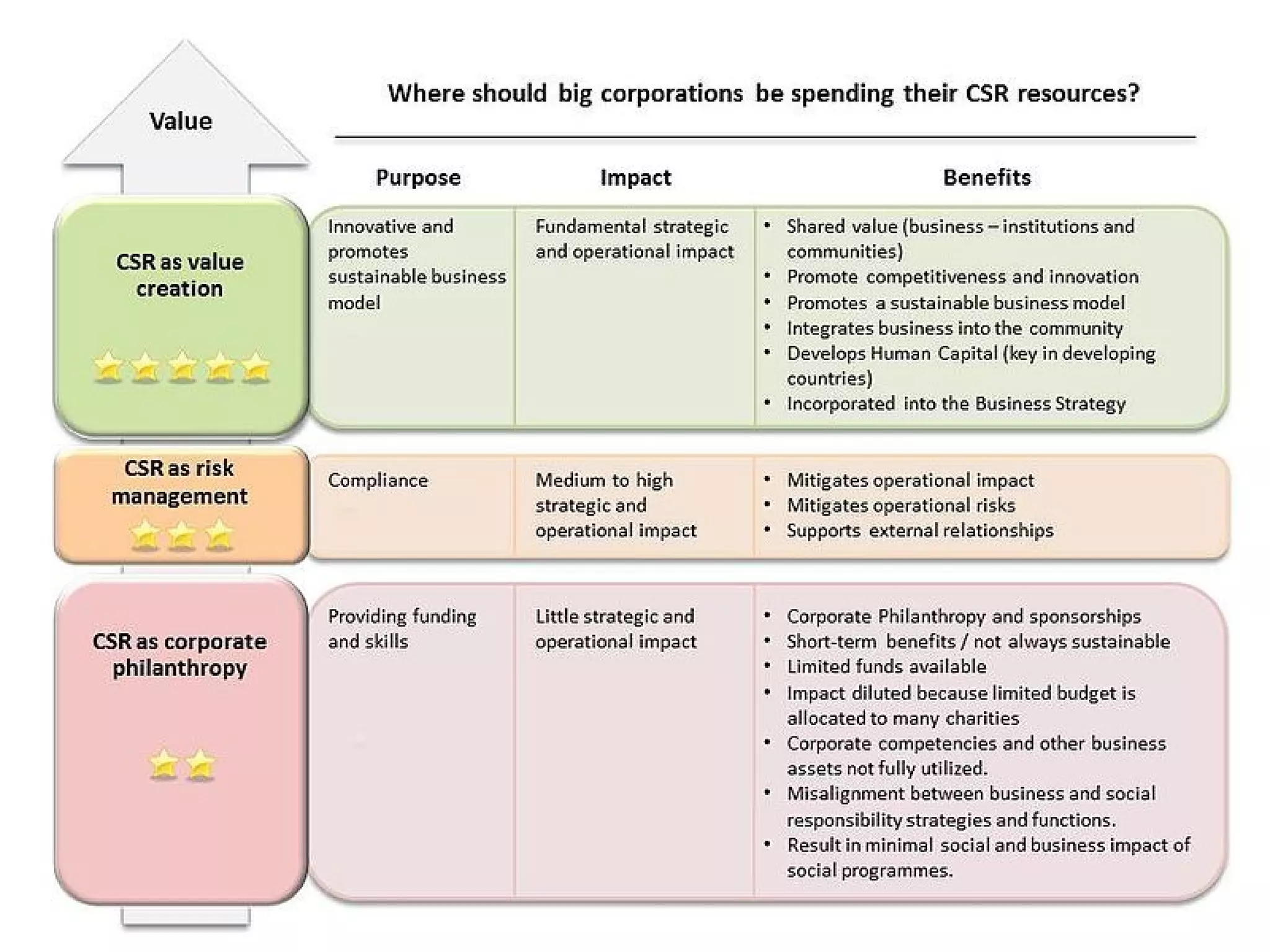
  • #17 http://en.wikipedia.org/wiki/File:CSR_framework_-_value1.jpg
  • #19 http://www.companydirectors.com.au/conference/0cont/b/gl/henderson.html http://www.jhu.edu/news_info/news/faculty/images/hanke.gif
  • #21 Stanislaw Lec – Polish poet Teaching the corporate cannibals how to use the three-pronged fork of sustainability (economic progress, environmental quality, social equity) is progress, but one cannot be truly confident unless the cannibal signs up for ‘cannibalism-anonymous’!
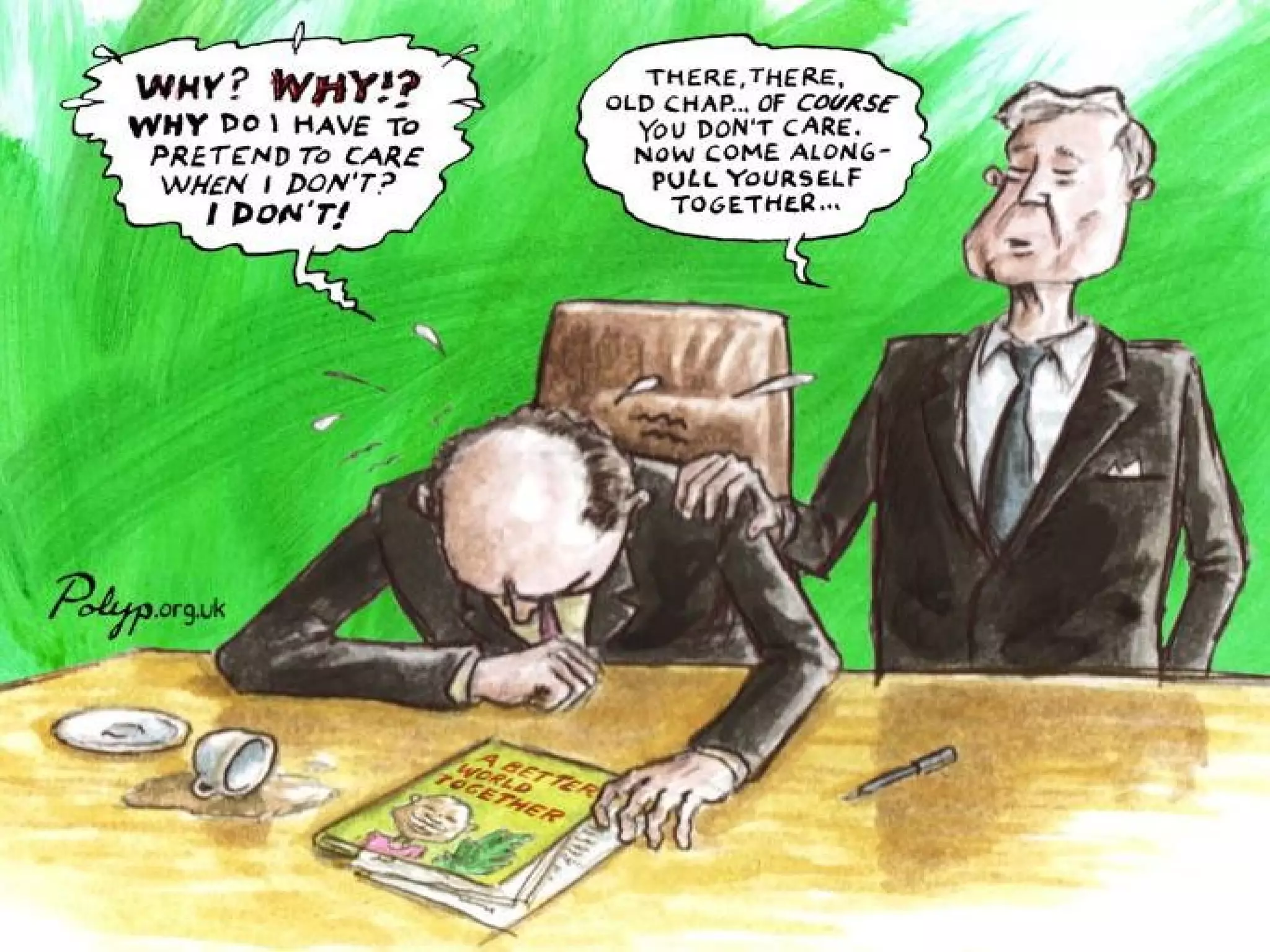
  • #24 http://4.bp.blogspot.com/-P6eFU_MIV88/TvGgE7UzNUI/AAAAAAAAAZY/6mecn1rMGuM/s1600/polyp_cartoon_corporate_social_responsibility.jpg
  • #25 http://intangibles.typepad.com/theintangibles/csr-and-transparency/
  • #31 http://www.flickr.com/photos/tth91722