Grounding of global business – the case of
Norwegian companies in Indonesia
Tarje I. Wanvik
Background
! 

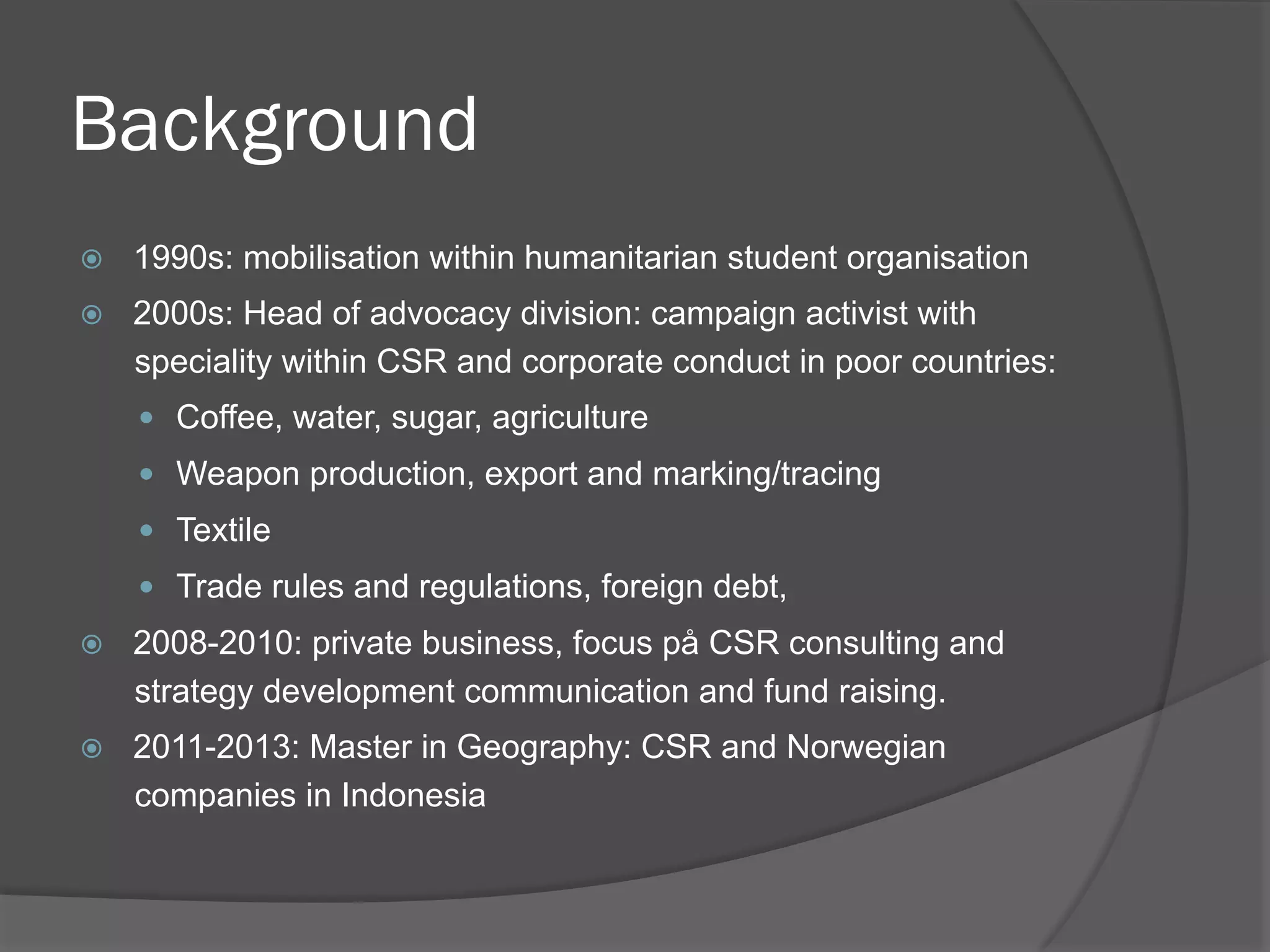
1990s: mobilisation within humanitarian student organisation

! 

2000s: Head of advocacy division: campaign activist with
speciality within CSR and corporate conduct in poor countries:
"  Coffee, water, sugar, agriculture
"  Weapon production, export and marking/tracing
"  Textile
"  Trade rules and regulations, foreign debt,

! 

2008-2010: private business, focus på CSR consulting and
strategy development communication and fund raising.

! 

2011-2013: Master in Geography: CSR and Norwegian
companies in Indonesia
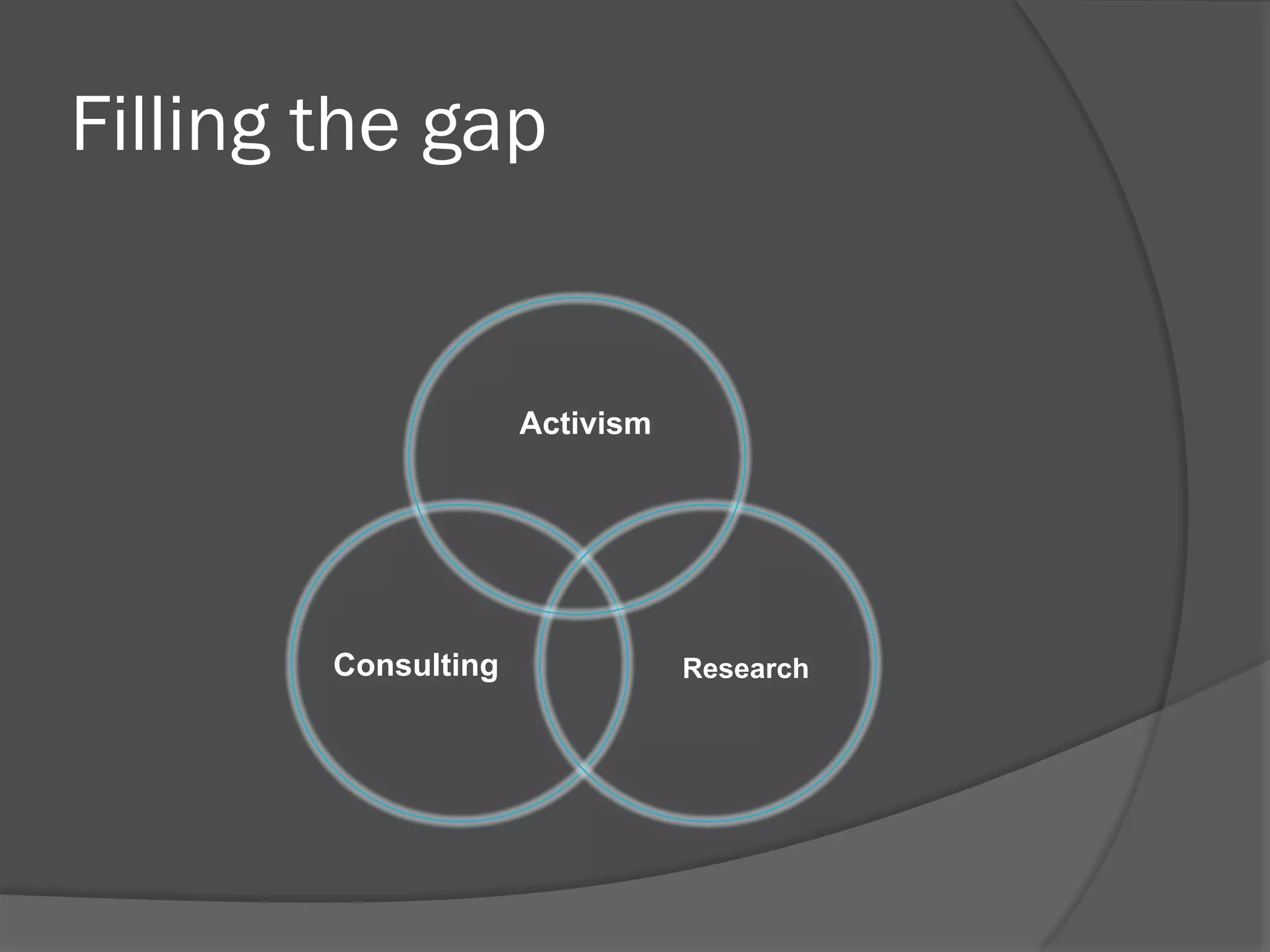
Filling the gap

Activism

Consulting

Research
“Anything can be located anywhere”
“Every firm, every economic function is –
quite literally, grounded in specific locations”
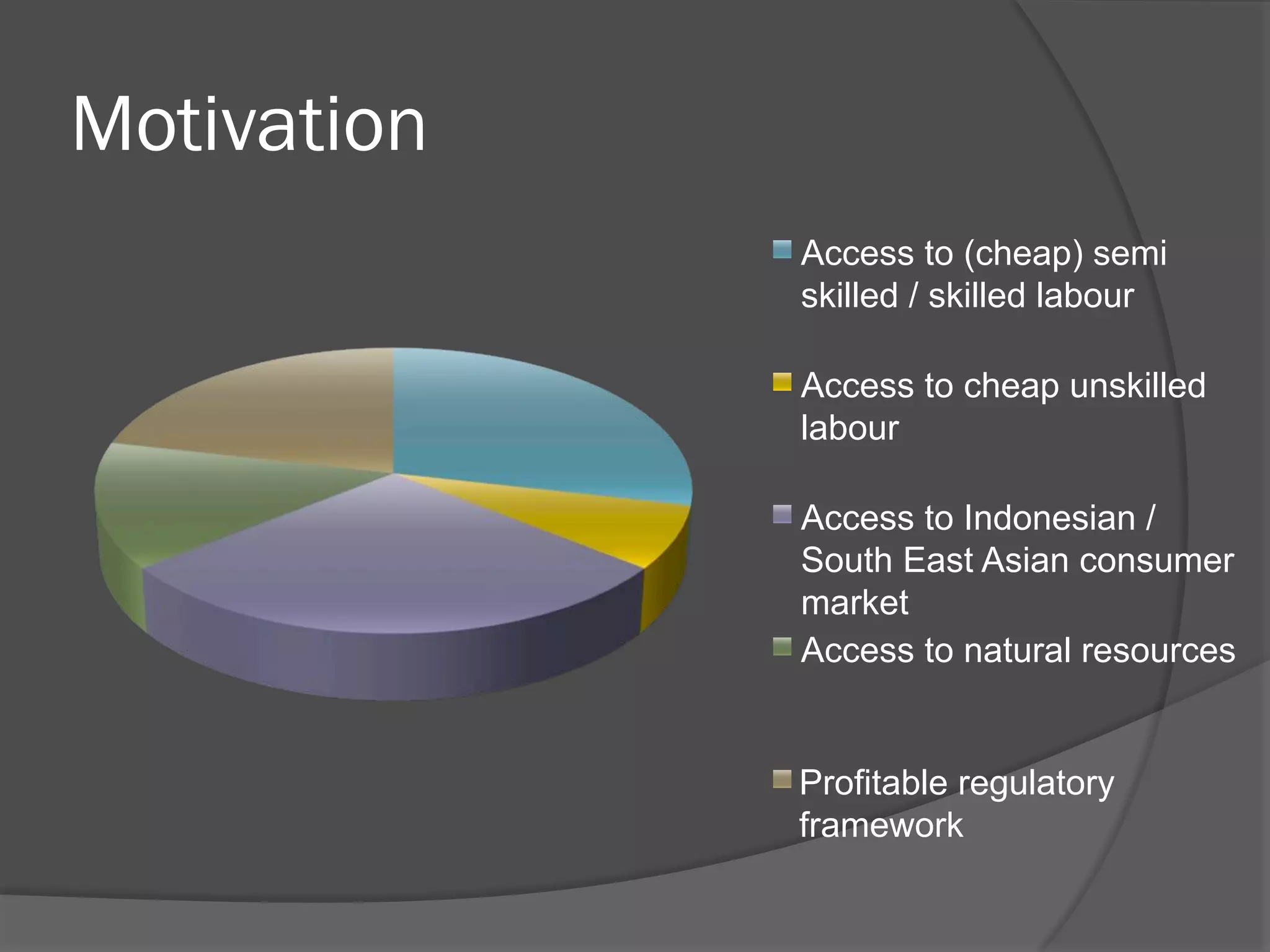
Motivation
Access to (cheap) semi
skilled / skilled labour
Access to cheap unskilled
labour
Access to Indonesian /
South East Asian consumer
market
Access to natural resources

Profitable regulatory
framework
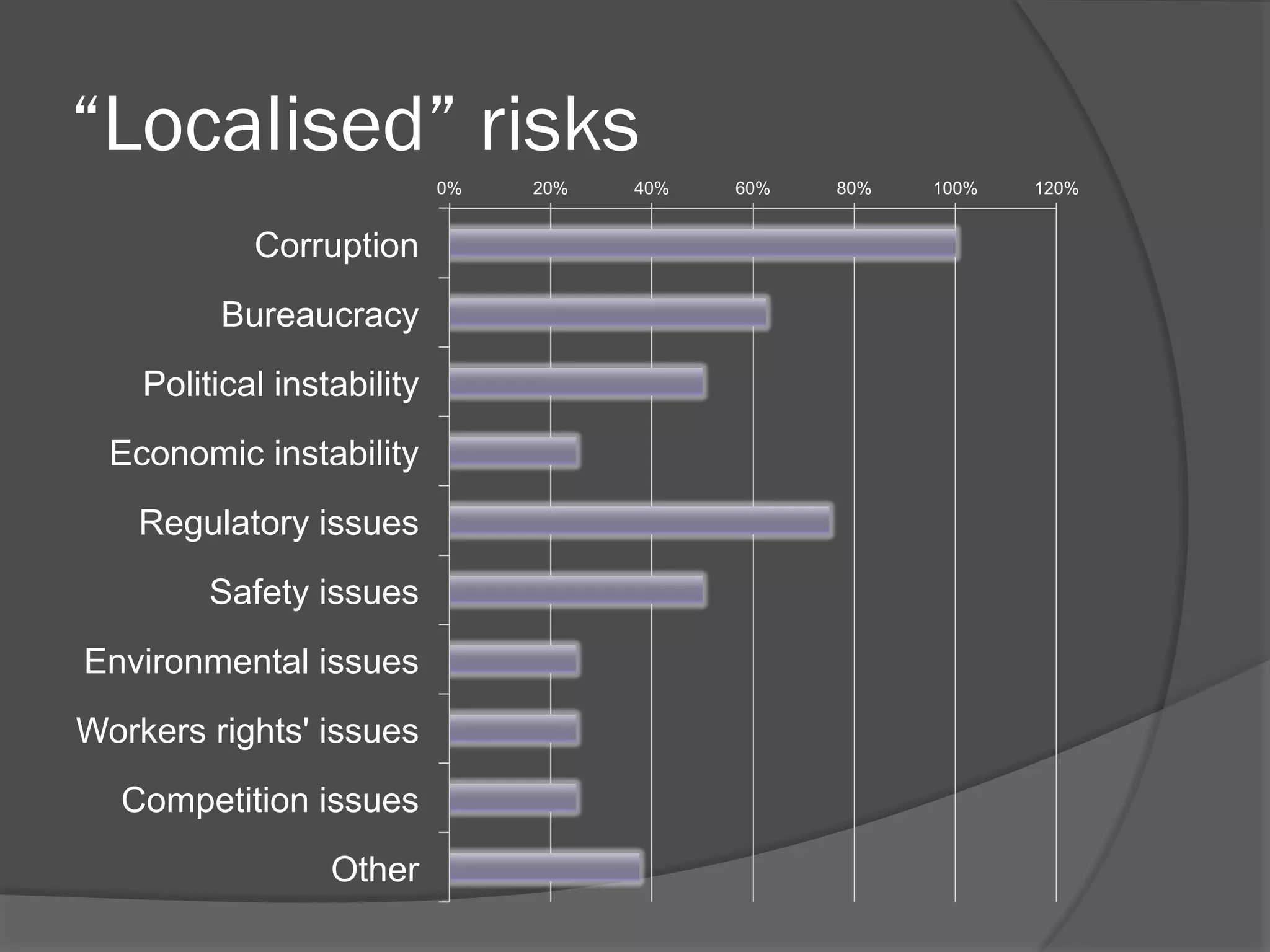
“Localised” risks
0%

Corruption
Bureaucracy
Political instability
Economic instability
Regulatory issues
Safety issues
Environmental issues
Workers rights' issues
Competition issues
Other

20%

40%

60%

80%

100%

120%
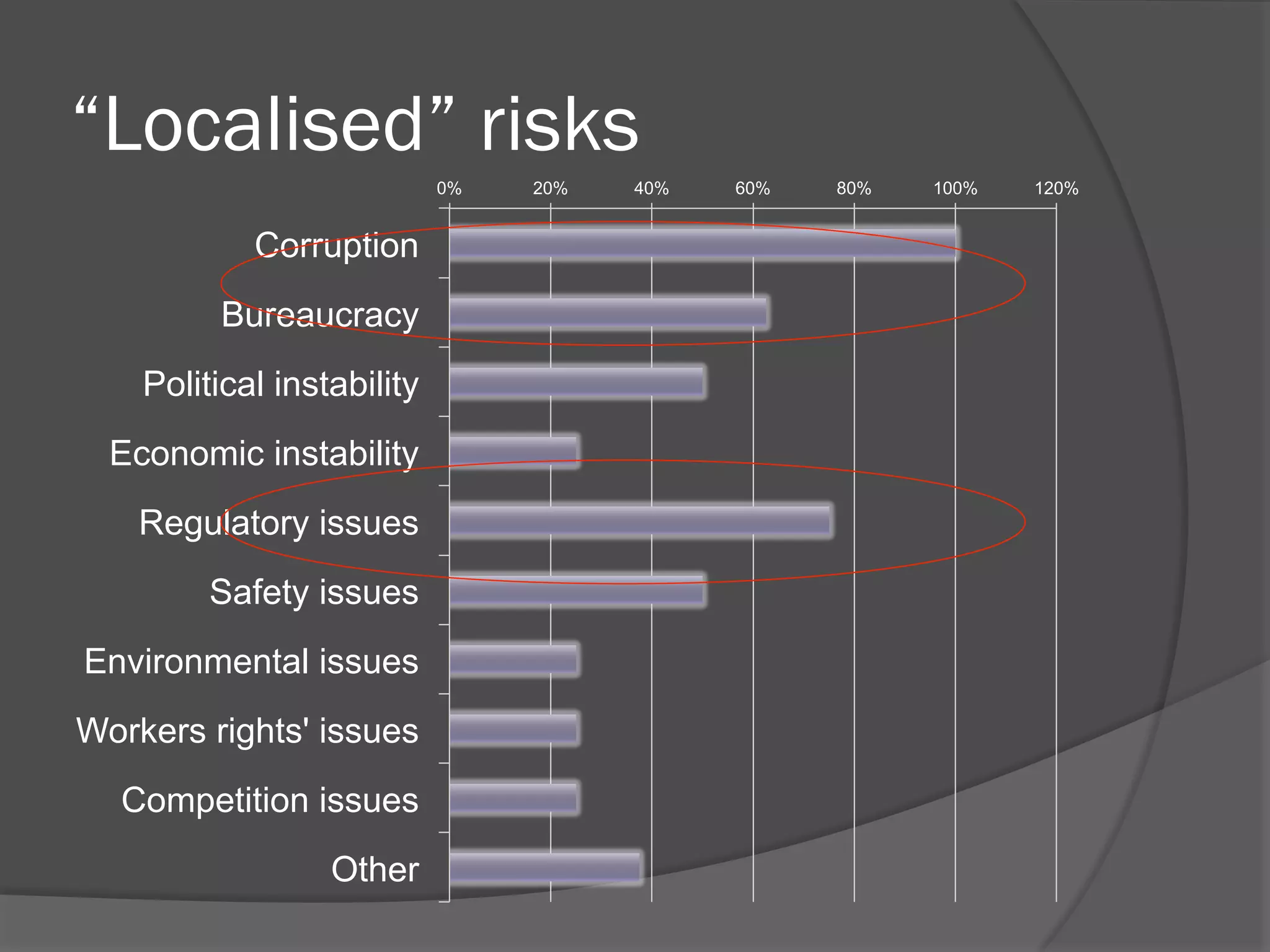
“Localised” risks
0%

Corruption
Bureaucracy
Political instability
Economic instability
Regulatory issues
Safety issues
Environmental issues
Workers rights' issues
Competition issues
Other

20%

40%

60%

80%

100%

120%
Presentation, part 1
! 

Research questions

! 

Empirical and theoretical sources and definitions

Part 2
! 

What do I see? (CSR law, CSR practice)

! 

Why do I see this? (motivation, target groups,
objectives)

! 

Discussion: attachment versus detachment forces
and strategies and grounding effects.
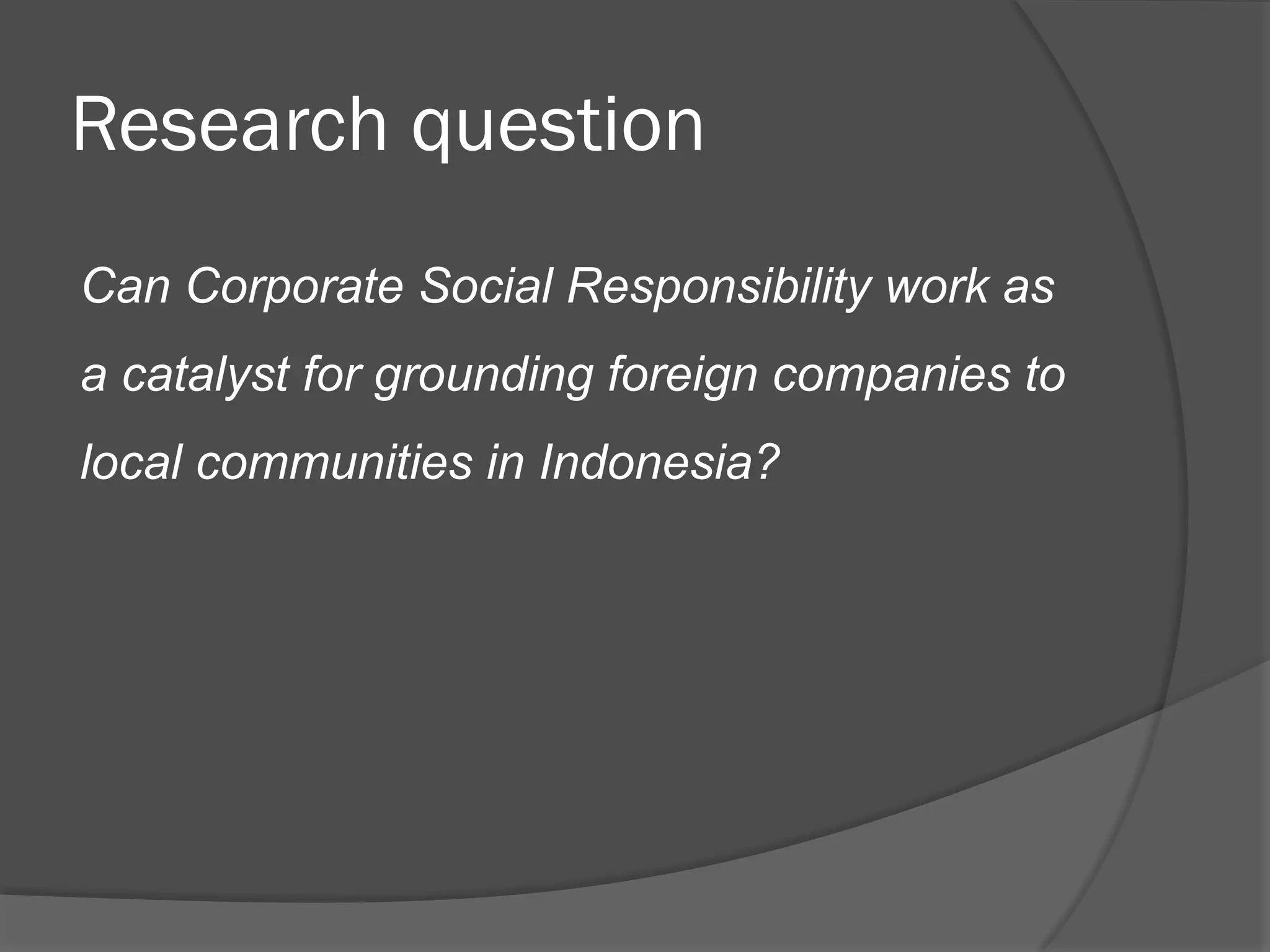
Research question
Can Corporate Social Responsibility work as
a catalyst for grounding foreign companies to
local communities in Indonesia?
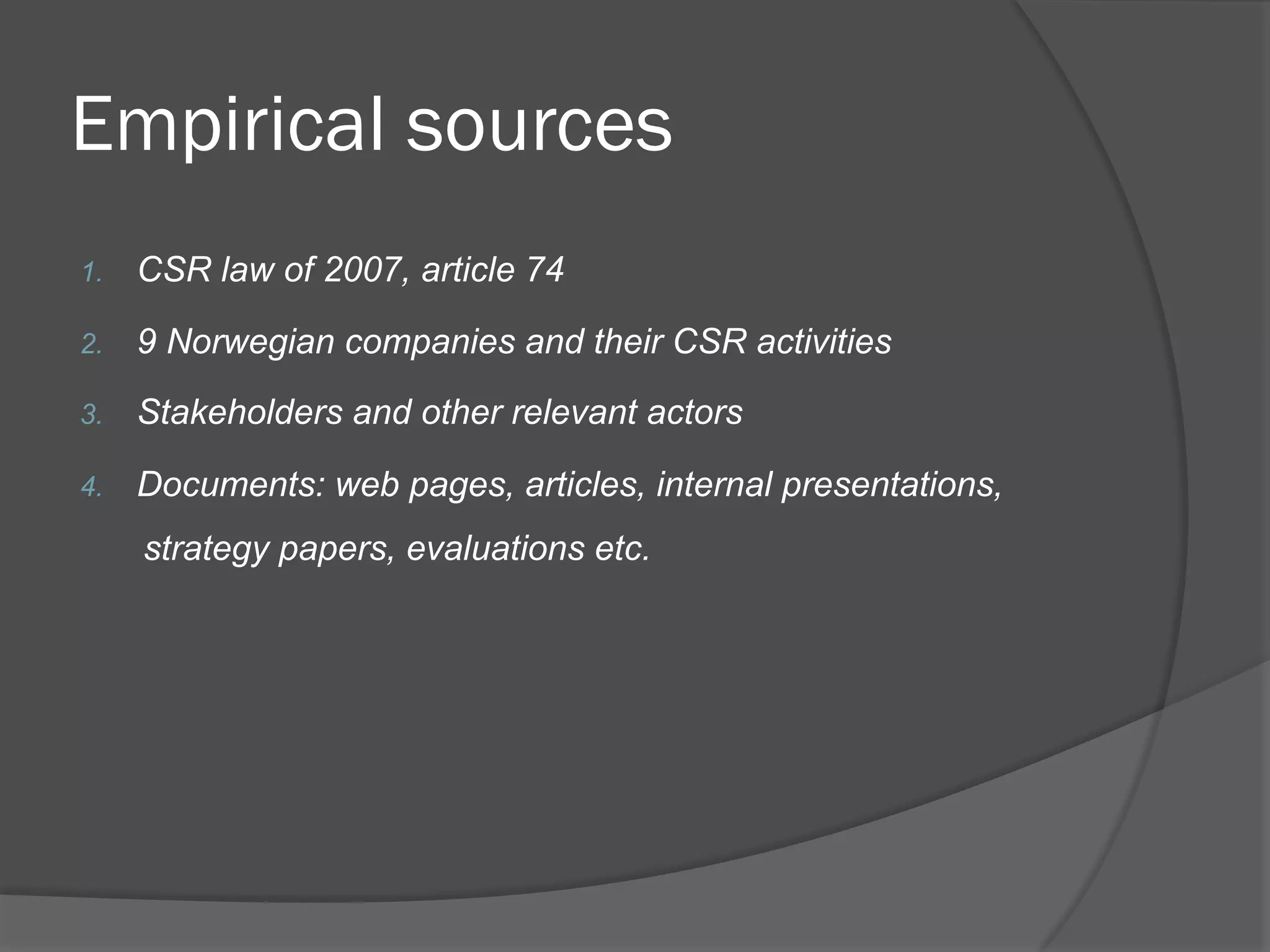
Empirical sources
1. 

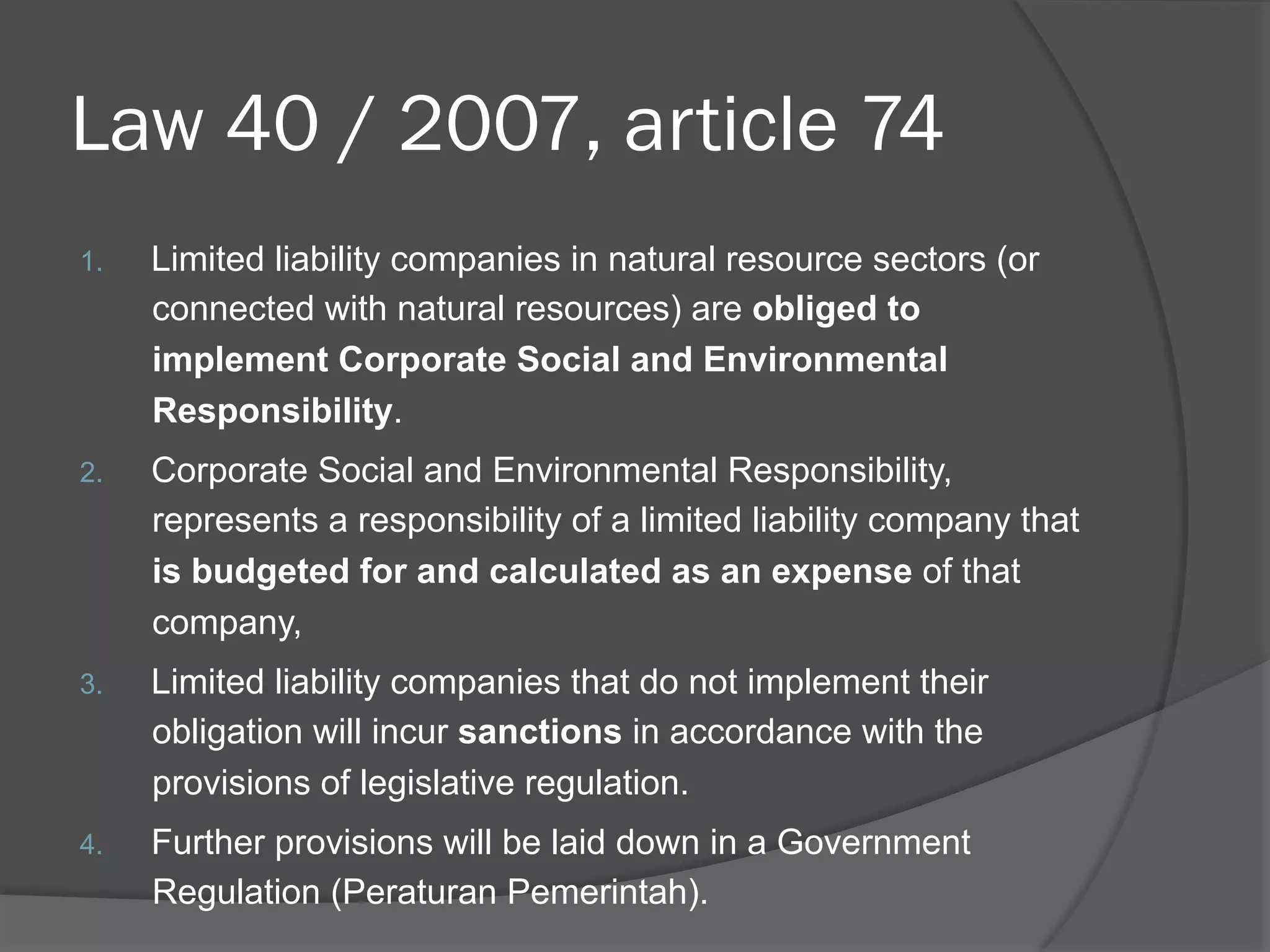
CSR law of 2007, article 74

2. 

9 Norwegian companies and their CSR activities

3. 

Stakeholders and other relevant actors

4. 

Documents: web pages, articles, internal presentations,
strategy papers, evaluations etc.
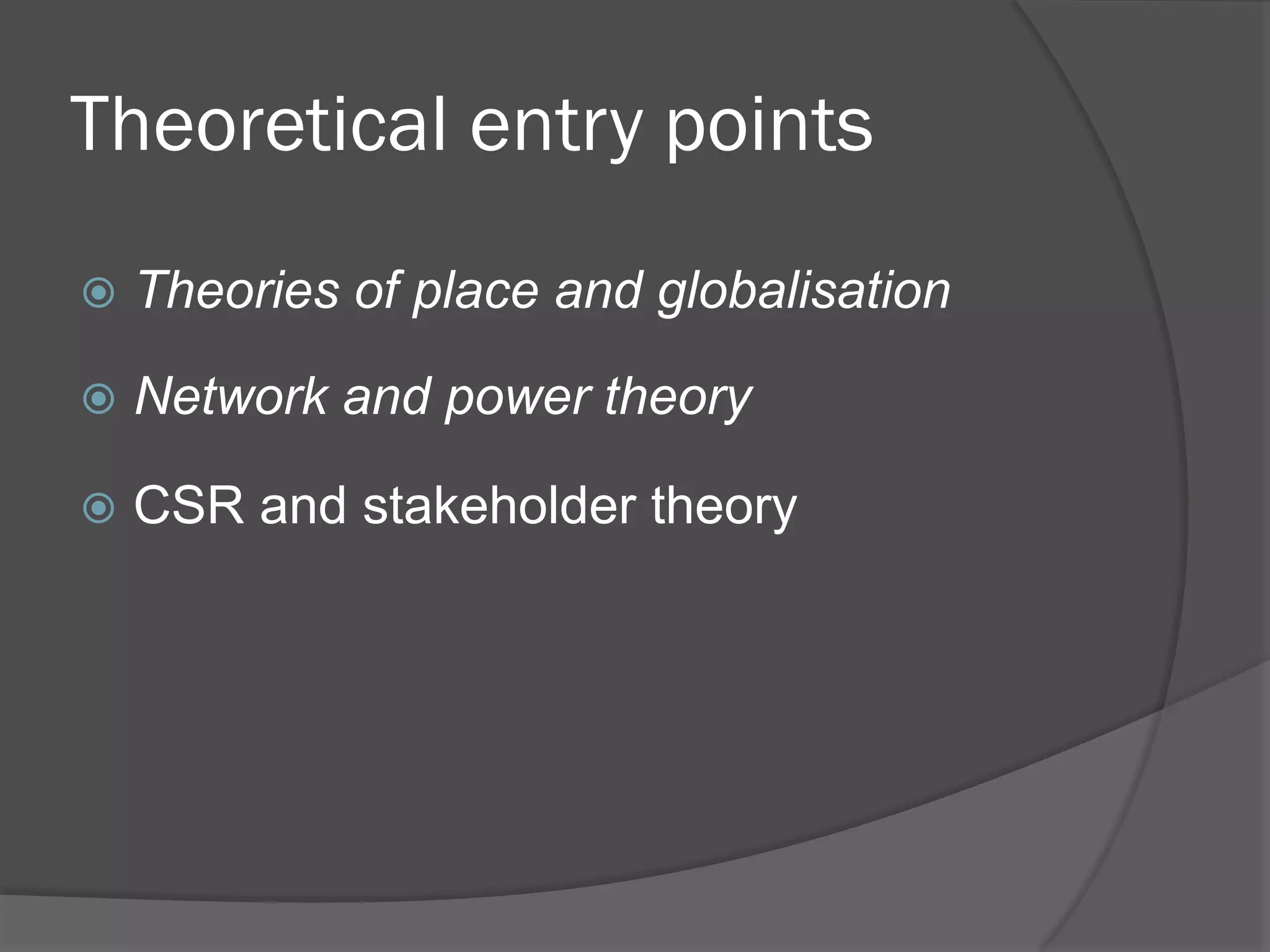
Theoretical entry points
!  Theories

of place and globalisation

!  Network

and power theory

!  CSR

and stakeholder theory
What is place?
! 

Three-part definition of place (Agnew)
"  Location (where; longitude, latitude, relative)
"  Locale (what; material context of social life:

buildings, roads, parks, fields, social relations)
"  Sense of place: (how; the way in which place is
given meaning)
! 

Place interweaves all three realms and
cannot be reduced to any of them (Sack)
Community = place
!  Many

spatial corresponding
characteristics:
"  Tolerance (Walzer 1997)
"  Reciprocity (Putnam 2000)
"  Trust (Grimen 2009)

!  Closely

linked to Social Capital
(Bourdieu 1991):
"  Networks, norms and trust facilitate

cooperation
Space vs Place
!  Investing

in a place (Tuan)
Assemblages
!  Assemblages

(DeLanda 2006)

"  Material, immaterial and representational
"  Components brought together
"  Product of historical process
"  Unique and singular individuals

(communities, organisations, atoms,
species, ecosystems etc.)
"  Own capacities and tendencies: new parts
can enter, assemblage can constitute new
relations
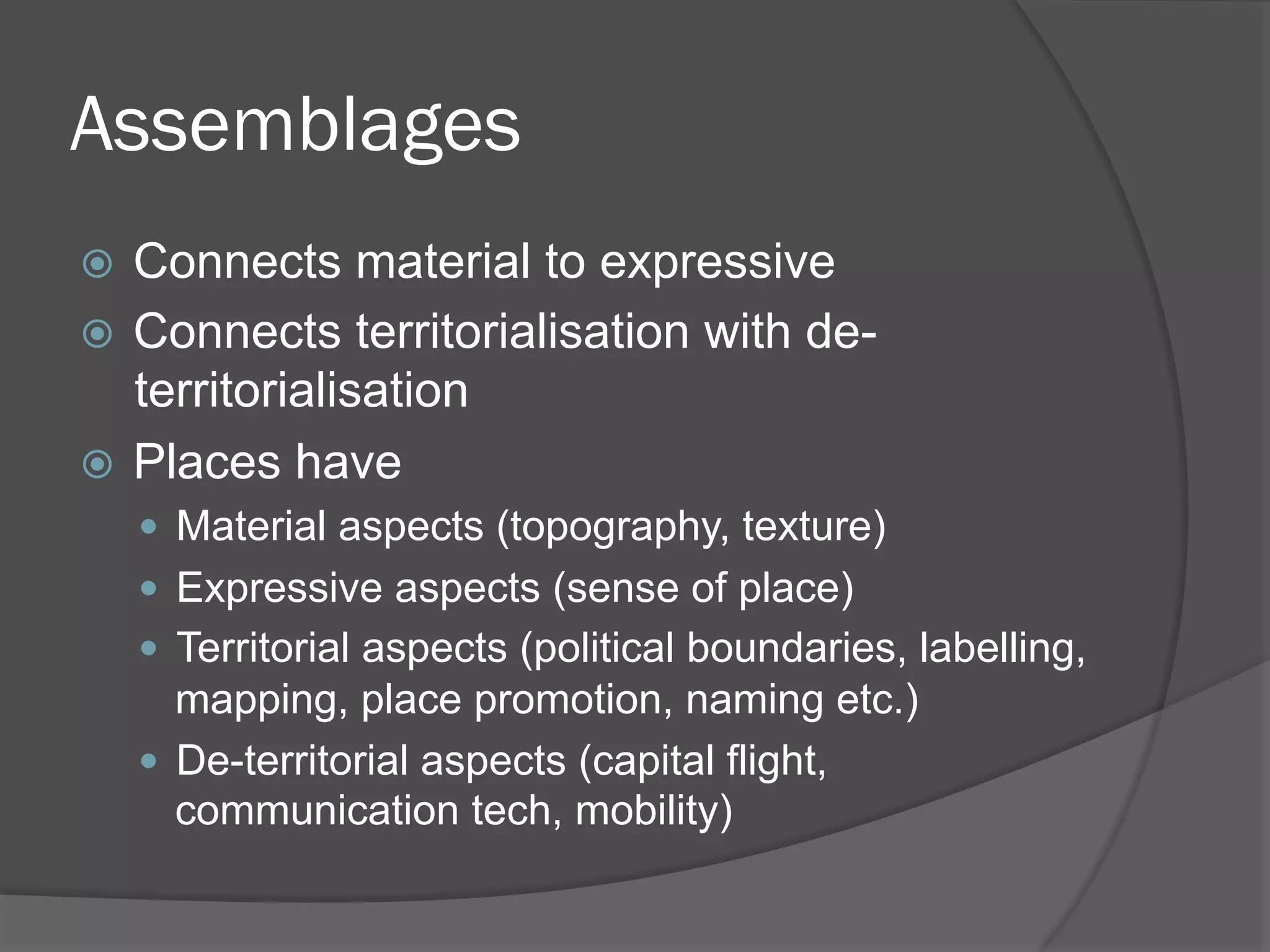
Assemblages
Connects material to expressive
!  Connects territorialisation with deterritorialisation
!  Places have
! 

"  Material aspects (topography, texture)
"  Expressive aspects (sense of place)
"  Territorial aspects (political boundaries, labelling,

mapping, place promotion, naming etc.)
"  De-territorial aspects (capital flight,
communication tech, mobility)
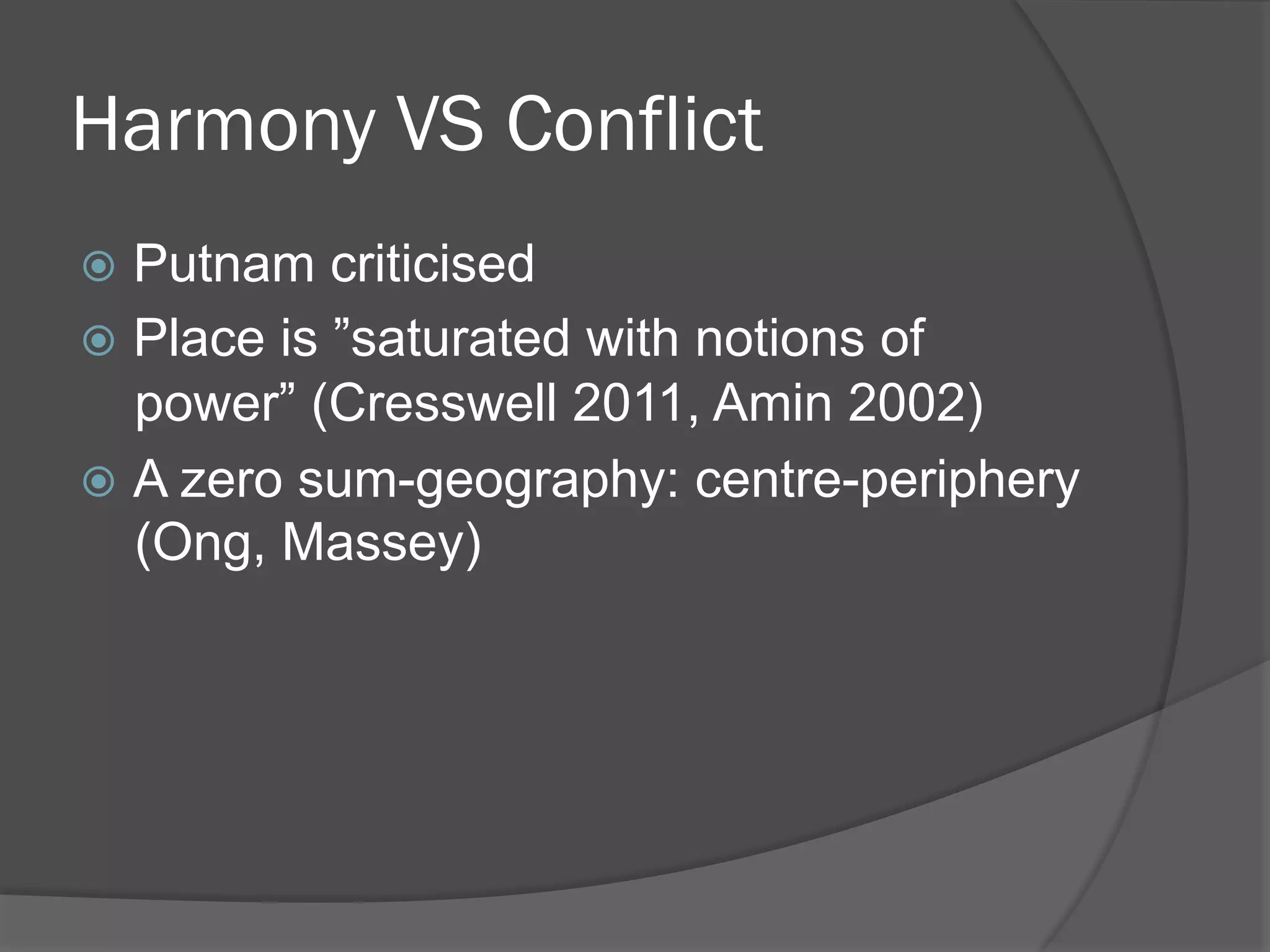
Harmony VS Conflict
!  Putnam

criticised
!  Place is ”saturated with notions of
power” (Cresswell 2011, Amin 2002)
!  A zero sum-geography: centre-periphery
(Ong, Massey)
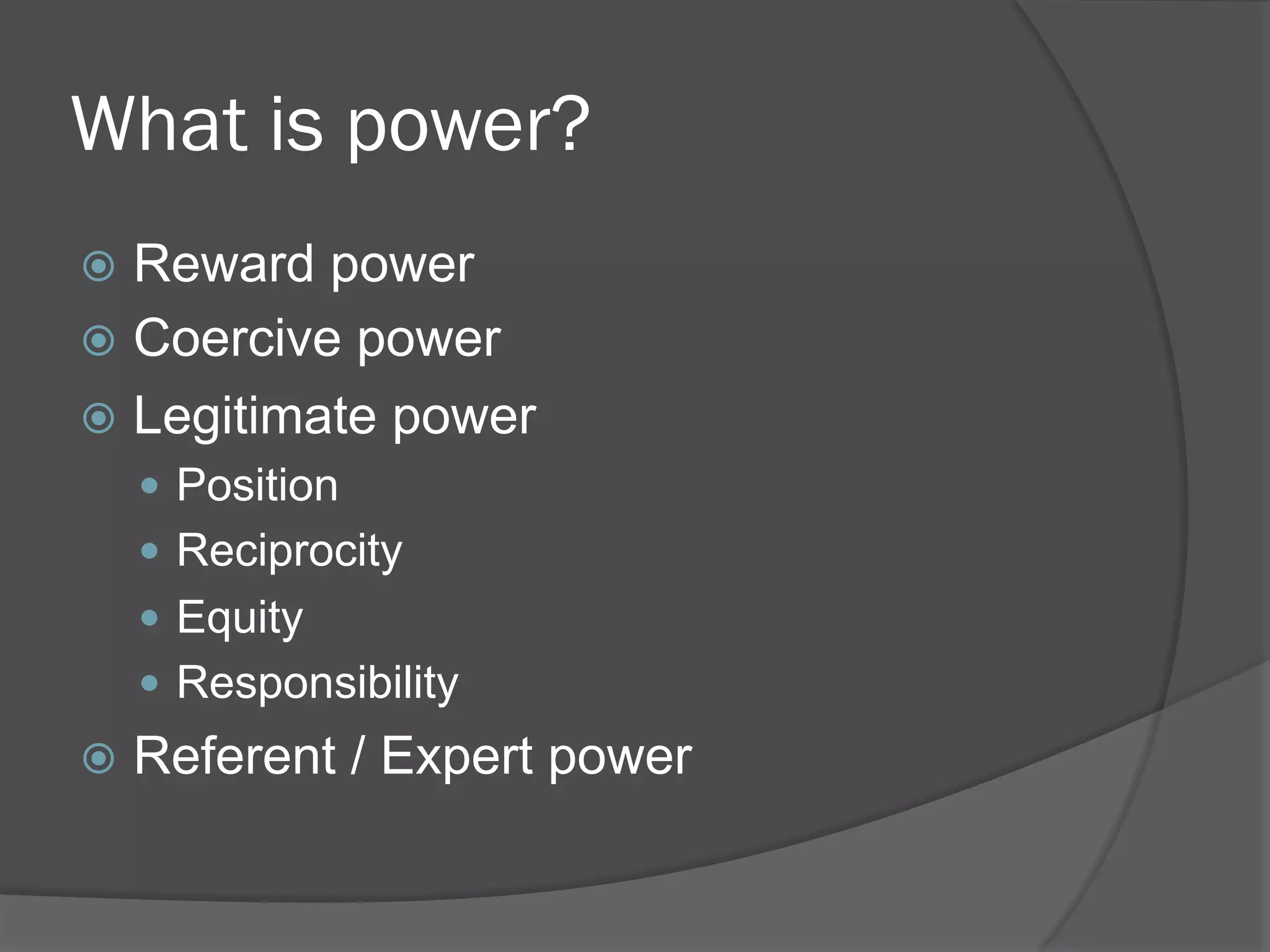
What is power?
!  Reward

power
!  Coercive power
!  Legitimate power
"  Position
"  Reciprocity
"  Equity
"  Responsibility

!  Referent

/ Expert power
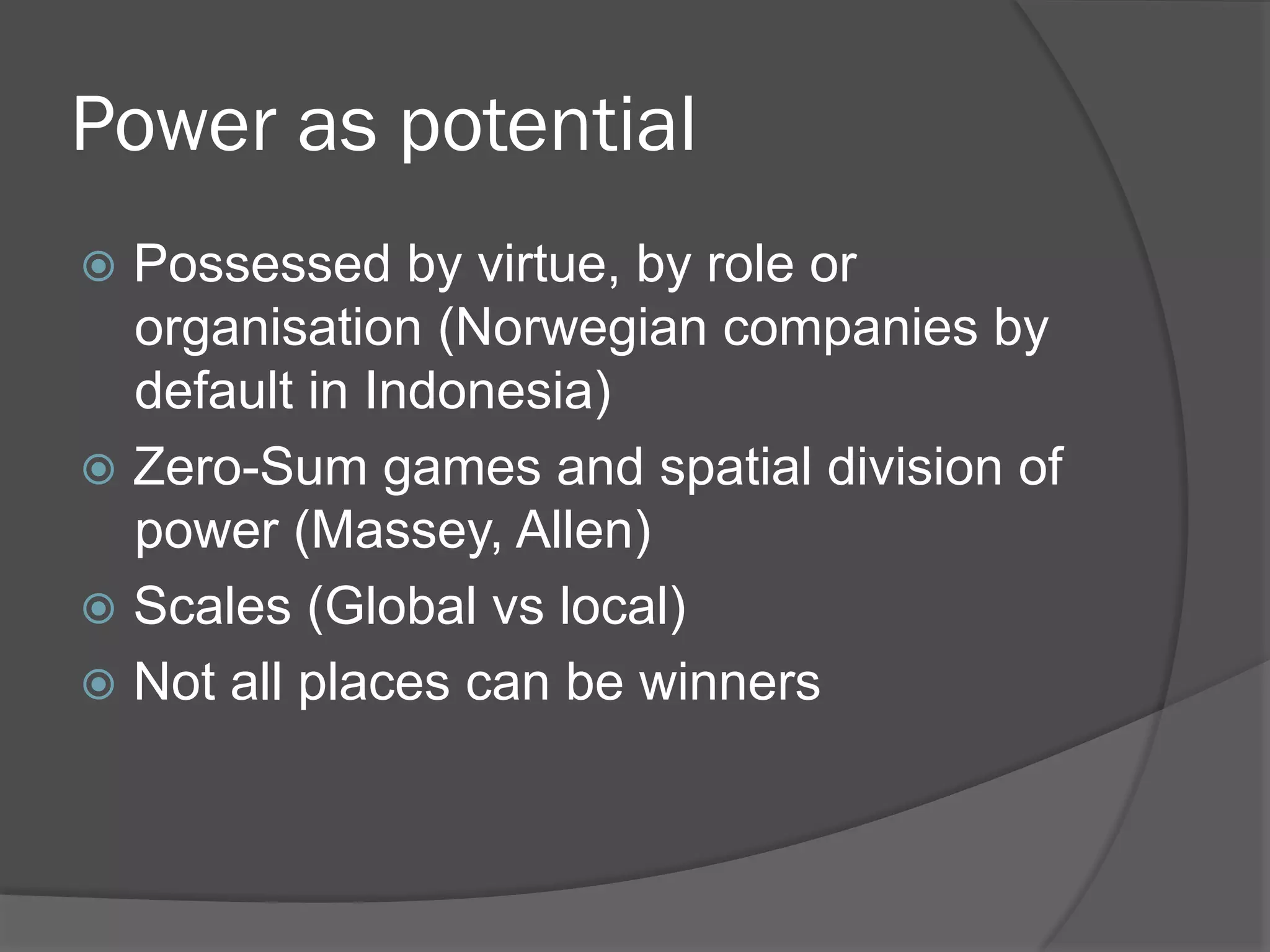
Power as potential
!  Possessed

by virtue, by role or
organisation (Norwegian companies by
default in Indonesia)
!  Zero-Sum games and spatial division of
power (Massey, Allen)
!  Scales (Global vs local)
!  Not all places can be winners
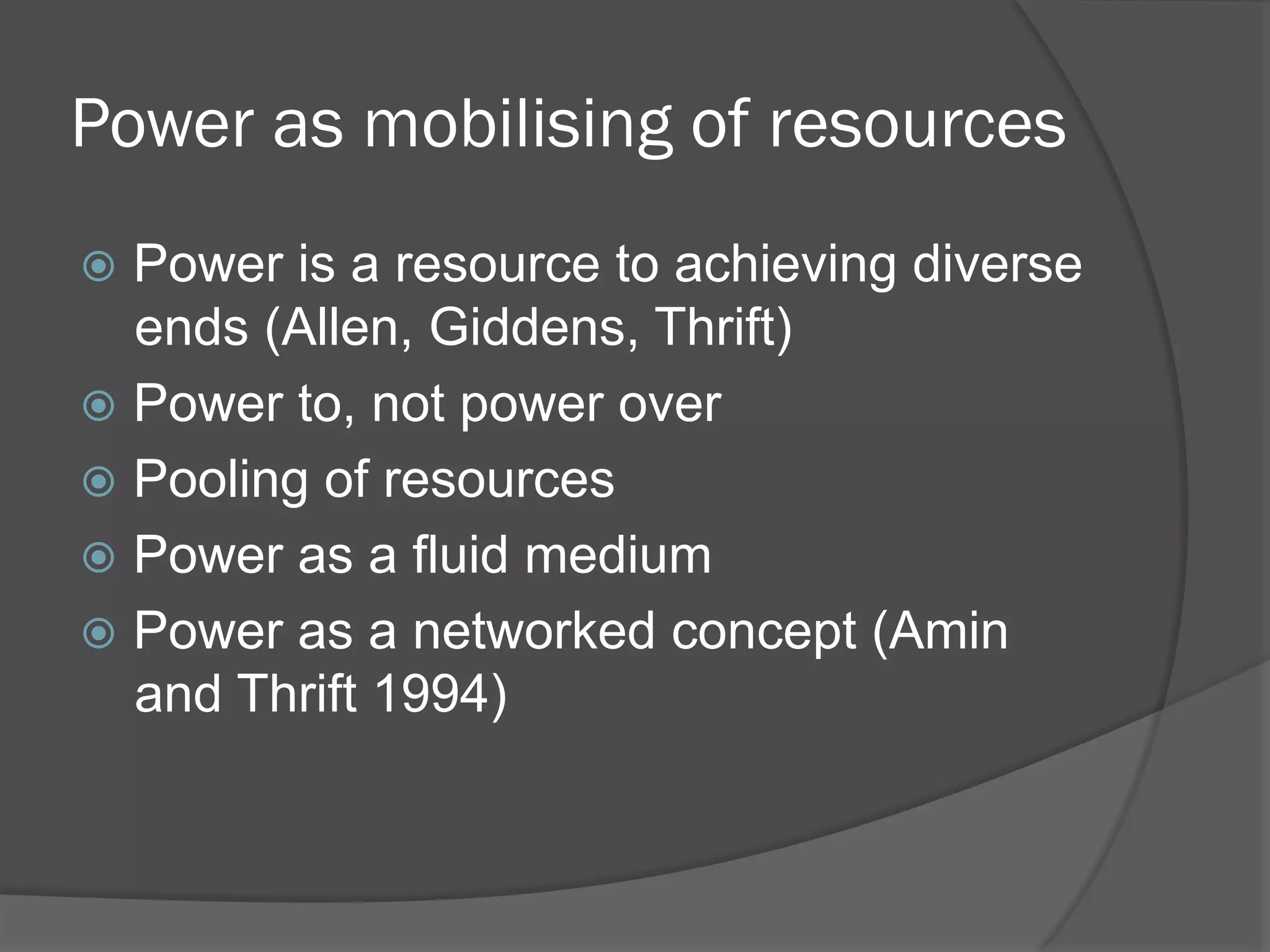
Power as mobilising of resources
!  Power

is a resource to achieving diverse
ends (Allen, Giddens, Thrift)
!  Power to, not power over
!  Pooling of resources
!  Power as a fluid medium
!  Power as a networked concept (Amin
and Thrift 1994)
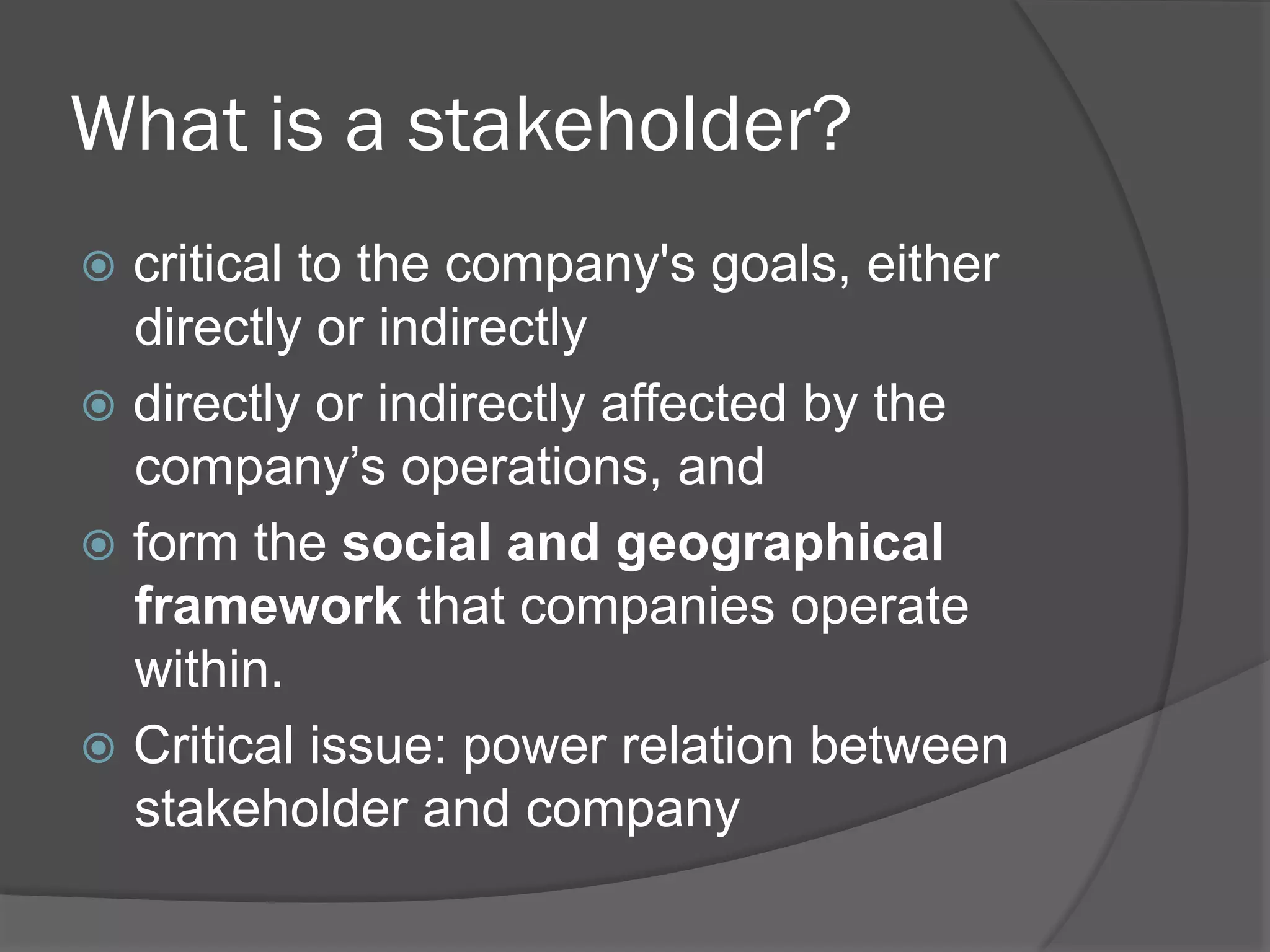
What is a stakeholder?
!  critical

to the company's goals, either
directly or indirectly
!  directly or indirectly affected by the
company’s operations, and
!  form the social and geographical
framework that companies operate
within.
!  Critical issue: power relation between
stakeholder and company
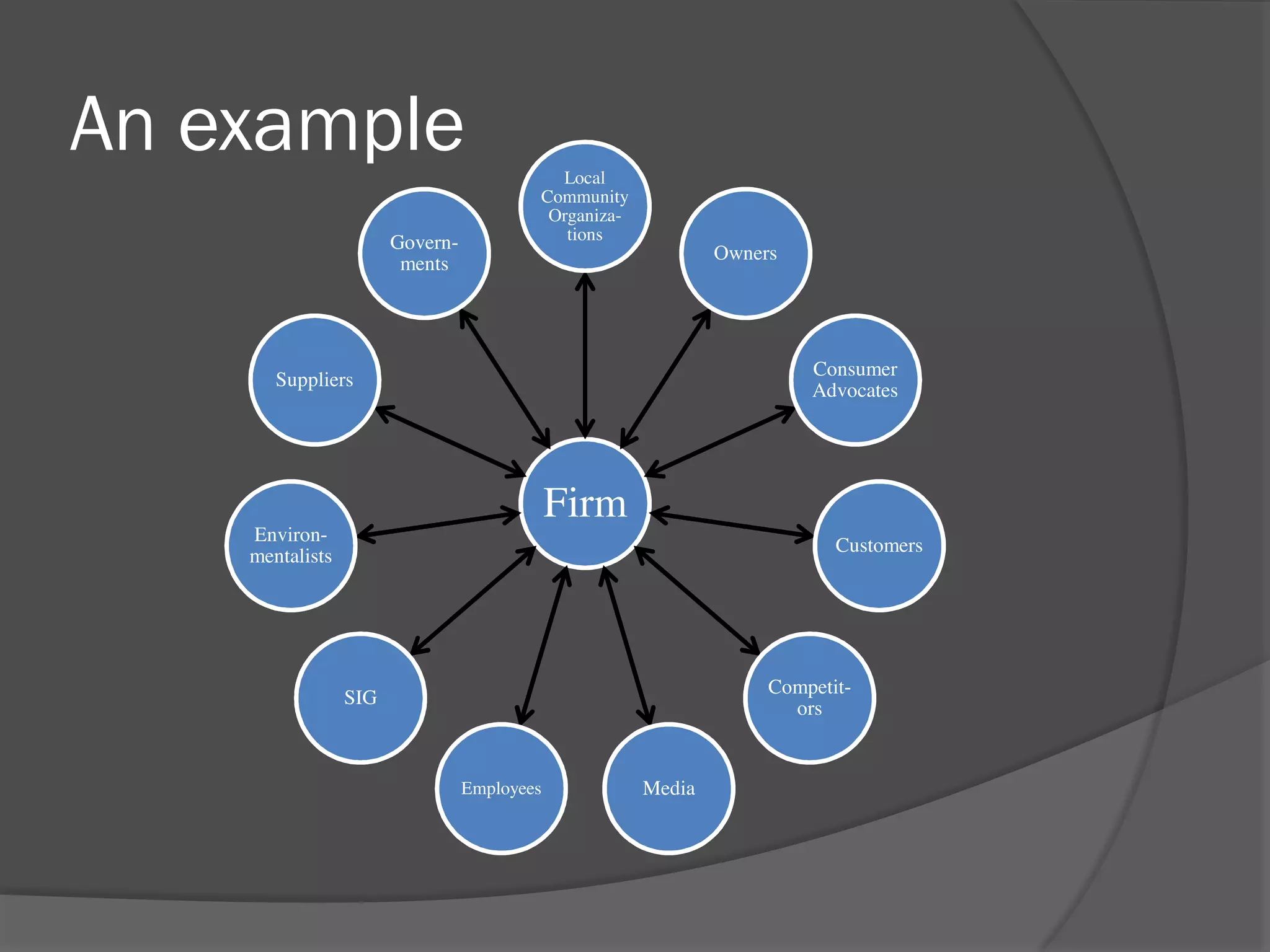
An example
Governments

Local
Community
Organizations

Owners

Consumer
Advocates

Suppliers

Firm

Environmentalists

Customers

Competitors

SIG

Employees

Media

Figure 3 Stakeholder view of firm (Freeman 1984, p.25)
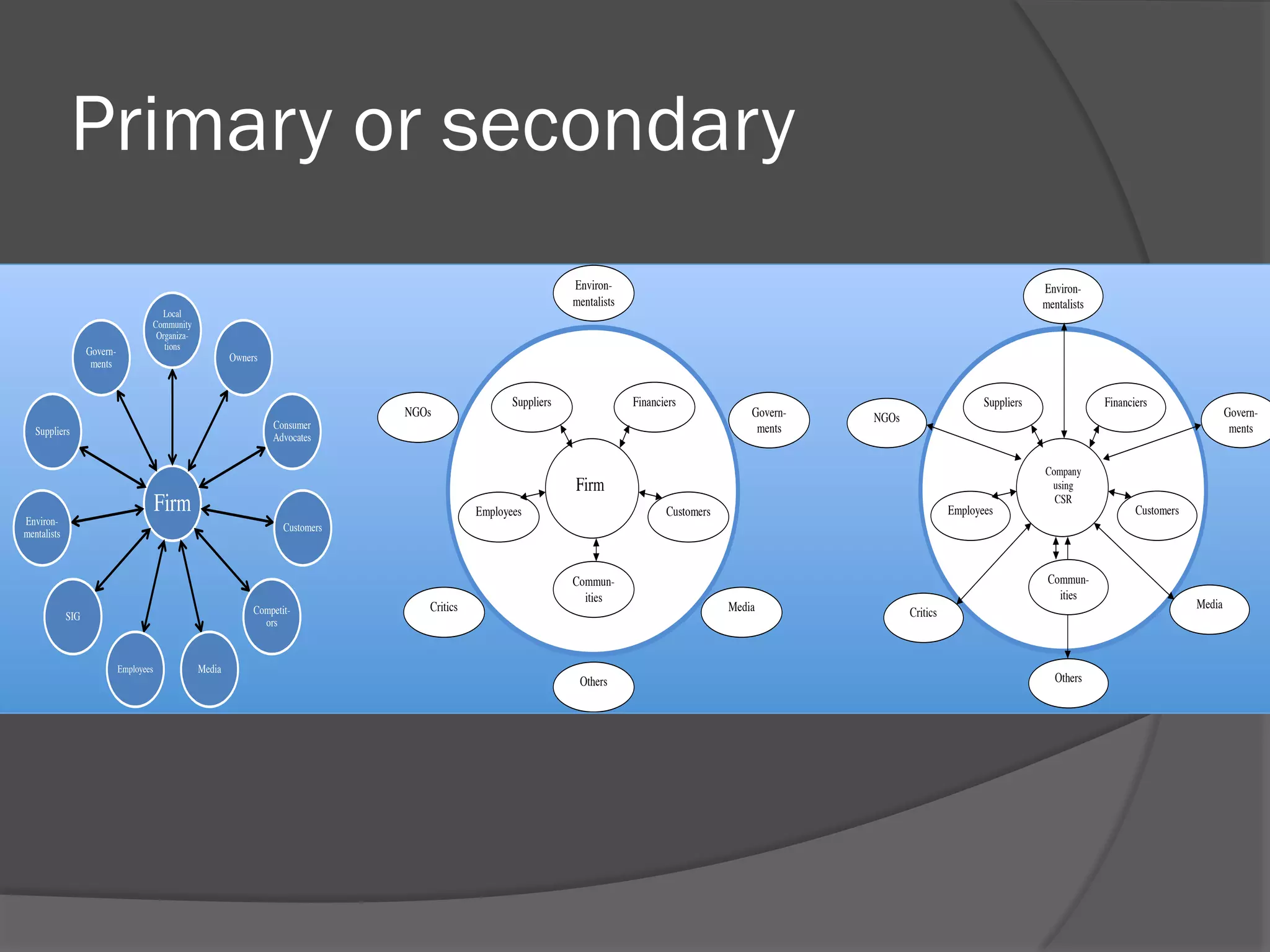
Primary or secondary
has been drawn according to Freeman to show that there are no possible linkages by
arrows between external stakeholders and a “firm” (Fassin 2008).

Governments

Environmentalists

Local
Community
Organizations

Environmentalists

Owners

NGOs

Suppliers

Financiers

Consumer
Advocates

Suppliers

Suppliers

Employees

Financiers

Governments

NGOs

Firm

Firm

Environmentalists

Governments

Employees

Customers

Company
using
CSR

Customers

Customers

Competitors

SIG

Employees

Media

Figure 3 Stakeholder view of firm (Freeman 1984, p.25)

Critics

Communities

Media

Communities
Critics

Others

Others

Figure 4 Freemans adapted version of the stakeholder
model from 2003 (Fassin 2008, p.115)

According to Freeman (1984) the aim of the stakeholder theory is to improve the
nderstanding and relationship between a company and its stakeholders. If aCarroll (Nygaard & Bengtsson 2002) among others (Grafstöm et al 2008) divide a
compacompany’s stakeholders into primary and secondary groups, whereas the primary
y is successful with satisfying their closest stakeholders, the company can gain
ong-term economical benefit as well as competitive advantages.
stakeholder can be seen as vital for a company’s survival, usually customers, employees, owners and suppliers. According to Carroll (Nygaard & Bengtsson 2002)
.5.1 Refined Stakeholder Theory
categorizing stakeholders into primary and secondary groups will make it possible
takeholders making increasing demands on a company, and companies have differfor a company to aim its strategic actions towards the stakeholder and be able to fulnt kind of responsibilities towards its stakeholders and its action affects thefill that particular stakeholder’s demand. If a company fails to satisfy these demands,
surounding environment. The theory is a useful guide when a company is to identify et al (2008) argue that the company will not survive.
Grafström
aluable stakeholders who might be of importance for a company’s CSR perfor-

Media

Figure 5 CSR-company and Stakeholders Model (authors own
version 2009), based on Freemans adapted version of the stakeholder model from 2003 (Fassin 2008, p.115)
3.5.3 Primary stakeholders

Communities
Communities can be described as the surrounding society wherein a company performs its CSR activities. The community often expects something in return from the
company in order to accept and give them legitimacy. Generally in developing countries companies give something back by employing local people in remote and rural
areas (Carroll 1998; Garriga & Melé 2004; Porter & Kramer 2006).
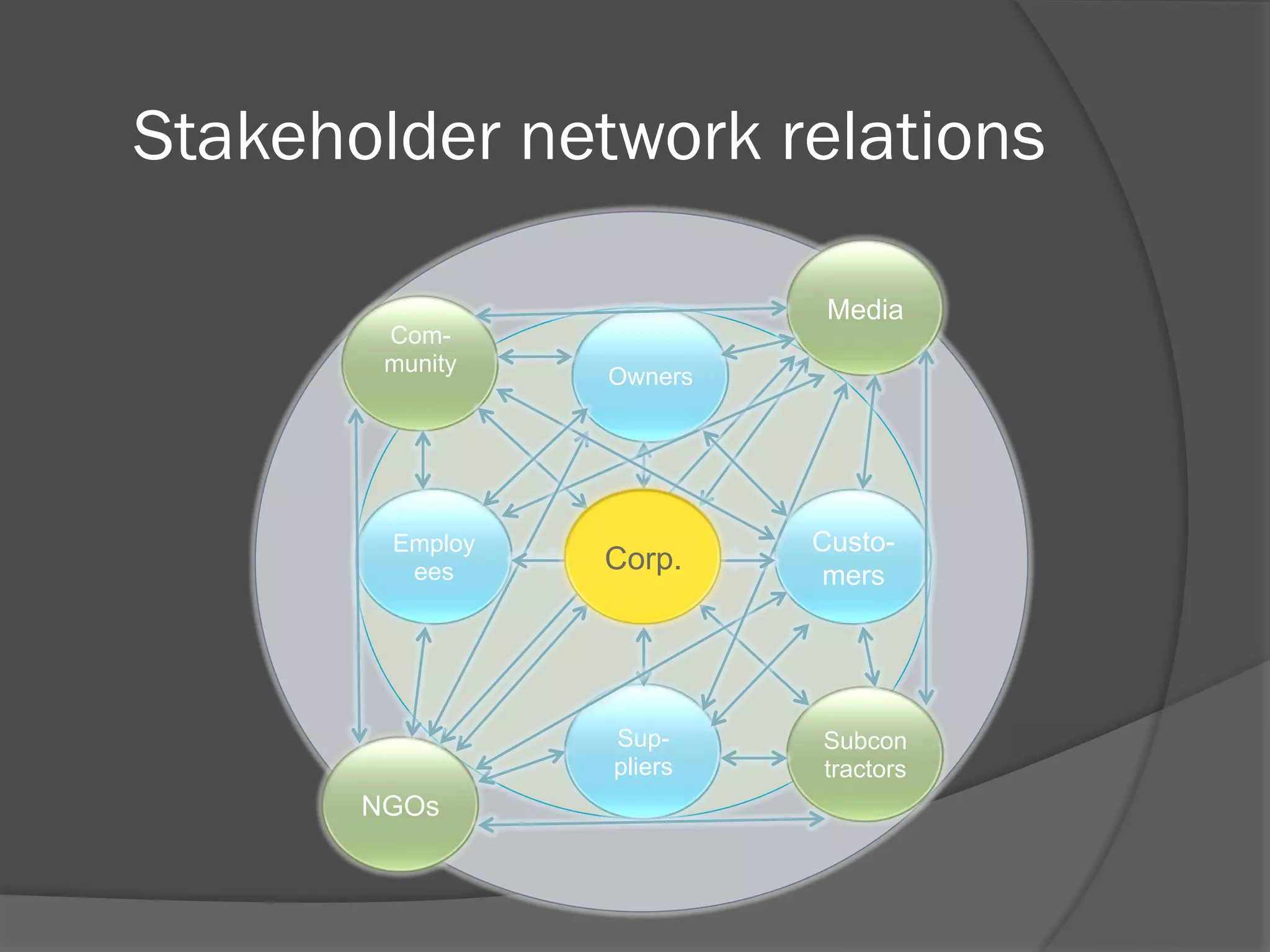
Stakeholder network relations
Community

Employ
ees

Media
Owners

Corp.
Selskap

Suppliers

NGOs

Customers

Subcon
tractors
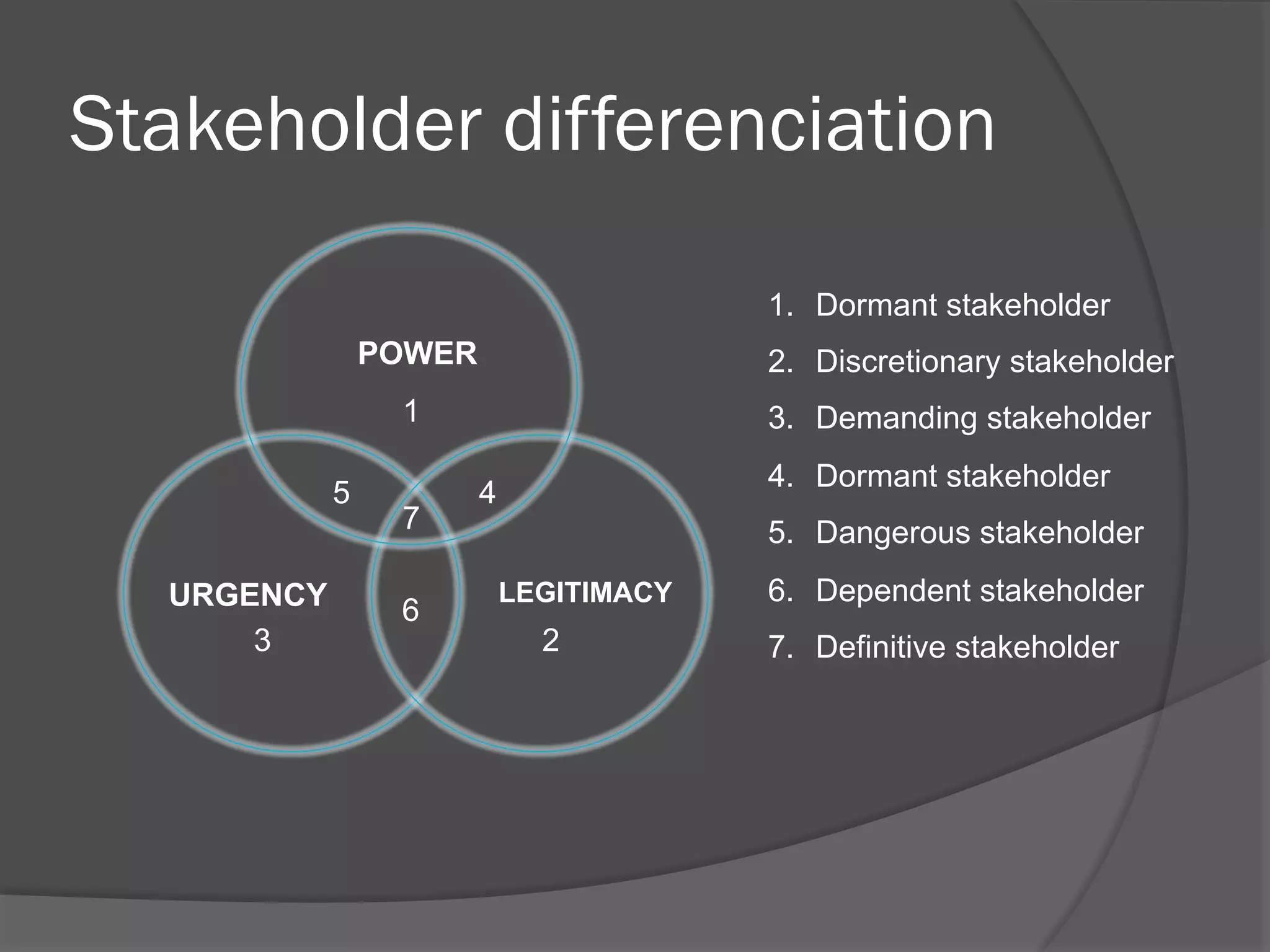
Stakeholder differenciation
1.  Dormant stakeholder
POWER

2.  Discretionary stakeholder

1
5
URGENCY
3

7
6

3.  Demanding stakeholder
4.  Dormant stakeholder

4

5.  Dangerous stakeholder
LEGITIMACY

2

6.  Dependent stakeholder
7.  Definitive stakeholder
What is CSR?
!  CSR

is the commitment of businesses to
behave ethically and to contribute to
sustainable economic development by
working with all relevant stakeholders to
improve their lives in ways that are good
for business, the sustainable
development agenda, and society at
large
Methodology
1. 

Document analysis

2. 

Interviews

3. 

Key informants

4. 

Field visits

5. 

Survey

6. 

Participatory observation
Presentation, part 2
! 

Research questions

! 

Empirical and theoretical sources and definitions

Part 2
! 

What do I see? (CSR law, CSR practice)

! 

Why do I see this? (motivation, target groups,
objectives)

! 

Discussion: attachment versus detachment forces
and strategies and grounding effects.
Law 40 / 2007, article 74
1. 

Limited liability companies in natural resource sectors (or
connected with natural resources) are obliged to
implement Corporate Social and Environmental
Responsibility.

2. 

Corporate Social and Environmental Responsibility,
represents a responsibility of a limited liability company that
is budgeted for and calculated as an expense of that
company,

3. 

Limited liability companies that do not implement their
obligation will incur sanctions in accordance with the
provisions of legislative regulation.

4. 

Further provisions will be laid down in a Government
Regulation (Peraturan Pemerintah).
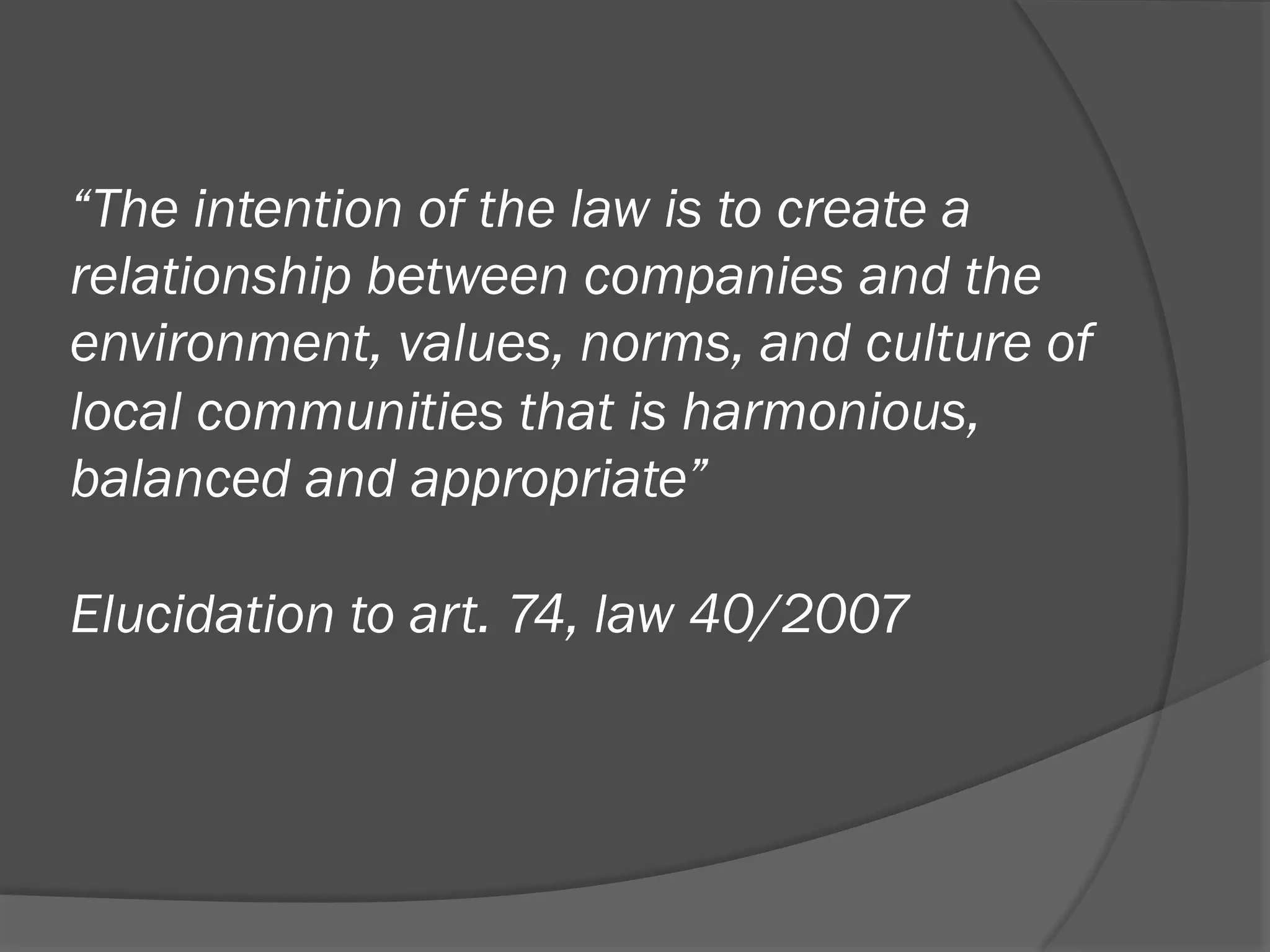
“The intention of the law is to create a
relationship between companies and the
environment, values, norms, and culture of
local communities that is harmonious,
balanced and appropriate”
Elucidation to art. 74, law 40/2007
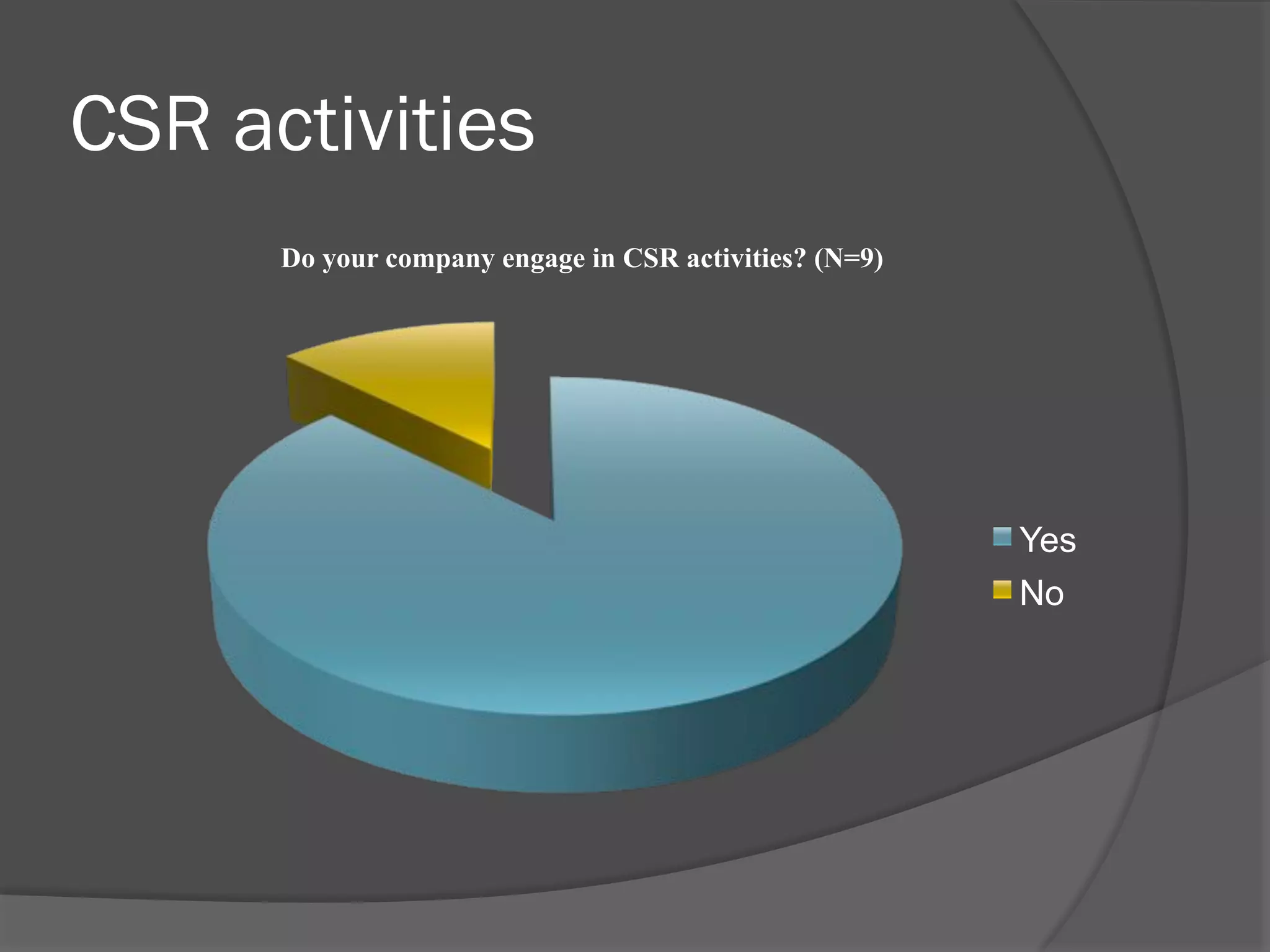
CSR activities
Do your company engage in CSR activities? (N=9)

Yes
No
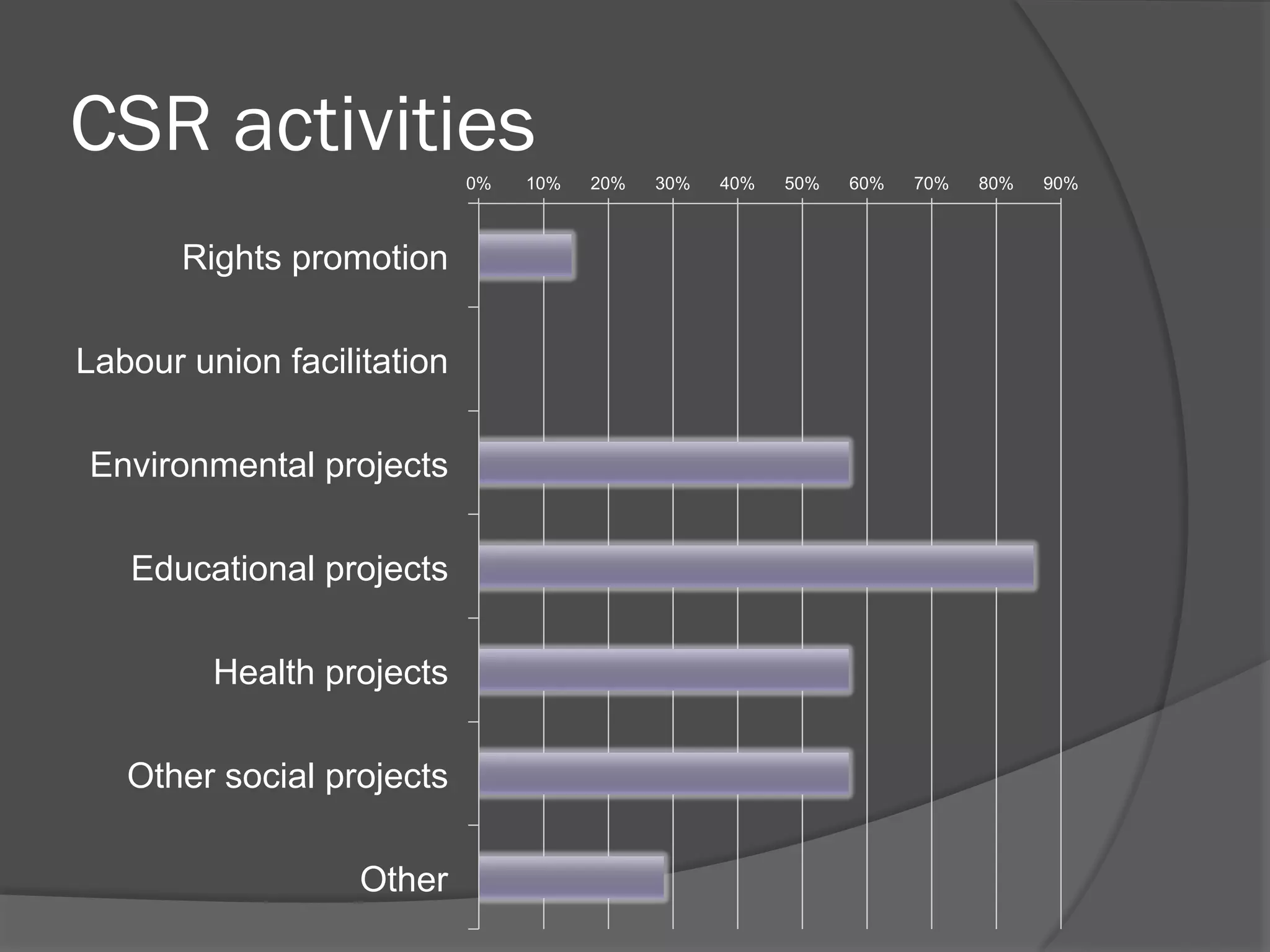
CSR activities
0%

Rights promotion
Labour union facilitation
Environmental projects
Educational projects
Health projects
Other social projects
Other

10%

20%

30%

40%

50%

60%

70%

80%

90%
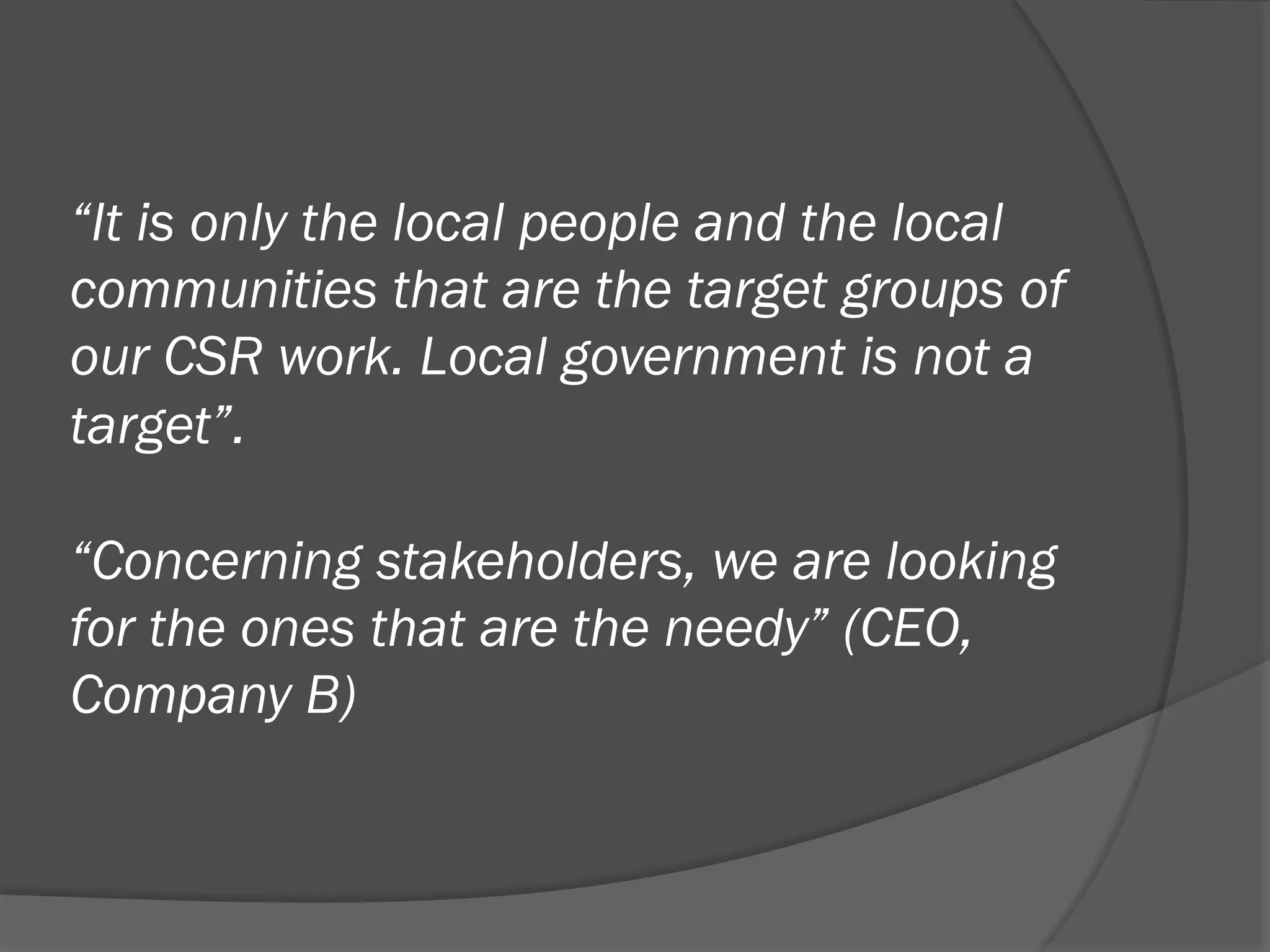
“It is only the local people and the local
communities that are the target groups of
our CSR work. Local government is not a
target”.
“Concerning stakeholders, we are looking
for the ones that are the needy” (CEO,
Company B)
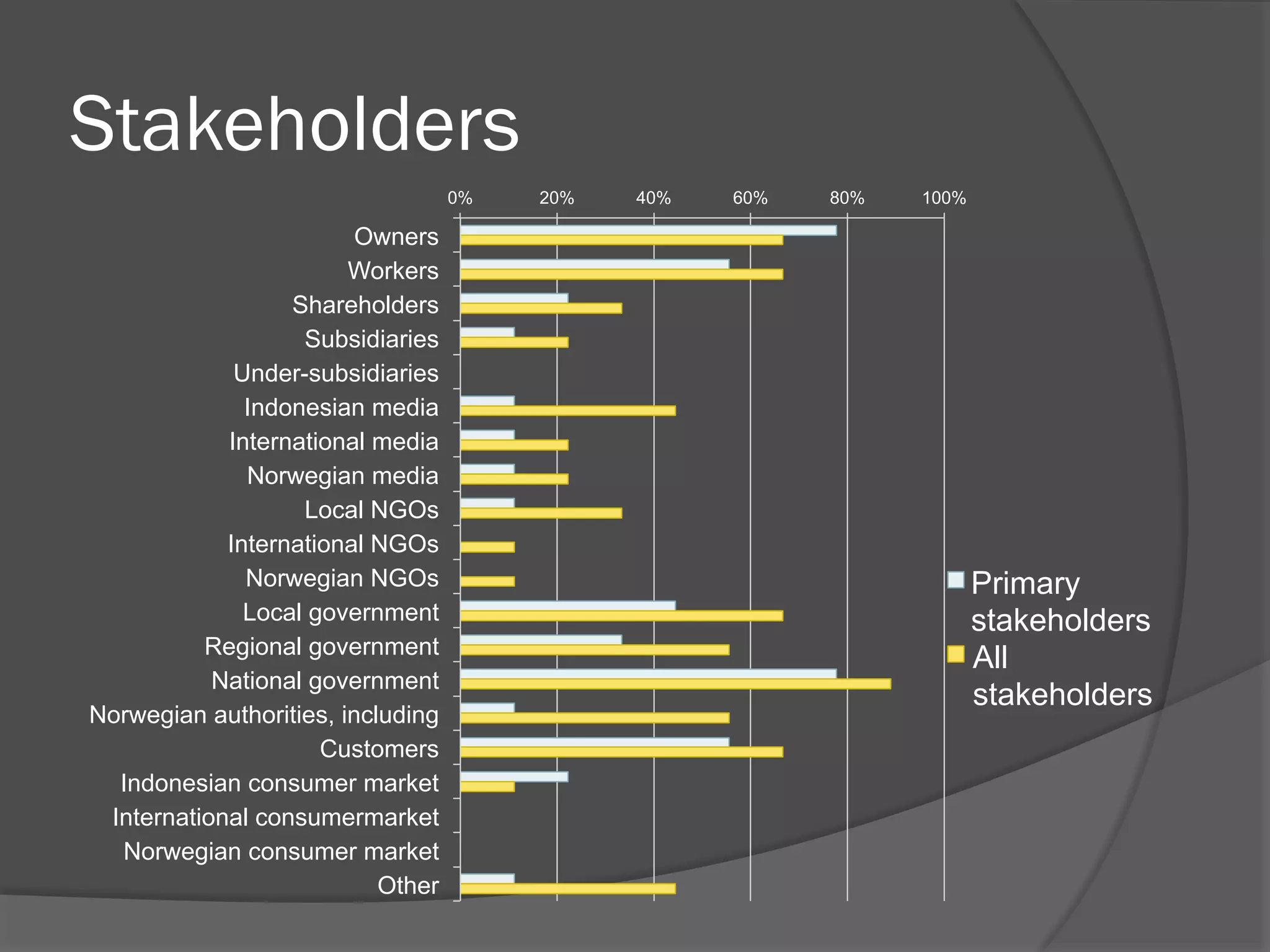
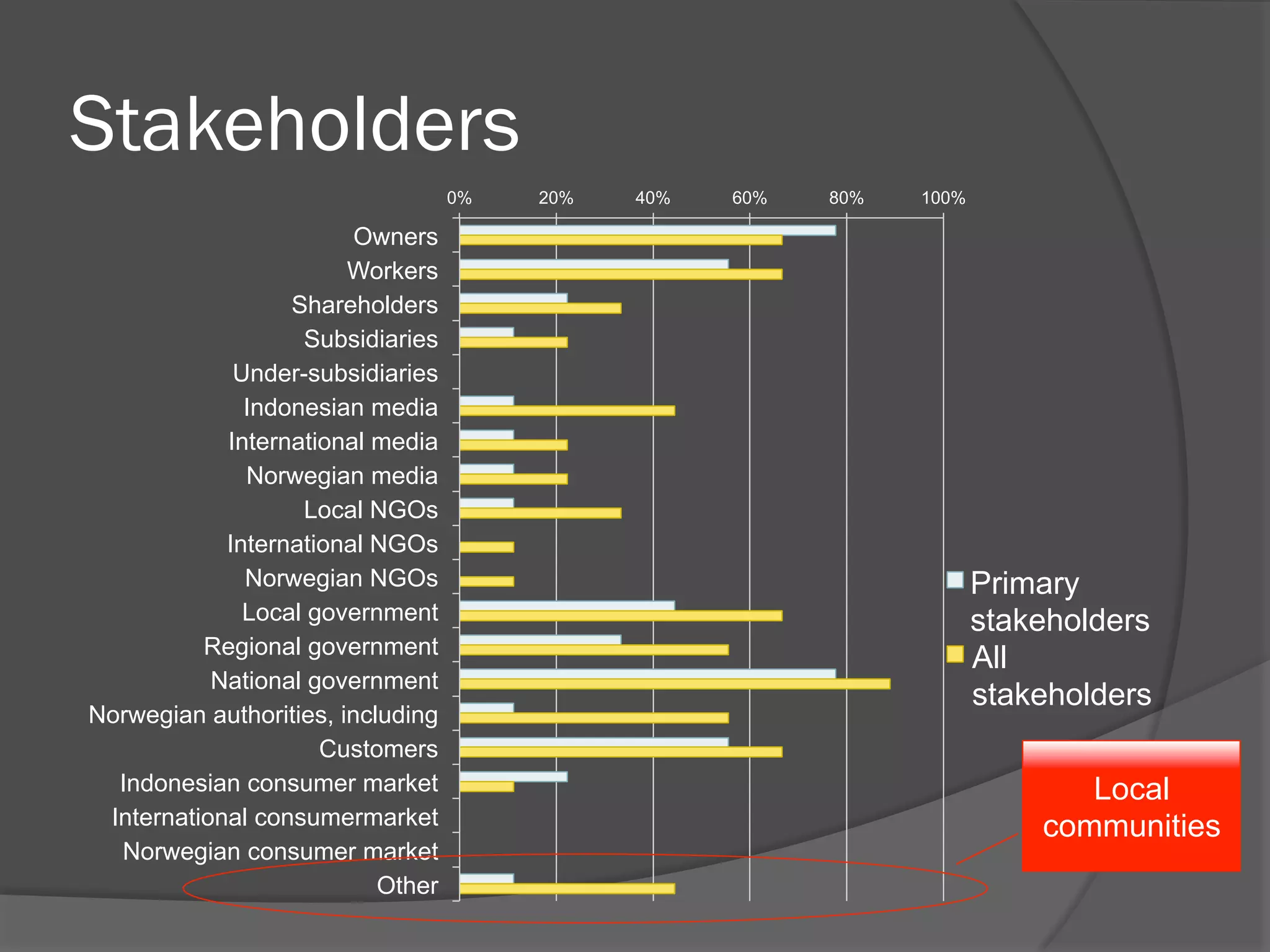
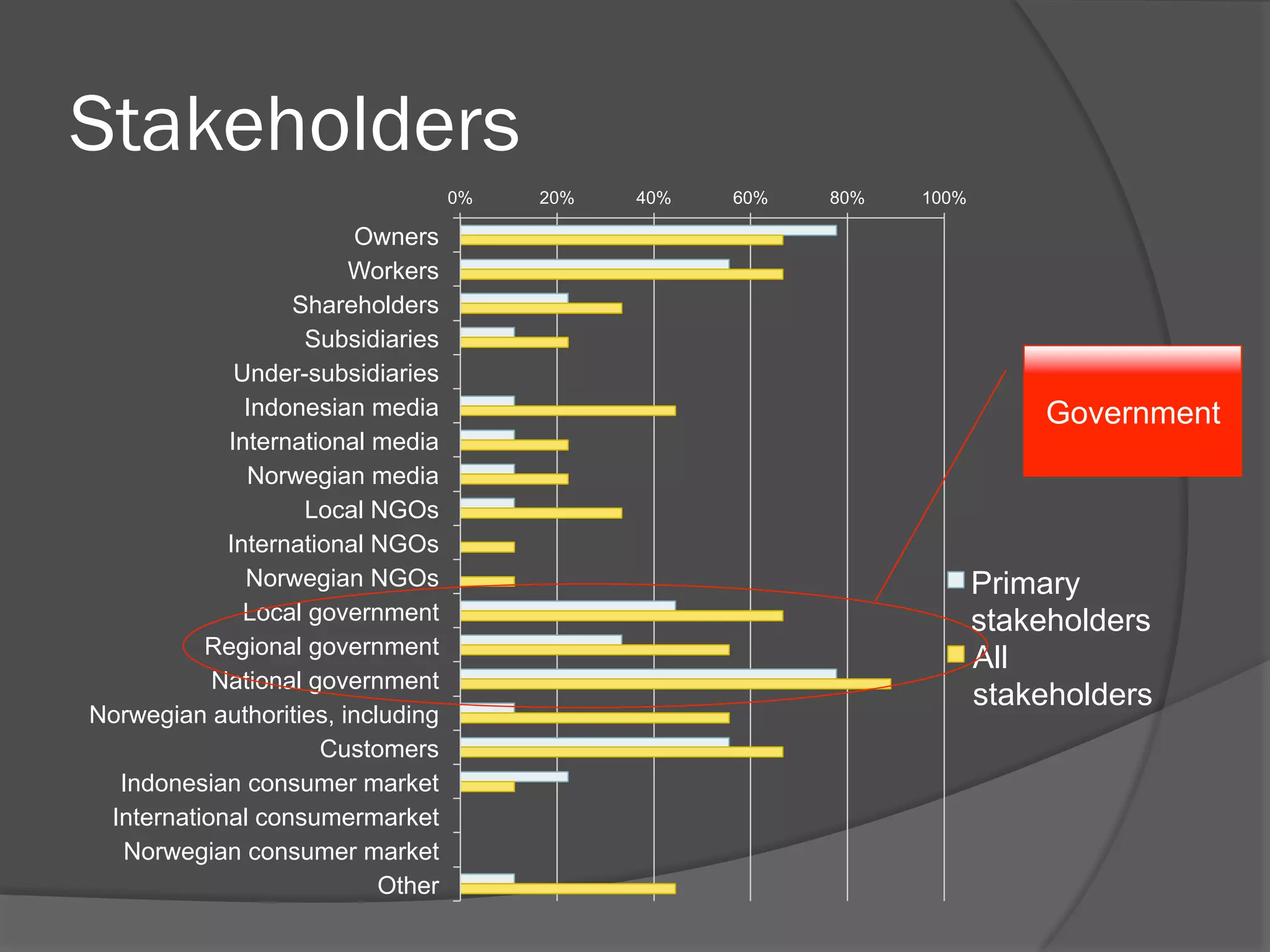
Stakeholders
0%

Owners
Workers
Shareholders
Subsidiaries
Under-subsidiaries
Indonesian media
International media
Norwegian media
Local NGOs
International NGOs
Norwegian NGOs
Local government
Regional government
National government
Norwegian authorities, including
Customers
Indonesian consumer market
International consumermarket
Norwegian consumer market
Other

20%

40%

60%

80%

100%

Primary
stakeholders
All
stakeholders
Stakeholders
0%

Owners
Workers
Shareholders
Subsidiaries
Under-subsidiaries
Indonesian media
International media
Norwegian media
Local NGOs
International NGOs
Norwegian NGOs
Local government
Regional government
National government
Norwegian authorities, including
Customers
Indonesian consumer market
International consumermarket
Norwegian consumer market
Other

20%

40%

60%

80%

100%

Primary
stakeholders
All
stakeholders
Local
communities
Stakeholders
0%

Owners
Workers
Shareholders
Subsidiaries
Under-subsidiaries
Indonesian media
International media
Norwegian media
Local NGOs
International NGOs
Norwegian NGOs
Local government
Regional government
National government
Norwegian authorities, including
Customers
Indonesian consumer market
International consumermarket
Norwegian consumer market
Other

20%

40%

60%

80%

100%

Government

Primary
stakeholders
All
stakeholders
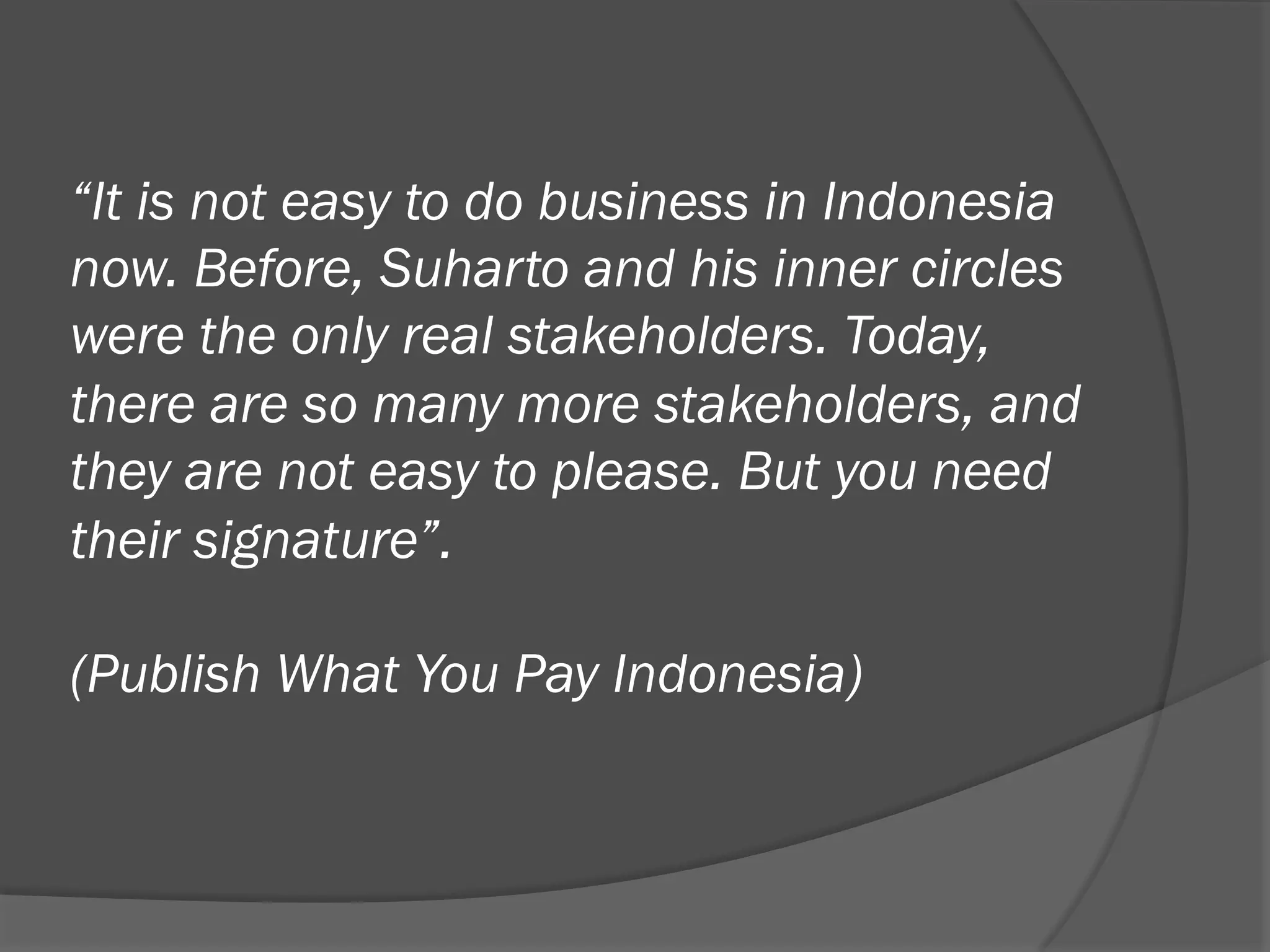
“It is not easy to do business in Indonesia
now. Before, Suharto and his inner circles
were the only real stakeholders. Today,
there are so many more stakeholders, and
they are not easy to please. But you need
their signature”.
(Publish What You Pay Indonesia)
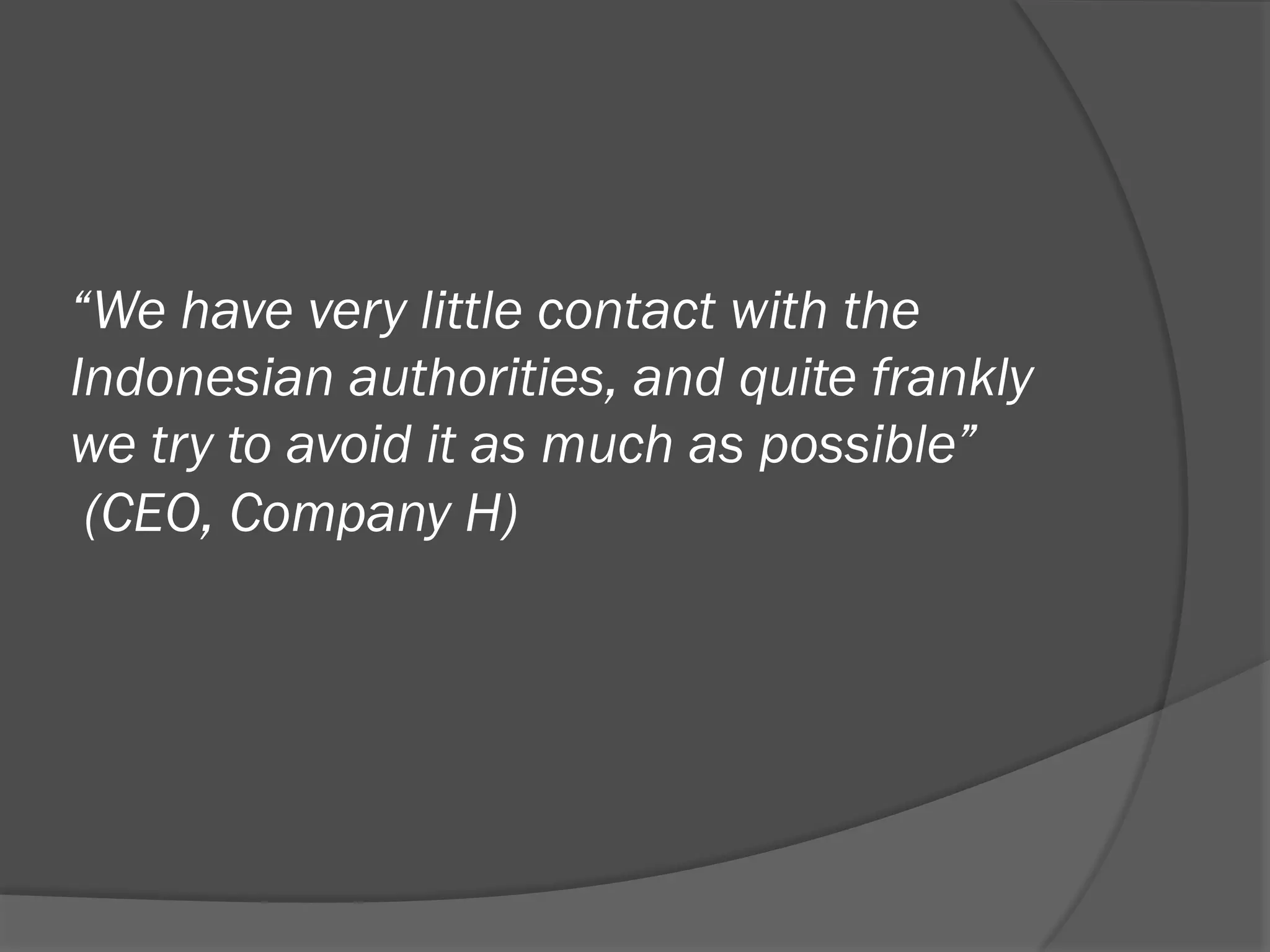
“We have very little contact with the
Indonesian authorities, and quite frankly
we try to avoid it as much as possible”
(CEO, Company H)
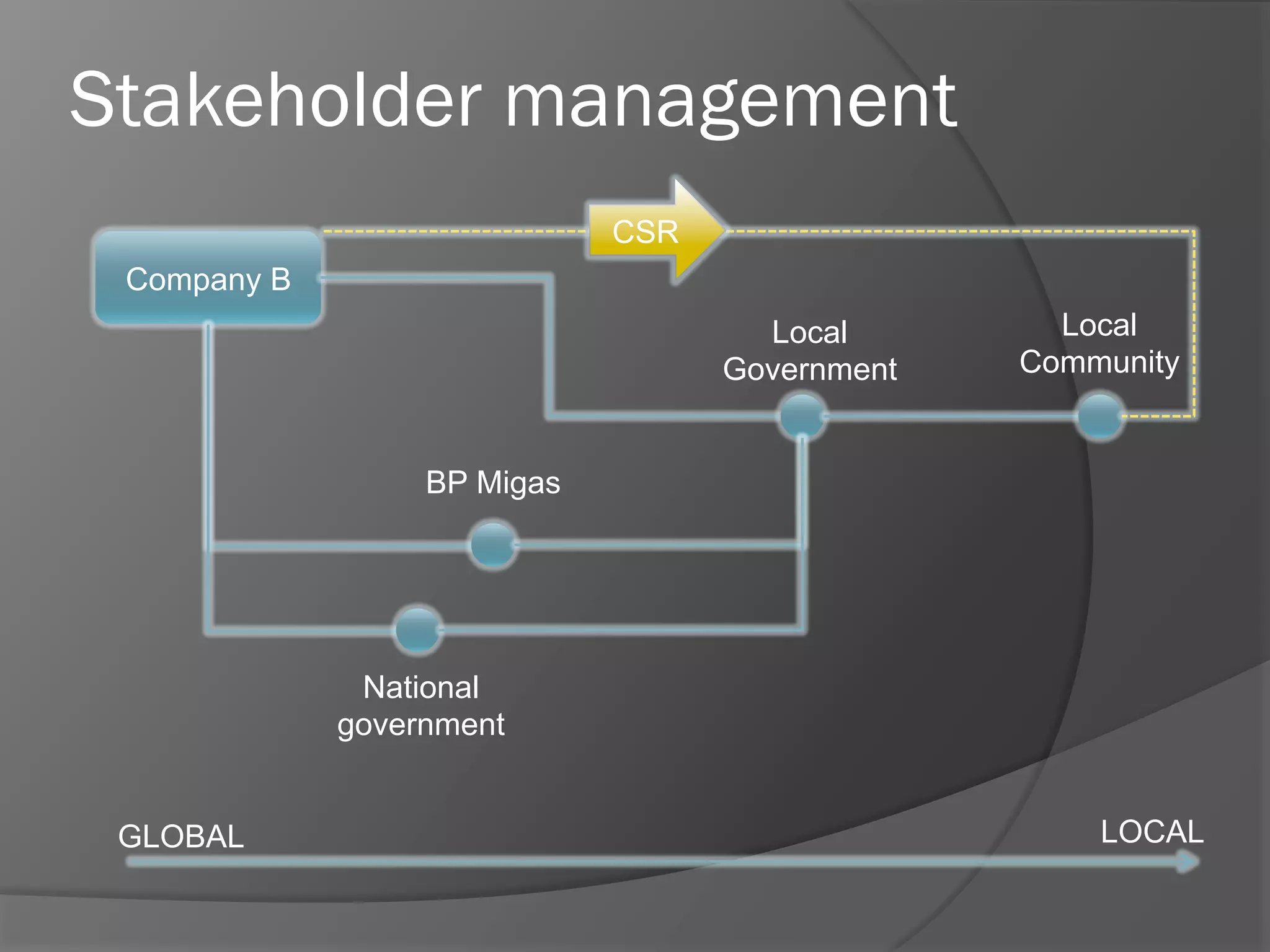
Stakeholder management
CSR
Company B
Local
Government

Local
Community

BP Migas

National
government
GLOBAL

LOCAL
“Sub district head and local government
give positive feedback on projects, and
refers to our company as “best practice” in
meeting with both the local communities
and other stakeholders in the area”
(CSR adviser, Company B)
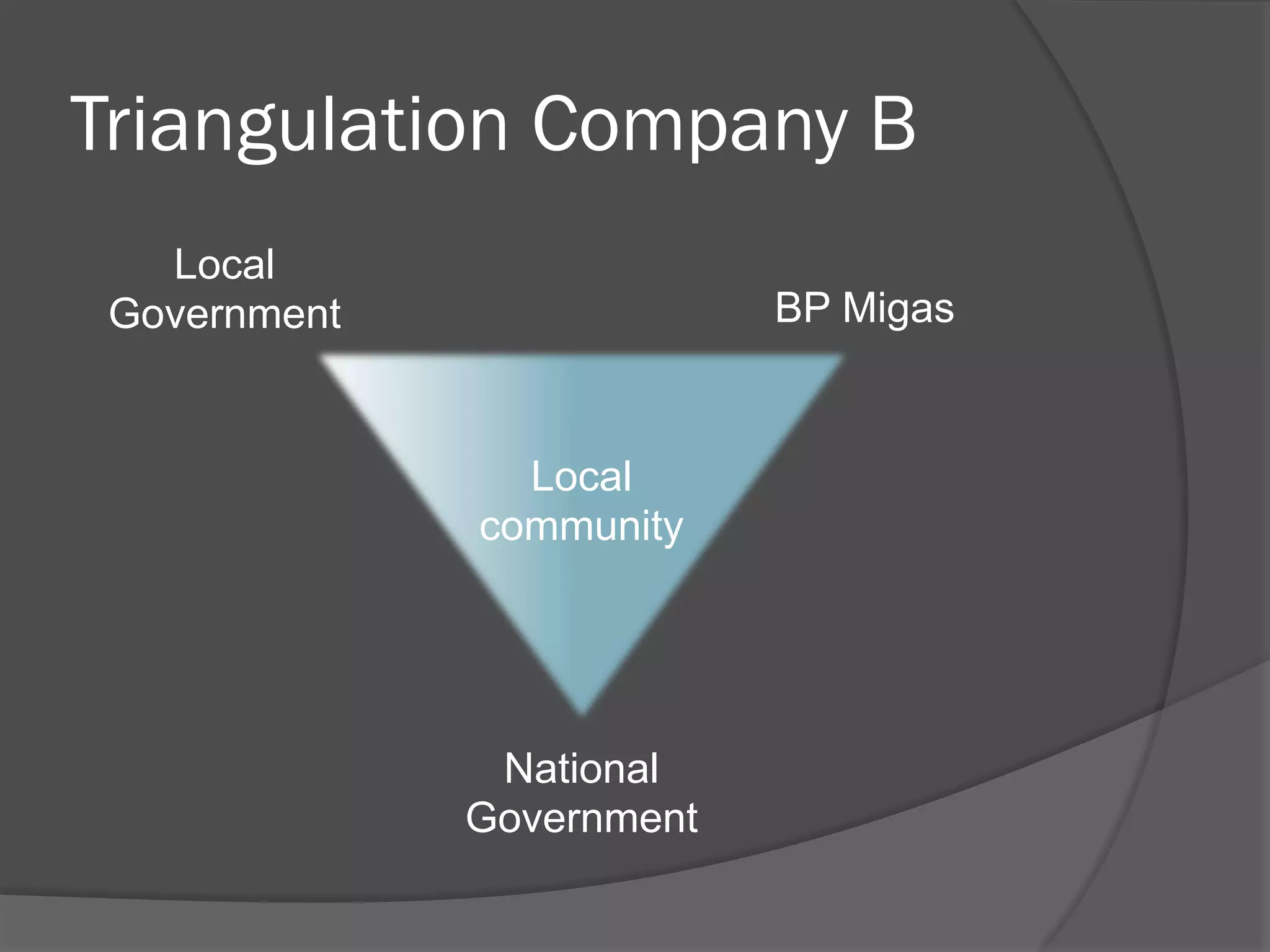
Triangulation Company B
Local
Government

BP Migas

Local Local
Community

community

National
Government
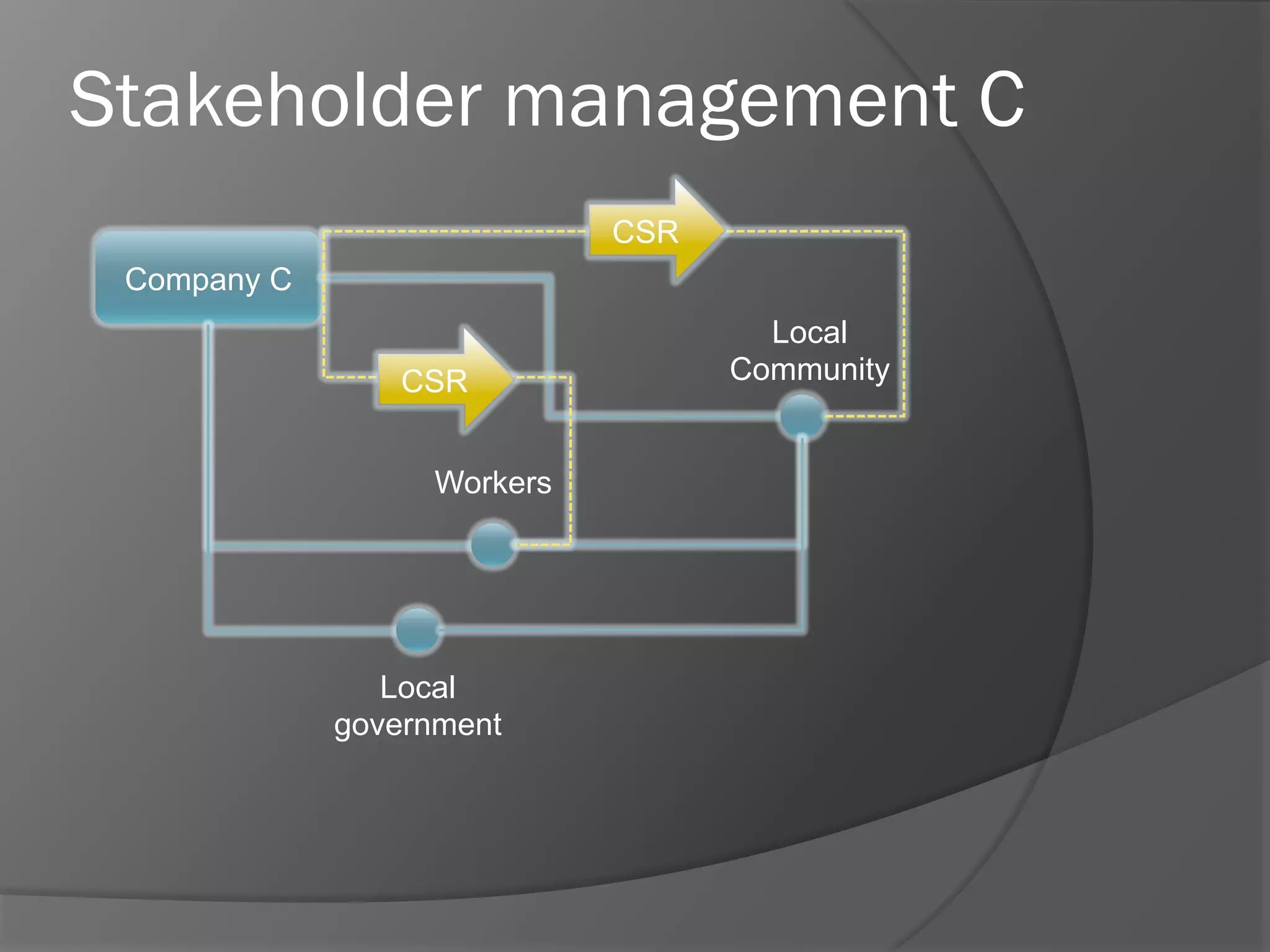
Stakeholder management C
CSR
Company C
CSR
Workers

Local
government

Local
Community
“ Our workers are by far the most
important stakeholder of this company,
together with the surrounding
communities. Our proactive relation to our
workers and their communities gives us
leverage in the re-occurring
demonstrations towards this industrial
estate. Protests have made us proactive”
(CEO, Company C)
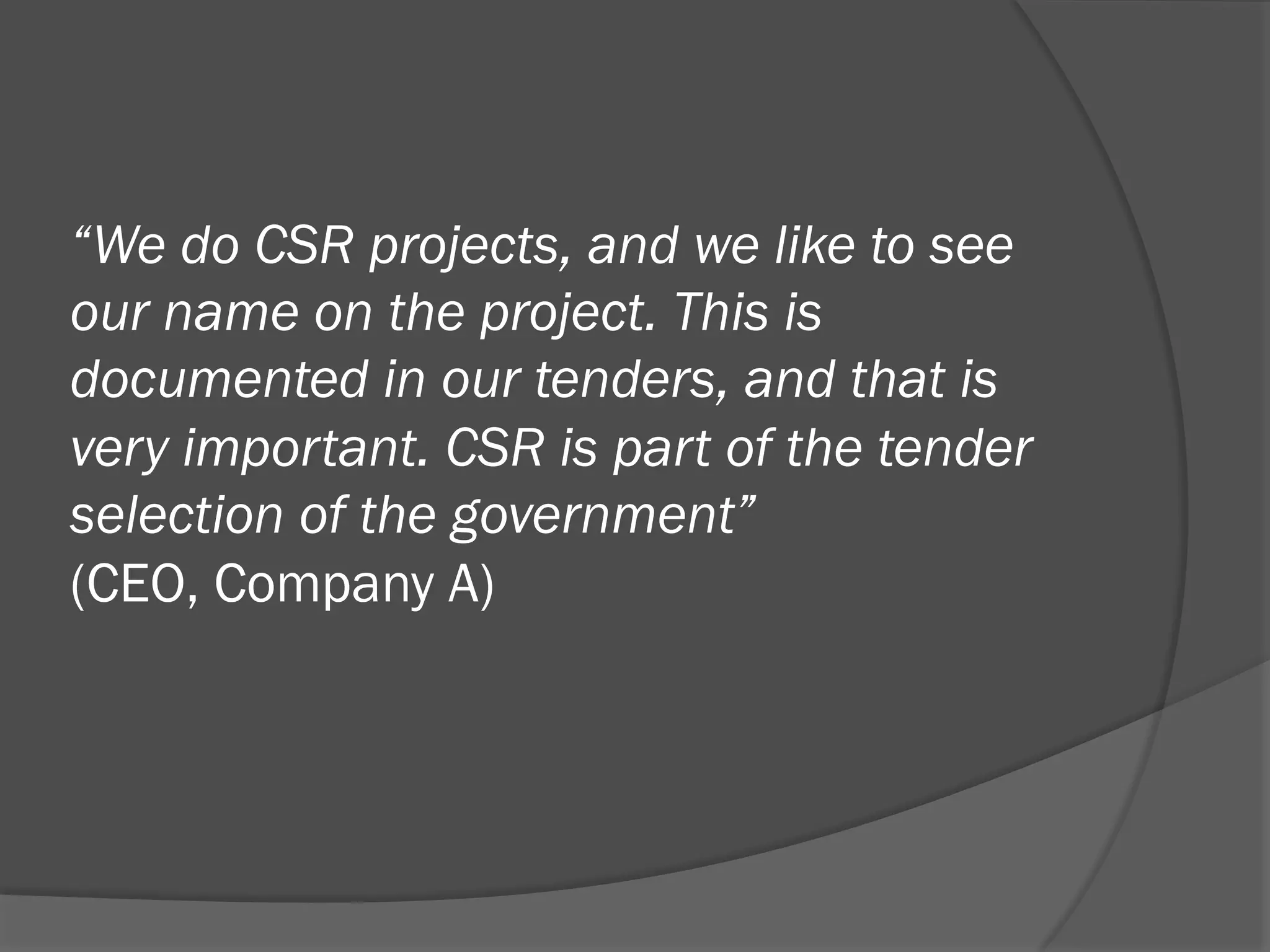
“We do CSR projects, and we like to see
our name on the project. This is
documented in our tenders, and that is
very important. CSR is part of the tender
selection of the government”
(CEO, Company A)
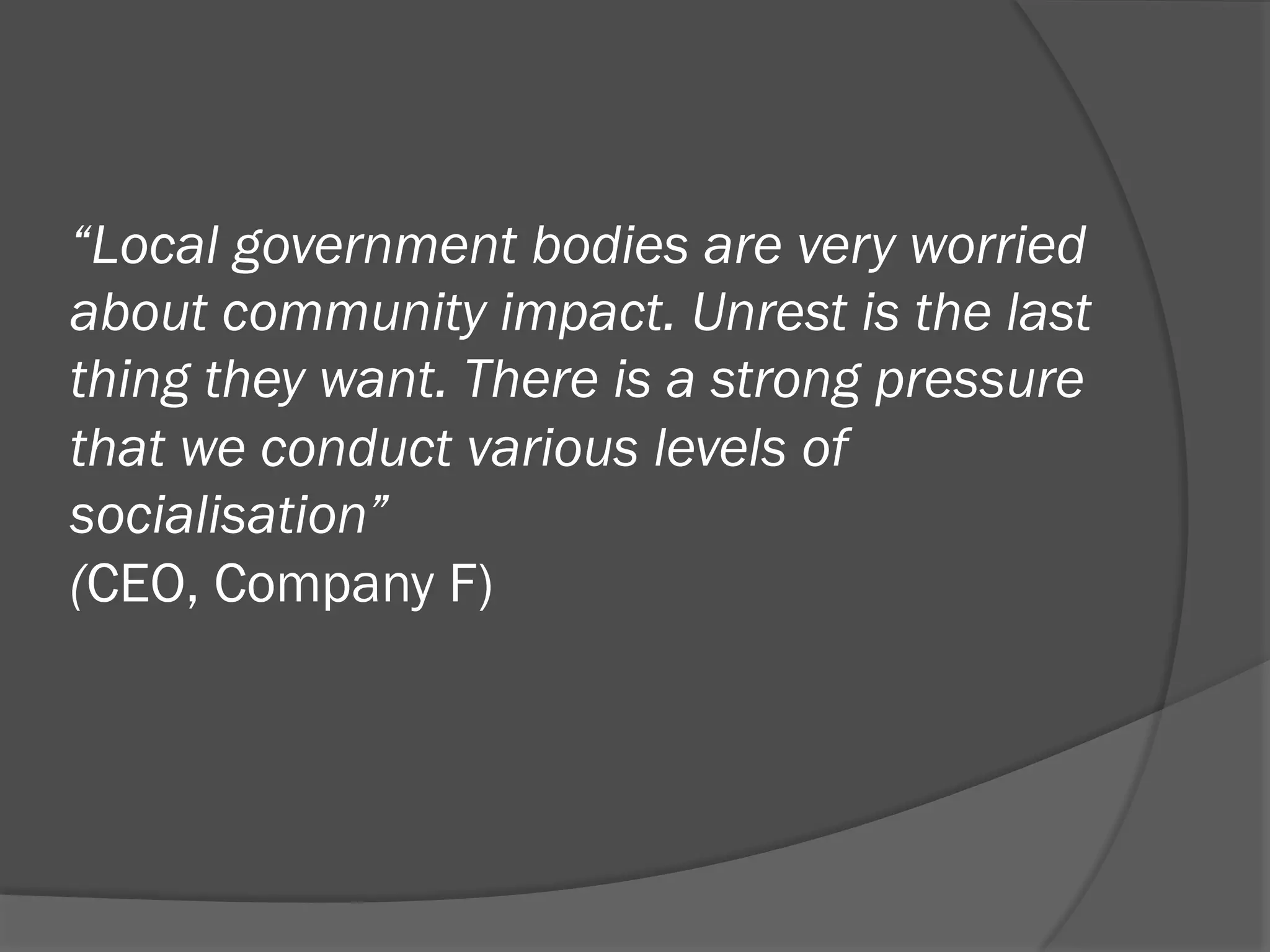
“Local government bodies are very worried
about community impact. Unrest is the last
thing they want. There is a strong pressure
that we conduct various levels of
socialisation”
(CEO, Company F)
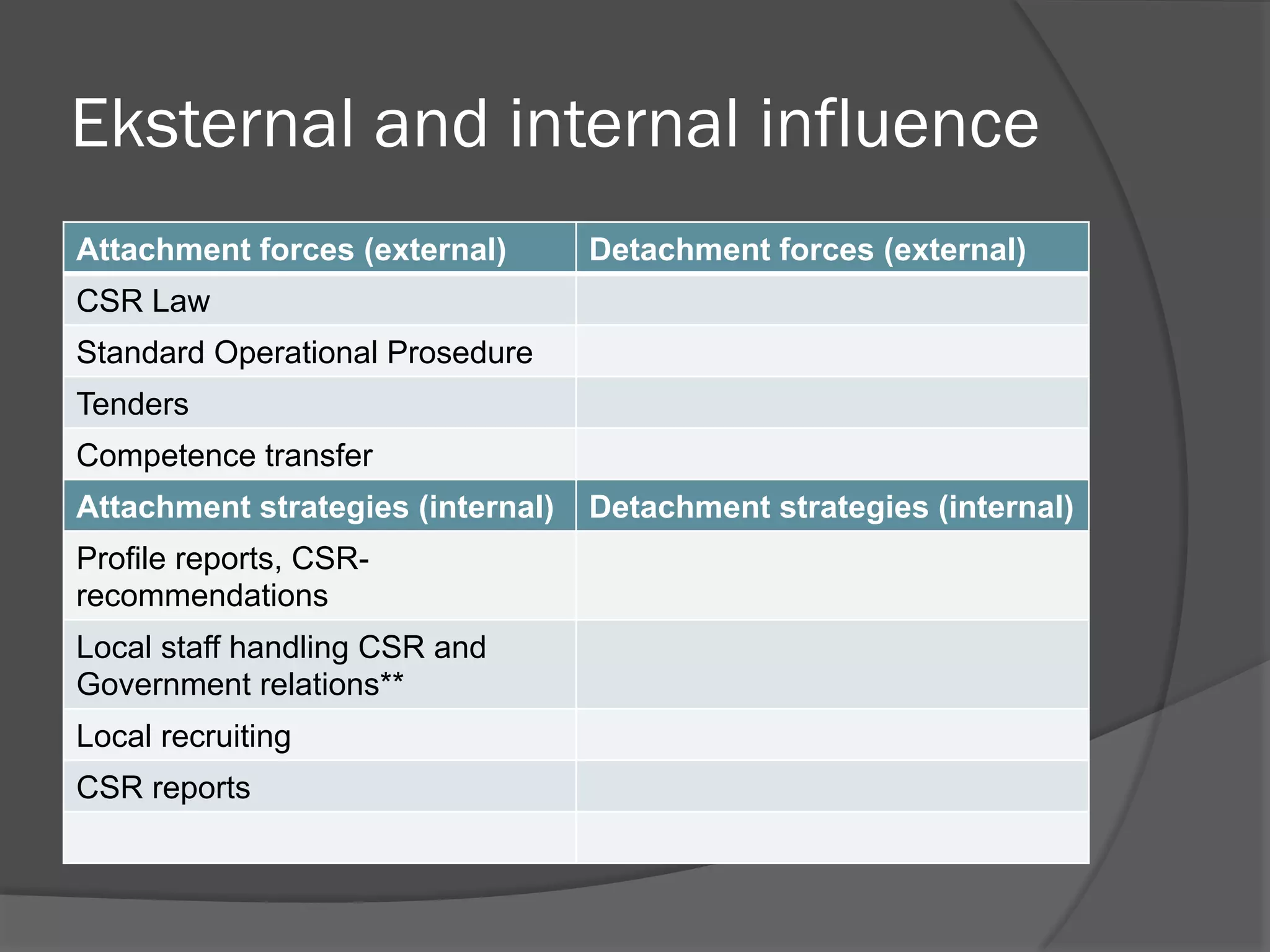
Eksternal and internal influence
Attachment forces (external)

Detachment forces (external)

Attachment strategies (internal)

Detachment strategies (internal)
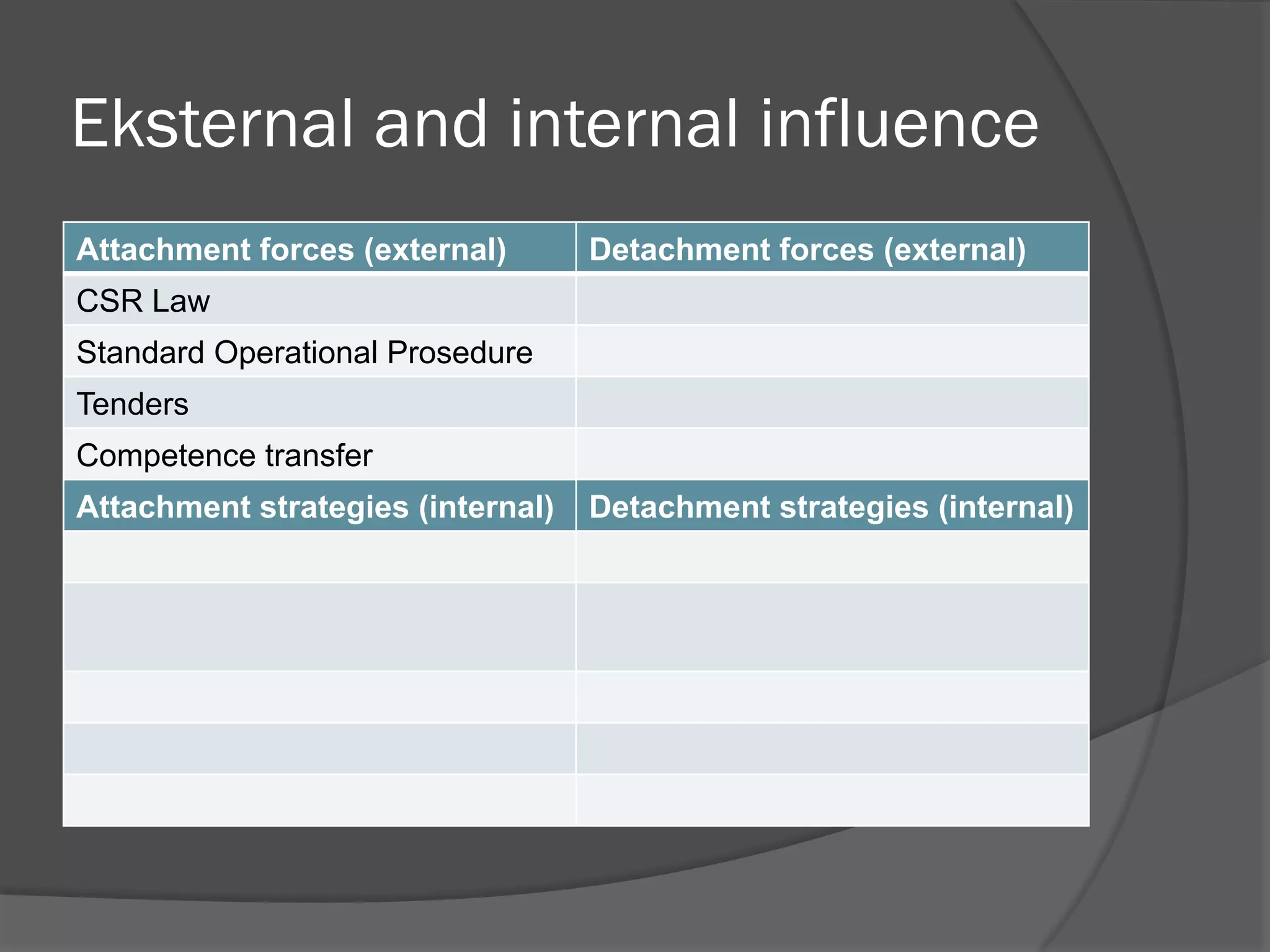
Eksternal and internal influence
Attachment forces (external)

Detachment forces (external)

CSR Law
Standard Operational Prosedure
Tenders
Competence transfer
Attachment strategies (internal)

Detachment strategies (internal)
Eksternal and internal influence
Attachment forces (external)

Detachment forces (external)

CSR Law
Standard Operational Prosedure
Tenders
Competence transfer
Attachment strategies (internal)
Profile reports, CSRrecommendations
Local staff handling CSR and
Government relations**
Local recruiting
CSR reports

Detachment strategies (internal)
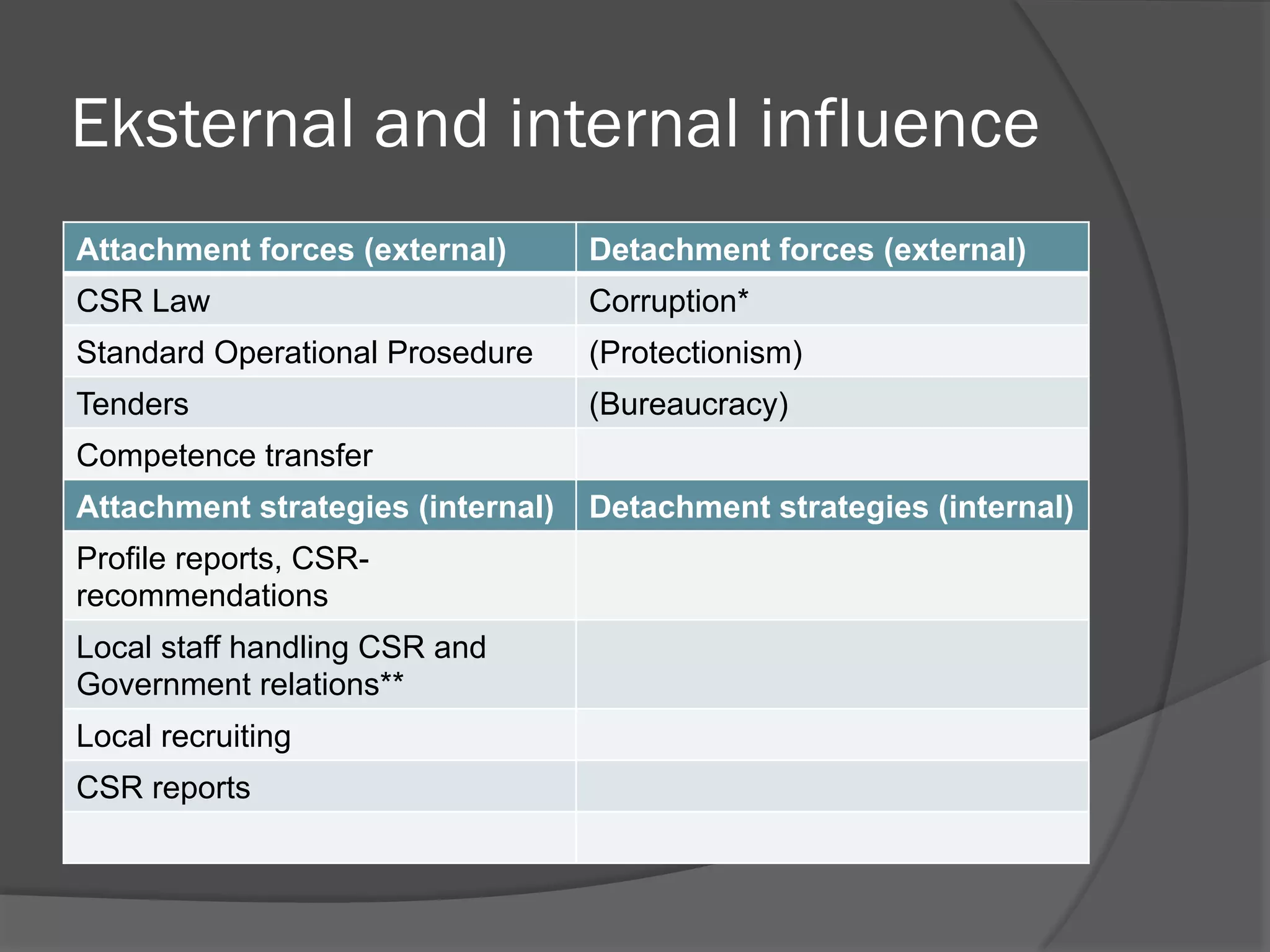
Eksternal and internal influence
Attachment forces (external)

Detachment forces (external)

CSR Law

Corruption*

Standard Operational Prosedure

(Protectionism)

Tenders

(Bureaucracy)

Competence transfer
Attachment strategies (internal)
Profile reports, CSRrecommendations
Local staff handling CSR and
Government relations**
Local recruiting
CSR reports

Detachment strategies (internal)
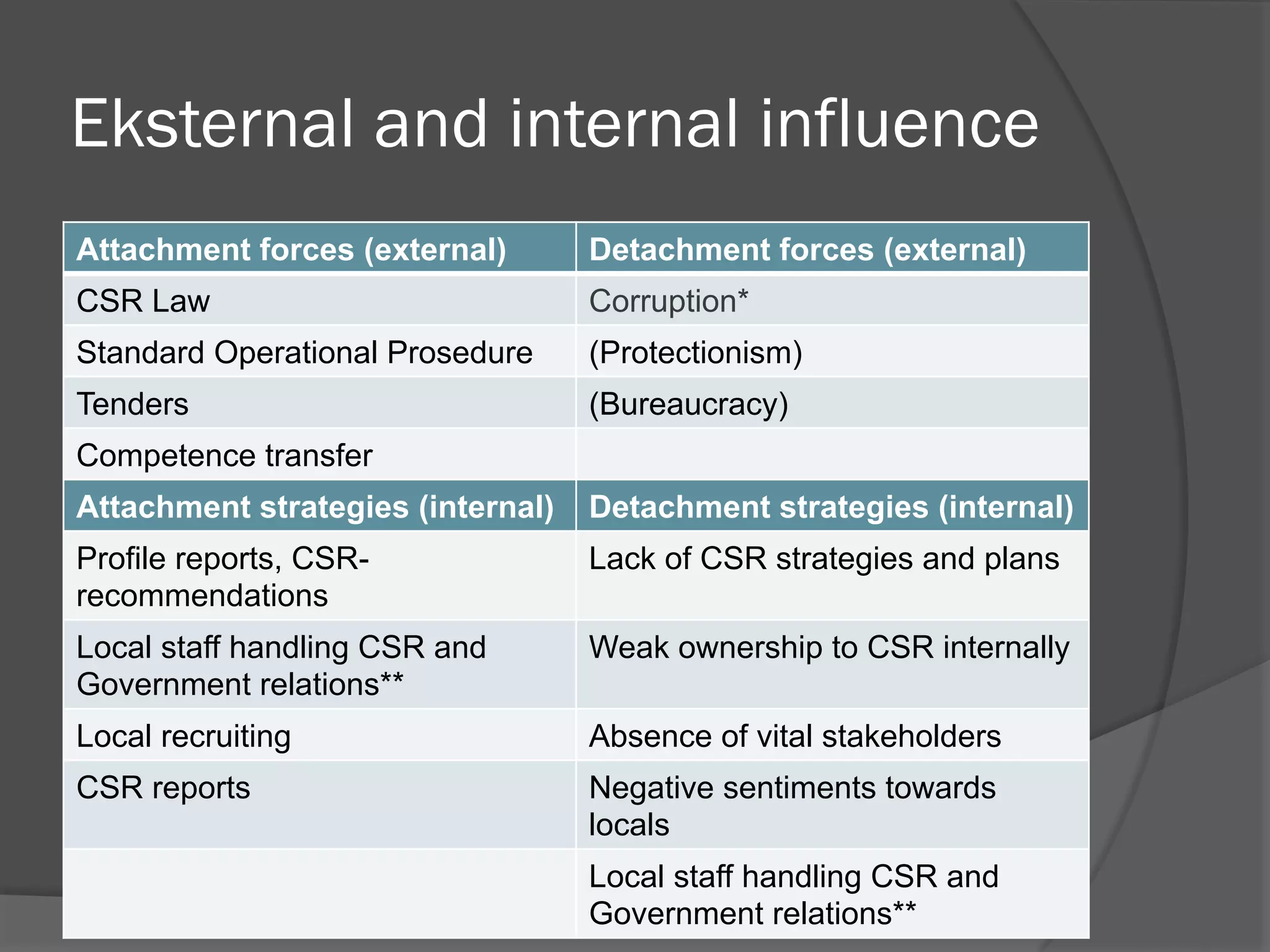
Eksternal and internal influence
Attachment forces (external)

Detachment forces (external)

CSR Law

Corruption*

Standard Operational Prosedure

(Protectionism)

Tenders

(Bureaucracy)

Competence transfer
Attachment strategies (internal)

Detachment strategies (internal)

Profile reports, CSRrecommendations

Lack of CSR strategies and plans

Local staff handling CSR and
Government relations**

Weak ownership to CSR internally

Local recruiting

Absence of vital stakeholders

CSR reports

Negative sentiments towards
locals
Local staff handling CSR and
Government relations**
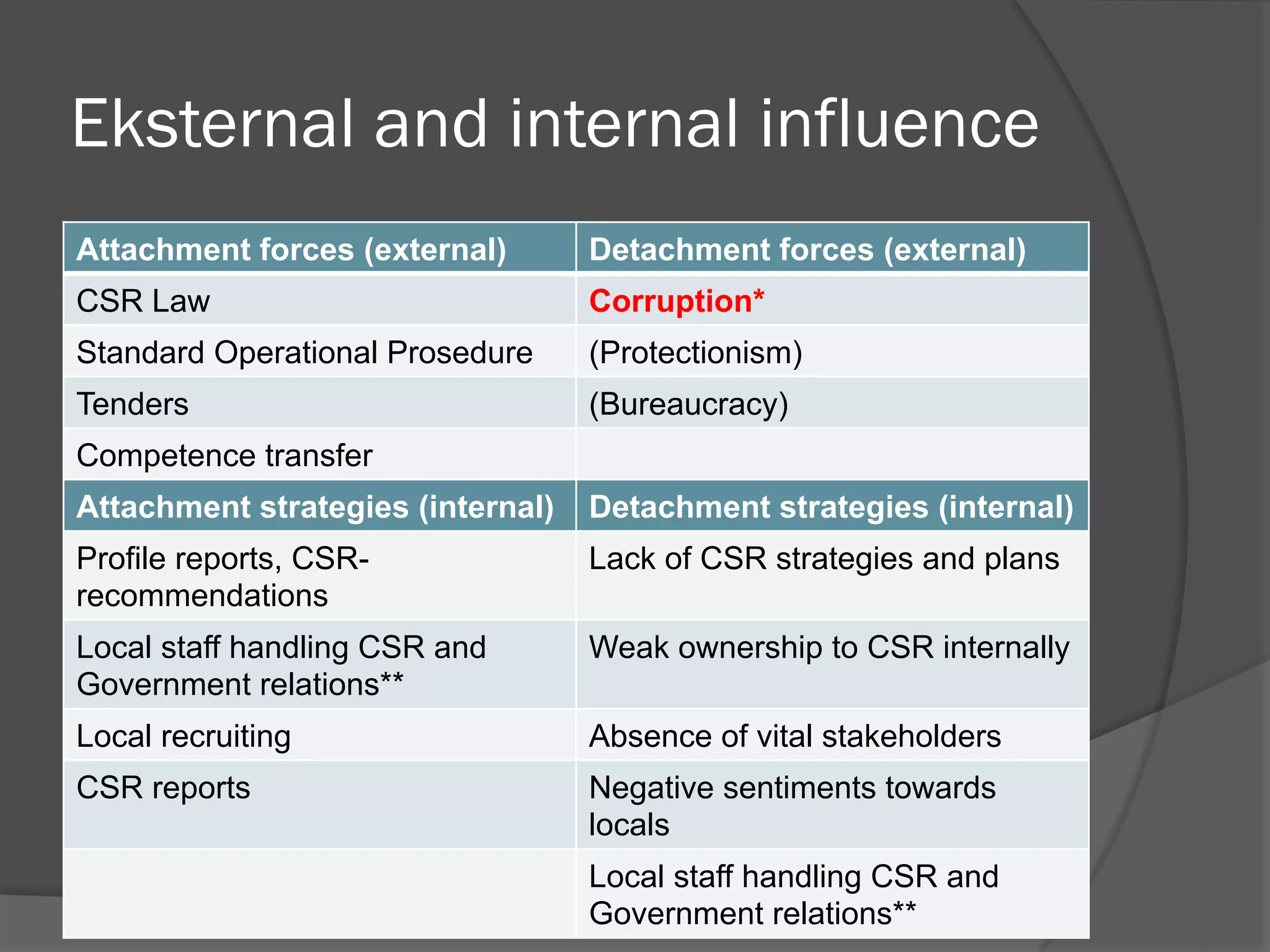
Eksternal and internal influence
Attachment forces (external)

Detachment forces (external)

CSR Law

Corruption*

Standard Operational Prosedure

(Protectionism)

Tenders

(Bureaucracy)

Competence transfer
Attachment strategies (internal)

Detachment strategies (internal)

Profile reports, CSRrecommendations

Lack of CSR strategies and plans

Local staff handling CSR and
Government relations**

Weak ownership to CSR internally

Local recruiting

Absence of vital stakeholders

CSR reports

Negative sentiments towards
locals
Local staff handling CSR and
Government relations**
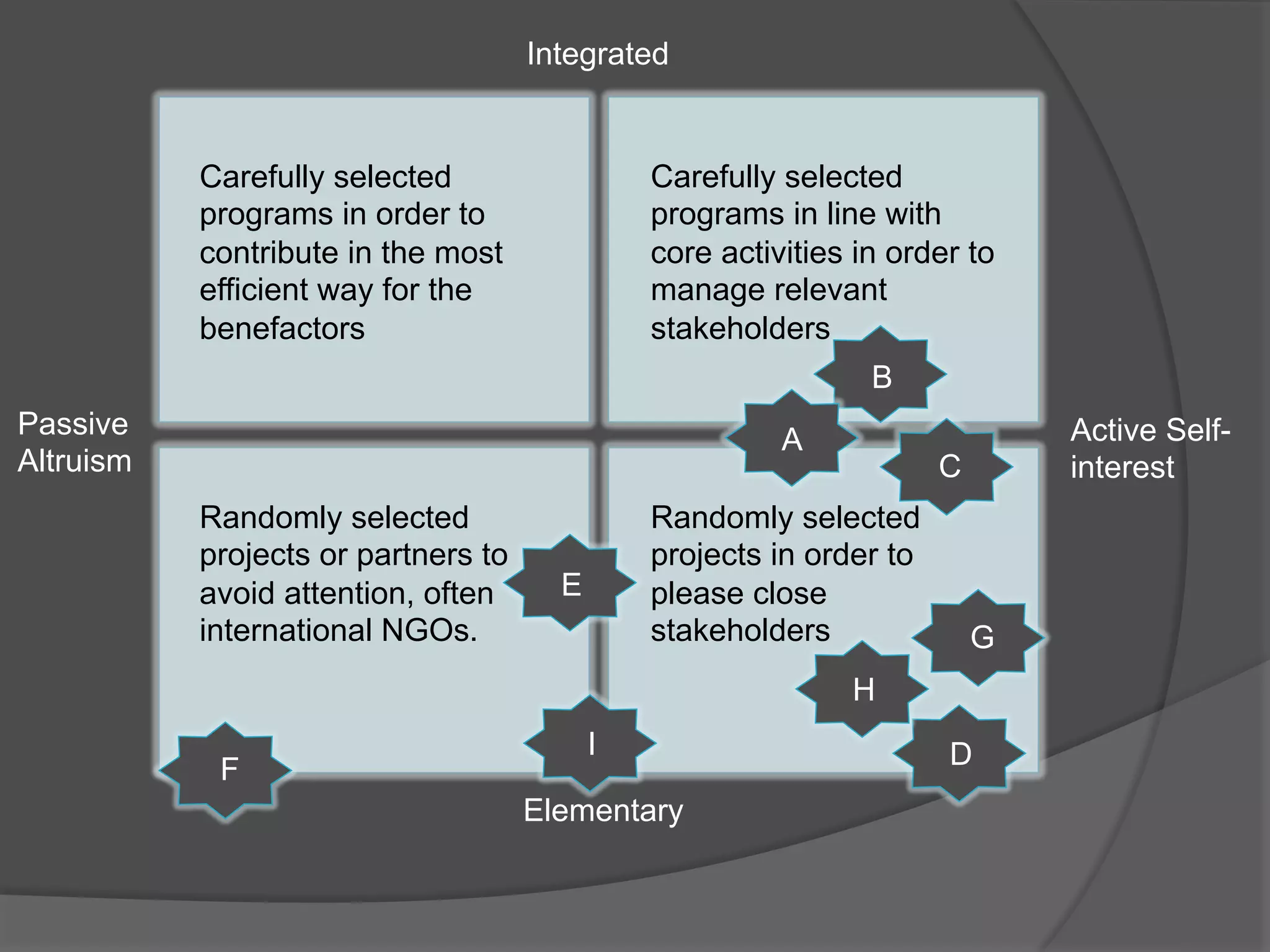
Stages of Corporate Citizenship
Elementary

Engaged

Innovative

Integrated

Transforming

B
C
A
E
G
H
D
I
F

(“The Paradoxes in Communicating Corporate Social Responsibility,” Sandra Waddock and Bradley K. Googins in “The Handbook of Communication and Corporate
Social Responsibiliy” – Øivind Ihnen, Jennifer L. Bartlett and Steve May [eds.], 2011)
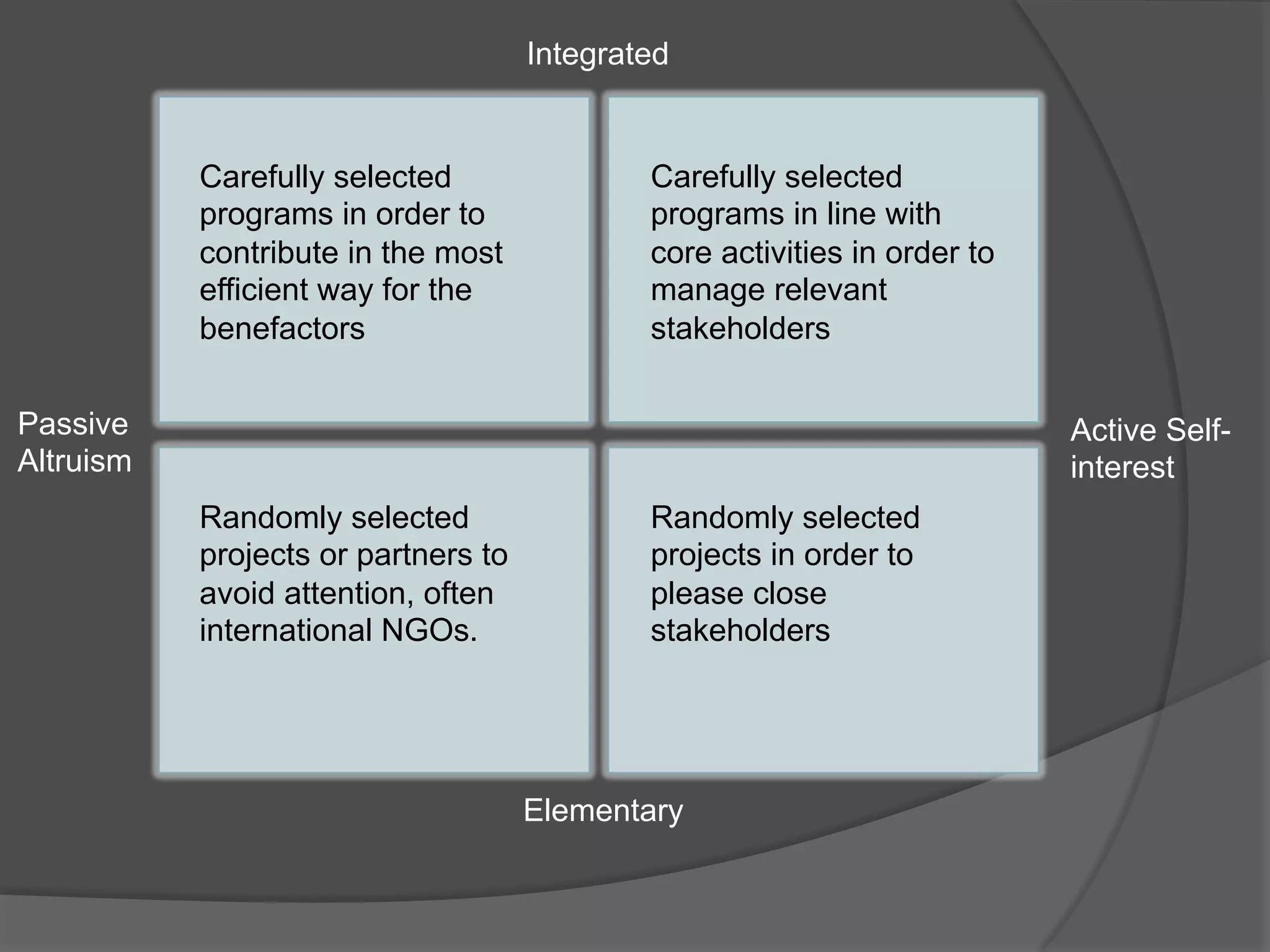
Integrated

Carefully selected
programs in order to
contribute in the most
efficient way for the
benefactors

Carefully selected
programs in line with
core activities in order to
manage relevant
stakeholders

Passive
Altruism

Active Selfinterest
Randomly selected
projects or partners to
avoid attention, often
international NGOs.

Randomly selected
projects in order to
please close
stakeholders

Elementary
Integrated

Carefully selected
programs in line with
core activities in order to
manage relevant
stakeholders

Carefully selected
programs in order to
contribute in the most
efficient way for the
benefactors

B
Passive
Altruism

A
Randomly selected
projects or partners to
avoid attention, often
international NGOs.

C

Randomly selected
projects in order to
please close
stakeholders

E

Active Selfinterest

G

H
F

I
Elementary

D
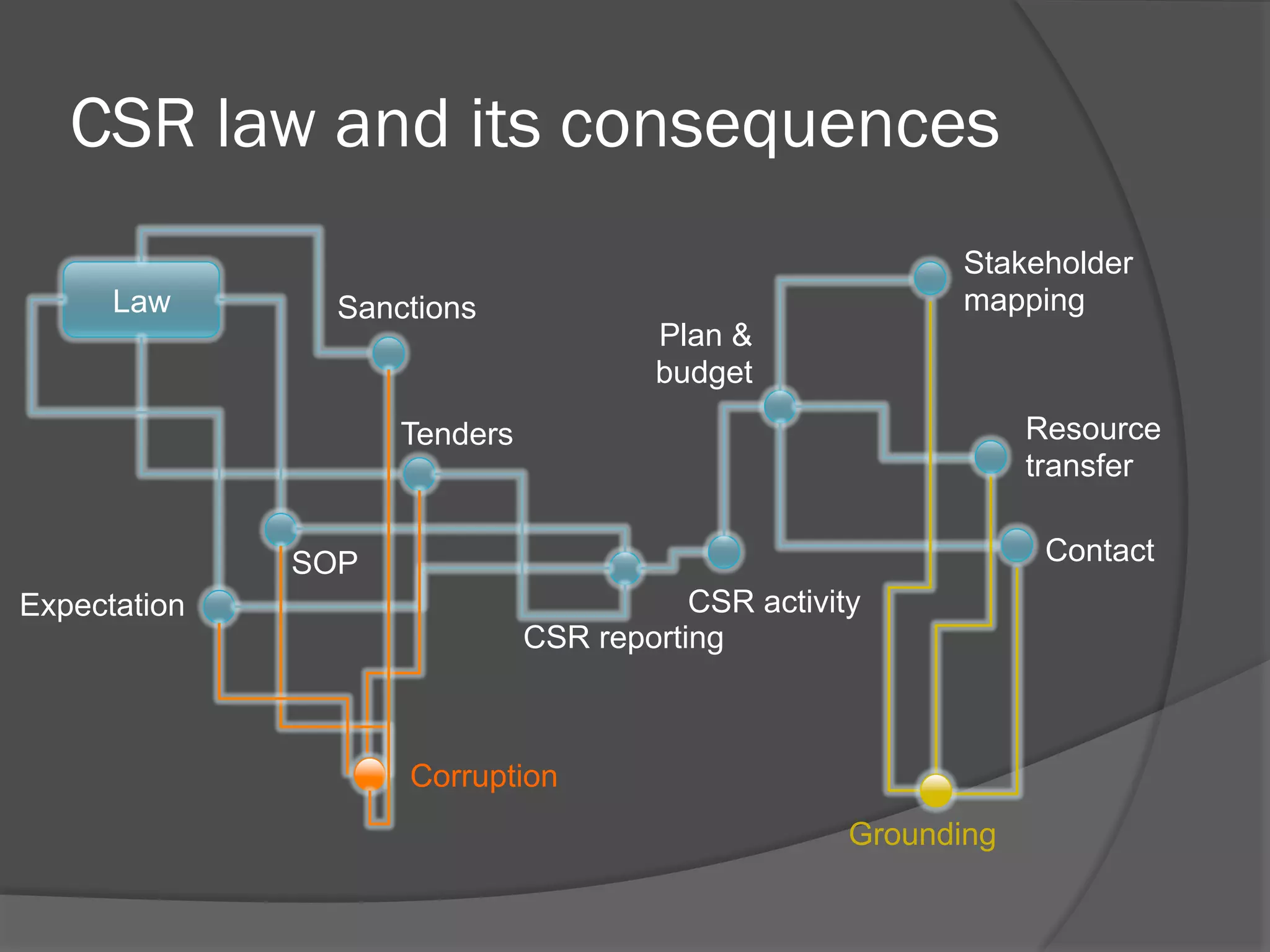
CSR law and its consequences
Law

Sanctions

Stakeholder
mapping

Plan &
budget

Resource
transfer

Tenders

Contact

SOP
Expectation

CSR activity
CSR reporting

Corruption
Grounding
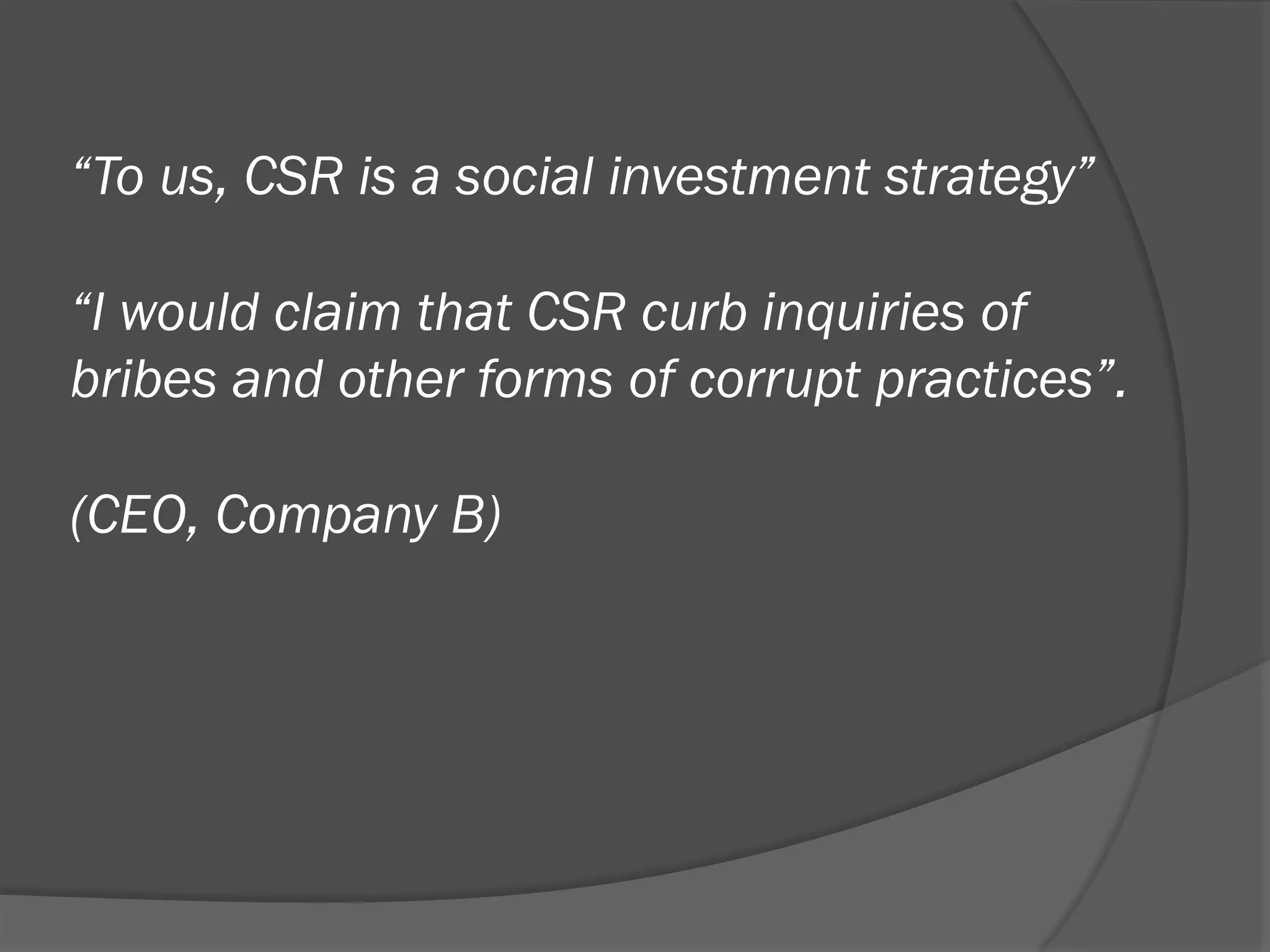
“To us, CSR is a social investment strategy”
“I would claim that CSR curb inquiries of
bribes and other forms of corrupt practices”.
(CEO, Company B)
Research questions
Can Corporate Social Responsibility work
as a catalyst for grounding foreign
companies to local communities in
Indonesia?
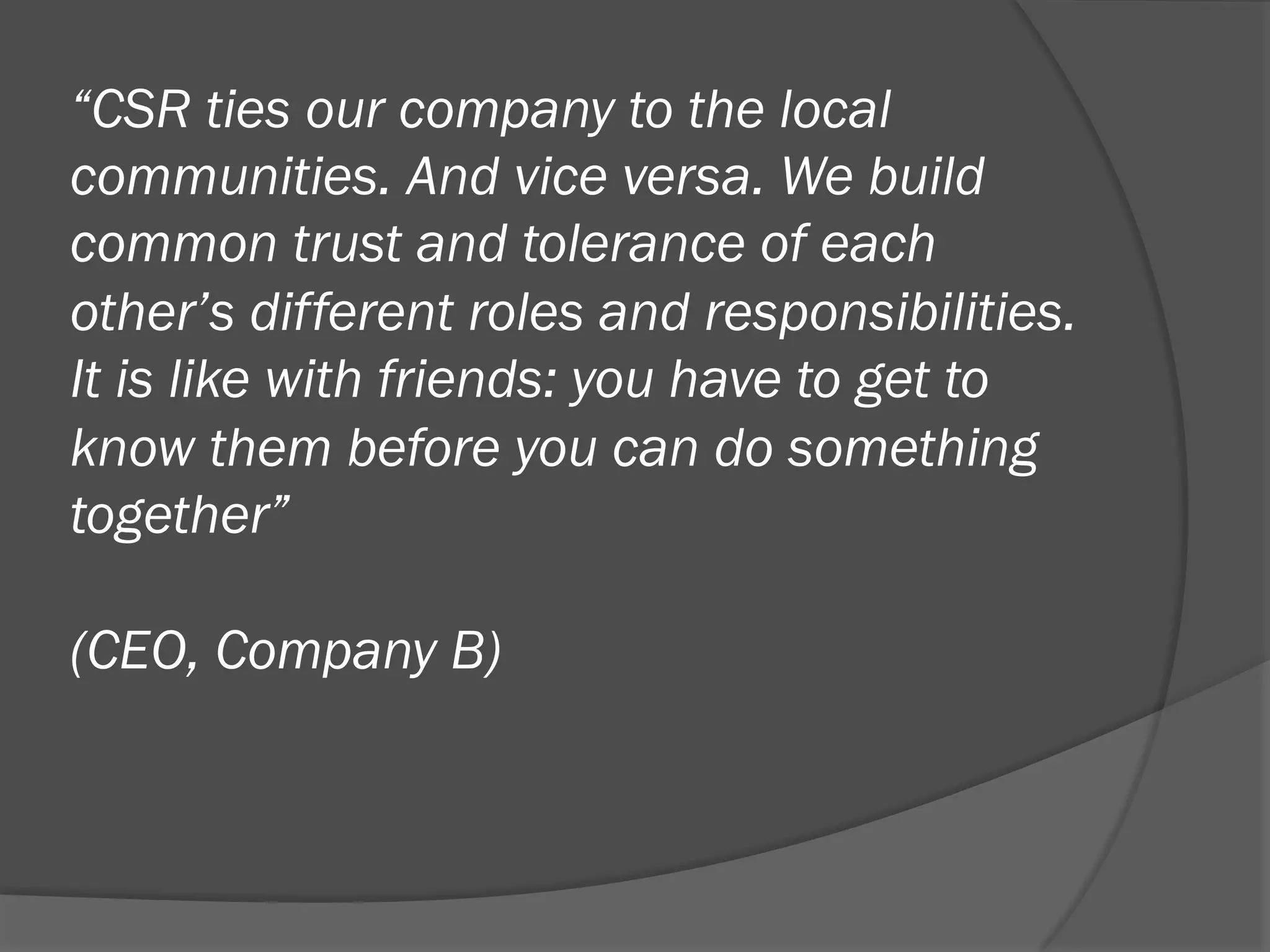
“CSR ties our company to the local
communities. And vice versa. We build
common trust and tolerance of each
other’s different roles and responsibilities.
It is like with friends: you have to get to
know them before you can do something
together”
(CEO, Company B)
Thank you for your attention!
Tarje I. Wanvik
tarje.wanvik@geog.uib.no
+47 970 70 987

Globalisation and CSR - grounding of Norwegian companies in local context

  • 1.
    Grounding of globalbusiness – the case of Norwegian companies in Indonesia Tarje I. Wanvik
  • 2.
    Background !  1990s: mobilisation withinhumanitarian student organisation !  2000s: Head of advocacy division: campaign activist with speciality within CSR and corporate conduct in poor countries: "  Coffee, water, sugar, agriculture "  Weapon production, export and marking/tracing "  Textile "  Trade rules and regulations, foreign debt, !  2008-2010: private business, focus på CSR consulting and strategy development communication and fund raising. !  2011-2013: Master in Geography: CSR and Norwegian companies in Indonesia
  • 3.
  • 4.
    “Anything can belocated anywhere”
  • 5.
    “Every firm, everyeconomic function is – quite literally, grounded in specific locations”
  • 6.
    Motivation Access to (cheap)semi skilled / skilled labour Access to cheap unskilled labour Access to Indonesian / South East Asian consumer market Access to natural resources Profitable regulatory framework
  • 7.
    “Localised” risks 0% Corruption Bureaucracy Political instability Economicinstability Regulatory issues Safety issues Environmental issues Workers rights' issues Competition issues Other 20% 40% 60% 80% 100% 120%
  • 8.
    “Localised” risks 0% Corruption Bureaucracy Political instability Economicinstability Regulatory issues Safety issues Environmental issues Workers rights' issues Competition issues Other 20% 40% 60% 80% 100% 120%
  • 9.
    Presentation, part 1 !  Researchquestions !  Empirical and theoretical sources and definitions Part 2 !  What do I see? (CSR law, CSR practice) !  Why do I see this? (motivation, target groups, objectives) !  Discussion: attachment versus detachment forces and strategies and grounding effects.
  • 10.
    Research question Can CorporateSocial Responsibility work as a catalyst for grounding foreign companies to local communities in Indonesia?
  • 11.
    Empirical sources 1.  CSR lawof 2007, article 74 2.  9 Norwegian companies and their CSR activities 3.  Stakeholders and other relevant actors 4.  Documents: web pages, articles, internal presentations, strategy papers, evaluations etc.
  • 12.
    Theoretical entry points ! Theories of place and globalisation !  Network and power theory !  CSR and stakeholder theory
  • 13.
    What is place? !  Three-partdefinition of place (Agnew) "  Location (where; longitude, latitude, relative) "  Locale (what; material context of social life: buildings, roads, parks, fields, social relations) "  Sense of place: (how; the way in which place is given meaning) !  Place interweaves all three realms and cannot be reduced to any of them (Sack)
  • 14.
    Community = place ! Many spatial corresponding characteristics: "  Tolerance (Walzer 1997) "  Reciprocity (Putnam 2000) "  Trust (Grimen 2009) !  Closely linked to Social Capital (Bourdieu 1991): "  Networks, norms and trust facilitate cooperation
  • 15.
    Space vs Place ! Investing in a place (Tuan)
  • 16.
    Assemblages !  Assemblages (DeLanda 2006) " Material, immaterial and representational "  Components brought together "  Product of historical process "  Unique and singular individuals (communities, organisations, atoms, species, ecosystems etc.) "  Own capacities and tendencies: new parts can enter, assemblage can constitute new relations
  • 17.
    Assemblages Connects material toexpressive !  Connects territorialisation with deterritorialisation !  Places have !  "  Material aspects (topography, texture) "  Expressive aspects (sense of place) "  Territorial aspects (political boundaries, labelling, mapping, place promotion, naming etc.) "  De-territorial aspects (capital flight, communication tech, mobility)
  • 18.
    Harmony VS Conflict ! Putnam criticised !  Place is ”saturated with notions of power” (Cresswell 2011, Amin 2002) !  A zero sum-geography: centre-periphery (Ong, Massey)
  • 19.
    What is power? ! Reward power !  Coercive power !  Legitimate power "  Position "  Reciprocity "  Equity "  Responsibility !  Referent / Expert power
  • 20.
    Power as potential ! Possessed by virtue, by role or organisation (Norwegian companies by default in Indonesia) !  Zero-Sum games and spatial division of power (Massey, Allen) !  Scales (Global vs local) !  Not all places can be winners
  • 21.
    Power as mobilisingof resources !  Power is a resource to achieving diverse ends (Allen, Giddens, Thrift) !  Power to, not power over !  Pooling of resources !  Power as a fluid medium !  Power as a networked concept (Amin and Thrift 1994)
  • 22.
    What is astakeholder? !  critical to the company's goals, either directly or indirectly !  directly or indirectly affected by the company’s operations, and !  form the social and geographical framework that companies operate within. !  Critical issue: power relation between stakeholder and company
  • 23.
  • 24.
    Primary or secondary hasbeen drawn according to Freeman to show that there are no possible linkages by arrows between external stakeholders and a “firm” (Fassin 2008). Governments Environmentalists Local Community Organizations Environmentalists Owners NGOs Suppliers Financiers Consumer Advocates Suppliers Suppliers Employees Financiers Governments NGOs Firm Firm Environmentalists Governments Employees Customers Company using CSR Customers Customers Competitors SIG Employees Media Figure 3 Stakeholder view of firm (Freeman 1984, p.25) Critics Communities Media Communities Critics Others Others Figure 4 Freemans adapted version of the stakeholder model from 2003 (Fassin 2008, p.115) According to Freeman (1984) the aim of the stakeholder theory is to improve the nderstanding and relationship between a company and its stakeholders. If aCarroll (Nygaard & Bengtsson 2002) among others (Grafstöm et al 2008) divide a compacompany’s stakeholders into primary and secondary groups, whereas the primary y is successful with satisfying their closest stakeholders, the company can gain ong-term economical benefit as well as competitive advantages. stakeholder can be seen as vital for a company’s survival, usually customers, employees, owners and suppliers. According to Carroll (Nygaard & Bengtsson 2002) .5.1 Refined Stakeholder Theory categorizing stakeholders into primary and secondary groups will make it possible takeholders making increasing demands on a company, and companies have differfor a company to aim its strategic actions towards the stakeholder and be able to fulnt kind of responsibilities towards its stakeholders and its action affects thefill that particular stakeholder’s demand. If a company fails to satisfy these demands, surounding environment. The theory is a useful guide when a company is to identify et al (2008) argue that the company will not survive. Grafström aluable stakeholders who might be of importance for a company’s CSR perfor- Media Figure 5 CSR-company and Stakeholders Model (authors own version 2009), based on Freemans adapted version of the stakeholder model from 2003 (Fassin 2008, p.115) 3.5.3 Primary stakeholders Communities Communities can be described as the surrounding society wherein a company performs its CSR activities. The community often expects something in return from the company in order to accept and give them legitimacy. Generally in developing countries companies give something back by employing local people in remote and rural areas (Carroll 1998; Garriga & Melé 2004; Porter & Kramer 2006).
  • 25.
  • 26.
    Stakeholder differenciation 1.  Dormantstakeholder POWER 2.  Discretionary stakeholder 1 5 URGENCY 3 7 6 3.  Demanding stakeholder 4.  Dormant stakeholder 4 5.  Dangerous stakeholder LEGITIMACY 2 6.  Dependent stakeholder 7.  Definitive stakeholder
  • 27.
    What is CSR? ! CSR is the commitment of businesses to behave ethically and to contribute to sustainable economic development by working with all relevant stakeholders to improve their lives in ways that are good for business, the sustainable development agenda, and society at large
  • 28.
  • 29.
    Presentation, part 2 !  Researchquestions !  Empirical and theoretical sources and definitions Part 2 !  What do I see? (CSR law, CSR practice) !  Why do I see this? (motivation, target groups, objectives) !  Discussion: attachment versus detachment forces and strategies and grounding effects.
  • 30.
    Law 40 /2007, article 74 1.  Limited liability companies in natural resource sectors (or connected with natural resources) are obliged to implement Corporate Social and Environmental Responsibility. 2.  Corporate Social and Environmental Responsibility, represents a responsibility of a limited liability company that is budgeted for and calculated as an expense of that company, 3.  Limited liability companies that do not implement their obligation will incur sanctions in accordance with the provisions of legislative regulation. 4.  Further provisions will be laid down in a Government Regulation (Peraturan Pemerintah).
  • 31.
    “The intention ofthe law is to create a relationship between companies and the environment, values, norms, and culture of local communities that is harmonious, balanced and appropriate” Elucidation to art. 74, law 40/2007
  • 32.
    CSR activities Do yourcompany engage in CSR activities? (N=9) Yes No
  • 33.
    CSR activities 0% Rights promotion Labourunion facilitation Environmental projects Educational projects Health projects Other social projects Other 10% 20% 30% 40% 50% 60% 70% 80% 90%
  • 34.
    “It is onlythe local people and the local communities that are the target groups of our CSR work. Local government is not a target”. “Concerning stakeholders, we are looking for the ones that are the needy” (CEO, Company B)
  • 35.
    Stakeholders 0% Owners Workers Shareholders Subsidiaries Under-subsidiaries Indonesian media International media Norwegianmedia Local NGOs International NGOs Norwegian NGOs Local government Regional government National government Norwegian authorities, including Customers Indonesian consumer market International consumermarket Norwegian consumer market Other 20% 40% 60% 80% 100% Primary stakeholders All stakeholders
  • 36.
    Stakeholders 0% Owners Workers Shareholders Subsidiaries Under-subsidiaries Indonesian media International media Norwegianmedia Local NGOs International NGOs Norwegian NGOs Local government Regional government National government Norwegian authorities, including Customers Indonesian consumer market International consumermarket Norwegian consumer market Other 20% 40% 60% 80% 100% Primary stakeholders All stakeholders Local communities
  • 37.
    Stakeholders 0% Owners Workers Shareholders Subsidiaries Under-subsidiaries Indonesian media International media Norwegianmedia Local NGOs International NGOs Norwegian NGOs Local government Regional government National government Norwegian authorities, including Customers Indonesian consumer market International consumermarket Norwegian consumer market Other 20% 40% 60% 80% 100% Government Primary stakeholders All stakeholders
  • 38.
    “It is noteasy to do business in Indonesia now. Before, Suharto and his inner circles were the only real stakeholders. Today, there are so many more stakeholders, and they are not easy to please. But you need their signature”. (Publish What You Pay Indonesia)
  • 39.
    “We have verylittle contact with the Indonesian authorities, and quite frankly we try to avoid it as much as possible” (CEO, Company H)
  • 40.
  • 41.
    “Sub district headand local government give positive feedback on projects, and refers to our company as “best practice” in meeting with both the local communities and other stakeholders in the area” (CSR adviser, Company B)
  • 42.
    Triangulation Company B Local Government BPMigas Local Local Community community National Government
  • 43.
    Stakeholder management C CSR CompanyC CSR Workers Local government Local Community
  • 44.
    “ Our workersare by far the most important stakeholder of this company, together with the surrounding communities. Our proactive relation to our workers and their communities gives us leverage in the re-occurring demonstrations towards this industrial estate. Protests have made us proactive” (CEO, Company C)
  • 45.
    “We do CSRprojects, and we like to see our name on the project. This is documented in our tenders, and that is very important. CSR is part of the tender selection of the government” (CEO, Company A)
  • 46.
    “Local government bodiesare very worried about community impact. Unrest is the last thing they want. There is a strong pressure that we conduct various levels of socialisation” (CEO, Company F)
  • 47.
    Eksternal and internalinfluence Attachment forces (external) Detachment forces (external) Attachment strategies (internal) Detachment strategies (internal)
  • 48.
    Eksternal and internalinfluence Attachment forces (external) Detachment forces (external) CSR Law Standard Operational Prosedure Tenders Competence transfer Attachment strategies (internal) Detachment strategies (internal)
  • 49.
    Eksternal and internalinfluence Attachment forces (external) Detachment forces (external) CSR Law Standard Operational Prosedure Tenders Competence transfer Attachment strategies (internal) Profile reports, CSRrecommendations Local staff handling CSR and Government relations** Local recruiting CSR reports Detachment strategies (internal)
  • 50.
    Eksternal and internalinfluence Attachment forces (external) Detachment forces (external) CSR Law Corruption* Standard Operational Prosedure (Protectionism) Tenders (Bureaucracy) Competence transfer Attachment strategies (internal) Profile reports, CSRrecommendations Local staff handling CSR and Government relations** Local recruiting CSR reports Detachment strategies (internal)
  • 51.
    Eksternal and internalinfluence Attachment forces (external) Detachment forces (external) CSR Law Corruption* Standard Operational Prosedure (Protectionism) Tenders (Bureaucracy) Competence transfer Attachment strategies (internal) Detachment strategies (internal) Profile reports, CSRrecommendations Lack of CSR strategies and plans Local staff handling CSR and Government relations** Weak ownership to CSR internally Local recruiting Absence of vital stakeholders CSR reports Negative sentiments towards locals Local staff handling CSR and Government relations**
  • 52.
    Eksternal and internalinfluence Attachment forces (external) Detachment forces (external) CSR Law Corruption* Standard Operational Prosedure (Protectionism) Tenders (Bureaucracy) Competence transfer Attachment strategies (internal) Detachment strategies (internal) Profile reports, CSRrecommendations Lack of CSR strategies and plans Local staff handling CSR and Government relations** Weak ownership to CSR internally Local recruiting Absence of vital stakeholders CSR reports Negative sentiments towards locals Local staff handling CSR and Government relations**
  • 53.
    Stages of CorporateCitizenship Elementary Engaged Innovative Integrated Transforming B C A E G H D I F (“The Paradoxes in Communicating Corporate Social Responsibility,” Sandra Waddock and Bradley K. Googins in “The Handbook of Communication and Corporate Social Responsibiliy” – Øivind Ihnen, Jennifer L. Bartlett and Steve May [eds.], 2011)
  • 54.
    Integrated Carefully selected programs inorder to contribute in the most efficient way for the benefactors Carefully selected programs in line with core activities in order to manage relevant stakeholders Passive Altruism Active Selfinterest Randomly selected projects or partners to avoid attention, often international NGOs. Randomly selected projects in order to please close stakeholders Elementary
  • 55.
    Integrated Carefully selected programs inline with core activities in order to manage relevant stakeholders Carefully selected programs in order to contribute in the most efficient way for the benefactors B Passive Altruism A Randomly selected projects or partners to avoid attention, often international NGOs. C Randomly selected projects in order to please close stakeholders E Active Selfinterest G H F I Elementary D
  • 56.
    CSR law andits consequences Law Sanctions Stakeholder mapping Plan & budget Resource transfer Tenders Contact SOP Expectation CSR activity CSR reporting Corruption Grounding
  • 57.
    “To us, CSRis a social investment strategy” “I would claim that CSR curb inquiries of bribes and other forms of corrupt practices”. (CEO, Company B)
  • 58.
    Research questions Can CorporateSocial Responsibility work as a catalyst for grounding foreign companies to local communities in Indonesia?
  • 59.
    “CSR ties ourcompany to the local communities. And vice versa. We build common trust and tolerance of each other’s different roles and responsibilities. It is like with friends: you have to get to know them before you can do something together” (CEO, Company B)
  • 60.
    Thank you foryour attention! Tarje I. Wanvik tarje.wanvik@geog.uib.no +47 970 70 987