

Corporate Responsibility
 Corporate Citizenship
Corporate Sustainability
Sustainability Reporting
         2009
       Reana Rossouw
 Next Generation Consultants
Overview
• The basics and definitions
• Responsibility vs Irresponsibility
• Sustainability Trends
• Sustainability in Practice – Case Studies
• Strategy Development, implementation
  and integration
• Reporting
• Frameworks and Compliance
The Basics
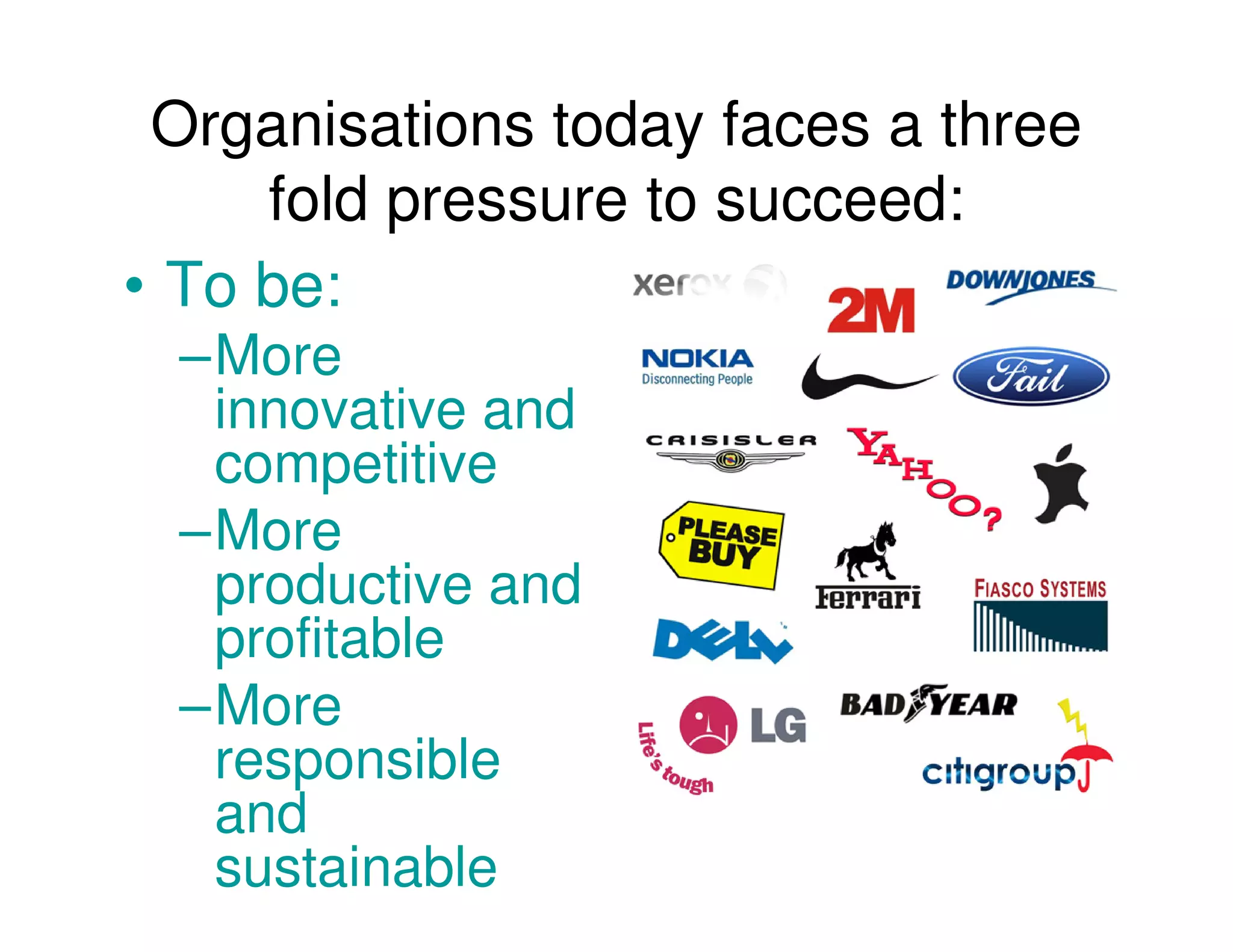
Organisations today faces a three
     fold pressure to succeed:
• To be:
 –More
  innovative and
  competitive
 –More
  productive and
  profitable
 –More
  responsible
  and
  sustainable
Sustainability Reporting

                  …is an organisation’s
                   public account of its
                   economic,
                   environmental and
                   social performance in
                   relation to its
                   operations, products
                   and services.

                  • Note: Organisation
                    includes corporate,
                    governmental and non-
                    governmental
                    organisations
       *www.krikor.info
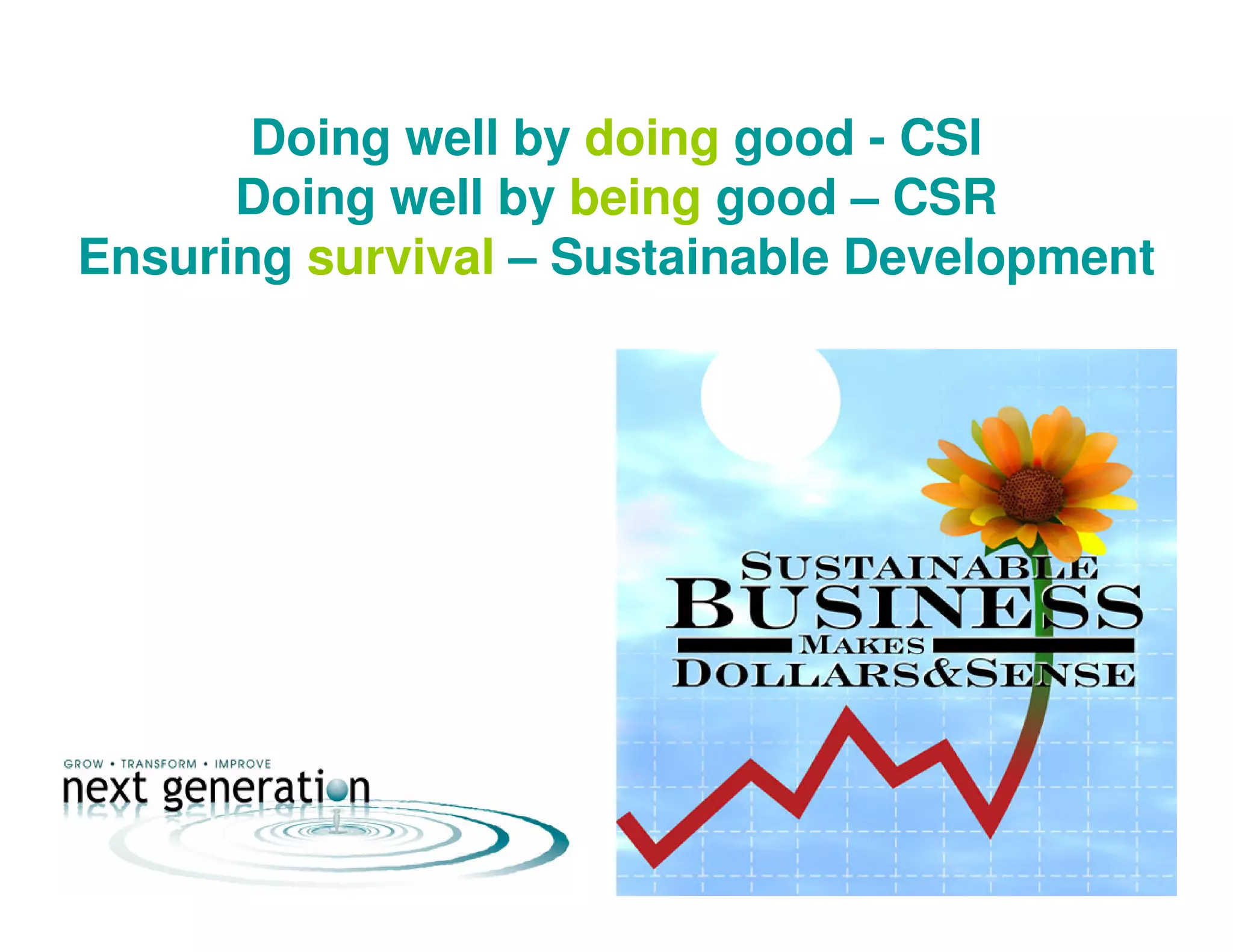
Doing well by doing good - CSI
      Doing well by being good – CSR
Ensuring survival – Sustainable Development
Sustainability Framework
                               Corporate Responsibility
                               Managing risks and impacts
                               across Economical, Social,
                               Environmental dimensions


                                        Corporate
                                       Sustainability


Corporate Citizenship                                       Corporate Governance:
Values, Beliefs, Principles,                                Compliance, Standards,
Policies, Contexts,                                         Frameworks, Principles,
Definitions                                                 Guidelines
CS and the different interpretations
• Different strokes for different folks:
   – To Chinese consumers, the hallmark of a socially responsible
     company is safe, high quality products
   – For Germans, it is secure employment
   – In Thailand, sustainable development is defined as holistic
     development which involves six dimensions: economic, social,
     environment, politics, technology and knowledge, and mental
     and spiritual balance.
   – In Bolivia, there is a particular emphasis on political dimensions
     (e.g. good governance and participation) and on the cultural and
     spiritual identity of diverse indigenous peoples
   – For Africans it is about proving legitimacy and credibility and
     ensuring poverty is alleviated
   – In South Africa what matters most is a company’s contribution
     to social needs such as healthcare and education
The Definitions
Theoretical Model


www.naturalstep.com
What drives business
              sustainability?


Changing Supply:     Changing Demand:   Changing Rules:

•Natural Resources   •Consumers         •Policy &
•Employees           •Stakeholders      Regulation
•Capital Markets
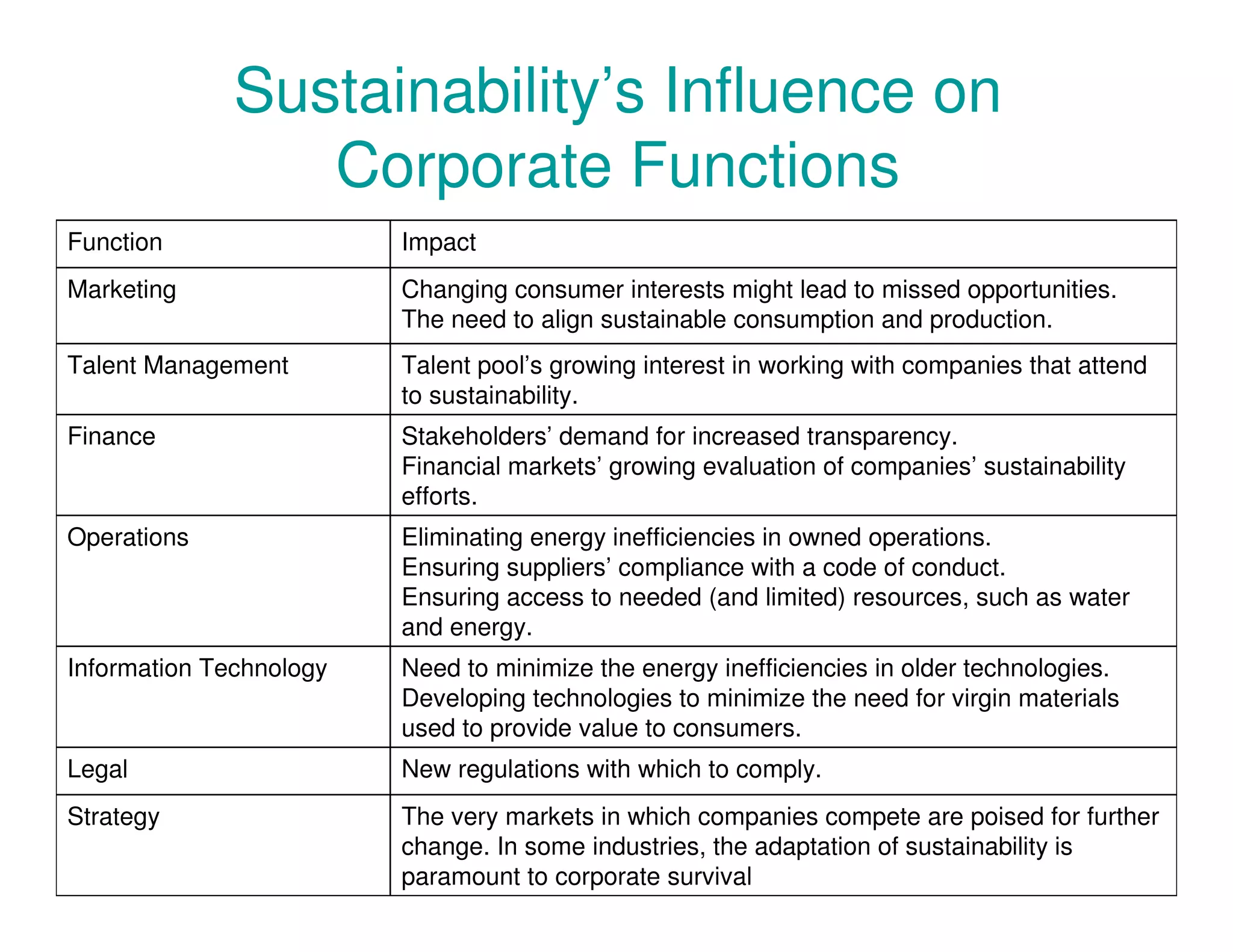
Sustainability’s Influence on
                 Corporate Functions
Function                 Impact
Marketing                Changing consumer interests might lead to missed opportunities.
                         The need to align sustainable consumption and production.
Talent Management        Talent pool’s growing interest in working with companies that attend
                         to sustainability.
Finance                  Stakeholders’ demand for increased transparency.
                         Financial markets’ growing evaluation of companies’ sustainability
                         efforts.
Operations               Eliminating energy inefficiencies in owned operations.
                         Ensuring suppliers’ compliance with a code of conduct.
                         Ensuring access to needed (and limited) resources, such as water
                         and energy.
Information Technology   Need to minimize the energy inefficiencies in older technologies.
                         Developing technologies to minimize the need for virgin materials
                         used to provide value to consumers.
Legal                    New regulations with which to comply.
Strategy                 The very markets in which companies compete are poised for further
                         change. In some industries, the adaptation of sustainability is
                         paramount to corporate survival
Lets Define…

                        • Sustainability
                           – Meeting the needs of the
                             present without
                             compromising the ability of
                             future generations to meet
                             their own needs


                        • Triple-bottom-line (TBL)
                           – Considers, measures and
                             refers to achieving a
                             balance between
                             integrated (economical)
                             financial, social and
                             environmental contributions
                             and performance to society
www.deloitte.uk
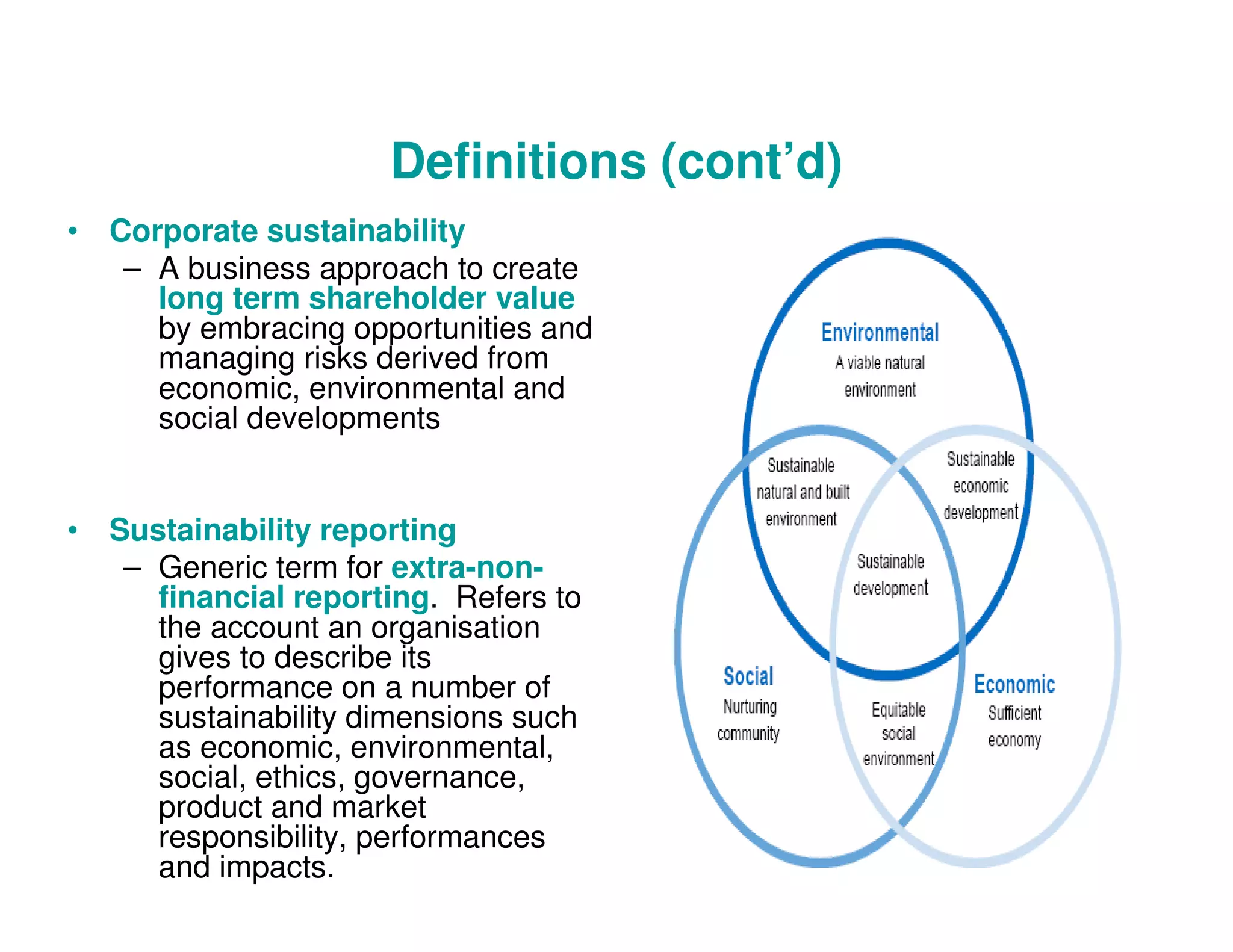
Definitions (cont’d)
• Corporate sustainability
   – A business approach to create
     long term shareholder value
     by embracing opportunities and
     managing risks derived from
     economic, environmental and
     social developments


• Sustainability reporting
   – Generic term for extra-non-
     financial reporting. Refers to
     the account an organisation
     gives to describe its
     performance on a number of
     sustainability dimensions such
     as economic, environmental,
     social, ethics, governance,
     product and market
     responsibility, performances
     and impacts.
Definitions (cont’d)
• Corporate Citizenship (CC)
   – Considers the rights and responsibilities of companies within a
     broader societal context relating to:
        • Managing the enterprise – how efficiently and ethically the
          company governs, controls and manages its operations
        • Workplace practices – how it manages its employees, workplace
          conditions and employment practices
        • Third party interactions – how it engages external stakeholders in
          the company supply chain, marketplace, government and community
        • Environment – how it controls its impact on the environment
        • Transformation – how South African companies meet their
          obligations to help all citizens become meaningful economic
          participants
        • Product and market stewardship – how it markets, what it
          produces, how it goes about taking product to market and owning up
          to the promises made in marketing and product development
Definitions (cont’d)
• Corporate governance
   – Generally refers to the process by which organisations are
     directed, controlled and held to account. It encompasses
     authority, accountability, stewardship, leadership, direction and
     the control exercised in the organisation
• Corporate (Social) Responsibility (CSR) (CR)
   – A good corporate citizen (a responsible one) is one that has
     comprehensive policies and practices in place. These enable it to
     make decisions and conduct its operations ethically, meet legal
     requirements and show consideration for society, communities
     and the environment.
• Corporate Social Investment (CSI)
   – Refers to a company’s contributions to society and community
     that are extraneous to its regular business activities.
Definitions (cont’d)

• Integrated Sustainability Reporting (ISR)
   – Relates to non-financial reporting as suggested and
     outlined in the King Report on Corporate
     Governance for South Africa – namely reporting on
     the nature and extent of a company’s social,
     transformation, ethical, safety, health and
     environmental management practices and policies.

• Most companies in South Africa use the GRI – Global
  Reporting Initiative as the benchmark for their reporting
  standards
Definitions (cont’d)
• In South Africa, it is expected that the Companies Act
  will be passed into law on July 1, 2009. The Act will be
  effective from March 1, 2010.
• The new provisions (in the Act) will be based on ‘King III’
  which applies to all entities, regardless of the manner
  and form of incorporation and establishment.
• King III recommends that sustainability reporting should
   – be focussed on substance over form and should transparently
     disclose information that is material, relevant, accessible,
     understandable and comparable with past performance of the
     company
   – be formalised as part of the company’s reporting processes
   – have independent assurance
The Concept
• It is no longer just about being ethical and fair in
  our dealings, nor just about managing our social
  or environmental impacts, nor just about being a
  good neighbor in our local communities,
  although all of these are important
• It is about turning social, economic and
  environmental challenges into opportunities
  for brand/product/process innovation, business
  development and competitive advantage.
• CR is not only central to business strategy
  but is increasingly becoming a critical driver
  of business growth
The Drivers
The Business Case
Key Drivers
• Key driving forces include:
   – Investor and consumer demands and governmental and public
     pressure
   – Particularly important is the support from Socially Responsible
     Investing (SRI) Indices .
   – The corporate responsibility movement is now entering a
     mainstreaming phase aided by standardisation activities such as
     the GRI, the AA1000 series and the ISO2600 guide.
   – The field of responsible business strategy and practice is
     becoming one of the most dynamic and challenging
     subjects corporate leaders are facing today and possibly
     one of the most important ones for shaping the future of our
     world.
Foundations of the business case
• An international imperative
   – The power of multinational companies
   – Universal rights and standards across developed and
     developing economies
• A national imperative
   – Conscious effort to address past imbalances and exclusions
   – The socio economic benefits of a stable, more equitable
     society
• Individual company rationale – it makes business sense
   –   Strong brand and reputation
   –   Employer of choice
   –   Market Position
   –   Trust of financial markets and increased shareholder value
   –   New ‘green’ products/services and new markets
• Both risk and opportunity management
What should business be doing
                    •   Commit to corporate action
                         – Incorporate long-term measures into a
                           definition of success, targeting profitability
                           that is sustainable, and supported by a
                           responsible record in managing social,
                           environmental and employment matters
                    •   Understand the issues
                         – Making operations environmentally and
                           socially sustainable, making society
                           sustainable, selling products responsibly,
                           influencing suppliers
                    •   Use precedent and best practice
                         – Comply with standards, codes and
                           guidelines
                    •   Embed the right management
                        approach
                         – From board and executive level the
                           authority for sustainability must be
                           devolved throughout the organisation
                           through all processes, systems and
                           operations
                    •   Convert risks and opportunities into
                        actions
                    •   Manage and measure performance
www.leryco.co.uk    •   Communicate and report
Benefits of Sustainability
• Increased profit
• Increased access to capital – new sources (investment)
• Reduced operating costs/increased operational efficiency
  (environmental practices)
• Enhanced brand image and reputation
• Increased sales and customer loyalty
• Increased productivity and quality
• Increased ability to attract and retain employees
• Reduced regulatory oversight
• Reducing risk and increased risk management
• Competitive advantage
• Increased market share
Challenges of Sustainbility
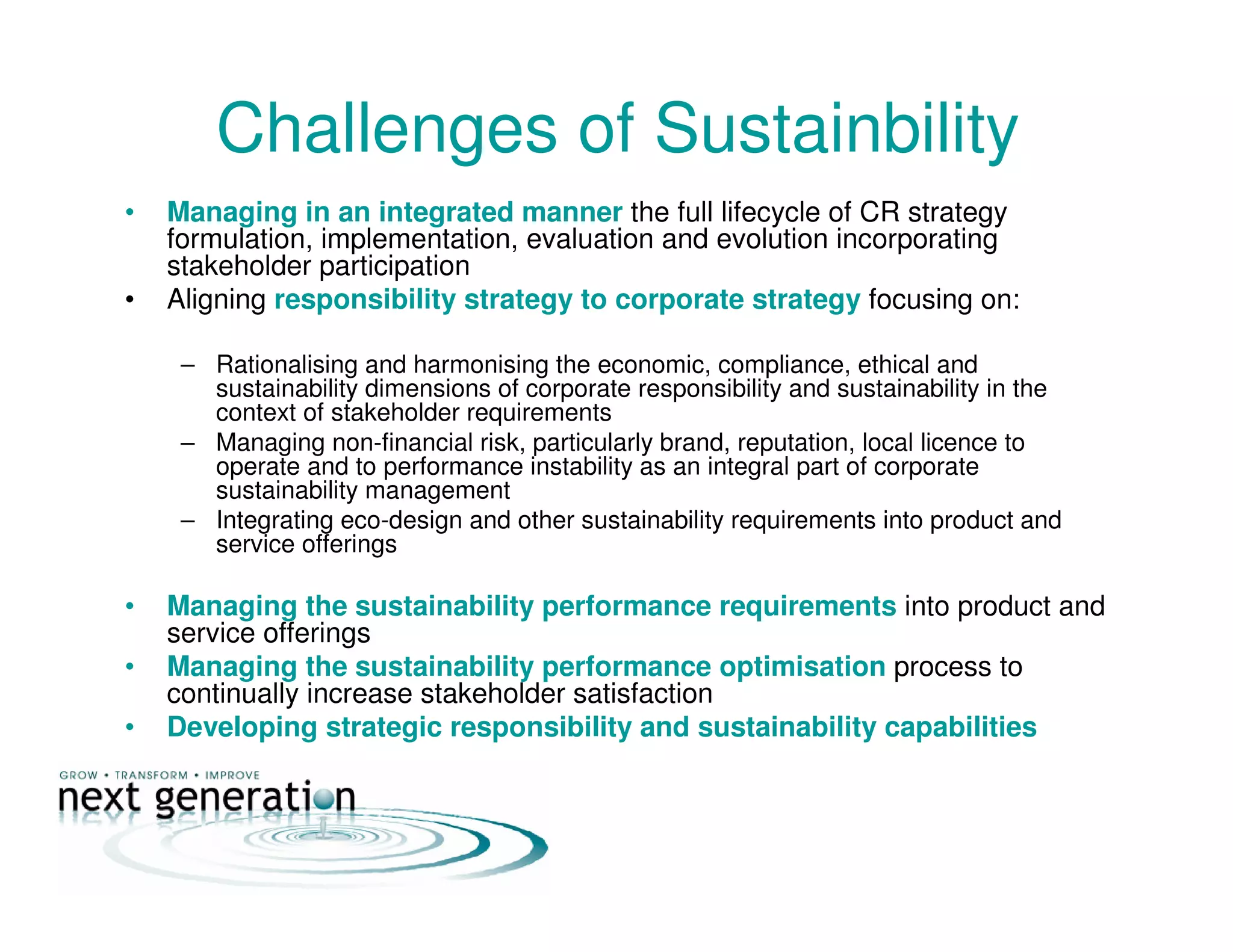
•   Managing in an integrated manner the full lifecycle of CR strategy
    formulation, implementation, evaluation and evolution incorporating
    stakeholder participation
•   Aligning responsibility strategy to corporate strategy focusing on:

     – Rationalising and harmonising the economic, compliance, ethical and
       sustainability dimensions of corporate responsibility and sustainability in the
       context of stakeholder requirements
     – Managing non-financial risk, particularly brand, reputation, local licence to
       operate and to performance instability as an integral part of corporate
       sustainability management
     – Integrating eco-design and other sustainability requirements into product and
       service offerings

•   Managing the sustainability performance requirements into product and
    service offerings
•   Managing the sustainability performance optimisation process to
    continually increase stakeholder satisfaction
•   Developing strategic responsibility and sustainability capabilities
Challenges for individual
      companies
             • Discussion
             • How do we define
               sustainability
             • What is our language
             • What matters to us most
             • What will drive us in
               future
             • What are our (company
               specific, industry specific)
               future risks and
               challenges
             • What is our 2020/2025
               vision
Objectives and motivations of
       sustainable companies
• Increased transparency and improved
  governance aimed at rebuilding public trust and
  investor confidence
• Delivering wider societal value including support
  for health and human rights improvements and
  environmental protection
• Contributing to regional development and global
  partnerships for sustainable development
• Addressing in a balanced way the concerns of
  their key stakeholders
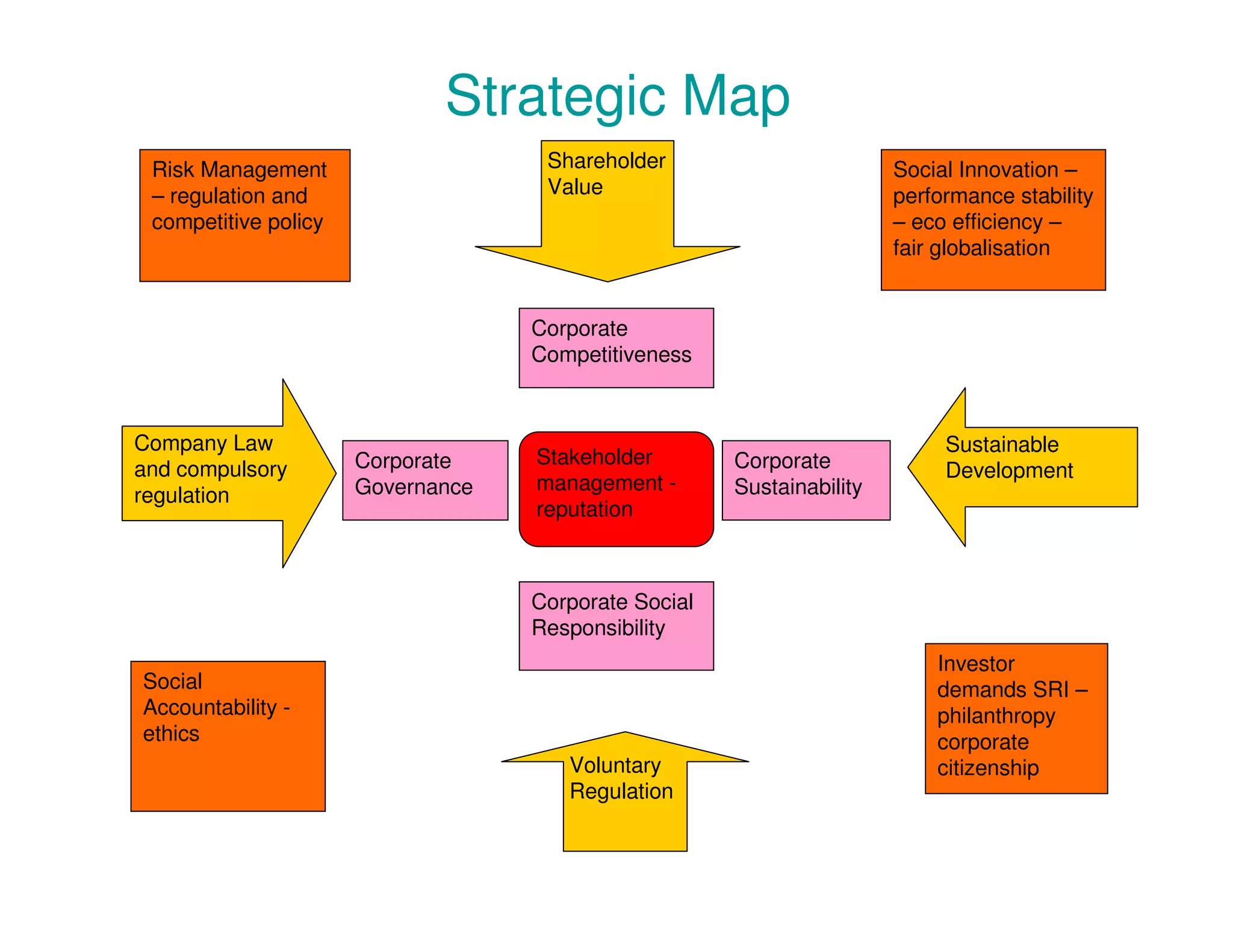
Strategic Map
 Risk Management                    Shareholder                        Social Innovation –
 – regulation and                   Value                              performance stability
 competitive policy                                                    – eco efficiency –
                                                                       fair globalisation


                                   Corporate
                                   Competitiveness


Company Law                                                                 Sustainable
                      Corporate    Stakeholder        Corporate
and compulsory                                                              Development
                      Governance   management -       Sustainability
regulation
                                   reputation


                                   Corporate Social
                                   Responsibility
                                                                           Investor
Social                                                                     demands SRI –
Accountability -                                                           philanthropy
ethics                                                                     corporate
                                      Voluntary                            citizenship
                                      Regulation
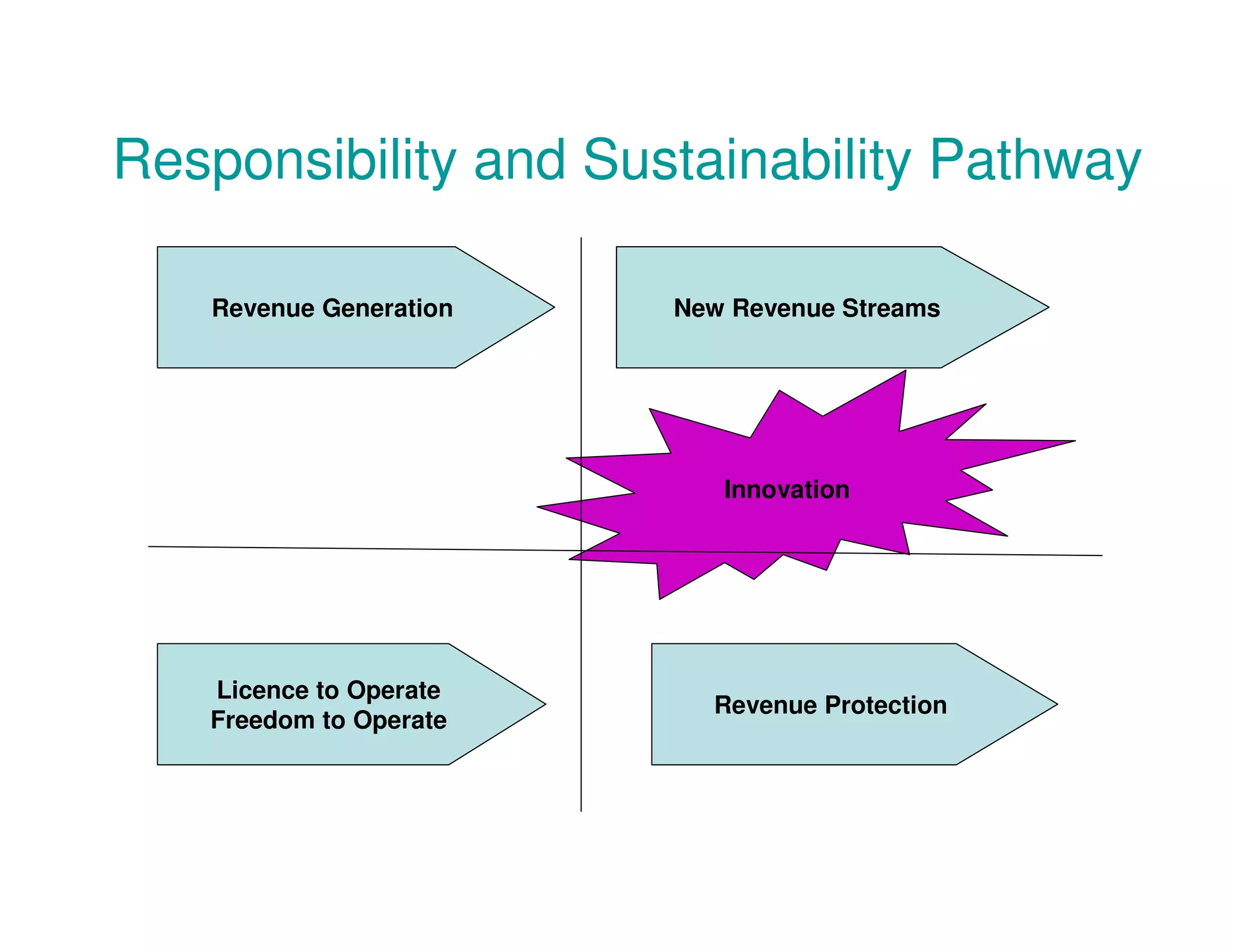
Responsibility and Sustainability Pathway

      Cost Saving         Resilience
       Efficiency        New Future


                          Innovation


     Compliance
      Reputation          Connectivity
        Risk              Stakeholders
     Management
Responsibility and Sustainability Pathway

   Revenue Generation   New Revenue Streams


                           Innovation


   Licence to Operate
                          Revenue Protection
   Freedom to Operate
Framework
• Eight core characteristics
    – Understanding society: understanding the role of each player in
      society – government, business, trade unions, non governmental
      organisations and civil society
    – Respecting environment: considering the cost of natural economics,
      placing a value on natural resources and calculating benefits
    – Building capacity: participating in partnerships and creating strategic
      networks and alliances
    – Questioning business as usual: challenging the way of doing things
      and being open to new ideas
    – Shareholder relations: identifying stakeholders, building relations,
      engaging in dialogue and balancing demands
    – Strategic view: taking a strategic view of the business environment
    – Harnessing diversity: respecting diversity and adapting to different
      situations
    – Quality control: feedback on the effectiveness of the CR process,
      communication and training programs should be an integral part of CR
      quality management
Driving Forces
                   SRI
 Investor                          Government
 Demands                           Pressure


 Green
 Buying          Corporate          Regulation
                 Responsibility
                 and
                 Sustainability


Consumer
Demands
                                  Public
                  Public          Pressure
                  Confidence
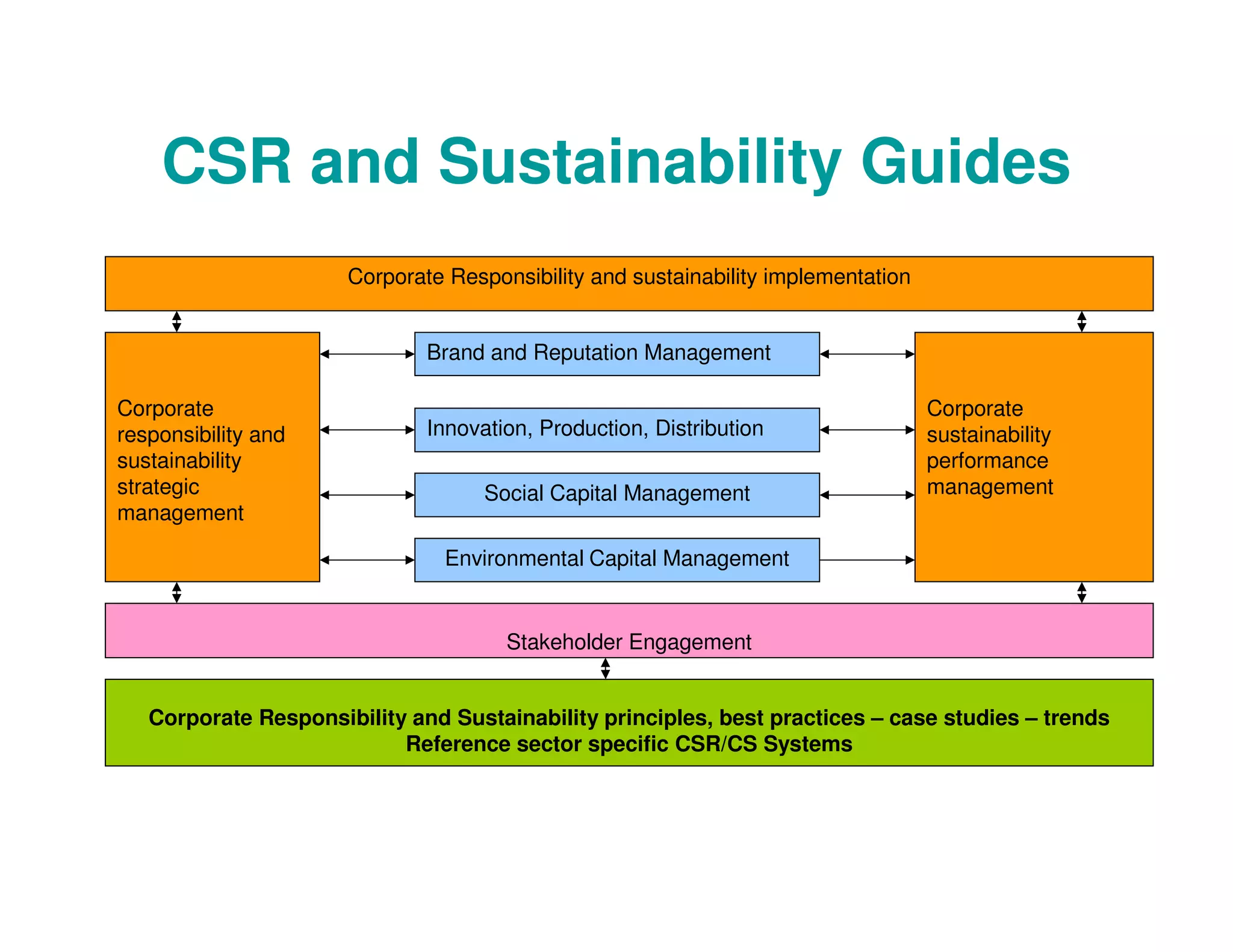
CSR and Sustainability Guides
                      Corporate Responsibility and sustainability implementation


                              Brand and Reputation Management

Corporate                                                                          Corporate
responsibility and            Innovation, Production, Distribution                 sustainability
sustainability                                                                     performance
strategic                           Social Capital Management                      management
management

                                Environmental Capital Management


                                      Stakeholder Engagement


   Corporate Responsibility and Sustainability principles, best practices – case studies – trends
                           Reference sector specific CSR/CS Systems
Emerging Frameworks
TBL - CS Framework
                                           Market
                                           Impact
                     Social
Industry             Impact
                                           Product
                                           Impact


 Clients        SUSTAINABILITY
                 SUSTAINBILITY             Brand
                                           Impact


                                     Economic
Suppliers    Environmental           Impact
             Impact

                 Governance   Compliance             Transformation
TBL Framework
Environmental                                       Social
Key Drivers:                                        Key Drivers:
Climate Change                                      Making operations socially sustainable
Escalating operating costs                          Making society sustainable
National Energy Efficiency strategy and accord      Selling products responsibly
Whitepaper on renewable energy                      Influencing suppliers
Green Building Council of SA
Risks                                               Risks:
Unquantified supply and cost risks for operations   Loss of business due to failure to achieve scorecard objectives
Escalating building operating costs                 Government censure and loss of business
Penalties and sanctions                             Operational restrictions
Reputational damage                                 Additional regulations
Opportunities:                                      Opportunities:
Lower carbon footprints                             High BEE ratings
Decreasing operating costs                          Business partner of choice
Productivity gains                                  Government business opportunities
Reputational gains                                  Reputation gains
Focus Areas:                                        Focus Areas:
Water Consumption                                   BEE; Employment Equity and skills development; Workplace
Fuel consumption                                    conditions and policies; Occupational health & safety
Electricity Consumption                             Employee wellness; HIV/Aids; Enterprise Development
Waste and Effluent Management                       Corporate Social Investment; Ethical consumerism
Emissions and climate change                        Responsible marketing and advertising; Product pricing
Carbon trading                                      Product access; Packaging & Waste; Preferential procurement
Environmental rehabilitation                        Product sourcing and traceability
Stakeholder Framework
Employee                                                               Product
Relations                                 Product Stewardship          Development

                                                                         Product
Customer                                                                 Access
Relations
              Market Stewardship
Supplier                                                               Product
Relations                                       Social Impact          Knowledge

                                                                       Product
Broker                                                                 Management
Relations
                                        Brand Stewardship
                                                                       Product
Shareholder                                                            Distribution/
Relations                                                              Marketing
                            Pricing               Sales Practices
                            Practices
Community
Relations
                Marketing               Communication
                                                              Sponsorship & Public
                Practices               Practices
Investor                                                      Relations Practices
Relations
Stakeholder issues
Stakeholders                     Key Issues
Shareholders                     Return on Investment
                                 Corporate Governance

Employees                        Salary & Benefits
                                 Health & Safety
                                 Training & Development
                                 Equal Opportunities
                                 Communications

Consumers                        Price/Value
                                 Easy access to products/services/ distribution
                                 Quality of product
                                 Advertising policy
Business Partners                Jobs sustained
                                 Payment of bills
                                 Technology transfer

Government and Community         Tax contribution
                                 Local economic impact
                                 Transfer pricing policies
                                 Charity contributions
                                 Community investment
                                 Commercial sponsorship

Environment                      Sustainable raw materials
                                 Emissions – water/air
                                 Energy efficiency
                                 Waste management
                                 Reduced packaging
                                 Recycling
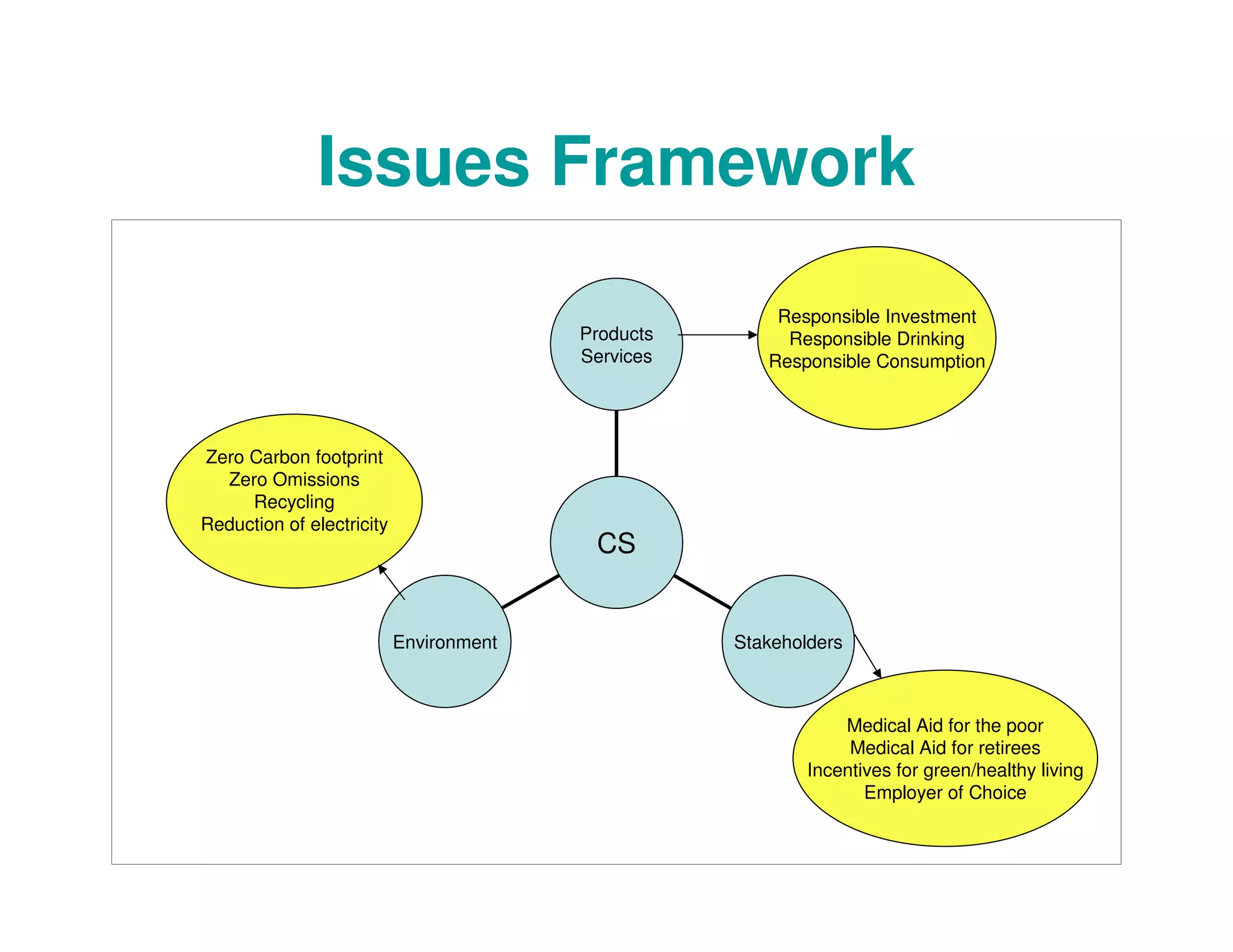
Issues Framework

                                                        Responsible Investment
                                         Products        Responsible Drinking
                                         Services      Responsible Consumption


Zero Carbon footprint
  Zero Omissions
     Recycling
Reduction of electricity
                                          CS


                           Environment              Stakeholders


                                                                Medical Aid for the poor
                                                                 Medical Aid for retirees
                                                            Incentives for green/healthy living
                                                                   Employer of Choice
Issues Frameworks


www.labnet.co.uk & www. Parlermo.co.uk
Industry Sustainability Frameworks
                        Brand Management
                 Customer Relationship Management                                 Social
Economical            Innovation Management
                          Piracy Protection
                     Supply Chain Management
                         Privacy Protection              Occupational Health & Safety
                        Market Opportunities               Stakeholder Engagement
                      Price Risk Management                 Standards for Suppliers
                                                      Access & Impact Products/Services
                                                               Social Integration
    Business Risks & Opportunities                  Product Quality & Lifecycle Management
        Climate Change Strategy                             Responsible Marketing
  Environmental Policy & management                       Human Rights & Corruption
  Operational Environmental Footprint                          Capacity Building
       Operational Eco Efficiency                        Corporate Social Investment
               Packaging
         Raw Material Sourcing
              Biodiversity
               Recycling
          Transport & Logistics                Environmental
           Emissions/Carbon
         Hazardous Substances
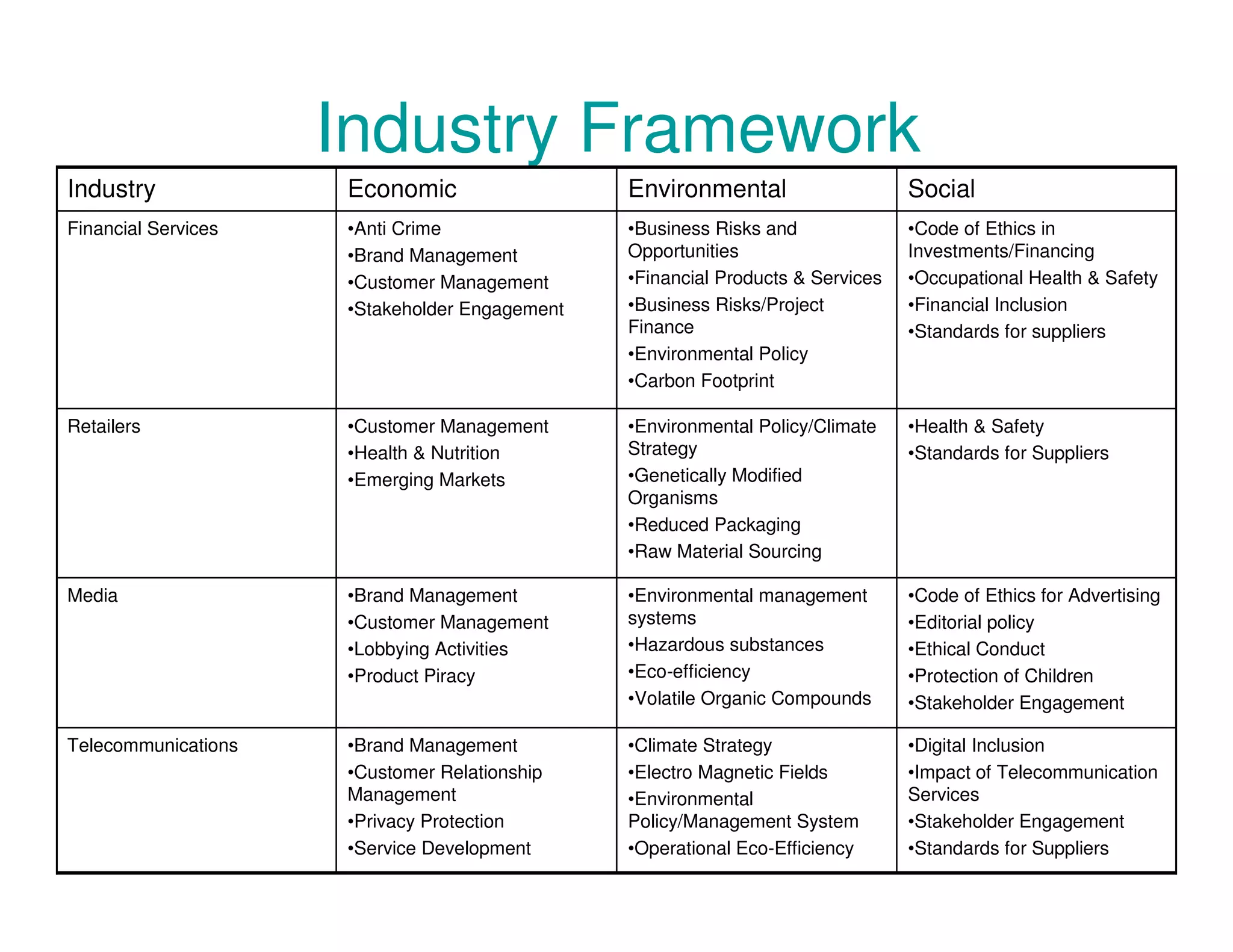
Industry Framework
Industry             Economic                  Environmental                    Social
Financial Services   •Anti Crime               •Business Risks and              •Code of Ethics in
                     •Brand Management         Opportunities                    Investments/Financing
                     •Customer Management      •Financial Products & Services   •Occupational Health & Safety
                     •Stakeholder Engagement   •Business Risks/Project          •Financial Inclusion
                                               Finance                          •Standards for suppliers
                                               •Environmental Policy
                                               •Carbon Footprint

Retailers            •Customer Management      •Environmental Policy/Climate    •Health & Safety
                     •Health & Nutrition       Strategy                         •Standards for Suppliers
                     •Emerging Markets         •Genetically Modified
                                               Organisms
                                               •Reduced Packaging
                                               •Raw Material Sourcing

Media                •Brand Management         •Environmental management        •Code of Ethics for Advertising
                     •Customer Management      systems                          •Editorial policy
                     •Lobbying Activities      •Hazardous substances            •Ethical Conduct
                     •Product Piracy           •Eco-efficiency                  •Protection of Children
                                               •Volatile Organic Compounds      •Stakeholder Engagement

Telecommunications   •Brand Management         •Climate Strategy                •Digital Inclusion
                     •Customer Relationship    •Electro Magnetic Fields         •Impact of Telecommunication
                     Management                •Environmental                   Services
                     •Privacy Protection       Policy/Management System         •Stakeholder Engagement
                     •Service Development      •Operational Eco-Efficiency      •Standards for Suppliers
It’s not all about reporting…


It’s about management and
     business practices.
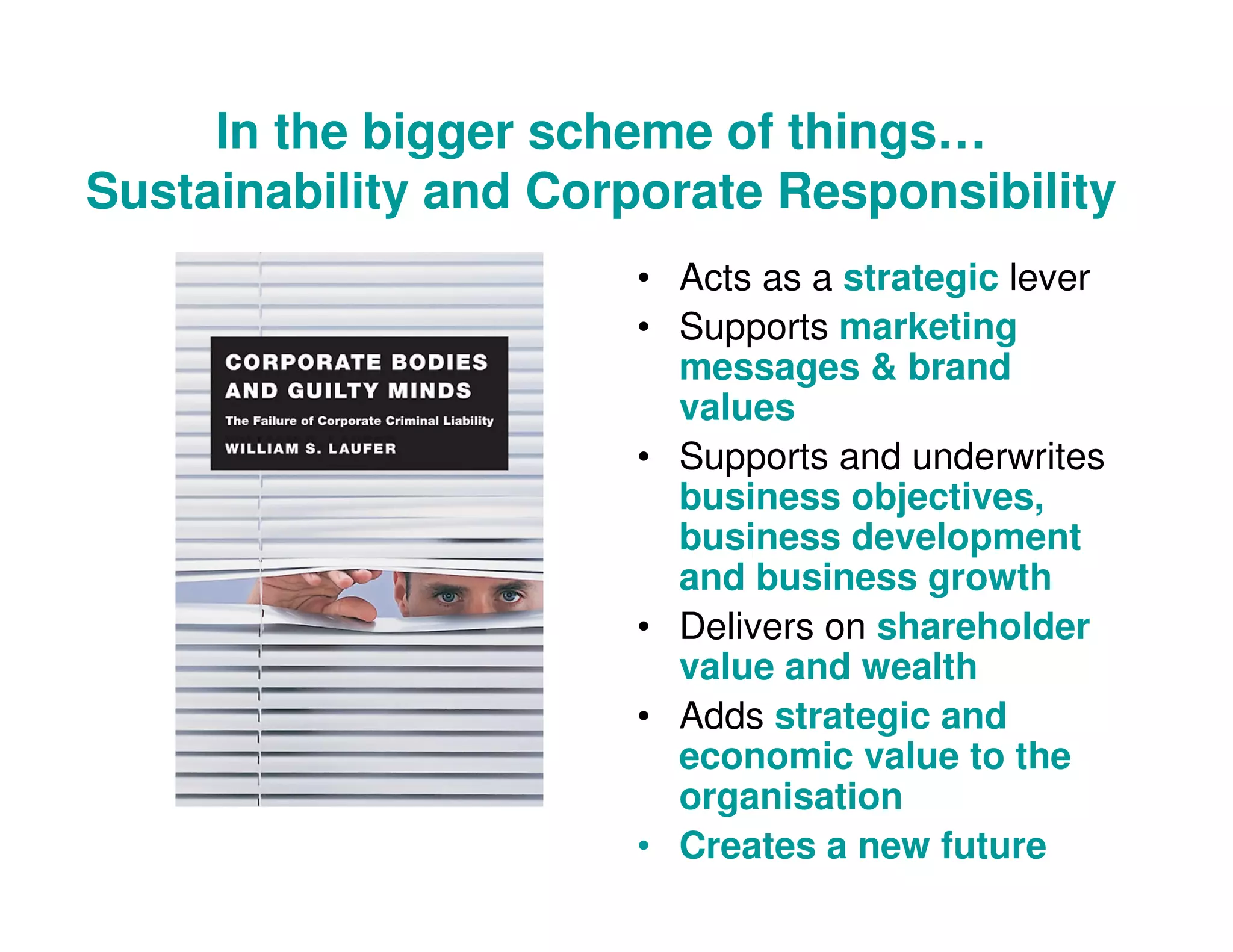
In the bigger scheme of things…
Sustainability and Corporate Responsibility
                      • Acts as a strategic lever
                      • Supports marketing
                        messages & brand
                        values
                      • Supports and underwrites
                        business objectives,
                        business development
                        and business growth
                      • Delivers on shareholder
                        value and wealth
                      • Adds strategic and
                        economic value to the
                        organisation
                      • Creates a new future
Effective CR requires companies to:
                    • Develop guidelines
                    • Build collaborative
                      partnerships
                    • Engage with external
                      stakeholders
                    • Develop indicators to
                      measure progress
                    • Measure results and
                      impacts
                    • Incorporate CR into
                      strategic business
                      decisions and activities
                    • Build social capital
                      among management
Sustainability Trends

Reputation vs Risk vs Compliance
What about the recession?
                  •   According to a new study from Panel
                      Intelligence, 80 percent of sustainability
                      leaders surveyed (65 execs from Fortune
                      500 companies) in November say they
                      intend to maintain or increase spending
                      in areas related to sustainability next
                      year. In fact, they reported that
                      sustainability and clean technology
                      spending, as a percentage of corporate
                      revenues, is expected to increase 73
                      percent through 2010.
                  •   Another recent study by A.T. Kearney
                      reveals that, as a result of “ecoflation”
                      (based on future analysis of increases in
                      commodity prices, environmental and
                      governmental policy and climate situations),
                      packaged goods companies may expect a
                      reduction in earnings of 19 to 47 percent
                      in the next decade if they do not
                      implement adequate sustainability
                      measures. That’s nothing short of
                      startling. Thankfully, unlike much of the rest
                      of the business world of late, optimism and
                      sound business sense do not seem to be in
                      short supply among corporate responsibility
                      leaders of some of the world’s leading
                      companies.
www.coneinc.com
Sustainability & recession
•   Responses from 65 sustainability executives of Fortune
    500 companies.
     –   Sustainability and clean technology spending - as a
         percentage of corporate revenues - is expected to increase
         73 percent through 2010.
     –   Eighty-two percent of respondents rated energy efficiency
         as the most important area of current focus and investment.
     –   Corporate spending on sustainable waste management
         initiatives is expected to grow by 20 percent in 2009, the
         highest percentage increase of any subcategory.
     –   Cost savings, revenue generation and brand strength are
         the most important drivers of environmental and clean
         technology initiatives.
     –   Nearly 55 percent of respondents observe no financial
         criteria (i.e. ROI, payback period) when evaluating
         sustainability projects for their respective organizations.
     –   A majority of respondents believe capital remains available
         for sustainability projects.

•   Business practices are an additional purchasing
    influence, as today's savvy consumers are now
    asking "Is this a good company?" and "What does it
    stand for?"
•   The environment and economic development are
    among the top four causes consumers want
    companies to address, along with health and
    education
•   Consumers may become activists if companies
    engage in negative business practices; 85 percent
    would consider switching to another company's
    products/services
•   Relevant and compelling communication are key to
    breaking through                                                   www.mckinsey.com
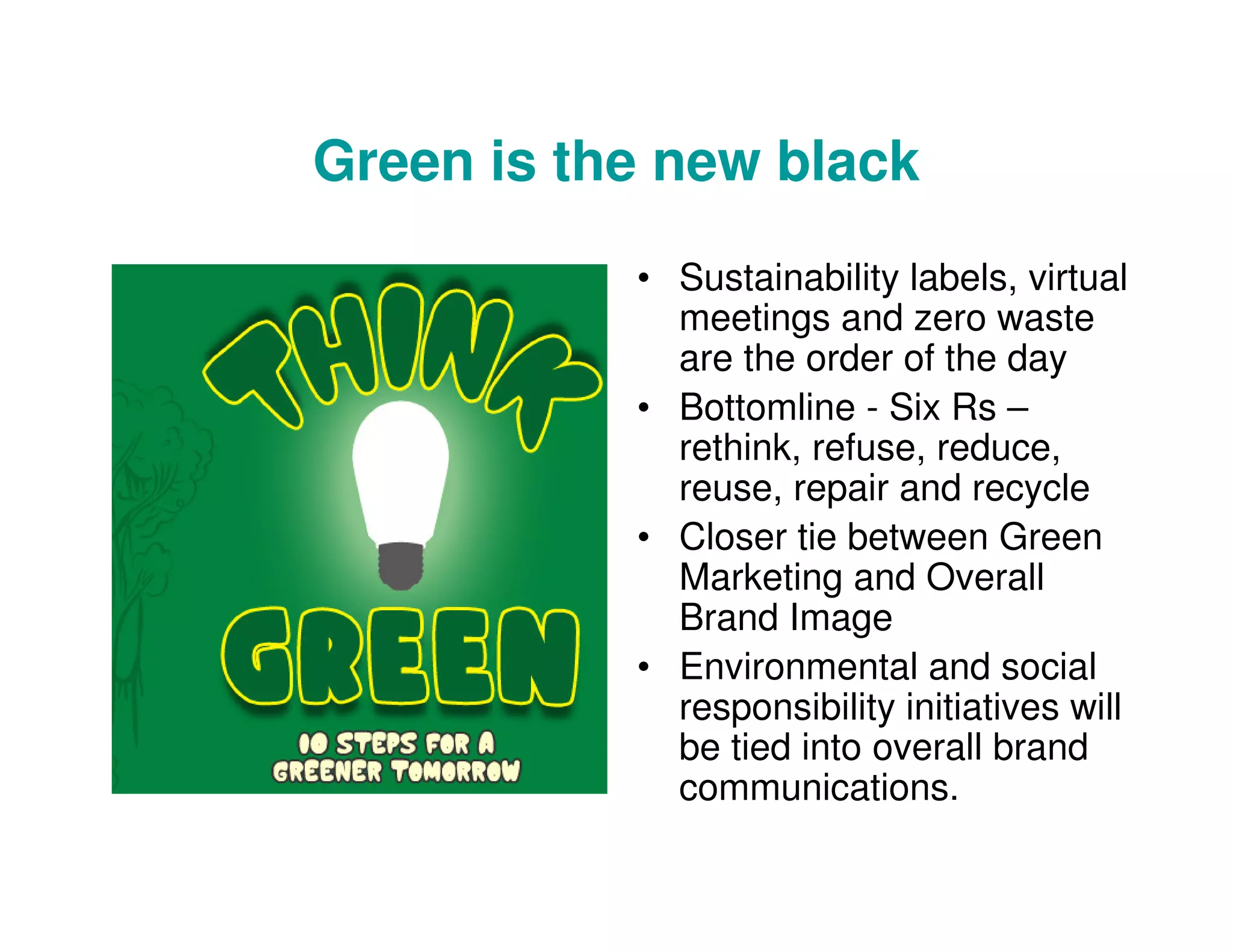
Green is the new black
           • Sustainability labels, virtual
             meetings and zero waste
             are the order of the day
           • Bottomline - Six Rs –
             rethink, refuse, reduce,
             reuse, repair and recycle
           • Closer tie between Green
             Marketing and Overall
             Brand Image
           • Environmental and social
             responsibility initiatives will
             be tied into overall brand
             communications.
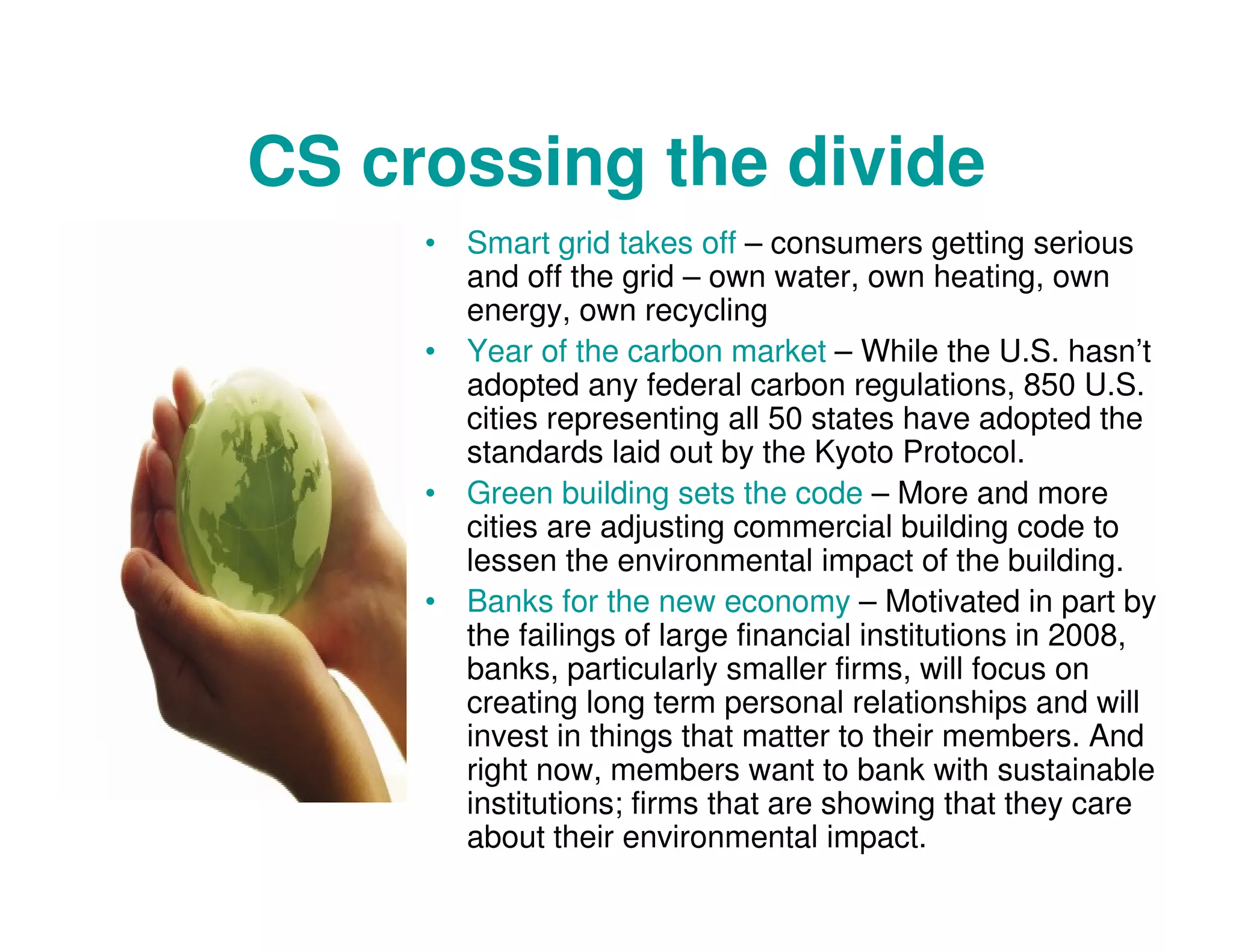
CS crossing the divide
     • Smart grid takes off – consumers getting serious
       and off the grid – own water, own heating, own
       energy, own recycling
     • Year of the carbon market – While the U.S. hasn’t
       adopted any federal carbon regulations, 850 U.S.
       cities representing all 50 states have adopted the
       standards laid out by the Kyoto Protocol.
     • Green building sets the code – More and more
       cities are adjusting commercial building code to
       lessen the environmental impact of the building.
     • Banks for the new economy – Motivated in part by
       the failings of large financial institutions in 2008,
       banks, particularly smaller firms, will focus on
       creating long term personal relationships and will
       invest in things that matter to their members. And
       right now, members want to bank with sustainable
       institutions; firms that are showing that they care
       about their environmental impact.
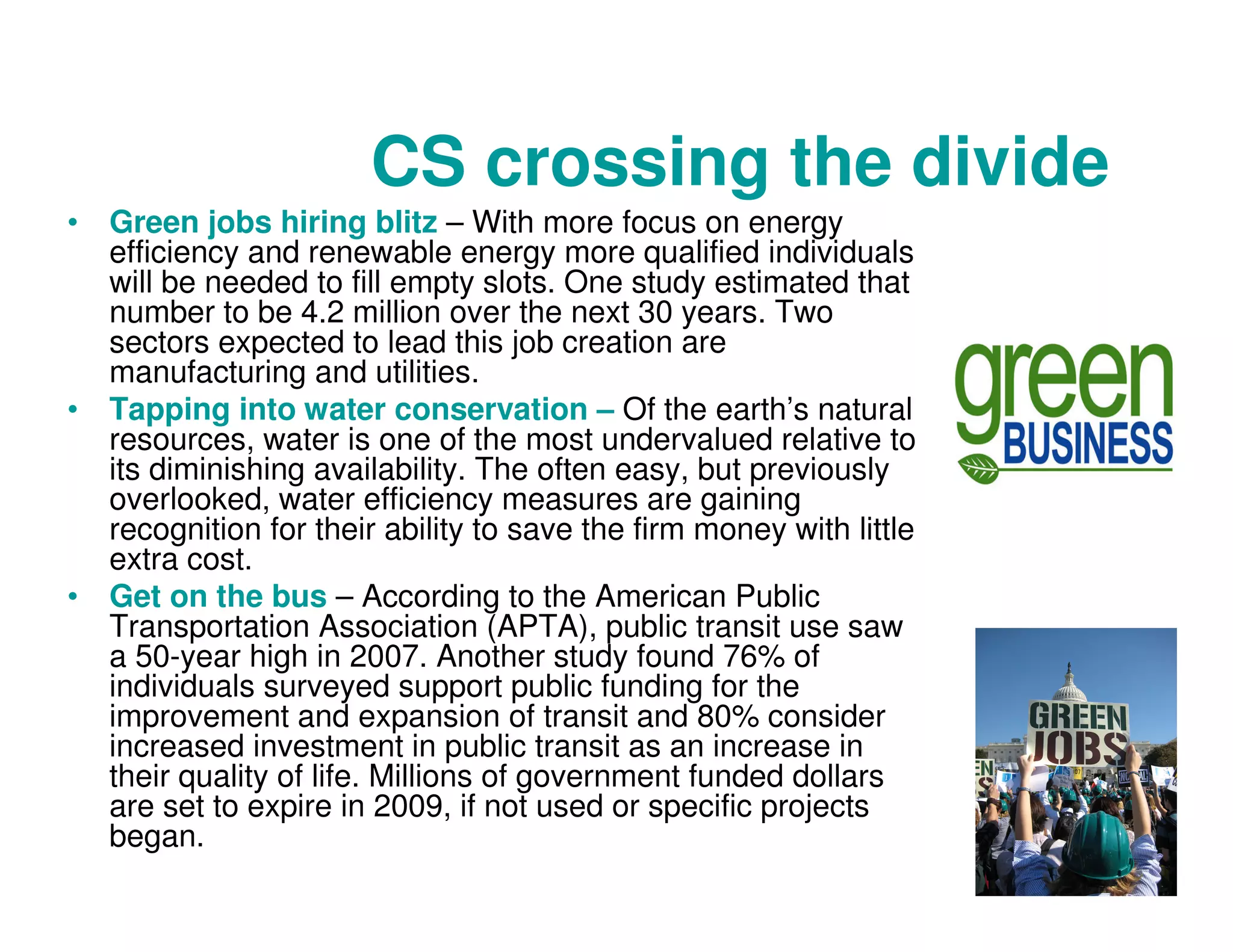
CS crossing the divide
• Green jobs hiring blitz – With more focus on energy
  efficiency and renewable energy more qualified individuals
  will be needed to fill empty slots. One study estimated that
  number to be 4.2 million over the next 30 years. Two
  sectors expected to lead this job creation are
  manufacturing and utilities.
• Tapping into water conservation – Of the earth’s natural
  resources, water is one of the most undervalued relative to
  its diminishing availability. The often easy, but previously
  overlooked, water efficiency measures are gaining
  recognition for their ability to save the firm money with little
  extra cost.
• Get on the bus – According to the American Public
  Transportation Association (APTA), public transit use saw
  a 50-year high in 2007. Another study found 76% of
  individuals surveyed support public funding for the
  improvement and expansion of transit and 80% consider
  increased investment in public transit as an increase in
  their quality of life. Millions of government funded dollars
  are set to expire in 2009, if not used or specific projects
  began.
CS crossing the divide
           •   Solar’s future luster - While solar
               installations have predominantly been
               photovoltaic (PV) systems for home
               and businesses, utility scale solar
               farms and concentrated solar thermal
               plants are set to surge. This growth
               will be accelerated by an increase in
               venture capital investment and an
               extension on the life of federal tax
               credits.
           •   'Go green’ goes down – Businesses
               will no longer be able to say they have
               gone green and have little to show for
               it. Consumers will want to see the long
               term sustainable efforts businesses
               are making. Being green as become
               more common, which means firms will
               need to be authentic and internally
               committed to being sustainable.
           •   Biomimicry – a new language, a new
               future, going back to nature for future
               sustainable solutions
What are people talking about – the
           Buzz Trend
• Global Warming/Climate
  change
• Renewable
  energy/Alternative fuels
• Resource conservation
• Carbon Emissions
• Pollution
• Packaging/Plastic
• Transportation
• Toxins
• Organics


                             www.greenconsumer.com
The future …


• THE FUTURE….
  – CS will continue to spread across the supply chain and across
    borders. Climate change, urbanisation, and poverty are global
    challenges that require global solutions. With their capital, power,
    and innovative potential, firms have a moral responsibility to help
    solve these problems. As a result, CS has to consider an ever
    increasing range of social and environmental factors from around
    the globe. Finally, globalisation results in an intensified scramble
    for resources, capital, labour and market share. CS helps
    companies to raise their attractiveness as a customer, partner,
    employer, or supplier.
Finding Solutions
• CS is no longer just about being good, managing the public image,
  or improving products: Sustainability and efficiency initiatives save
  costs and increase the value of the company. The FTSE4Good
  Index and the emergence of external CS rankings highlight how
  companies are increasingly assessed in terms of their
  sustainability and CSR activities.
• Solution-oriented CSR is the key vehicle to promote sustainability.
  CS could be the business blueprint for the future. It will reshape
  business ecosystems, changing the way companies are organized
  and engage with their stakeholders. In a customer-driven
  economy, CSR will be actively managed, an integral part of
  company strategy, and a hard factor for company success. It will
  impact the nature of competition, foster the development of
  sustainability related innovations, and facilitate the emergence of
  new, more successful, business models. As companies are forced to
  become more socially and environmentally responsible CSR will
  move into boardrooms and tighten its influence on decision-making
  processes. For the future world of business, CS is clearly not a
  short-term phenomenon, but a trend-driven necessity.
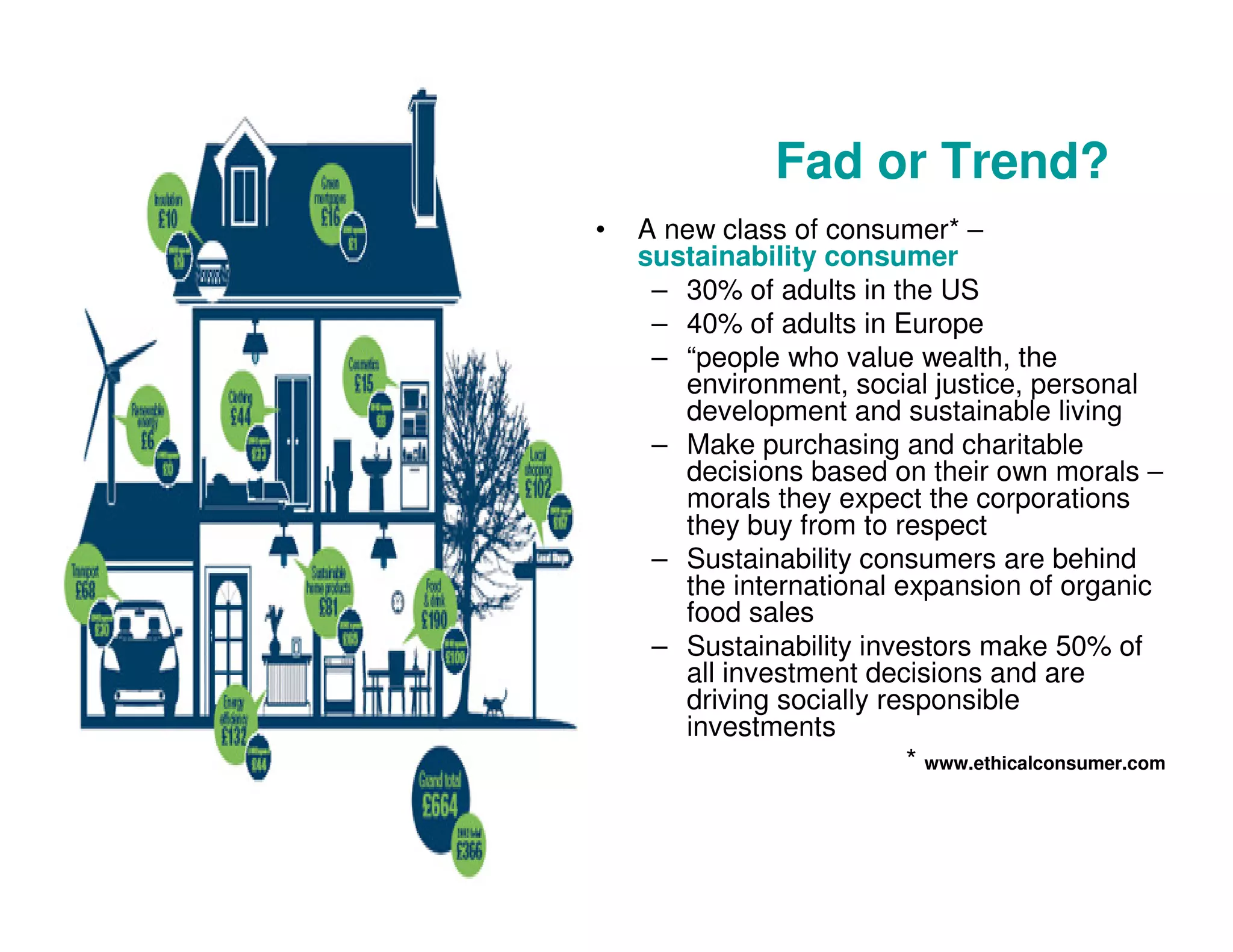
Fad or Trend?
•   A new class of consumer* –
    sustainability consumer
     – 30% of adults in the US
     – 40% of adults in Europe
     – “people who value wealth, the
       environment, social justice, personal
       development and sustainable living
     – Make purchasing and charitable
       decisions based on their own morals –
       morals they expect the corporations
       they buy from to respect
     – Sustainability consumers are behind
       the international expansion of organic
       food sales
     – Sustainability investors make 50% of
       all investment decisions and are
       driving socially responsible
       investments
                          * www.ethicalconsumer.com
CSR Monitor 2007 – Global Study*
• Key Findings

   – Significant numbers of investors take a company’s social performance
     into consideration when making investment decisions – 61%
   – In wealthy countries, social responsibility makes a greater contribution to
     corporate reputation than brand image – 49% of CSR factors compared
     to 35% for brand image and 10% for financial management
   – Companies that ignore social responsibility place market share at risk –
     42% will punish socially irresponsible companies
   – Views and behaviors of opinion leaders indicate that consumers social
     expectations of companies will continue grow
   – North American consumers represent the most socially demanding
     market for companies
   – Two distinct groups of citizens making up a third of the world are
     engaged in pressurising companies to assume greater social
     responsibility – conventional activists and social activists
                                                                 *Mckinsey Research
2009 GlobeScan Report
    • Consumers in India, Brazil and China scored the highest -- and
      those in the U.S., the lowest -- for green behavior among the
      countries included the Greendex survey conducted by Globescan
    • Green building is on the rise, spurring new technologies that save
      energy and money while creating more healthful workplaces.
    • There is a green race taking place in the automobile industry, with
      every major manufacturer planning to introduce electric vehicles.
    • The leading consumer product makers and retailers are starting to
      rigorously assess the environmental impact of their products using
      sophisticated metrics, sending signals up the supply chain that
      tomorrow’s products will need to hew to higher levels of
      environmental responsibility.


www.greenbiz.com
Ethical Consumers
• Ethical Consumers worry about…
   – Organic meat, produce and baby food
   – Fair Trade coffee, tea, bananas,
     chocolate, honey
   – Paper/Timber certified as sustainably
     managed by the Forest Stewardship
     Council
   – Energy-efficient light bulbs and
     renewable energy
   – Unleaded petrol and low-sulphur
     diesel
   – Recycled paper
   – Landfill and the management of
     natural resources such as water, the
     environment and healthy food
But seriously how serious?*
•   Marks & Spencer – Plan A
      – Business wide 500M Pound eco-plan
           • Carbon neutral, no waste to landfill, extend sustainable sourcing,
              set new standards in ethical trading and help customers and
              employees live a healthier lifestyle
•   Tesco’s – “making sustainability a significant driver of consumption” 500 M
    Pound plan
      – Developing a carbon counter “carbon calorie” value of all products,
         introduce green loyalty card points for customers who buy organic,
         fairtrade and biodegradable products, increase range of energy-efficient
         goods
•   MacDonald’s health drives pays off – sales growth of 5.8% since
    introducing new advertising campaign introducing healthy eating and
    exercise
•   Danone, Kellogg’s, Kraft, Nestle, Tesco, PepsiCo, Morrisons have
    launched 4m Pound campaign to promote GDA labels (guideline daily
    amount) for healthier eating – committed to produce more responsible food
    products
•   Kellogg’s Special K products have become mega brands with over 500m
    Pounds in retail sales per year – Special K bars 286m Pounds per year –
    10 000 steps per day has increased brand awareness and market share by
    more than 35% - “being a responsible corporate citizen is working for us”
                                                     * Food Review – February 2007
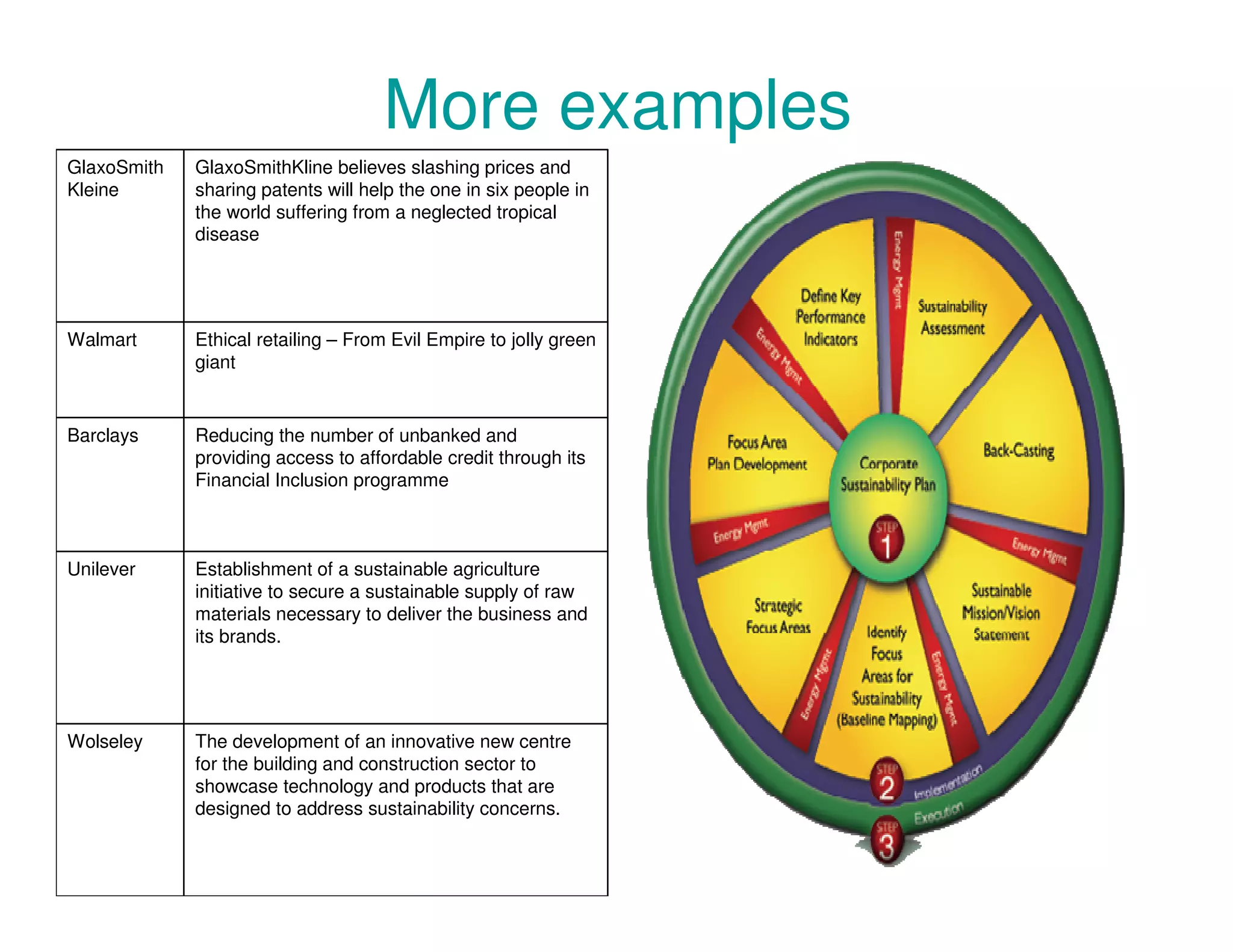
More examples
GlaxoSmith   GlaxoSmithKline believes slashing prices and
Kleine       sharing patents will help the one in six people in
             the world suffering from a neglected tropical
             disease


Walmart      Ethical retailing – From Evil Empire to jolly green
             giant


Barclays     Reducing the number of unbanked and
             providing access to affordable credit through its
             Financial Inclusion programme


Unilever     Establishment of a sustainable agriculture
             initiative to secure a sustainable supply of raw
             materials necessary to deliver the business and
             its brands.


Wolseley     The development of an innovative new centre
             for the building and construction sector to
             showcase technology and products that are
             designed to address sustainability concerns.
What is a corporate’s responsibility?

What is typically corporate socially responsible
           behavior and what is not?
Lets Talk:

What about Tiger Brands and the
      R100 million fine?
  Sasol and the €100m fine?
Industries in the spotlight
•   Tobacco and Liquor Advertising – addiction to
    nicotine and alcohol (BAT, Distell)
•   Total ban of advertising to children (Youth brands) -
    Kellogg's
•   Obesity amongst world population - McDonalds
•   Consumer Boycotts – Gillette and L’Oreal – animal
    testing
•   Heinz – tuna fishing nets harming dolphins
•   Lesbian/Gay rights – Phillip Morris – US election
    campaigns
•   Caterpillar – War in Iraq
•   Nestle, Nescare and Nescafe – from babies to
    mothers
•   Starbucks – from coffee to drugs
•   Nike and Gap – child labour
•   Coke – anti globalisation – more precious than water
•   Sarah Lee – food porn
•   Enron, Worldcom, Parmalat – internal corruption
•   Cape plc – exploited mineworkers in unhealthy
    asbestos mines
•   De Beers – Blood diamonds in Africa
•   Saambou, Masterbond. Fidentia and Leisurenet –
    defrauding investors
•   Banks – excessive credit, exorbitant fees
•   Telkom - monopoly
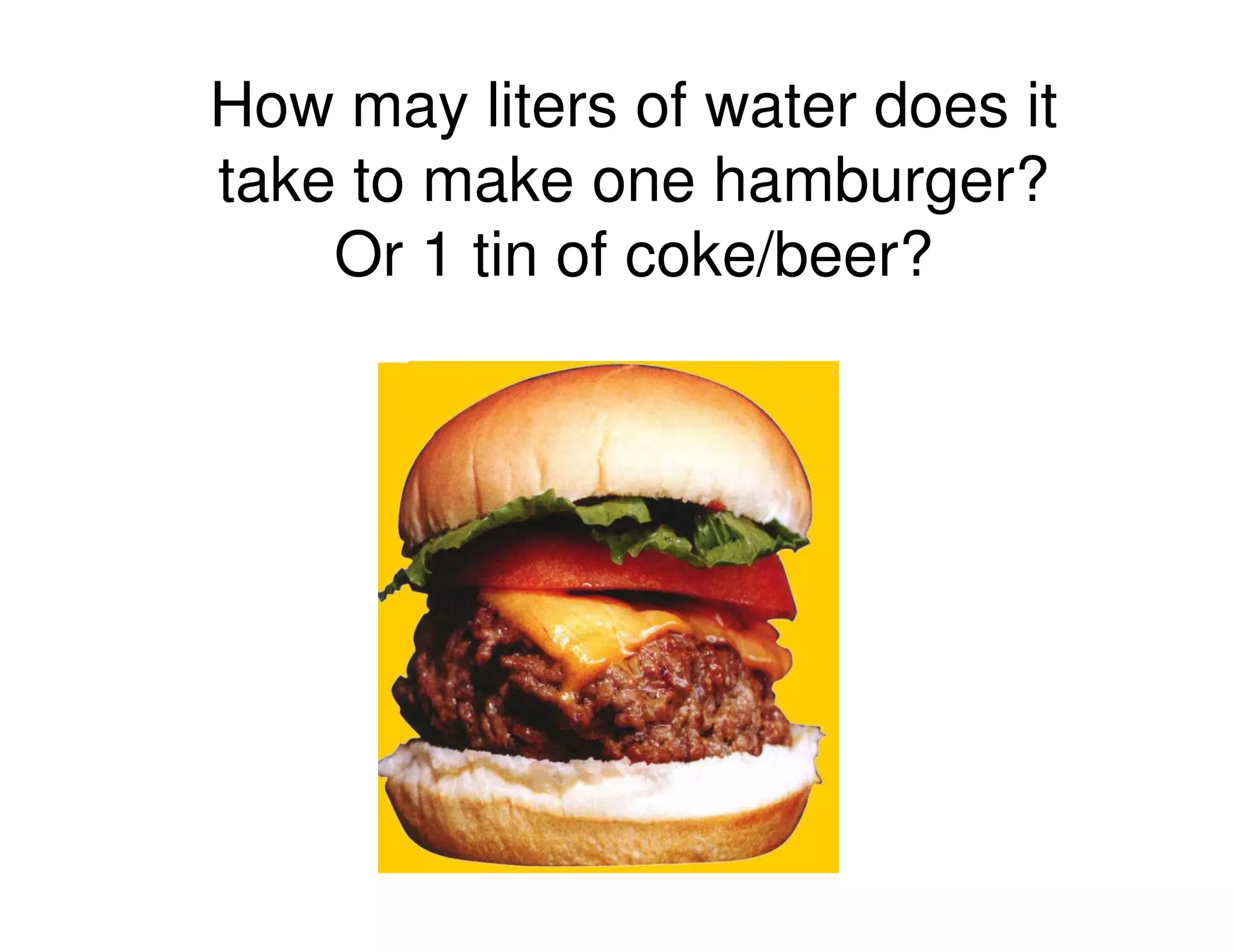
How may liters of water does it
take to make one hamburger?
    Or 1 tin of coke/beer?
Determining Sustainability
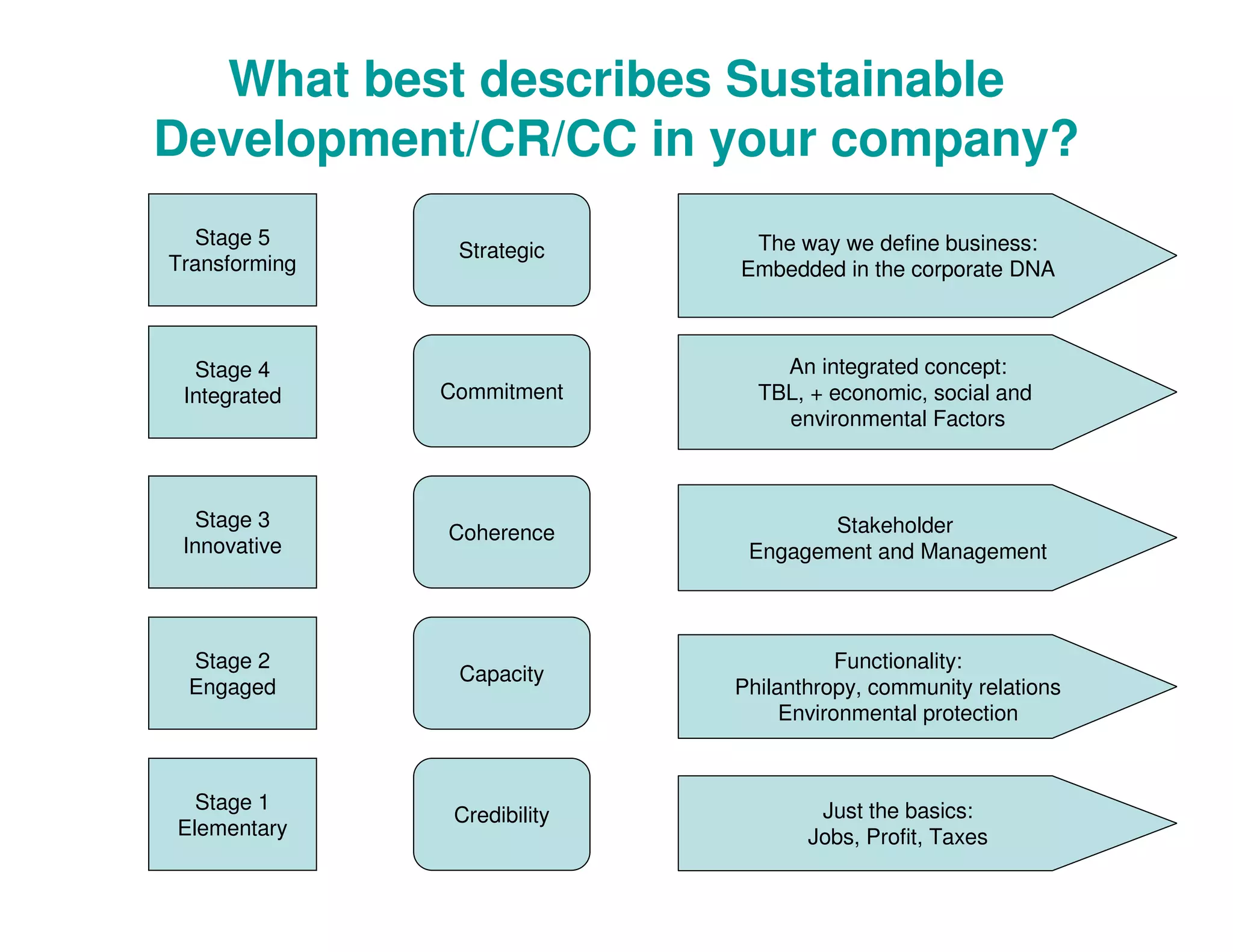
What best describes Sustainable
Development/CR/CC in your company?
  Stage 5                      The way we define business:
                Strategic
Transforming                  Embedded in the corporate DNA


  Stage 4                         An integrated concept:
 Integrated    Commitment       TBL, + economic, social and
                                  environmental Factors


   Stage 3                            Stakeholder
               Coherence
 Innovative                    Engagement and Management


 Stage 2                                 Functionality:
                Capacity
 Engaged                      Philanthropy, community relations
                                   Environmental protection


  Stage 1                             Just the basics:
                Credibility
Elementary                           Jobs, Profit, Taxes
Path to Corporate Responsibility
                  (Harvard Business Review)
                         5                                            1
                                                              Defensive Stage
                    Civil Stage
                                                           Unexpected Criticism
                 Collective actions
                                                        Activists, Media, Customers
                     Advocacy
                                                   Responds – via crises communications
                     Education
                                                                   strategy
                     Practices


             4
      Strategic Stage                                                         2
Realign strategy to address                                           Compliance Stage
    business practices                                        Policies, Reputation Management,
     Competitive Edge                                                  Risk Management
                                                               King II, JSE SRI, GRI, BEE, etc.

                                               3
                                        Managerial Stage
                                      Standards – Past PR &
                                         Communication
Development of Citizenship
                Outside In/Inside Out
                               Stage 1           Stage 2         Stage 3        Stage 4          Stage 5
                               Compliant         Engaged         innovative     Integrated       Transforming

Relating to    Issues          Defensive         Reactive        Responsive     Pro-Active       Defining
society:       Management                        Policies        Programmes     Systems
Outside In
               Stakeholder     Unilateral        Interactive     Mutual         Partnership      Multi-
               Relationships                                     Influence                       Organisational
                                                                                                 Alliances
               Transparency    Flank             Public          Public         Assurance        Full Exposure
                               Protection        Relationships   Reporting

Responding     Citizenship     Jobs, Profits &   Philanthropy,   Responsible    Sustainability   Change the
to society:    Concept         Taxes             Environmental   to             or Triple        Game
Inside Out                                       Protection      Stakeholders   Bottom Line

               Strategic       Legal             Reputation      Business       Value            Market
               Intent          Compliance                        Case           Proposition      Creation or
                                                                                                 Social change
               Leadership      Lip service,      Supporter, in   Steward, on    Champion, in     Visionary,
                               out of touch      the loop        top of it      front of it      ahead of the
                                                                                                 pack
               Structure       Marginal:         Functional      Cross          Organisational   Mainstream:
                               Staff Driven      ownership       functional     alignment        Business
                                                                 coordination                    Driven
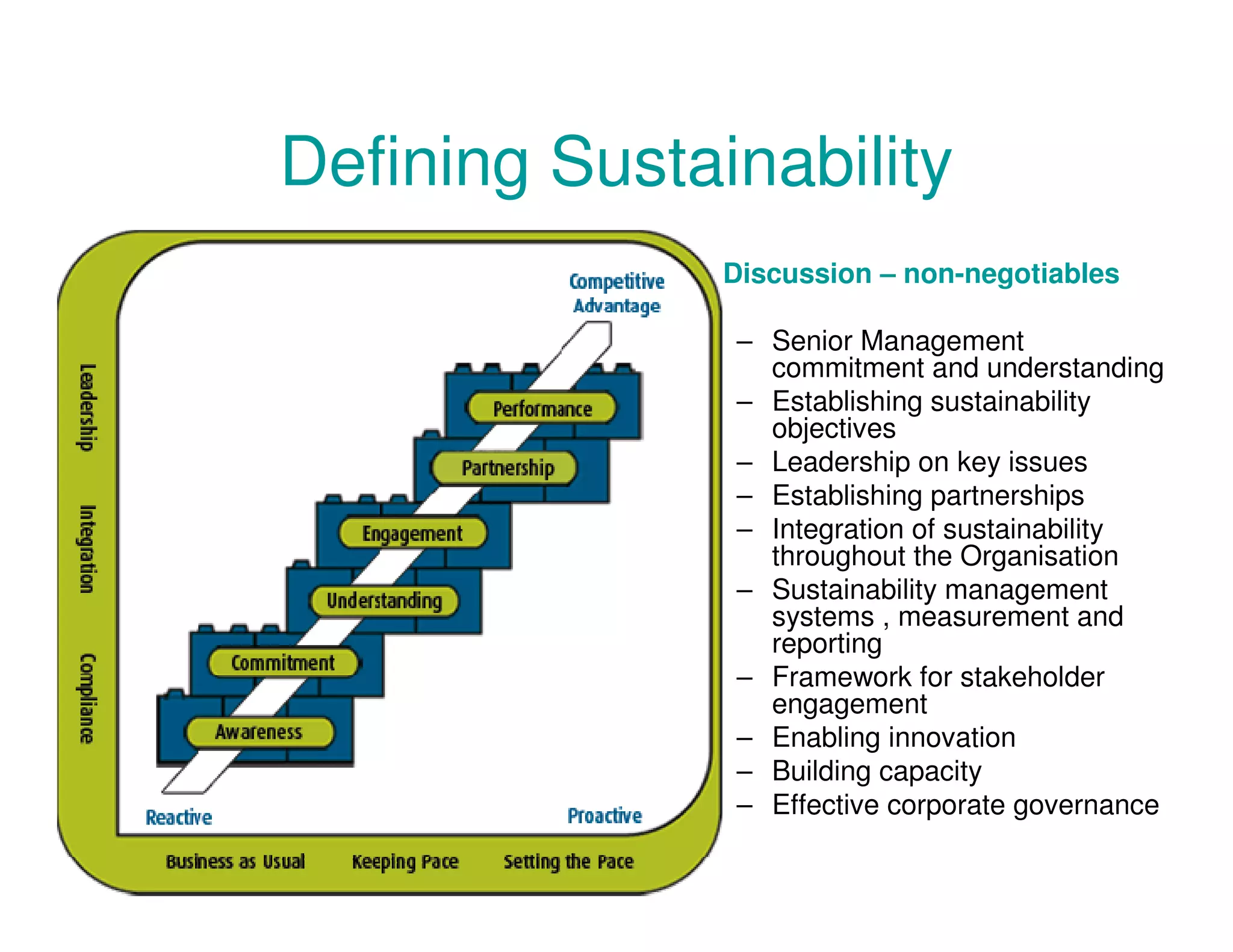
Defining Sustainability
             •   Discussion – non-negotiables

                 – Senior Management
                   commitment and understanding
                 – Establishing sustainability
                   objectives
                 – Leadership on key issues
                 – Establishing partnerships
                 – Integration of sustainability
                   throughout the Organisation
                 – Sustainability management
                   systems , measurement and
                   reporting
                 – Framework for stakeholder
                   engagement
                 – Enabling innovation
                 – Building capacity
                 – Effective corporate governance
What is good citizenship?
What are corporate responsibilities?*
                   • Ethics, governance and acting
                      responsibly
                   • Responsibility towards society
                   • Serving broader stakeholder
                      interests
                   • Good HR Practices and
                      employment equity
                   • Good environmental practices
                   • Product and market
                      stewardship
                   • Focus wider than the pursuit of
                      profits
                   • Assist government with socio-
                      economic agenda
                   • Ensuring long term business
                      survival
                   *Corporate Citizenship Handbook
Inhibitors of Good Citizenship
• Lack of financial resources
• Lack of time to understand and implement
• Poor awareness and knowledge of the
  subject area
• Lack of skills and understanding of the
  subject area
• Poor management buy-in in the importance
  of responsible business practices
• Employees not interested – see it as a
  burden
• No real business benefit evident to
  executive management
• Poor executive support
Its really very simple …. sustainable and
responsible business practices means…
• Discontinuing product offerings that are considered harmful but not
  illegal
• Selecting suppliers based on their sustainable business practices
• Choosing manufacturing and packaging materials that are the most
  environmentally friendly
• Providing full disclosure of product content
• Developing programs that support employee well being
• Establishing guidelines for marketing to children
• Providing increased access for disabled populations
• Respecting privacy of consumer information
• Developing process improvements such as eliminating the use of
  hazardous waste materials
• Ensuring everybody can afford your product
Is this serious stuff?
      Is anyone paying attention to this?
• Sustainability strategy and management
    – Anglo American, Anglo Platinum, Exxaro, Kumba, Liberty, Mondi, Pick &
      Pay, Santam
• Stakeholder engagement
    – Engen, Sasol, Exxaro
• HR management and development, skills development and training,
  BEE & Transformation
    – Old Mutual, Rand Merchant Bank, Liberty Group, Absa, Engen
• Enterprise Development – Anglo Plat & American
• Customer Care and Satisfaction – Nedbank & Liberty
• Supply Chain Management – Metropolitan, SAB
• Emissions, air pollution and carbon footprint – ArcelorMittalo, Exxaro,
  Mondi
• CSI – Absa, Engen
• Energy use, efficiency and renewables – Anglo American, Engen,
  Exxaro
If its any consolation…
                     It’s a journey.
              Some of us are starting out
Some of us are re-aligning and re-focusing, re-adjusting
               Some of us are perfecting
        Some of us are benchmarking already.
Standards & Compliance
Frameworks & Guidelines
   Industry Initiatives

     Refer to Handout
Laws and compliance
                             International                               Local
Prescribed laws,             •Universal Declaration of Human             •SA Constitution & Bill of Rights
aspirational principles      Rights                                      •Companies Act
conventions and              •International Labour Organisation          •Basic Conditions of Employment Act
standards                    (ILO) Standards                             •Labour Relations Act
                             •ISO 9000                                   •Occupational Health & Safety Act
                             •ISO 14001                                  •National Environmental Management Act
                             •OHSAS 18000                                •Mineral & Petroleum Resources Dev. Act
                             •OECD Guidelines                            •National Water Act
                             •Ecocert                                    •Directors Fiduciary Duties
                             •Fairtrade and Ethical Trading Initiative   •Common law & judicial precedent
                             •Kyoto Protocol                             •NOSA grading
                             •Equator Principles                         •National Small Business Act
                             •AA1000                                     •Environmental Management Act


Guidelines                   •Global Reporting Initiative                •King II
                             •AA 1000 Series                             •JSE Listing Requirements
                             •SA8000 Standard                            •JSE SRI Index
                             •UN Global Compact                          •New Partnership for Africa’s
                             •Sigma Guidelines                           Development (NEPAD)
                             •Dow Jones Sustainability Index
                             •FTSE4Good Index

Transformation Initiatives   •“Region-specific” Initiatives              •Broad Based BEE Act
                                                                         •Employment Equity Act
                                                                         •Skills Development Act
                                                                         •Industry Charters
                                                                         •Preferential Procurement Act
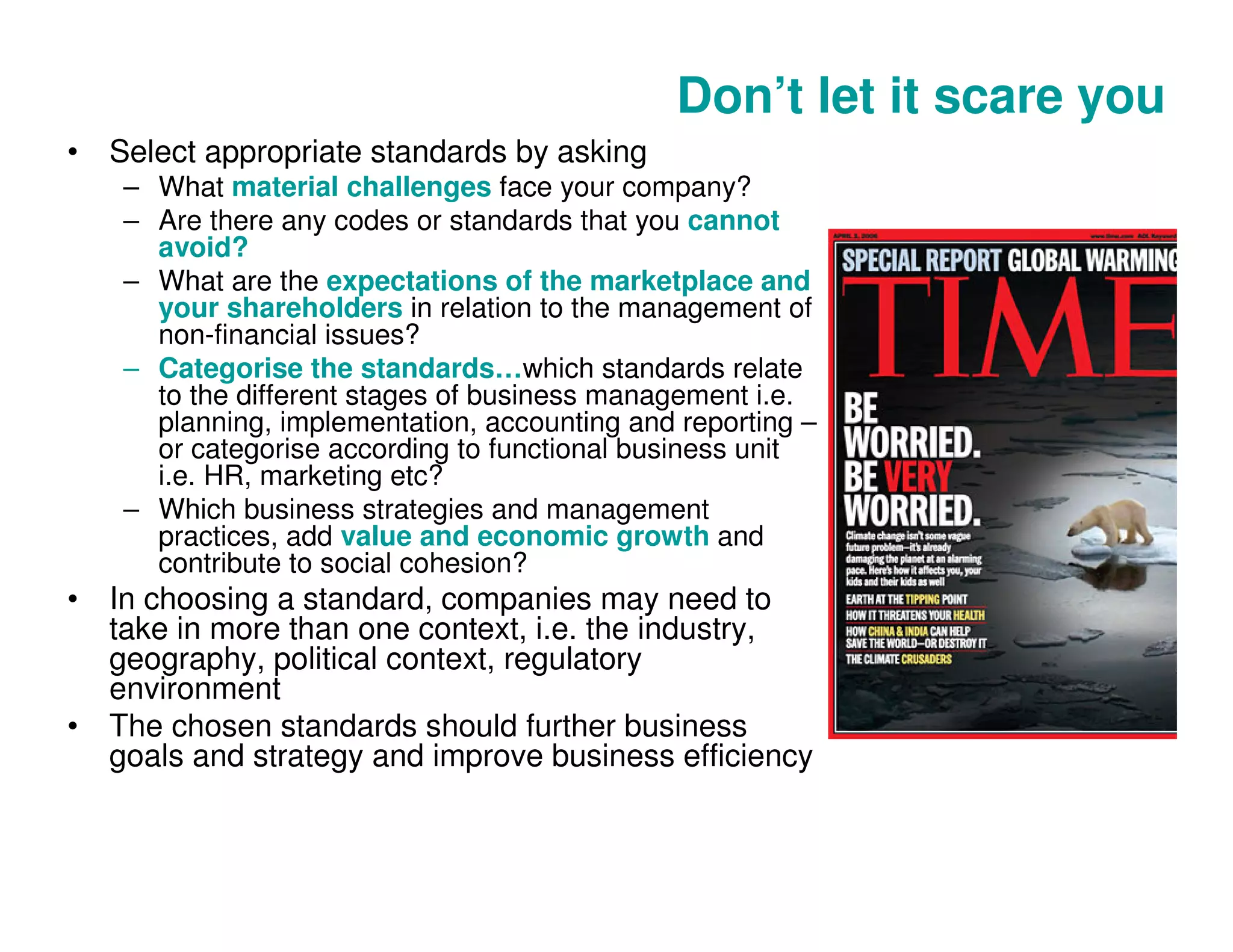
Don’t let it scare you
• Select appropriate standards by asking
   – What material challenges face your company?
   – Are there any codes or standards that you cannot
     avoid?
   – What are the expectations of the marketplace and
     your shareholders in relation to the management of
     non-financial issues?
   – Categorise the standards…which standards relate
     to the different stages of business management i.e.
     planning, implementation, accounting and reporting –
     or categorise according to functional business unit
     i.e. HR, marketing etc?
   – Which business strategies and management
     practices, add value and economic growth and
     contribute to social cohesion?
• In choosing a standard, companies may need to
  take in more than one context, i.e. the industry,
  geography, political context, regulatory
  environment
• The chosen standards should further business
  goals and strategy and improve business efficiency
One step at a time…
Governance                  JSE-SRI; King III, Companies Act
Report                      GRI – www.globalreporting.org
Assurance                   AA1000 Assurance Standard
                            AA1000 Stakeholder Engagement
                            Standard
                            Issues Management Tool
                            www.accountability.org.uk
Carbon Disclosure Project   www.cdproject.net
Industry Standards          Equator Principles (financial)
                            Ethical Trading (retail)
                            Forest Stewardship (paper)
IT DEPENDS ON WHO YOU ARE IT DEPENDS ON WHAT YOU
(Industry)                WANT TO DO/ACHIEVE
Industry Based Initiatives
•   The rise of industry based initiatives in CSR is one of the major
    transformations in the landscape of CSR
•   Momentum is growing in developing countries around sustainability issues,
    and industry initiatives provide an architecture that allows for consultation
    between
     – Developed and developing countries
     – Private and public sectors
     – Producers, buyers and retailers
•   Industry based initiatives can be useful in
     – Establishing collective to-do lists
     – Identifying comparative advantages of individual companies
     – Defining roles for individual companies
     – Distributing CSR activities by working in partnership
     – Stakeholder engagement is easier
     – Providing common systems for monitoring, verification, certification and reporting
     – Building consumer confidence and managing reputation risk better than a single
       company can on its own
     – Providing economies of scale and access to public funding for structural changes
       within an industry, within supply chains or regions
     – Serving as portals for dissemination of information in a coordinated manner
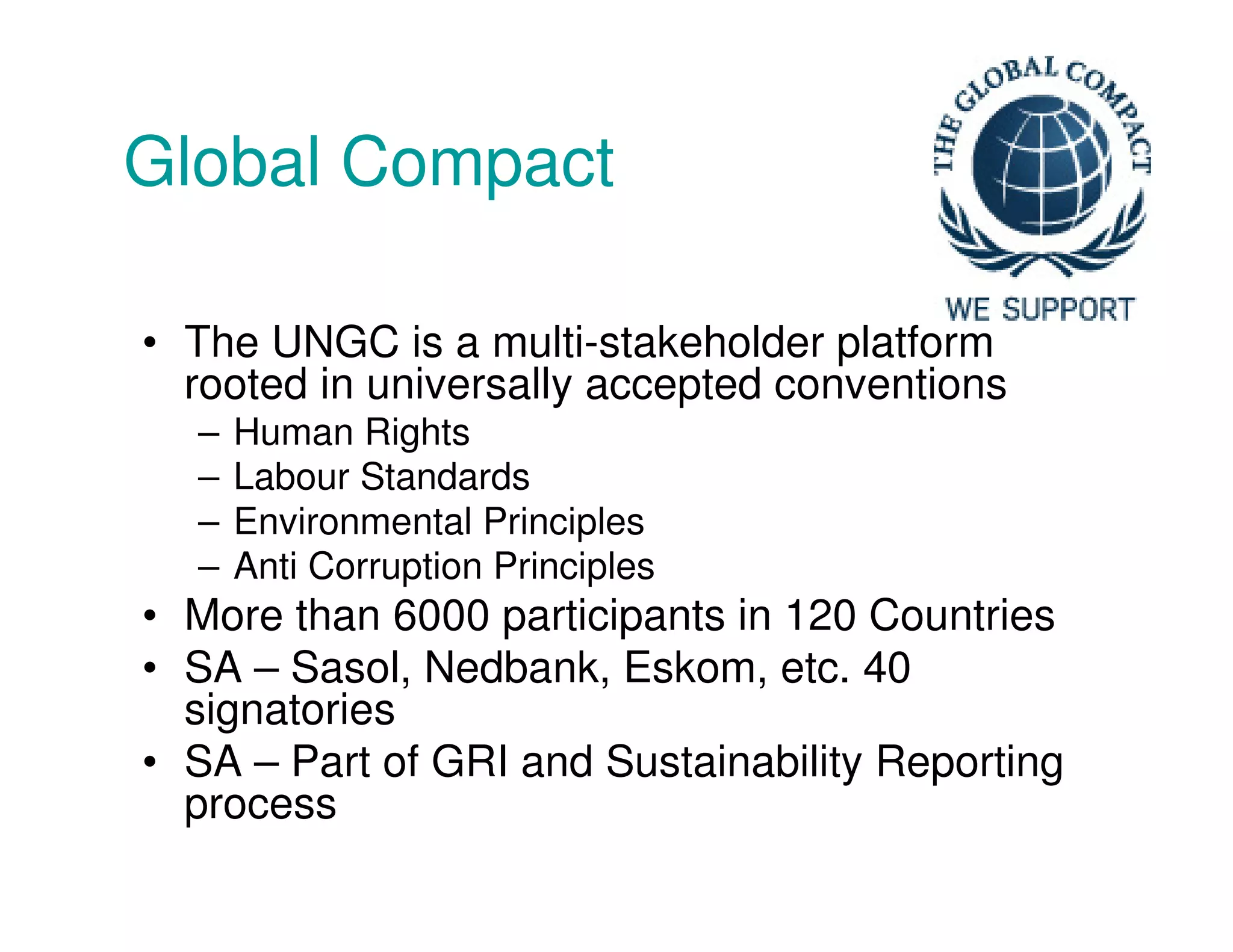
Global Compact

• The UNGC is a multi-stakeholder platform
  rooted in universally accepted conventions
  –   Human Rights
  –   Labour Standards
  –   Environmental Principles
  –   Anti Corruption Principles
• More than 6000 participants in 120 Countries
• SA – Sasol, Nedbank, Eskom, etc. 40
  signatories
• SA – Part of GRI and Sustainability Reporting
  process
UNGC – Membership
               Commitments
• Leadership commitment (board & management) – Letter
  to UN
• Willingness to engage in continuous performance
  improvement (set strategic & operational goals,
  measuring results, communication internally and
  externally)
• Openness to dialogue and learning around critical issues
  (participate in events local and global, engage in
  stakeholder engagement and dialogue)
• Commitment to transparency, accountability and public
  disclosure (annual COP – Communication on Progress)
   – COP – Report against at least 2 indicators
       • Labour, environment, human rights, anti corruption
UNGC – COP Reports
• CEO Statement of commitment
• Description of practical implementation of
  10 principles (1st year only 2 indicators)
• Definition of performance indicators &
  measurement of outcomes (GRI/ETHOS)
• Post on GC website and own plus
  communication to stakeholders
• Verification – external consultants,
  stakeholder feedback, peer review
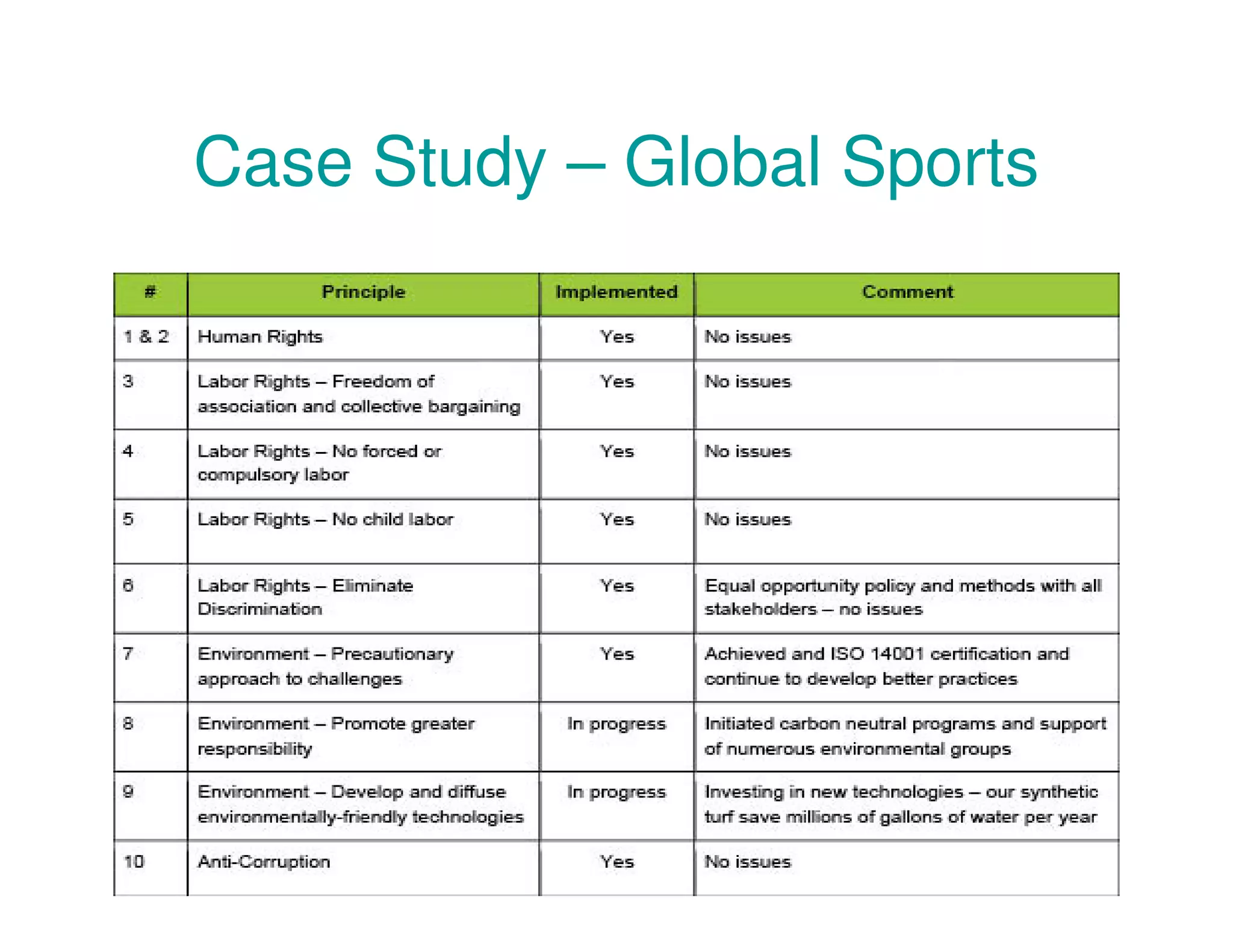
Case Study – Global Sports
Case Study – Danisco
(2 indicators – 1st report)
Where do we start


What is the process
In summary…

                       Allowing external stakeholders to
                        Influence corporate strategy to
                        ensure the future sustainability
                   of the company and all its stakeholders.
                          Its about owning up to your
                                 responsibilities


 Changing and adapting business
strategy and operations to support            Its about the learning in the process
      the new responsibilities                    of becoming more responsible
                                          It is a new awareness and consciousness
Managing CR – the process…
• Engaging Stakeholders
• Embedding citizenship in organisation
   – Structures and resources for managing
     corporate citizenship
   – CEO involvement
   – Management commitment
• Communicating citizenship
   – Reporting
   – Referencing codes and standards
   – Verifying reports
Elements of integration


Stakeholder           Management
Engagement              Systems


          Reporting and
           Verification
Let’s make it work!
• Engaging with stakeholders
   – By obtaining input and feedback, management
     systems can be developed and changed
• Embed management systems and actions
   – Developing a framework to translate policy into
     management systems and actions, and to entrench
     responsible and considerate behavior across all
     management structures
• Reporting should follow performance
   – Reporting becomes a logical extension of responsible
     citizenship practices, using it as a tool to support the
     process, focusing on issues that are material, setting
     targets derived from action plans and tracking
     performance
Sustainability Process

                                                             1.
                                                          Identify
                                                       Stakeholders
                                                                                         2.
                             10.
                                                                               Initial Identification
                  Assess, Redefine and re-map
                                                                               Of material issues


                                                                                                             3.
          9.
                                                                                                    Determine and define
   Measure, monitor
                                                                                                  Engagement, objective and
And assess performance
                                                                                                           scope

                                                    Stakeholder
                                                    Engagement
           8.                                                                                                 4.
     Operationalise                                                                                 Establish engagement
And internalise learnings                                                                           Plan & period schedule


                                7.
                                                                                      5.
                      Understand material
                                                                             Determine and define
                  Aspects, identify opportunities
                                                                           Ways of engaging that work
                             And risk                        6.
                                                    Build and strengthen
                                                          capacity
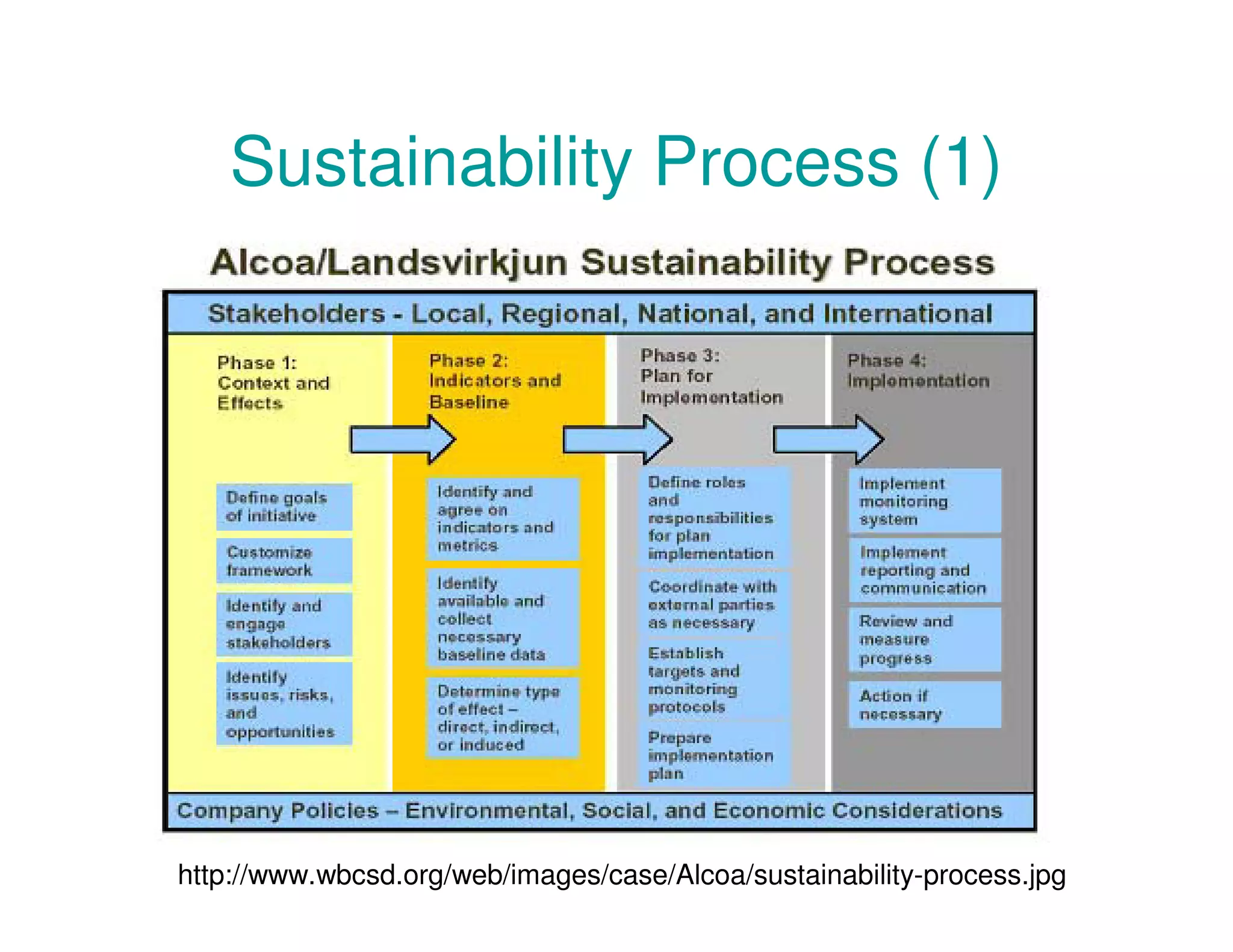
Sustainability Process (1)


http://www.wbcsd.org/web/images/case/Alcoa/sustainability-process.jpg
Sustainability Process (2)


www.fmcg-sustain.com.au/.../approaches/
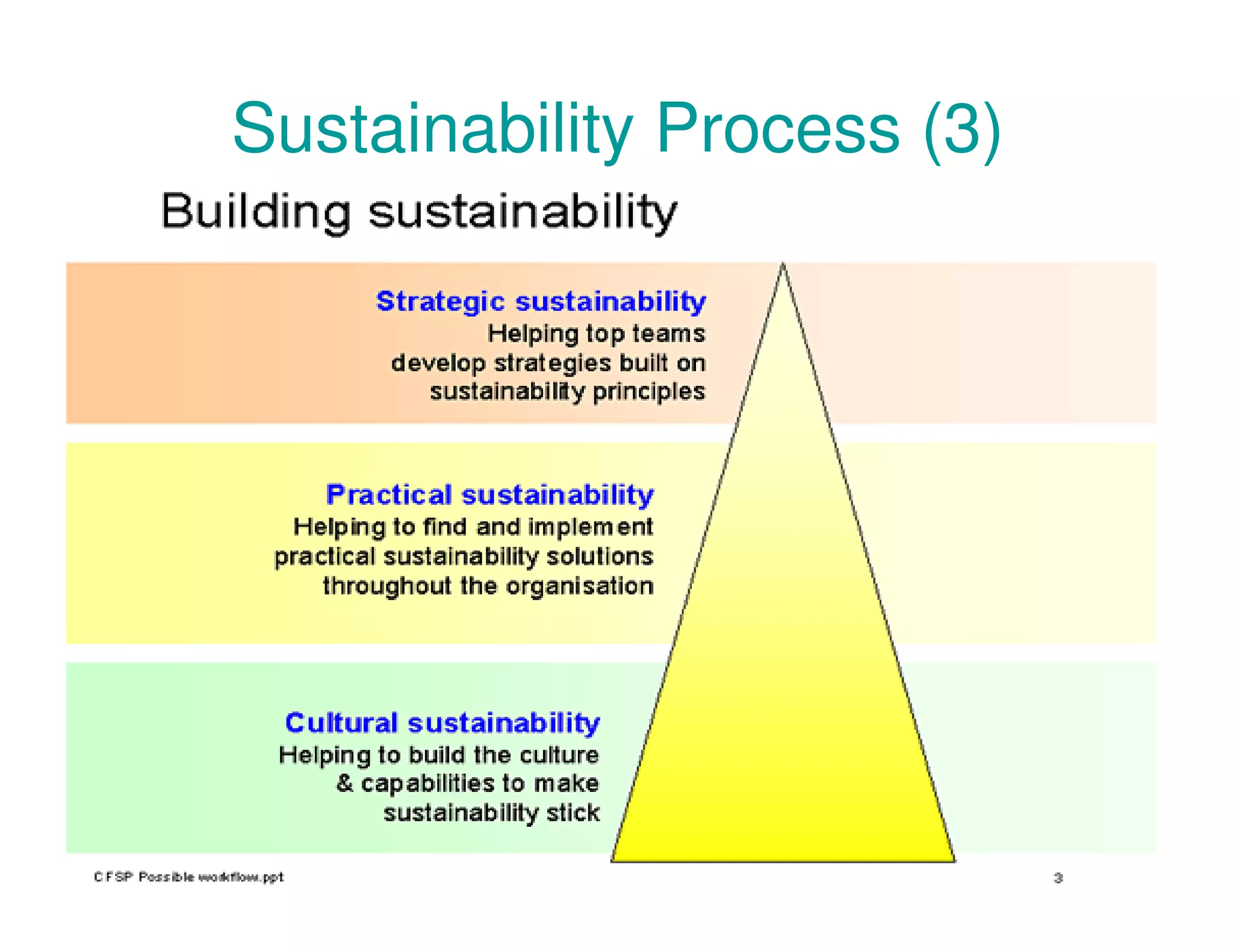
Sustainability Process (3)
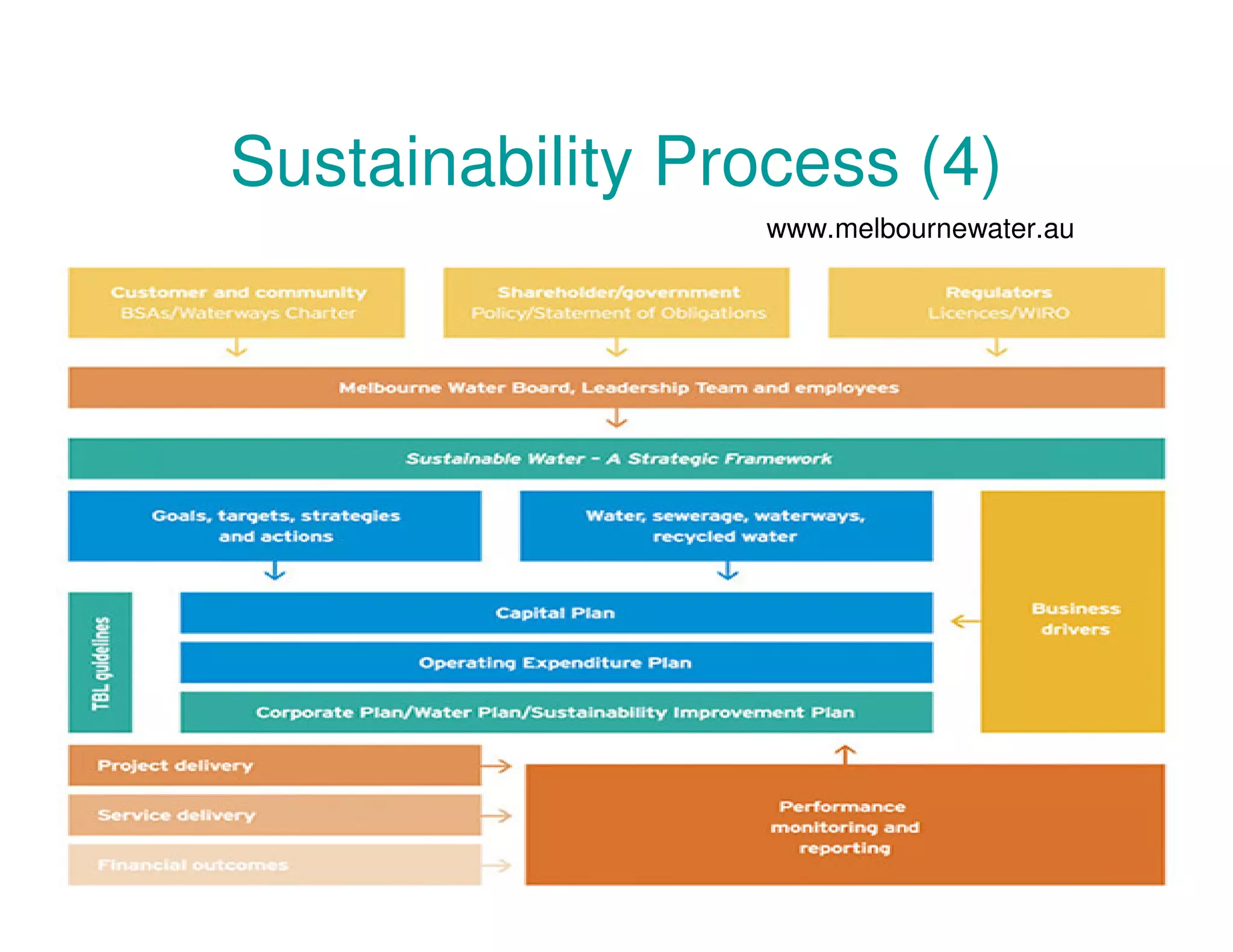
Sustainability Process (4)
                  www.melbournewater.au
Case Study: SAP
Strategic      •   Strategic Sustainability is:
                    – integral to the business model and fundamental
Sustainability         to the business
                    – a source of differentiation, builds organisational
                       reputation with key stakeholders and helps
                       branding
                    – gives a leading edge through innovation,
                       patents, licences, low cost, speed to market and
                       first mover advantage
                    – hard to copy
                    – builds margin and returns via increased prices,
                       lower costs, lower assets; and importantly
                    – it is likely to be specific to the company, in the
                       organisation’s upstream business processes
                       and is often externally focused
               •   Tactical Sustainability, on the other hand, is:
                    – an ‘add on’ and does not impact core business –
                       every company can do it. It is not a source of
                       differentiation; it offers no real leading edge (and
                       in the case of carbon will become purely a
                       compliance issue), and is easy to copy by
                       competitors. It does not build margin because all
                       firms use it and customers can compare and
                       bargain. Tactical Sustainability is likely to be
                       generic to the industry, in the organisation’s
                       downstream processes and often internally
                       focused.
What Should You Do?
•   Develop Capability:
     – Sustainability is becoming more important. Organisations need to develop the
       capability to scan the external environment for changes in legislation, pressure
       from key customers, consumers and competitors, cost increases in key inputs,
       technology opportunities, etc.
•   Bottom Line Focus:
     – During this economic crisis, economic performance is even more important. Set
       sustainability strategies with higher expectations of economic benefits and
       focus on those sustainability initiatives that attract customers and consumers,
       and address costs, without being capital intensive.
•   Link to Business Strategy:
     – Consider how your approach to sustainability aligns with your overarching
       business strategy and differentiates your offer and market position from your
       competitors. The more strategic your approach, the greater the benefits will be.
•   Set Targets:
     – Research / develop targets, measures and controls and report regularly.
•   Resource Appropriately:
     – If you have a sustainability strategy, allocate good people, assign clear
       responsibilities, clarify priorities, coordinate/simplify the multiple initiatives ,
       and share/replicate successes.
•   Build Capacity:
     – If you don’t have a sustainability strategy, educate managers and seek out best
       practice (including results), pilot various approaches and demonstrate results,
       audit key areas to identify improvement opportunities, prepare a strategy to
       prioritise and coordinate the overall approach.
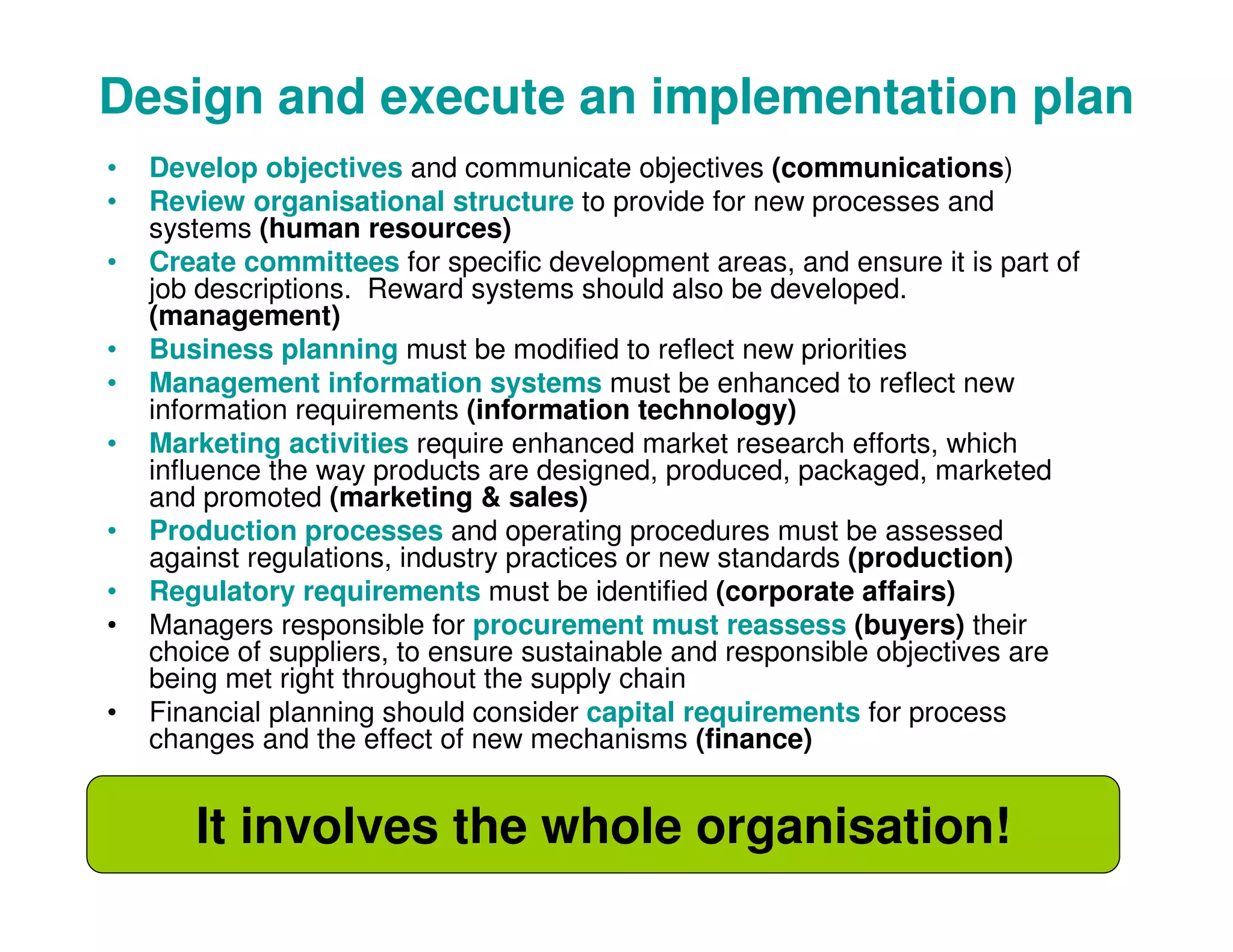
Design and execute an implementation plan
•   Develop objectives and communicate objectives (communications)
•   Review organisational structure to provide for new processes and
    systems (human resources)
•   Create committees for specific development areas, and ensure it is part of
    job descriptions. Reward systems should also be developed.
    (management)
•   Business planning must be modified to reflect new priorities
•   Management information systems must be enhanced to reflect new
    information requirements (information technology)
•   Marketing activities require enhanced market research efforts, which
    influence the way products are designed, produced, packaged, marketed
    and promoted (marketing & sales)
•   Production processes and operating procedures must be assessed
    against regulations, industry practices or new standards (production)
•   Regulatory requirements must be identified (corporate affairs)
•   Managers responsible for procurement must reassess (buyers) their
    choice of suppliers, to ensure sustainable and responsible objectives are
    being met right throughout the supply chain
•   Financial planning should consider capital requirements for process
    changes and the effect of new mechanisms (finance)


       It involves the whole organisation!
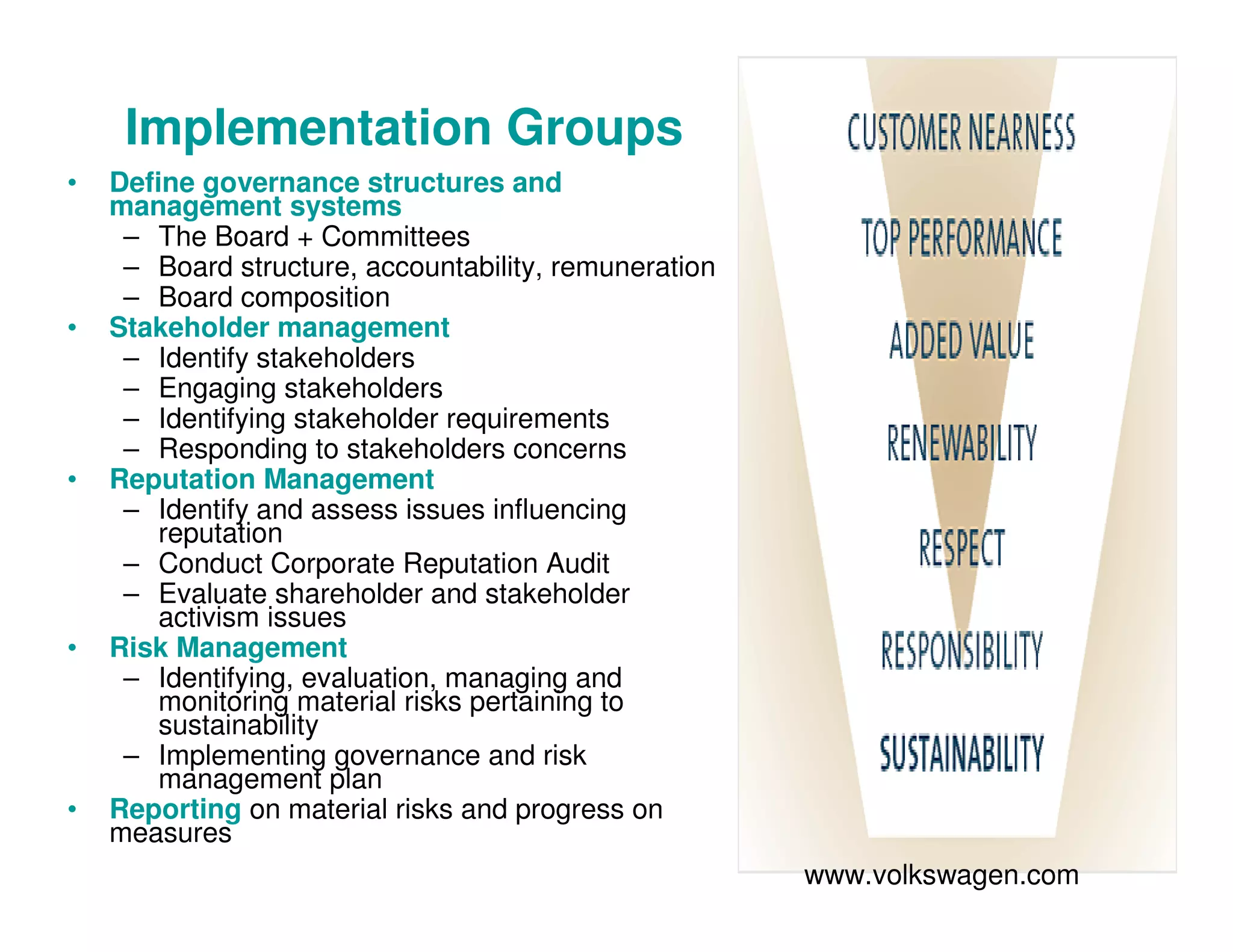
Implementation Groups
•   Define governance structures and
    management systems
     – The Board + Committees
     – Board structure, accountability, remuneration
     – Board composition
•   Stakeholder management
     – Identify stakeholders
     – Engaging stakeholders
     – Identifying stakeholder requirements
     – Responding to stakeholders concerns
•   Reputation Management
     – Identify and assess issues influencing
        reputation
     – Conduct Corporate Reputation Audit
     – Evaluate shareholder and stakeholder
        activism issues
•   Risk Management
     – Identifying, evaluation, managing and
        monitoring material risks pertaining to
        sustainability
     – Implementing governance and risk
        management plan
•   Reporting on material risks and progress on
    measures
                                                       www.volkswagen.com
Process
• Sensitising – becoming aware of the issues
• Discovering – becoming aware through experimentalism – small
  projects and concrete projects
• Embedding – linking structure and strategy with systems
• Routinising – linking CR to the company’s core competencies
Develop a supportive corporate culture

• Re-training may be required
• Exposure to new stakeholder
  groups may be required
• The importance of change and
  the impact of change needs to
  be explained to all levels within
  the organisation
• The lead must come from
  senior executives and the
  board
Develop measures and standards of
                     performance
              •   Industry charters, BEE scorecards are
                  already public measurement tools, others
                  will have to be developed
              •   Other compliance issues both global and
                  local reporting initiatives need to be studied
                  to ensure relevance and appropriateness of
                  reports
              •   Industry specific sustainability initiatives
                  need to be evaluated:
                   –   Clothing Industry (Ethical Clothing)
                   –   Retail Industry (Fairtrade)
                   –   Mining Industry (Kimberly Process)
                   –   Petrochemicals & Manufacturing Industry
                       (Kyoto Agreement)
                   –   Liquor Industry (Dublin Principles)
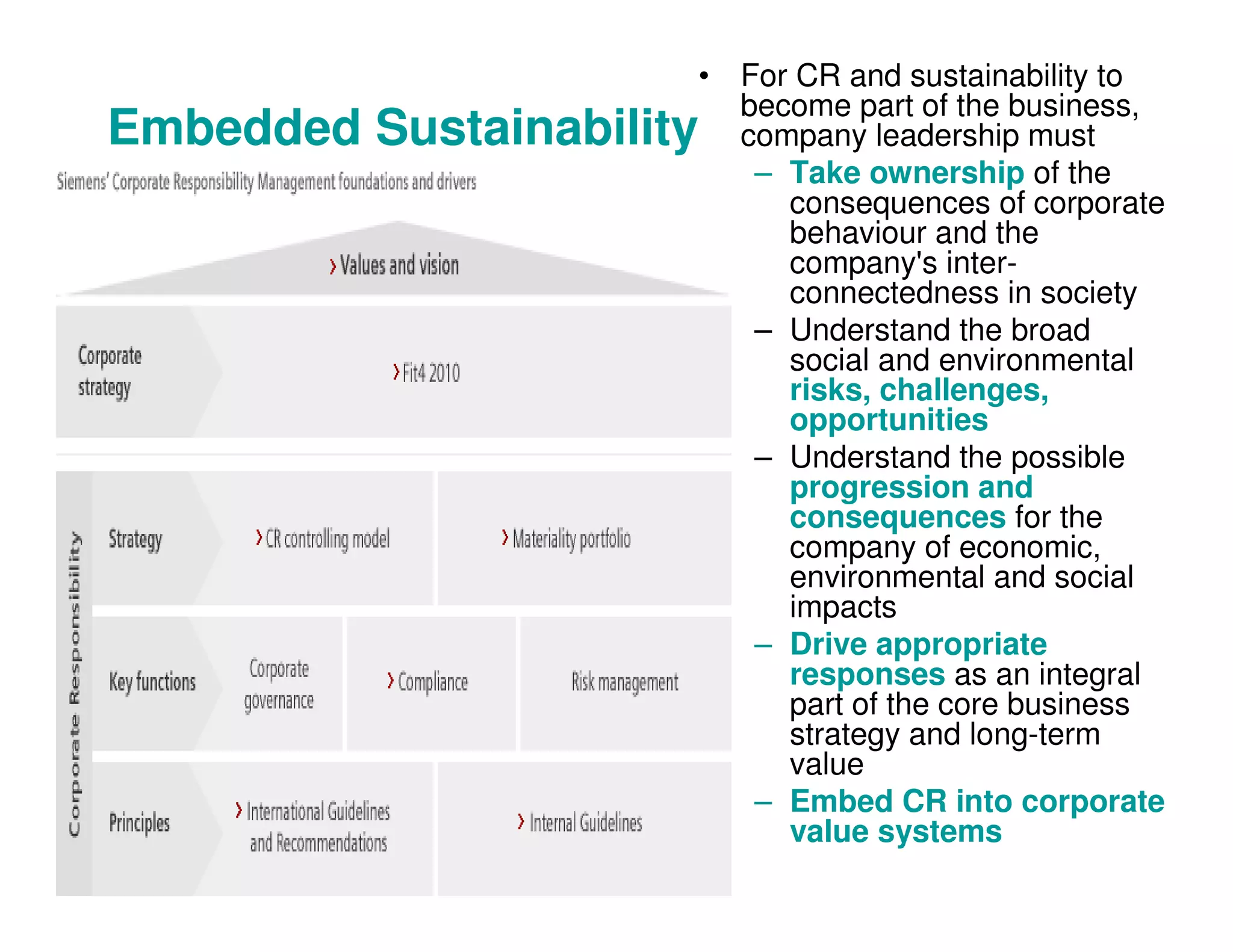
• For CR and sustainability to
                           become part of the business,
Embedded   Sustainability company leadership must
                            – Take ownership of the
                              consequences of corporate
                              behaviour and the
                              company's inter-
                              connectedness in society
                            – Understand the broad
                              social and environmental
                              risks, challenges,
                              opportunities
                            – Understand the possible
                              progression and
                              consequences for the
                              company of economic,
                              environmental and social
                              impacts
                            – Drive appropriate
                              responses as an integral
                              part of the core business
                              strategy and long-term
                              value
                            – Embed CR into corporate
                              value systems
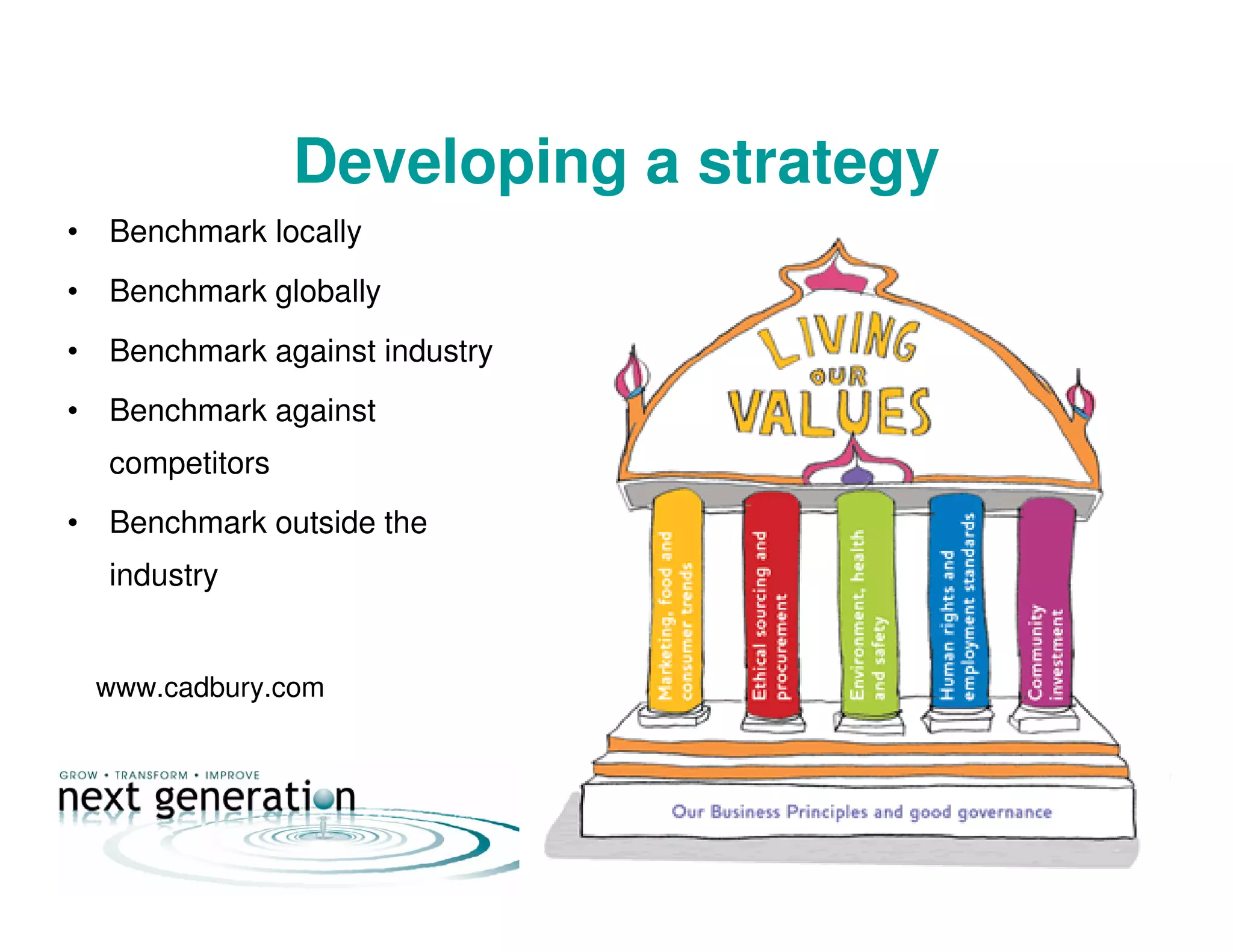
Developing a strategy
• Benchmark locally
• Benchmark globally
• Benchmark against industry
• Benchmark against
  competitors
• Benchmark outside the
  industry


 www.cadbury.com
Effective Sustainability Management
• Be sure to get approval and buy-in from the executive
• Appoint a champion to drive the process
• Engage senior management and make them understand the rational for
  the company’s sustainability agenda
• Make sustainability issues relevant for the management team in the
  context of their business operations
• Ensure that they are involved in co-creating the companies sustainability
  policies, criteria and measures
• Fine-tune, with management a population of sustainability measurement
  indicators that are appropriate and relevant for the business
• Agree on targets against which to be measured in relation to each
  sustainability indicator
• Embed the process in the organisation’s management system in a rigorous
  and structured way
• Measure, monitor and provide feedback on a regular basis
This is going to cost money…
                          •    Indicators of performance
                                – Realistic levels of
                                  expenditure (how much?)
                                – Expenditure within the
                                  definition of CR & CS
                                – Continuity of expenditure
                                – Staff participation
                                – Partnerships
                                – Stakeholder participation
                                – Application of non-cash
                                  resources
                                – Reporting on outcomes
                                – Reporting on business
                                  benefits


                                    www.dfic.co.uk
Stakeholder Engagement
Stakeholders
                                   Customers
                       Owners                      Media

         Employees                                         Consumers


                                                                 Shareholders/
   Suppliers
                                                                   Investors


  Local
Communities                     Corporation                          Financiers


                                                                    Local
    Society
                                                                  Authorities


                                                            Provincial
        Lobby Groups
                                                           Government
                                                  National
                     Environment     Future      Government
                                   Generations
Stakeholder
       Engagement and
          Management
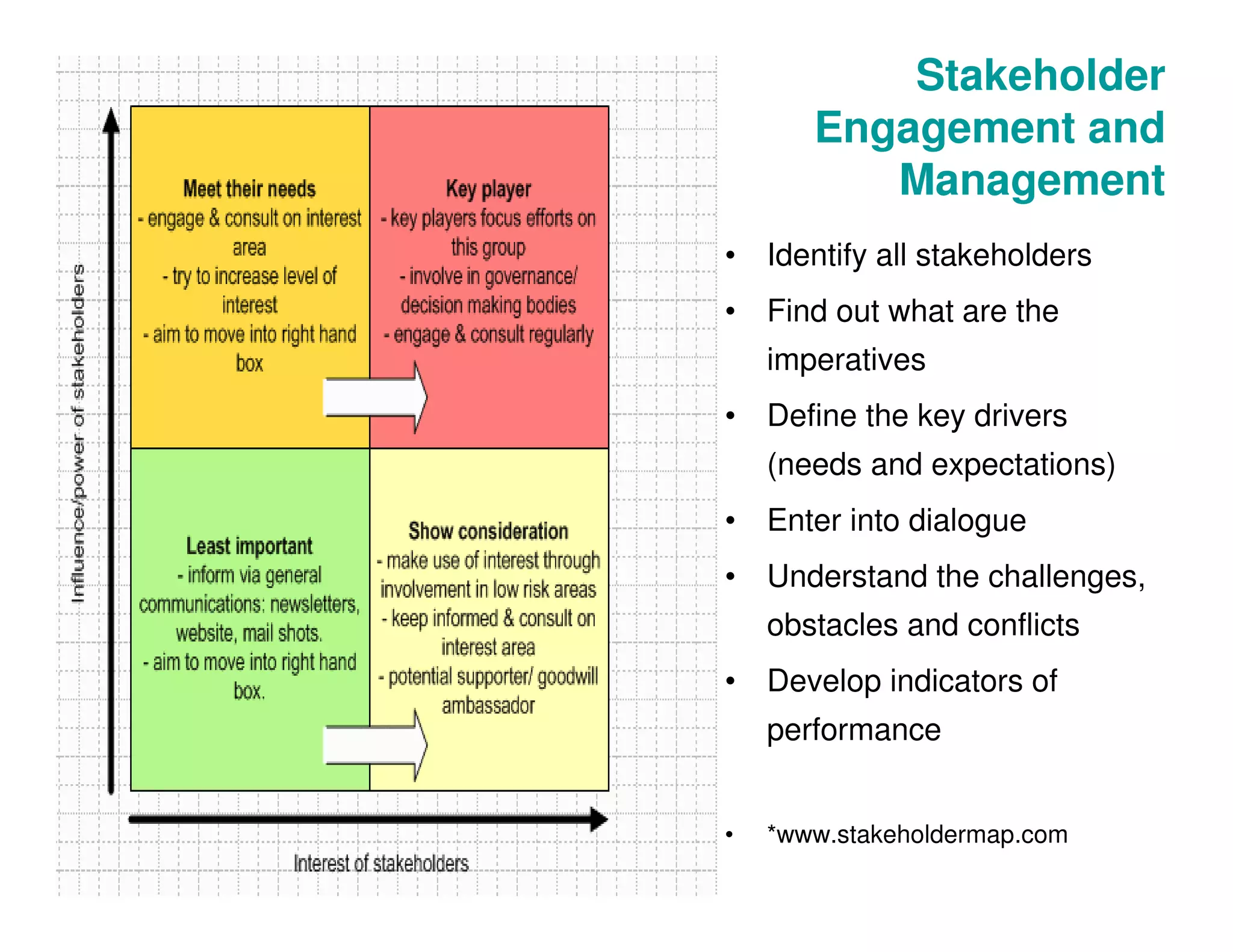
• Identify all stakeholders
• Find out what are the
    imperatives
• Define the key drivers
    (needs and expectations)
• Enter into dialogue
• Understand the challenges,
    obstacles and conflicts
• Develop indicators of
    performance


•   *www.stakeholdermap.com
Coca Cola
Stakeholder Engagement Methodology


          *www.cocacola.co.uk
Key Challenge
1. Failure to identify and engage with stakeholders is likely to result in sustainability
reports that are not suitable and, more damaging, that lead to poor performance by (a)
damaging customer satisfaction and perceptions, (b) adversely affecting employee
motivation and morale, (c) damaging relationships in the supply chain, and (d) possibly
compromising an organization's reputation with the wider community.
2. Balancing stakeholder expectations in a way that does not compromise the long-term
sustainability of the organization.
Stakeholder engagement should inform
      future business strategies
                    • It assists with priority
                      determination
                    • Confirms material risks
                    • Set sustainable development
                      policies and objectives
                    • Developed by internal
                      stakeholders in response to
                      external stakeholder
                      expectations
                    • Responses to stakeholder
                      issues through policies and
                      strategies must be clear,
                      concise and measurable –
                      determine level of aggregation
                           www.gsk.com
Determining Risks, Impacts,
         Targets
         Materiality
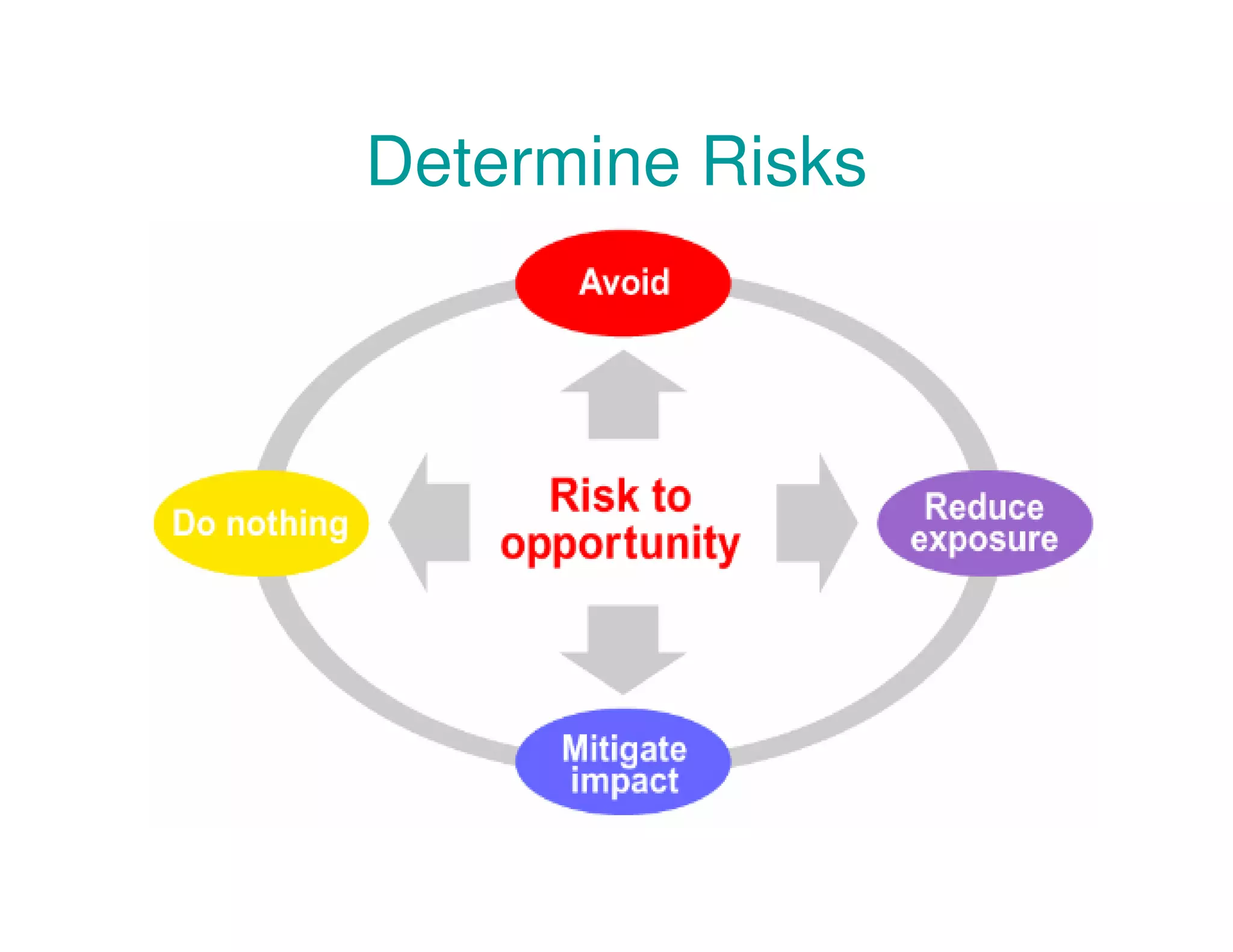
Determine Risks
Materiality, Impact & Risk


www.kovet.hu
Materiality (1)


www.segro.com
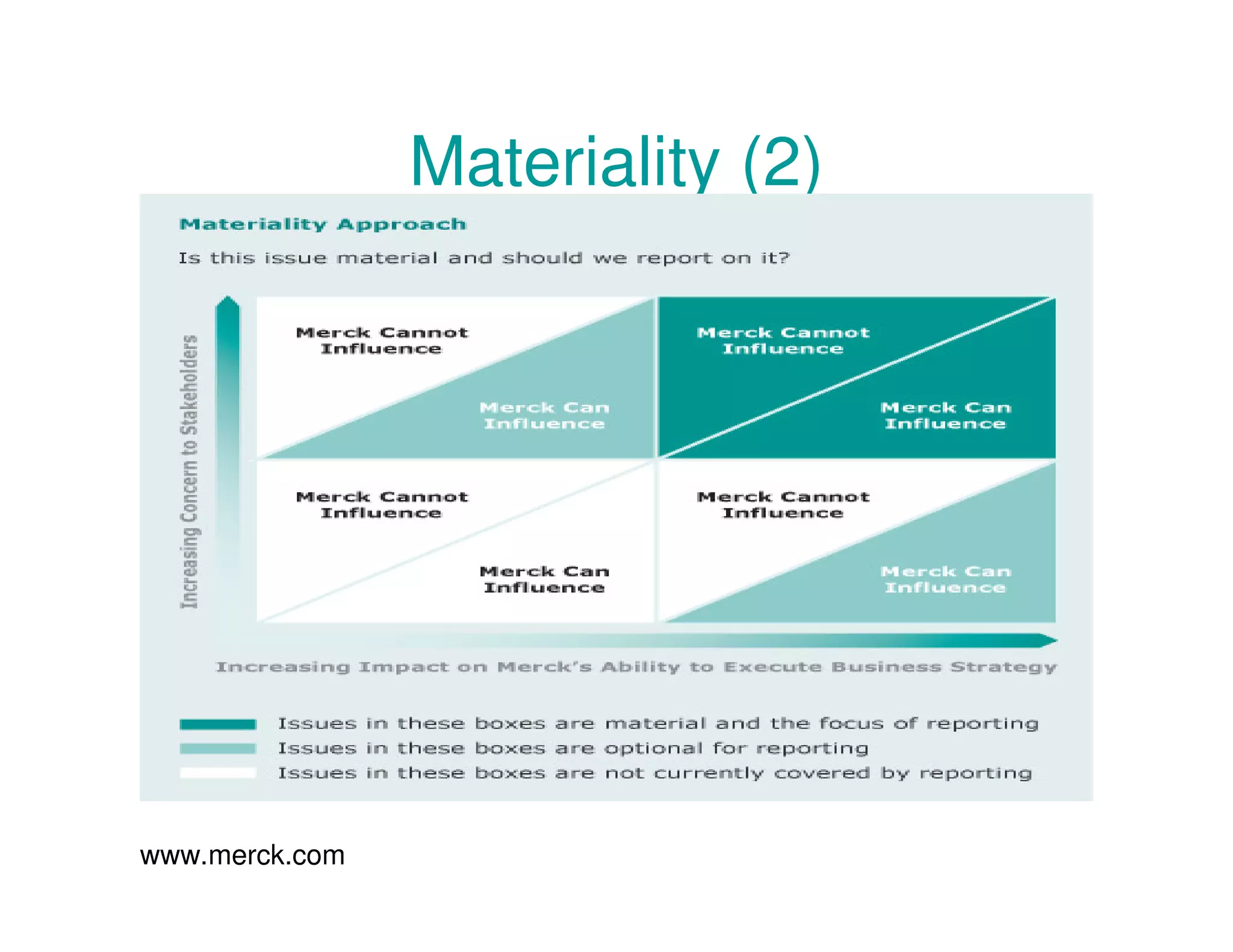
Materiality (2)


www.merck.com
Materiality (3)


www.intel.com
Materiality (4)


www.omron.com
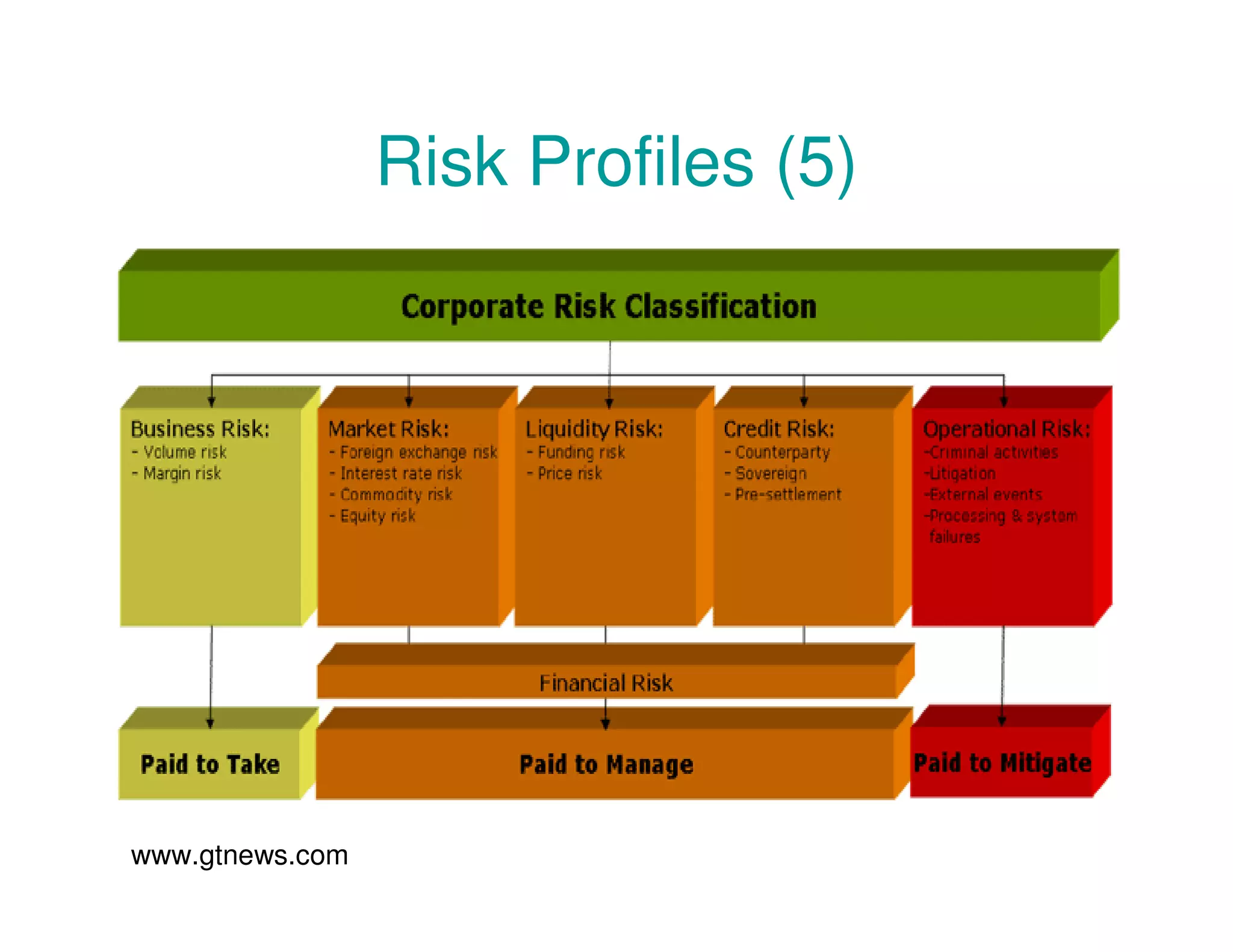
Risk Profiles (5)


www.gtnews.com
AIG Risk Profiling (6)


www.aig.com
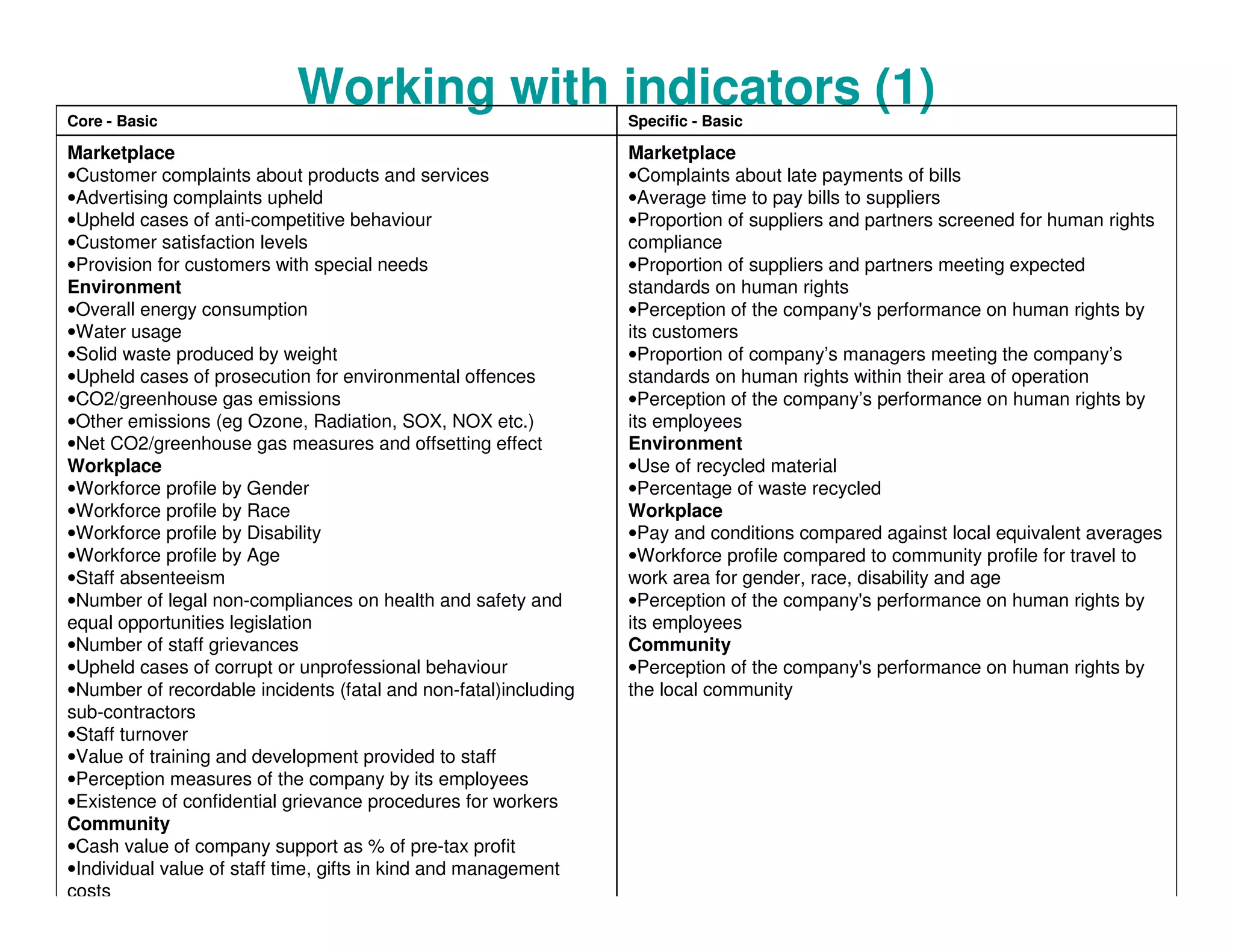
Core - Basic
                            Working with indicators (1)          Specific - Basic

Marketplace                                                      Marketplace
•Customer complaints about products and services                 •Complaints about late payments of bills
•Advertising complaints upheld                                   •Average time to pay bills to suppliers
•Upheld cases of anti-competitive behaviour                      •Proportion of suppliers and partners screened for human rights
•Customer satisfaction levels                                    compliance
•Provision for customers with special needs                      •Proportion of suppliers and partners meeting expected
Environment                                                      standards on human rights
•Overall energy consumption                                      •Perception of the company's performance on human rights by
•Water usage                                                     its customers
•Solid waste produced by weight                                  •Proportion of company’s managers meeting the company’s
•Upheld cases of prosecution for environmental offences          standards on human rights within their area of operation
•CO2/greenhouse gas emissions                                    •Perception of the company’s performance on human rights by
•Other emissions (eg Ozone, Radiation, SOX, NOX etc.)            its employees
•Net CO2/greenhouse gas measures and offsetting effect           Environment
Workplace                                                        •Use of recycled material
•Workforce profile by Gender                                     •Percentage of waste recycled
•Workforce profile by Race                                       Workplace
•Workforce profile by Disability                                 •Pay and conditions compared against local equivalent averages
•Workforce profile by Age                                        •Workforce profile compared to community profile for travel to
•Staff absenteeism                                               work area for gender, race, disability and age
•Number of legal non-compliances on health and safety and        •Perception of the company's performance on human rights by
equal opportunities legislation                                  its employees
•Number of staff grievances                                      Community
•Upheld cases of corrupt or unprofessional behaviour             •Perception of the company's performance on human rights by
•Number of recordable incidents (fatal and non-fatal)including   the local community
sub-contractors
•Staff turnover
•Value of training and development provided to staff
•Perception measures of the company by its employees
•Existence of confidential grievance procedures for workers
Community
•Cash value of company support as % of pre-tax profit
•Individual value of staff time, gifts in kind and management
costs
Working with indicators (2)
Core                                                 Specific
Advanced                                             Advanced
Marketplace                                          Marketplace
•Social impact, cost or benefits, of the company’s   •Customer loyalty measures
core products and services                           •Recognising and catering for diversity in
                                                     advertising and product labelling
Environment
•Environmental impact over the supply chain          Community
•Environmental impact, costs or benefits of          •Project progress and achievement measures
companies core products and services                 •Leverage of other resources

Workplace
•Impact evaluations of the effects of downsizing,
restructuring etc.

Community
•Impact evaluations carried out on community
programmes
•Perception measures of the company as a good
neighbour
Fast Track Learning
Corporate Responsibility Mistakes
•   Lacking vision
     – It is not about “where are we now and what might we do about CR”.
     – It is about “where do we want to be in 10 years time”
     – Then it’s about “what and how do we need to change to bring about our vision for the
       next ten years”
•   Oblivious to the scale of required change
     – The magnitude of change, the required new creative and innovative thinking is not
       about selectively modifying existing business practices
     – It is about new, more responsible and smarter ways to create shareholder value and
       wealth
•   Sub strategic
     – It is not a staff function at a sub-strategic level with little connection to the strategy of the
       business, its core competencies and capabilities or management know-how
     – It requires an understanding of the significance of the range of issues that contribute to
       CR and the ways that it may affect business. This means to address the possibility of
       changing systems in the core of the business, changing incentive systems,
       changing the focus of decision-making, and management systems in the core of
       the business while implementing CR projects in specific business units
CR Mistakes (cont’d)
•   Unsophisticated view of CR
     – Many companies do not separate the two roles of CR – protecting the assets of the firm
       and providing a basis for the creation of new value
•   Inability to hear outside voices
     – CR demands new views from a range of stakeholders. With no clear distinction between
       value protection and value creation, it is not easy to engage stakeholders in appropriate
       ways, to ask them appropriate questions and to listen, understand and adhere to their
       suggestions
•   Sticking with old managerial competencies
     – Few have recognised that the competencies required in the past may not meet the
       needs of the future. I.e. stakeholder engagement, product development, environmental
       management, risk management are new management skills development areas
•   One worldview approach
     – Many CR programs, focus only or a company’s home country specific compliance
       requirements. This does not do justice to the real difference between CR agendas across
       countries, or specific communities and stakeholders. Excessive uniformity is an almost
       universal mistake in CR.
CR Mistakes (cont’d)
• Uneven approach
   – Making substantial commitment and achieving good CR performance in
     some divisions, or business areas, while other parts of the company
     might view it as irresponsible. E.g. many companies have made carbon-
     neutrality pledges without tackling other big CR issues such as child labour or
     unsafe working conditions.
   – In doing so they often create the impression that their CR are driven by image
     considerations rather than a deep-seated conviction that requires CR as a
     core business asset.
• Non-participative management
   – Many CR programs have been formulated and implemented through top-
     down directives, not matched by the requirements to make CR a part of
     company culture and procedures.
   – Best practice requires companies to manage CR through a network of
     ‘change champions’ but this is rarely practiced
• Failure to see CR as innovation
   – The failure to see that CR is best practiced on a continuous innovation
     process that links CR to a company’s business model. Many companies
     are seeking to be more innovative for competitive reasons, yet few regard
     their CR programs as directed to value protection or value creation or as
     innovation in its own right.
Working with actual reports
      and strategies
       Practical Session
Best Practice

Awards and Recognition
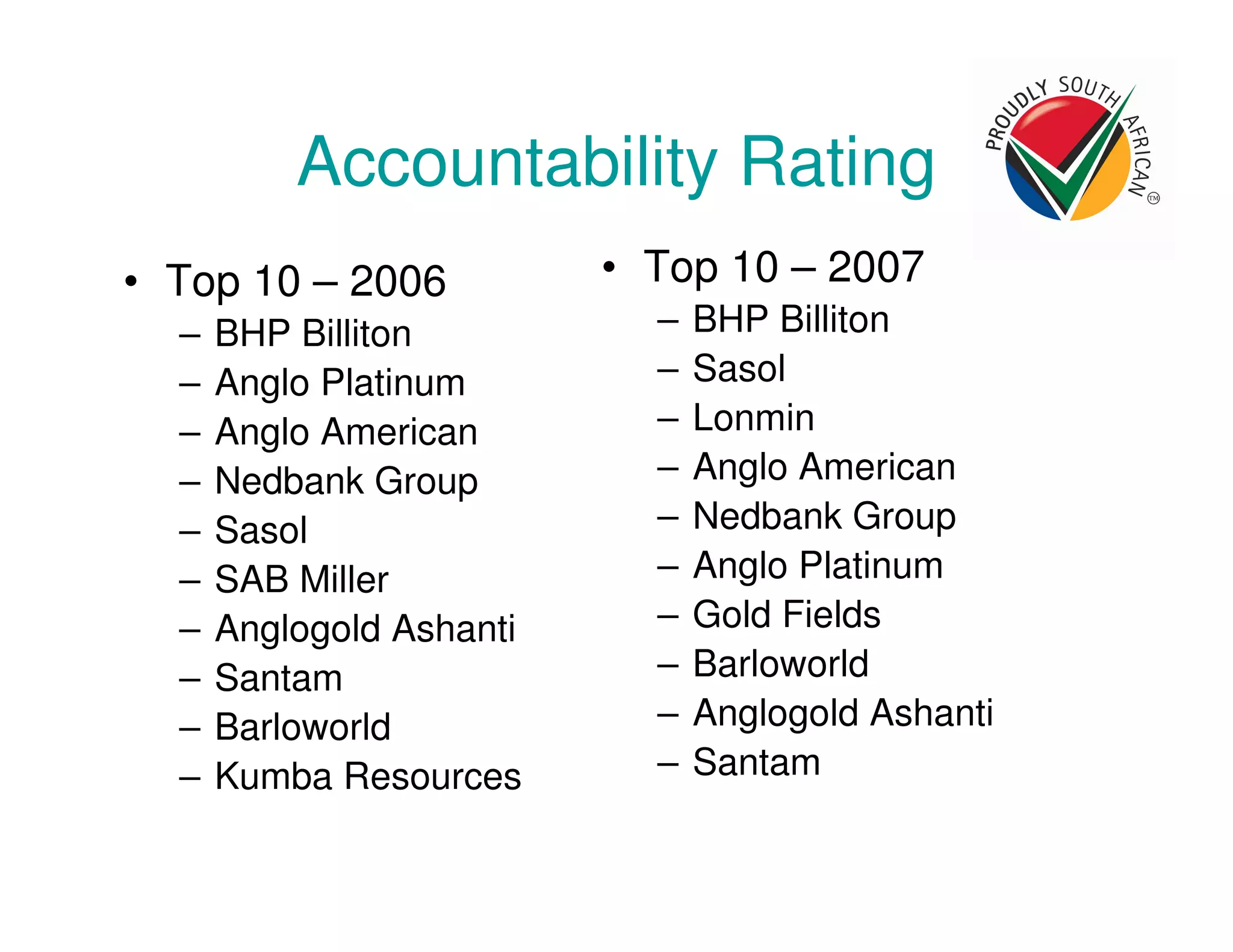
Accountability Rating
• Top 10 – 2006           • Top 10 – 2007
  –   BHP Billiton          –   BHP Billiton
  –   Anglo Platinum        –   Sasol
  –   Anglo American        –   Lonmin
  –   Nedbank Group         –   Anglo American
  –   Sasol                 –   Nedbank Group
  –   SAB Miller            –   Anglo Platinum
  –   Anglogold Ashanti     –   Gold Fields
  –   Santam                –   Barloworld
  –   Barloworld            –   Anglogold Ashanti
  –   Kumba Resources       –   Santam
Accountability Rating
• Assessed according to
  – Strategy, Governance, Performance Management,
    Stakeholder Involvement, Public Disclosure,
    Assurance
• Key Trends
  – Materials sector – mining, chemical, metals and
    glass, oil and gas – best performing sector
  – Followed by Financial sector (38%) and industrial
    sector (35%), retail/FMCG sector (29%)
SA – Accountability Ranking
1    BHP Billiton               78.6   26   Edgars Consolidated Stores         39.7
2    Anglo Platinum             70.1   27   Richemont Securities               38.8
3    Anglo American             69.4   28   Investec Ltd                       38.1
4    Nedbank Group              67.4   29   Investec Plc                       38.1
5    Sasol                      66.0   30   Unitrans                           37.4
6    SAB Miller                 61.6   31   Firstrand Group                    37.0
7    Anglogold Ashanti          54.9   32   AECI                               36.4
8    Santam                     54.7   33   Allied Electronics Group           35.5
9    Barlowworld                54.2   34   Liberty Group                      34.8
10   Kumba Resources            53.8   35   Network Healthcare Holdings        32.8
11   Harmony Gold               52.9   36   Imperial Holdings                  31.7
12   Massmart Holdings          51.3   37   JD Group                           30.1
13   Aveng                      49.1   38   Old Mutual                         25.2
14   Sappi                      48.9   39   Nampak                             24.9
15   Impala Platinum Holdings   48.4   40   Datatec                            24.1
16   Telkom SA                  48.0   41   Super Group                        24.0
17   Absa Group                 46.6   42   Dimension Data Holdings            22.6
18   Pick & Pay Stores          46.6   43   Shoprite Holdings                  22.5
19   Standard Bank Group        45.7   44   Murray & Roberts Holdings          20.0
20   Woolworths Holdings        45.1   45   New Clicks Holdings                19.3
21   MTN Group                  43.0   46   Steinhoff International Holdings   19.0
22   Bidvest Group              41.7   47   Mittal Steel                       18.9
23   Gold Fields                41.7   48   The Spar Group                     16.9
24   Metropolitan Holdings      41.1   49   Naspers                            14.5
25   Sanlam                     40.0   50   Remgro                             13.0
• High environmental impact classification
               – 2006: Anglo American PLC, Anglo
SRI Index         America Platinum Corp Ltd, Impala
                  Platinum Holdings Ltd, Oceana
                  Group Ltd, Sasol Ltd, Tongaat-Hulett
                  Group Ltd
               – 2007: Anglo American, Anglogold
                  Ashanti, Aveng, Gold Fields, Group
                  Five, Highveld Steel, Illovo Sugar,
                  Merafe Resources, Sasol, Tongaat
                  Hulett
            • Medium environmental impact
              classification
               – 2006: Edgars, Medi Clinic, Telkom,
                  Woolworths
               – 2007: Massmart
            • Low environmental impact classification
               – 2006: Liberty, Nedbank, Remgro
               – 2007: Absa Group, African Bank
                  Investments
            • Set criteria to measure environmental,
              social, corporate governance and
              broader economic practices - Also
              consider policies, management,
              performance and reporting
Others - SA Results
• SA Companies on the Dow Jones
  Sustainability World Index
  – African Bank Investments Ltd, Investec Ltd,
    Nedbank Group Ltd, Bidvest Group Ltd
• Good Governance Awards
  – Focuses on remuneration practices, corporate
    ethics and integrity, risk management, BBBEE
    and transformation
    • Overall Winner - 2006 – FirstRand Group – 2007 –
      FirstRand Group
SA Sustainability Reporting Rewards
• Ernst & Young Excellence in Sustainability Reporting
   – 2006: Sasol (1st), Anglo American Platinum (2nd), Bidvest (3rd),
     BHP Billiton(4th), Kumba Resources(5th)
   – 2007: Sasol, Barloworld, Massmart Holdings, Nedbank Group,
     Absa Group, Telkom, Kumba Resources, Anglogold Ashanti,
     Edgars Consolidated Stores and Aspen Pharmacare Holdings.
   – Focuses on sustainability context, report content and boundary,
     triple bottom line impacts, report quality and effectiveness,
     assurance and credibility
• ACCA South Africa Awards
   – Anglo Platinum, Spier (1st runner up), African Bank & Sasol
     (jointly 2nd runner up), Woolworths (best improved report),
     Massmart (best newcomer)
   – Focus on completeness, credibility, communication
Reporting
Reporting Process
Why report?
•   In response to pressure from advocates and communities related to specific
    events or business practices
•   It is an effort to strengthen the reputation and market competitiveness,
•   Maintain the ‘licence to operate’
•   Demonstrate a serious commitment to a code of conduct to which
    organisations subscribe
•   Maintain and strengthen trust with community and advocacy groups,
    investors, consumers and other stakeholders
•   Link disparate functions such as finance, marketing, R&D and operations into
    a more strategic vision and operation, opening new conversations that pave the
    way for discovery and innovation
•   Identify trouble spots and unanticipated opportunities, in supply chains,
    among customers, communities or regulators, or in the areas of reputation and
    brand management
•   Access and measure the value of sustainability practices in the
    organisation in relations to the organisation’s overall business strategy and
    competitiveness
•   Reduce share price volatility and uncertainty occasioned by surprise,
    untimely or incomplete disclosure
From Annual Report to Sustainability
                      Report
•   Annual financial reports now need to include environmental, social and economic
    impact and not just focus on publishing of historical financial results.

     – Description of commitment to economic, environmental and social goals
     – Performance against benchmarks, targets and industry norms
     – Major challenges for the organisation in integrating financial performance with
       environmental and social performance
     – Percentage of board directors that are independent, non-executive directors
•   Profitability
     – Increase/decrease in retained earnings at the end of the period, used to
       calculate return on average capital employed
     – Total recycling and reuse of water
     – Organisation’s indirect economic impacts
•   Taxes and subsidies
     – Subsidies received broken down by country or region
     – Total sum of all taxes of all types paid broken down by country or region
Reporting (cont’d)
  • Corporate social responsibility policies
     – Externally developed voluntary charters or
       principles to which the organisation
       subscribes
     – Policies and/or systems for managing
       upstream and downstream impacts
     – Approaches to stakeholder consultation and
       frequency
     – Awards received relevant to social, ethical
       and environmental performance
  • Restrictions
     – Descriptions of policies including child
       labour
     – Descriptions of policies, guidelines and
       procedures to address the needs of
       indigenous peoples
     – Amount of monies paid to political parties
       and institutions whose prime function is to
       fund political parties and candidates
Reporting (cont’d)
• Director liability and future expectations
   – Explanation of whether and how the
     precautionary approach or principle is
     addressed by the organisation
   – Status of certification pertaining to
     economic, environmental and social
     management systems
   – Explanation of the nature and effect of
     restatements of information provided in
     earlier reports and the reasons for such
     restatements
   – Description of policy for preserving
     customer health and safety during the use
     of products and services
Reporting (cont’d)
•   Key performance indicators for balanced scorecards
     – Percentage of materials used that are wastes
     – Direct energy use segmented by primary source
     – Standard injury lost days, absentee rates and fatalities
•   Preferred supplier standards
     – Percentage of contracts that were paid in accordance with agreed terms
     – Descriptions of policies, guidelines, corporate structure and procedures to deal with all
       aspects of human rights
     – Performance of suppliers relative to environmental requirements
•   Tradable permits
     – Greenhouse gas emissions
     – Use and emissions of ozone-depleting substances
     – Significant environmental impacts of transportation used for logistical purposes
•   Voluntary regulations and standards
     – Location and size of land owned, leased or managed in biodiversity rich habitats
     – Changes to natural habitats resulting from activities and operations and percentage of
       habitat protected or restored
     – Voluntary code compliance, product labels or awards with respect to social/and or
       environmental responsibility that an organisation is qualified to use or has received
Linkages between sustainability and financial
reporting
• Sustainability reporting complements financial reports with
  forward looking information that can enhance the report and the
  understanding of key value drivers such as human capital
  formation, corporate governance, management of
  environmental risks and liabilities and the ability to innovate
• It shows an understanding of the external environments
  (products, labour and capital markets and regulatory structures)
  in which the company conducts its business
• It assesses the elements that underpin the company’s
  competitive advantage (through cost leadership and
  product/service differentiation and the formation of intellectual
  capital)
• It is about disclosing known future uncertainties and trends that
  may materially affect financial performance
Reporting Research*
• Many reports still do not address relevant core business issues
• Many reports fail to address the biggest sustainability issues such
  as sector-specific impacts and global issues such as dependence
  on fossil fuel, human rights and labour issues
• Mainstream investors are developing a genuine interest in
  sustainability reporting as a means to evaluate long term prospects
• Local, national and global priorities and the needs of a broader
  group of stakeholders need to be reflected in reports – many reports
  do not show evidence of adequate engagement with stakeholders,
  reports need to move away from a summary of corporate priorities
• Communication needs to be thorough and new media present many
  opportunities to interact with stakeholders
• External assurance is the only way to ensure credibility in the future
                                                  *www.corporateregister.com
                                                                  *acca.com
Key Trends - Reporting
•   Learning curve
     –   Many reports stress that they are taking the first steps in integrating environmental, social and
         economic factors into company policies and operations or that they are just learning how to do
         sustainability reporting.
•   Anecdotal (little data)
     –   Reports are full of short stories on different company projects or programs but include few
         numbers
•   Data collection
     –   Most reports do not indicate how information was collected
•   Level of detail
     –   Several reports provide little meaningful data
•   Targets
     –   The absence of targets means that the progress made towards sustainability cannot be
         measured
•   Credibility
     –   Most rapports seem to be put together by communications team and contain little more than
         broad policy statements and in some cases reference to global agreements and events
•   Stakeholder participation
     –   Few reports show how input from different stakeholders has improved performance
•   Honesty and admitting limitations
     –   Reports tell only one part of the story, and failure to get external verification supports the notion
         that the report is an attempt to ‘greenwash’ the message
Hot topics in reporting
•   Financial Analysts
     – How do corporate reporters seek to
        engage the financial world?
•   Verification & Assurance
     – The GRI will drive market demand, but
        how can real value be added?
•   Supply Chain
     – As value webs globalize, how can they
        be made transparent?
•   Emerging Economics
     – Who is reporting on – and in – less
        developed regions?
•   Economic Bottom Line
     – Beyond financial accounting, what
        economic information do we want?
•   Brands & Reputation
     – How does reporting link to corporate
        and brand reputation and value?
•   Governance
     – What are the appropriate roles for
        boards and top executives?
Industry focus on Reporting*
•   Financial Sector
     – Encourage socially responsible lending in emerging
        markets, growth of sustainable asset management, credit
        and insurance activities
•   Consumer – food & beverage/ trade & retail
     – Poor labour standards in supply chains and food safety,
        issues associated with obesity and consumer health
•   Oil & Energy
     – Climate change, verification of GHG emissions
•   Chemicals & Pharmaceuticals
     – Polluting and hazardous incidents, affordability and
        access to medicines, patent challenges
•   Heavy Industry
     – Indigenous employment, gender balances,
•   Telecoms & ICT
     – Digital divide, impact on public policy, life-cycle analysis of
        products
*KPMG report on CR Reporting
Emerging Reporting Frameworks
• Triple Bottom Line Framework
  – Economic, Social, Environmental Context
• Stakeholder based Framework
  – Issues, expectations, targets, indicators context
• Internally based Framework
  – Marketing, Communications, Compliance
    Management – supply side, sell side context
• Topical issue based Framework
  – Industry issues – Blood Diamonds – Cleaner Fuels,
    Climate change, etc
Reporting in a nutshell
• For successful sustainability reporting consider –
   – Adopting an incremental approach – sustainability
     reporting is complex and should be a process of
     continual improvement
   – Identify sustainability risks and opportunities
   – Ensure report relevance and completeness
   – Provide a forward looking perspective
   – Present comparative data in context
   – Take account of sensitive information
   – Provide report assurance
Sustainability Reports “MUST HAVES”
• Economic performance indicators which include direct
  economic impacts, customers, suppliers, employees, capital
  sources and the public sector
• Environmental performance indicators which include energy,
  water, biodiversity, emissions, effluents and waste, supplier’s
  uses and more
• Social Performance indicators include labour practices,
  health and safety, training and education, diversity, non-
  discrimination, human rights, societal issues (community
  involvement, involvement in bribery and corruption and
  competition and pricing practices), product responsibility,
  products and services offered, advertising practices, respect for
  privacy
Key elements of a sustainability report
•   a. Chairman/CEO statement –
     – A high-level statement demonstrating the
        company’s commitment to corporate
        responsibility and sustainability.
•   b. Organisational profile –
     – Overview of the company’s products and
        services and nature of organisation, details of
        markets served and details of awards
        received.
•   c. Scope & profile of report –
     – Details of the profile (i.e. reporting period,
        date of most recent report, contact points)
        and scope (i.e. procedure for selecting
        information and data) of report.
•   d. External initiatives –
     – Overview of key external initiatives which the
        company has signed up to and if GRI G3
        Guidelines are used, the provision of the GRI
        Content Index.
•   e. Governance –
     – Details of the governance structures in place
        within the company and the management
        systems that help implement the vision and
        strategy of the company.
Key elements of a sustainability report
                   •   f. Stakeholder engagement –
                         – The stakeholder engagement process and
                            procedures should be highlighted here and key
                            stakeholders should be identified in this
                            segment.
                   •   g. Economic performance –
                         – An overview of the company’s economic
                            performance and sustainability and the
                            economic impacts on key stakeholders should
                            be included here.
                   •   h. Environmental performance –
                         – Details of the environmental performance of
                            the company and the impacts of the
                            company’s operations on the environment
                            should be detailed here.
                   •   i. Social performance (labour practices) –
                         – The overall labour policies in place within the
                            company and data pertaining to the
                            employees should be included in this section.
                   •   j. Social performance (community work) –
                         – The community work and other philanthropic
                            activities under taken by the company should
                            be detailed in this section.
                   •   k. Social performance (product responsibility) –
                         – Details of how the company is responsible with
                            its products and services should be included
                            here.
Sustainability Reporting…


…is an organisation’s public account of its
   economic, environmental and social
performance in relation to its operations,
         products and services.

     Note: Organisation includes corporate,
governmental and non-governmental organisations
Sustainability reporting brings about
    balance, accountability and
            transparency

 Reporting by itself rarely drives companies to aggressively seek
    new activities that create social and environmental value.
Therefore reporting is predominantly a communications strategy –
                  an important and effective one.

  But it is not a business strategy and won’t drive change.
The GRI Guidelines
The GRI
• The GRI – Global
  Reporting Initiative is
  a independent,
  international
  institution whose
  mission is to develop,
  promote and
  disseminate globally
  applicable reporting
  guidelines
The purpose of the GRI is…
to elevate sustainability reporting to the
    same level, rigour, comparability,
 credibility and verifiability expected of
  financial reporting, while serving the
 information needs of a broad array of
     stakeholders from civil society,
   government, labour and the private
       business community itself.
The GRI is built on the pillars of
inclusiveness, transparency and technical
                excellence.

It helps stakeholders assess the current
and future performance of the reporting
              organisation.
The GRI family of documents

• The GRI Guidelines
• Sector supplements – providing guidance that captures
  sustainability issues faced by specific industry sectors,
  e.g. financial services, telecommunications, auto
  manufacturing, mining
• Technical protocols – providing detailed measurement
  methods and procedures for reporting on indicators
  contained in the core guidelines e.g. energy indicators
  providing definitions (e.g. direct vs. indirect energy) and
  measurement methodologies (e.g. conversions, units)
• Issue guidance documents – on topics such as
  ‘diversity’ and ‘productivity’
GRI Reporting Framework
•   Defining report content
•   Defining report quality
•   Setting the report boundary
•   Profile Disclosures
•   Disclosure on Management Approach
•   Performance Indicators
•   Sector Supplements
Reporting Structure
1. Strategy & Analysis                2. Organisational Profile           3. Report Parameters                          4.   Governance, commitment
                                                                                                                             and engagements
•Statement from CEO about             •Organisational                     •Report Scope and Boundary
the relevance of sustainability       Background information              •This section includes a                      •    Governance
to the organisation and its                                               description of how the report                 •    External Initiatives
strategy.                             RG 2.1 – 2.10                       content has been determined, the              •    Stakeholder Engagement
•Description of key impacts                                               prioritization of topics and a list of        •    This section explains how
and opportunities                                                         the stakeholders that are                          the reporting organisation is
This should be a concise                                                  expected to use the report                         governed, who the decision
section of a few pages in                                                 RG 3.1 – 3.11                                      makers are, and how
length. This is about the                                                                                                    stakeholders have been
impacts of the organisation                                               •GRI Content Index                                 engaged.
BUT is also about how                                                     •Table identifying the location of            •    It also describes how
sustainability trends affect the                                          all standard disclosures                           external initiatives are
organisation                                                              RG 3.12                                            supported
                                                                          •Assurance
RG 1.1 – 1.2                                                              •This section covers the policy               RG 4.1-4.17
                                                                          with regard to any external
                                                                          assurance of the report
                                                                          RG 3.13

                                             5. Management Approach and Performance Indicators
This provide a brief overview of how the organisation manages aspects under the indicator categories – economic, environmental and social (labour,
                                             human rights, society and product responsibility) separately
                                                                     RG 25-36

Economic                                              Environmental                                            Social

Disclosure on Management Approach                     Disclosure on Management Approach                        Disclosure on Management Approach

•Goals and Performance                                •Goals and Performance                                   •Goals and Performance
•Policy                                               •Organisational Responsibility                           •Policy
•Additional Contextual Information                    •Training and Awareness                                  •Organisational Responsibility
                                                      •Monitoring and Follow-up                                •Training and Awareness
Performance Indicators                                •Additional contextual information                       •Monitoring and Follow Up
RG 25-36 + Protocols                                                                                           •Additional Contextual Information
                                                      Performance Indicators
                                                      RG 25-36 + Protocols                                     Performance Indicators
                                                                                                               RG 25-36 + Protocols

                                                             Application Level Grid
                           For a report to be recognised as GRI-based, self declaration of a level is required
G3 Principles

• Defining report            • Quality of reported
  content:                     information:
  – Stakeholder                –   Accuracy
    inclusiveness              –   Neutrality
  – Completeness               –   Comparability
  – Materiality                –   Clarity
  – Sustainability context     –   Timeliness
                               –   Reliability
GRI Performance Indicators
 • Economic indicators
    – Concerns an organisations impacts, direct and indirect on the
      economic resources of its stakeholders and on economic
      systems at the local, national and global levels. Inclusive of
      wages, pensions and other benefits paid to employees;
      monies received from customers and paid to suppliers; and
      taxes paid and subsidies received.
 • Environmental indicators
    – impact on living and non-living natural systems, including
      eco-systems, land, air and water. Inclusive of impact of products
      and services; energy, material and water use; greenhouse gas
      and other emissions; effluents and waste generation; impact on
      biodiversity; use of hazardous materials; recycling, pollution,
      waste reduction and other environmental programs;
      environmental expenditures; and fines and penalties for non-
      compliance
 • Social indicators
    – impact on social systems – labour practices (e.g. diversity,
      employee health and safety); human rights (e.g. child labour,
      compliance issues) and broader social issues affecting
      consumers, communities, and other stakeholders (e.g. bribery
      and corruption, community relations)
Indicators
Category     Economic          Environmental          Social               Process
Aspect       •   Economic      •   Materials          •   Labour           •   Materiality
                 performance   •   Energy                 Practices            Principle
             •   Market        •   Water              •   Human Rights     •   Sustainability
                 presence      •   Biodiversity       •   Society              Context
             •   Indirect      •   Emissions,         •   Product          •   Completeness
                 Economic          Effluents, Waste       Responsibility       Principle
                 impacts       •   Products &                              •   Stakeholder
                                   Services                                    process
                               •   Compliance


Indicators   •   EC1           •   EN1                •   LA1              Core Indicators
             •   EC2           •   EN2                •   HR1              Additional
             •   EC3           •   EN3                •   SO1              Indicators
                                                      •   PR1              Sector
                                                                           Supplements
                                                                           Technical Protocols
Verification and Application
           Levels
GRI Application Levels
Assurance
Typically….


‘Based on our review, nothing has come to
our attention that causes us to believe that
  the selected quantitative performance
  information… is not presented fairly in
   accordance with the relevant criteria.’
Assurance
• AccountAbility defines assurance as
   – “an evaluation method that uses a specified set of
     principles and standards to assess the quality of an
     organisation’s subject matter and the underlying systems,
     processes and competencies that underpin its
     performance”.
• The International Federation of Accountants defines an
  assurance engagement as one
   – “in which a practitioner expresses a conclusion designed to
     enhance the degree of confidence of the intended users
     …about the evaluation or measurement of a subject matter
     against criteria”.
• Assurance is the outcome not the methodology. The
  intended outcome is to influence stakeholders directly or
  indirectly.
• Verification or auditing are quite simply a means or a
  method to achieve a certain level of assurance.
Assurance Standards
       • The International Standard for
         Assurance Engagements
         (ISAE) 3000 has become
         obligatory for accounting firms
         doing corporate responsibility
         assurance if there is no national
         alternative.
       • The corporate responsibility
         assurance standard AA1000AS,
         issued by the non-profit
         organization AccountAbility, has
         also increased in use, being
         referenced in 36 percent of
         assurance reports
                           www.tatainteractive.com
Summary
• Assurance statements should result from a process which
  examines the veracity and completeness of a CS report.
• We have no ‘common currency’ across CS report statements,
  which means each statement must be assessed individually to see
  the terms of reference and the work done.
• Statements framed positively are more useful to external
  stakeholders than statements framed negatively. These approaches
  correspond with ‘reasonable’ and ‘limited’ assurance levels,
  respectively.
• An alternative to true ‘assurance’ may be for companies to use
  stakeholder panels. Few companies are using them at present, but
  they may be of value if approached in the right way.
• Two current approaches are seen to be inherently inferior and
  are not recommended: the practice of having the same
  organisation prepare both the report itself and the assurance
  statement, and the practice of publishing ‘opinion statements’
  by individuals.
• Assurance statements would benefit from following the principles
  underlying good CS reporting: Transparency and accountability.
AA 1000 Assurance Standard
– Basic description. This should cover the work undertaken, and in
  particular describe the level of Assurance pursued, including where
  different levels have been applied in the Assurance process, as well as a
  description of the agreed criteria to be used during the Assurance
  process. Conclusions as to the quality of the Report and underlying
  organisational processes, systems and competencies, which must cover
  whether:
    • i. The Report provides a fair and balanced representation of material
      aspects of the Reporting Organisation’s performance for the period in
      question (i.e. materiality).
    • ii. The organisation has an effective process in place for identifying and
      understanding activities, performance, impacts and Stakeholder views
      (i.e. completeness).
    • iii. The organisation has an effective process in place for managing aspects
      of Sustainability Performance and responding to Stakeholder views, including
      any significant weaknesses in the underlying organisational processes,
      systems and competencies (i.e. responsiveness).
    • iv. Additional Commentary, which could cover the following:
          – i. Highlighting progress in both Reporting and Assurance since the last
            Report.
          – ii. Suggestions for improvements in the Reporting Organisation’s
            sustainability Reporting, and their underlying processes, systems and
            competencies in the next cycle.
Assurance Provider Standards
• Declaration of independence with respect to the Reporting
  Organisation.
   – The Assurance Provider is required to make information publicly
     available about its independence from the Reporting Organisation and
     impartiality toward its Stakeholders, as well as its own competencies.
     This information should be provided in the Assurance Statement or
     related public documents. Any interests that detract from this
     independence and impartiality need to be transparently declared by the
     Assurance Provider
• Conflict-of-interest policies that it adheres to, concerning
  employment relationships, for example, including any professional
  codes that it adheres to on a voluntary or mandatory basis.
• An account of any recent, ongoing or potential financial or
  commercial relationships between the Assurance Provider and
  the Reporting Organisation, for example, fee-for service (e.g.
  consultancy, research, other forms of accounting, Assurance, or
  advice), governance arrangements and/or ownership (e.g.
  directorships or shareholdings). This should apply to both the
  organisations concerned and the individuals involved in the
  Assurance assignment.
Assurance Provider Standards
• Individual Competencies:
   – Assurance Providers must ensure that the individuals
     involved in any specific Assurance process are
     demonstrably competent.
   – The competencies of any team of individuals
     providing Assurance should include:
       • Professional qualifications, for example skills in
         handling quantitative data, training in aspects of
         Assurance, knowledge of specific aspects of
         performance and impact, e.g. environmental,
         human rights.
       • Assurance experience - Particularly prior
         experience in social and ethical, environmental,
         economic and financial Assurance.
       • Area of expertise covering key dimensions of the
         information provided and the organisation’s context
         and Stakeholders.
Assurance Provider Standards
• Organisational Competencies:
  – The organisations through which individuals provide
    Assurance must be able to demonstrate adequate
    institutional competencies. This should include:

     • Adequate Assurance oversight to ensure that the
       organisation is undertaking Assurance to the highest possible
       standards and is not compromised by commercial interests
       or inadequate competencies. Oversight of Assurance work is
       required by one or more mechanisms or processes, such as
       an Assurance Committee, involving people neither
       undertaking nor directly benefiting from the Assurance work
       in question.
     • Adequate understanding of the legal aspects of the
       Assurance process, and adequate professional indemnity
       insurance.
     • Infrastructure to ensure the above as well as the secure,
       long-term storage of Assurance-related material.
GRI Assurance Requirements
• Meaning the steps taken to increase
  confidence in a report
   – Verification of (specified)
     reported data
   – Quality of systems and
     processes that generate
     (specific) data
   – Effectiveness of management
     systems related to particular
     issues
   – Materiality of reported information
   – Completeness of the
     sustainability picture on which a
     report is based
   – Responsiveness of the company
     to stakeholder needs
   – Stakeholders opinions on the
     appropriateness of a company’s
     reporting on an issue
In Closing
•   DO make sure your cover is well supported inside your
Best           •
                   report.
                   DO create a visual or thematic link to the cover of your
Practice (1)   •
                   annual report
                   DO describe any guidelines used in report preparation such
                   as the Global Reporting Initiative Guidelines, the UN Global
                   Compact principles, AccountAbility’s AA1000 Assurance
                   Standard principles or other industry-specific guidelines.
               •   DO include a contact for questions regarding the report or its
                   context.
               •   DO provide detail on your brands, products and/or services
                   as well as the scale of the company such as number of
                   employees, net sales or market capitalization.
               •   DO describe the trends, risks and opportunities in CS and
                   explain their significance to the company.
               •   DO provide an outlook on challenges and anticipated
                   performance
               •   DO identify the individuals who are responsible and
                   accountable for CS issues within the company and where
                   they fit into the governance structure.
               •   DO describe the systems and processes in place or being
                   implemented to manage environmental, social and economic
                   issues and risks.
Best Practice (2)
•   DO use diagrams and illustrations to clarify complex
    operations or to describe your business structure.
•   DO use captions to explain photos, illustrations and graphs.
•   DO emphasize objectives related to your company’s most
    significant issues.
•   DO report your progress against quantified objectives. This
    makes it possible to demonstrate the effectiveness of actions
    and strategies.
•   DO benchmark your performance against your peers.
•   DO provide enough data for readers to understand the trend
    as well as absolute performance.
•   DO distinguish between performance measures that are useful
    to understanding performance and those that are deemed to
    be KPIs
•   DO put up your CS report in both HTML and PDF formats.
•   DO make your CS site easily accessible from your corporate
    home page
•   DO list your major stakeholder groups and report on the
    approaches taken to engage each group.
Best Practice (3)
 •   DO provide clear company contact information
 •   DO explain what information in the report has been verified for
     accuracy – and what has not.
 •   DO consider using an external auditor who can review your
     results using accepted guidelines such as AA1000 or ISAE
     3000.
 •   DO provide objective commentary on the report strengths and
     opportunities for improvement.
 •   DO identify trends in your performance.
 •   DO include commentary on the management of risks and
     opportunities
 •   DO discuss all of your mitigation strategies including energy
     efficiency, renewable energy initiatives, emissions trading,
     carbon offsets and transportation initiatives
 •   DO include a mix of internal and external stakeholders to show
     balance and consistency in your sustainability vision, efforts
     and impact
Challenges going forward

            •   Keeping the momentum
            •   Clarify and consolidate the language
            •   Communication begins where
                reporting ends
            •   Internet reporting must become more
                functional
            •   Keep up the effort on the economic
                bottom line
            •   Explore the business case
            •   The growing focus on governance and
                value drivers will lead to more
                advanced business models
            •   Talk to the financial markets in a
                language they understand
            •   Corporate governance is a big issue –
                and there is nothing simple about it
            •   The framework of standards, codes
                and norms must be tightened
• Confidentiality remains an
               issue
Challenges   • Developing African specific
               frameworks
             • Making CC and CR a core
               part of business
             • Influence of external
               stakeholders on business
               strategy and comfort
               challenge to shareholders
             • Promoting Africa as a
               preferred investment region
             • Developing an appropriate
               CC communications strategy
             • Balancing responsibility with
               competitiveness
             • Making sure sustainability
               for the company is relevant
               (material)
From Strategy to Reality
•   Develop a Sustainability Strategy
•   Appoint a Steering committee
•   Identify strategic focus areas
•   Develop scheduled/phased priority action
    plans
•   Identification of major sustainability
    contributors
•   Identifying material issues and risks
•   Develop code of conduct and ethics
•   Identify and manage key economical, social
    and environmental issues
•   Identify and engage with key stakeholders
•   Monitor the efficiency and effectiveness of
    management systems and controls
•   Ensure reliability of social, environmental and
    economical performance management
    information
•   Monitoring alignment with the company’s
    statement of business principles and
    strategies
•   Verify the information and assure information
Let’s finish
•   Corporate Responsibility and Sustainability
    is a journey
      – It requires companies to think about
          their operations in a new way
      – It takes substantial effort
      – It cannot be achieved overnight
      – It starts with executive level recognition
          of the business rationale and
          understanding how citizenship and
          sustainability elements relate in the
          company’s context
      – And it proceeds by defining appropriate
          policies and developing an iterative
          response through systems, action
          plans and targets
      – Ultimately, responsible citizenship is a
          value system that takes time to
          permeate all sections and all aspects of
          the organisation
      – It is a journey towards prosperous and
          sustainable business
Contact

•   Reana Rossouw
•   Next Generation Consultants
•   Specialists in Corporate Responsibility and Social Investment and
    Development
•   Tel & Fax: (021) 9766291
•   E-mail: rrossouw@mweb.co.za
•   Web: www.nextgeneration.co.za
Please note:

     This presentation is part of a larger body of research and
                            knowledge.

   More information on tools, articles, research can be found on
                   www.nextgeneration.co.za.

This information is the property of Next Generation Consultants and
       may not be copied or used without express permission.
Practical Work – Reviewing actual reports
•   Does the report include elements of environmental, social and economic reporting?
•   Does the company present a coherent vision of sustainability?
•   Are the company’s key sustainability challenges clearly stated and prioritised?
•   Is the company’s sustainability strategy clear?
•   Is there a balance to the environmental, social and economic performance data
    presented?
•   Does this report represent innovation in a particular area of reporting?
•   Does the report use various forms of assurance, including stakeholder comments,
    verification and other external reviews?
•   Does the report show an appreciation of stakeholder concerns?
•   Is the performance data credible, material and meaningful?
•   Is there evidence of sustainability considerations becoming embedded in the
    company culture, and genuinely part of core strategy?
•   Does the report disclose the company’s lobbying activities?
•   Is the report useful in enabling stakeholders to make a decision about the company?
•   Does the company report on information that is most relevant to its activities, and that
    addresses the interests of its targeted stakeholders?
•   Is the report forward looking, rather than merely a historical account?
•   Does the report demonstrate progress toward managing material risks and
    opportunities?
•   Is the information relevant and presented in an easy to understand way, does the
    information have depth and is it useful?
•   Do the report demonstrate future financial and profit implications arising from
    sustainability considerations?

Corporate Responsibility and Sustainability 2009 - South Africa

  • 1.
    Corporate Responsibility CorporateCitizenship Corporate Sustainability Sustainability Reporting 2009 Reana Rossouw Next Generation Consultants
  • 2.
    Overview • The basicsand definitions • Responsibility vs Irresponsibility • Sustainability Trends • Sustainability in Practice – Case Studies • Strategy Development, implementation and integration • Reporting • Frameworks and Compliance
  • 3.
  • 4.
    Organisations today facesa three fold pressure to succeed: • To be: –More innovative and competitive –More productive and profitable –More responsible and sustainable
  • 5.
    Sustainability Reporting …is an organisation’s public account of its economic, environmental and social performance in relation to its operations, products and services. • Note: Organisation includes corporate, governmental and non- governmental organisations *www.krikor.info
  • 6.
    Doing well bydoing good - CSI Doing well by being good – CSR Ensuring survival – Sustainable Development
  • 7.
    Sustainability Framework Corporate Responsibility Managing risks and impacts across Economical, Social, Environmental dimensions Corporate Sustainability Corporate Citizenship Corporate Governance: Values, Beliefs, Principles, Compliance, Standards, Policies, Contexts, Frameworks, Principles, Definitions Guidelines
  • 8.
    CS and thedifferent interpretations • Different strokes for different folks: – To Chinese consumers, the hallmark of a socially responsible company is safe, high quality products – For Germans, it is secure employment – In Thailand, sustainable development is defined as holistic development which involves six dimensions: economic, social, environment, politics, technology and knowledge, and mental and spiritual balance. – In Bolivia, there is a particular emphasis on political dimensions (e.g. good governance and participation) and on the cultural and spiritual identity of diverse indigenous peoples – For Africans it is about proving legitimacy and credibility and ensuring poverty is alleviated – In South Africa what matters most is a company’s contribution to social needs such as healthcare and education
  • 9.
  • 10.
  • 11.
    What drives business sustainability? Changing Supply: Changing Demand: Changing Rules: •Natural Resources •Consumers •Policy & •Employees •Stakeholders Regulation •Capital Markets
  • 12.
    Sustainability’s Influence on Corporate Functions Function Impact Marketing Changing consumer interests might lead to missed opportunities. The need to align sustainable consumption and production. Talent Management Talent pool’s growing interest in working with companies that attend to sustainability. Finance Stakeholders’ demand for increased transparency. Financial markets’ growing evaluation of companies’ sustainability efforts. Operations Eliminating energy inefficiencies in owned operations. Ensuring suppliers’ compliance with a code of conduct. Ensuring access to needed (and limited) resources, such as water and energy. Information Technology Need to minimize the energy inefficiencies in older technologies. Developing technologies to minimize the need for virgin materials used to provide value to consumers. Legal New regulations with which to comply. Strategy The very markets in which companies compete are poised for further change. In some industries, the adaptation of sustainability is paramount to corporate survival
  • 13.
    Lets Define… • Sustainability – Meeting the needs of the present without compromising the ability of future generations to meet their own needs • Triple-bottom-line (TBL) – Considers, measures and refers to achieving a balance between integrated (economical) financial, social and environmental contributions and performance to society www.deloitte.uk
  • 14.
    Definitions (cont’d) • Corporatesustainability – A business approach to create long term shareholder value by embracing opportunities and managing risks derived from economic, environmental and social developments • Sustainability reporting – Generic term for extra-non- financial reporting. Refers to the account an organisation gives to describe its performance on a number of sustainability dimensions such as economic, environmental, social, ethics, governance, product and market responsibility, performances and impacts.
  • 15.
    Definitions (cont’d) • CorporateCitizenship (CC) – Considers the rights and responsibilities of companies within a broader societal context relating to: • Managing the enterprise – how efficiently and ethically the company governs, controls and manages its operations • Workplace practices – how it manages its employees, workplace conditions and employment practices • Third party interactions – how it engages external stakeholders in the company supply chain, marketplace, government and community • Environment – how it controls its impact on the environment • Transformation – how South African companies meet their obligations to help all citizens become meaningful economic participants • Product and market stewardship – how it markets, what it produces, how it goes about taking product to market and owning up to the promises made in marketing and product development
  • 16.
    Definitions (cont’d) • Corporategovernance – Generally refers to the process by which organisations are directed, controlled and held to account. It encompasses authority, accountability, stewardship, leadership, direction and the control exercised in the organisation • Corporate (Social) Responsibility (CSR) (CR) – A good corporate citizen (a responsible one) is one that has comprehensive policies and practices in place. These enable it to make decisions and conduct its operations ethically, meet legal requirements and show consideration for society, communities and the environment. • Corporate Social Investment (CSI) – Refers to a company’s contributions to society and community that are extraneous to its regular business activities.
  • 17.
    Definitions (cont’d) • IntegratedSustainability Reporting (ISR) – Relates to non-financial reporting as suggested and outlined in the King Report on Corporate Governance for South Africa – namely reporting on the nature and extent of a company’s social, transformation, ethical, safety, health and environmental management practices and policies. • Most companies in South Africa use the GRI – Global Reporting Initiative as the benchmark for their reporting standards
  • 18.
    Definitions (cont’d) • InSouth Africa, it is expected that the Companies Act will be passed into law on July 1, 2009. The Act will be effective from March 1, 2010. • The new provisions (in the Act) will be based on ‘King III’ which applies to all entities, regardless of the manner and form of incorporation and establishment. • King III recommends that sustainability reporting should – be focussed on substance over form and should transparently disclose information that is material, relevant, accessible, understandable and comparable with past performance of the company – be formalised as part of the company’s reporting processes – have independent assurance
  • 19.
    The Concept • Itis no longer just about being ethical and fair in our dealings, nor just about managing our social or environmental impacts, nor just about being a good neighbor in our local communities, although all of these are important • It is about turning social, economic and environmental challenges into opportunities for brand/product/process innovation, business development and competitive advantage. • CR is not only central to business strategy but is increasingly becoming a critical driver of business growth
  • 20.
  • 21.
    Key Drivers • Keydriving forces include: – Investor and consumer demands and governmental and public pressure – Particularly important is the support from Socially Responsible Investing (SRI) Indices . – The corporate responsibility movement is now entering a mainstreaming phase aided by standardisation activities such as the GRI, the AA1000 series and the ISO2600 guide. – The field of responsible business strategy and practice is becoming one of the most dynamic and challenging subjects corporate leaders are facing today and possibly one of the most important ones for shaping the future of our world.
  • 22.
    Foundations of thebusiness case • An international imperative – The power of multinational companies – Universal rights and standards across developed and developing economies • A national imperative – Conscious effort to address past imbalances and exclusions – The socio economic benefits of a stable, more equitable society • Individual company rationale – it makes business sense – Strong brand and reputation – Employer of choice – Market Position – Trust of financial markets and increased shareholder value – New ‘green’ products/services and new markets • Both risk and opportunity management
  • 23.
    What should businessbe doing • Commit to corporate action – Incorporate long-term measures into a definition of success, targeting profitability that is sustainable, and supported by a responsible record in managing social, environmental and employment matters • Understand the issues – Making operations environmentally and socially sustainable, making society sustainable, selling products responsibly, influencing suppliers • Use precedent and best practice – Comply with standards, codes and guidelines • Embed the right management approach – From board and executive level the authority for sustainability must be devolved throughout the organisation through all processes, systems and operations • Convert risks and opportunities into actions • Manage and measure performance www.leryco.co.uk • Communicate and report
  • 24.
    Benefits of Sustainability •Increased profit • Increased access to capital – new sources (investment) • Reduced operating costs/increased operational efficiency (environmental practices) • Enhanced brand image and reputation • Increased sales and customer loyalty • Increased productivity and quality • Increased ability to attract and retain employees • Reduced regulatory oversight • Reducing risk and increased risk management • Competitive advantage • Increased market share
  • 25.
    Challenges of Sustainbility • Managing in an integrated manner the full lifecycle of CR strategy formulation, implementation, evaluation and evolution incorporating stakeholder participation • Aligning responsibility strategy to corporate strategy focusing on: – Rationalising and harmonising the economic, compliance, ethical and sustainability dimensions of corporate responsibility and sustainability in the context of stakeholder requirements – Managing non-financial risk, particularly brand, reputation, local licence to operate and to performance instability as an integral part of corporate sustainability management – Integrating eco-design and other sustainability requirements into product and service offerings • Managing the sustainability performance requirements into product and service offerings • Managing the sustainability performance optimisation process to continually increase stakeholder satisfaction • Developing strategic responsibility and sustainability capabilities
  • 26.
    Challenges for individual companies • Discussion • How do we define sustainability • What is our language • What matters to us most • What will drive us in future • What are our (company specific, industry specific) future risks and challenges • What is our 2020/2025 vision
  • 27.
    Objectives and motivationsof sustainable companies • Increased transparency and improved governance aimed at rebuilding public trust and investor confidence • Delivering wider societal value including support for health and human rights improvements and environmental protection • Contributing to regional development and global partnerships for sustainable development • Addressing in a balanced way the concerns of their key stakeholders
  • 28.
    Strategic Map RiskManagement Shareholder Social Innovation – – regulation and Value performance stability competitive policy – eco efficiency – fair globalisation Corporate Competitiveness Company Law Sustainable Corporate Stakeholder Corporate and compulsory Development Governance management - Sustainability regulation reputation Corporate Social Responsibility Investor Social demands SRI – Accountability - philanthropy ethics corporate Voluntary citizenship Regulation
  • 29.
    Responsibility and SustainabilityPathway Cost Saving Resilience Efficiency New Future Innovation Compliance Reputation Connectivity Risk Stakeholders Management
  • 30.
    Responsibility and SustainabilityPathway Revenue Generation New Revenue Streams Innovation Licence to Operate Revenue Protection Freedom to Operate
  • 31.
    Framework • Eight corecharacteristics – Understanding society: understanding the role of each player in society – government, business, trade unions, non governmental organisations and civil society – Respecting environment: considering the cost of natural economics, placing a value on natural resources and calculating benefits – Building capacity: participating in partnerships and creating strategic networks and alliances – Questioning business as usual: challenging the way of doing things and being open to new ideas – Shareholder relations: identifying stakeholders, building relations, engaging in dialogue and balancing demands – Strategic view: taking a strategic view of the business environment – Harnessing diversity: respecting diversity and adapting to different situations – Quality control: feedback on the effectiveness of the CR process, communication and training programs should be an integral part of CR quality management
  • 32.
    Driving Forces SRI Investor Government Demands Pressure Green Buying Corporate Regulation Responsibility and Sustainability Consumer Demands Public Public Pressure Confidence
  • 33.
    CSR and SustainabilityGuides Corporate Responsibility and sustainability implementation Brand and Reputation Management Corporate Corporate responsibility and Innovation, Production, Distribution sustainability sustainability performance strategic Social Capital Management management management Environmental Capital Management Stakeholder Engagement Corporate Responsibility and Sustainability principles, best practices – case studies – trends Reference sector specific CSR/CS Systems
  • 34.
  • 35.
    TBL - CSFramework Market Impact Social Industry Impact Product Impact Clients SUSTAINABILITY SUSTAINBILITY Brand Impact Economic Suppliers Environmental Impact Impact Governance Compliance Transformation
  • 36.
    TBL Framework Environmental Social Key Drivers: Key Drivers: Climate Change Making operations socially sustainable Escalating operating costs Making society sustainable National Energy Efficiency strategy and accord Selling products responsibly Whitepaper on renewable energy Influencing suppliers Green Building Council of SA Risks Risks: Unquantified supply and cost risks for operations Loss of business due to failure to achieve scorecard objectives Escalating building operating costs Government censure and loss of business Penalties and sanctions Operational restrictions Reputational damage Additional regulations Opportunities: Opportunities: Lower carbon footprints High BEE ratings Decreasing operating costs Business partner of choice Productivity gains Government business opportunities Reputational gains Reputation gains Focus Areas: Focus Areas: Water Consumption BEE; Employment Equity and skills development; Workplace Fuel consumption conditions and policies; Occupational health & safety Electricity Consumption Employee wellness; HIV/Aids; Enterprise Development Waste and Effluent Management Corporate Social Investment; Ethical consumerism Emissions and climate change Responsible marketing and advertising; Product pricing Carbon trading Product access; Packaging & Waste; Preferential procurement Environmental rehabilitation Product sourcing and traceability
  • 37.
    Stakeholder Framework Employee Product Relations Product Stewardship Development Product Customer Access Relations Market Stewardship Supplier Product Relations Social Impact Knowledge Product Broker Management Relations Brand Stewardship Product Shareholder Distribution/ Relations Marketing Pricing Sales Practices Practices Community Relations Marketing Communication Sponsorship & Public Practices Practices Investor Relations Practices Relations
  • 38.
    Stakeholder issues Stakeholders Key Issues Shareholders Return on Investment Corporate Governance Employees Salary & Benefits Health & Safety Training & Development Equal Opportunities Communications Consumers Price/Value Easy access to products/services/ distribution Quality of product Advertising policy Business Partners Jobs sustained Payment of bills Technology transfer Government and Community Tax contribution Local economic impact Transfer pricing policies Charity contributions Community investment Commercial sponsorship Environment Sustainable raw materials Emissions – water/air Energy efficiency Waste management Reduced packaging Recycling
  • 39.
    Issues Framework Responsible Investment Products Responsible Drinking Services Responsible Consumption Zero Carbon footprint Zero Omissions Recycling Reduction of electricity CS Environment Stakeholders Medical Aid for the poor Medical Aid for retirees Incentives for green/healthy living Employer of Choice
  • 40.
  • 41.
    Industry Sustainability Frameworks Brand Management Customer Relationship Management Social Economical Innovation Management Piracy Protection Supply Chain Management Privacy Protection Occupational Health & Safety Market Opportunities Stakeholder Engagement Price Risk Management Standards for Suppliers Access & Impact Products/Services Social Integration Business Risks & Opportunities Product Quality & Lifecycle Management Climate Change Strategy Responsible Marketing Environmental Policy & management Human Rights & Corruption Operational Environmental Footprint Capacity Building Operational Eco Efficiency Corporate Social Investment Packaging Raw Material Sourcing Biodiversity Recycling Transport & Logistics Environmental Emissions/Carbon Hazardous Substances
  • 42.
    Industry Framework Industry Economic Environmental Social Financial Services •Anti Crime •Business Risks and •Code of Ethics in •Brand Management Opportunities Investments/Financing •Customer Management •Financial Products & Services •Occupational Health & Safety •Stakeholder Engagement •Business Risks/Project •Financial Inclusion Finance •Standards for suppliers •Environmental Policy •Carbon Footprint Retailers •Customer Management •Environmental Policy/Climate •Health & Safety •Health & Nutrition Strategy •Standards for Suppliers •Emerging Markets •Genetically Modified Organisms •Reduced Packaging •Raw Material Sourcing Media •Brand Management •Environmental management •Code of Ethics for Advertising •Customer Management systems •Editorial policy •Lobbying Activities •Hazardous substances •Ethical Conduct •Product Piracy •Eco-efficiency •Protection of Children •Volatile Organic Compounds •Stakeholder Engagement Telecommunications •Brand Management •Climate Strategy •Digital Inclusion •Customer Relationship •Electro Magnetic Fields •Impact of Telecommunication Management •Environmental Services •Privacy Protection Policy/Management System •Stakeholder Engagement •Service Development •Operational Eco-Efficiency •Standards for Suppliers
  • 43.
    It’s not allabout reporting… It’s about management and business practices.
  • 44.
    In the biggerscheme of things… Sustainability and Corporate Responsibility • Acts as a strategic lever • Supports marketing messages & brand values • Supports and underwrites business objectives, business development and business growth • Delivers on shareholder value and wealth • Adds strategic and economic value to the organisation • Creates a new future
  • 45.
    Effective CR requirescompanies to: • Develop guidelines • Build collaborative partnerships • Engage with external stakeholders • Develop indicators to measure progress • Measure results and impacts • Incorporate CR into strategic business decisions and activities • Build social capital among management
  • 46.
  • 47.
    What about therecession? • According to a new study from Panel Intelligence, 80 percent of sustainability leaders surveyed (65 execs from Fortune 500 companies) in November say they intend to maintain or increase spending in areas related to sustainability next year. In fact, they reported that sustainability and clean technology spending, as a percentage of corporate revenues, is expected to increase 73 percent through 2010. • Another recent study by A.T. Kearney reveals that, as a result of “ecoflation” (based on future analysis of increases in commodity prices, environmental and governmental policy and climate situations), packaged goods companies may expect a reduction in earnings of 19 to 47 percent in the next decade if they do not implement adequate sustainability measures. That’s nothing short of startling. Thankfully, unlike much of the rest of the business world of late, optimism and sound business sense do not seem to be in short supply among corporate responsibility leaders of some of the world’s leading companies. www.coneinc.com
  • 48.
    Sustainability & recession • Responses from 65 sustainability executives of Fortune 500 companies. – Sustainability and clean technology spending - as a percentage of corporate revenues - is expected to increase 73 percent through 2010. – Eighty-two percent of respondents rated energy efficiency as the most important area of current focus and investment. – Corporate spending on sustainable waste management initiatives is expected to grow by 20 percent in 2009, the highest percentage increase of any subcategory. – Cost savings, revenue generation and brand strength are the most important drivers of environmental and clean technology initiatives. – Nearly 55 percent of respondents observe no financial criteria (i.e. ROI, payback period) when evaluating sustainability projects for their respective organizations. – A majority of respondents believe capital remains available for sustainability projects. • Business practices are an additional purchasing influence, as today's savvy consumers are now asking "Is this a good company?" and "What does it stand for?" • The environment and economic development are among the top four causes consumers want companies to address, along with health and education • Consumers may become activists if companies engage in negative business practices; 85 percent would consider switching to another company's products/services • Relevant and compelling communication are key to breaking through www.mckinsey.com
  • 49.
    Green is thenew black • Sustainability labels, virtual meetings and zero waste are the order of the day • Bottomline - Six Rs – rethink, refuse, reduce, reuse, repair and recycle • Closer tie between Green Marketing and Overall Brand Image • Environmental and social responsibility initiatives will be tied into overall brand communications.
  • 50.
    CS crossing thedivide • Smart grid takes off – consumers getting serious and off the grid – own water, own heating, own energy, own recycling • Year of the carbon market – While the U.S. hasn’t adopted any federal carbon regulations, 850 U.S. cities representing all 50 states have adopted the standards laid out by the Kyoto Protocol. • Green building sets the code – More and more cities are adjusting commercial building code to lessen the environmental impact of the building. • Banks for the new economy – Motivated in part by the failings of large financial institutions in 2008, banks, particularly smaller firms, will focus on creating long term personal relationships and will invest in things that matter to their members. And right now, members want to bank with sustainable institutions; firms that are showing that they care about their environmental impact.
  • 51.
    CS crossing thedivide • Green jobs hiring blitz – With more focus on energy efficiency and renewable energy more qualified individuals will be needed to fill empty slots. One study estimated that number to be 4.2 million over the next 30 years. Two sectors expected to lead this job creation are manufacturing and utilities. • Tapping into water conservation – Of the earth’s natural resources, water is one of the most undervalued relative to its diminishing availability. The often easy, but previously overlooked, water efficiency measures are gaining recognition for their ability to save the firm money with little extra cost. • Get on the bus – According to the American Public Transportation Association (APTA), public transit use saw a 50-year high in 2007. Another study found 76% of individuals surveyed support public funding for the improvement and expansion of transit and 80% consider increased investment in public transit as an increase in their quality of life. Millions of government funded dollars are set to expire in 2009, if not used or specific projects began.
  • 52.
    CS crossing thedivide • Solar’s future luster - While solar installations have predominantly been photovoltaic (PV) systems for home and businesses, utility scale solar farms and concentrated solar thermal plants are set to surge. This growth will be accelerated by an increase in venture capital investment and an extension on the life of federal tax credits. • 'Go green’ goes down – Businesses will no longer be able to say they have gone green and have little to show for it. Consumers will want to see the long term sustainable efforts businesses are making. Being green as become more common, which means firms will need to be authentic and internally committed to being sustainable. • Biomimicry – a new language, a new future, going back to nature for future sustainable solutions
  • 53.
    What are peopletalking about – the Buzz Trend • Global Warming/Climate change • Renewable energy/Alternative fuels • Resource conservation • Carbon Emissions • Pollution • Packaging/Plastic • Transportation • Toxins • Organics www.greenconsumer.com
  • 54.
    The future … •THE FUTURE…. – CS will continue to spread across the supply chain and across borders. Climate change, urbanisation, and poverty are global challenges that require global solutions. With their capital, power, and innovative potential, firms have a moral responsibility to help solve these problems. As a result, CS has to consider an ever increasing range of social and environmental factors from around the globe. Finally, globalisation results in an intensified scramble for resources, capital, labour and market share. CS helps companies to raise their attractiveness as a customer, partner, employer, or supplier.
  • 55.
    Finding Solutions • CSis no longer just about being good, managing the public image, or improving products: Sustainability and efficiency initiatives save costs and increase the value of the company. The FTSE4Good Index and the emergence of external CS rankings highlight how companies are increasingly assessed in terms of their sustainability and CSR activities. • Solution-oriented CSR is the key vehicle to promote sustainability. CS could be the business blueprint for the future. It will reshape business ecosystems, changing the way companies are organized and engage with their stakeholders. In a customer-driven economy, CSR will be actively managed, an integral part of company strategy, and a hard factor for company success. It will impact the nature of competition, foster the development of sustainability related innovations, and facilitate the emergence of new, more successful, business models. As companies are forced to become more socially and environmentally responsible CSR will move into boardrooms and tighten its influence on decision-making processes. For the future world of business, CS is clearly not a short-term phenomenon, but a trend-driven necessity.
  • 56.
    Fad or Trend? • A new class of consumer* – sustainability consumer – 30% of adults in the US – 40% of adults in Europe – “people who value wealth, the environment, social justice, personal development and sustainable living – Make purchasing and charitable decisions based on their own morals – morals they expect the corporations they buy from to respect – Sustainability consumers are behind the international expansion of organic food sales – Sustainability investors make 50% of all investment decisions and are driving socially responsible investments * www.ethicalconsumer.com
  • 57.
    CSR Monitor 2007– Global Study* • Key Findings – Significant numbers of investors take a company’s social performance into consideration when making investment decisions – 61% – In wealthy countries, social responsibility makes a greater contribution to corporate reputation than brand image – 49% of CSR factors compared to 35% for brand image and 10% for financial management – Companies that ignore social responsibility place market share at risk – 42% will punish socially irresponsible companies – Views and behaviors of opinion leaders indicate that consumers social expectations of companies will continue grow – North American consumers represent the most socially demanding market for companies – Two distinct groups of citizens making up a third of the world are engaged in pressurising companies to assume greater social responsibility – conventional activists and social activists *Mckinsey Research
  • 58.
    2009 GlobeScan Report • Consumers in India, Brazil and China scored the highest -- and those in the U.S., the lowest -- for green behavior among the countries included the Greendex survey conducted by Globescan • Green building is on the rise, spurring new technologies that save energy and money while creating more healthful workplaces. • There is a green race taking place in the automobile industry, with every major manufacturer planning to introduce electric vehicles. • The leading consumer product makers and retailers are starting to rigorously assess the environmental impact of their products using sophisticated metrics, sending signals up the supply chain that tomorrow’s products will need to hew to higher levels of environmental responsibility. www.greenbiz.com
  • 59.
    Ethical Consumers • EthicalConsumers worry about… – Organic meat, produce and baby food – Fair Trade coffee, tea, bananas, chocolate, honey – Paper/Timber certified as sustainably managed by the Forest Stewardship Council – Energy-efficient light bulbs and renewable energy – Unleaded petrol and low-sulphur diesel – Recycled paper – Landfill and the management of natural resources such as water, the environment and healthy food
  • 60.
    But seriously howserious?* • Marks & Spencer – Plan A – Business wide 500M Pound eco-plan • Carbon neutral, no waste to landfill, extend sustainable sourcing, set new standards in ethical trading and help customers and employees live a healthier lifestyle • Tesco’s – “making sustainability a significant driver of consumption” 500 M Pound plan – Developing a carbon counter “carbon calorie” value of all products, introduce green loyalty card points for customers who buy organic, fairtrade and biodegradable products, increase range of energy-efficient goods • MacDonald’s health drives pays off – sales growth of 5.8% since introducing new advertising campaign introducing healthy eating and exercise • Danone, Kellogg’s, Kraft, Nestle, Tesco, PepsiCo, Morrisons have launched 4m Pound campaign to promote GDA labels (guideline daily amount) for healthier eating – committed to produce more responsible food products • Kellogg’s Special K products have become mega brands with over 500m Pounds in retail sales per year – Special K bars 286m Pounds per year – 10 000 steps per day has increased brand awareness and market share by more than 35% - “being a responsible corporate citizen is working for us” * Food Review – February 2007
  • 61.
    More examples GlaxoSmith GlaxoSmithKline believes slashing prices and Kleine sharing patents will help the one in six people in the world suffering from a neglected tropical disease Walmart Ethical retailing – From Evil Empire to jolly green giant Barclays Reducing the number of unbanked and providing access to affordable credit through its Financial Inclusion programme Unilever Establishment of a sustainable agriculture initiative to secure a sustainable supply of raw materials necessary to deliver the business and its brands. Wolseley The development of an innovative new centre for the building and construction sector to showcase technology and products that are designed to address sustainability concerns.
  • 62.
    What is acorporate’s responsibility? What is typically corporate socially responsible behavior and what is not?
  • 63.
    Lets Talk: What aboutTiger Brands and the R100 million fine? Sasol and the €100m fine?
  • 64.
    Industries in thespotlight • Tobacco and Liquor Advertising – addiction to nicotine and alcohol (BAT, Distell) • Total ban of advertising to children (Youth brands) - Kellogg's • Obesity amongst world population - McDonalds • Consumer Boycotts – Gillette and L’Oreal – animal testing • Heinz – tuna fishing nets harming dolphins • Lesbian/Gay rights – Phillip Morris – US election campaigns • Caterpillar – War in Iraq • Nestle, Nescare and Nescafe – from babies to mothers • Starbucks – from coffee to drugs • Nike and Gap – child labour • Coke – anti globalisation – more precious than water • Sarah Lee – food porn • Enron, Worldcom, Parmalat – internal corruption • Cape plc – exploited mineworkers in unhealthy asbestos mines • De Beers – Blood diamonds in Africa • Saambou, Masterbond. Fidentia and Leisurenet – defrauding investors • Banks – excessive credit, exorbitant fees • Telkom - monopoly
  • 65.
    How may litersof water does it take to make one hamburger? Or 1 tin of coke/beer?
  • 66.
  • 67.
    What best describesSustainable Development/CR/CC in your company? Stage 5 The way we define business: Strategic Transforming Embedded in the corporate DNA Stage 4 An integrated concept: Integrated Commitment TBL, + economic, social and environmental Factors Stage 3 Stakeholder Coherence Innovative Engagement and Management Stage 2 Functionality: Capacity Engaged Philanthropy, community relations Environmental protection Stage 1 Just the basics: Credibility Elementary Jobs, Profit, Taxes
  • 68.
    Path to CorporateResponsibility (Harvard Business Review) 5 1 Defensive Stage Civil Stage Unexpected Criticism Collective actions Activists, Media, Customers Advocacy Responds – via crises communications Education strategy Practices 4 Strategic Stage 2 Realign strategy to address Compliance Stage business practices Policies, Reputation Management, Competitive Edge Risk Management King II, JSE SRI, GRI, BEE, etc. 3 Managerial Stage Standards – Past PR & Communication
  • 69.
    Development of Citizenship Outside In/Inside Out Stage 1 Stage 2 Stage 3 Stage 4 Stage 5 Compliant Engaged innovative Integrated Transforming Relating to Issues Defensive Reactive Responsive Pro-Active Defining society: Management Policies Programmes Systems Outside In Stakeholder Unilateral Interactive Mutual Partnership Multi- Relationships Influence Organisational Alliances Transparency Flank Public Public Assurance Full Exposure Protection Relationships Reporting Responding Citizenship Jobs, Profits & Philanthropy, Responsible Sustainability Change the to society: Concept Taxes Environmental to or Triple Game Inside Out Protection Stakeholders Bottom Line Strategic Legal Reputation Business Value Market Intent Compliance Case Proposition Creation or Social change Leadership Lip service, Supporter, in Steward, on Champion, in Visionary, out of touch the loop top of it front of it ahead of the pack Structure Marginal: Functional Cross Organisational Mainstream: Staff Driven ownership functional alignment Business coordination Driven
  • 70.
    Defining Sustainability • Discussion – non-negotiables – Senior Management commitment and understanding – Establishing sustainability objectives – Leadership on key issues – Establishing partnerships – Integration of sustainability throughout the Organisation – Sustainability management systems , measurement and reporting – Framework for stakeholder engagement – Enabling innovation – Building capacity – Effective corporate governance
  • 71.
    What is goodcitizenship? What are corporate responsibilities?* • Ethics, governance and acting responsibly • Responsibility towards society • Serving broader stakeholder interests • Good HR Practices and employment equity • Good environmental practices • Product and market stewardship • Focus wider than the pursuit of profits • Assist government with socio- economic agenda • Ensuring long term business survival *Corporate Citizenship Handbook
  • 72.
    Inhibitors of GoodCitizenship • Lack of financial resources • Lack of time to understand and implement • Poor awareness and knowledge of the subject area • Lack of skills and understanding of the subject area • Poor management buy-in in the importance of responsible business practices • Employees not interested – see it as a burden • No real business benefit evident to executive management • Poor executive support
  • 73.
    Its really verysimple …. sustainable and responsible business practices means… • Discontinuing product offerings that are considered harmful but not illegal • Selecting suppliers based on their sustainable business practices • Choosing manufacturing and packaging materials that are the most environmentally friendly • Providing full disclosure of product content • Developing programs that support employee well being • Establishing guidelines for marketing to children • Providing increased access for disabled populations • Respecting privacy of consumer information • Developing process improvements such as eliminating the use of hazardous waste materials • Ensuring everybody can afford your product
  • 74.
    Is this seriousstuff? Is anyone paying attention to this? • Sustainability strategy and management – Anglo American, Anglo Platinum, Exxaro, Kumba, Liberty, Mondi, Pick & Pay, Santam • Stakeholder engagement – Engen, Sasol, Exxaro • HR management and development, skills development and training, BEE & Transformation – Old Mutual, Rand Merchant Bank, Liberty Group, Absa, Engen • Enterprise Development – Anglo Plat & American • Customer Care and Satisfaction – Nedbank & Liberty • Supply Chain Management – Metropolitan, SAB • Emissions, air pollution and carbon footprint – ArcelorMittalo, Exxaro, Mondi • CSI – Absa, Engen • Energy use, efficiency and renewables – Anglo American, Engen, Exxaro
  • 75.
    If its anyconsolation… It’s a journey. Some of us are starting out Some of us are re-aligning and re-focusing, re-adjusting Some of us are perfecting Some of us are benchmarking already.
  • 76.
    Standards & Compliance Frameworks& Guidelines Industry Initiatives Refer to Handout
  • 77.
    Laws and compliance International Local Prescribed laws, •Universal Declaration of Human •SA Constitution & Bill of Rights aspirational principles Rights •Companies Act conventions and •International Labour Organisation •Basic Conditions of Employment Act standards (ILO) Standards •Labour Relations Act •ISO 9000 •Occupational Health & Safety Act •ISO 14001 •National Environmental Management Act •OHSAS 18000 •Mineral & Petroleum Resources Dev. Act •OECD Guidelines •National Water Act •Ecocert •Directors Fiduciary Duties •Fairtrade and Ethical Trading Initiative •Common law & judicial precedent •Kyoto Protocol •NOSA grading •Equator Principles •National Small Business Act •AA1000 •Environmental Management Act Guidelines •Global Reporting Initiative •King II •AA 1000 Series •JSE Listing Requirements •SA8000 Standard •JSE SRI Index •UN Global Compact •New Partnership for Africa’s •Sigma Guidelines Development (NEPAD) •Dow Jones Sustainability Index •FTSE4Good Index Transformation Initiatives •“Region-specific” Initiatives •Broad Based BEE Act •Employment Equity Act •Skills Development Act •Industry Charters •Preferential Procurement Act
  • 78.
    Don’t let itscare you • Select appropriate standards by asking – What material challenges face your company? – Are there any codes or standards that you cannot avoid? – What are the expectations of the marketplace and your shareholders in relation to the management of non-financial issues? – Categorise the standards…which standards relate to the different stages of business management i.e. planning, implementation, accounting and reporting – or categorise according to functional business unit i.e. HR, marketing etc? – Which business strategies and management practices, add value and economic growth and contribute to social cohesion? • In choosing a standard, companies may need to take in more than one context, i.e. the industry, geography, political context, regulatory environment • The chosen standards should further business goals and strategy and improve business efficiency
  • 79.
    One step ata time… Governance JSE-SRI; King III, Companies Act Report GRI – www.globalreporting.org Assurance AA1000 Assurance Standard AA1000 Stakeholder Engagement Standard Issues Management Tool www.accountability.org.uk Carbon Disclosure Project www.cdproject.net Industry Standards Equator Principles (financial) Ethical Trading (retail) Forest Stewardship (paper) IT DEPENDS ON WHO YOU ARE IT DEPENDS ON WHAT YOU (Industry) WANT TO DO/ACHIEVE
  • 80.
    Industry Based Initiatives • The rise of industry based initiatives in CSR is one of the major transformations in the landscape of CSR • Momentum is growing in developing countries around sustainability issues, and industry initiatives provide an architecture that allows for consultation between – Developed and developing countries – Private and public sectors – Producers, buyers and retailers • Industry based initiatives can be useful in – Establishing collective to-do lists – Identifying comparative advantages of individual companies – Defining roles for individual companies – Distributing CSR activities by working in partnership – Stakeholder engagement is easier – Providing common systems for monitoring, verification, certification and reporting – Building consumer confidence and managing reputation risk better than a single company can on its own – Providing economies of scale and access to public funding for structural changes within an industry, within supply chains or regions – Serving as portals for dissemination of information in a coordinated manner
  • 81.
    Global Compact • TheUNGC is a multi-stakeholder platform rooted in universally accepted conventions – Human Rights – Labour Standards – Environmental Principles – Anti Corruption Principles • More than 6000 participants in 120 Countries • SA – Sasol, Nedbank, Eskom, etc. 40 signatories • SA – Part of GRI and Sustainability Reporting process
  • 82.
    UNGC – Membership Commitments • Leadership commitment (board & management) – Letter to UN • Willingness to engage in continuous performance improvement (set strategic & operational goals, measuring results, communication internally and externally) • Openness to dialogue and learning around critical issues (participate in events local and global, engage in stakeholder engagement and dialogue) • Commitment to transparency, accountability and public disclosure (annual COP – Communication on Progress) – COP – Report against at least 2 indicators • Labour, environment, human rights, anti corruption
  • 83.
    UNGC – COPReports • CEO Statement of commitment • Description of practical implementation of 10 principles (1st year only 2 indicators) • Definition of performance indicators & measurement of outcomes (GRI/ETHOS) • Post on GC website and own plus communication to stakeholders • Verification – external consultants, stakeholder feedback, peer review
  • 84.
    Case Study –Global Sports
  • 85.
    Case Study –Danisco (2 indicators – 1st report)
  • 86.
    Where do westart What is the process
  • 87.
    In summary… Allowing external stakeholders to Influence corporate strategy to ensure the future sustainability of the company and all its stakeholders. Its about owning up to your responsibilities Changing and adapting business strategy and operations to support Its about the learning in the process the new responsibilities of becoming more responsible It is a new awareness and consciousness
  • 88.
    Managing CR –the process… • Engaging Stakeholders • Embedding citizenship in organisation – Structures and resources for managing corporate citizenship – CEO involvement – Management commitment • Communicating citizenship – Reporting – Referencing codes and standards – Verifying reports
  • 89.
    Elements of integration Stakeholder Management Engagement Systems Reporting and Verification
  • 90.
    Let’s make itwork! • Engaging with stakeholders – By obtaining input and feedback, management systems can be developed and changed • Embed management systems and actions – Developing a framework to translate policy into management systems and actions, and to entrench responsible and considerate behavior across all management structures • Reporting should follow performance – Reporting becomes a logical extension of responsible citizenship practices, using it as a tool to support the process, focusing on issues that are material, setting targets derived from action plans and tracking performance
  • 91.
    Sustainability Process 1. Identify Stakeholders 2. 10. Initial Identification Assess, Redefine and re-map Of material issues 3. 9. Determine and define Measure, monitor Engagement, objective and And assess performance scope Stakeholder Engagement 8. 4. Operationalise Establish engagement And internalise learnings Plan & period schedule 7. 5. Understand material Determine and define Aspects, identify opportunities Ways of engaging that work And risk 6. Build and strengthen capacity
  • 92.
  • 93.
  • 94.
  • 95.
    Sustainability Process (4) www.melbournewater.au
  • 96.
  • 97.
    Strategic • Strategic Sustainability is: – integral to the business model and fundamental Sustainability to the business – a source of differentiation, builds organisational reputation with key stakeholders and helps branding – gives a leading edge through innovation, patents, licences, low cost, speed to market and first mover advantage – hard to copy – builds margin and returns via increased prices, lower costs, lower assets; and importantly – it is likely to be specific to the company, in the organisation’s upstream business processes and is often externally focused • Tactical Sustainability, on the other hand, is: – an ‘add on’ and does not impact core business – every company can do it. It is not a source of differentiation; it offers no real leading edge (and in the case of carbon will become purely a compliance issue), and is easy to copy by competitors. It does not build margin because all firms use it and customers can compare and bargain. Tactical Sustainability is likely to be generic to the industry, in the organisation’s downstream processes and often internally focused.
  • 98.
    What Should YouDo? • Develop Capability: – Sustainability is becoming more important. Organisations need to develop the capability to scan the external environment for changes in legislation, pressure from key customers, consumers and competitors, cost increases in key inputs, technology opportunities, etc. • Bottom Line Focus: – During this economic crisis, economic performance is even more important. Set sustainability strategies with higher expectations of economic benefits and focus on those sustainability initiatives that attract customers and consumers, and address costs, without being capital intensive. • Link to Business Strategy: – Consider how your approach to sustainability aligns with your overarching business strategy and differentiates your offer and market position from your competitors. The more strategic your approach, the greater the benefits will be. • Set Targets: – Research / develop targets, measures and controls and report regularly. • Resource Appropriately: – If you have a sustainability strategy, allocate good people, assign clear responsibilities, clarify priorities, coordinate/simplify the multiple initiatives , and share/replicate successes. • Build Capacity: – If you don’t have a sustainability strategy, educate managers and seek out best practice (including results), pilot various approaches and demonstrate results, audit key areas to identify improvement opportunities, prepare a strategy to prioritise and coordinate the overall approach.
  • 99.
    Design and executean implementation plan • Develop objectives and communicate objectives (communications) • Review organisational structure to provide for new processes and systems (human resources) • Create committees for specific development areas, and ensure it is part of job descriptions. Reward systems should also be developed. (management) • Business planning must be modified to reflect new priorities • Management information systems must be enhanced to reflect new information requirements (information technology) • Marketing activities require enhanced market research efforts, which influence the way products are designed, produced, packaged, marketed and promoted (marketing & sales) • Production processes and operating procedures must be assessed against regulations, industry practices or new standards (production) • Regulatory requirements must be identified (corporate affairs) • Managers responsible for procurement must reassess (buyers) their choice of suppliers, to ensure sustainable and responsible objectives are being met right throughout the supply chain • Financial planning should consider capital requirements for process changes and the effect of new mechanisms (finance) It involves the whole organisation!
  • 100.
    Implementation Groups • Define governance structures and management systems – The Board + Committees – Board structure, accountability, remuneration – Board composition • Stakeholder management – Identify stakeholders – Engaging stakeholders – Identifying stakeholder requirements – Responding to stakeholders concerns • Reputation Management – Identify and assess issues influencing reputation – Conduct Corporate Reputation Audit – Evaluate shareholder and stakeholder activism issues • Risk Management – Identifying, evaluation, managing and monitoring material risks pertaining to sustainability – Implementing governance and risk management plan • Reporting on material risks and progress on measures www.volkswagen.com
  • 101.
    Process • Sensitising –becoming aware of the issues • Discovering – becoming aware through experimentalism – small projects and concrete projects • Embedding – linking structure and strategy with systems • Routinising – linking CR to the company’s core competencies
  • 102.
    Develop a supportivecorporate culture • Re-training may be required • Exposure to new stakeholder groups may be required • The importance of change and the impact of change needs to be explained to all levels within the organisation • The lead must come from senior executives and the board
  • 103.
    Develop measures andstandards of performance • Industry charters, BEE scorecards are already public measurement tools, others will have to be developed • Other compliance issues both global and local reporting initiatives need to be studied to ensure relevance and appropriateness of reports • Industry specific sustainability initiatives need to be evaluated: – Clothing Industry (Ethical Clothing) – Retail Industry (Fairtrade) – Mining Industry (Kimberly Process) – Petrochemicals & Manufacturing Industry (Kyoto Agreement) – Liquor Industry (Dublin Principles)
  • 104.
    • For CRand sustainability to become part of the business, Embedded Sustainability company leadership must – Take ownership of the consequences of corporate behaviour and the company's inter- connectedness in society – Understand the broad social and environmental risks, challenges, opportunities – Understand the possible progression and consequences for the company of economic, environmental and social impacts – Drive appropriate responses as an integral part of the core business strategy and long-term value – Embed CR into corporate value systems
  • 105.
    Developing a strategy •Benchmark locally • Benchmark globally • Benchmark against industry • Benchmark against competitors • Benchmark outside the industry www.cadbury.com
  • 106.
    Effective Sustainability Management •Be sure to get approval and buy-in from the executive • Appoint a champion to drive the process • Engage senior management and make them understand the rational for the company’s sustainability agenda • Make sustainability issues relevant for the management team in the context of their business operations • Ensure that they are involved in co-creating the companies sustainability policies, criteria and measures • Fine-tune, with management a population of sustainability measurement indicators that are appropriate and relevant for the business • Agree on targets against which to be measured in relation to each sustainability indicator • Embed the process in the organisation’s management system in a rigorous and structured way • Measure, monitor and provide feedback on a regular basis
  • 107.
    This is goingto cost money… • Indicators of performance – Realistic levels of expenditure (how much?) – Expenditure within the definition of CR & CS – Continuity of expenditure – Staff participation – Partnerships – Stakeholder participation – Application of non-cash resources – Reporting on outcomes – Reporting on business benefits www.dfic.co.uk
  • 108.
  • 109.
    Stakeholders Customers Owners Media Employees Consumers Shareholders/ Suppliers Investors Local Communities Corporation Financiers Local Society Authorities Provincial Lobby Groups Government National Environment Future Government Generations
  • 110.
    Stakeholder Engagement and Management • Identify all stakeholders • Find out what are the imperatives • Define the key drivers (needs and expectations) • Enter into dialogue • Understand the challenges, obstacles and conflicts • Develop indicators of performance • *www.stakeholdermap.com
  • 111.
    Coca Cola Stakeholder EngagementMethodology *www.cocacola.co.uk
  • 112.
    Key Challenge 1. Failureto identify and engage with stakeholders is likely to result in sustainability reports that are not suitable and, more damaging, that lead to poor performance by (a) damaging customer satisfaction and perceptions, (b) adversely affecting employee motivation and morale, (c) damaging relationships in the supply chain, and (d) possibly compromising an organization's reputation with the wider community. 2. Balancing stakeholder expectations in a way that does not compromise the long-term sustainability of the organization.
  • 113.
    Stakeholder engagement shouldinform future business strategies • It assists with priority determination • Confirms material risks • Set sustainable development policies and objectives • Developed by internal stakeholders in response to external stakeholder expectations • Responses to stakeholder issues through policies and strategies must be clear, concise and measurable – determine level of aggregation www.gsk.com
  • 114.
    Determining Risks, Impacts, Targets Materiality
  • 115.
  • 116.
    Materiality, Impact &Risk www.kovet.hu
  • 117.
  • 118.
  • 119.
  • 120.
  • 121.
  • 122.
    AIG Risk Profiling(6) www.aig.com
  • 123.
    Core - Basic Working with indicators (1) Specific - Basic Marketplace Marketplace •Customer complaints about products and services •Complaints about late payments of bills •Advertising complaints upheld •Average time to pay bills to suppliers •Upheld cases of anti-competitive behaviour •Proportion of suppliers and partners screened for human rights •Customer satisfaction levels compliance •Provision for customers with special needs •Proportion of suppliers and partners meeting expected Environment standards on human rights •Overall energy consumption •Perception of the company's performance on human rights by •Water usage its customers •Solid waste produced by weight •Proportion of company’s managers meeting the company’s •Upheld cases of prosecution for environmental offences standards on human rights within their area of operation •CO2/greenhouse gas emissions •Perception of the company’s performance on human rights by •Other emissions (eg Ozone, Radiation, SOX, NOX etc.) its employees •Net CO2/greenhouse gas measures and offsetting effect Environment Workplace •Use of recycled material •Workforce profile by Gender •Percentage of waste recycled •Workforce profile by Race Workplace •Workforce profile by Disability •Pay and conditions compared against local equivalent averages •Workforce profile by Age •Workforce profile compared to community profile for travel to •Staff absenteeism work area for gender, race, disability and age •Number of legal non-compliances on health and safety and •Perception of the company's performance on human rights by equal opportunities legislation its employees •Number of staff grievances Community •Upheld cases of corrupt or unprofessional behaviour •Perception of the company's performance on human rights by •Number of recordable incidents (fatal and non-fatal)including the local community sub-contractors •Staff turnover •Value of training and development provided to staff •Perception measures of the company by its employees •Existence of confidential grievance procedures for workers Community •Cash value of company support as % of pre-tax profit •Individual value of staff time, gifts in kind and management costs
  • 124.
    Working with indicators(2) Core Specific Advanced Advanced Marketplace Marketplace •Social impact, cost or benefits, of the company’s •Customer loyalty measures core products and services •Recognising and catering for diversity in advertising and product labelling Environment •Environmental impact over the supply chain Community •Environmental impact, costs or benefits of •Project progress and achievement measures companies core products and services •Leverage of other resources Workplace •Impact evaluations of the effects of downsizing, restructuring etc. Community •Impact evaluations carried out on community programmes •Perception measures of the company as a good neighbour
  • 125.
  • 127.
    Corporate Responsibility Mistakes • Lacking vision – It is not about “where are we now and what might we do about CR”. – It is about “where do we want to be in 10 years time” – Then it’s about “what and how do we need to change to bring about our vision for the next ten years” • Oblivious to the scale of required change – The magnitude of change, the required new creative and innovative thinking is not about selectively modifying existing business practices – It is about new, more responsible and smarter ways to create shareholder value and wealth • Sub strategic – It is not a staff function at a sub-strategic level with little connection to the strategy of the business, its core competencies and capabilities or management know-how – It requires an understanding of the significance of the range of issues that contribute to CR and the ways that it may affect business. This means to address the possibility of changing systems in the core of the business, changing incentive systems, changing the focus of decision-making, and management systems in the core of the business while implementing CR projects in specific business units
  • 128.
    CR Mistakes (cont’d) • Unsophisticated view of CR – Many companies do not separate the two roles of CR – protecting the assets of the firm and providing a basis for the creation of new value • Inability to hear outside voices – CR demands new views from a range of stakeholders. With no clear distinction between value protection and value creation, it is not easy to engage stakeholders in appropriate ways, to ask them appropriate questions and to listen, understand and adhere to their suggestions • Sticking with old managerial competencies – Few have recognised that the competencies required in the past may not meet the needs of the future. I.e. stakeholder engagement, product development, environmental management, risk management are new management skills development areas • One worldview approach – Many CR programs, focus only or a company’s home country specific compliance requirements. This does not do justice to the real difference between CR agendas across countries, or specific communities and stakeholders. Excessive uniformity is an almost universal mistake in CR.
  • 129.
    CR Mistakes (cont’d) •Uneven approach – Making substantial commitment and achieving good CR performance in some divisions, or business areas, while other parts of the company might view it as irresponsible. E.g. many companies have made carbon- neutrality pledges without tackling other big CR issues such as child labour or unsafe working conditions. – In doing so they often create the impression that their CR are driven by image considerations rather than a deep-seated conviction that requires CR as a core business asset. • Non-participative management – Many CR programs have been formulated and implemented through top- down directives, not matched by the requirements to make CR a part of company culture and procedures. – Best practice requires companies to manage CR through a network of ‘change champions’ but this is rarely practiced • Failure to see CR as innovation – The failure to see that CR is best practiced on a continuous innovation process that links CR to a company’s business model. Many companies are seeking to be more innovative for competitive reasons, yet few regard their CR programs as directed to value protection or value creation or as innovation in its own right.
  • 130.
    Working with actualreports and strategies Practical Session
  • 131.
  • 132.
    Accountability Rating • Top10 – 2006 • Top 10 – 2007 – BHP Billiton – BHP Billiton – Anglo Platinum – Sasol – Anglo American – Lonmin – Nedbank Group – Anglo American – Sasol – Nedbank Group – SAB Miller – Anglo Platinum – Anglogold Ashanti – Gold Fields – Santam – Barloworld – Barloworld – Anglogold Ashanti – Kumba Resources – Santam
  • 133.
    Accountability Rating • Assessedaccording to – Strategy, Governance, Performance Management, Stakeholder Involvement, Public Disclosure, Assurance • Key Trends – Materials sector – mining, chemical, metals and glass, oil and gas – best performing sector – Followed by Financial sector (38%) and industrial sector (35%), retail/FMCG sector (29%)
  • 134.
    SA – AccountabilityRanking 1 BHP Billiton 78.6 26 Edgars Consolidated Stores 39.7 2 Anglo Platinum 70.1 27 Richemont Securities 38.8 3 Anglo American 69.4 28 Investec Ltd 38.1 4 Nedbank Group 67.4 29 Investec Plc 38.1 5 Sasol 66.0 30 Unitrans 37.4 6 SAB Miller 61.6 31 Firstrand Group 37.0 7 Anglogold Ashanti 54.9 32 AECI 36.4 8 Santam 54.7 33 Allied Electronics Group 35.5 9 Barlowworld 54.2 34 Liberty Group 34.8 10 Kumba Resources 53.8 35 Network Healthcare Holdings 32.8 11 Harmony Gold 52.9 36 Imperial Holdings 31.7 12 Massmart Holdings 51.3 37 JD Group 30.1 13 Aveng 49.1 38 Old Mutual 25.2 14 Sappi 48.9 39 Nampak 24.9 15 Impala Platinum Holdings 48.4 40 Datatec 24.1 16 Telkom SA 48.0 41 Super Group 24.0 17 Absa Group 46.6 42 Dimension Data Holdings 22.6 18 Pick & Pay Stores 46.6 43 Shoprite Holdings 22.5 19 Standard Bank Group 45.7 44 Murray & Roberts Holdings 20.0 20 Woolworths Holdings 45.1 45 New Clicks Holdings 19.3 21 MTN Group 43.0 46 Steinhoff International Holdings 19.0 22 Bidvest Group 41.7 47 Mittal Steel 18.9 23 Gold Fields 41.7 48 The Spar Group 16.9 24 Metropolitan Holdings 41.1 49 Naspers 14.5 25 Sanlam 40.0 50 Remgro 13.0
  • 135.
    • High environmentalimpact classification – 2006: Anglo American PLC, Anglo SRI Index America Platinum Corp Ltd, Impala Platinum Holdings Ltd, Oceana Group Ltd, Sasol Ltd, Tongaat-Hulett Group Ltd – 2007: Anglo American, Anglogold Ashanti, Aveng, Gold Fields, Group Five, Highveld Steel, Illovo Sugar, Merafe Resources, Sasol, Tongaat Hulett • Medium environmental impact classification – 2006: Edgars, Medi Clinic, Telkom, Woolworths – 2007: Massmart • Low environmental impact classification – 2006: Liberty, Nedbank, Remgro – 2007: Absa Group, African Bank Investments • Set criteria to measure environmental, social, corporate governance and broader economic practices - Also consider policies, management, performance and reporting
  • 136.
    Others - SAResults • SA Companies on the Dow Jones Sustainability World Index – African Bank Investments Ltd, Investec Ltd, Nedbank Group Ltd, Bidvest Group Ltd • Good Governance Awards – Focuses on remuneration practices, corporate ethics and integrity, risk management, BBBEE and transformation • Overall Winner - 2006 – FirstRand Group – 2007 – FirstRand Group
  • 137.
    SA Sustainability ReportingRewards • Ernst & Young Excellence in Sustainability Reporting – 2006: Sasol (1st), Anglo American Platinum (2nd), Bidvest (3rd), BHP Billiton(4th), Kumba Resources(5th) – 2007: Sasol, Barloworld, Massmart Holdings, Nedbank Group, Absa Group, Telkom, Kumba Resources, Anglogold Ashanti, Edgars Consolidated Stores and Aspen Pharmacare Holdings. – Focuses on sustainability context, report content and boundary, triple bottom line impacts, report quality and effectiveness, assurance and credibility • ACCA South Africa Awards – Anglo Platinum, Spier (1st runner up), African Bank & Sasol (jointly 2nd runner up), Woolworths (best improved report), Massmart (best newcomer) – Focus on completeness, credibility, communication
  • 138.
  • 139.
  • 140.
    Why report? • In response to pressure from advocates and communities related to specific events or business practices • It is an effort to strengthen the reputation and market competitiveness, • Maintain the ‘licence to operate’ • Demonstrate a serious commitment to a code of conduct to which organisations subscribe • Maintain and strengthen trust with community and advocacy groups, investors, consumers and other stakeholders • Link disparate functions such as finance, marketing, R&D and operations into a more strategic vision and operation, opening new conversations that pave the way for discovery and innovation • Identify trouble spots and unanticipated opportunities, in supply chains, among customers, communities or regulators, or in the areas of reputation and brand management • Access and measure the value of sustainability practices in the organisation in relations to the organisation’s overall business strategy and competitiveness • Reduce share price volatility and uncertainty occasioned by surprise, untimely or incomplete disclosure
  • 141.
    From Annual Reportto Sustainability Report • Annual financial reports now need to include environmental, social and economic impact and not just focus on publishing of historical financial results. – Description of commitment to economic, environmental and social goals – Performance against benchmarks, targets and industry norms – Major challenges for the organisation in integrating financial performance with environmental and social performance – Percentage of board directors that are independent, non-executive directors • Profitability – Increase/decrease in retained earnings at the end of the period, used to calculate return on average capital employed – Total recycling and reuse of water – Organisation’s indirect economic impacts • Taxes and subsidies – Subsidies received broken down by country or region – Total sum of all taxes of all types paid broken down by country or region
  • 142.
    Reporting (cont’d) • Corporate social responsibility policies – Externally developed voluntary charters or principles to which the organisation subscribes – Policies and/or systems for managing upstream and downstream impacts – Approaches to stakeholder consultation and frequency – Awards received relevant to social, ethical and environmental performance • Restrictions – Descriptions of policies including child labour – Descriptions of policies, guidelines and procedures to address the needs of indigenous peoples – Amount of monies paid to political parties and institutions whose prime function is to fund political parties and candidates
  • 143.
    Reporting (cont’d) • Directorliability and future expectations – Explanation of whether and how the precautionary approach or principle is addressed by the organisation – Status of certification pertaining to economic, environmental and social management systems – Explanation of the nature and effect of restatements of information provided in earlier reports and the reasons for such restatements – Description of policy for preserving customer health and safety during the use of products and services
  • 144.
    Reporting (cont’d) • Key performance indicators for balanced scorecards – Percentage of materials used that are wastes – Direct energy use segmented by primary source – Standard injury lost days, absentee rates and fatalities • Preferred supplier standards – Percentage of contracts that were paid in accordance with agreed terms – Descriptions of policies, guidelines, corporate structure and procedures to deal with all aspects of human rights – Performance of suppliers relative to environmental requirements • Tradable permits – Greenhouse gas emissions – Use and emissions of ozone-depleting substances – Significant environmental impacts of transportation used for logistical purposes • Voluntary regulations and standards – Location and size of land owned, leased or managed in biodiversity rich habitats – Changes to natural habitats resulting from activities and operations and percentage of habitat protected or restored – Voluntary code compliance, product labels or awards with respect to social/and or environmental responsibility that an organisation is qualified to use or has received
  • 145.
    Linkages between sustainabilityand financial reporting • Sustainability reporting complements financial reports with forward looking information that can enhance the report and the understanding of key value drivers such as human capital formation, corporate governance, management of environmental risks and liabilities and the ability to innovate • It shows an understanding of the external environments (products, labour and capital markets and regulatory structures) in which the company conducts its business • It assesses the elements that underpin the company’s competitive advantage (through cost leadership and product/service differentiation and the formation of intellectual capital) • It is about disclosing known future uncertainties and trends that may materially affect financial performance
  • 146.
    Reporting Research* • Manyreports still do not address relevant core business issues • Many reports fail to address the biggest sustainability issues such as sector-specific impacts and global issues such as dependence on fossil fuel, human rights and labour issues • Mainstream investors are developing a genuine interest in sustainability reporting as a means to evaluate long term prospects • Local, national and global priorities and the needs of a broader group of stakeholders need to be reflected in reports – many reports do not show evidence of adequate engagement with stakeholders, reports need to move away from a summary of corporate priorities • Communication needs to be thorough and new media present many opportunities to interact with stakeholders • External assurance is the only way to ensure credibility in the future *www.corporateregister.com *acca.com
  • 147.
    Key Trends -Reporting • Learning curve – Many reports stress that they are taking the first steps in integrating environmental, social and economic factors into company policies and operations or that they are just learning how to do sustainability reporting. • Anecdotal (little data) – Reports are full of short stories on different company projects or programs but include few numbers • Data collection – Most reports do not indicate how information was collected • Level of detail – Several reports provide little meaningful data • Targets – The absence of targets means that the progress made towards sustainability cannot be measured • Credibility – Most rapports seem to be put together by communications team and contain little more than broad policy statements and in some cases reference to global agreements and events • Stakeholder participation – Few reports show how input from different stakeholders has improved performance • Honesty and admitting limitations – Reports tell only one part of the story, and failure to get external verification supports the notion that the report is an attempt to ‘greenwash’ the message
  • 148.
    Hot topics inreporting • Financial Analysts – How do corporate reporters seek to engage the financial world? • Verification & Assurance – The GRI will drive market demand, but how can real value be added? • Supply Chain – As value webs globalize, how can they be made transparent? • Emerging Economics – Who is reporting on – and in – less developed regions? • Economic Bottom Line – Beyond financial accounting, what economic information do we want? • Brands & Reputation – How does reporting link to corporate and brand reputation and value? • Governance – What are the appropriate roles for boards and top executives?
  • 149.
    Industry focus onReporting* • Financial Sector – Encourage socially responsible lending in emerging markets, growth of sustainable asset management, credit and insurance activities • Consumer – food & beverage/ trade & retail – Poor labour standards in supply chains and food safety, issues associated with obesity and consumer health • Oil & Energy – Climate change, verification of GHG emissions • Chemicals & Pharmaceuticals – Polluting and hazardous incidents, affordability and access to medicines, patent challenges • Heavy Industry – Indigenous employment, gender balances, • Telecoms & ICT – Digital divide, impact on public policy, life-cycle analysis of products *KPMG report on CR Reporting
  • 150.
    Emerging Reporting Frameworks •Triple Bottom Line Framework – Economic, Social, Environmental Context • Stakeholder based Framework – Issues, expectations, targets, indicators context • Internally based Framework – Marketing, Communications, Compliance Management – supply side, sell side context • Topical issue based Framework – Industry issues – Blood Diamonds – Cleaner Fuels, Climate change, etc
  • 151.
    Reporting in anutshell • For successful sustainability reporting consider – – Adopting an incremental approach – sustainability reporting is complex and should be a process of continual improvement – Identify sustainability risks and opportunities – Ensure report relevance and completeness – Provide a forward looking perspective – Present comparative data in context – Take account of sensitive information – Provide report assurance
  • 152.
    Sustainability Reports “MUSTHAVES” • Economic performance indicators which include direct economic impacts, customers, suppliers, employees, capital sources and the public sector • Environmental performance indicators which include energy, water, biodiversity, emissions, effluents and waste, supplier’s uses and more • Social Performance indicators include labour practices, health and safety, training and education, diversity, non- discrimination, human rights, societal issues (community involvement, involvement in bribery and corruption and competition and pricing practices), product responsibility, products and services offered, advertising practices, respect for privacy
  • 153.
    Key elements ofa sustainability report • a. Chairman/CEO statement – – A high-level statement demonstrating the company’s commitment to corporate responsibility and sustainability. • b. Organisational profile – – Overview of the company’s products and services and nature of organisation, details of markets served and details of awards received. • c. Scope & profile of report – – Details of the profile (i.e. reporting period, date of most recent report, contact points) and scope (i.e. procedure for selecting information and data) of report. • d. External initiatives – – Overview of key external initiatives which the company has signed up to and if GRI G3 Guidelines are used, the provision of the GRI Content Index. • e. Governance – – Details of the governance structures in place within the company and the management systems that help implement the vision and strategy of the company.
  • 154.
    Key elements ofa sustainability report • f. Stakeholder engagement – – The stakeholder engagement process and procedures should be highlighted here and key stakeholders should be identified in this segment. • g. Economic performance – – An overview of the company’s economic performance and sustainability and the economic impacts on key stakeholders should be included here. • h. Environmental performance – – Details of the environmental performance of the company and the impacts of the company’s operations on the environment should be detailed here. • i. Social performance (labour practices) – – The overall labour policies in place within the company and data pertaining to the employees should be included in this section. • j. Social performance (community work) – – The community work and other philanthropic activities under taken by the company should be detailed in this section. • k. Social performance (product responsibility) – – Details of how the company is responsible with its products and services should be included here.
  • 155.
    Sustainability Reporting… …is anorganisation’s public account of its economic, environmental and social performance in relation to its operations, products and services. Note: Organisation includes corporate, governmental and non-governmental organisations
  • 156.
    Sustainability reporting bringsabout balance, accountability and transparency Reporting by itself rarely drives companies to aggressively seek new activities that create social and environmental value. Therefore reporting is predominantly a communications strategy – an important and effective one. But it is not a business strategy and won’t drive change.
  • 157.
  • 158.
    The GRI • TheGRI – Global Reporting Initiative is a independent, international institution whose mission is to develop, promote and disseminate globally applicable reporting guidelines
  • 159.
    The purpose ofthe GRI is… to elevate sustainability reporting to the same level, rigour, comparability, credibility and verifiability expected of financial reporting, while serving the information needs of a broad array of stakeholders from civil society, government, labour and the private business community itself.
  • 160.
    The GRI isbuilt on the pillars of inclusiveness, transparency and technical excellence. It helps stakeholders assess the current and future performance of the reporting organisation.
  • 161.
    The GRI familyof documents • The GRI Guidelines • Sector supplements – providing guidance that captures sustainability issues faced by specific industry sectors, e.g. financial services, telecommunications, auto manufacturing, mining • Technical protocols – providing detailed measurement methods and procedures for reporting on indicators contained in the core guidelines e.g. energy indicators providing definitions (e.g. direct vs. indirect energy) and measurement methodologies (e.g. conversions, units) • Issue guidance documents – on topics such as ‘diversity’ and ‘productivity’
  • 163.
    GRI Reporting Framework • Defining report content • Defining report quality • Setting the report boundary • Profile Disclosures • Disclosure on Management Approach • Performance Indicators • Sector Supplements
  • 164.
    Reporting Structure 1. Strategy& Analysis 2. Organisational Profile 3. Report Parameters 4. Governance, commitment and engagements •Statement from CEO about •Organisational •Report Scope and Boundary the relevance of sustainability Background information •This section includes a • Governance to the organisation and its description of how the report • External Initiatives strategy. RG 2.1 – 2.10 content has been determined, the • Stakeholder Engagement •Description of key impacts prioritization of topics and a list of • This section explains how and opportunities the stakeholders that are the reporting organisation is This should be a concise expected to use the report governed, who the decision section of a few pages in RG 3.1 – 3.11 makers are, and how length. This is about the stakeholders have been impacts of the organisation •GRI Content Index engaged. BUT is also about how •Table identifying the location of • It also describes how sustainability trends affect the all standard disclosures external initiatives are organisation RG 3.12 supported •Assurance RG 1.1 – 1.2 •This section covers the policy RG 4.1-4.17 with regard to any external assurance of the report RG 3.13 5. Management Approach and Performance Indicators This provide a brief overview of how the organisation manages aspects under the indicator categories – economic, environmental and social (labour, human rights, society and product responsibility) separately RG 25-36 Economic Environmental Social Disclosure on Management Approach Disclosure on Management Approach Disclosure on Management Approach •Goals and Performance •Goals and Performance •Goals and Performance •Policy •Organisational Responsibility •Policy •Additional Contextual Information •Training and Awareness •Organisational Responsibility •Monitoring and Follow-up •Training and Awareness Performance Indicators •Additional contextual information •Monitoring and Follow Up RG 25-36 + Protocols •Additional Contextual Information Performance Indicators RG 25-36 + Protocols Performance Indicators RG 25-36 + Protocols Application Level Grid For a report to be recognised as GRI-based, self declaration of a level is required
  • 165.
    G3 Principles • Definingreport • Quality of reported content: information: – Stakeholder – Accuracy inclusiveness – Neutrality – Completeness – Comparability – Materiality – Clarity – Sustainability context – Timeliness – Reliability
  • 166.
    GRI Performance Indicators • Economic indicators – Concerns an organisations impacts, direct and indirect on the economic resources of its stakeholders and on economic systems at the local, national and global levels. Inclusive of wages, pensions and other benefits paid to employees; monies received from customers and paid to suppliers; and taxes paid and subsidies received. • Environmental indicators – impact on living and non-living natural systems, including eco-systems, land, air and water. Inclusive of impact of products and services; energy, material and water use; greenhouse gas and other emissions; effluents and waste generation; impact on biodiversity; use of hazardous materials; recycling, pollution, waste reduction and other environmental programs; environmental expenditures; and fines and penalties for non- compliance • Social indicators – impact on social systems – labour practices (e.g. diversity, employee health and safety); human rights (e.g. child labour, compliance issues) and broader social issues affecting consumers, communities, and other stakeholders (e.g. bribery and corruption, community relations)
  • 167.
    Indicators Category Economic Environmental Social Process Aspect • Economic • Materials • Labour • Materiality performance • Energy Practices Principle • Market • Water • Human Rights • Sustainability presence • Biodiversity • Society Context • Indirect • Emissions, • Product • Completeness Economic Effluents, Waste Responsibility Principle impacts • Products & • Stakeholder Services process • Compliance Indicators • EC1 • EN1 • LA1 Core Indicators • EC2 • EN2 • HR1 Additional • EC3 • EN3 • SO1 Indicators • PR1 Sector Supplements Technical Protocols
  • 168.
  • 169.
  • 171.
  • 172.
    Typically…. ‘Based on ourreview, nothing has come to our attention that causes us to believe that the selected quantitative performance information… is not presented fairly in accordance with the relevant criteria.’
  • 173.
    Assurance • AccountAbility definesassurance as – “an evaluation method that uses a specified set of principles and standards to assess the quality of an organisation’s subject matter and the underlying systems, processes and competencies that underpin its performance”. • The International Federation of Accountants defines an assurance engagement as one – “in which a practitioner expresses a conclusion designed to enhance the degree of confidence of the intended users …about the evaluation or measurement of a subject matter against criteria”. • Assurance is the outcome not the methodology. The intended outcome is to influence stakeholders directly or indirectly. • Verification or auditing are quite simply a means or a method to achieve a certain level of assurance.
  • 174.
    Assurance Standards • The International Standard for Assurance Engagements (ISAE) 3000 has become obligatory for accounting firms doing corporate responsibility assurance if there is no national alternative. • The corporate responsibility assurance standard AA1000AS, issued by the non-profit organization AccountAbility, has also increased in use, being referenced in 36 percent of assurance reports www.tatainteractive.com
  • 175.
    Summary • Assurance statementsshould result from a process which examines the veracity and completeness of a CS report. • We have no ‘common currency’ across CS report statements, which means each statement must be assessed individually to see the terms of reference and the work done. • Statements framed positively are more useful to external stakeholders than statements framed negatively. These approaches correspond with ‘reasonable’ and ‘limited’ assurance levels, respectively. • An alternative to true ‘assurance’ may be for companies to use stakeholder panels. Few companies are using them at present, but they may be of value if approached in the right way. • Two current approaches are seen to be inherently inferior and are not recommended: the practice of having the same organisation prepare both the report itself and the assurance statement, and the practice of publishing ‘opinion statements’ by individuals. • Assurance statements would benefit from following the principles underlying good CS reporting: Transparency and accountability.
  • 176.
    AA 1000 AssuranceStandard – Basic description. This should cover the work undertaken, and in particular describe the level of Assurance pursued, including where different levels have been applied in the Assurance process, as well as a description of the agreed criteria to be used during the Assurance process. Conclusions as to the quality of the Report and underlying organisational processes, systems and competencies, which must cover whether: • i. The Report provides a fair and balanced representation of material aspects of the Reporting Organisation’s performance for the period in question (i.e. materiality). • ii. The organisation has an effective process in place for identifying and understanding activities, performance, impacts and Stakeholder views (i.e. completeness). • iii. The organisation has an effective process in place for managing aspects of Sustainability Performance and responding to Stakeholder views, including any significant weaknesses in the underlying organisational processes, systems and competencies (i.e. responsiveness). • iv. Additional Commentary, which could cover the following: – i. Highlighting progress in both Reporting and Assurance since the last Report. – ii. Suggestions for improvements in the Reporting Organisation’s sustainability Reporting, and their underlying processes, systems and competencies in the next cycle.
  • 177.
    Assurance Provider Standards •Declaration of independence with respect to the Reporting Organisation. – The Assurance Provider is required to make information publicly available about its independence from the Reporting Organisation and impartiality toward its Stakeholders, as well as its own competencies. This information should be provided in the Assurance Statement or related public documents. Any interests that detract from this independence and impartiality need to be transparently declared by the Assurance Provider • Conflict-of-interest policies that it adheres to, concerning employment relationships, for example, including any professional codes that it adheres to on a voluntary or mandatory basis. • An account of any recent, ongoing or potential financial or commercial relationships between the Assurance Provider and the Reporting Organisation, for example, fee-for service (e.g. consultancy, research, other forms of accounting, Assurance, or advice), governance arrangements and/or ownership (e.g. directorships or shareholdings). This should apply to both the organisations concerned and the individuals involved in the Assurance assignment.
  • 178.
    Assurance Provider Standards •Individual Competencies: – Assurance Providers must ensure that the individuals involved in any specific Assurance process are demonstrably competent. – The competencies of any team of individuals providing Assurance should include: • Professional qualifications, for example skills in handling quantitative data, training in aspects of Assurance, knowledge of specific aspects of performance and impact, e.g. environmental, human rights. • Assurance experience - Particularly prior experience in social and ethical, environmental, economic and financial Assurance. • Area of expertise covering key dimensions of the information provided and the organisation’s context and Stakeholders.
  • 179.
    Assurance Provider Standards •Organisational Competencies: – The organisations through which individuals provide Assurance must be able to demonstrate adequate institutional competencies. This should include: • Adequate Assurance oversight to ensure that the organisation is undertaking Assurance to the highest possible standards and is not compromised by commercial interests or inadequate competencies. Oversight of Assurance work is required by one or more mechanisms or processes, such as an Assurance Committee, involving people neither undertaking nor directly benefiting from the Assurance work in question. • Adequate understanding of the legal aspects of the Assurance process, and adequate professional indemnity insurance. • Infrastructure to ensure the above as well as the secure, long-term storage of Assurance-related material.
  • 180.
    GRI Assurance Requirements •Meaning the steps taken to increase confidence in a report – Verification of (specified) reported data – Quality of systems and processes that generate (specific) data – Effectiveness of management systems related to particular issues – Materiality of reported information – Completeness of the sustainability picture on which a report is based – Responsiveness of the company to stakeholder needs – Stakeholders opinions on the appropriateness of a company’s reporting on an issue
  • 181.
  • 182.
    DO make sure your cover is well supported inside your Best • report. DO create a visual or thematic link to the cover of your Practice (1) • annual report DO describe any guidelines used in report preparation such as the Global Reporting Initiative Guidelines, the UN Global Compact principles, AccountAbility’s AA1000 Assurance Standard principles or other industry-specific guidelines. • DO include a contact for questions regarding the report or its context. • DO provide detail on your brands, products and/or services as well as the scale of the company such as number of employees, net sales or market capitalization. • DO describe the trends, risks and opportunities in CS and explain their significance to the company. • DO provide an outlook on challenges and anticipated performance • DO identify the individuals who are responsible and accountable for CS issues within the company and where they fit into the governance structure. • DO describe the systems and processes in place or being implemented to manage environmental, social and economic issues and risks.
  • 183.
    Best Practice (2) • DO use diagrams and illustrations to clarify complex operations or to describe your business structure. • DO use captions to explain photos, illustrations and graphs. • DO emphasize objectives related to your company’s most significant issues. • DO report your progress against quantified objectives. This makes it possible to demonstrate the effectiveness of actions and strategies. • DO benchmark your performance against your peers. • DO provide enough data for readers to understand the trend as well as absolute performance. • DO distinguish between performance measures that are useful to understanding performance and those that are deemed to be KPIs • DO put up your CS report in both HTML and PDF formats. • DO make your CS site easily accessible from your corporate home page • DO list your major stakeholder groups and report on the approaches taken to engage each group.
  • 184.
    Best Practice (3) • DO provide clear company contact information • DO explain what information in the report has been verified for accuracy – and what has not. • DO consider using an external auditor who can review your results using accepted guidelines such as AA1000 or ISAE 3000. • DO provide objective commentary on the report strengths and opportunities for improvement. • DO identify trends in your performance. • DO include commentary on the management of risks and opportunities • DO discuss all of your mitigation strategies including energy efficiency, renewable energy initiatives, emissions trading, carbon offsets and transportation initiatives • DO include a mix of internal and external stakeholders to show balance and consistency in your sustainability vision, efforts and impact
  • 185.
    Challenges going forward • Keeping the momentum • Clarify and consolidate the language • Communication begins where reporting ends • Internet reporting must become more functional • Keep up the effort on the economic bottom line • Explore the business case • The growing focus on governance and value drivers will lead to more advanced business models • Talk to the financial markets in a language they understand • Corporate governance is a big issue – and there is nothing simple about it • The framework of standards, codes and norms must be tightened
  • 186.
    • Confidentiality remainsan issue Challenges • Developing African specific frameworks • Making CC and CR a core part of business • Influence of external stakeholders on business strategy and comfort challenge to shareholders • Promoting Africa as a preferred investment region • Developing an appropriate CC communications strategy • Balancing responsibility with competitiveness • Making sure sustainability for the company is relevant (material)
  • 187.
    From Strategy toReality • Develop a Sustainability Strategy • Appoint a Steering committee • Identify strategic focus areas • Develop scheduled/phased priority action plans • Identification of major sustainability contributors • Identifying material issues and risks • Develop code of conduct and ethics • Identify and manage key economical, social and environmental issues • Identify and engage with key stakeholders • Monitor the efficiency and effectiveness of management systems and controls • Ensure reliability of social, environmental and economical performance management information • Monitoring alignment with the company’s statement of business principles and strategies • Verify the information and assure information
  • 188.
    Let’s finish • Corporate Responsibility and Sustainability is a journey – It requires companies to think about their operations in a new way – It takes substantial effort – It cannot be achieved overnight – It starts with executive level recognition of the business rationale and understanding how citizenship and sustainability elements relate in the company’s context – And it proceeds by defining appropriate policies and developing an iterative response through systems, action plans and targets – Ultimately, responsible citizenship is a value system that takes time to permeate all sections and all aspects of the organisation – It is a journey towards prosperous and sustainable business
  • 189.
    Contact • Reana Rossouw • Next Generation Consultants • Specialists in Corporate Responsibility and Social Investment and Development • Tel & Fax: (021) 9766291 • E-mail: rrossouw@mweb.co.za • Web: www.nextgeneration.co.za
  • 190.
    Please note: This presentation is part of a larger body of research and knowledge. More information on tools, articles, research can be found on www.nextgeneration.co.za. This information is the property of Next Generation Consultants and may not be copied or used without express permission.
  • 191.
    Practical Work –Reviewing actual reports • Does the report include elements of environmental, social and economic reporting? • Does the company present a coherent vision of sustainability? • Are the company’s key sustainability challenges clearly stated and prioritised? • Is the company’s sustainability strategy clear? • Is there a balance to the environmental, social and economic performance data presented? • Does this report represent innovation in a particular area of reporting? • Does the report use various forms of assurance, including stakeholder comments, verification and other external reviews? • Does the report show an appreciation of stakeholder concerns? • Is the performance data credible, material and meaningful? • Is there evidence of sustainability considerations becoming embedded in the company culture, and genuinely part of core strategy? • Does the report disclose the company’s lobbying activities? • Is the report useful in enabling stakeholders to make a decision about the company? • Does the company report on information that is most relevant to its activities, and that addresses the interests of its targeted stakeholders? • Is the report forward looking, rather than merely a historical account? • Does the report demonstrate progress toward managing material risks and opportunities? • Is the information relevant and presented in an easy to understand way, does the information have depth and is it useful? • Do the report demonstrate future financial and profit implications arising from sustainability considerations?