PROTEIN CALORIE MALNUTRITION
PRESENTED BY:
CH.BINDU MADHAVI
II/VI PHARMD
Y17PHD0805
 INTRODUCTION:
 DEFINITION: Protein-Calorie Malnutrition (PCM) refers to a nutritional status in which
reduced availability of nutrients leads to changes in body composition and function.
 The condition has mild, moderate, and severe degrees.
 It is considered as the primary nutritional problem in India. Also called the 1st National
Nutritional Disorder.
 The term protein-energy malnutrition (PEM) applies to a group of related disorders that
include marasmus, kwashiorkor and intermediate states of marasmus-kwashiorkor.
 PEM is due to “food gap” between the intake and requirement.
 CLASSIFICATION:
 Types include:
 Kwashiorkor (protein malnutrition predominant)
 Marasmus (deficiency in calorie intake)
 Marasmic kwashiorkor (marked protein deficiency and marked calorie insufficiency signs
present, sometimes referred to as the most severe form of malnutrition).
 EPIDEMOLOGY
 Protein energy malnutrition is more common in low-income countries, including children
from large urban areas in low socioeconomic neighbourhood’s.
 This may also occur in children with chronic diseases, and children who are
institutionalized or hospitalized for a different diagnosis.
 PCM is fairly common worldwide in both children and adults and accounts for 6 million
deaths annually.
 ETIOLOGY:
 Different combinations of many aetiological factors can lead to PEM in children. They are:
 Economic and Social Factors
 Environmental Factors
 Age
 Biological Factors
 Risk factors :include a primary diagnosis of intellectual disability, cystic fibrosis,
cardiovascular disease, end stage renal disease, oncologic disease, genetic disease,
neurological disease, multiple diagnoses, or prolonged hospitalization
 PATHOPHYSIOLOGY:
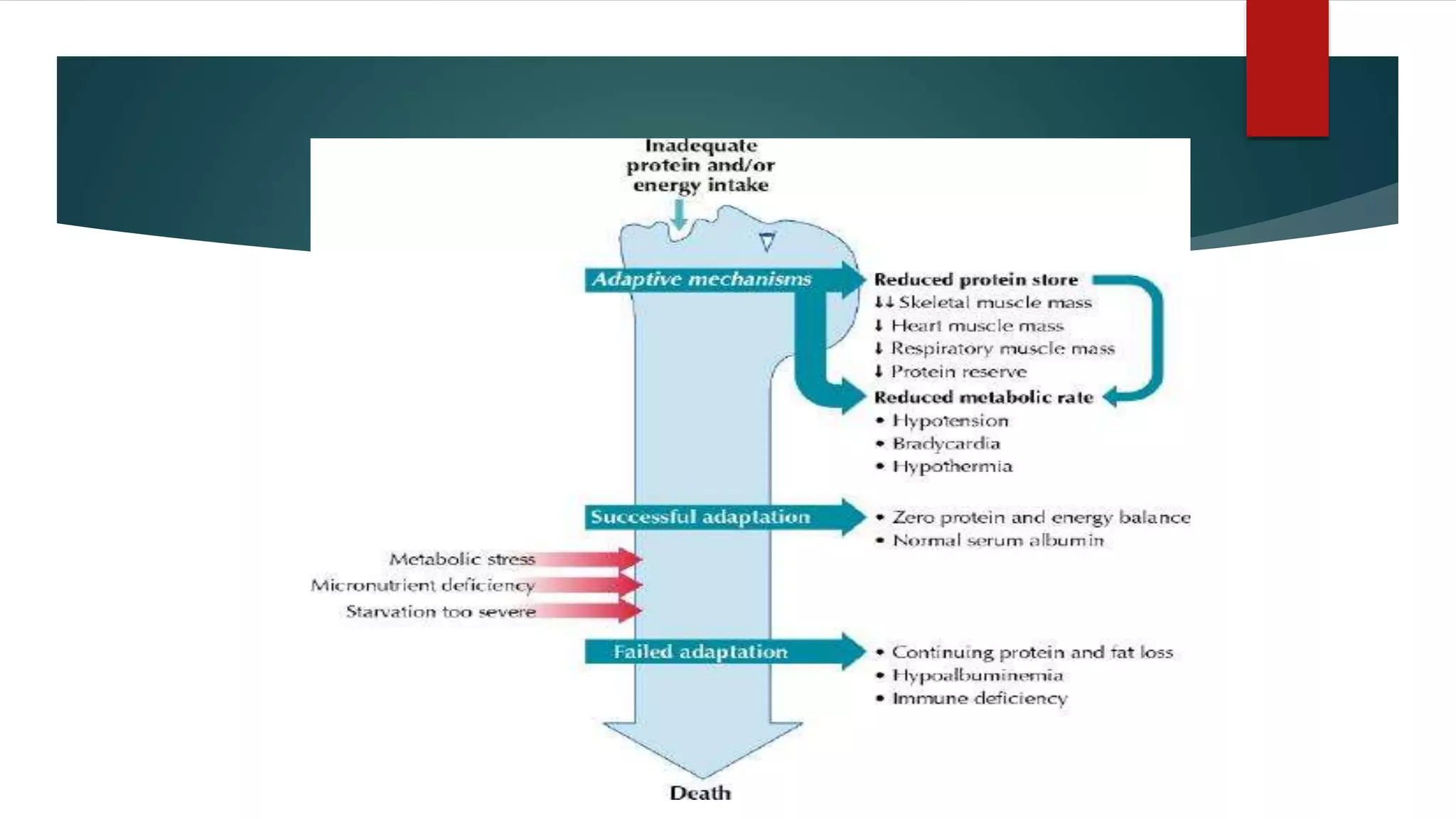
 PCM is caused by starvation. It is the disease that develops when protein intake or energy intake, or both, chronically fail to meet the
body's requirements for these nutrients.
 This state makes the body to start adjusting metabolically and in terms of hormone secretion.
 Like the production of thyroxine is decreased in order to reduce the metabolic rate so that less energy is required.
 Fat loss is slowed by a reduction in energy expenditure that the body accomplishes both by reducing the metabolic rate.
 As a result growth is suspended .this accounts for retardation that is seen in malnourished child.
 This accounts for the severe wasting seen in malnourished child.
 The body literally digests itself to maintain the serum levels.
 As a result there is progressive loss of fat and muscle tissue as well as depletion of electrolytes.
 As a result immune system does not work properly which lead to infections and may worsen the condition of children.
 As long as the starvation ratio of energy and protein is not too low, successful adaptation will reduce energy and protein requirements
to match it, restoring homeostasis and maintaining key physiologic functions..
 KWASHIORKOR
 The term kwashiorkor is taken from the Ga language of Ghana and means "the sickness of
the weaning”.
 Williams first used the term in 1933, and it refers to an inadequate protein intake with
reasonable caloric (energy) intake.
 Kwashiorkor, also called wet protein-energy malnutrition, is a form of PEM characterized
primarily by protein deficiency.
 This condition usually appears at the age of about 12 months when breastfeeding is
discontinued, but it can develop at any time during a child's formative years.
 It causes fluid retention (edema); dry, peeling skin; and hair discoloration.
 Kwashiorkor was thought to be caused by insufficient protein consumption but with sufficient
calorie intake.
 More recently, micronutrient and antioxidant deficiencies have come to be recognized as
contributory.
 Victims of kwashiorkor fail to produce antibodies following vaccination against diseases, including
diphtheria and typhoid.
 Generally, the disease can be treated by adding food energy and protein to the diet; however, it can
have a long-term impact on a child's physical and mental development, and in severe cases may lead
to death.
 CAUSES:
 Kwashiorkor is a severe form of malnutrition, caused by a deficiency in dietary protein.
 The extreme lack of protein causes an osmotic imbalance in the gastro-intestinal system causing
swelling of the gut diagnosed as an edema or retention of water.
SYMPTOMS :
 Changes in skin pigment.
 Decreased muscle mass
 Diarrhea
 Failure to gain weight and grow
 Fatigue
 Large belly (protrudes)
 Loss of muscle mass
 Rash (dermatitis)
 Swelling (edema)
 Diagnosis:
 Physical examination to examine muscle wasting, laboratory investigations.
 Treatment:
 In order to avoid problems, the person must be rehabilitated with small but frequent rations, given
every two to four hours.
 During one week, the diet, hyperglycidic, is gradually enriched in protein as well as essential
elements: sweet milk with mineral salts and vitamins. The diet may include lactases—so that children
who have developed lactose intolerance can ingest dairy products—and antibiotics—to compensate for
immunodeficiency.
 After two to three weeks, the milk is replaced by boiled cereals fortified with minerals and vitamins
until its mass is at least 80% of normal weight.
 Traditional food can then be reintroduced. The child is considered healed when their mass reaches 85%
of normal.
 MARASMUS
 The term marasmus is derived from the Greek word marasmos, which means withering or wasting.
 Marasmus is a form of severe protein-energy malnutrition characterized by energy deficiency.
 Primarily caused by energy deficiency, marasmus is characterized by stunted growth and wasting of muscle and tissue.
 Marasmus usually develops between the ages of six months and one year in children who have been weaned from
breast milk or who suffer from weakening conditions like chronic diarrhea.
 Causes:
 Marasmus is caused by a severe deficiency of nearly all nutrients, especially protein, carbohydrates and lipids, usually
due to poverty and scarcity of food.
 Viral, bacterial and parasitic infections can cause children to absorb few nutrients, even when consumption is adequate.
 It develop in children who have weakening conditions such as chronic diarrhoea.
 SYMPTOMS:
 Severe growth retardation
 Loss of subcutaneous fat
 Severe muscle wasting
 Wrinkled skin
 Bony prominence
 Associated vitamin deficiencies
 Dehydration
 Temperature is subnormal
 Muscles are weak
 Oedema and fatty infiltration are absent
 TREATMENT:
 Initially, the child is given dried skim-milk powder mixed with boiled water which is then followed by
mixing it with vegetable oils and finally sugar.
 Refeeding must be done slowly . Once children start to recover, they should have more balanced diets
which meet their nutritional needs.
 Infections are also common in children with marasmus. So, they are treated with antibiotics also.
 Ultimately, marasmus can progress to the point of no return when the body's ability for protein
synthesis is lost.
 At this point, attempts to correct the disorder by giving food or protein are futile.
 MARASMARICKWASHIORKOR
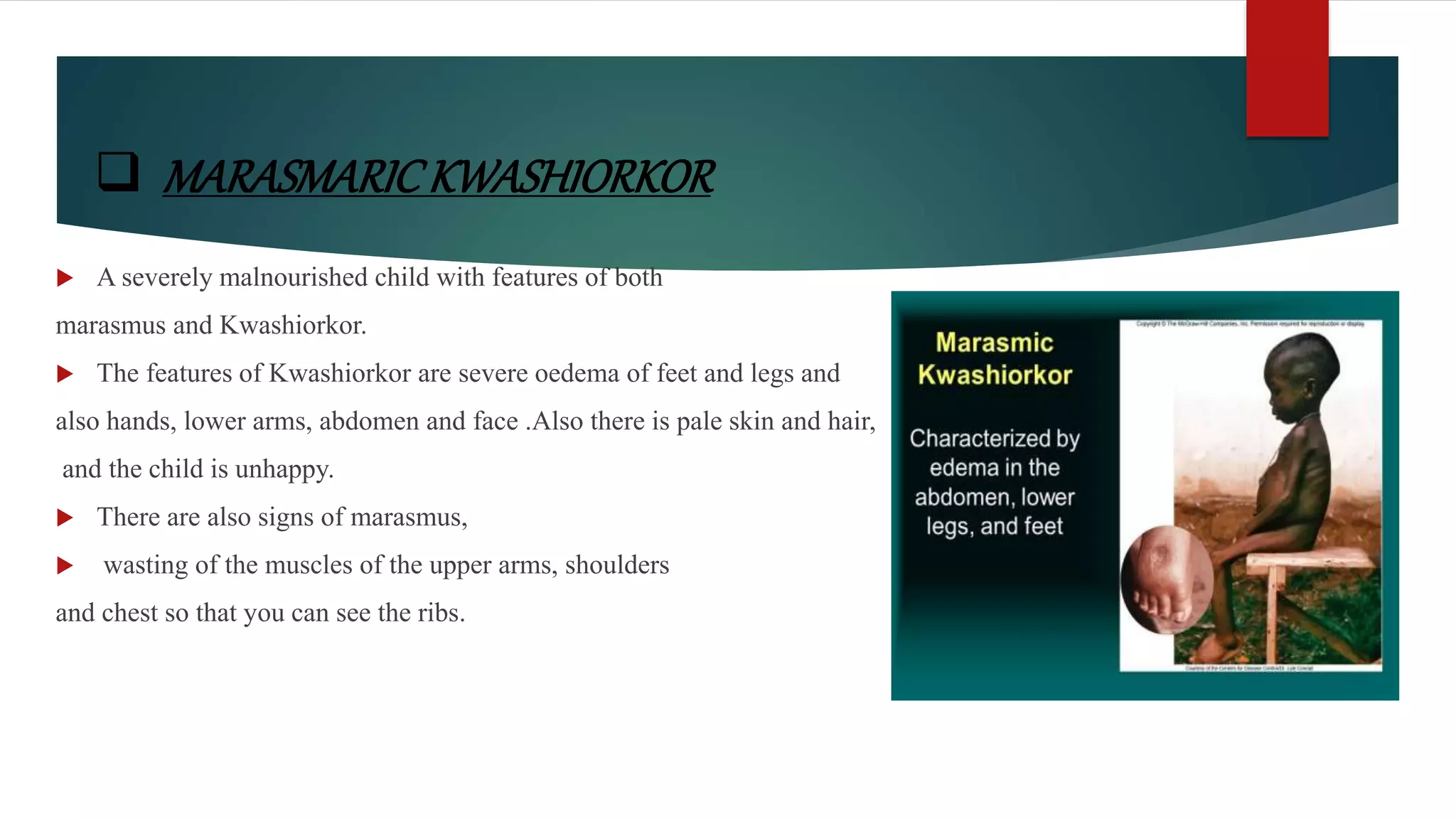
 A severely malnourished child with features of both
marasmus and Kwashiorkor.
 The features of Kwashiorkor are severe oedema of feet and legs and
also hands, lower arms, abdomen and face .Also there is pale skin and hair,
and the child is unhappy.
 There are also signs of marasmus,
 wasting of the muscles of the upper arms, shoulders
and chest so that you can see the ribs.
 UNDERWEIGHT:
 Children with subclinical PEM can be detected by their weight for age or weight for height, which are
significantly below normal.
 They may have reduced plasma albumin.
 They are at risk for respiratory and gastric infections.
CLINICAL PRESENTATIONS:
 Poor weight gain
 Slowing of growth
 Edema: Areas that are most affected are the distal extremities.
 Abdominal distension secondary to poor abdominal musculature
 Hepatomegaly secondary to fatty infiltration
 Dry peeling skin with raw exposed areas
 Hyper pigmented plaques over areas of trauma
 Nails become fissured or ridged.
 Hair is thin, sparse, brittle, easily pulled out, and turns a dull brown or reddish colour.
TREATMENT:
 Treatment strategy can be divided into three stages.
 Resolving life threatening conditions
 Restoring nutritional status
 Ensuring nutritional rehabilitation.
 There are three stages of treatment.
 1. Hospital Treatment -The following conditions should be corrected. Hypothermia, hypoglycemia, infection,
dehydration, electrolyte imbalance, anaemia and other vitamin and mineral deficiencies.
 2. Dietary Management -The diet should be from locally available staple foods - inexpensive, easily digestible,
evenly distributed throughout the day and increased number of feedings to increase the quantity of food.
 3. Rehabilitation -The concept of nutritional rehabilitation is based on practical nutritional training for mothers
in which they learn by feeding their children back to health under supervision and using local foods.
 Prevention of Protein-Energy Malnutrition:
 The following measures can help in the prevention of protein-energy malnutrition to a large extent and allow the
infant or pre-school child to grow up in a healthy manner.
 Promoting breast feeding
 Educating the mother about nutrition and correct feeding practice
 Fortification of food
 Proper immunization of the infant from time to time
 Early diagnoses and appropriate treatment
 Emphasizing on the importance of family planning and spacing between births
 Diet Plan for Protein-Energy Malnutrition:
 One of the major aspects of a correct diet plan for protein-energy malnutrition is to include macronutrients in
the child's diet.
 An optimum choice of treatment is the inclusion of milk-based formulas which help provide both proteins and
sufficient energy to the child or infant suffering from Protein-Energy Malnutrition (PEM).
 Doctors usually advice giving to the patient during the beginning of the dietary treatment and within 7 days,
the rate for children should reach an approx. of 4g/kg of protein and 175 kcal/kg.
 In case of adults, it should be 2g/kg of protein along with 60kcal/kg. It is absolutely essential to add a daily
multivitamin along with the diet for quick recovery from Protein-Energy Malnutrition (PEM).
 Sanitation and hygiene:
 Good sanitation and hygiene can play a major role in places where there is not a regular supply of healthy food
and clean water.
 Poor sanitation and hygiene can lead to infections that can worsen the symptoms of marasmus and other types of
malnutrition and make it harder to recover.
 Cooking foods at high heat to destroy bacteria and reheating it before eating.
 Boiling water before drinking, cooking, or bathing in areas where clean water is difficult to access is essential to
prevent spreading waterborne diseases.
 Breastfeeding infants for 6 months can help protect them from nutritional difficulties, especially in places where
food is short.
Protein calorie malnutrition

Protein calorie malnutrition

  • 1.
    PROTEIN CALORIE MALNUTRITION PRESENTEDBY: CH.BINDU MADHAVI II/VI PHARMD Y17PHD0805
  • 2.
     INTRODUCTION:  DEFINITION:Protein-Calorie Malnutrition (PCM) refers to a nutritional status in which reduced availability of nutrients leads to changes in body composition and function.  The condition has mild, moderate, and severe degrees.  It is considered as the primary nutritional problem in India. Also called the 1st National Nutritional Disorder.  The term protein-energy malnutrition (PEM) applies to a group of related disorders that include marasmus, kwashiorkor and intermediate states of marasmus-kwashiorkor.  PEM is due to “food gap” between the intake and requirement.
  • 3.
     CLASSIFICATION:  Typesinclude:  Kwashiorkor (protein malnutrition predominant)  Marasmus (deficiency in calorie intake)  Marasmic kwashiorkor (marked protein deficiency and marked calorie insufficiency signs present, sometimes referred to as the most severe form of malnutrition).
  • 4.
     EPIDEMOLOGY  Proteinenergy malnutrition is more common in low-income countries, including children from large urban areas in low socioeconomic neighbourhood’s.  This may also occur in children with chronic diseases, and children who are institutionalized or hospitalized for a different diagnosis.  PCM is fairly common worldwide in both children and adults and accounts for 6 million deaths annually.
  • 5.
     ETIOLOGY:  Differentcombinations of many aetiological factors can lead to PEM in children. They are:  Economic and Social Factors  Environmental Factors  Age  Biological Factors  Risk factors :include a primary diagnosis of intellectual disability, cystic fibrosis, cardiovascular disease, end stage renal disease, oncologic disease, genetic disease, neurological disease, multiple diagnoses, or prolonged hospitalization
  • 6.
     PATHOPHYSIOLOGY:  PCMis caused by starvation. It is the disease that develops when protein intake or energy intake, or both, chronically fail to meet the body's requirements for these nutrients.  This state makes the body to start adjusting metabolically and in terms of hormone secretion.  Like the production of thyroxine is decreased in order to reduce the metabolic rate so that less energy is required.  Fat loss is slowed by a reduction in energy expenditure that the body accomplishes both by reducing the metabolic rate.  As a result growth is suspended .this accounts for retardation that is seen in malnourished child.  This accounts for the severe wasting seen in malnourished child.  The body literally digests itself to maintain the serum levels.  As a result there is progressive loss of fat and muscle tissue as well as depletion of electrolytes.  As a result immune system does not work properly which lead to infections and may worsen the condition of children.  As long as the starvation ratio of energy and protein is not too low, successful adaptation will reduce energy and protein requirements to match it, restoring homeostasis and maintaining key physiologic functions..
  • 8.
     KWASHIORKOR  Theterm kwashiorkor is taken from the Ga language of Ghana and means "the sickness of the weaning”.  Williams first used the term in 1933, and it refers to an inadequate protein intake with reasonable caloric (energy) intake.  Kwashiorkor, also called wet protein-energy malnutrition, is a form of PEM characterized primarily by protein deficiency.  This condition usually appears at the age of about 12 months when breastfeeding is discontinued, but it can develop at any time during a child's formative years.  It causes fluid retention (edema); dry, peeling skin; and hair discoloration.
  • 9.
     Kwashiorkor wasthought to be caused by insufficient protein consumption but with sufficient calorie intake.  More recently, micronutrient and antioxidant deficiencies have come to be recognized as contributory.  Victims of kwashiorkor fail to produce antibodies following vaccination against diseases, including diphtheria and typhoid.  Generally, the disease can be treated by adding food energy and protein to the diet; however, it can have a long-term impact on a child's physical and mental development, and in severe cases may lead to death.  CAUSES:  Kwashiorkor is a severe form of malnutrition, caused by a deficiency in dietary protein.  The extreme lack of protein causes an osmotic imbalance in the gastro-intestinal system causing swelling of the gut diagnosed as an edema or retention of water.
  • 10.
    SYMPTOMS :  Changesin skin pigment.  Decreased muscle mass  Diarrhea  Failure to gain weight and grow  Fatigue  Large belly (protrudes)  Loss of muscle mass  Rash (dermatitis)  Swelling (edema)
  • 11.
     Diagnosis:  Physicalexamination to examine muscle wasting, laboratory investigations.  Treatment:  In order to avoid problems, the person must be rehabilitated with small but frequent rations, given every two to four hours.  During one week, the diet, hyperglycidic, is gradually enriched in protein as well as essential elements: sweet milk with mineral salts and vitamins. The diet may include lactases—so that children who have developed lactose intolerance can ingest dairy products—and antibiotics—to compensate for immunodeficiency.  After two to three weeks, the milk is replaced by boiled cereals fortified with minerals and vitamins until its mass is at least 80% of normal weight.  Traditional food can then be reintroduced. The child is considered healed when their mass reaches 85% of normal.
  • 12.
     MARASMUS  Theterm marasmus is derived from the Greek word marasmos, which means withering or wasting.  Marasmus is a form of severe protein-energy malnutrition characterized by energy deficiency.  Primarily caused by energy deficiency, marasmus is characterized by stunted growth and wasting of muscle and tissue.  Marasmus usually develops between the ages of six months and one year in children who have been weaned from breast milk or who suffer from weakening conditions like chronic diarrhea.  Causes:  Marasmus is caused by a severe deficiency of nearly all nutrients, especially protein, carbohydrates and lipids, usually due to poverty and scarcity of food.  Viral, bacterial and parasitic infections can cause children to absorb few nutrients, even when consumption is adequate.  It develop in children who have weakening conditions such as chronic diarrhoea.
  • 13.
     SYMPTOMS:  Severegrowth retardation  Loss of subcutaneous fat  Severe muscle wasting  Wrinkled skin  Bony prominence  Associated vitamin deficiencies  Dehydration  Temperature is subnormal  Muscles are weak  Oedema and fatty infiltration are absent
  • 14.
     TREATMENT:  Initially,the child is given dried skim-milk powder mixed with boiled water which is then followed by mixing it with vegetable oils and finally sugar.  Refeeding must be done slowly . Once children start to recover, they should have more balanced diets which meet their nutritional needs.  Infections are also common in children with marasmus. So, they are treated with antibiotics also.  Ultimately, marasmus can progress to the point of no return when the body's ability for protein synthesis is lost.  At this point, attempts to correct the disorder by giving food or protein are futile.
  • 15.
     MARASMARICKWASHIORKOR  Aseverely malnourished child with features of both marasmus and Kwashiorkor.  The features of Kwashiorkor are severe oedema of feet and legs and also hands, lower arms, abdomen and face .Also there is pale skin and hair, and the child is unhappy.  There are also signs of marasmus,  wasting of the muscles of the upper arms, shoulders and chest so that you can see the ribs.
  • 16.
     UNDERWEIGHT:  Childrenwith subclinical PEM can be detected by their weight for age or weight for height, which are significantly below normal.  They may have reduced plasma albumin.  They are at risk for respiratory and gastric infections.
  • 17.
    CLINICAL PRESENTATIONS:  Poorweight gain  Slowing of growth  Edema: Areas that are most affected are the distal extremities.  Abdominal distension secondary to poor abdominal musculature  Hepatomegaly secondary to fatty infiltration  Dry peeling skin with raw exposed areas  Hyper pigmented plaques over areas of trauma  Nails become fissured or ridged.  Hair is thin, sparse, brittle, easily pulled out, and turns a dull brown or reddish colour.
  • 18.
    TREATMENT:  Treatment strategycan be divided into three stages.  Resolving life threatening conditions  Restoring nutritional status  Ensuring nutritional rehabilitation.  There are three stages of treatment.  1. Hospital Treatment -The following conditions should be corrected. Hypothermia, hypoglycemia, infection, dehydration, electrolyte imbalance, anaemia and other vitamin and mineral deficiencies.  2. Dietary Management -The diet should be from locally available staple foods - inexpensive, easily digestible, evenly distributed throughout the day and increased number of feedings to increase the quantity of food.  3. Rehabilitation -The concept of nutritional rehabilitation is based on practical nutritional training for mothers in which they learn by feeding their children back to health under supervision and using local foods.
  • 19.
     Prevention ofProtein-Energy Malnutrition:  The following measures can help in the prevention of protein-energy malnutrition to a large extent and allow the infant or pre-school child to grow up in a healthy manner.  Promoting breast feeding  Educating the mother about nutrition and correct feeding practice  Fortification of food  Proper immunization of the infant from time to time  Early diagnoses and appropriate treatment  Emphasizing on the importance of family planning and spacing between births
  • 20.
     Diet Planfor Protein-Energy Malnutrition:  One of the major aspects of a correct diet plan for protein-energy malnutrition is to include macronutrients in the child's diet.  An optimum choice of treatment is the inclusion of milk-based formulas which help provide both proteins and sufficient energy to the child or infant suffering from Protein-Energy Malnutrition (PEM).  Doctors usually advice giving to the patient during the beginning of the dietary treatment and within 7 days, the rate for children should reach an approx. of 4g/kg of protein and 175 kcal/kg.  In case of adults, it should be 2g/kg of protein along with 60kcal/kg. It is absolutely essential to add a daily multivitamin along with the diet for quick recovery from Protein-Energy Malnutrition (PEM).
  • 21.
     Sanitation andhygiene:  Good sanitation and hygiene can play a major role in places where there is not a regular supply of healthy food and clean water.  Poor sanitation and hygiene can lead to infections that can worsen the symptoms of marasmus and other types of malnutrition and make it harder to recover.  Cooking foods at high heat to destroy bacteria and reheating it before eating.  Boiling water before drinking, cooking, or bathing in areas where clean water is difficult to access is essential to prevent spreading waterborne diseases.  Breastfeeding infants for 6 months can help protect them from nutritional difficulties, especially in places where food is short.