NUTRITIONAL
PROBLEMS
Presentation by:-
Ms.Chandani S. Modi
F. Y. M.Sc. Nursing,
C.M.P.C.O.N.,
Gandhinagar.
Introduction
• Nutrition is the selection of foods and preparation of foods and
their ingestion to be assimilated by the body.
• By the practicing a healthy diet, many of the known health
issues can be avoided.
Definition
• A nutritional deficiency occurs when the body doesn’t absorb
or get from food the necessary amount of a nutrient.
• Deficiencies can lead to a variety of health problems. These
can include digestion problems, skin disorders, stunted or
defective bone growth and even dementia.
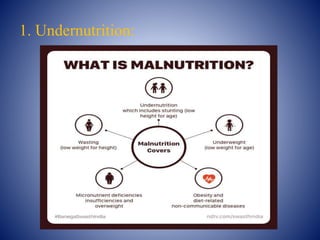
1. Undernutrition:
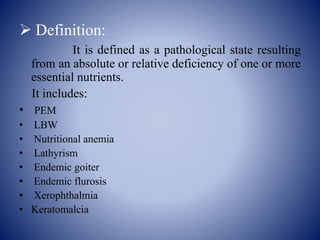
 Definition:
It is defined as a pathological state resulting
from an absolute or relative deficiency of one or more
essential nutrients.
It includes:
• PEM
• LBW
• Nutritional anemia
• Lathyrism
• Endemic goiter
• Endemic flurosis
• Xerophthalmia
• Keratomalcia
a) PEM:
It refers to a form of malnutrition where there
is inadequate protein and calorie intake.
It is considered as the primarily nutritional
problem in India.
 Causes:
• Childhood morbidity and mortality
• Conditions/diseases
• Kwashiorkor
• Marasmus
• Marasmic-kwashiorkor
 Contributory factors:
• Inadequate intake of food
• Diarrhea
• Respiratory infections
• Measles
• Poor envt. Hygiene
• Large family size
• Poor maternal health
• Failure of lactation
• Premature termination of breast feeding
• Delayed supplementary feeding
• Use of over diluted cow’s milk
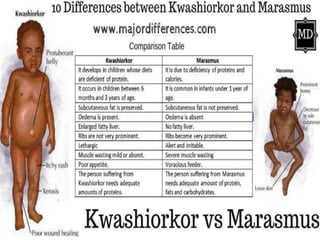
 KWASHIORKOR:-
Kwashiorkor is the most common and
widespread nutritional disorder in developing
countries. It is a form of malnutrition caused
by not getting enough protein in the diet.
 MARASMUS:-
Marasmus is a severe form of
malnutrition that consist of the chronic wasting
away of fat, muscle and their tissues in the
body.
• Malnutrition occurs when the body does not get
enough protein and calories.
• This lack of nutrition can range from a shortage of
certain vitamins to complete starvation.
Prevention:
• Oral rehydration therapy helps to prevent
dehydration caused by diarrhea.
• Exclusive breast feeding for 6 months thereafter
supplementary foods may be introduced along with
breast feeds.
• Immunization for infants and children
• Nutrition supplements
• Early diagnosis and treatment
• Promotion and correction of feeding practise
• Family planning and spacing of birth
b) LBW:
 Definition:
A LBW newborn is any newborn with a birth
weight of less than 2.5kg (including 2.499kg)
regardless of gestational age.
 Risk factors:
• Illness/infection
• Short maternal stature & Close birth intervals
• Very young age
• High Parity
• IUGR
 Prevention:
• Identification of mothers risk – malnutrition, heavy
work load, infections, disease and high BP
• Increasing food intake of mother, supplementary
feeding, distribution of iron and folic acid tablets
• Avoidance id smoking
• Improved sanitation methods
• Improving health and nutrition of young girls
• Controlling infections – UTI, rubella, syphilis,
malaria
c) Vitamin A deficiency:
Hypovitaminosis A is a lack of vitamin A in
blood and tissues. It is common in poorer countries
but rarely seen in more developed countries.
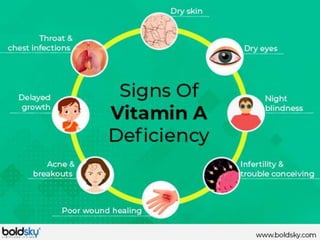
Nyctalopia (Night blindness) is one of the first sign of
VAD.
 Clinical features:
• Reduced vision in the night or dim light
• Dry eyes which could also lead to Xerophthelmia
• Corneal inflammation
• The child or adult may experience susceptibility
towards respiratory infection and urinary
infections
• Growth can be halted in children
• Skin might also show signs of vitamin A
deficiency. For example, it may get rough or dry
 Prevention:
• Administering large doses of Vitamin A orally on a
pediatric basis
• Regular and adequate intake of vitamin A
• Fortification of certain food with vitamin A – sugar,
salt, tea and skimmed milk
d) Nutritional Anemia:
 Definition:
Nutritional anemia is a condition where the
hemoglobin content of blood is lower than normal as
a result of a deficiency or one or more essential
nutrients, regardless of the cause of such deficiency.
 Risk factors:
• Inadequate diet
• Insufficient intake of iron
• Iron malabsorption
• Pregnancy
• Excessive menstrual bleeding
• Hook worm infection
• Malaria
• Close birth intervals
• GI bleed
• Infants and children
• Pregnant women
• Pre menopausal women
 Prevention:
• Estimation of HB to assess degree of anemia
• Blood transfusion in severe case of anemia (<8g/dl)
• Iron and folic acid supplements
• Food fortification with iron
• Changing dietary habits
• Control of parasites
• Nutritional education and awareness
e) Iodine Deficiency Disorder (IDD):
IDD leads to a much wider spectrum of
disorder commencing with the intrauterine life and
extending through childhood to adult life with
serious health and social implication.
 Disorders:
• Goiter
• Hypothyroidism
• Mental retardation
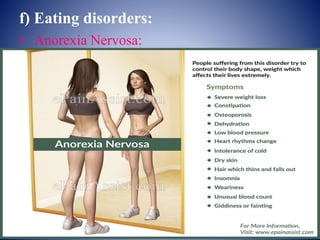
f) Eating disorders:
• Anorexia Nervosa:
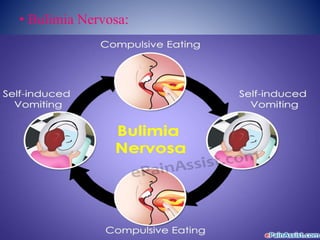
• Bulimia Nervosa:
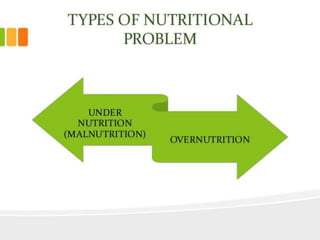
2. Over Nutrition:
It is defined as a pathological state resulting
from an absolute or relative excess of one or more
essential nutrients.
 Obesity:
• It is an epidemic disease, which consists of body
weight that is in excess of that appropriate for a
person’s height and age standardized to account for
differences, leading to an increased risk to health
related problems.
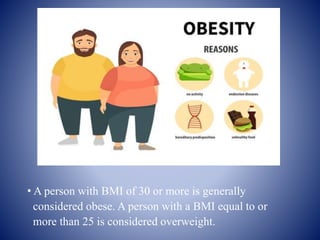
• A person with BMI of 30 or more is generally
considered obese. A person with a BMI equal to or
more than 25 is considered overweight.
Assignment
How can we solve the Nutritional
Problems???
Nutritional problems

Nutritional problems

  • 1.
    NUTRITIONAL PROBLEMS Presentation by:- Ms.Chandani S.Modi F. Y. M.Sc. Nursing, C.M.P.C.O.N., Gandhinagar.
  • 3.
    Introduction • Nutrition isthe selection of foods and preparation of foods and their ingestion to be assimilated by the body. • By the practicing a healthy diet, many of the known health issues can be avoided.
  • 4.
    Definition • A nutritionaldeficiency occurs when the body doesn’t absorb or get from food the necessary amount of a nutrient. • Deficiencies can lead to a variety of health problems. These can include digestion problems, skin disorders, stunted or defective bone growth and even dementia.
  • 6.
  • 7.
     Definition: It isdefined as a pathological state resulting from an absolute or relative deficiency of one or more essential nutrients. It includes: • PEM • LBW • Nutritional anemia • Lathyrism • Endemic goiter • Endemic flurosis • Xerophthalmia • Keratomalcia
  • 8.
    a) PEM: It refersto a form of malnutrition where there is inadequate protein and calorie intake. It is considered as the primarily nutritional problem in India.  Causes: • Childhood morbidity and mortality • Conditions/diseases • Kwashiorkor • Marasmus • Marasmic-kwashiorkor
  • 9.
     Contributory factors: •Inadequate intake of food • Diarrhea • Respiratory infections • Measles • Poor envt. Hygiene • Large family size • Poor maternal health • Failure of lactation • Premature termination of breast feeding • Delayed supplementary feeding • Use of over diluted cow’s milk
  • 10.
     KWASHIORKOR:- Kwashiorkor isthe most common and widespread nutritional disorder in developing countries. It is a form of malnutrition caused by not getting enough protein in the diet.  MARASMUS:- Marasmus is a severe form of malnutrition that consist of the chronic wasting away of fat, muscle and their tissues in the body.
  • 12.
    • Malnutrition occurswhen the body does not get enough protein and calories. • This lack of nutrition can range from a shortage of certain vitamins to complete starvation.
  • 13.
    Prevention: • Oral rehydrationtherapy helps to prevent dehydration caused by diarrhea. • Exclusive breast feeding for 6 months thereafter supplementary foods may be introduced along with breast feeds. • Immunization for infants and children • Nutrition supplements • Early diagnosis and treatment • Promotion and correction of feeding practise • Family planning and spacing of birth
  • 14.
    b) LBW:  Definition: ALBW newborn is any newborn with a birth weight of less than 2.5kg (including 2.499kg) regardless of gestational age.  Risk factors: • Illness/infection • Short maternal stature & Close birth intervals • Very young age • High Parity • IUGR
  • 15.
     Prevention: • Identificationof mothers risk – malnutrition, heavy work load, infections, disease and high BP • Increasing food intake of mother, supplementary feeding, distribution of iron and folic acid tablets • Avoidance id smoking • Improved sanitation methods • Improving health and nutrition of young girls • Controlling infections – UTI, rubella, syphilis, malaria
  • 16.
    c) Vitamin Adeficiency: Hypovitaminosis A is a lack of vitamin A in blood and tissues. It is common in poorer countries but rarely seen in more developed countries. Nyctalopia (Night blindness) is one of the first sign of VAD.
  • 18.
     Clinical features: •Reduced vision in the night or dim light • Dry eyes which could also lead to Xerophthelmia • Corneal inflammation • The child or adult may experience susceptibility towards respiratory infection and urinary infections • Growth can be halted in children • Skin might also show signs of vitamin A deficiency. For example, it may get rough or dry
  • 19.
     Prevention: • Administeringlarge doses of Vitamin A orally on a pediatric basis • Regular and adequate intake of vitamin A • Fortification of certain food with vitamin A – sugar, salt, tea and skimmed milk
  • 20.
    d) Nutritional Anemia: Definition: Nutritional anemia is a condition where the hemoglobin content of blood is lower than normal as a result of a deficiency or one or more essential nutrients, regardless of the cause of such deficiency.  Risk factors: • Inadequate diet • Insufficient intake of iron • Iron malabsorption
  • 21.
    • Pregnancy • Excessivemenstrual bleeding • Hook worm infection • Malaria • Close birth intervals • GI bleed • Infants and children • Pregnant women • Pre menopausal women
  • 22.
     Prevention: • Estimationof HB to assess degree of anemia • Blood transfusion in severe case of anemia (<8g/dl) • Iron and folic acid supplements • Food fortification with iron • Changing dietary habits • Control of parasites • Nutritional education and awareness
  • 23.
    e) Iodine DeficiencyDisorder (IDD): IDD leads to a much wider spectrum of disorder commencing with the intrauterine life and extending through childhood to adult life with serious health and social implication.  Disorders: • Goiter • Hypothyroidism • Mental retardation
  • 24.
    f) Eating disorders: •Anorexia Nervosa:
  • 25.
  • 26.
    2. Over Nutrition: Itis defined as a pathological state resulting from an absolute or relative excess of one or more essential nutrients.  Obesity: • It is an epidemic disease, which consists of body weight that is in excess of that appropriate for a person’s height and age standardized to account for differences, leading to an increased risk to health related problems.
  • 27.
    • A personwith BMI of 30 or more is generally considered obese. A person with a BMI equal to or more than 25 is considered overweight.
  • 29.
    Assignment How can wesolve the Nutritional Problems???