The Process of Transition 
John M Fisher 
Change happens!, how we deal with that change depends on who initiated the change and 
what control we have over the events in question. As change always impacts on the 
person (irregardless of any other elements changed it is always the individual who must 
deal with that change) we must understand what the impact will be for the individual. 
Any change, no matter how small, has the potential to have a major impact on an 
individual, their self view and subsequent performance. The anticipated outcome may 
generate conflict between one’s existing actions, values and beliefs and the anticipated 
new ones. 
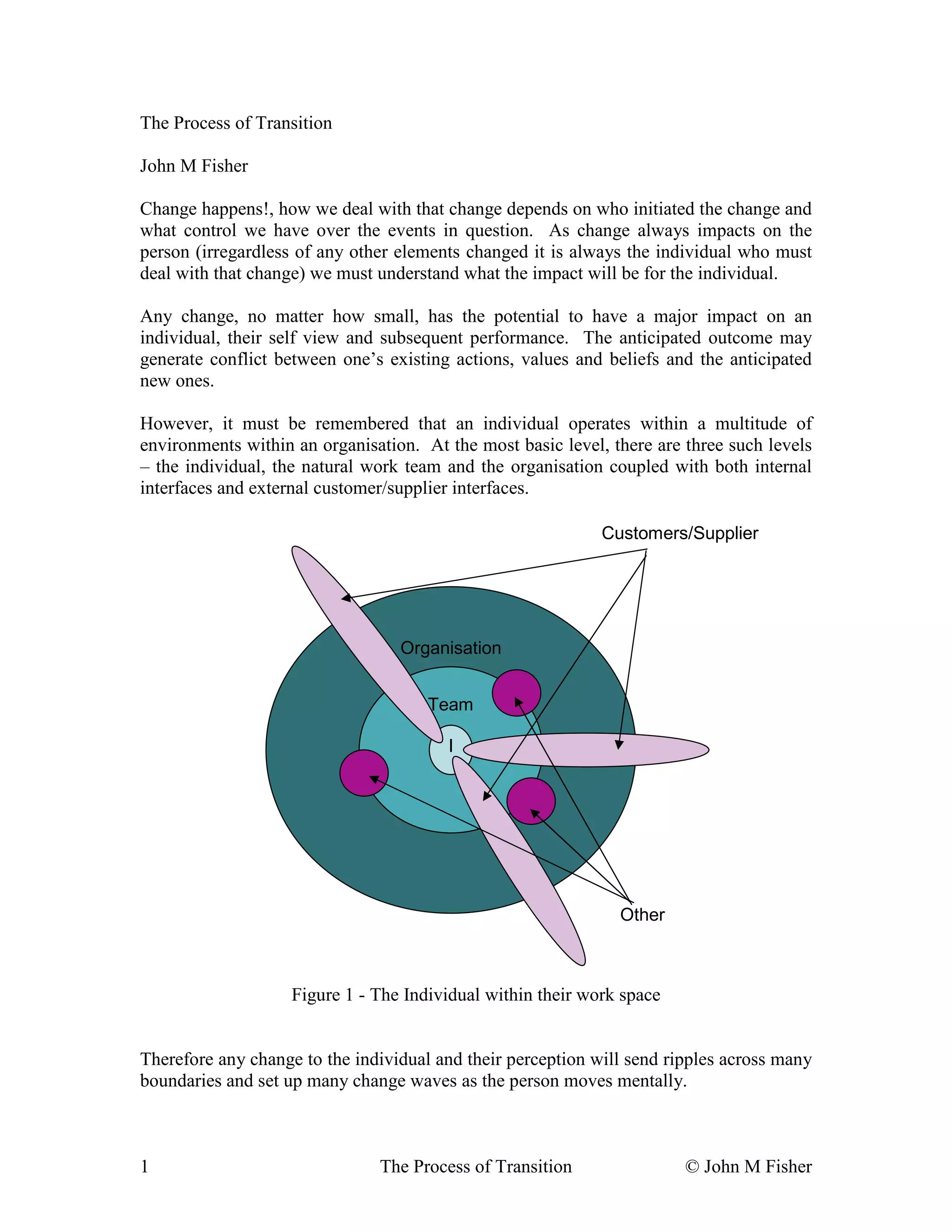
However, it must be remembered that an individual operates within a multitude of 
environments within an organisation. At the most basic level, there are three such levels 
– the individual, the natural work team and the organisation coupled with both internal 
interfaces and external customer/supplier interfaces. 
Organisation 
Team 
I 
Customers/Supplier 
Other 
Figure 1 - The Individual within their work space 
Therefore any change to the individual and their perception will send ripples across many 
boundaries and set up many change waves as the person moves mentally. 
1 The Process of Transition © John M Fisher
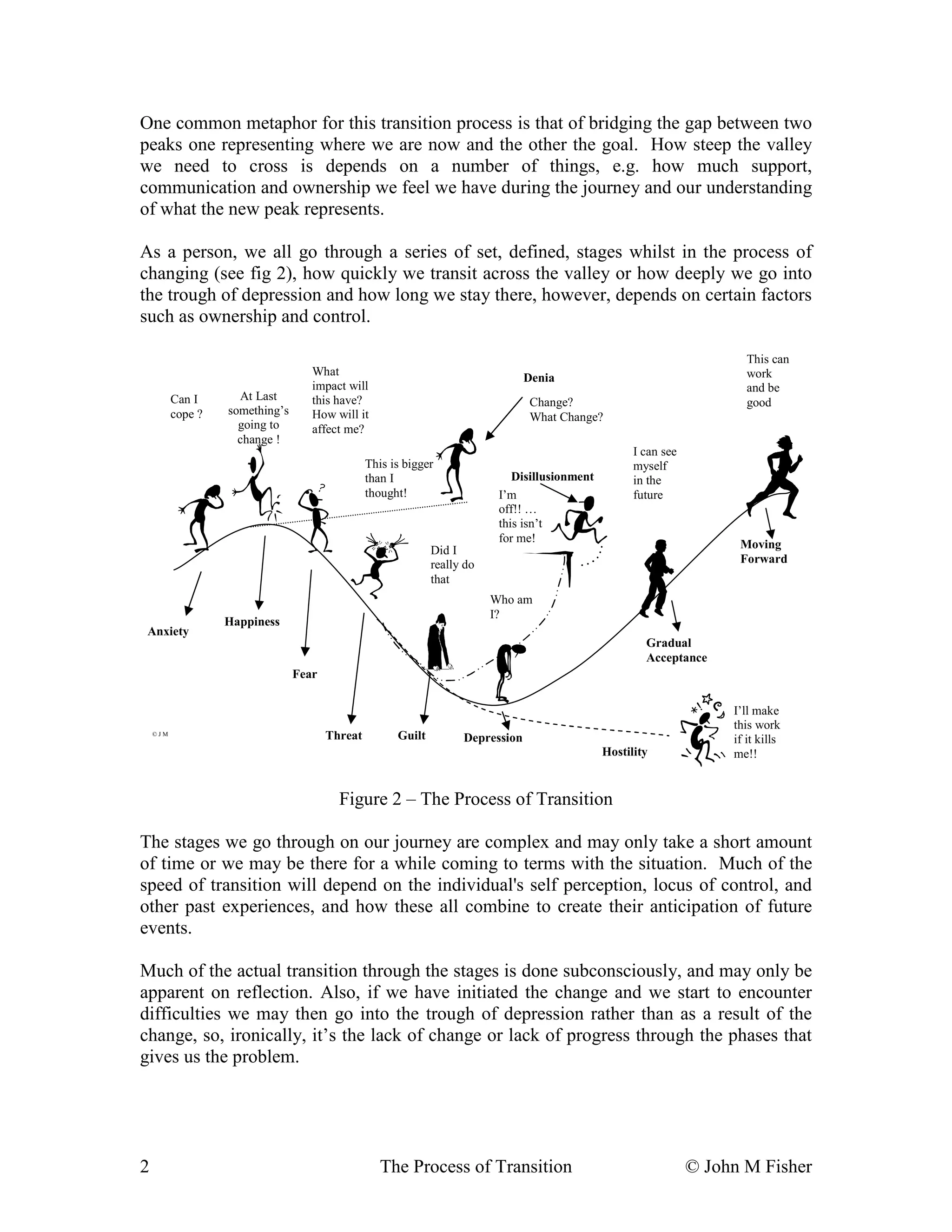
One common metaphor for this transition process is that of bridging the gap between two 
peaks one representing where we are now and the other the goal. How steep the valley 
we need to cross is depends on a number of things, e.g. how much support, 
communication and ownership we feel we have during the journey and our understanding 
of what the new peak represents. 
As a person, we all go through a series of set, defined, stages whilst in the process of 
changing (see fig 2), how quickly we transit across the valley or how deeply we go into 
the trough of depression and how long we stay there, however, depends on certain factors 
such as ownership and control. 
What 
impact will 
this have? 
How will it 
affect me? 
Threat 
This is bigger 
than I 
thought! 
Guilt 
Did I 
really do 
that 
Denia 
l 
Change? 
What Change? 
Disillusionment 
I’m 
off!!
 
this isn’t 
for me! 
Who am 
I? 
Depression 
Hostility 
Figure 2 – The Process of Transition 
Can I 
cope ? 
Anxiety 
At Last 
something’s 
going to 
change ! 
Happiness 
Fear 
I can see 
myself 
in the 
future 
Gradual 
Acceptance 
This can 
work 
and be 
good 
Moving 
Forward 
I’ll make 
this work 
if it kills 
me!! 
© J M 
The stages we go through on our journey are complex and may only take a short amount 
of time or we may be there for a while coming to terms with the situation. Much of the 
speed of transition will depend on the individual's self perception, locus of control, and 
other past experiences, and how these all combine to create their anticipation of future 
events. 
Much of the actual transition through the stages is done subconsciously, and may only be 
apparent on reflection. Also, if we have initiated the change and we start to encounter 
difficulties we may then go into the trough of depression rather than as a result of the 
change, so, ironically, it’s the lack of change or lack of progress through the phases that 
gives us the problem. 
2 The Process of Transition © John M Fisher
One danger for the individual, team and organisation occurs when an individual persists 
in operating a set of practices that have been consistently shown to fail (or result in an 
undesirable consequence) in the past and that do not help extend and elaborate their 
world-view. Another danger area is that of denial where people maintain operating as 
they always have denying that there is any change at all. Both of these can have 
detrimental impact on an organisation trying to change the culture and focus of its people. 
To help people move through the transition effectively we need to understand their 
perception of the past, present and future (Fisher, 2005). What is their past experience of 
change and how has it impacted on them?, how did they cope? Also what will they be 
losing as part of the change and what will they be gaining? 
The Stages 
Anxiety - the awareness that events lie outside one’s range of understanding or control. I 
believe the problem here is that individuals are unable to adequately picture the future. 
They do not have enough information to allow them to anticipate behaving in a different 
way within the new organisation. They are unsure how to adequately construe acting in 
the new work and social situations. 
Happiness – the awareness that ones viewpoint is recognised and shared by others. The 
impact of this is twofold. At the basic level there is a feeling of relief that something is 
going to change and not continue as before. Whether the past is perceived positively or 
negatively, there is still a feeling of anticipation and possibly excitement at the possibility 
of improvement. On another level, there is the satisfaction of knowing that some of your 
thoughts about the old system were correct (generally no matter how well we like the 
status quo there is something that is unsatisfactory about it) and that something is going 
to be done about. 
In the phase we generally expect the best and anticipate a bright future, placing our own 
construct system onto the change and seeing ourselves succeeding. One of the dangers in 
this phase is that of the inappropriate psychological contract. We may perceive more to 
the change, or believe we will get more from the change than is actually the case. The 
organisation needs to manage this phase and ensure unrealistic expectations are managed 
and redefined in the organisations terms without alienating the individual. 
The happiness phase is one of the more interesting phases and may be (almost) passed 
through without knowing. In this phase it is the "Thank Goodness, something is 
happening at last!" feeling coupled with the knowledge that we may be able to have an 
impact, or take control, of our destiny and that if we are lucky/involved/contribute things 
can only get better. If we can start interventions at this stage we can minimise the impact 
of the rest of the curve and virtually flatten the curve. By involving, informing, getting 
'buy in' at this time we can help people move through the process. 
Fear - the awareness of an imminent incidental change in one’s core behavioural system. 
People will need to act in a different manner and this will have an impact on both their 
3 The Process of Transition © John M Fisher
self-perception and on how others externally see them. However, in the main, they see 
little change in their normal interactions and believe they will be operating in much the 
same way, merely choosing a more appropriate, but new, action. 
Threat – the awareness of an imminent comprehensive change in one’s core behavioural 
structures. Here clients perceive a major lifestyle change, one that will radically alter 
their future choices and other people’s perception of them. They are unsure as to how 
they will be able to act/react in what is, potentially, a totally new and alien environment – 
one where the “old rules” no longer apply and there are no “new” ones established as yet. 
Guilt – awareness of dislodgement of self from one’s core self perception. Once the 
individual begins exploring their self-perception, how they acted/reacted in the past and 
looking at alternative interpretations they begin to re-define their sense of self. This, 
generally, involves identifying what are their core beliefs and how closely they have been 
to meeting them. Recognition of the inappropriateness of their previous actions and the 
implications for them as people can cause guilt as they realise the impact of their 
behaviour. 
Depression – This phase is characterised by a general lack of motivation and confusion. 
Individuals are uncertain as to what the future holds and how they can fit into the future 
“world”. Their representations are inappropriate and the resultant undermining of their 
core sense of self leaves them adrift with no sense of identity and no clear vision of how 
to operate. 
Disillusionment – The awareness that your values, beliefs and goals are incompatible 
with those of the organisation. The pitfalls associated with this phase are that the 
employee becomes unmotivated, unfocused and increasingly dissatisfied and gradually 
withdraws their labour, either mentally (by just “going through the motions”, doing the 
bare minimum, actively undermining the change by criticising/complaining) or physically 
by resigning. 
Hostility – continued effort to validate social predictions that have already proved to be a 
failure. The problem here is that individual’s continue to operate processes that have 
repeatedly failed to achieve a successful outcome and are no longer part of the new 
process or are surplus to the new way of working. The new processes are ignored at best 
and actively undermined at worst. 
Denial – This stage is defined by a lack of acceptance of any change and denies that there 
will be any impact on the individual. People keep acting as if the change has not 
happened, using old practices and processes and ignoring evidence or information 
contrary to their belief systems. 
4 The Process of Transition © John M Fisher
It can be seen from the transition curve that it is important for an individual to understand 
the impact that the change will have on their own personal view of the world; and for 
them to be able to work through the implications for themselves. 
One danger for the individual, team and organisation occurs when an individual persists 
in operating a set of practices that have been consistently shown to fail (or result in an 
undesirable consequence) in the past and that do not help extend and elaborate their 
world-view. Another danger area is that of denial where people maintain operating as 
they always have denying that there is any change at all. Both of these can have 
detrimental impact on an organisation trying to change the culture and focus of its people. 
Another danger is that without some reflection, and possibly soul-searching, we do not 
recognise which phase of the curve we may be in. The goal of the 'manager'/change agent 
is to help make the transition as effective and painless as possible. By providing 
education, information, support, etc. we can help people transition through the curve and 
emerge on the other side. One of the dangers is that once we are caught up in the emotion 
of the change we may miss the signs of threat, anxiety, etc. and 'react'/cope by 
complaining or attempting to make things as they were (and also increase our stress 
levels as a result). 
To help people move through the transition effectively we need to understand their 
perception of the past, present and future. What is their past experience of change and 
how has it impacted on them?, how did they cope? Also what will they be losing as part 
of the change and what will they be gaining? 
Reference 
Fisher J M, (2005), A Time for change, Human Resource Development International vol 
8:2 (2005), pp 257 – 264, Taylor & Francis 
5 The Process of Transition © John M Fisher

The process of transition - John Fisher

  • 1.
    The Process ofTransition John M Fisher Change happens!, how we deal with that change depends on who initiated the change and what control we have over the events in question. As change always impacts on the person (irregardless of any other elements changed it is always the individual who must deal with that change) we must understand what the impact will be for the individual. Any change, no matter how small, has the potential to have a major impact on an individual, their self view and subsequent performance. The anticipated outcome may generate conflict between one’s existing actions, values and beliefs and the anticipated new ones. However, it must be remembered that an individual operates within a multitude of environments within an organisation. At the most basic level, there are three such levels – the individual, the natural work team and the organisation coupled with both internal interfaces and external customer/supplier interfaces. Organisation Team I Customers/Supplier Other Figure 1 - The Individual within their work space Therefore any change to the individual and their perception will send ripples across many boundaries and set up many change waves as the person moves mentally. 1 The Process of Transition © John M Fisher
  • 2.
    One common metaphorfor this transition process is that of bridging the gap between two peaks one representing where we are now and the other the goal. How steep the valley we need to cross is depends on a number of things, e.g. how much support, communication and ownership we feel we have during the journey and our understanding of what the new peak represents. As a person, we all go through a series of set, defined, stages whilst in the process of changing (see fig 2), how quickly we transit across the valley or how deeply we go into the trough of depression and how long we stay there, however, depends on certain factors such as ownership and control. What impact will this have? How will it affect me? Threat This is bigger than I thought! Guilt Did I really do that Denia l Change? What Change? Disillusionment I’m off!!
 this isn’t for me! Who am I? Depression Hostility Figure 2 – The Process of Transition Can I cope ? Anxiety At Last something’s going to change ! Happiness Fear I can see myself in the future Gradual Acceptance This can work and be good Moving Forward I’ll make this work if it kills me!! © J M The stages we go through on our journey are complex and may only take a short amount of time or we may be there for a while coming to terms with the situation. Much of the speed of transition will depend on the individual's self perception, locus of control, and other past experiences, and how these all combine to create their anticipation of future events. Much of the actual transition through the stages is done subconsciously, and may only be apparent on reflection. Also, if we have initiated the change and we start to encounter difficulties we may then go into the trough of depression rather than as a result of the change, so, ironically, it’s the lack of change or lack of progress through the phases that gives us the problem. 2 The Process of Transition © John M Fisher
  • 3.
    One danger forthe individual, team and organisation occurs when an individual persists in operating a set of practices that have been consistently shown to fail (or result in an undesirable consequence) in the past and that do not help extend and elaborate their world-view. Another danger area is that of denial where people maintain operating as they always have denying that there is any change at all. Both of these can have detrimental impact on an organisation trying to change the culture and focus of its people. To help people move through the transition effectively we need to understand their perception of the past, present and future (Fisher, 2005). What is their past experience of change and how has it impacted on them?, how did they cope? Also what will they be losing as part of the change and what will they be gaining? The Stages Anxiety - the awareness that events lie outside one’s range of understanding or control. I believe the problem here is that individuals are unable to adequately picture the future. They do not have enough information to allow them to anticipate behaving in a different way within the new organisation. They are unsure how to adequately construe acting in the new work and social situations. Happiness – the awareness that ones viewpoint is recognised and shared by others. The impact of this is twofold. At the basic level there is a feeling of relief that something is going to change and not continue as before. Whether the past is perceived positively or negatively, there is still a feeling of anticipation and possibly excitement at the possibility of improvement. On another level, there is the satisfaction of knowing that some of your thoughts about the old system were correct (generally no matter how well we like the status quo there is something that is unsatisfactory about it) and that something is going to be done about. In the phase we generally expect the best and anticipate a bright future, placing our own construct system onto the change and seeing ourselves succeeding. One of the dangers in this phase is that of the inappropriate psychological contract. We may perceive more to the change, or believe we will get more from the change than is actually the case. The organisation needs to manage this phase and ensure unrealistic expectations are managed and redefined in the organisations terms without alienating the individual. The happiness phase is one of the more interesting phases and may be (almost) passed through without knowing. In this phase it is the "Thank Goodness, something is happening at last!" feeling coupled with the knowledge that we may be able to have an impact, or take control, of our destiny and that if we are lucky/involved/contribute things can only get better. If we can start interventions at this stage we can minimise the impact of the rest of the curve and virtually flatten the curve. By involving, informing, getting 'buy in' at this time we can help people move through the process. Fear - the awareness of an imminent incidental change in one’s core behavioural system. People will need to act in a different manner and this will have an impact on both their 3 The Process of Transition © John M Fisher
  • 4.
    self-perception and onhow others externally see them. However, in the main, they see little change in their normal interactions and believe they will be operating in much the same way, merely choosing a more appropriate, but new, action. Threat – the awareness of an imminent comprehensive change in one’s core behavioural structures. Here clients perceive a major lifestyle change, one that will radically alter their future choices and other people’s perception of them. They are unsure as to how they will be able to act/react in what is, potentially, a totally new and alien environment – one where the “old rules” no longer apply and there are no “new” ones established as yet. Guilt – awareness of dislodgement of self from one’s core self perception. Once the individual begins exploring their self-perception, how they acted/reacted in the past and looking at alternative interpretations they begin to re-define their sense of self. This, generally, involves identifying what are their core beliefs and how closely they have been to meeting them. Recognition of the inappropriateness of their previous actions and the implications for them as people can cause guilt as they realise the impact of their behaviour. Depression – This phase is characterised by a general lack of motivation and confusion. Individuals are uncertain as to what the future holds and how they can fit into the future “world”. Their representations are inappropriate and the resultant undermining of their core sense of self leaves them adrift with no sense of identity and no clear vision of how to operate. Disillusionment – The awareness that your values, beliefs and goals are incompatible with those of the organisation. The pitfalls associated with this phase are that the employee becomes unmotivated, unfocused and increasingly dissatisfied and gradually withdraws their labour, either mentally (by just “going through the motions”, doing the bare minimum, actively undermining the change by criticising/complaining) or physically by resigning. Hostility – continued effort to validate social predictions that have already proved to be a failure. The problem here is that individual’s continue to operate processes that have repeatedly failed to achieve a successful outcome and are no longer part of the new process or are surplus to the new way of working. The new processes are ignored at best and actively undermined at worst. Denial – This stage is defined by a lack of acceptance of any change and denies that there will be any impact on the individual. People keep acting as if the change has not happened, using old practices and processes and ignoring evidence or information contrary to their belief systems. 4 The Process of Transition © John M Fisher
  • 5.
    It can beseen from the transition curve that it is important for an individual to understand the impact that the change will have on their own personal view of the world; and for them to be able to work through the implications for themselves. One danger for the individual, team and organisation occurs when an individual persists in operating a set of practices that have been consistently shown to fail (or result in an undesirable consequence) in the past and that do not help extend and elaborate their world-view. Another danger area is that of denial where people maintain operating as they always have denying that there is any change at all. Both of these can have detrimental impact on an organisation trying to change the culture and focus of its people. Another danger is that without some reflection, and possibly soul-searching, we do not recognise which phase of the curve we may be in. The goal of the 'manager'/change agent is to help make the transition as effective and painless as possible. By providing education, information, support, etc. we can help people transition through the curve and emerge on the other side. One of the dangers is that once we are caught up in the emotion of the change we may miss the signs of threat, anxiety, etc. and 'react'/cope by complaining or attempting to make things as they were (and also increase our stress levels as a result). To help people move through the transition effectively we need to understand their perception of the past, present and future. What is their past experience of change and how has it impacted on them?, how did they cope? Also what will they be losing as part of the change and what will they be gaining? Reference Fisher J M, (2005), A Time for change, Human Resource Development International vol 8:2 (2005), pp 257 – 264, Taylor & Francis 5 The Process of Transition © John M Fisher