Leading Others
Through Change
Agenda
• Overview of Change
• Change versus Transition
• Teams in Transition
• Approach to Change
• Summary
Change . . .
•Part of life
•Impossible to avoid
•Creates stress
•Involves both loss and growth
•Can be a crisis and an opportunity
Change versus Transition
• Change is situational and is external to us
i.e. new job/boss, marriage, death of a loved one, divorce, birth
of a child, downturn in economy, move to a new place, illness
• Transition is the process of adapting to the change
Think about the times you’ve moved
• How long did it take for you to move your “stuff” from point A to
point B?
• How long did it take you to feel at home?
Change is an event; Transition is a process
Common Reactions to Change
• Denial
• Resistance
• Isolation
• Sadness
• Detachment
• Anger
• Interpersonal conflicts
• Communication issues
• Insecurity
• Loss of Control
• Decreased motivation
• Wish for things to go back to how they were
Reactions to change are individual and depend on a variety of factors, such as life
experience, personal values, cultural background, gender influences, personality style,
and stage of life
Dynamics of Change
• No matter how exciting or necessary the change….
There is a sense of Loss
• No matter how skilled people are….
There is a sense of Confusion and Uncertainty
• To varying degrees and at various stages….
Expect Resistance
• No matter how carefully the change was implemented ...
People will feel a loss of control
Losses Associated with Change
• Loss of the Known and Tried
• Loss of Control
• Loss of Structure
• Loss of Predictable/Comfortable
• Loss of Future
• Loss of Attachments
• Loss of Turf
• Loss of Meaning
• Loss of Future
Reflecting/Anticipating Changes
• Identify workplace changes that have occurred over the past year
Staffing
Roles/responsibilities
Quantity of work
Type/methods of work
Technological changes
Challenging events
Celebrations/accomplishments
• What changes do you anticipate in the next 6 months?
Teams in Transition
• Just as each person has his/her own individual reaction to change, the
team is going through a similar transition
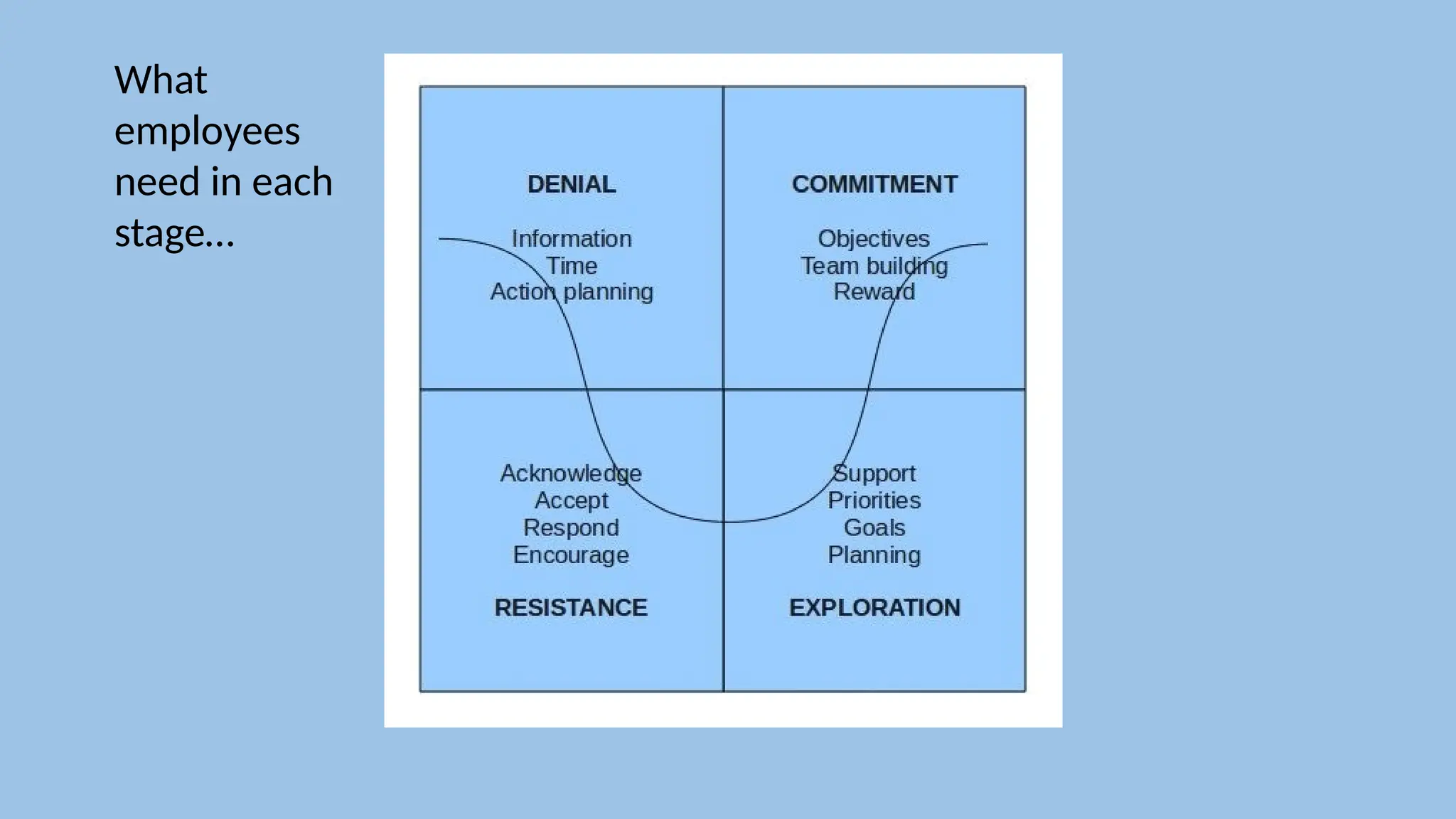
• The four main stages of teams in transition are:
Denial, Resistance, Exploration, and Commitment
• People on the team may be in different stages at the same time
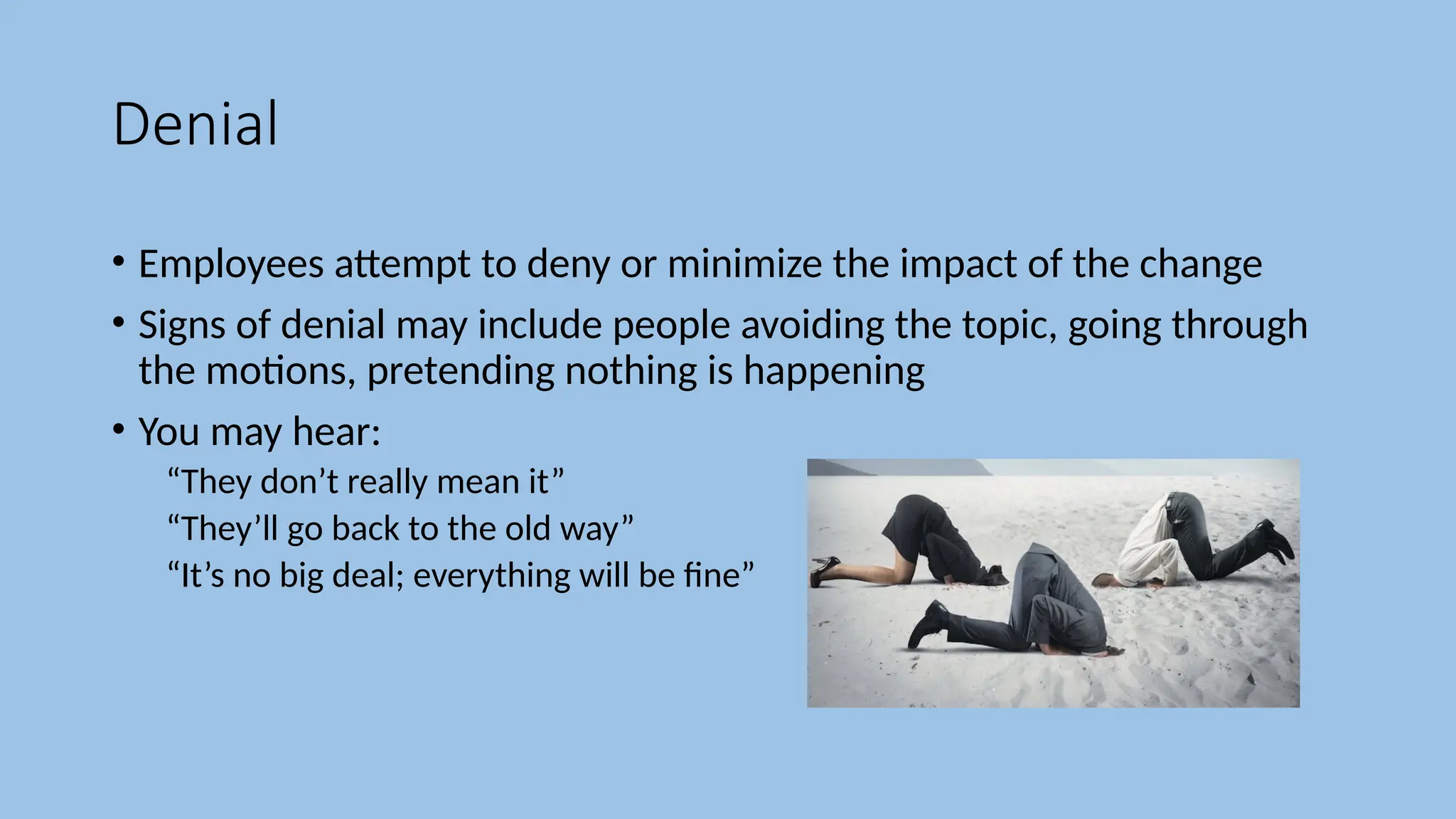
Denial
• Employees attempt to deny or minimize the impact of the change
• Signs of denial may include people avoiding the topic, going through
the motions, pretending nothing is happening
• You may hear:
“They don’t really mean it”
“They’ll go back to the old way”
“It’s no big deal; everything will be fine”
Resistance
• Denial is often followed by a period of resistance, when things seem
to get worse, and people may feel increasingly apprehensive and
irritated
• Signs of Resistance may include mistakes, careless work, anger, low
energy, distraction
• You may hear:
“They can’t do this to me! It isn’t fair!”
“This should never have happened.”
“I’m afraid I won’t be able to do this”
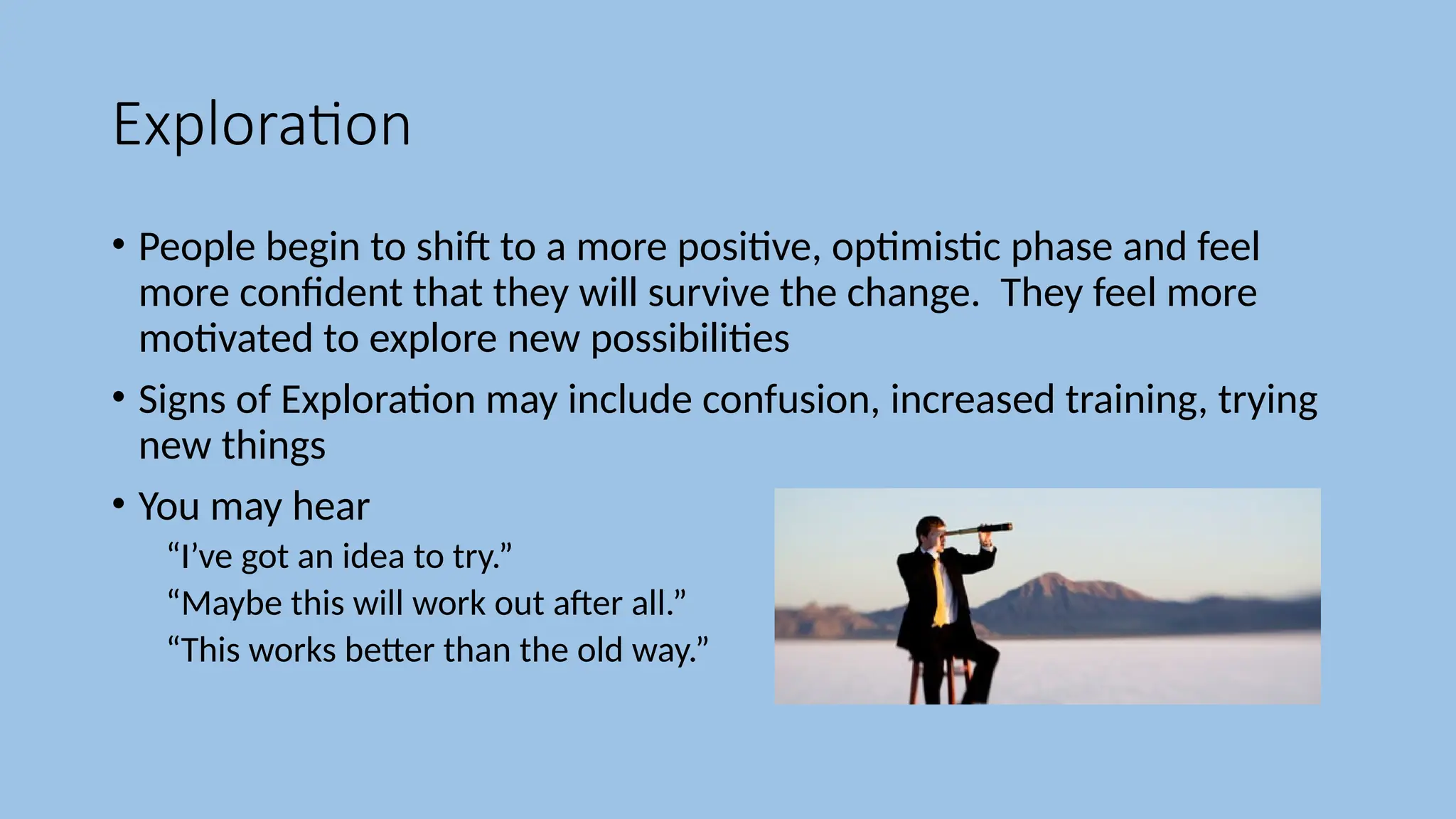
Exploration
• People begin to shift to a more positive, optimistic phase and feel
more confident that they will survive the change. They feel more
motivated to explore new possibilities
• Signs of Exploration may include confusion, increased training, trying
new things
• You may hear
“I’ve got an idea to try.”
“Maybe this will work out after all.”
“This works better than the old way.”
• In this final stage, a new sense of cohesion starts to emerge. People are ready to
work together to create new stability. There is a sense of pride in having mastered
the challenge
• Signs of Commitment may include independent decision making, cooperation and
improved teamwork
• You may hear:
“We’ve come a long way.”
“How can we work together on this?”
“We’re going to be the best team around.”
Commitment
What
employees
need in each
stage…
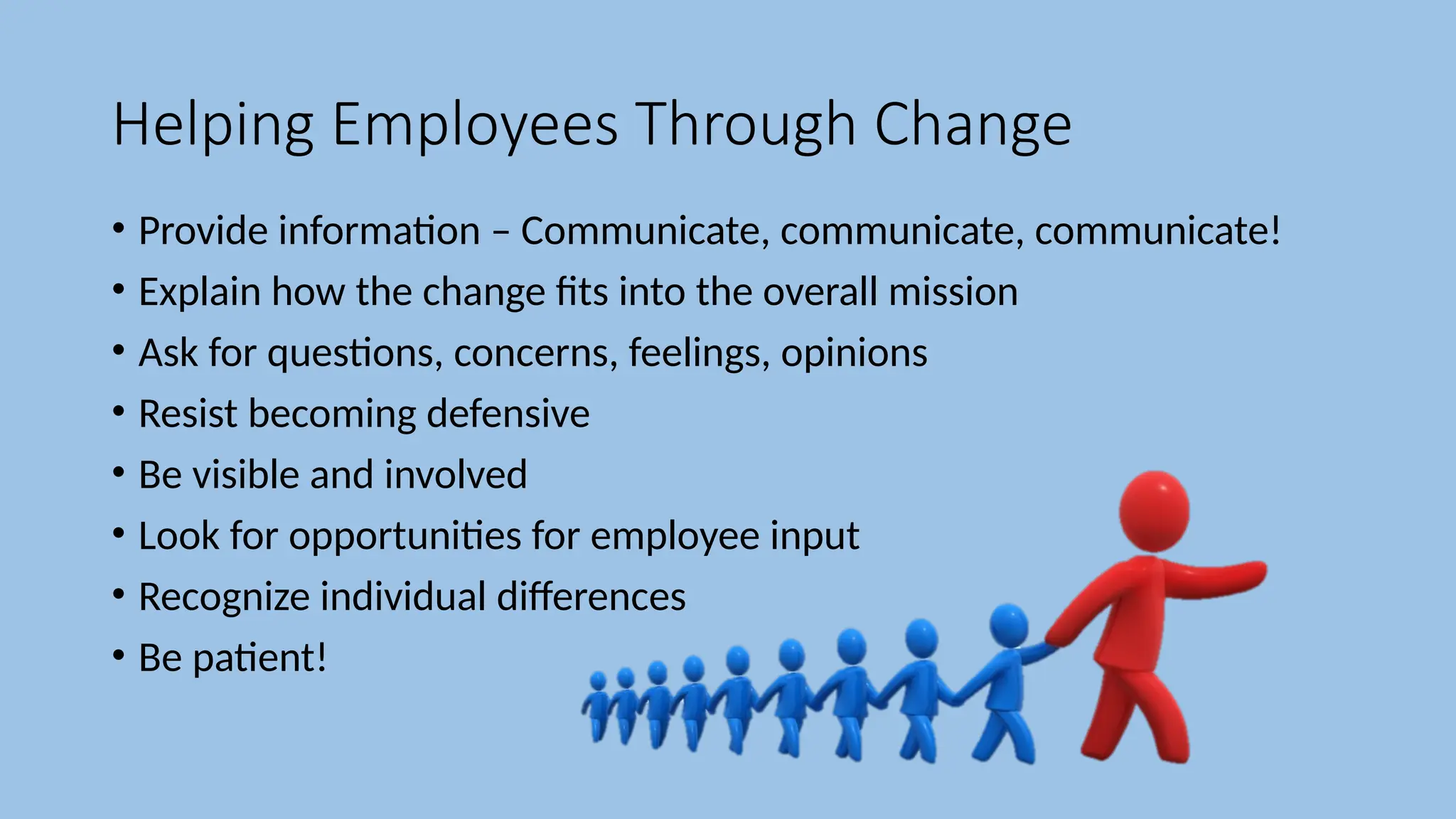
Helping Employees Through Change
• Provide information – Communicate, communicate, communicate!
• Explain how the change fits into the overall mission
• Ask for questions, concerns, feelings, opinions
• Resist becoming defensive
• Be visible and involved
• Look for opportunities for employee input
• Recognize individual differences
• Be patient!
What to Avoid
• Autocratic behavior
• Avoiding employees
• Dismissing other’s concerns
• Rah! Rah! Jumping ahead too quickly
• Assuming others will react the same way you do to change
• Ignoring your own needs
• Going it alone
As you face changes in your life…
• Look at what’s ending and acknowledge your losses
• Understand and try to accept that there will be periods of
uncertainty and heightened emotion
• Look to your experience in dealing with change in the past to help
deal with present changes
• Adopt the attitudes and behaviors that can help you move forward in
a positive direction
• Identify what you can control and what you cannot
• Choose to take action on the things you can, and let go of the things
you can’t
Remember. . .
Smooth seas do not make skillful sailors.
~African Proverb

LeadingThroughChange.pptx for research students

  • 1.
  • 2.
    Agenda • Overview ofChange • Change versus Transition • Teams in Transition • Approach to Change • Summary
  • 3.
    Change . .. •Part of life •Impossible to avoid •Creates stress •Involves both loss and growth •Can be a crisis and an opportunity
  • 4.
    Change versus Transition •Change is situational and is external to us i.e. new job/boss, marriage, death of a loved one, divorce, birth of a child, downturn in economy, move to a new place, illness • Transition is the process of adapting to the change
  • 5.
    Think about thetimes you’ve moved • How long did it take for you to move your “stuff” from point A to point B? • How long did it take you to feel at home? Change is an event; Transition is a process
  • 6.
    Common Reactions toChange • Denial • Resistance • Isolation • Sadness • Detachment • Anger • Interpersonal conflicts • Communication issues • Insecurity • Loss of Control • Decreased motivation • Wish for things to go back to how they were Reactions to change are individual and depend on a variety of factors, such as life experience, personal values, cultural background, gender influences, personality style, and stage of life
  • 7.
    Dynamics of Change •No matter how exciting or necessary the change…. There is a sense of Loss • No matter how skilled people are…. There is a sense of Confusion and Uncertainty • To varying degrees and at various stages…. Expect Resistance • No matter how carefully the change was implemented ... People will feel a loss of control
  • 8.
    Losses Associated withChange • Loss of the Known and Tried • Loss of Control • Loss of Structure • Loss of Predictable/Comfortable • Loss of Future • Loss of Attachments • Loss of Turf • Loss of Meaning • Loss of Future
  • 10.
    Reflecting/Anticipating Changes • Identifyworkplace changes that have occurred over the past year Staffing Roles/responsibilities Quantity of work Type/methods of work Technological changes Challenging events Celebrations/accomplishments • What changes do you anticipate in the next 6 months?
  • 11.
    Teams in Transition •Just as each person has his/her own individual reaction to change, the team is going through a similar transition • The four main stages of teams in transition are: Denial, Resistance, Exploration, and Commitment • People on the team may be in different stages at the same time
  • 12.
    Denial • Employees attemptto deny or minimize the impact of the change • Signs of denial may include people avoiding the topic, going through the motions, pretending nothing is happening • You may hear: “They don’t really mean it” “They’ll go back to the old way” “It’s no big deal; everything will be fine”
  • 13.
    Resistance • Denial isoften followed by a period of resistance, when things seem to get worse, and people may feel increasingly apprehensive and irritated • Signs of Resistance may include mistakes, careless work, anger, low energy, distraction • You may hear: “They can’t do this to me! It isn’t fair!” “This should never have happened.” “I’m afraid I won’t be able to do this”
  • 14.
    Exploration • People beginto shift to a more positive, optimistic phase and feel more confident that they will survive the change. They feel more motivated to explore new possibilities • Signs of Exploration may include confusion, increased training, trying new things • You may hear “I’ve got an idea to try.” “Maybe this will work out after all.” “This works better than the old way.”
  • 15.
    • In thisfinal stage, a new sense of cohesion starts to emerge. People are ready to work together to create new stability. There is a sense of pride in having mastered the challenge • Signs of Commitment may include independent decision making, cooperation and improved teamwork • You may hear: “We’ve come a long way.” “How can we work together on this?” “We’re going to be the best team around.” Commitment
  • 17.
  • 18.
    Helping Employees ThroughChange • Provide information – Communicate, communicate, communicate! • Explain how the change fits into the overall mission • Ask for questions, concerns, feelings, opinions • Resist becoming defensive • Be visible and involved • Look for opportunities for employee input • Recognize individual differences • Be patient!
  • 19.
    What to Avoid •Autocratic behavior • Avoiding employees • Dismissing other’s concerns • Rah! Rah! Jumping ahead too quickly • Assuming others will react the same way you do to change • Ignoring your own needs • Going it alone
  • 20.
    As you facechanges in your life… • Look at what’s ending and acknowledge your losses • Understand and try to accept that there will be periods of uncertainty and heightened emotion • Look to your experience in dealing with change in the past to help deal with present changes • Adopt the attitudes and behaviors that can help you move forward in a positive direction • Identify what you can control and what you cannot • Choose to take action on the things you can, and let go of the things you can’t
  • 21.
    Remember. . . Smoothseas do not make skillful sailors. ~African Proverb