Transition Management


               guiding people through C H A N G E
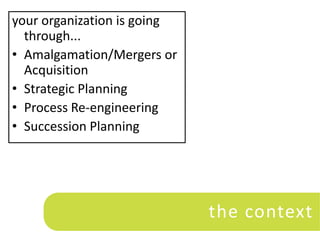
your organization is going
  through...
• Amalgamation/Mergers or
  Acquisition
• Strategic Planning
• Process Re-engineering
• Succession Planning


                             the context
Is this what
   you see?


         look around you/into a mirror
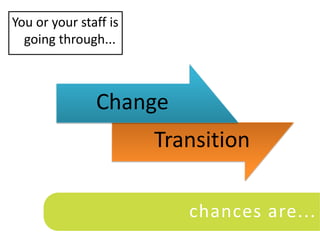
You or your staff is
  going through...


               Change
                       Transition

                          chances are...
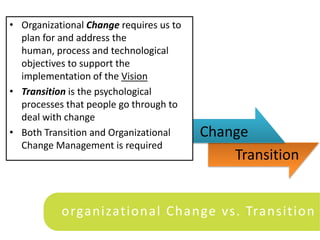
• Organizational Change requires us to
  plan for and address the
  human, process and technological
  objectives to support the
  implementation of the Vision
• Transition is the psychological
  processes that people go through to
  deal with change
• Both Transition and Organizational     Change
  Change Management is required
                                             Transition


           organizational Change vs. Transition
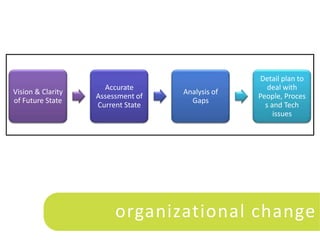
Detail plan to
                     Accurate                       deal with
Vision & Clarity                   Analysis of
                   Assessment of                 People, Proces
of Future State                      Gaps
                   Current State                   s and Tech
                                                      issues


                        organizational change
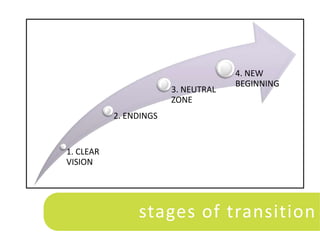
4. NEW
                                     BEGINNING
                        3. NEUTRAL
                        ZONE
           2. ENDINGS


1. CLEAR
VISION


                stages of transition
Clear vision needs to
  be established
  when initiating
  change.


                 stage 1 – Clear Vision
Dealing with Transition
• As change agents, it is important to
  understand the stages of Transition
  and the impact of each stage on
  ourselves.
• Important then to prepare our teams
  for transition and to understand our
  roles in facilitating a successful
  transition process for them.


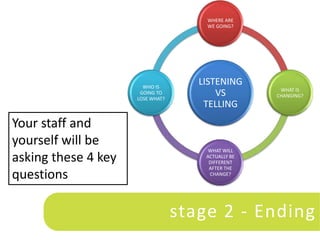
                            stage 2 - Ending
WHERE ARE
                                      WE GOING?


                       WHO IS
                                     LISTENING
                                                     WHAT IS
                      GOING TO
                     LOSE WHAT?
                                         VS         CHANGING?
                                      TELLING
Your staff and
yourself will be
                                       WHAT WILL
asking these 4 key                    ACTUALLY BE
                                       DIFFERENT
                                       AFTER THE
questions                              CHANGE?


                                  stage 2 - Ending
Clarity about
  new vision is
  required


                  where are we going?
Be simple
  concise &
  clear


              what ’s going to change?
•   The nature/scope of work
•   Locations
•   Services
•   Structural
•   Reporting Relationships
•   Catchment area
•   Other


          w h at w i l l a c t u a l l y b e d i ffe re nt a f te r t h e
                                                            c h a n ge ?
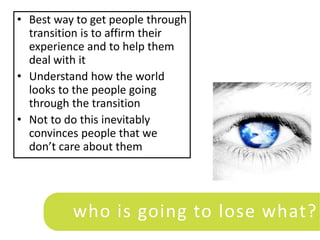
• Best way to get people through
  transition is to affirm their
  experience and to help them
  deal with it
• Understand how the world
  looks to the people going
  through the transition
• Not to do this inevitably
  convinces people that we
  don’t care about them


          who is going to lose what?
• “One doesn’t discover new lands without
  consenting to lose sight of the shore for a
  long time” - Andre Gide
• Anxiety rises and motivation falls – self
  protective
• Productivity suffers
• Old problems re-emerge
• Confusion and miscommunication
• Polarization between early adapters and late
  adapters
IMPORTANT TO MANAGE AND NORMALIZE THE
  NEUTRAL ZONE


                    stage 3 - neutral zone
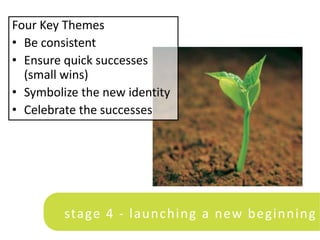
Four Key Themes
• Be consistent
• Ensure quick successes
  (small wins)
• Symbolize the new identity
• Celebrate the successes


         stage 4 - launching a new beginning
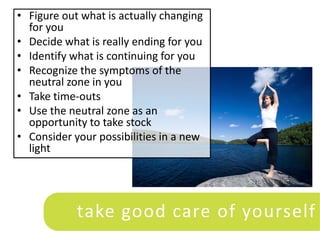
• Figure out what is actually changing
  for you
• Decide what is really ending for you
• Identify what is continuing for you
• Recognize the symptoms of the
  neutral zone in you
• Take time-outs
• Use the neutral zone as an
  opportunity to take stock
• Consider your possibilities in a new
  light


            take good care of yourself
Barnes Management Group

1 Yonge Street. Suite 911
Toronto, Ontario

(416) 977-3811
info@barnesmanagementgroup.ca

www.barnesmanagementgroup.ca
twitter.com/#!/BarnesMgmtGroup

Transition management

  • 1.
    Transition Management guiding people through C H A N G E
  • 2.
    your organization isgoing through... • Amalgamation/Mergers or Acquisition • Strategic Planning • Process Re-engineering • Succession Planning the context
  • 3.
    Is this what you see? look around you/into a mirror
  • 4.
    You or yourstaff is going through... Change Transition chances are...
  • 5.
    • Organizational Changerequires us to plan for and address the human, process and technological objectives to support the implementation of the Vision • Transition is the psychological processes that people go through to deal with change • Both Transition and Organizational Change Change Management is required Transition organizational Change vs. Transition
  • 6.
    Detail plan to Accurate deal with Vision & Clarity Analysis of Assessment of People, Proces of Future State Gaps Current State s and Tech issues organizational change
  • 7.
    4. NEW BEGINNING 3. NEUTRAL ZONE 2. ENDINGS 1. CLEAR VISION stages of transition
  • 8.
    Clear vision needsto be established when initiating change. stage 1 – Clear Vision
  • 9.
    Dealing with Transition •As change agents, it is important to understand the stages of Transition and the impact of each stage on ourselves. • Important then to prepare our teams for transition and to understand our roles in facilitating a successful transition process for them. stage 2 - Ending
  • 10.
    WHERE ARE WE GOING? WHO IS LISTENING WHAT IS GOING TO LOSE WHAT? VS CHANGING? TELLING Your staff and yourself will be WHAT WILL asking these 4 key ACTUALLY BE DIFFERENT AFTER THE questions CHANGE? stage 2 - Ending
  • 11.
    Clarity about new vision is required where are we going?
  • 12.
    Be simple concise & clear what ’s going to change?
  • 13.
    The nature/scope of work • Locations • Services • Structural • Reporting Relationships • Catchment area • Other w h at w i l l a c t u a l l y b e d i ffe re nt a f te r t h e c h a n ge ?
  • 14.
    • Best wayto get people through transition is to affirm their experience and to help them deal with it • Understand how the world looks to the people going through the transition • Not to do this inevitably convinces people that we don’t care about them who is going to lose what?
  • 15.
    • “One doesn’tdiscover new lands without consenting to lose sight of the shore for a long time” - Andre Gide • Anxiety rises and motivation falls – self protective • Productivity suffers • Old problems re-emerge • Confusion and miscommunication • Polarization between early adapters and late adapters IMPORTANT TO MANAGE AND NORMALIZE THE NEUTRAL ZONE stage 3 - neutral zone
  • 16.
    Four Key Themes •Be consistent • Ensure quick successes (small wins) • Symbolize the new identity • Celebrate the successes stage 4 - launching a new beginning
  • 17.
    • Figure outwhat is actually changing for you • Decide what is really ending for you • Identify what is continuing for you • Recognize the symptoms of the neutral zone in you • Take time-outs • Use the neutral zone as an opportunity to take stock • Consider your possibilities in a new light take good care of yourself
  • 18.
    Barnes Management Group 1Yonge Street. Suite 911 Toronto, Ontario (416) 977-3811 info@barnesmanagementgroup.ca www.barnesmanagementgroup.ca twitter.com/#!/BarnesMgmtGroup