
Welcome

Change Management
Agenda
Dashboard
Speakers
Q&A
Follow-Up
Brenda Mishak Beckman

Facilitator and Strategic Planning
Consultant
with Morris Interactive
What is Change?
                      Everyday we see change
                          in nature as day
Change is a natural     becomes night and
   part of life         night becomes day


                         Every year we see
                       change as one season
                         turns into another


                        As we age our lives
                        change all the time
Change Is Normal and Necessary

 Change is an essential element of the
    world and it must be accepted


Change is also an opportunity for self-
     motivation and innovation
Our Reactions To Change

         Adapting to change is about accepting
         our grief over what we are letting go of


          Change affects everyone differently;
                 there is no “normal”

Page 3
Remembering Change
Think of a change you have experienced
• Did you feel threatened, confused or angry at the time?
• Did it open up new insights, opportunities, and/or possibilities?
• Did you have moments of anticipation and energy?

Success stories are important:
•   Do you have a success story to share?
•   What did you do to help yourself through it?
•   What did those around you do to help you?
•   Is there anything you wish people would have done that they did
    not do?
The Power of Change
WHY WE RESIST CHANGE
The Human Reaction to Change
Resistance to Change
Why do people resist change?

What do people resist some changes and not others?

What might they perceive they will be losing?

What might they gain?
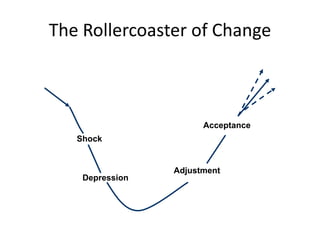
The Rollercoaster of Change


                       Acceptance
   Shock


                 Adjustment
    Depression
Actually Change Is Not The Problem
                  Change is situational
             New site, new team roles, new policy


  Transition is the psychological process people go
  through to come to terms with the new situation


Basically change is external while transition is internal
The Power of Change
TRANSITION: THE WAY TO PREPARE
FOR CHANGE
Transition
Unless transition occurs change will not work


Change is about the outcome


Transition in not about the outcome

Transition is about the ending that you will have to make
to leave the old situation behind
Transition
Occurs even in the “good” changes


Involves letting go of the old reality

To transition we must understand what it is we are
letting go of

In other words transition starts with an ending
The Truth About Transition


Change + Human Beings = Transition

                                         To come through
                                        it successfully you
Transition cannot   Transition can be
                                           must manage
   be avoided           managed
                                           each stage of
                                             transition
The Transition Cycle
There are three stages involved in any transition:

1. An ending stage
   – We let go of something stable, known, and dependable
2. A middle neutral zone
   – We are forced to hang in mid-air, without orientation to the past
     or the future
3. A beginnings stage
   – We plunge headlong into a new way and a new future
Stage 1: Letting Go
To properly transition you must understand what you are
                       letting go of


                   This can include giving up:


                           Groups or               Ease of
Feelings of   Habits and   teams you               getting
                                        Networks             Etc.
confidence     routines     are apart              things
                                of                  done
Stage #2: The Neutral Zone
     Understanding what comes after letting go


  The space between the old reality and the new
                      one


     The time when the old way is gone and the
           new way does not feel good yet
Page 13
What is The Neutral Zone
It is like winter when the old growth returns to the soil awaiting
                        the rebirth of spring


                          Like winter:

                                    It is when the old habits are no
   It is both a dangerous and         longer applicable to the new
         opportune place            process and the new ones have
                                           not been formed yet
Understanding the Neutral Zone
• You cannot rush through this or escape the zone
   – Escaping prematurely will block the change and result
     in a loss of opportunity
   – If you try to avoid this phase you will stop the
     transition

• The neutral zone is a time for creativity, renewal
  and development

• Confusion is normal and is not a sign that
  something is wrong with you or the change
Normalize the Neutral Zone
• The neutral zone is not a meaningless place.
  – It is a time people figure out how things will get done
    in the future
  – A time filled with creativity where everyone’s input is
    needed and valid
  – A time of group bonding and brainstorming

• If time is given for this phase and people are
  encouraged to input ideas then the transition will
  be smooth
Stage 3: The New Beginning
• The end of the neutral zone is a new
  beginning

• The new beginning only happens if people
  have transitioned by:
  – Letting go
  – Reflecting and brainstorming in the neutral zone
The New Way

                                     This is the new
                    People may         reality and if
This may seem        have flash    people embrace it
                                    they will feel the
like a dream at     backs to the           same
       first         way things    confidence, relaxa
                    were before     tion and joy they
                                        did before
The Power of Change
HOW TO COPE AND MOVE
THROUGH CHANGE
The Transition

Identify what
you are losing


                  Identify what
                  those around
                  you are losing
Identify What is Actually Changing
               Yourself
• What are you looking at in the big picture?

• How does this affect your everyday reality?
  – Do not generalize
     • i.e. “I’ll be busier”
  – Be specific
     • i.e. “I will not have time to get all my work done by 3
       o’clock when I go home”
Ask Specific Questions

  Be specific for each category below
   and describe exactly what will be
                different:
                                What are the
                 What are the                  In each case
                                   further
   What is         secondary                    above who
                                changes the
actually going   changes that                   will have to
                                 secondary
 to change?       this change                    let go of
                                changes will
                  will cause?                     what?
                                   cause?
Decide on What is Really Over For You

What are you going to have to let go of?

• What is over for you?
• What are you going to lose in the transition?

It may be difficult to see clearly and describe this
accurately

You are likely to react with denial
Transition Losses
                   Losses are internal
feelings, views, understandings, assumptions and self-
                        images


            Remember change is external


      What you lose is actually part of yourself
List Possible Transition Losses
Examples of transition losses include:
• A dream that has motivated you in your life and
  career
• An understanding about your relationship with
  your organization
• A belief you had about the value you and your job
  bring to the organization
• Faith you have in yourself, your competency, your
  honesty and your ability to influence outcomes
The Pain of Loss
         Loss hurts so the best clue is pain


       What hurts most is the current change


Spend time letting yourself experience these feelings
The Grieving Process
• You need to grieve for the change that is
  occurring
  – Signs of grieving can involve
    anger, sadness, fear, depression, confusion etc.

• This is a natural sequence of emotions people go
  through when they lose something that matters
  to them

• You must expect and accept these emotions as
  part of the process
Distinguish Between Current Losses
            and Old Wounds
• Sometimes a current issue triggers past issues to
  arise:
  – When this happens there is more tension
  – Your past may make you more vulnerable to the
    current issue


• Having knowledge of this can help you to let go of
  negative emotions by helping you to understand:
  – Which emotions are related to past events
  – Which emotions are a result of the current change
Identify What is Not Changing
• Not everything is changing!
   – A lot of your work and your life will remain the same
• Only a piece of your life is coming to an end
   – Make a list of the things that are not changing
   – List the things you have lost track of, things like old
     interests, relationships & recreational activities
   – Think of how to restore and protect these parts of
     your life
   – What can you do to reinforce these things?
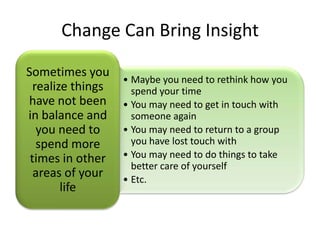
Change Can Bring Insight

Sometimes you
                   • Maybe you need to rethink how you
  realize things     spend your time
have not been      • You may need to get in touch with
in balance and       someone again
   you need to     • You may need to return to a group
   spend more        you have lost touch with
 times in other    • You may need to do things to take
                     better care of yourself
  areas of your    • Etc.
        life
Recognize the Symptoms of the
             Neutral Zone
The neutral zone is a confusing place where:

• You may feel empty, dead, flat etc.
• You may have fantasies of quitting
• You may feel hopeful one day and sad the next

You must keep going forward

• You must keep doing the necessary things at home and work

Remember what you are feeling is normal and there is
nothing wrong with you
Be Creative in the Neutral Zone
• The neutral zone is a time to examine your life
   – Consider possibilities you would not normally consider
   – Look for new ways of doing things and new
     friendships or networks
   – Create a list of possibilities for your life
   – Experiment a little every day to do things differently
      • i.e. take a different route to work, have lunch in a new
        way, move your desk, plan your weekend differently etc.
• Making small movements is a way to feel
  empowered in the neutral zone
The Four Rules to Face Change
1. Show up
  –   Get through the fear and just show up for event or the
      change
2. Be present
  –   Bring all your energies to the table
  –   Do not just put in your time
3. Tell the truth
  –   Avoid saying what you think you should say
  –   Tell the truth
4. Let go of outcomes
  – We cannot control what will happen
  – We must accept the outcome
The Power of Change
HOW TO ASSIST OTHERS TO
CHANGE
Accept the Subjective View of Others


                     It is important that
Remember what is
                     you allow others an
loss to one person
                        opportunity to
may not be loss to
                      react in their own
       others
                              way
Overreactions are O.K.
• Do not be shocked by the overreactions of others
  – People need time to adjust


• Remember:
  – Change causes transition which means a sense of loss
    and it is this sense of loss (not the change) people are
    reacting too
  – A piece of their world is being lost so have compassion
Acknowledge the Losses Openly
        Bring the losses into the open


Acknowledge them and express your concern for
          those who are suffering


          Do this simply and directly
Expect and Accept Signs of Grieving in
              Others

We must expect and accept the following
emotions:

• Anger, sadness, fear, depression, confusion etc.


Remember these are the natural sequence of
emotions people go through when grieving
Be Aware of Denial
• Denial is a natural first stage in the grieving
  process
   – It is a way in which hurt people protect themselves
     from the first impact of loss


• Denial is healthy and normal if it does not last too
  long
   – If it continues for a long time you should check in with
     them and let them know you are concerned for their
     well-being
Nothing Personal
                 Treat all emotions
              seriously but remember
                   you have not
              personally caused these
  Grieving           emotions
people have
   many
              Avoid getting defensive
 emotions


                 Avoid argument
Tools to Assist Others: Anger
• Anger
  – Listen
  – Acknowledge that the anger is understandable
  – Don’t take on blame if it is directed at you
  – Distinguish between acceptable feelings and
    unacceptable acting-out behaviors
     • “I understand how you feeling but if you continue in
       this way you will hurt the whole team”
Helping Others: Bargaining
Bargaining is the unrealistic attempts to get out of the
situation or make it go away by wanting to make deals
                   with management

                                            Avoid being
                                             pulled by
                      Help them to           desperate
Help the person
                     understand the      arguments or by
 to see the real
                    change has and is   strategies that the
    situation
                       happening           person thinks
                                        should have been
                                               used
Helping Others: Anxiety

 Anxiety (silent
or expressed) is • Remember anxiety is natural
 a realistic fear • Avoid making people feel bad
                    about it
of an unknown
 future which • Show empathy for their fears
                    but keep giving the person
  can result in     information to help them see
  catastrophic      that the future is not so bad
  projections
Helping Others: Sadness

 Sadness is
the heart of
               • Encourage people to
the grieving     say what they are
process and      feeling
  includes     • Share your feelings too
 everything    • Empathize
from silence
   to tears
Helping Others: Disorientation

Disorientation     • Give people extra support
   includes          and attention
confusion, forg    • Give people the
etfulness, feeli     opportunity to express it
 ngs of being      • Reassure them the
   lost and          disorientation is natural
  insecurity         and that others feel it too
Helping Others: Depression
• Depression includes feelings of being
  down, flat, dead, hopeless and being tired all the
  time
   – The first step is to realize you cannot make it go away
      • People have to go through it, not around it
   – Show them you understand and even share some of
     the same feelings
   – Help them to focus on the work that needs to be done
   – Remind them on the things they still have control
     over
Basic Principles in Assisting Others

Not everyone experiences all these emotions

Help others to see they can accept the situation and
move forward

Do not suppress your feelings or ask others to do the
same

Do not push yourself or others to “get over it”
The Power of Change
HOW CHANGE CREATES BETTER
RELATIONSHIPS
The Result of Change
         Change creates internal transition


Transition makes people think about how they treat
              themselves and others


For this reason change can help people to forge new
           or better bonds with each other
Change is Opportunity for Better
           Relationships


If we remember change is the way to
making all relationships better then
we will be more willing to accept and
work through transition
The Power of Change
WHAT IS CHANGING
New Organizational Chart
Questions to assist in transition:
• Identify what is actually changing in yourself
    – Ask specific questions

• What is really over for you?
    – What are the possible transition losses for you?

• What do you think your grieving process will involve?
    – Are there any old wounds you need to be aware of?

• Make a list of what is not changing in your life
    – Is there any insight about your life?

• What will be the signs that you are in the neutral zone?
    – What small changes can you make to empower you?
Assisting Others

Think about how you can assist others
         with this change?


   What reactions do you expect?
New Supervisors
Questions to assist in transition:
• Identify what is actually changing in yourself
    – Ask specific questions

• What is really over for you?
    – What are the possible transition losses for you?

• What do you think your grieving process will involve?
    – Are there any old wounds you need to be aware of?

• Make a list of what is not changing in your life
    – Is there any insight about your life?

• What will be the signs that you are in the neutral zone?
    – What small changes can you make to empower you?
Assisting Others

Think about how you can assist others
         with this change?


   What reactions do you expect?
Always Remember
    Follow the four rules to face change


Remember your values and the values of your
              organization


       Good luck with the transition
Q&A
Please send your questions via the Chat or
Question widget on your dashboard.
Thank You for Participating!
Interested in more professional development?
  Check out our website for more information
           www.morrisinteractive.ca
              Or you can find us on:
www.twitter.com/MorrisInt
www.facebook.com/MorrisInteractive

Change Management

  • 1.
  • 2.
  • 3.
    Brenda Mishak Beckman Facilitatorand Strategic Planning Consultant with Morris Interactive
  • 4.
    What is Change? Everyday we see change in nature as day Change is a natural becomes night and part of life night becomes day Every year we see change as one season turns into another As we age our lives change all the time
  • 5.
    Change Is Normaland Necessary Change is an essential element of the world and it must be accepted Change is also an opportunity for self- motivation and innovation
  • 6.
    Our Reactions ToChange Adapting to change is about accepting our grief over what we are letting go of Change affects everyone differently; there is no “normal” Page 3
  • 7.
    Remembering Change Think ofa change you have experienced • Did you feel threatened, confused or angry at the time? • Did it open up new insights, opportunities, and/or possibilities? • Did you have moments of anticipation and energy? Success stories are important: • Do you have a success story to share? • What did you do to help yourself through it? • What did those around you do to help you? • Is there anything you wish people would have done that they did not do?
  • 8.
    The Power ofChange WHY WE RESIST CHANGE
  • 9.
  • 10.
    Resistance to Change Whydo people resist change? What do people resist some changes and not others? What might they perceive they will be losing? What might they gain?
  • 11.
    The Rollercoaster ofChange Acceptance Shock Adjustment Depression
  • 12.
    Actually Change IsNot The Problem Change is situational New site, new team roles, new policy Transition is the psychological process people go through to come to terms with the new situation Basically change is external while transition is internal
  • 13.
    The Power ofChange TRANSITION: THE WAY TO PREPARE FOR CHANGE
  • 14.
    Transition Unless transition occurschange will not work Change is about the outcome Transition in not about the outcome Transition is about the ending that you will have to make to leave the old situation behind
  • 15.
    Transition Occurs even inthe “good” changes Involves letting go of the old reality To transition we must understand what it is we are letting go of In other words transition starts with an ending
  • 16.
    The Truth AboutTransition Change + Human Beings = Transition To come through it successfully you Transition cannot Transition can be must manage be avoided managed each stage of transition
  • 17.
    The Transition Cycle Thereare three stages involved in any transition: 1. An ending stage – We let go of something stable, known, and dependable 2. A middle neutral zone – We are forced to hang in mid-air, without orientation to the past or the future 3. A beginnings stage – We plunge headlong into a new way and a new future
  • 18.
    Stage 1: LettingGo To properly transition you must understand what you are letting go of This can include giving up: Groups or Ease of Feelings of Habits and teams you getting Networks Etc. confidence routines are apart things of done
  • 19.
    Stage #2: TheNeutral Zone Understanding what comes after letting go The space between the old reality and the new one The time when the old way is gone and the new way does not feel good yet Page 13
  • 20.
    What is TheNeutral Zone It is like winter when the old growth returns to the soil awaiting the rebirth of spring Like winter: It is when the old habits are no It is both a dangerous and longer applicable to the new opportune place process and the new ones have not been formed yet
  • 21.
    Understanding the NeutralZone • You cannot rush through this or escape the zone – Escaping prematurely will block the change and result in a loss of opportunity – If you try to avoid this phase you will stop the transition • The neutral zone is a time for creativity, renewal and development • Confusion is normal and is not a sign that something is wrong with you or the change
  • 22.
    Normalize the NeutralZone • The neutral zone is not a meaningless place. – It is a time people figure out how things will get done in the future – A time filled with creativity where everyone’s input is needed and valid – A time of group bonding and brainstorming • If time is given for this phase and people are encouraged to input ideas then the transition will be smooth
  • 23.
    Stage 3: TheNew Beginning • The end of the neutral zone is a new beginning • The new beginning only happens if people have transitioned by: – Letting go – Reflecting and brainstorming in the neutral zone
  • 24.
    The New Way This is the new People may reality and if This may seem have flash people embrace it they will feel the like a dream at backs to the same first way things confidence, relaxa were before tion and joy they did before
  • 25.
    The Power ofChange HOW TO COPE AND MOVE THROUGH CHANGE
  • 26.
    The Transition Identify what youare losing Identify what those around you are losing
  • 27.
    Identify What isActually Changing Yourself • What are you looking at in the big picture? • How does this affect your everyday reality? – Do not generalize • i.e. “I’ll be busier” – Be specific • i.e. “I will not have time to get all my work done by 3 o’clock when I go home”
  • 28.
    Ask Specific Questions Be specific for each category below and describe exactly what will be different: What are the What are the In each case further What is secondary above who changes the actually going changes that will have to secondary to change? this change let go of changes will will cause? what? cause?
  • 29.
    Decide on Whatis Really Over For You What are you going to have to let go of? • What is over for you? • What are you going to lose in the transition? It may be difficult to see clearly and describe this accurately You are likely to react with denial
  • 30.
    Transition Losses Losses are internal feelings, views, understandings, assumptions and self- images Remember change is external What you lose is actually part of yourself
  • 31.
    List Possible TransitionLosses Examples of transition losses include: • A dream that has motivated you in your life and career • An understanding about your relationship with your organization • A belief you had about the value you and your job bring to the organization • Faith you have in yourself, your competency, your honesty and your ability to influence outcomes
  • 32.
    The Pain ofLoss Loss hurts so the best clue is pain What hurts most is the current change Spend time letting yourself experience these feelings
  • 33.
    The Grieving Process •You need to grieve for the change that is occurring – Signs of grieving can involve anger, sadness, fear, depression, confusion etc. • This is a natural sequence of emotions people go through when they lose something that matters to them • You must expect and accept these emotions as part of the process
  • 34.
    Distinguish Between CurrentLosses and Old Wounds • Sometimes a current issue triggers past issues to arise: – When this happens there is more tension – Your past may make you more vulnerable to the current issue • Having knowledge of this can help you to let go of negative emotions by helping you to understand: – Which emotions are related to past events – Which emotions are a result of the current change
  • 35.
    Identify What isNot Changing • Not everything is changing! – A lot of your work and your life will remain the same • Only a piece of your life is coming to an end – Make a list of the things that are not changing – List the things you have lost track of, things like old interests, relationships & recreational activities – Think of how to restore and protect these parts of your life – What can you do to reinforce these things?
  • 36.
    Change Can BringInsight Sometimes you • Maybe you need to rethink how you realize things spend your time have not been • You may need to get in touch with in balance and someone again you need to • You may need to return to a group spend more you have lost touch with times in other • You may need to do things to take better care of yourself areas of your • Etc. life
  • 37.
    Recognize the Symptomsof the Neutral Zone The neutral zone is a confusing place where: • You may feel empty, dead, flat etc. • You may have fantasies of quitting • You may feel hopeful one day and sad the next You must keep going forward • You must keep doing the necessary things at home and work Remember what you are feeling is normal and there is nothing wrong with you
  • 38.
    Be Creative inthe Neutral Zone • The neutral zone is a time to examine your life – Consider possibilities you would not normally consider – Look for new ways of doing things and new friendships or networks – Create a list of possibilities for your life – Experiment a little every day to do things differently • i.e. take a different route to work, have lunch in a new way, move your desk, plan your weekend differently etc. • Making small movements is a way to feel empowered in the neutral zone
  • 39.
    The Four Rulesto Face Change 1. Show up – Get through the fear and just show up for event or the change 2. Be present – Bring all your energies to the table – Do not just put in your time 3. Tell the truth – Avoid saying what you think you should say – Tell the truth 4. Let go of outcomes – We cannot control what will happen – We must accept the outcome
  • 40.
    The Power ofChange HOW TO ASSIST OTHERS TO CHANGE
  • 41.
    Accept the SubjectiveView of Others It is important that Remember what is you allow others an loss to one person opportunity to may not be loss to react in their own others way
  • 42.
    Overreactions are O.K. •Do not be shocked by the overreactions of others – People need time to adjust • Remember: – Change causes transition which means a sense of loss and it is this sense of loss (not the change) people are reacting too – A piece of their world is being lost so have compassion
  • 43.
    Acknowledge the LossesOpenly Bring the losses into the open Acknowledge them and express your concern for those who are suffering Do this simply and directly
  • 44.
    Expect and AcceptSigns of Grieving in Others We must expect and accept the following emotions: • Anger, sadness, fear, depression, confusion etc. Remember these are the natural sequence of emotions people go through when grieving
  • 45.
    Be Aware ofDenial • Denial is a natural first stage in the grieving process – It is a way in which hurt people protect themselves from the first impact of loss • Denial is healthy and normal if it does not last too long – If it continues for a long time you should check in with them and let them know you are concerned for their well-being
  • 46.
    Nothing Personal Treat all emotions seriously but remember you have not personally caused these Grieving emotions people have many Avoid getting defensive emotions Avoid argument
  • 47.
    Tools to AssistOthers: Anger • Anger – Listen – Acknowledge that the anger is understandable – Don’t take on blame if it is directed at you – Distinguish between acceptable feelings and unacceptable acting-out behaviors • “I understand how you feeling but if you continue in this way you will hurt the whole team”
  • 48.
    Helping Others: Bargaining Bargainingis the unrealistic attempts to get out of the situation or make it go away by wanting to make deals with management Avoid being pulled by Help them to desperate Help the person understand the arguments or by to see the real change has and is strategies that the situation happening person thinks should have been used
  • 49.
    Helping Others: Anxiety Anxiety (silent or expressed) is • Remember anxiety is natural a realistic fear • Avoid making people feel bad about it of an unknown future which • Show empathy for their fears but keep giving the person can result in information to help them see catastrophic that the future is not so bad projections
  • 50.
    Helping Others: Sadness Sadness is the heart of • Encourage people to the grieving say what they are process and feeling includes • Share your feelings too everything • Empathize from silence to tears
  • 51.
    Helping Others: Disorientation Disorientation • Give people extra support includes and attention confusion, forg • Give people the etfulness, feeli opportunity to express it ngs of being • Reassure them the lost and disorientation is natural insecurity and that others feel it too
  • 52.
    Helping Others: Depression •Depression includes feelings of being down, flat, dead, hopeless and being tired all the time – The first step is to realize you cannot make it go away • People have to go through it, not around it – Show them you understand and even share some of the same feelings – Help them to focus on the work that needs to be done – Remind them on the things they still have control over
  • 53.
    Basic Principles inAssisting Others Not everyone experiences all these emotions Help others to see they can accept the situation and move forward Do not suppress your feelings or ask others to do the same Do not push yourself or others to “get over it”
  • 54.
    The Power ofChange HOW CHANGE CREATES BETTER RELATIONSHIPS
  • 55.
    The Result ofChange Change creates internal transition Transition makes people think about how they treat themselves and others For this reason change can help people to forge new or better bonds with each other
  • 56.
    Change is Opportunityfor Better Relationships If we remember change is the way to making all relationships better then we will be more willing to accept and work through transition
  • 57.
    The Power ofChange WHAT IS CHANGING
  • 58.
    New Organizational Chart Questionsto assist in transition: • Identify what is actually changing in yourself – Ask specific questions • What is really over for you? – What are the possible transition losses for you? • What do you think your grieving process will involve? – Are there any old wounds you need to be aware of? • Make a list of what is not changing in your life – Is there any insight about your life? • What will be the signs that you are in the neutral zone? – What small changes can you make to empower you?
  • 59.
    Assisting Others Think abouthow you can assist others with this change? What reactions do you expect?
  • 60.
    New Supervisors Questions toassist in transition: • Identify what is actually changing in yourself – Ask specific questions • What is really over for you? – What are the possible transition losses for you? • What do you think your grieving process will involve? – Are there any old wounds you need to be aware of? • Make a list of what is not changing in your life – Is there any insight about your life? • What will be the signs that you are in the neutral zone? – What small changes can you make to empower you?
  • 61.
    Assisting Others Think abouthow you can assist others with this change? What reactions do you expect?
  • 62.
    Always Remember Follow the four rules to face change Remember your values and the values of your organization Good luck with the transition
  • 63.
    Q&A Please send yourquestions via the Chat or Question widget on your dashboard.
  • 64.
    Thank You forParticipating! Interested in more professional development? Check out our website for more information www.morrisinteractive.ca Or you can find us on: www.twitter.com/MorrisInt www.facebook.com/MorrisInteractive