Managing
Making the Most of Change
Transitions
By: William Bridges, PhD with
Susan Bridges
Intro & Part One: The Problem
Presentation By:
Jennifer Tagaban, Jerry Smith & Bryan Doak
Introduction
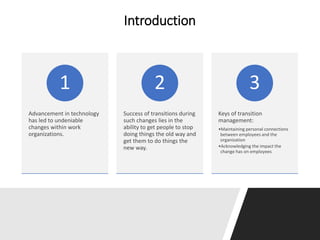
Advancement in technology
has led to undeniable
changes within work
organizations.
1
Success of transitions during
such changes lies in the
ability to get people to stop
doing things the old way and
get them to do things the
new way.
2
Keys of transition
management:
•Maintaining personal connections
between employees and the
organization
•Acknowledging the impact the
change has on employees
3
Change vs.
Transition
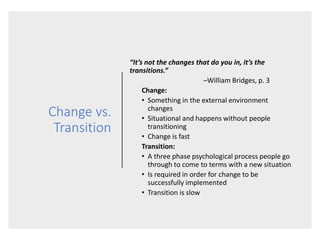
“It’s not the changes that do you in, it’s the
transitions.”
–William Bridges, p. 3
Change:
• Something in the external environment
changes
• Situational and happens without people
transitioning
• Change is fast
Transition:
• A three phase psychological process people go
through to come to terms with a new situation
• Is required in order for change to be
successfully implemented
• Transition is slow
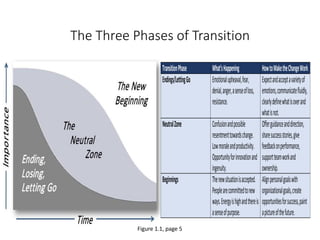
The Three Phases of Transition
Figure 1.1, page 5
TransitionPhase What’sHappening HowtoMaketheChangeWork
Endings/LettingGo Emotionalupheaval,fear,
denial,anger,asenseofloss,
resistance.
Expectandacceptavarietyof
emotions,communicatefluidly,
clearlydefinewhatisoverand
whatisnot.
NeutralZone Confusionandpossible
resentmenttowardschange.
Lowmoraleandproductivity.
Opportunityforinnovationand
ingenuity.
Offerguidanceanddirection,
sharesuccessstories,give
feedbackonperformance,
supportteamworkand
ownership.
Beginnings Thenewsituationisaccepted.
Peoplearecommittedtonew
ways.Energyishighandthereis
asenseofpurpose.
Alignpersonalgoalswith
organizationalgoals,create
opportunitiesforsuccess,paint
apictureofthefuture.
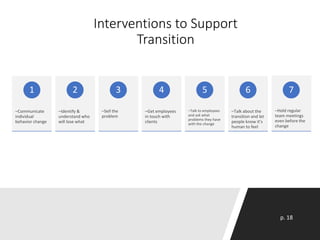
Interventions to Support
Transition
–Communicate
individual
behavior change
1
–Identify &
understand who
will lose what
2
–Sell the
problem
3
–Get employees
in touch with
clients
4
–Talk to employees
and ask what
problems they have
with the change
5
–Talk about the
transition and let
people know it’s
human to feel
6
–Hold regular
team meetings
even before the
change
7
p. 18
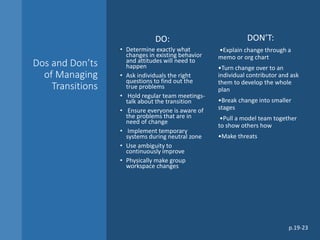
Dos and Don’ts
of Managing
Transitions
DO:
• Determine exactly what
changes in existing behavior
and attitudes will need to
happen
• Ask individuals the right
questions to find out the
true problems
• Hold regular team meetings-
talk about the transition
• Ensure everyone is aware of
the problems that are in
need of change
• Implement temporary
systems during neutral zone
• Use ambiguity to
continuously improve
• Physically make group
workspace changes
DON’T:
•Explain change through a
memo or org chart
•Turn change over to an
individual contributor and ask
them to develop the whole
plan
•Break change into smaller
stages
•Pull a model team together
to show others how
•Make threats
p.19-23
Managing
Making the Most of Change
Transitions
By: William Bridges, PhD with
Susan Bridges
Part Two: The Solution
Presentation By:
Linda Elliott-Nelson, Peggy Locklear, & Travis Mitchell
Let
It
Go
Transitions require changes that bring about endings, which nobody
likes
Changes to protocols, teams, environments, and chains of
command make things unfamiliar and uncomfortable
It’s not necessarily the changes themselves, but the
feeling of loss and the ‘Neutral Zone’ that they resist
Try to understand who is losing what, and why it matters
to them– including secondary and tertiary effects (and
losses)
There will be overreaction from those who feel they were
treated unfairly previously, who are feeling a larger symbolic
loss, or who feel unvalued
Acknowledge the loss. Expect the six stages of grief:
Anger, Bargaining, Anxiety, Sadness, Disorientation, and Depression
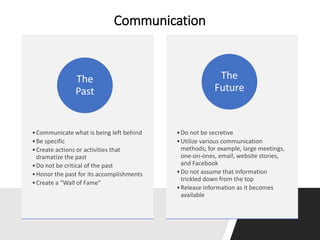
Communication
•Communicate what is being left behind
•Be specific
•Create actions or activities that
dramatize the past
•Do not be critical of the past
•Honor the past for its accomplishments
•Create a “Wall of Fame”
The
Past
•Do not be secretive
•Utilize various communication
methods; for example, large meetings,
one-on-ones, email, website stories,
and Facebook
•Do not assume that information
trickled down from the top
•Release information as it becomes
available
The
Future
Neutral
Zone
|between the old ways and the new
ways|
During this time:
 Anxiety rises
 There are mixed signals
 People become polarized
BUT, it is also a creative time
Actions
 “Normalize” the neutral zone
 Time for reorientation and redefinition
 Create temporary systems with checkpoints
and short range
 Strengthen intragroup connections
 Use transition monitoring team
 Time to step back and take stock
 Encourage learning in discovery and
innovation
 Look for opportunities
Managing
Making the Most of Change
Transitions
By: William Bridges, PhD with
Susan Bridges
Part II: The Solution II
Launching a New Beginning &Transition,
Development, and Renewal
Presentation By: Angie Creel & Steve Moore
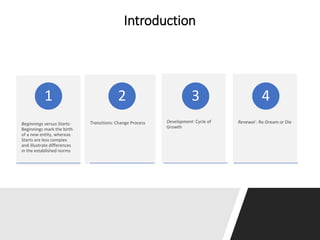
Introduction
Beginnings versus Starts:
Beginnings mark the birth
of a new entity, whereas
Starts are less complex
and illustrate differences
in the established norms
1
Transitions: Change Process
2
Development: Cycle of
Growth
3
Renewal : Re-Dream or Die
4
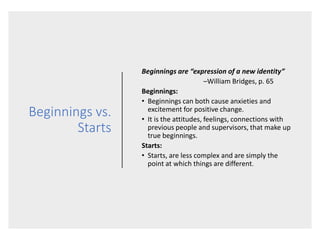
Beginnings vs.
Starts
Beginnings are “expression of a new identity”
–William Bridges, p. 65
Beginnings:
• Beginnings can both cause anxieties and
excitement for positive change.
• It is the attitudes, feelings, connections with
previous people and supervisors, that make up
true beginnings.
Starts:
• Starts, are less complex and are simply the
point at which things are different.
Beginnings
must be
“encouraged,
supported, and
reinforced”-
Bridges, p. 68
• Have a clear
PURPOSE for the new
beginning.
Communicate it.
• Paint a PICTURE of
what the end result
will be. Let people
envision the goal.
• Devise a PLAN to get
to where you’d like to
be. Communicate a
clear path of action.
• Give each participant
a PART to play and
describe how it fits
with the whole
picture.
Actions that can help are:
Reinforcing
the
"New Beginning"
Rule 1: Be Consistent
Be
Rule 2: Ensure Quick Successes
Ensure
Rule 3: Symbolize the New Identity
Symbolize
Rule 4: Celebrate the Success
Celebrate
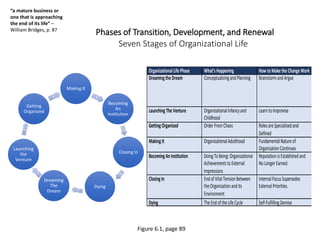
Phases of Transition, Development, and Renewal
Seven Stages of Organizational Life
Figure 6.1, page 89
Making It
Becoming
An
Institution
Closing In
Dying
Dreaming
The
Dream
Launching
the
Venture
Getting
Organized
OrganizationalLifePhase What’sHappening HowtoMaketheChangeWork
DreamingtheDream ConceptualizingandPlanning BrainstormandArgue
LaunchingTheVenture OrganizationalInfancyand
Childhood
LearntoImprovise
GettingOrganized OrderFrom Chaos RolesareSpecializedand
Defined
MakingIt OrganizationalAdulthood FundamentalNatureof
OrganizationContinues
BecomingAnInstitution DoingToBeing:Organizational
AchievementstoExternal
Impressions
ReputationisEstablished and
NoLongerEarned.
ClosingIn EndofVitalTensionBetween
theOrganizationand its
Environment
InternalFocusSupersedes
ExternalPriorities.
Dying TheEnd oftheLifeCycle Self-FulfillingDemise
“a mature business or
one that is approaching
the end of its life” –
William Bridges, p. 87
Phases of Transition, Development, and Renewal
Organizational Renewal
Figure 6.2, page 99
4:
Succeeding,
Making It
5
Becoming
An
Institution
6B: Closing
In
7B: Closing In
6 A: The
Path of
Renewal
7A:
Beginning
Anew
1:
Dreaming
The Dream
2:
Launching
the Venture
3:
Getting
Organized
Organizational Life Phase What’s Happening How to Make the Change
Work
Dreaming the Dream Conceptualizing and
Planning
Re-Dream The Dream
Launching The Venture Organizational Infancy
and Childhood
Recapture the Venture
Sprit
Getting Organized Order From Chaos Remodel the policies,
roles and structures of a
young organization
Making It Organizational Adulthood Let Go and Move On
5: Becoming An
Institution
Doing To Being:
Organizational
Achievements to External
Impressions
Get Used to Life in the
Neutral Zone
6A: The Path of Renewal Embodiment of new
Behaviors and Attitudes
Live in the now as the
Institution moves to the
Tomorrow . Jump to 7 A
OR DIE
6B: Closing In End of Vital Tension
Between the
Organization and its
Environment
Internal Focus
Supersedes External
Priorities.
7B: Closing In Die
7A: Beginning Anew
Dreaming the Dream
Conceptualizing and
Planning
Re-Dream The Dream
“development originally
meant –out of an initial
seen dream as surely as an
oak unfolds out of an
acorn”- William Bridges, p. 102
Transitions and Renewal:
A Checklist
Yes No
____ ____
____ ____
____ ____
____ ____
____ ____
____ ____
____ ____
___ ___
___ ___
Understand the seven stages of the organizational life cycle?
Identify where the organization is in its own cycle?
Distinguish between details of organization’s situation?
Identify the original dream that represented the first stage?
Explain characteristics of Venture developmental stage?
Understand difference between everyday efforts be more organized and developmental stage called “Getting Organized”?
Explain the new concerns and attitudes that develop as an organization moves from making it to becoming an institution?
Understand the “moment of truth” of an organization- time when it must make a choice that will determine if it’ll survive?
Know the three transition-based questions to ask when planning how the organization can move through a transformative time?
p.106-107
Managing
Making the Most of Change
Transitions
By: William Bridges, PhD with
Susan Bridges
Part III: Dealing with Nonstop Change in the
Organization and in Your Life
Presentation By: Jana Moore & Kari Gardner
The Three Phases of Change
Have an Ending, Neutral Zone and
New Beginning
• You are likely to be in more than one phase at the
same time.
• There are likely to be multiple changes overlapping.
However…
Look for
Patterns and
Orchestrate
Responses
• The organization’s history is a life history and
change is moving from one chapter to the next.
• Connect the dots (of the changes) and create
responses to changes based on the overall
patterns.
• Strive for a clear picture of the overarching
change in the midst of lots of smaller changes.
Managing Multiple Changes
Postpone extra
changes
1
Identify &
understand who
will lose what
2
Do worst-case
scenarios
3
Make the
transition to
“change as the
norm”
4
Clarify your
purpose
5
Rebuild trust
and unload old
baggage
6
Sell problems,
not solutions
7
The Cycle of
Challenge and
Response
• Create creative
solutions to ongoing
problems.
• Create a culture of
responding to
challenges and
embracing change
• Develop this culture of
responding at every
level of the organization
• Create a sense of
purpose and control by
encouraging creative
responses
Increase the
organization’s
transition
worthiness
Managing
Making the Most of Change
Transitions
By: William Bridges, PhD with
Susan Bridges
Part 4: The Conclusion
Presentation By:
Wendy Hoag & Sandra Rodriguez
Why should we manage
transitions?
• Our moral responsibility is not to stop the future,
but to shape it…to channel our destiny in
humane directions and to ease the trauma of
transition.
Alvin Toffler,
American Futurist
Unmanaged
Transitions
G.R.A.S.S.
Guilt Those who shaped the
change, and those impacted
by the change.
Resentment “…yesterday’s changes leave
a legacy of resentment,
today’s changes are
undermined before they are
launched.”
Anxiety Stifles innovation and
motivation.
Self-Absorption Causes people to focus on
their own concerns and not
the concerns of others.
Stress Affects health and safety.
Tips for
Managing
Transitions
Know Know which things you shouldn’t do.
Don’t
waste
Don’t waste your time on things that may have
little benefit.
Plan Plan things appropriately.
Start Start planning things that will take time.
Take Take care of things that need immediate
attention.

Bridges Managing Transitions.pdf

  • 1.
    Managing Making the Mostof Change Transitions By: William Bridges, PhD with Susan Bridges Intro & Part One: The Problem Presentation By: Jennifer Tagaban, Jerry Smith & Bryan Doak
  • 2.
    Introduction Advancement in technology hasled to undeniable changes within work organizations. 1 Success of transitions during such changes lies in the ability to get people to stop doing things the old way and get them to do things the new way. 2 Keys of transition management: •Maintaining personal connections between employees and the organization •Acknowledging the impact the change has on employees 3
  • 3.
    Change vs. Transition “It’s notthe changes that do you in, it’s the transitions.” –William Bridges, p. 3 Change: • Something in the external environment changes • Situational and happens without people transitioning • Change is fast Transition: • A three phase psychological process people go through to come to terms with a new situation • Is required in order for change to be successfully implemented • Transition is slow
  • 4.
    The Three Phasesof Transition Figure 1.1, page 5 TransitionPhase What’sHappening HowtoMaketheChangeWork Endings/LettingGo Emotionalupheaval,fear, denial,anger,asenseofloss, resistance. Expectandacceptavarietyof emotions,communicatefluidly, clearlydefinewhatisoverand whatisnot. NeutralZone Confusionandpossible resentmenttowardschange. Lowmoraleandproductivity. Opportunityforinnovationand ingenuity. Offerguidanceanddirection, sharesuccessstories,give feedbackonperformance, supportteamworkand ownership. Beginnings Thenewsituationisaccepted. Peoplearecommittedtonew ways.Energyishighandthereis asenseofpurpose. Alignpersonalgoalswith organizationalgoals,create opportunitiesforsuccess,paint apictureofthefuture.
  • 5.
    Interventions to Support Transition –Communicate individual behaviorchange 1 –Identify & understand who will lose what 2 –Sell the problem 3 –Get employees in touch with clients 4 –Talk to employees and ask what problems they have with the change 5 –Talk about the transition and let people know it’s human to feel 6 –Hold regular team meetings even before the change 7 p. 18
  • 6.
    Dos and Don’ts ofManaging Transitions DO: • Determine exactly what changes in existing behavior and attitudes will need to happen • Ask individuals the right questions to find out the true problems • Hold regular team meetings- talk about the transition • Ensure everyone is aware of the problems that are in need of change • Implement temporary systems during neutral zone • Use ambiguity to continuously improve • Physically make group workspace changes DON’T: •Explain change through a memo or org chart •Turn change over to an individual contributor and ask them to develop the whole plan •Break change into smaller stages •Pull a model team together to show others how •Make threats p.19-23
  • 7.
    Managing Making the Mostof Change Transitions By: William Bridges, PhD with Susan Bridges Part Two: The Solution Presentation By: Linda Elliott-Nelson, Peggy Locklear, & Travis Mitchell
  • 8.
    Let It Go Transitions require changesthat bring about endings, which nobody likes Changes to protocols, teams, environments, and chains of command make things unfamiliar and uncomfortable It’s not necessarily the changes themselves, but the feeling of loss and the ‘Neutral Zone’ that they resist Try to understand who is losing what, and why it matters to them– including secondary and tertiary effects (and losses) There will be overreaction from those who feel they were treated unfairly previously, who are feeling a larger symbolic loss, or who feel unvalued Acknowledge the loss. Expect the six stages of grief: Anger, Bargaining, Anxiety, Sadness, Disorientation, and Depression
  • 9.
    Communication •Communicate what isbeing left behind •Be specific •Create actions or activities that dramatize the past •Do not be critical of the past •Honor the past for its accomplishments •Create a “Wall of Fame” The Past •Do not be secretive •Utilize various communication methods; for example, large meetings, one-on-ones, email, website stories, and Facebook •Do not assume that information trickled down from the top •Release information as it becomes available The Future
  • 10.
    Neutral Zone |between the oldways and the new ways| During this time:  Anxiety rises  There are mixed signals  People become polarized BUT, it is also a creative time Actions  “Normalize” the neutral zone  Time for reorientation and redefinition  Create temporary systems with checkpoints and short range  Strengthen intragroup connections  Use transition monitoring team  Time to step back and take stock  Encourage learning in discovery and innovation  Look for opportunities
  • 11.
    Managing Making the Mostof Change Transitions By: William Bridges, PhD with Susan Bridges Part II: The Solution II Launching a New Beginning &Transition, Development, and Renewal Presentation By: Angie Creel & Steve Moore
  • 12.
    Introduction Beginnings versus Starts: Beginningsmark the birth of a new entity, whereas Starts are less complex and illustrate differences in the established norms 1 Transitions: Change Process 2 Development: Cycle of Growth 3 Renewal : Re-Dream or Die 4
  • 13.
    Beginnings vs. Starts Beginnings are“expression of a new identity” –William Bridges, p. 65 Beginnings: • Beginnings can both cause anxieties and excitement for positive change. • It is the attitudes, feelings, connections with previous people and supervisors, that make up true beginnings. Starts: • Starts, are less complex and are simply the point at which things are different.
  • 14.
    Beginnings must be “encouraged, supported, and reinforced”- Bridges,p. 68 • Have a clear PURPOSE for the new beginning. Communicate it. • Paint a PICTURE of what the end result will be. Let people envision the goal. • Devise a PLAN to get to where you’d like to be. Communicate a clear path of action. • Give each participant a PART to play and describe how it fits with the whole picture. Actions that can help are:
  • 15.
    Reinforcing the "New Beginning" Rule 1:Be Consistent Be Rule 2: Ensure Quick Successes Ensure Rule 3: Symbolize the New Identity Symbolize Rule 4: Celebrate the Success Celebrate
  • 16.
    Phases of Transition,Development, and Renewal Seven Stages of Organizational Life Figure 6.1, page 89 Making It Becoming An Institution Closing In Dying Dreaming The Dream Launching the Venture Getting Organized OrganizationalLifePhase What’sHappening HowtoMaketheChangeWork DreamingtheDream ConceptualizingandPlanning BrainstormandArgue LaunchingTheVenture OrganizationalInfancyand Childhood LearntoImprovise GettingOrganized OrderFrom Chaos RolesareSpecializedand Defined MakingIt OrganizationalAdulthood FundamentalNatureof OrganizationContinues BecomingAnInstitution DoingToBeing:Organizational AchievementstoExternal Impressions ReputationisEstablished and NoLongerEarned. ClosingIn EndofVitalTensionBetween theOrganizationand its Environment InternalFocusSupersedes ExternalPriorities. Dying TheEnd oftheLifeCycle Self-FulfillingDemise “a mature business or one that is approaching the end of its life” – William Bridges, p. 87
  • 17.
    Phases of Transition,Development, and Renewal Organizational Renewal Figure 6.2, page 99 4: Succeeding, Making It 5 Becoming An Institution 6B: Closing In 7B: Closing In 6 A: The Path of Renewal 7A: Beginning Anew 1: Dreaming The Dream 2: Launching the Venture 3: Getting Organized Organizational Life Phase What’s Happening How to Make the Change Work Dreaming the Dream Conceptualizing and Planning Re-Dream The Dream Launching The Venture Organizational Infancy and Childhood Recapture the Venture Sprit Getting Organized Order From Chaos Remodel the policies, roles and structures of a young organization Making It Organizational Adulthood Let Go and Move On 5: Becoming An Institution Doing To Being: Organizational Achievements to External Impressions Get Used to Life in the Neutral Zone 6A: The Path of Renewal Embodiment of new Behaviors and Attitudes Live in the now as the Institution moves to the Tomorrow . Jump to 7 A OR DIE 6B: Closing In End of Vital Tension Between the Organization and its Environment Internal Focus Supersedes External Priorities. 7B: Closing In Die 7A: Beginning Anew Dreaming the Dream Conceptualizing and Planning Re-Dream The Dream “development originally meant –out of an initial seen dream as surely as an oak unfolds out of an acorn”- William Bridges, p. 102
  • 18.
    Transitions and Renewal: AChecklist Yes No ____ ____ ____ ____ ____ ____ ____ ____ ____ ____ ____ ____ ____ ____ ___ ___ ___ ___ Understand the seven stages of the organizational life cycle? Identify where the organization is in its own cycle? Distinguish between details of organization’s situation? Identify the original dream that represented the first stage? Explain characteristics of Venture developmental stage? Understand difference between everyday efforts be more organized and developmental stage called “Getting Organized”? Explain the new concerns and attitudes that develop as an organization moves from making it to becoming an institution? Understand the “moment of truth” of an organization- time when it must make a choice that will determine if it’ll survive? Know the three transition-based questions to ask when planning how the organization can move through a transformative time? p.106-107
  • 19.
    Managing Making the Mostof Change Transitions By: William Bridges, PhD with Susan Bridges Part III: Dealing with Nonstop Change in the Organization and in Your Life Presentation By: Jana Moore & Kari Gardner
  • 20.
    The Three Phasesof Change Have an Ending, Neutral Zone and New Beginning • You are likely to be in more than one phase at the same time. • There are likely to be multiple changes overlapping. However…
  • 21.
    Look for Patterns and Orchestrate Responses •The organization’s history is a life history and change is moving from one chapter to the next. • Connect the dots (of the changes) and create responses to changes based on the overall patterns. • Strive for a clear picture of the overarching change in the midst of lots of smaller changes.
  • 22.
    Managing Multiple Changes Postponeextra changes 1 Identify & understand who will lose what 2 Do worst-case scenarios 3 Make the transition to “change as the norm” 4 Clarify your purpose 5 Rebuild trust and unload old baggage 6 Sell problems, not solutions 7
  • 23.
    The Cycle of Challengeand Response • Create creative solutions to ongoing problems. • Create a culture of responding to challenges and embracing change • Develop this culture of responding at every level of the organization • Create a sense of purpose and control by encouraging creative responses Increase the organization’s transition worthiness
  • 24.
    Managing Making the Mostof Change Transitions By: William Bridges, PhD with Susan Bridges Part 4: The Conclusion Presentation By: Wendy Hoag & Sandra Rodriguez
  • 25.
    Why should wemanage transitions? • Our moral responsibility is not to stop the future, but to shape it…to channel our destiny in humane directions and to ease the trauma of transition. Alvin Toffler, American Futurist
  • 26.
    Unmanaged Transitions G.R.A.S.S. Guilt Those whoshaped the change, and those impacted by the change. Resentment “…yesterday’s changes leave a legacy of resentment, today’s changes are undermined before they are launched.” Anxiety Stifles innovation and motivation. Self-Absorption Causes people to focus on their own concerns and not the concerns of others. Stress Affects health and safety.
  • 27.
    Tips for Managing Transitions Know Knowwhich things you shouldn’t do. Don’t waste Don’t waste your time on things that may have little benefit. Plan Plan things appropriately. Start Start planning things that will take time. Take Take care of things that need immediate attention.