DEPARTMENT= PRE-PHYSICIAN
TOPIC NAME - concepts nurses process
, nurse diagnosis
Nursing Process
• The nursing process is a deliberate, problem-
solving approach to meeting the health care and
nursing needs of patients. It involves assessment
(data collection), nursing diagnosis, planning,
implementation, and evaluation, with subsequent
modifications used as feedback mechanisms that
promote the resolution of the nursing diagnoses.
The process as a whole is cyclical, the steps being
interrelated, interdependent, and recurrent.
Copyright 2008 by Pearson Education, Inc.
Assessing
• Collecting data
• Organizing data
• Validating is the act of “double-checking” or
verifying data to confirm that it is accurate
and factual.
• Documenting data
• Goal
– Establish a database about the client’s response to
health concerns or illness
Copyright 2008 by Pearson Education, Inc.
Planning
• Determining how to prevent, reduce, or resolve
identified priority client problems
• Determining how to support client strengths
• Determining how to implement nursing interventions
in an organized, individualized, and goal-directed
manner
• Goals
– Develop an individualized care plan that specifies client
goals/desired outcomes
– Related nursing interventions
• Organizing data is categorizing data
systematically using a specified format.
• Validating data is the act of “double-checking”
or verifying data to confirm that it is accurate
and factual.
• Documenting is accurately and factually
recording data.
NURSING DIAGNISIS
Types of Nursing Diagnosis
– Actual
– Risk
– Wellness
– Possible
– Syndrome
Actual Diagnosis
– Problem present at the time of the assessment
• Presence of associated signs and symptoms
• (ineffective breathing pattern)
– Risk Diagnosis
– Problem does not exirice
– Presence of risk factors
Wellness Diagnosis
• Readiness for enhancement
• describes human responses to levels of
wellness in an individual, family, or
community that have a readiness
enhancement.”
• (readiness for enhanced spiritual well-being
or readiness for enhanced family coping)
Possible Diagnosis
– Evidence about a health problem incomplete or
unclear
– Requires more data to either support or to refute
it
– (possible social isolation)
Steps in Diagnostic Process
• Analyzing data
– Compare data against standards
– Cluster cues
– Identify gaps and inconsistencies
• Identifying health problems, risks, and
strengths
• Formulating diagnostic statements
• Basic three-part statement
– Problem (P)
– Etiology (E)
– Signs and symptoms (S)
• The following are guidelines for
writing nursing diagnosis statements:
• Write statements in terms of a problem
instead of a need.
• Word the statement so that it is legally
advisable.
• Use nonjudgmental statements.
• Be sure both elements of the statement do
not say the say thing.
Factors to Consider When Setting
Priorities
• Client’s health values and beliefs
• Client’s priorities
• Resources available to the nurse and client
• Urgency of the health problem
• Medical treatment plan
Describe the relationship of
goals/desired outcomes to the
nursing diagnoses.
• Goals/Desired Outcomes and Nursing
Diagnosis
• Goals derived from diagnostic label
• Diagnostic label contains the unhealthy
response (problem)
• Goal/desired outcome demonstrates
resolution of the unhealthy response
(problem)
Thank you

The nursing process

  • 1.
    DEPARTMENT= PRE-PHYSICIAN TOPIC NAME- concepts nurses process , nurse diagnosis
  • 2.
    Nursing Process • Thenursing process is a deliberate, problem- solving approach to meeting the health care and nursing needs of patients. It involves assessment (data collection), nursing diagnosis, planning, implementation, and evaluation, with subsequent modifications used as feedback mechanisms that promote the resolution of the nursing diagnoses. The process as a whole is cyclical, the steps being interrelated, interdependent, and recurrent.
  • 4.
    Copyright 2008 byPearson Education, Inc. Assessing • Collecting data • Organizing data • Validating is the act of “double-checking” or verifying data to confirm that it is accurate and factual. • Documenting data • Goal – Establish a database about the client’s response to health concerns or illness
  • 5.
    Copyright 2008 byPearson Education, Inc. Planning • Determining how to prevent, reduce, or resolve identified priority client problems • Determining how to support client strengths • Determining how to implement nursing interventions in an organized, individualized, and goal-directed manner • Goals – Develop an individualized care plan that specifies client goals/desired outcomes – Related nursing interventions
  • 7.
    • Organizing datais categorizing data systematically using a specified format. • Validating data is the act of “double-checking” or verifying data to confirm that it is accurate and factual. • Documenting is accurately and factually recording data.
  • 8.
    NURSING DIAGNISIS Types ofNursing Diagnosis – Actual – Risk – Wellness – Possible – Syndrome
  • 9.
    Actual Diagnosis – Problempresent at the time of the assessment • Presence of associated signs and symptoms • (ineffective breathing pattern) – Risk Diagnosis – Problem does not exirice – Presence of risk factors
  • 10.
    Wellness Diagnosis • Readinessfor enhancement • describes human responses to levels of wellness in an individual, family, or community that have a readiness enhancement.” • (readiness for enhanced spiritual well-being or readiness for enhanced family coping)
  • 11.
    Possible Diagnosis – Evidenceabout a health problem incomplete or unclear – Requires more data to either support or to refute it – (possible social isolation)
  • 12.
    Steps in DiagnosticProcess • Analyzing data – Compare data against standards – Cluster cues – Identify gaps and inconsistencies • Identifying health problems, risks, and strengths • Formulating diagnostic statements
  • 13.
    • Basic three-partstatement – Problem (P) – Etiology (E) – Signs and symptoms (S)
  • 14.
    • The followingare guidelines for writing nursing diagnosis statements: • Write statements in terms of a problem instead of a need. • Word the statement so that it is legally advisable. • Use nonjudgmental statements. • Be sure both elements of the statement do not say the say thing.
  • 15.
    Factors to ConsiderWhen Setting Priorities • Client’s health values and beliefs • Client’s priorities • Resources available to the nurse and client • Urgency of the health problem • Medical treatment plan
  • 16.
    Describe the relationshipof goals/desired outcomes to the nursing diagnoses. • Goals/Desired Outcomes and Nursing Diagnosis • Goals derived from diagnostic label • Diagnostic label contains the unhealthy response (problem) • Goal/desired outcome demonstrates resolution of the unhealthy response (problem)
  • 17.

Editor's Notes

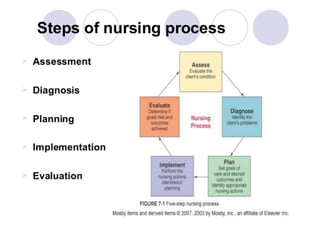
  • #4 Figure 11-1 The nursing process in action.