NURSING CARE PLAN PLAYS AN IMPORTANT PART IN NURSING CARE. KNOWING HOW TO DRAW A GOOD WORKING NURSING CARE PLAN IS NOT ONLY REQUIRED BUT AN IMPORTANT PART OF NURSING CARE.
A nursing careplan (NCP) is a formal process that correctly
identifies existing needs and recognizes a client’s potential
needs or risks. Care plans provide a way of communication
among nurses, their patients, and other healthcare
providers to achieve healthcare outcomes.
2.
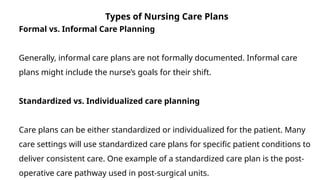
Formal vs. InformalCare Planning
Generally, informal care plans are not formally documented. Informal care
plans might include the nurse’s goals for their shift.
Standardized vs. Individualized care planning
Care plans can be either standardized or individualized for the patient. Many
care settings will use standardized care plans for specific patient conditions to
deliver consistent care. One example of a standardized care plan is the post-
operative care pathway used in post-surgical units.
Types of Nursing Care Plans
3.
Step 1: DataCollection or Assessment
The first step in writing a nursing care plan is to create a client
database using assessment techniques and data collection methods
(physical assessment, health history, interview, medical records review,
and diagnostic studies). A client database includes all the health
information gathered. In this step, the nurse can identify the related or
risk factors and defining characteristics that can be used to formulate a
nursing diagnosis. Some agencies or nursing schools have specific
assessment formats you can use.
STEPS IN WRITING NURSING CARE PLAN
4.
Step 2: DataAnalysis and Organization
Now that you have information about the client’s health, analyze, cluster,
and organize the data to formulate your nursing diagnosis, priorities,
and desired outcomes.
Step 3: Formulating Your Nursing Diagnoses
Nursing diagnoses are a uniform way of identifying, focusing on and
dealing with specific client needs and responses to actual and high-risk
problems. Actual or potential health problems that can be prevented or
resolved by independent nursing intervention are termed nursing
diagnoses.
5.
TYPES OF NURSINGDIAGNOSES.
The four types of nursing diagnosis are Actual (Problem-Focused), Risk,
Health Promotion, and Syndrome.
A problem-focused diagnosis (also known as actual diagnosis) is a client
problem present at the time of the nursing assessment. These diagnoses
are based on the presence of associated signs and symptoms. Actual
nursing diagnosis should not be viewed as more important than risk
diagnoses. There are many instances where a risk diagnosis can be the
diagnosis with the highest priority for a patient. Problem-focused nursing
diagnoses have three components: (1) nursing diagnosis, (2) related factors,
and (3) defining characteristics. Examples of actual nursing diagnoses are:
6.
Anxiety relatedto stress as evidenced by increased tension,
apprehension, and expression of concern regarding upcoming
surgery
Acute pain related to decreased myocardial flow as evidenced by
grimacing, expression of pain, guarding behavior
7.
Risk Nursing Diagnosis
Thesecond type of nursing diagnosis is called risk nursing
diagnosis. These are clinical judgment for a problem does not exist, but
the presence of risk factors indicates that a problem is likely to develop
unless nurses intervene. A risk diagnosis is based on the patient’s current
health status, past health history, and other risk factors that may
increase the patient’s likelihood of experiencing a health problem. These
are integral part of nursing care because they help to identify potential
problems early on and allows the nurse to take steps to prevent or
mitigate the risk.
8.
Examples of risknursing diagnosis are:
Risk for Injury as evidenced by reduced cognitive awareness and use of
sedative medications.
Risk for Infection as evidenced by surgical wound, compromised immune
system, and prolonged hospitalization.
Risk for Falls as evidenced by muscle weakness, history of previous falls,
impaired mobility, and use of assistive devices.
The problem statement,or the diagnostic
label, describes the client’s health
problem or response to which nursing
therapy is given concisely. A diagnostic
label usually has two parts: qualifier and
focus of the diagnosis. Qualifiers (also
called modifiers) are words that have
been added to some diagnostic labels to
give additional meaning, limit, or specify
the diagnostic statement. Exempted in
this rule are one-word nursing diagnoses
(e.g., Anxiety, Constipation, Diarrhea,
Nausea, etc.) where their qualifier and
focus are inherent in the one term.
12.
Qualifier Focus ofthe Diagnosis
Deficient Fluid volume
Imbalanced Nutrition: Less Than Body Requirements
Impaired Gas Exchange
Ineffective Tissue Perfusion
Risk for Injury
The etiology, orrelated factors,
component of a nursing diagnosis
label identifies one or more probable
causes of the health problem, are the
conditions involved in the
development of the problem, gives
direction to the required nursing
therapy, and enables the nurse to
individualize the client’s care.
Nursing interventions should be
aimed at etiological factors in order
to remove the underlying cause of the
nursing diagnosis. Etiology is linked
with the problem statement with the
phrase “related to” for example:
• Activity intolerance related to generalized weakness.
• Decreased cardiac output related to abnormality in blood profile
Risk factors areused
instead of etiological
factors for risk nursing
diagnosis. Risk factors are
forces that put an
individual (or group) at an
increased vulnerability to
an unhealthy condition.
Risk factors are written
following the phrase “as
evidenced by” in the
diagnostic statement.
Risk for falls as evidenced by old age
and use of walker.
Risk for infection as evidenced by
break in skin integrity.
17.
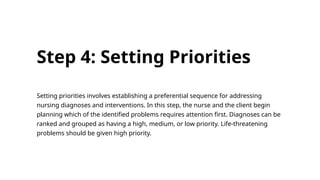
Step 4: SettingPriorities
Setting priorities involves establishing a preferential sequence for addressing
nursing diagnoses and interventions. In this step, the nurse and the client begin
planning which of the identified problems requires attention first. Diagnoses can be
ranked and grouped as having a high, medium, or low priority. Life-threatening
problems should be given high priority.
After assigning prioritiesfor your
nursing diagnosis, the nurse and the
client set goals for each determined
priority. Goals or desired outcomes
describe what the nurse hopes to achieve
by implementing the nursing
interventions derived from the client’s
nursing diagnoses. Goals provide
direction for planning interventions,
serve as criteria for evaluating client
progress, enable the client and nurse to
determine which problems have been
resolved, and help motivate the client
and nurse by providing a sense of
achievement.
20.
One overall goalis
determined for each
nursing diagnosis.
The terms “goal
outcomes “and
“expected outcomes”
are often used
interchangeably.
21.
According to Hamilton
andPrice (2013), goals
should be SMART.
SMART stands for
specific, measurable,
attainable, realistic,
and time-oriented
goals.
Realistic or Results-
Oriented.This is
important to look
forward to effective
and successful
outcomes by keeping in
mind the available
resources at hand.
26.
Timely or Time-
Oriented.Every goal
needs a designated
time parameter, a
deadline to focus on,
and something to
work toward.
Discharge planning.
Involves naminglong-
term goals, therefore
promoting continued
restorative care and
problem resolution
through home health,
physical therapy, or
various other referral
Goals or desired
outcomestatements
usually have four
components: a subject,
a verb, conditions or
modifiers, and a
criterion of desired
performance.
32.
Subject. The subjectis the
client, any part of the client,
or some attribute of the client
(i.e., pulse, temperature,
urinary output). That subject
is often omitted in writing
goals because it is assumed
that the subject is the client
unless indicated otherwise
(family, significant other).
33.
Verb. The verb
specifiesan action
the client is to
perform, for
example, what the
client is to do, learn,
or experience.
34.
Conditions or modifiers.
Theseare the “what,
when, where, or how”
that are added to the
verb to explain the
circumstances under
which the behavior is to
be performed.
35.
Criterion of desired
performance.The criterion
indicates the standard by
which a performance is
evaluated or the level at
which the client will
perform the specified
behavior. These are
optional.
Write goals and
outcomesin terms of
client responses and
not as activities of the
nurse. Begin each goal
with “Client will […]”
help focus the goal on
client behavior and
responses.
38.
Avoid writing
goals onwhat the
nurse hopes to
accomplish, and
focus on what the
client will do.
Ensure that eachgoal is
derived from only one
nursing diagnosis. Keeping
it this way facilitates
evaluation of care by
ensuring that planned
nursing interventions are
clearly related to the
diagnosis set.
43.
Care plans must
beupdated
continually, not
just at admission
or discharge.
44.
Lastly, make sure
thatthe client
considers the
goals important
and values them
to ensure
cooperation.
45.
Step 6: SelectingNursing
Interventions
are activities or actions that a nurse performs to achieve client goals. Interventions
chosen should focus on eliminating or reducing the etiology of the priority nursing
problem or diagnosis. As for risk nursing problems, interventions should focus on
reducing the client’s risk factors. In this step, nursing interventions are identified
and written during the planning step of the nursing process; however, they are
actually performed during the implementation step.
Independent nursing
interventions areactivities
that nurses are licensed to
initiate based on their sound
judgement and skills.
Includes: ongoing
assessment, emotional
support, providing comfort,
teaching, physical care, and
making referrals to other
health care professionals.
49.
Dependent nursing interventions
areactivities carried out under
the physician’s orders or
supervision. Includes orders to
direct the nurse to provide
medications,
intravenous therapy, diagnostic
tests, treatments, diet, and
activity or rest. Assessment and
providing explanation while
administering medical orders are
also part of the dependent
50.
Collaborative interventions
are actionsthat the nurse
carries out in collaboration
with other health team
members, such as physicians,
social workers, dietitians, and
therapists. These actions are
developed in consultation
with other health care
professionals to gain their
professional viewpoint.
specific and clearlystated,
beginning with an action verb
indicating what the nurse is
expected to do. Action verb starts
the intervention and must be
precise. Qualifiers of how, when,
where, time, frequency, and amount
provide the content of the planned
activity. For example: “Educate
parents on how to take temperature
and notify of any changes,” or
“Assess urine for color, amount,
odor, and turbidity.”





![Write goals and
outcomes in terms of
client responses and
not as activities of the
nurse. Begin each goal
with “Client will […]”
help focus the goal on
client behavior and
responses.](https://image.slidesharecdn.com/nursingcareplan-250415113317-7973f053/85/NURSING-CARE-PLAN-docx-Presentation-pptx-37-320.jpg)