THE NATURALTHE NATURAL
APPROACHAPPROACH
what is the natural
approach ?
background
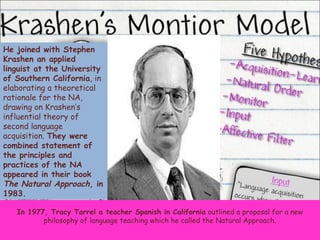
In 1977, Tracy Tarrel a teacher Spanish in California outlined a proposal for a new
philosophy of language teaching which he called the Natural Approach.
He joined with Stephen
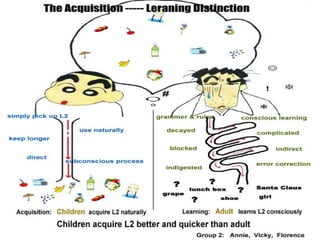
Krashen an applied
linguist at the University
of Southern California, in
elaborating a theoretical
rationale for the NA,
drawing on Krashen’s
influential theory of
second language
acquisition. They were
combined statement of
the principles and
practices of the NA
appeared in their book
The Natural Approach, in
1983.
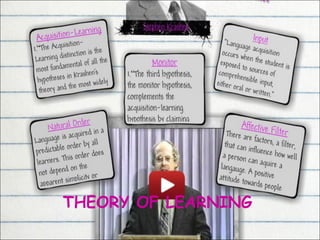
THEORY OF LEARNING
b.
Particular
emphasizs is
laid on
language as
a set of
messages
that can be
understood
Theory of
language:
a. The
communica
tive view
of
language is
the view
behind the
THE NATURAL APPROACH IN
THE CLASSROOM
The Natural Approach is designed to
develop basic communication skills. The
development stages are :
a.Comprehension (preproduction),
b.Early Production, and
c.Speech Emergence.
This approach to teaching language has
been proven to be particularly effective
with limited English proficient students.
A.PREPODUCTION
In order to
maximize
opportunities for
comprehension
experiences.
natural approach
intruction ;
1.create activities
designed to teach
student to recognize the
meaning in words used
in meanigful contexts,
2. teach students to
guess at the meanig of
phrases without
knowing all of the words
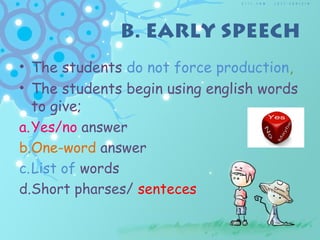
B. EARLY SPEECH
• The students do not force production,
• The students begin using english words
to give;
a.Yes/no answer
b.One-word answer
c.List of words
d.Short pharses/ senteces
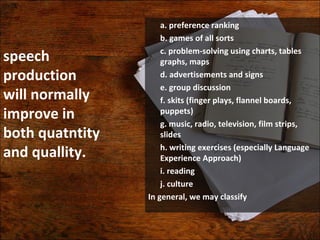
speech
production
will normally
improve in
both quatntity
and quallity.
a. preference ranking
b. games of all sorts
c. problem-solving using charts, tables
graphs, maps
d. advertisements and signs
e. group discussion
f. skits (finger plays, flannel boards,
puppets)
g. music, radio, television, film strips,
slides
h. writing exercises (especially Language
Experience Approach)
i. reading
j. culture
In general, we may classify
CONCLUTIONS
The natural approach belongs
to a traditional of language teaching
method based on observation and
interprestation of how learners acquire
both firts and second language in
nonformal setting. Such methods reject
the formal ( grammatical ) organization
of language as prerequisite to teaching.
Thanks you

The natural approach.pptmmmmm

  • 1.
  • 2.
    what is thenatural approach ? background
  • 3.
    In 1977, TracyTarrel a teacher Spanish in California outlined a proposal for a new philosophy of language teaching which he called the Natural Approach. He joined with Stephen Krashen an applied linguist at the University of Southern California, in elaborating a theoretical rationale for the NA, drawing on Krashen’s influential theory of second language acquisition. They were combined statement of the principles and practices of the NA appeared in their book The Natural Approach, in 1983.
  • 4.
  • 6.
    b. Particular emphasizs is laid on languageas a set of messages that can be understood Theory of language: a. The communica tive view of language is the view behind the
  • 7.
    THE NATURAL APPROACHIN THE CLASSROOM The Natural Approach is designed to develop basic communication skills. The development stages are : a.Comprehension (preproduction), b.Early Production, and c.Speech Emergence. This approach to teaching language has been proven to be particularly effective with limited English proficient students.
  • 8.
    A.PREPODUCTION In order to maximize opportunitiesfor comprehension experiences. natural approach intruction ; 1.create activities designed to teach student to recognize the meaning in words used in meanigful contexts, 2. teach students to guess at the meanig of phrases without knowing all of the words
  • 9.
    B. EARLY SPEECH •The students do not force production, • The students begin using english words to give; a.Yes/no answer b.One-word answer c.List of words d.Short pharses/ senteces
  • 10.
    speech production will normally improve in bothquatntity and quallity. a. preference ranking b. games of all sorts c. problem-solving using charts, tables graphs, maps d. advertisements and signs e. group discussion f. skits (finger plays, flannel boards, puppets) g. music, radio, television, film strips, slides h. writing exercises (especially Language Experience Approach) i. reading j. culture In general, we may classify
  • 11.
    CONCLUTIONS The natural approachbelongs to a traditional of language teaching method based on observation and interprestation of how learners acquire both firts and second language in nonformal setting. Such methods reject the formal ( grammatical ) organization of language as prerequisite to teaching.
  • 12.