Background
Tracy Dale Terrel
 Spanish Teacher in
California
 1977 “A proposal for a
‘new’
philosophy
of
languag
e
Natur
al
teaching called
the Approach”
 Attemp to incorporate the
‘naturalistic’
principles identified in L2
Acquisition
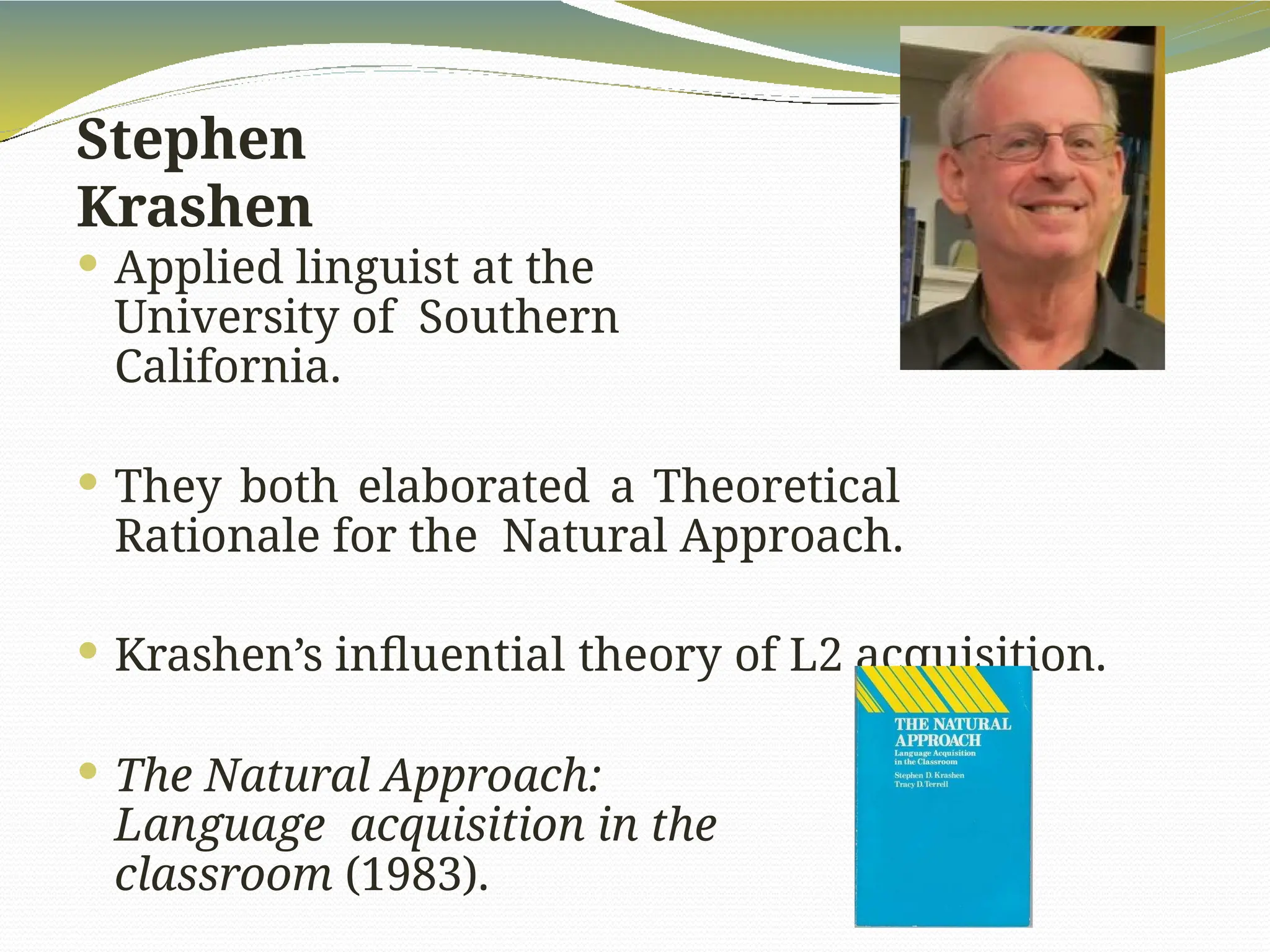
Stephen
Krashen
 Applied linguist at the
University of Southern
California.
 They both elaborated a Theoretical
Rationale for the Natural Approach.
 Krashen’s influential theory of L2 acquisition.
 The Natural Approach:
Language acquisition in the
classroom (1983).
 Natural Approach as a Traditional Approach
 “based on the use of languages in
communicative situations without recourse to the
native language”
 Therefore, with no reference to grammar
analysis, grammatical drilling, or to a particular
theory of grammar.
 “Such approaches have been
called natural, psychological,
phonetic, new, reform, direct,
analytic, imitative and so
forth”.
 Natural Approach ≠ Natural Method
 “Natural” in the Direct Method:
 Emphasized the principles of naturalistic language learning in
young children.
 Similarly, the Natural Approach is believed to conform to the
naturalistic principles found in succesful second language
acquisition.
 However, it places less emphasis on T monologues, direct
repetition, and formal questions and answers, and less focus
on accurate production of target language sentences..
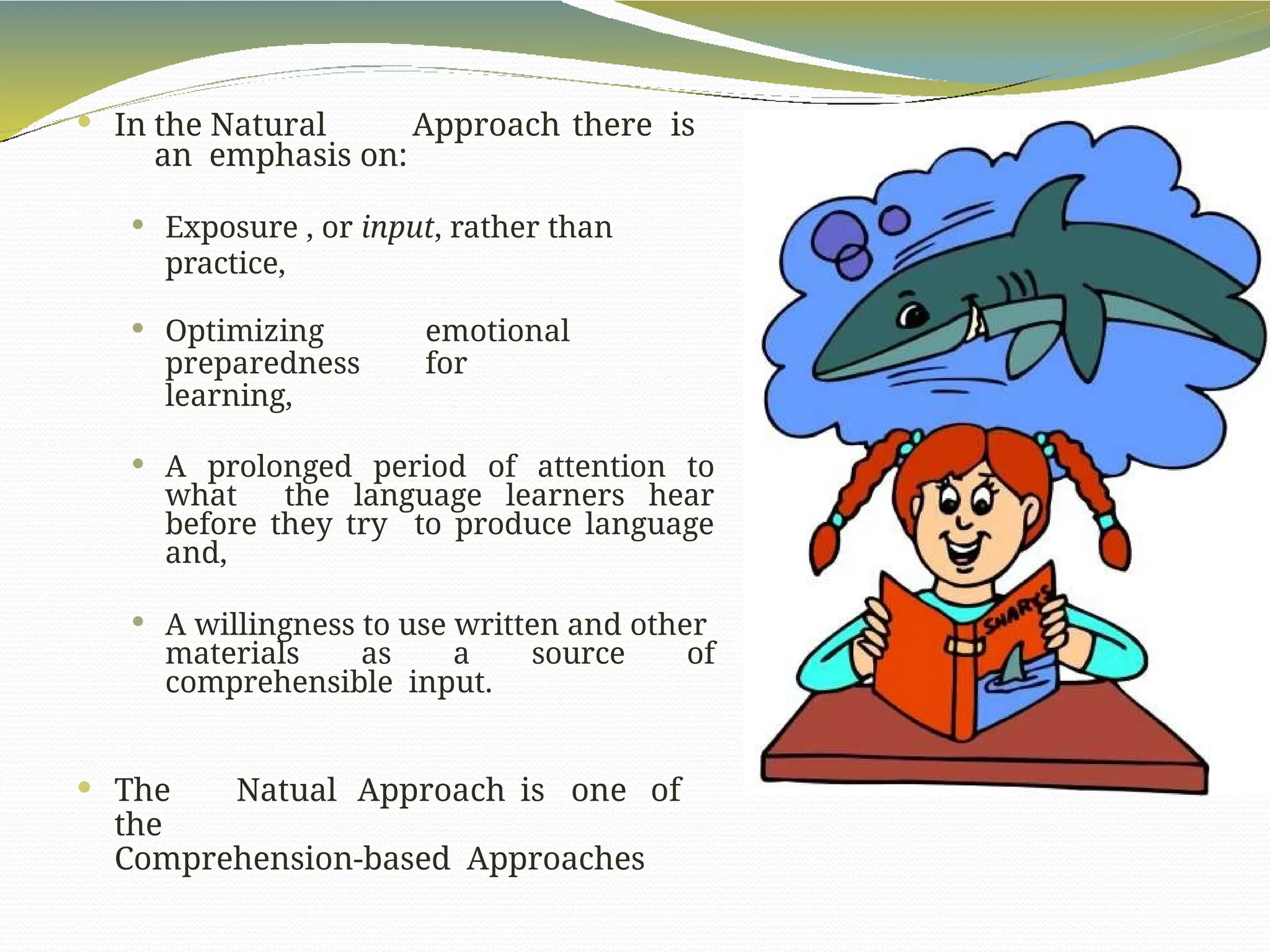
 In the Natural Approach there is
an emphasis on:
 Exposure , or input, rather than
practice,
 Optimizing emotional
preparedness for
learning,
 A prolonged period of attention to
what the language learners hear
before they try to produce language
and,
 A willingness to use written and other
materials as a source of
comprehensible input.
 The Natual Approach is one of
the
Comprehension-based Approaches
Approach
Theory of Language
 “The essenceof languages is
meaning. Vocabulary,
not grammar, is the heart of language.” (Brown,
2007)
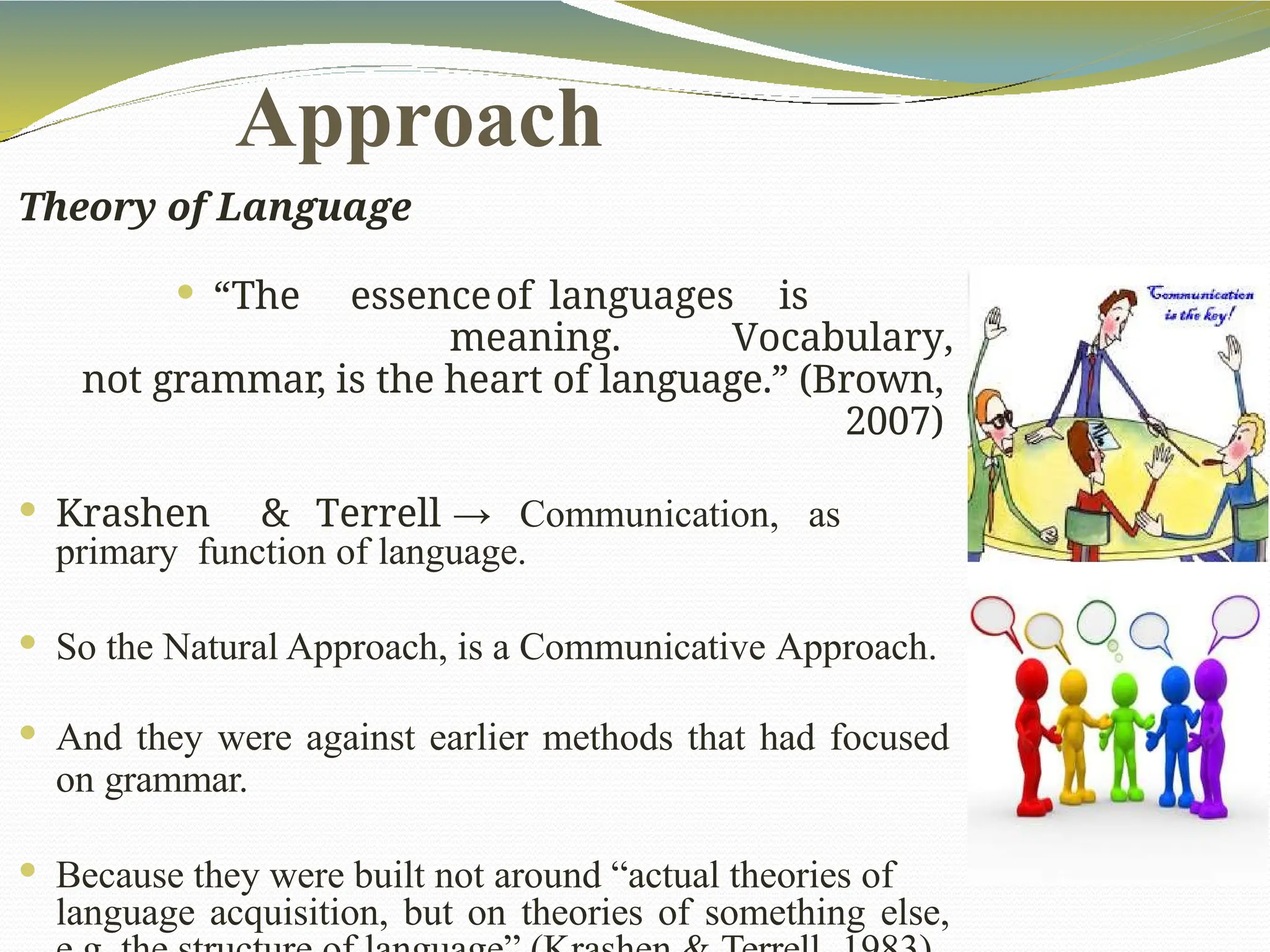
 Krashen & Terrell → Communication, as
primary function of language.
 So the Natural Approach, is a Communicative Approach.
 And they were against earlier methods that had focused
on grammar.
 Because they were built not around “actual theories of
language acquisition, but on theories of something else,
 CLT ≠ NA little attention to a Theory of Language.
 In a recent critic they are said not to have a theory of language.
 Their emphasis on vocabulary may suggest a view of
languages as its lexicon and the grammar the way to exploit it
to produce messages.
 The quantity of information in the lexicon far outweighs that in
any other part of the language, and if there is anything to the
notion of redundancy it should be easier to reconstruct a
message containing just words than one containing just the
syntactic relations. The significant fact is the subordinate role
of grammar. The most important thing is to get the words in.
(Bolinger, in Terrell, 1977)
 Language is a vehicle for communicating
meanings and messages.
 “Acquisition can take place only when people
understand messages in the target language”
(Krashen & Terrell, 1983)
 The NA assumes linguistic hierarchy of
structural complexity that on masters
through encounters with “input” containing
structures at the “I+1” level.
 Lexical items in messages are necessarily
grammatically structured, and more complex
messages involve more complex grammatical
structure.
 But there is no need for teachers, learners nor
language teaching materials to pay attention
to grammatical structures.
Theory of
Learning
 Krashen’s Language Acquisition Theory
 The NA “is based on an empirically grounded theory of second
language acquisition, which has been supported by a large
number of scientific studies in a wide variety of language
acquisition and learning contexts” (Krashen & Terrell, 1983).
The Acqusition/Learning Hypothesis
 Acquisition: The ‘natural’ unconscious process to
language proficiency through meaningful communication.
 Learning: Conscious process in which language rules are
developed through formal teaching and correction of errors.
 Therefore, Learning cannot lead to Acquisition.
The Monitor
Hypothesis
 Conscious learning can function only as a monitor or
editor
that checks and repairs the output of the acquired
system.
 Limits to success:
 Time. There must be sufficient time for a learner to
choose
and apply a learned rule.
 Focus on form. The language user must be focused on
correctness or on the form of the output.
 Knowledge of rules. The performer must know the rules.
The monitor does best with rules that are simple in two
ways. They must be simple [0 describe and they must not
require complex movements and rearrangements.
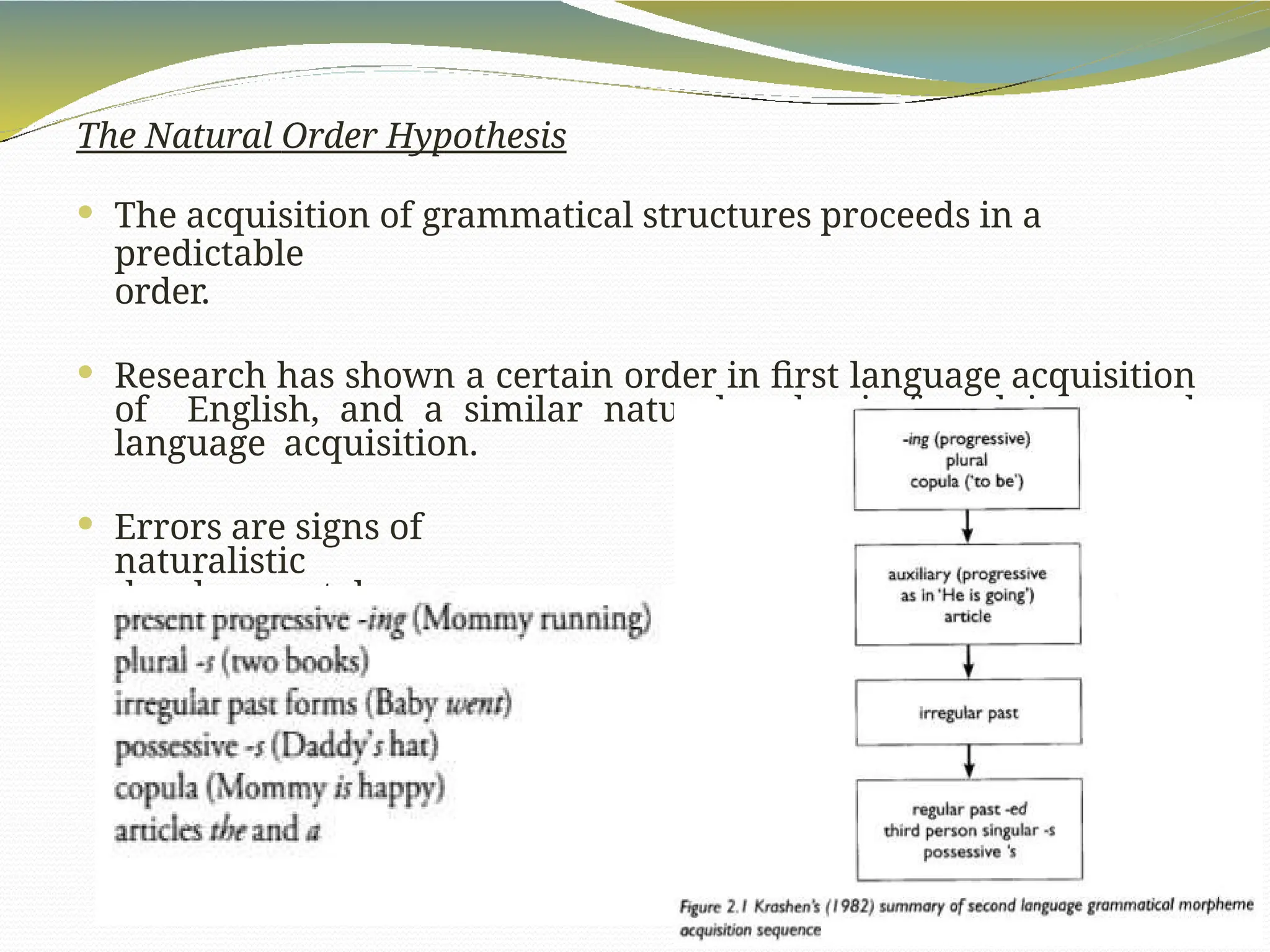
The Natural Order Hypothesis
 The acquisition of grammatical structures proceeds in a
predictable
order.
 Research has shown a certain order in first language acquisition
of English, and a similar natural order is found in second
language acquisition.
 Errors are signs of
naturalistic
developmental processes.
The Input
Hypothesis
 It explains the relationship between what the learner is exposed
to of a
language (the input) and language acquisition.
 The hypothesis relates to acquisition, and not to learning.
 People acquire language best by understanding input that is slightly
beyond their current level of competence “by understanding language
containing I + 1” (Krashen & Terrell, 1983).
 Clues based on the situation and the context, extralinguistic in formation, and
knowledge of the world make comprehension possible.
 The ability to speak fluently cannot be taught directly; it "emerges"
independently in time, after the acquirer has built up linguistic
competence by understanding input.
 If there is a sufficient quantity of comprehensible input, I+1 will usually
be provided automatically. Comprehensible input refers to utterances
that the learner understands based on the context in which they are
used.
 Input need not to be tuned to a learner’s current level of linguistic
competence and in fact cannot be so finely tuned in a language class,
where learners will be at many different levels of competence.
The Affective Filter
Hypothesis
 Krashen sees the learner's emotional state or attitudes as an adjustable
filter that freely passes, impedes, or blocks input necessary to
acquisition.
 Motivation. Learners with high motivation generally do better.
 Self-confidence. Learners with self-confidence and a good self-image
tend to be more successful.
 Anxiety. Low personal anxiety and low classroom anxiety
are more
conducive to second language acquisition.
 Acquirers with a low affective filter seek and receive more input,
interact with confidence, and are more receptive to the input they
receive.
 The affective filter is said to rise in early adolescence, and this may
account for
children's apparent superiority to older acquirers of a second
language.
Implications of these
hypotheses
as possible must
he
 As much comprehensible
input presented.
 Whatever helps comprehension is important. Visual
aids are useful, as is exposure to a wide range of
vocabulary rather than study of syntactic structure.
 The focus in the classroom should be on listening
and reading; speaking should be allowed to
"emerge.“

 In order to lower the affective filter, student work
should center on meaningful communication rather
than on form; input should be interesting and so
contribute to a relaxed classroom atmosphere.
Design
Objective
s
 The Natural Approach "is for beginners and is designed to help them
become intermediates“ in communicative skills.
 Specific objectives depend upon learner needs and the skill (reading,
writing,
listening, or speaking) and level being taught.
 Krashen and Terrell feel it is important to communicate to learners what
they can expect of a course as well as what they should not expect.
 “After 100-150 hours of Natural Approach Spanish, you will be able to: "get
around" in Spanish; you will be able to communicate with a monolingual
native speaker of Spanish without difficulty; read most ordinary texts in
Spanish with some use of a dictionary; know enough Spanish to continue to
improve on your own.

After 100- 150 hours of Natural Approach Spanish you will not be able to: pass
for a native speaker, use Spanish as easily as you use English, understand
native speakers when they talk to each other; use Spanish on the telephone
with great comfort; participate easily in a conversation with several other
native speakers on unfamiliar topics.” (Krashen & Terrell, 1983)
 “The purpose of a language course will vary according to
the needs of the students and their particular interests“
(Krashen & Terrell, 1983)
 “We do not expect the students at the end of a particular
course to have acquired a certain group of structures or
forms. Instead we expect them to deal with a particular
set of topics in a given situation.”
 It is difficult to specify communicative goals that
necessarily fit the needs of all students.
 Any list of topics and situations must be understood as
syllabus suggestions rather than as specifications.
 Input is provided "over a wider variety of topics
while pursuing communicative goals, the
necessary grammatical structures are
automatically provided in the input”
 Krashen & Terrell,
1983
Types of Learning and Teaching Activities
 “Activities allowing comprehensible input, about
things in the here-and-now. Focus on meaning,
not form” (Brown, 2007).
 From the beginning, emphasis is on presenting
comprehensible input in the target language.
 E.g. objects in the classroom and the content of
pictures.
 Learners are not required to speak until they feel
ready, but they are expected to respond to
teacher commands and questions in other ways.
 The teacher talks slowly and distinctly,
asking questions and eliciting one-word
answers.
Those
rathe
r
that focus
on than
languag
e
 "Acquisition activities"
→ meaningful
communication form.
 Pair or group work may be employed,followed
by whole-class discussion led by the teacher.
 Techniques recommended by Krashen and Terrell
are often borrowed from other methods and
adapted to meet the requirements of Natural
Approach theory.
 Total Physical Response, command-based activities
 Direct Method, activities in which mime, gesture,
and context are used to elicit questions and
answers; and even situation-based practice of
structures and patterns.
 Communicative Language Teaching, Group-work
activities
Learning Roles
 “They should not try to learn the usual sense, but
should try to lose themselves in activities
involving meaningful communication” (Brown,
2007).
 The language acquirer is seen as a processor of
comprehensible input.
 Learners' roles are seen to change according to
their stage of linguistic development.
 Pre-Production Stage: Students "participate in the
language activity without having to respond in the
target language" (Krashen and Terrell 1983: 76). (e.g.
they can act out physical commands, point to
pictures, and so forth.)
 Early-Production Stage, students respond to either-
or questions, use single words and short phrases, fill
in charts, and use fixed conversational patterns (e.g.,
How are you? What's your name?).
 Speech-Emergent Phase, students involve
themselves in role play and games, contribute
personal information and opinions, and participate
in group problem solving.
Learners’ Four Responsibilities
 Provide information about their specific goals so that
acquisition activities can focus on the topics and
situations most relevant to their needs.
 Take an active role in ensuring comprehensible input.
They should learn and use conversational management
techniques to regulate input.
 Decide when to start producing speech and when to
upgrade it.
 Where learning exercises (i.e. grammar study) are to be a
part of the program, decide with the teacher the relative
amount of time to be devoted to them and perhaps even
complete and correct them independently.
Teacher Roles
 “The teacher is the primary source of comprehensible
input. Must create positive low-anxiety climate. Must
choose and orchestrate a rich mixture of classroom
activities” (Brown, 2007).
 Source: The teacher is the generator of a constant flow of
language input.
 Environmenter: The teacher creates a classroom
atmosphere that is interesting, friendly, and in which
there is a low affective filter for learning.
 Director: The teacher is seen as responsible for collecting
materials and designing their use, based not just on
teacher perceptions but on elicited student needs and
interests.
The Role of Instructional Material
 “Materials come from realia rather than from
textbooks. Primary aim is to promote
comprehension and communication” (Brown,
2007).
 They make classroom activities as
meaningful as possible by supplying "the
extra- linguistic context that helps the
acquirer to understand and thereby to
acquire“
 Pictures and other visual aids facilitate the
acquisition of a large vocabulary within the
 Recommended materials include schedules,
brochures, advertisements, maps, and graded
books.
 Games, in general, are seen as useful
classroom materials since …
 "games by their very nature, focus the student on
what it is they are doing and use the language as a
tool for reaching the goal rather than as a goal in
itself “.
Conclusions
 The Natural Approach belongs to a tradition of
language teaching methods based on observation
and interpretation of how learners acquire both first
and second languages in non formal settings.
 Such methods reject the formal
(grammatical)
organization of language as a prerequisite to
teaching.
 A focus on comprehension and meaningful
communication as well as the provision of the right
kinds of comprehensible input provide the
necessary and sufficient conditions for successful
classroom second and foreign language acquisition.
 The Natural Approach is hence evolutionary
rather than revolutionary in its procedures.
 Its greatest claim to originality lies in its use as a
method that emphasizes comprehensible and
meaningful practice activities, rather than
production of grammatically perfect utterances
and sentences.

Natural approach in the english class for students

  • 2.
    Background Tracy Dale Terrel Spanish Teacher in California  1977 “A proposal for a ‘new’ philosophy of languag e Natur al teaching called the Approach”  Attemp to incorporate the ‘naturalistic’ principles identified in L2 Acquisition
  • 3.
    Stephen Krashen  Applied linguistat the University of Southern California.  They both elaborated a Theoretical Rationale for the Natural Approach.  Krashen’s influential theory of L2 acquisition.  The Natural Approach: Language acquisition in the classroom (1983).
  • 4.
     Natural Approachas a Traditional Approach  “based on the use of languages in communicative situations without recourse to the native language”  Therefore, with no reference to grammar analysis, grammatical drilling, or to a particular theory of grammar.  “Such approaches have been called natural, psychological, phonetic, new, reform, direct, analytic, imitative and so forth”.
  • 5.
     Natural Approach≠ Natural Method  “Natural” in the Direct Method:  Emphasized the principles of naturalistic language learning in young children.  Similarly, the Natural Approach is believed to conform to the naturalistic principles found in succesful second language acquisition.  However, it places less emphasis on T monologues, direct repetition, and formal questions and answers, and less focus on accurate production of target language sentences..
  • 6.
     In theNatural Approach there is an emphasis on:  Exposure , or input, rather than practice,  Optimizing emotional preparedness for learning,  A prolonged period of attention to what the language learners hear before they try to produce language and,  A willingness to use written and other materials as a source of comprehensible input.  The Natual Approach is one of the Comprehension-based Approaches
  • 7.
    Approach Theory of Language “The essenceof languages is meaning. Vocabulary, not grammar, is the heart of language.” (Brown, 2007)  Krashen & Terrell → Communication, as primary function of language.  So the Natural Approach, is a Communicative Approach.  And they were against earlier methods that had focused on grammar.  Because they were built not around “actual theories of language acquisition, but on theories of something else,
  • 8.
     CLT ≠NA little attention to a Theory of Language.  In a recent critic they are said not to have a theory of language.  Their emphasis on vocabulary may suggest a view of languages as its lexicon and the grammar the way to exploit it to produce messages.  The quantity of information in the lexicon far outweighs that in any other part of the language, and if there is anything to the notion of redundancy it should be easier to reconstruct a message containing just words than one containing just the syntactic relations. The significant fact is the subordinate role of grammar. The most important thing is to get the words in. (Bolinger, in Terrell, 1977)
  • 9.
     Language isa vehicle for communicating meanings and messages.  “Acquisition can take place only when people understand messages in the target language” (Krashen & Terrell, 1983)  The NA assumes linguistic hierarchy of structural complexity that on masters through encounters with “input” containing structures at the “I+1” level.  Lexical items in messages are necessarily grammatically structured, and more complex messages involve more complex grammatical structure.  But there is no need for teachers, learners nor language teaching materials to pay attention to grammatical structures.
  • 10.
    Theory of Learning  Krashen’sLanguage Acquisition Theory  The NA “is based on an empirically grounded theory of second language acquisition, which has been supported by a large number of scientific studies in a wide variety of language acquisition and learning contexts” (Krashen & Terrell, 1983). The Acqusition/Learning Hypothesis  Acquisition: The ‘natural’ unconscious process to language proficiency through meaningful communication.  Learning: Conscious process in which language rules are developed through formal teaching and correction of errors.  Therefore, Learning cannot lead to Acquisition.
  • 11.
    The Monitor Hypothesis  Consciouslearning can function only as a monitor or editor that checks and repairs the output of the acquired system.  Limits to success:  Time. There must be sufficient time for a learner to choose and apply a learned rule.  Focus on form. The language user must be focused on correctness or on the form of the output.  Knowledge of rules. The performer must know the rules. The monitor does best with rules that are simple in two ways. They must be simple [0 describe and they must not require complex movements and rearrangements.
  • 12.
    The Natural OrderHypothesis  The acquisition of grammatical structures proceeds in a predictable order.  Research has shown a certain order in first language acquisition of English, and a similar natural order is found in second language acquisition.  Errors are signs of naturalistic developmental processes.
  • 13.
    The Input Hypothesis  Itexplains the relationship between what the learner is exposed to of a language (the input) and language acquisition.  The hypothesis relates to acquisition, and not to learning.  People acquire language best by understanding input that is slightly beyond their current level of competence “by understanding language containing I + 1” (Krashen & Terrell, 1983).  Clues based on the situation and the context, extralinguistic in formation, and knowledge of the world make comprehension possible.  The ability to speak fluently cannot be taught directly; it "emerges" independently in time, after the acquirer has built up linguistic competence by understanding input.  If there is a sufficient quantity of comprehensible input, I+1 will usually be provided automatically. Comprehensible input refers to utterances that the learner understands based on the context in which they are used.  Input need not to be tuned to a learner’s current level of linguistic competence and in fact cannot be so finely tuned in a language class, where learners will be at many different levels of competence.
  • 14.
    The Affective Filter Hypothesis Krashen sees the learner's emotional state or attitudes as an adjustable filter that freely passes, impedes, or blocks input necessary to acquisition.  Motivation. Learners with high motivation generally do better.  Self-confidence. Learners with self-confidence and a good self-image tend to be more successful.  Anxiety. Low personal anxiety and low classroom anxiety are more conducive to second language acquisition.  Acquirers with a low affective filter seek and receive more input, interact with confidence, and are more receptive to the input they receive.  The affective filter is said to rise in early adolescence, and this may account for children's apparent superiority to older acquirers of a second language.
  • 15.
    Implications of these hypotheses aspossible must he  As much comprehensible input presented.  Whatever helps comprehension is important. Visual aids are useful, as is exposure to a wide range of vocabulary rather than study of syntactic structure.  The focus in the classroom should be on listening and reading; speaking should be allowed to "emerge.“   In order to lower the affective filter, student work should center on meaningful communication rather than on form; input should be interesting and so contribute to a relaxed classroom atmosphere.
  • 16.
    Design Objective s  The NaturalApproach "is for beginners and is designed to help them become intermediates“ in communicative skills.  Specific objectives depend upon learner needs and the skill (reading, writing, listening, or speaking) and level being taught.  Krashen and Terrell feel it is important to communicate to learners what they can expect of a course as well as what they should not expect.  “After 100-150 hours of Natural Approach Spanish, you will be able to: "get around" in Spanish; you will be able to communicate with a monolingual native speaker of Spanish without difficulty; read most ordinary texts in Spanish with some use of a dictionary; know enough Spanish to continue to improve on your own.  After 100- 150 hours of Natural Approach Spanish you will not be able to: pass for a native speaker, use Spanish as easily as you use English, understand native speakers when they talk to each other; use Spanish on the telephone with great comfort; participate easily in a conversation with several other native speakers on unfamiliar topics.” (Krashen & Terrell, 1983)
  • 17.
     “The purposeof a language course will vary according to the needs of the students and their particular interests“ (Krashen & Terrell, 1983)  “We do not expect the students at the end of a particular course to have acquired a certain group of structures or forms. Instead we expect them to deal with a particular set of topics in a given situation.”  It is difficult to specify communicative goals that necessarily fit the needs of all students.  Any list of topics and situations must be understood as syllabus suggestions rather than as specifications.
  • 18.
     Input isprovided "over a wider variety of topics while pursuing communicative goals, the necessary grammatical structures are automatically provided in the input”  Krashen & Terrell, 1983
  • 19.
    Types of Learningand Teaching Activities  “Activities allowing comprehensible input, about things in the here-and-now. Focus on meaning, not form” (Brown, 2007).  From the beginning, emphasis is on presenting comprehensible input in the target language.  E.g. objects in the classroom and the content of pictures.  Learners are not required to speak until they feel ready, but they are expected to respond to teacher commands and questions in other ways.
  • 20.
     The teachertalks slowly and distinctly, asking questions and eliciting one-word answers. Those rathe r that focus on than languag e  "Acquisition activities" → meaningful communication form.  Pair or group work may be employed,followed by whole-class discussion led by the teacher.
  • 21.
     Techniques recommendedby Krashen and Terrell are often borrowed from other methods and adapted to meet the requirements of Natural Approach theory.  Total Physical Response, command-based activities  Direct Method, activities in which mime, gesture, and context are used to elicit questions and answers; and even situation-based practice of structures and patterns.  Communicative Language Teaching, Group-work activities
  • 22.
    Learning Roles  “Theyshould not try to learn the usual sense, but should try to lose themselves in activities involving meaningful communication” (Brown, 2007).  The language acquirer is seen as a processor of comprehensible input.  Learners' roles are seen to change according to their stage of linguistic development.
  • 23.
     Pre-Production Stage:Students "participate in the language activity without having to respond in the target language" (Krashen and Terrell 1983: 76). (e.g. they can act out physical commands, point to pictures, and so forth.)  Early-Production Stage, students respond to either- or questions, use single words and short phrases, fill in charts, and use fixed conversational patterns (e.g., How are you? What's your name?).  Speech-Emergent Phase, students involve themselves in role play and games, contribute personal information and opinions, and participate in group problem solving.
  • 24.
    Learners’ Four Responsibilities Provide information about their specific goals so that acquisition activities can focus on the topics and situations most relevant to their needs.  Take an active role in ensuring comprehensible input. They should learn and use conversational management techniques to regulate input.  Decide when to start producing speech and when to upgrade it.  Where learning exercises (i.e. grammar study) are to be a part of the program, decide with the teacher the relative amount of time to be devoted to them and perhaps even complete and correct them independently.
  • 25.
    Teacher Roles  “Theteacher is the primary source of comprehensible input. Must create positive low-anxiety climate. Must choose and orchestrate a rich mixture of classroom activities” (Brown, 2007).  Source: The teacher is the generator of a constant flow of language input.  Environmenter: The teacher creates a classroom atmosphere that is interesting, friendly, and in which there is a low affective filter for learning.  Director: The teacher is seen as responsible for collecting materials and designing their use, based not just on teacher perceptions but on elicited student needs and interests.
  • 26.
    The Role ofInstructional Material  “Materials come from realia rather than from textbooks. Primary aim is to promote comprehension and communication” (Brown, 2007).  They make classroom activities as meaningful as possible by supplying "the extra- linguistic context that helps the acquirer to understand and thereby to acquire“  Pictures and other visual aids facilitate the acquisition of a large vocabulary within the
  • 27.
     Recommended materialsinclude schedules, brochures, advertisements, maps, and graded books.  Games, in general, are seen as useful classroom materials since …  "games by their very nature, focus the student on what it is they are doing and use the language as a tool for reaching the goal rather than as a goal in itself “.
  • 28.
    Conclusions  The NaturalApproach belongs to a tradition of language teaching methods based on observation and interpretation of how learners acquire both first and second languages in non formal settings.  Such methods reject the formal (grammatical) organization of language as a prerequisite to teaching.  A focus on comprehension and meaningful communication as well as the provision of the right kinds of comprehensible input provide the necessary and sufficient conditions for successful classroom second and foreign language acquisition.
  • 29.
     The NaturalApproach is hence evolutionary rather than revolutionary in its procedures.  Its greatest claim to originality lies in its use as a method that emphasizes comprehensible and meaningful practice activities, rather than production of grammatically perfect utterances and sentences.