University of IBN-ZOHR
FLSH
MA TEFL&ICT

Introduction to Media

Presented by: Younes TAIA

Based on: Chapter 6, A survey of the
interpersonal Rhetoric ‘Wilde, The Importance
of being Earnest, Act III
•
•
•
•
•
•

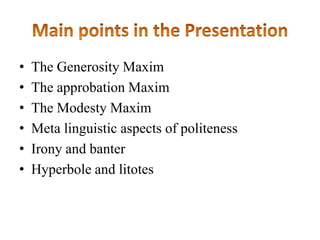
The Generosity Maxim
The approbation Maxim
The Modesty Maxim
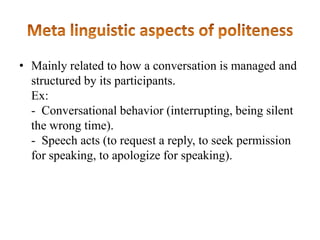
Meta linguistic aspects of politeness
Irony and banter
Hyperbole and litotes
It states: 'Minimize the expression of
beliefs which imply cost to other; maximize
the expression of beliefs which imply benefit
to other.' The first part of this maxim refers to
negative politeness strategy of minimizing the
imposition, and the second part reflects the
positive politeness strategy of attending to the
hearer's interests, wants, and needs.
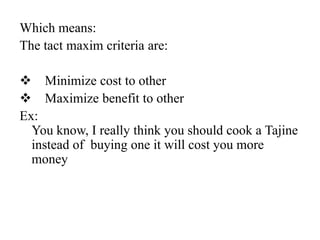
Which means:
The tact maxim criteria are:

 Minimize cost to other
 Maximize benefit to other
Ex:
You know, I really think you should cook a Tajine
instead of buying one it will cost you more
money
It Concerns a relationship between two
participants namely “self” and “other”, and
sometimes a third part (bystanders, or those
who belong to “self” or “other”.
• Minimize benefit to self: Maximize cost to self
also called the “self-centered” maxim.
Ex:

[1]ƚ You can lend me your car.(impolite) ƚ
[2] I can lend you my car.
[3] You must come and have dinner with us.
[4] We must come and have dinner with
you.(impolite) ƚ
The expressions [2] and [3] are assumed to be
polite, as they imply benefit to “Other” and
Cost to “self”. While in [1] and [4] both scales
are reversed.

Note: we are still concerned with absolute politeness
• In some of the cases (similar to the previous Examples), only
the Tact maxims seem to be relevant.
Ex:
“You can cook omelets in less than half the time you would
spend cooking Tajine”
Benefit to “other”, does not imply any cost to “self”.
• While, in other cases, the Generosity maxim appear to apply
without the Tact maxim.
Ex:
could I have some more Tea? Marginally still greater
politeness is achieved if reference is omitted to „self‟ as
beneficiary: Is there some more Tea?
• Minimize dispraise of “other”; maximize praise of
“other”. Also called the “flattery maxim”
• This maxim avoid uttering unpleasant things
especially about “other”.
Ex:
What a marvelous omelets you cooked!
Is a highly valued expression in the Approbation
Maxim.
Similarly, in this Example, it is acceptably polite to
say, (referring to the performance in my presentation)
•
Classmate 1: His Performance was outstanding!
•
Classmate 2: Yes, wasn‟t it!
But suppose classmate 2 is the performer:
•
Classmate 1: Your performance was outstanding!
•
Classmate 2: Yes, wasn‟t it!
In this case, Classmate 2 falls foul in the Modesty Maxim, to
which I shall turn in the next Section.
Bearing in mind that dispraise of “other” is impolite in the
approbation maxim, it would be understandable that there are
various strategies of indirectness in order to mitigate the effect
of criticism.
Ex:
•
Classmate 1: His Performance was magnificent, wasn‟t it!
•
Classmate 2: Was it?
supposing both 1 and 2 listened to the performance, 2‟s reply is
evasive and implicates an unfavorable opinion. Because if 2
agrees with 1, s/he would (by the PP) have done so.
In this case “Classmates 2” violates the CP (maxim of
Quantity), similarly to the Example given by Grice, and which
was shown in the first presentation in Class.

 Younes is writing a testmonial about X who is a condidate for
a philosophy job:
«Dear sir! Mr Mohamed’s command of English is good,and his
attendance at tutorials has been regular »
 Younes violates the maxim of quantity ( he chooses not to be
well informative)
• Minimize praise of Self; Maximize dispraise of Self.
Ex:
1. A) They were so kind to us.
B) Yes, they were, weren‟t they.
As the Example shows, it is common to agree with another‟s
commendation except when it is a commendation on oneself.
2. Please accept this small gift as a token of our esteem.
Please accept this large gift as a token of our esteem.
As the Example shows, the understatement of one‟s generosity is
shown to be quite normal and conventional, yet the
exaggeration breaks the first sub maxim of Modesty which is
to commit the social transgression of boasting.
The Modesty Maxim might be more powerful in
some societies than others.
Ex:
Japan VS Morocco
 Maxim of agreement: when there is a tendency to exaggerate
agreement with people, and to mitigate disagreement by
expressing regret, partial agreement.
Ex: A) This Chapter is Difficult to explain
B) True, but the language is simple.
 Maxim of Sympathy: when we use expression that allow us to
assume whether an event is a fortunate or unfortunate.
Ex: A) I’m sorry to hear about your Professors.
B) I’m delighted to hear about your classmates.
• Mainly related to how a conversation is managed and
structured by its participants.
Ex:
- Conversational behavior (interrupting, being silent
the wrong time).
- Speech acts (to request a reply, to seek permission
for speaking, to apologize for speaking).
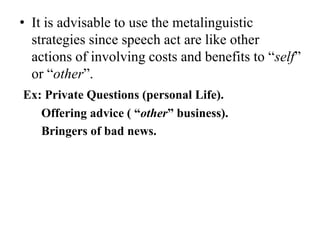
• It is advisable to use the metalinguistic
strategies since speech act are like other
actions of involving costs and benefits to “self”
or “other”.
Ex: Private Questions (personal Life).
Offering advice ( “other” business).
Bringers of bad news.
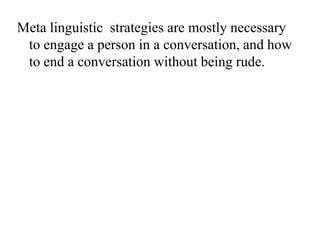
Meta linguistic strategies are mostly necessary
to engage a person in a conversation, and how
to end a conversation without being rude.
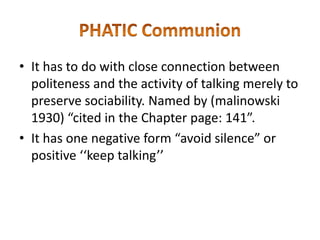
• It has to do with close connection between
politeness and the activity of talking merely to
preserve sociability. Named by (malinowski
1930) “cited in the Chapter page: 141”.
• It has one negative form “avoid silence” or
positive ‘‘keep talking’’
• It takes its place along side the CP and the PP in the
interpersonal rhetoric. However it is different in that
its function can only be explained in terms of other
principles, it is a “second-order principle” which
enables speaker to be impolite while seeming to be
polite.
• If the PP promotes a bias toward Comity instead of
conflict in social relations, the IP promotes the
“antisocial” use of language.
Ex:
• That’s all I wanted!
As we say in Darija: Hadchi li bqa lia
• With friends like you, who needs enemies!
The falseness of these statement will be clear by
a contradictory tone of utterances.
• The ironic force of a remark is often signaled
by exaggeration or understatement, which
makes it difficult for “other” to interpret the
remark at its face value.
Banter Principle is a minor importance of other
principles. (rhetorical principles)
It‟s manifested in a great deal of casual linguistic
game.
Ex:
Here Comes Your trouble making questions!
What a mean Question!
• They refers to two ways of violating the CP;
the hyperbole (overstatement): it refer to a
case where the speaker‟s description is
stronger than is warranted by the state of
affairs described.
Ex: it made my blood boil
Or as we say in Darija: Glab lia Rassi
Violation to the Maxim of Quality.
Litotes (understatement): it refers to the
opposite of Hyperbole.
Ex: I wasn’t born yesterday.
Violation to the Maxim of Quantity
• There is a natural preference for overstating
polite beliefs,
Ex: That was a great question.
• And for understanding impolite ones,
Ex: I wasn‟t over impressed by her speech
The understanding of praise will normally be
directed toward “self” rather than “other”.
Another Ex:
A) That wasn‟t such a bad presentation I performed.
B) That wasn‟t such a bad presentation you performed.
in (A) it is relatively acceptable to say it‟s a “selfcongratulation, while in (B) is a rude and impolite
compliment to a classmates on his performance.
NB: not all cases of hyperbole and litotes can be
explained by reference to their role in
enhancing politeness. There is frequency of
overstatement in conversations, especially in
idiomatic expressions;
Ex:
 you were all Ears!
 I have been working my fingers to the bone to
finish this presentation!
At risk of proliferating too many pragmatic
principles, an Interest Principle must be
considered, which enables a conversation to be
interesting in the sense of having
unpredictability or news value. An example
would be the temptation we feel when retelling
a personal anecdote, we tend to make various
kinds of elaboration and exaggeration just to
arouse the attention of the others.
However, if this interest principle is
used constantly by a person, the addressee tend
to adjust his interpretation so that they lose
their interest value and become predictable.
Once the interest principle is minimized in a
conversation by a person who use it frequently,
credit to what is being said it regained.
To explain more the motivation for litotes
(understatement), psychologists acknowledged
what they called “ pollyanna Hypothesis”.
This states that people prefer talking about
positive things in their conversations, which
seems not to be always a good thing as it allows
“euphemism”; when a person disguise unpleasant
subjects by referring to them through means of
inoffensive expressions.
Ex:
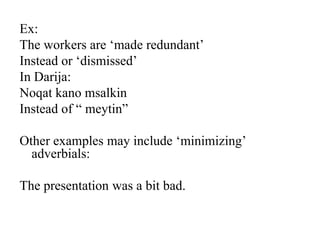
The workers are „made redundant‟
Instead or „dismissed‟
In Darija:
Noqat kano msalkin
Instead of “ meytin”
Other examples may include „minimizing‟
adverbials:
The presentation was a bit bad.
The interpersonal rhetoric

The interpersonal rhetoric

  • 1.
    University of IBN-ZOHR FLSH MATEFL&ICT Introduction to Media Presented by: Younes TAIA Based on: Chapter 6, A survey of the interpersonal Rhetoric ‘Wilde, The Importance of being Earnest, Act III
  • 2.
    • • • • • • The Generosity Maxim Theapprobation Maxim The Modesty Maxim Meta linguistic aspects of politeness Irony and banter Hyperbole and litotes
  • 3.
    It states: 'Minimizethe expression of beliefs which imply cost to other; maximize the expression of beliefs which imply benefit to other.' The first part of this maxim refers to negative politeness strategy of minimizing the imposition, and the second part reflects the positive politeness strategy of attending to the hearer's interests, wants, and needs.
  • 4.
    Which means: The tactmaxim criteria are:  Minimize cost to other  Maximize benefit to other Ex: You know, I really think you should cook a Tajine instead of buying one it will cost you more money
  • 5.
    It Concerns arelationship between two participants namely “self” and “other”, and sometimes a third part (bystanders, or those who belong to “self” or “other”.
  • 6.
    • Minimize benefitto self: Maximize cost to self also called the “self-centered” maxim. Ex: [1]ƚ You can lend me your car.(impolite) ƚ [2] I can lend you my car. [3] You must come and have dinner with us. [4] We must come and have dinner with you.(impolite) ƚ
  • 7.
    The expressions [2]and [3] are assumed to be polite, as they imply benefit to “Other” and Cost to “self”. While in [1] and [4] both scales are reversed. Note: we are still concerned with absolute politeness
  • 8.
    • In someof the cases (similar to the previous Examples), only the Tact maxims seem to be relevant. Ex: “You can cook omelets in less than half the time you would spend cooking Tajine” Benefit to “other”, does not imply any cost to “self”. • While, in other cases, the Generosity maxim appear to apply without the Tact maxim. Ex: could I have some more Tea? Marginally still greater politeness is achieved if reference is omitted to „self‟ as beneficiary: Is there some more Tea?
  • 9.
    • Minimize dispraiseof “other”; maximize praise of “other”. Also called the “flattery maxim” • This maxim avoid uttering unpleasant things especially about “other”. Ex: What a marvelous omelets you cooked! Is a highly valued expression in the Approbation Maxim.
  • 10.
    Similarly, in thisExample, it is acceptably polite to say, (referring to the performance in my presentation) • Classmate 1: His Performance was outstanding! • Classmate 2: Yes, wasn‟t it! But suppose classmate 2 is the performer: • Classmate 1: Your performance was outstanding! • Classmate 2: Yes, wasn‟t it! In this case, Classmate 2 falls foul in the Modesty Maxim, to which I shall turn in the next Section.
  • 11.
    Bearing in mindthat dispraise of “other” is impolite in the approbation maxim, it would be understandable that there are various strategies of indirectness in order to mitigate the effect of criticism. Ex: • Classmate 1: His Performance was magnificent, wasn‟t it! • Classmate 2: Was it? supposing both 1 and 2 listened to the performance, 2‟s reply is evasive and implicates an unfavorable opinion. Because if 2 agrees with 1, s/he would (by the PP) have done so.
  • 12.
    In this case“Classmates 2” violates the CP (maxim of Quantity), similarly to the Example given by Grice, and which was shown in the first presentation in Class.  Younes is writing a testmonial about X who is a condidate for a philosophy job: «Dear sir! Mr Mohamed’s command of English is good,and his attendance at tutorials has been regular »  Younes violates the maxim of quantity ( he chooses not to be well informative)
  • 13.
    • Minimize praiseof Self; Maximize dispraise of Self. Ex: 1. A) They were so kind to us. B) Yes, they were, weren‟t they. As the Example shows, it is common to agree with another‟s commendation except when it is a commendation on oneself. 2. Please accept this small gift as a token of our esteem. Please accept this large gift as a token of our esteem. As the Example shows, the understatement of one‟s generosity is shown to be quite normal and conventional, yet the exaggeration breaks the first sub maxim of Modesty which is to commit the social transgression of boasting.
  • 14.
    The Modesty Maximmight be more powerful in some societies than others. Ex: Japan VS Morocco
  • 15.
     Maxim ofagreement: when there is a tendency to exaggerate agreement with people, and to mitigate disagreement by expressing regret, partial agreement. Ex: A) This Chapter is Difficult to explain B) True, but the language is simple.  Maxim of Sympathy: when we use expression that allow us to assume whether an event is a fortunate or unfortunate. Ex: A) I’m sorry to hear about your Professors. B) I’m delighted to hear about your classmates.
  • 16.
    • Mainly relatedto how a conversation is managed and structured by its participants. Ex: - Conversational behavior (interrupting, being silent the wrong time). - Speech acts (to request a reply, to seek permission for speaking, to apologize for speaking).
  • 17.
    • It isadvisable to use the metalinguistic strategies since speech act are like other actions of involving costs and benefits to “self” or “other”. Ex: Private Questions (personal Life). Offering advice ( “other” business). Bringers of bad news.
  • 18.
    Meta linguistic strategiesare mostly necessary to engage a person in a conversation, and how to end a conversation without being rude.
  • 19.
    • It hasto do with close connection between politeness and the activity of talking merely to preserve sociability. Named by (malinowski 1930) “cited in the Chapter page: 141”. • It has one negative form “avoid silence” or positive ‘‘keep talking’’
  • 20.
    • It takesits place along side the CP and the PP in the interpersonal rhetoric. However it is different in that its function can only be explained in terms of other principles, it is a “second-order principle” which enables speaker to be impolite while seeming to be polite. • If the PP promotes a bias toward Comity instead of conflict in social relations, the IP promotes the “antisocial” use of language.
  • 21.
    Ex: • That’s allI wanted! As we say in Darija: Hadchi li bqa lia • With friends like you, who needs enemies! The falseness of these statement will be clear by a contradictory tone of utterances.
  • 22.
    • The ironicforce of a remark is often signaled by exaggeration or understatement, which makes it difficult for “other” to interpret the remark at its face value.
  • 23.
    Banter Principle isa minor importance of other principles. (rhetorical principles) It‟s manifested in a great deal of casual linguistic game. Ex: Here Comes Your trouble making questions! What a mean Question!
  • 24.
    • They refersto two ways of violating the CP; the hyperbole (overstatement): it refer to a case where the speaker‟s description is stronger than is warranted by the state of affairs described. Ex: it made my blood boil Or as we say in Darija: Glab lia Rassi Violation to the Maxim of Quality.
  • 25.
    Litotes (understatement): itrefers to the opposite of Hyperbole. Ex: I wasn’t born yesterday. Violation to the Maxim of Quantity
  • 26.
    • There isa natural preference for overstating polite beliefs, Ex: That was a great question. • And for understanding impolite ones, Ex: I wasn‟t over impressed by her speech The understanding of praise will normally be directed toward “self” rather than “other”.
  • 27.
    Another Ex: A) Thatwasn‟t such a bad presentation I performed. B) That wasn‟t such a bad presentation you performed. in (A) it is relatively acceptable to say it‟s a “selfcongratulation, while in (B) is a rude and impolite compliment to a classmates on his performance.
  • 28.
    NB: not allcases of hyperbole and litotes can be explained by reference to their role in enhancing politeness. There is frequency of overstatement in conversations, especially in idiomatic expressions; Ex:  you were all Ears!  I have been working my fingers to the bone to finish this presentation!
  • 29.
    At risk ofproliferating too many pragmatic principles, an Interest Principle must be considered, which enables a conversation to be interesting in the sense of having unpredictability or news value. An example would be the temptation we feel when retelling a personal anecdote, we tend to make various kinds of elaboration and exaggeration just to arouse the attention of the others.
  • 30.
    However, if thisinterest principle is used constantly by a person, the addressee tend to adjust his interpretation so that they lose their interest value and become predictable. Once the interest principle is minimized in a conversation by a person who use it frequently, credit to what is being said it regained.
  • 31.
    To explain morethe motivation for litotes (understatement), psychologists acknowledged what they called “ pollyanna Hypothesis”. This states that people prefer talking about positive things in their conversations, which seems not to be always a good thing as it allows “euphemism”; when a person disguise unpleasant subjects by referring to them through means of inoffensive expressions.
  • 32.
    Ex: The workers are„made redundant‟ Instead or „dismissed‟ In Darija: Noqat kano msalkin Instead of “ meytin” Other examples may include „minimizing‟ adverbials: The presentation was a bit bad.