NATURAL APPROACH
5180351
5180368
5180383
NATURAL APPROACH
 History and Background
 Objectives
 Theories
 Learner and Teacher’s roles
 Advantages and Disadvantages
HISTORY AND BACKGROUND
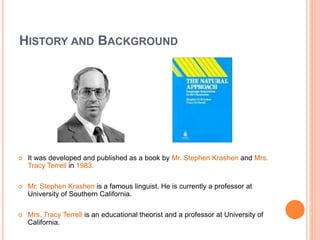
 It was developed and published as a book by Mr. Stephen Krashen and Mrs.
Tracy Terrell in 1983.
 Mr. Stephen Krashen is a famous linguist. He is currently a professor at
University of Southern California.
 Mrs. Tracy Terrell is an educational theorist and a professor at University of
California.
HISTORY AND BACKGROUND
 The publication of this book, “The Natural Approach”, made a wide
impact globally.
 Natural Approach believes that adults can still acquire second
languages. The ability of language acquisition does not disappear as
we grow up.
HISTORY AND BACKGROUND
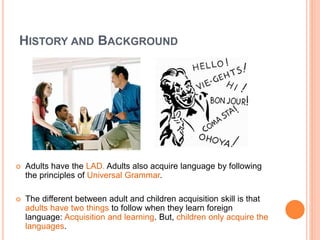
 Adults have the LAD. Adults also acquire language by following
the principles of Universal Grammar.
 The different between adult and children acquisition skill is that
adults have two things to follow when they learn foreign
language: Acquisition and learning. But, children only acquire the
languages.
HISTORY AND BACKGROUND
 In the book, Mr. Krashen and Mrs. Terrell consider their
approach as a traditional method.
OBJECTIVES
 To help adults in learning the foreign language
naturally.
 The learner will be able to pick up the grammar by
themselves when they are ready.
THEORIES
 The Acquisition-Learning hypothesis –
 is the most basic steps of all in the Krashen’s theory
 It’s the most well known among linguists and language
practitioners.
 The learner has two ways of learning the second
language, which are the acquired system and the
learned system.
 The monitor hypothesis
 when the learner can check and correct language
output.
THEORIES
 The Natural Order hypothesis
 When people acquire language by using grammatical
structures in a predictable order.
 The input hypothesis
 The acquisition of languages are in a predictable order.
Everybody have the same steps of learning acquisition.
THEORIES
 The Affective Filter hypothesis
 When the learner’s emotional state
can act as a filter that can prevent
input from reaching the learner’s
language acquisition device.
 Filter is up = Negative emotional
factors and they won’t acquire
language.
 Filter is down = Learner will learn
better.
ROLES OF TEACHER AND LEARNER
 Teacher:
• Act as an authority in the class
• Imitate the first language learning process
• Creatively instruct students to do activities that benefit
the language learning.
 Student:
• Responds to the teacher by physical action
• Interact to teacher and other students
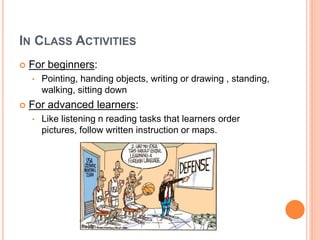
IN CLASS ACTIVITIES
 For beginners:
• Pointing, handing objects, writing or drawing , standing,
walking, sitting down
 For advanced learners:
• Like listening n reading tasks that learners order
pictures, follow written instruction or maps.
ADVANTAGES & DISADVANTAGES
 Advantages
• This method is very easy
• Reliable as it’s widely used
• There’s no grammar instruction in this method
 Disadvantages
• It takes long time and learner can do only elementary
things
• It does not suit for those who do not have much time
• The method rarely concerns about correctness
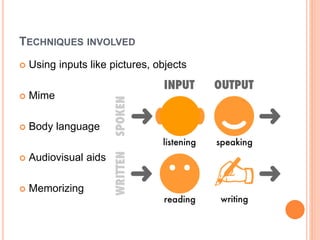
TECHNIQUES INVOLVED
 Using inputs like pictures, objects
 Mime
 Body language
 Audiovisual aids
 Memorizing
THANK YOU FOR YOUR ATTENTION

Natural approach

  • 1.
  • 2.
    NATURAL APPROACH  Historyand Background  Objectives  Theories  Learner and Teacher’s roles  Advantages and Disadvantages
  • 3.
    HISTORY AND BACKGROUND It was developed and published as a book by Mr. Stephen Krashen and Mrs. Tracy Terrell in 1983.  Mr. Stephen Krashen is a famous linguist. He is currently a professor at University of Southern California.  Mrs. Tracy Terrell is an educational theorist and a professor at University of California.
  • 4.
    HISTORY AND BACKGROUND The publication of this book, “The Natural Approach”, made a wide impact globally.  Natural Approach believes that adults can still acquire second languages. The ability of language acquisition does not disappear as we grow up.
  • 5.
    HISTORY AND BACKGROUND Adults have the LAD. Adults also acquire language by following the principles of Universal Grammar.  The different between adult and children acquisition skill is that adults have two things to follow when they learn foreign language: Acquisition and learning. But, children only acquire the languages.
  • 6.
    HISTORY AND BACKGROUND In the book, Mr. Krashen and Mrs. Terrell consider their approach as a traditional method.
  • 7.
    OBJECTIVES  To helpadults in learning the foreign language naturally.  The learner will be able to pick up the grammar by themselves when they are ready.
  • 8.
    THEORIES  The Acquisition-Learninghypothesis –  is the most basic steps of all in the Krashen’s theory  It’s the most well known among linguists and language practitioners.  The learner has two ways of learning the second language, which are the acquired system and the learned system.  The monitor hypothesis  when the learner can check and correct language output.
  • 9.
    THEORIES  The NaturalOrder hypothesis  When people acquire language by using grammatical structures in a predictable order.  The input hypothesis  The acquisition of languages are in a predictable order. Everybody have the same steps of learning acquisition.
  • 10.
    THEORIES  The AffectiveFilter hypothesis  When the learner’s emotional state can act as a filter that can prevent input from reaching the learner’s language acquisition device.  Filter is up = Negative emotional factors and they won’t acquire language.  Filter is down = Learner will learn better.
  • 11.
    ROLES OF TEACHERAND LEARNER  Teacher: • Act as an authority in the class • Imitate the first language learning process • Creatively instruct students to do activities that benefit the language learning.  Student: • Responds to the teacher by physical action • Interact to teacher and other students
  • 12.
    IN CLASS ACTIVITIES For beginners: • Pointing, handing objects, writing or drawing , standing, walking, sitting down  For advanced learners: • Like listening n reading tasks that learners order pictures, follow written instruction or maps.
  • 13.
    ADVANTAGES & DISADVANTAGES Advantages • This method is very easy • Reliable as it’s widely used • There’s no grammar instruction in this method  Disadvantages • It takes long time and learner can do only elementary things • It does not suit for those who do not have much time • The method rarely concerns about correctness
  • 14.
    TECHNIQUES INVOLVED  Usinginputs like pictures, objects  Mime  Body language  Audiovisual aids  Memorizing
  • 15.
    THANK YOU FORYOUR ATTENTION