Presentati
on
• Shoaib Ahmed (BS-CIS-50385)
• Umar Farooq Khan (BS-CIS-50611)
• Nadir Abrar (BS-CIS-50452)
• Muhammad Dawood suleman
The great pyramid of Giza are
three in number.
Most were built as tombs for the
country's pharaos.
They were built over the span of
three generations by the rulers
Menkaure, Khafre, and Khufu.
Pyramids are included in 7
wonders of the world.
Pyramids of Giza held the title for
worlds tallest men made structure
over 3871 years.
 It is the oldest and largest of
the three pyramids in
the Giza.
 It is the oldest of the Seven
Wonders of the Ancient
World.
 Its build during the rule of
Khufu Pharaoh.
 It constructed over a 20
years period.
 Height: 146.5 m(481 ft).
 The Great Pyramid was
the tallest man-made
structure in the world for
more than 3,800 years.
 In AD 1301, a massive
earthquake loosened many of
the outer casing stones of
pyramid.
 Khufu was the second
pharaoh of the 4th dynasty.
 Reign: 2589–2566 BC
 He is not a good warrior nor
a politician but history Know
about him due to his great
pyramid.
 The Greeks believed that
slave labor was used.
 Verner supposed that the
labor consisting of
two gangs of 100,000 men.
 The Great Pyramid was
surfaced by white "casing
stones“.
 The original entrance to the
Great Pyramid is 17 meters
(56 ft) vertically above
ground level.
 The "Queen's Chamber" is
exactly half-way between the
north and south faces of the
pyramid.
 The “King's Chamber” is
10.47 meters (34.4 ft) from
east to west.
 The Great Pyramid is
surrounded by a complex of
several buildings including
small pyramids.
 This pyramid is the only one
in Egypt known to have
passages inside that go up
and go down.
The second-tallest and
second-largest of the Ancient
Egyptian Pyramids of Giza.
The tomb of the Fourth
Dynasty pharaoh Khafre.
Constructed:
2570 BC
It was first explored in
modern times by Italian
archeologist Giovanni Belzoni
on march 2,1818
The king of 4th dynasty.
He was the son of Khufu.
Reign:26 years, 2570 BC.
The builder of khafre pyramid
Some archeologist claim that he
made The sphinx but no solid
proof exists about this myth.
Diorite statue of Khafra, now in the Egyptian
Museum at Cairo
The pyramid has a base length
of 215.5 m (706 Ft)
A height of 136.4 meters
(448 ft.)
Only approximately 10 feet
shorter than the Great
Pyramid.
The pyramid is made of
limestone blocks weighing
more than 2 tons each
Bottom course of the cladding
is pink granite but higher
sections are clad in limestone
It has a slope angle of 53º.10.
In casing the whole pyramid white limestone was
used that covers the top third of the pyramid.
The pyramid sits on bedrock 10 m (33 ft.) higher than
Khufu’s pyramid, which makes it appear to be taller.
It is made of very large stones at bottom but as the
pyramid rises, the stones become smaller, becoming
only 50 cm
The chamber is located in the
bedrock.
It is rectangular 14 m by 5m.
Khafre’s sarcophagus was carved out
of a solid block of granite and sunk
partially in the floor.
Belzoni discovered an empty
sarcophagus and Arabic writing
which said that the pyramid had been
opened in the time of King Ali
Muhammad, approximately 1200
A.D.
There are two entrances to the
burial chamber
First that is cut through
plateau bedrock; underground
entrance.
The other opens 11.54 m
(38 ft.) up the face of the
pyramid.
It is a limestone statue of a
reclining mythical creature with a
lion's body and a human head) that
stands infront of khafre pyramid,it
is believed that his face represents
pharaoh khafre’s face.
It is 73.5 meters long, 19.3 meters
wide, and 20.22 m high.
No one knows much about it
therefore it is popular idea of the
"Riddle of the Sphinx"
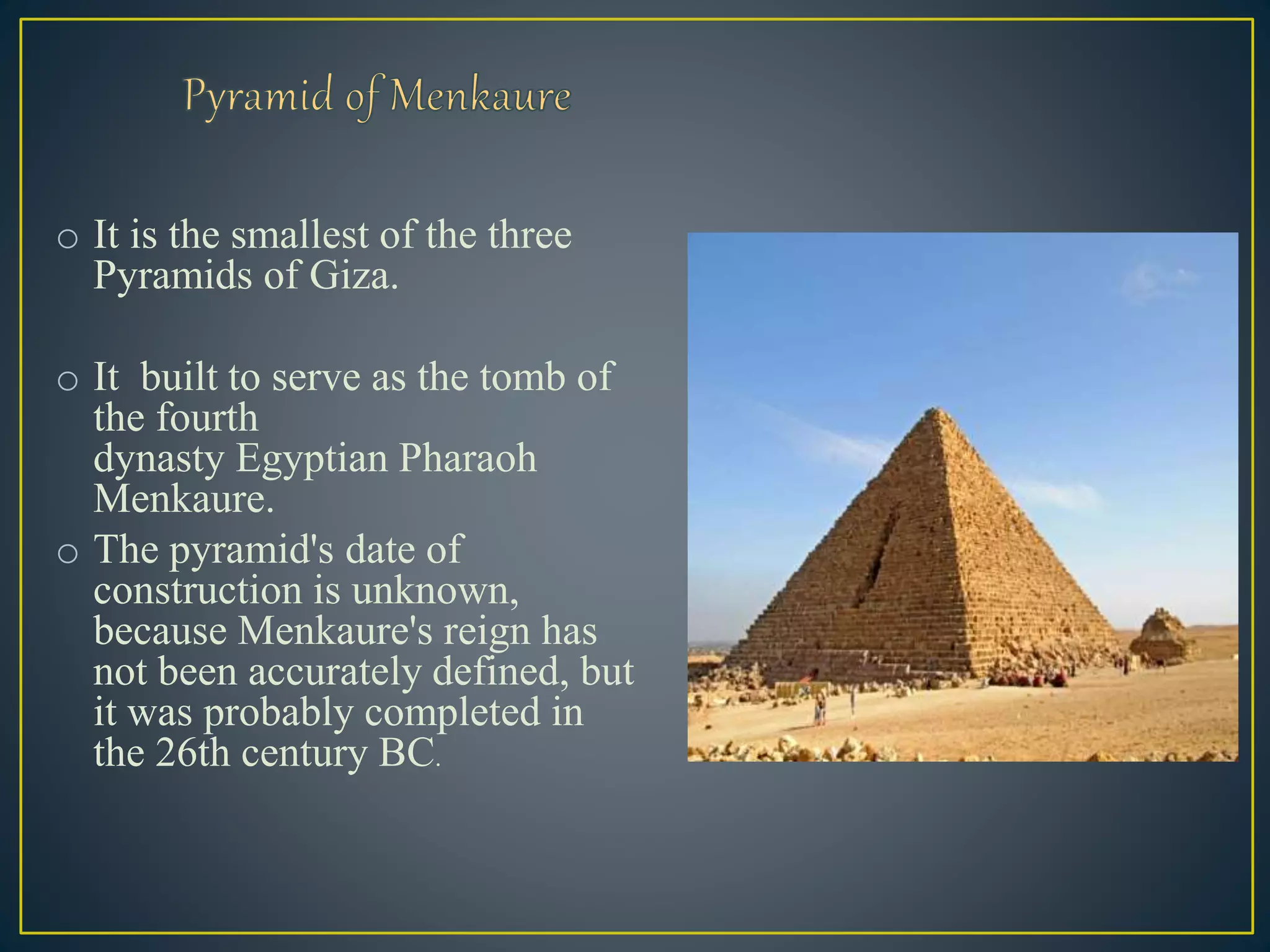
o It is the smallest of the three
Pyramids of Giza.
o It built to serve as the tomb of
the fourth
dynasty Egyptian Pharaoh
Menkaure.
o The pyramid's date of
construction is unknown,
because Menkaure's reign has
not been accurately defined, but
it was probably completed in
the 26th century BC.
o Menkaure's pyramid had an original height of 65.5 meters.
o Now its height is 61m(204 Ft).
o It was constructed of limestone and granite. The first sixteen
courses of the exterior were made of red granite.
o The blocks of local stone in the walls of the mortuary temple
weighed as much as 220 tons.
The inside of the ceiling of his
tomb chamber has been cut to
an arch.
o Tried To damage in 12th
century by Al-Malik Al-
Aziz.
o They stayed at their job for
eight months.
o They were not able to
remove more than one or
two stones each day.
It was called Deir el-Medina
It was discovered by Mark
Lehner and his team
This town is located to the southeast
of the Khafre and Menkaure
complexes.
Among the discoveries at the
workers' village are communal
sleeping quarters, bakeries, breweries
and kitchens
The workers' town discovered
appears to date to the middle 4th
dynasty (2520–2472 BC),
The community contained around sixty-eight houses
spread over at total area of 5,600 m2 with a narrow road
running through village.
When Greek historian Herodotus visited Giza in
450 BC, he was told by Egyptian priests that "the Great
Pyramid had taken 400,000 men 20 years to build,
working in three-month shifts 100,000 men at a time.“
Evidence from the tombs indicates that a workforce of
10,000 laborers working in three-month shifts took
around 30 years to build a pyramid.
Researchers into ancient law and
practice find a rich source of
information recorded in the texts
from the village
The Women were supplied with
servants by the government to assist
with the grinding of the grain and
laundry tasks,
The wives of the workers cared for
the children and baked the bread, a
prime food source in these societies
The workers and their families were not slaves but free
citizens with recourse to the justice system as required,
The community had its own court of law made up of a
foreman, deputies, craftsmen and were authorised to deal
with all civil and some criminal cases, typically relating to
the non-payment of goods or services
The workmen and inhabitants of Deir el-Medina received
care for their health problems through medical
treatment, prayer, and magic.
• In 25years of kingdom of Ramses III ( 1170 BCE) the laborers
were so exasperated by delays in supplies they threw down
their tools and walked off the job in what may have been the
first sit-down strike in recorded history.
o The pyramids of Giza and others are thought to have
been constructed to house the remains of the
deceased Pharaohs who ruled over Ancient Egypt
o It's theorized the pyramid not only served as a tomb
for the Pharaoh, but also as storage for the various
items he would need in the afterlife.
o The people of Ancient Egypt believed that death on
Earth was the start of a journey to the next world.
o The embalmed body of the King was entombed
underneath or within the pyramid to protect it and
allow his transformation and ascension to the afterlife.
The glory of King is in the sky
His power is in the horizon...

Great Pyramids of Egypt

  • 1.
  • 2.
    • Shoaib Ahmed(BS-CIS-50385) • Umar Farooq Khan (BS-CIS-50611) • Nadir Abrar (BS-CIS-50452) • Muhammad Dawood suleman
  • 4.
    The great pyramidof Giza are three in number. Most were built as tombs for the country's pharaos. They were built over the span of three generations by the rulers Menkaure, Khafre, and Khufu. Pyramids are included in 7 wonders of the world. Pyramids of Giza held the title for worlds tallest men made structure over 3871 years.
  • 5.
     It isthe oldest and largest of the three pyramids in the Giza.  It is the oldest of the Seven Wonders of the Ancient World.  Its build during the rule of Khufu Pharaoh.  It constructed over a 20 years period.
  • 6.
     Height: 146.5m(481 ft).  The Great Pyramid was the tallest man-made structure in the world for more than 3,800 years.  In AD 1301, a massive earthquake loosened many of the outer casing stones of pyramid.
  • 7.
     Khufu wasthe second pharaoh of the 4th dynasty.  Reign: 2589–2566 BC  He is not a good warrior nor a politician but history Know about him due to his great pyramid.
  • 8.
     The Greeksbelieved that slave labor was used.  Verner supposed that the labor consisting of two gangs of 100,000 men.  The Great Pyramid was surfaced by white "casing stones“.
  • 9.
     The originalentrance to the Great Pyramid is 17 meters (56 ft) vertically above ground level.  The "Queen's Chamber" is exactly half-way between the north and south faces of the pyramid.
  • 10.
     The “King'sChamber” is 10.47 meters (34.4 ft) from east to west.  The Great Pyramid is surrounded by a complex of several buildings including small pyramids.  This pyramid is the only one in Egypt known to have passages inside that go up and go down.
  • 11.
    The second-tallest and second-largestof the Ancient Egyptian Pyramids of Giza. The tomb of the Fourth Dynasty pharaoh Khafre. Constructed: 2570 BC It was first explored in modern times by Italian archeologist Giovanni Belzoni on march 2,1818
  • 12.
    The king of4th dynasty. He was the son of Khufu. Reign:26 years, 2570 BC. The builder of khafre pyramid Some archeologist claim that he made The sphinx but no solid proof exists about this myth. Diorite statue of Khafra, now in the Egyptian Museum at Cairo
  • 13.
    The pyramid hasa base length of 215.5 m (706 Ft) A height of 136.4 meters (448 ft.) Only approximately 10 feet shorter than the Great Pyramid. The pyramid is made of limestone blocks weighing more than 2 tons each Bottom course of the cladding is pink granite but higher sections are clad in limestone It has a slope angle of 53º.10.
  • 14.
    In casing thewhole pyramid white limestone was used that covers the top third of the pyramid. The pyramid sits on bedrock 10 m (33 ft.) higher than Khufu’s pyramid, which makes it appear to be taller. It is made of very large stones at bottom but as the pyramid rises, the stones become smaller, becoming only 50 cm
  • 15.
    The chamber islocated in the bedrock. It is rectangular 14 m by 5m. Khafre’s sarcophagus was carved out of a solid block of granite and sunk partially in the floor. Belzoni discovered an empty sarcophagus and Arabic writing which said that the pyramid had been opened in the time of King Ali Muhammad, approximately 1200 A.D.
  • 16.
    There are twoentrances to the burial chamber First that is cut through plateau bedrock; underground entrance. The other opens 11.54 m (38 ft.) up the face of the pyramid.
  • 17.
    It is alimestone statue of a reclining mythical creature with a lion's body and a human head) that stands infront of khafre pyramid,it is believed that his face represents pharaoh khafre’s face. It is 73.5 meters long, 19.3 meters wide, and 20.22 m high. No one knows much about it therefore it is popular idea of the "Riddle of the Sphinx"
  • 18.
    o It isthe smallest of the three Pyramids of Giza. o It built to serve as the tomb of the fourth dynasty Egyptian Pharaoh Menkaure. o The pyramid's date of construction is unknown, because Menkaure's reign has not been accurately defined, but it was probably completed in the 26th century BC.
  • 20.
    o Menkaure's pyramidhad an original height of 65.5 meters. o Now its height is 61m(204 Ft). o It was constructed of limestone and granite. The first sixteen courses of the exterior were made of red granite. o The blocks of local stone in the walls of the mortuary temple weighed as much as 220 tons.
  • 21.
    The inside ofthe ceiling of his tomb chamber has been cut to an arch.
  • 22.
    o Tried Todamage in 12th century by Al-Malik Al- Aziz. o They stayed at their job for eight months. o They were not able to remove more than one or two stones each day.
  • 23.
    It was calledDeir el-Medina It was discovered by Mark Lehner and his team This town is located to the southeast of the Khafre and Menkaure complexes. Among the discoveries at the workers' village are communal sleeping quarters, bakeries, breweries and kitchens The workers' town discovered appears to date to the middle 4th dynasty (2520–2472 BC),
  • 24.
    The community containedaround sixty-eight houses spread over at total area of 5,600 m2 with a narrow road running through village. When Greek historian Herodotus visited Giza in 450 BC, he was told by Egyptian priests that "the Great Pyramid had taken 400,000 men 20 years to build, working in three-month shifts 100,000 men at a time.“ Evidence from the tombs indicates that a workforce of 10,000 laborers working in three-month shifts took around 30 years to build a pyramid.
  • 25.
    Researchers into ancientlaw and practice find a rich source of information recorded in the texts from the village The Women were supplied with servants by the government to assist with the grinding of the grain and laundry tasks, The wives of the workers cared for the children and baked the bread, a prime food source in these societies
  • 26.
    The workers andtheir families were not slaves but free citizens with recourse to the justice system as required, The community had its own court of law made up of a foreman, deputies, craftsmen and were authorised to deal with all civil and some criminal cases, typically relating to the non-payment of goods or services The workmen and inhabitants of Deir el-Medina received care for their health problems through medical treatment, prayer, and magic.
  • 27.
    • In 25yearsof kingdom of Ramses III ( 1170 BCE) the laborers were so exasperated by delays in supplies they threw down their tools and walked off the job in what may have been the first sit-down strike in recorded history.
  • 28.
    o The pyramidsof Giza and others are thought to have been constructed to house the remains of the deceased Pharaohs who ruled over Ancient Egypt o It's theorized the pyramid not only served as a tomb for the Pharaoh, but also as storage for the various items he would need in the afterlife. o The people of Ancient Egypt believed that death on Earth was the start of a journey to the next world. o The embalmed body of the King was entombed underneath or within the pyramid to protect it and allow his transformation and ascension to the afterlife.
  • 29.
    The glory ofKing is in the sky His power is in the horizon...