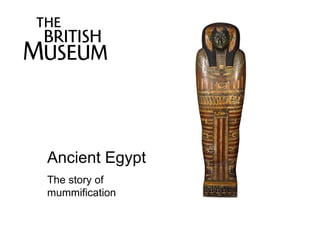
Ancient Egypt The story of mummification
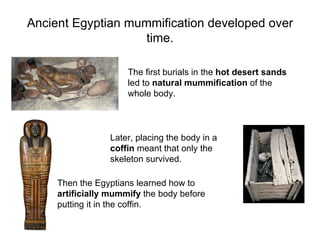
Ancient Egyptian mummification developed over time. The first burials in the  hot desert sands  led to  natural mummification  of the whole body. Later, placing the body in a  coffin  meant that only the skeleton survived. Then the Egyptians learned how to  artificially mummify  the body before putting it in the coffin.
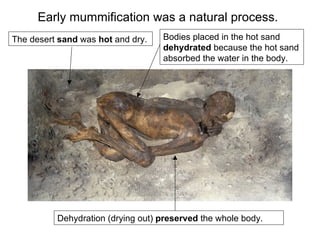
Early mummification was a natural process. The desert  sand  was  hot  and dry.  Dehydration (drying out)  preserved  the whole body. Bodies placed in the hot sand  dehydrated  because the hot sand absorbed the water in the body.
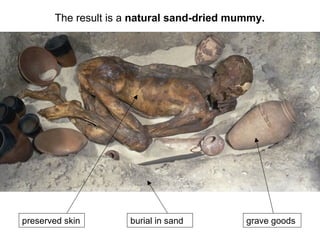
The result is a  natural sand-dried mummy. preserved skin grave goods burial in sand
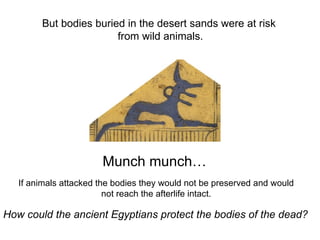
But bodies buried in the desert sands were at risk  from wild animals. Munch munch… How could the ancient Egyptians protect the bodies of the dead? If animals attacked the bodies they would not be preserved and would not reach the afterlife intact.
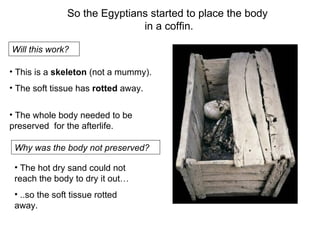
So the Egyptians started to place the body  in a coffin. Will this work? This is a  skeleton  (not a mummy). The soft tissue has  rotted  away.  The whole body needed to be preserved  for the afterlife.  Why was the body not preserved? The hot dry sand could not reach the body to dry it out… ..so the soft tissue rotted away.
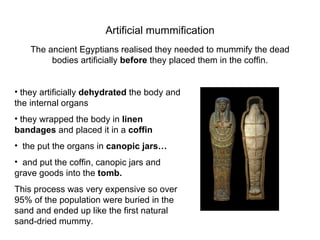
Artificial mummification The ancient Egyptians realised they needed to mummify the dead bodies artificially  before  they placed them in the coffin. they artificially  dehydrated  the body and the internal organs they wrapped the body in  linen bandages  and placed it in a  coffin the put the organs in  canopic jars… and put the coffin, canopic jars and grave goods into the  tomb. This process was very expensive so over 95% of the population were buried in the sand   and ended up like the first natural sand-dried mummy.
Find out more about ancient Egyptian mummies Visit the main Museum website  www.britishmuseum.org Use Explore to look at some of our mummies www.britishmuseum.org/explore/introduction.aspx Learn more about mummification www.ancientegypt.co.uk

Egypt History Mummification Slideshow Ks2

  • 1.
    Ancient Egypt Thestory of mummification
  • 2.
    Ancient Egyptian mummificationdeveloped over time. The first burials in the hot desert sands led to natural mummification of the whole body. Later, placing the body in a coffin meant that only the skeleton survived. Then the Egyptians learned how to artificially mummify the body before putting it in the coffin.
  • 3.
    Early mummification wasa natural process. The desert sand was hot and dry. Dehydration (drying out) preserved the whole body. Bodies placed in the hot sand dehydrated because the hot sand absorbed the water in the body.
  • 4.
    The result isa natural sand-dried mummy. preserved skin grave goods burial in sand
  • 5.
    But bodies buriedin the desert sands were at risk from wild animals. Munch munch… How could the ancient Egyptians protect the bodies of the dead? If animals attacked the bodies they would not be preserved and would not reach the afterlife intact.
  • 6.
    So the Egyptiansstarted to place the body in a coffin. Will this work? This is a skeleton (not a mummy). The soft tissue has rotted away. The whole body needed to be preserved for the afterlife. Why was the body not preserved? The hot dry sand could not reach the body to dry it out… ..so the soft tissue rotted away.
  • 7.
    Artificial mummification Theancient Egyptians realised they needed to mummify the dead bodies artificially before they placed them in the coffin. they artificially dehydrated the body and the internal organs they wrapped the body in linen bandages and placed it in a coffin the put the organs in canopic jars… and put the coffin, canopic jars and grave goods into the tomb. This process was very expensive so over 95% of the population were buried in the sand and ended up like the first natural sand-dried mummy.
  • 8.
    Find out moreabout ancient Egyptian mummies Visit the main Museum website www.britishmuseum.org Use Explore to look at some of our mummies www.britishmuseum.org/explore/introduction.aspx Learn more about mummification www.ancientegypt.co.uk