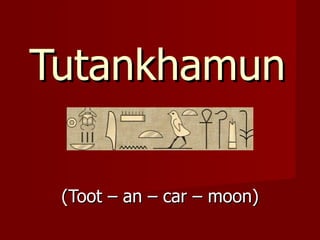
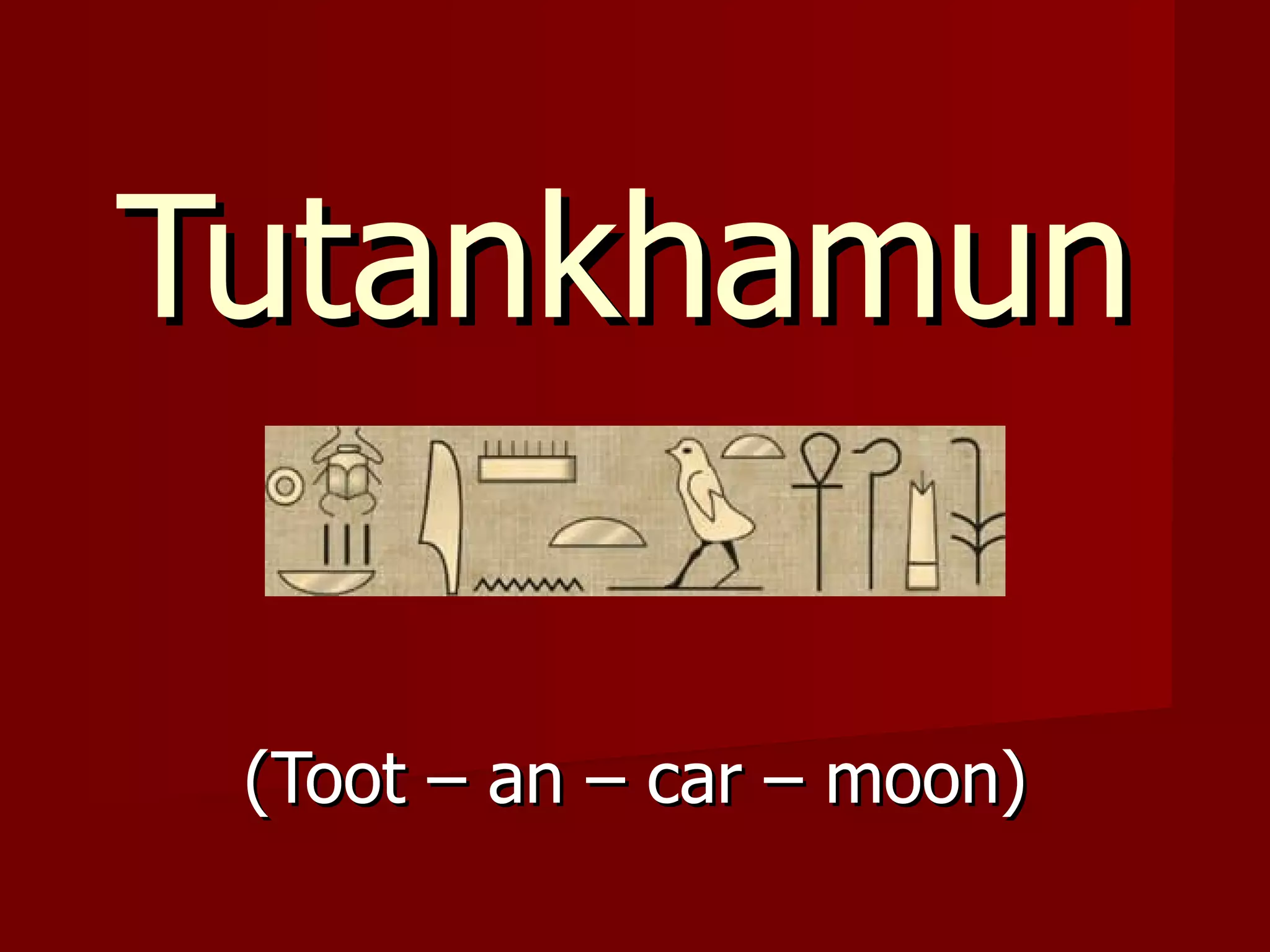
Tutankhamun

 (Toot – an – car – moon)
The Boy King
   Born around 1343 B.C, died December/ January
    1324 B.C
   Pharaoh for 9 – 10 years
   Father was Amenhotep. Mother possibly Queen
    Kiya.
   Married his half sister Ankhesenamun when he
    was ten years old
   Childhood was spent in Amarna
   Moved back to Thebes when he became king
   Servants were used for all menial tasks eg.
    Bathing, dressing, shaving his head and leaving
    a small braid at the side
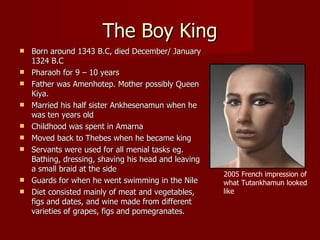
                                                      2005 French impression of
   Guards for when he went swimming in the Nile      what Tutankhamun looked
   Diet consisted mainly of meat and vegetables,     like
    figs and dates, and wine made from different
    varieties of grapes, figs and pomegranates.
The Boy King cont’d
   Entertained themselves with board
    games such as Senet.
   Musicians played harps, lutes and
    pipes
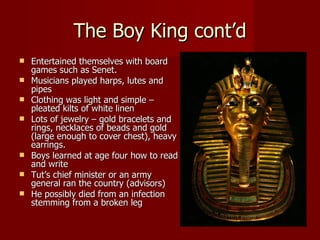
   Clothing was light and simple –
    pleated kilts of white linen
   Lots of jewelry – gold bracelets and
    rings, necklaces of beads and gold
    (large enough to cover chest), heavy
    earrings.
   Boys learned at age four how to read
    and write
   Tut’s chief minister or an army
    general ran the country (advisors)
   He possibly died from an infection
    stemming from a broken leg
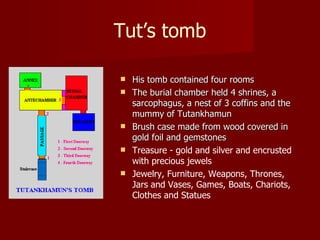
Tut’s tomb

   His tomb contained four rooms
   The burial chamber held 4 shrines, a
    sarcophagus, a nest of 3 coffins and the
    mummy of Tutankhamun
   Brush case made from wood covered in
    gold foil and gemstones
   Treasure - gold and silver and encrusted
    with precious jewels
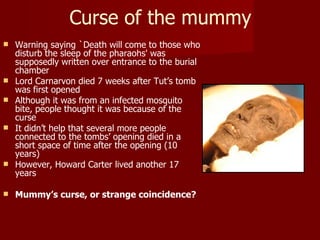
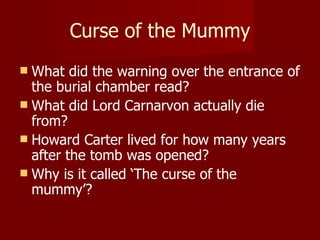
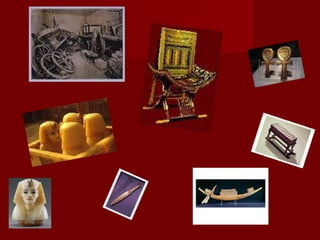
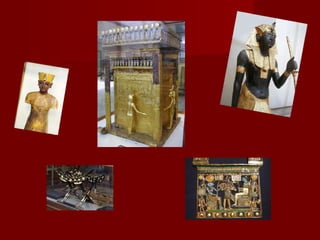
   Jewelry, Furniture, Weapons, Thrones,
    Jars and Vases, Games, Boats, Chariots,
    Clothes and Statues
Questions about Tut
   What year did he die?
   If peasants ate bread and drank beer, what
    would Tutankhamun have eaten?
   Who looked after his daily needs and what were
    they?
   What was required to go swimming in the Nile?
   Describe the clothing most likely worn by
    Tutankhamun and other royal family members?
   How many years did he rule as Pharaoh?
   What age was he when he died?
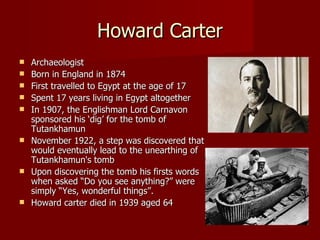
Howard Carter
   Archaeologist
   Born in England in 1874
   First travelled to Egypt at the age of 17
   Spent 17 years living in Egypt altogether
   In 1907, the Englishman Lord Carnavon
    sponsored his ‘dig’ for the tomb of
    Tutankhamun
   November 1922, a step was discovered that
    would eventually lead to the unearthing of
    Tutankhamun's tomb
   Upon discovering the tomb his firsts words
    when asked “Do you see anything?” were
    simply “Yes, wonderful things”.
   Howard carter died in 1939 aged 64
Questions about Howard Carter
 What was Howard Carters’ occupation?
 In 1907, an English Lord offered to
  sponsor the dig. What was this Lords’
  name?
 What is Carter famous for?
 What year was this?
 The first words used to describe what he
  had discovered were?
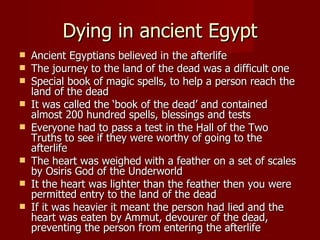
Dying in ancient Egypt
   Ancient Egyptians believed in the afterlife
   The journey to the land of the dead was a difficult one
   Special book of magic spells, to help a person reach the
    land of the dead
   It was called the ‘book of the dead’ and contained
    almost 200 hundred spells, blessings and tests
   Everyone had to pass a test in the Hall of the Two
    Truths to see if they were worthy of going to the
    afterlife
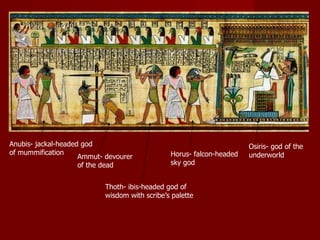
   The heart was weighed with a feather on a set of scales
    by Osiris God of the Underworld
   It the heart was lighter than the feather then you were
    permitted entry to the land of the dead
   If it was heavier it meant the person had lied and the
    heart was eaten by Ammut, devourer of the dead,
    preventing the person from entering the afterlife
Anubis- jackal-headed god                                             Osiris- god of the
of mummification                               Horus- falcon-headed   underworld
                     Ammut- devourer
                     of the dead               sky god


                           Thoth- ibis-headed god of
                           wisdom with scribe’s palette
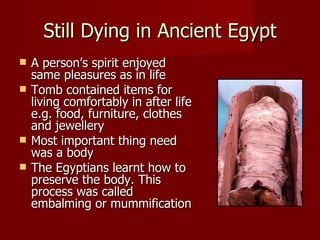
Still Dying in Ancient Egypt
   A person’s spirit enjoyed
    same pleasures as in life
   Tomb contained items for
    living comfortably in after life
    e.g. food, furniture, clothes
    and jewellery
   Most important thing need
    was a body
   The Egyptians learnt how to
    preserve the body. This
    process was called
    embalming or mummification
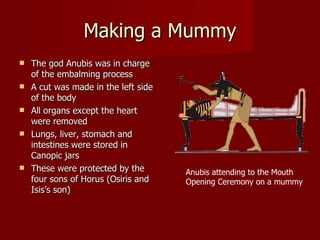
Making a Mummy
   The god Anubis was in charge
    of the embalming process
   A cut was made in the left side
    of the body
   All organs except the heart
    were removed
   Lungs, liver, stomach and
    intestines were stored in
    Canopic jars
   These were protected by the       Anubis attending to the Mouth
    four sons of Horus (Osiris and    Opening Ceremony on a mummy
    Isis’s son)
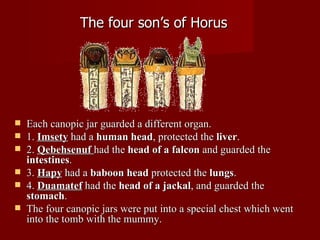
The four son’s of Horus


   Each canopic jar guarded a different organ.
   1. Imsety had a human head, protected the liver.
   2. Qebehsenuf had the head of a falcon and guarded the
    intestines.
   3. Hapy had a baboon head protected the lungs.
   4. Duamatef had the head of a jackal, and guarded the
    stomach.
   The four canopic jars were put into a special chest which went
    into the tomb with the mummy.
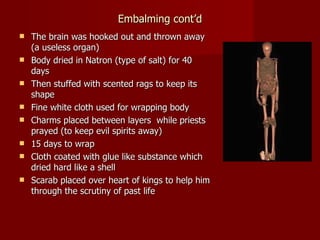
Embalming cont’d
   The brain was hooked out and thrown away
    (a useless organ)
   Body dried in Natron (type of salt) for 40
    days
   Then stuffed with scented rags to keep its
    shape
   Fine white cloth used for wrapping body
   Charms placed between layers while priests
    prayed (to keep evil spirits away)
   15 days to wrap
   Cloth coated with glue like substance which
    dried hard like a shell
   Scarab placed over heart of kings to help him
    through the scrutiny of past life
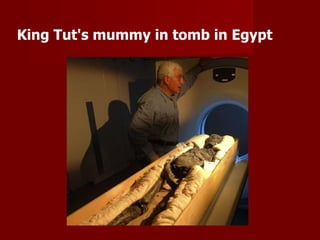
King Tut's mummy in tomb in Egypt
Questions about dying in Ancient Egypt
   Name the book of spells that helps a persons’ spirit
    reach the afterlife.
   What was the test in the Hall of Two Truths?
   Why was the Pharaoh's tomb filled with everyday items?
   What is the name given to the process for preserving the
    body?
   Name the containers the liver, lungs, stomach and
    intestines are stored in.
   The body was dried out in what substance and for how
    long?
   Charms were placed between the layers of cloth for
    what purpose?
Curse of the mummy
   Warning saying `Death will come to those who
    disturb the sleep of the pharaohs' was
    supposedly written over entrance to the burial
    chamber
   Lord Carnarvon died 7 weeks after Tut’s tomb
    was first opened
   Although it was from an infected mosquito
    bite, people thought it was because of the
    curse
   It didn’t help that several more people
    connected to the tombs’ opening died in a
    short space of time after the opening (10
    years)
   However, Howard Carter lived another 17
    years

   Mummy’s curse, or strange coincidence?
Curse of the Mummy
 What did the warning over the entrance of
  the burial chamber read?
 What did Lord Carnarvon actually die
  from?
 Howard Carter lived for how many years
  after the tomb was opened?
 Why is it called ‘The curse of the
  mummy’?
References
   http://www.woodlands-junior.kent.sch.uk/Homework/egypt/canopic.htm
   http://www.thenileandegypt.com/deities.html
   http://thegiftofthemuses.files.wordpress.com/2011/01/egyptian-afterlife1.jpg
   http://www.youtube.com/watch?v=TMovf5MAtm4
   http://www.independent.co.uk/news/world/africa/a-3000yearold-mystery-is-finally
 http://www.richard-seaman.com/Travel/Egypt/Cairo/Museum/Tutankhamun/Death
 http://www.touregypt.net/featurestories/kingtutdeath.htm

Tutankhamun

  • 1.
    Tutankhamun (Toot –an – car – moon)
  • 2.
    The Boy King  Born around 1343 B.C, died December/ January 1324 B.C  Pharaoh for 9 – 10 years  Father was Amenhotep. Mother possibly Queen Kiya.  Married his half sister Ankhesenamun when he was ten years old  Childhood was spent in Amarna  Moved back to Thebes when he became king  Servants were used for all menial tasks eg. Bathing, dressing, shaving his head and leaving a small braid at the side 2005 French impression of  Guards for when he went swimming in the Nile what Tutankhamun looked  Diet consisted mainly of meat and vegetables, like figs and dates, and wine made from different varieties of grapes, figs and pomegranates.
  • 3.
    The Boy Kingcont’d  Entertained themselves with board games such as Senet.  Musicians played harps, lutes and pipes  Clothing was light and simple – pleated kilts of white linen  Lots of jewelry – gold bracelets and rings, necklaces of beads and gold (large enough to cover chest), heavy earrings.  Boys learned at age four how to read and write  Tut’s chief minister or an army general ran the country (advisors)  He possibly died from an infection stemming from a broken leg
  • 4.
    Tut’s tomb  His tomb contained four rooms  The burial chamber held 4 shrines, a sarcophagus, a nest of 3 coffins and the mummy of Tutankhamun  Brush case made from wood covered in gold foil and gemstones  Treasure - gold and silver and encrusted with precious jewels  Jewelry, Furniture, Weapons, Thrones, Jars and Vases, Games, Boats, Chariots, Clothes and Statues
  • 5.
    Questions about Tut  What year did he die?  If peasants ate bread and drank beer, what would Tutankhamun have eaten?  Who looked after his daily needs and what were they?  What was required to go swimming in the Nile?  Describe the clothing most likely worn by Tutankhamun and other royal family members?  How many years did he rule as Pharaoh?  What age was he when he died?
  • 6.
    Howard Carter  Archaeologist  Born in England in 1874  First travelled to Egypt at the age of 17  Spent 17 years living in Egypt altogether  In 1907, the Englishman Lord Carnavon sponsored his ‘dig’ for the tomb of Tutankhamun  November 1922, a step was discovered that would eventually lead to the unearthing of Tutankhamun's tomb  Upon discovering the tomb his firsts words when asked “Do you see anything?” were simply “Yes, wonderful things”.  Howard carter died in 1939 aged 64
  • 7.
    Questions about HowardCarter  What was Howard Carters’ occupation?  In 1907, an English Lord offered to sponsor the dig. What was this Lords’ name?  What is Carter famous for?  What year was this?  The first words used to describe what he had discovered were?
  • 8.
    Dying in ancientEgypt  Ancient Egyptians believed in the afterlife  The journey to the land of the dead was a difficult one  Special book of magic spells, to help a person reach the land of the dead  It was called the ‘book of the dead’ and contained almost 200 hundred spells, blessings and tests  Everyone had to pass a test in the Hall of the Two Truths to see if they were worthy of going to the afterlife  The heart was weighed with a feather on a set of scales by Osiris God of the Underworld  It the heart was lighter than the feather then you were permitted entry to the land of the dead  If it was heavier it meant the person had lied and the heart was eaten by Ammut, devourer of the dead, preventing the person from entering the afterlife
  • 9.
    Anubis- jackal-headed god Osiris- god of the of mummification Horus- falcon-headed underworld Ammut- devourer of the dead sky god Thoth- ibis-headed god of wisdom with scribe’s palette
  • 10.
    Still Dying inAncient Egypt  A person’s spirit enjoyed same pleasures as in life  Tomb contained items for living comfortably in after life e.g. food, furniture, clothes and jewellery  Most important thing need was a body  The Egyptians learnt how to preserve the body. This process was called embalming or mummification
  • 11.
    Making a Mummy  The god Anubis was in charge of the embalming process  A cut was made in the left side of the body  All organs except the heart were removed  Lungs, liver, stomach and intestines were stored in Canopic jars  These were protected by the Anubis attending to the Mouth four sons of Horus (Osiris and Opening Ceremony on a mummy Isis’s son)
  • 12.
    The four son’sof Horus  Each canopic jar guarded a different organ.  1. Imsety had a human head, protected the liver.  2. Qebehsenuf had the head of a falcon and guarded the intestines.  3. Hapy had a baboon head protected the lungs.  4. Duamatef had the head of a jackal, and guarded the stomach.  The four canopic jars were put into a special chest which went into the tomb with the mummy.
  • 13.
    Embalming cont’d  The brain was hooked out and thrown away (a useless organ)  Body dried in Natron (type of salt) for 40 days  Then stuffed with scented rags to keep its shape  Fine white cloth used for wrapping body  Charms placed between layers while priests prayed (to keep evil spirits away)  15 days to wrap  Cloth coated with glue like substance which dried hard like a shell  Scarab placed over heart of kings to help him through the scrutiny of past life
  • 14.
    King Tut's mummyin tomb in Egypt
  • 15.
    Questions about dyingin Ancient Egypt  Name the book of spells that helps a persons’ spirit reach the afterlife.  What was the test in the Hall of Two Truths?  Why was the Pharaoh's tomb filled with everyday items?  What is the name given to the process for preserving the body?  Name the containers the liver, lungs, stomach and intestines are stored in.  The body was dried out in what substance and for how long?  Charms were placed between the layers of cloth for what purpose?
  • 16.
    Curse of themummy  Warning saying `Death will come to those who disturb the sleep of the pharaohs' was supposedly written over entrance to the burial chamber  Lord Carnarvon died 7 weeks after Tut’s tomb was first opened  Although it was from an infected mosquito bite, people thought it was because of the curse  It didn’t help that several more people connected to the tombs’ opening died in a short space of time after the opening (10 years)  However, Howard Carter lived another 17 years  Mummy’s curse, or strange coincidence?
  • 17.
    Curse of theMummy  What did the warning over the entrance of the burial chamber read?  What did Lord Carnarvon actually die from?  Howard Carter lived for how many years after the tomb was opened?  Why is it called ‘The curse of the mummy’?
  • 20.
    References  http://www.woodlands-junior.kent.sch.uk/Homework/egypt/canopic.htm  http://www.thenileandegypt.com/deities.html  http://thegiftofthemuses.files.wordpress.com/2011/01/egyptian-afterlife1.jpg  http://www.youtube.com/watch?v=TMovf5MAtm4  http://www.independent.co.uk/news/world/africa/a-3000yearold-mystery-is-finally  http://www.richard-seaman.com/Travel/Egypt/Cairo/Museum/Tutankhamun/Death  http://www.touregypt.net/featurestories/kingtutdeath.htm