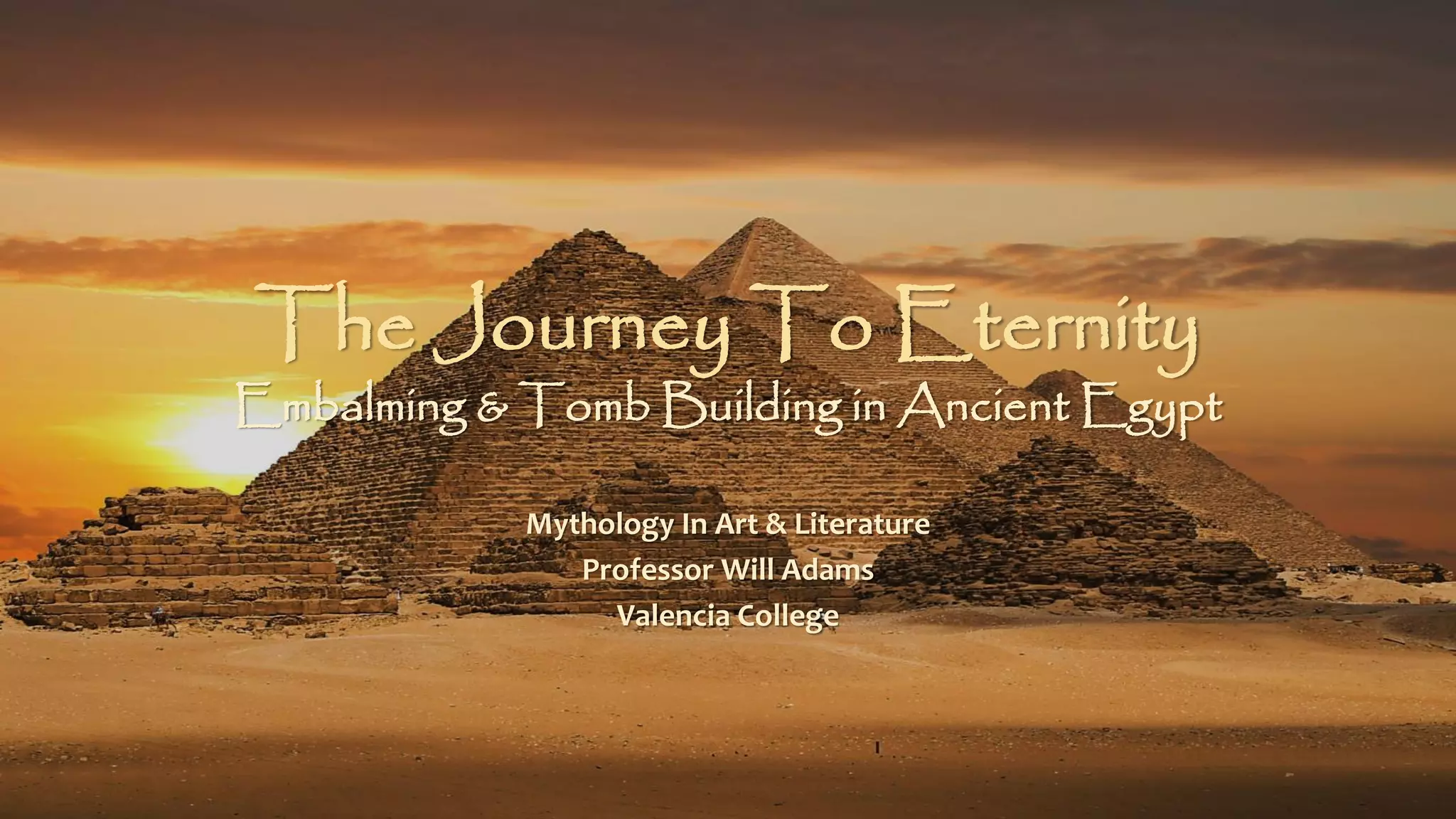
The Journey To Eternity
Embalming & Tomb Building in Ancient Egypt
Mythology In Art & Literature
Professor Will Adams
Valencia College
The Purpose of Egyptian Mummification
 The ancient Egyptians’ funerary customs & beliefs
called for the preservation of the body & ample
provisions for the afterlife.
 This was envisioned as a continuation of the mortal
existence after death.
 An ancient Egyptian would provide for the afterlife
as best as his or her economic abilities would allow.
 Today, this means that a huge amount of
information about daily life in ancient Egypt can be
found in the tombs.
 Examination of mummies provides information on
health, diet & life-expectancy.
The Purpose of Egyptian Mummification
 The body of a dead Egyptian would be made into a
mummy in order to preserve the body for its immortal
soul, or ka.
 The word "mummy" comes from the Arabic mumiyah
(body preserved by wax or bitumen)
 The process of mummification was complicated,
including removing organs & wrapping the body in
linen cloth.
 The body was treated with preservatives which dried
out the body of the mummy.
 The ancient Egyptians believed that, after death, their
bodies would travel to the world of the afterlife during
the day & return to their bodies at night.
The Purpose of Egyptian Mummification
 In order for the person’s spirit, or ka, to
live forever, it had to be able to recognize
& return to the body.
 If a spirit could not recognize the body it
belonged to, it would die.
 This is why the Egyptians wanted to
preserve the bodies of the dead in as life-
like a state as possible.
 Mummification guaranteed eternal life
for the spirit.
The Mummification Process
 The entire process took 70 days to
complete.
 Several embalmers conducted the task
in the special embalming shop, or per-
nefer.
 The chief embalmer was known as the
hery sheshta.
 He wore a jackal mask to represent
Anubis, the god of mummification.
The Mummification Process
 After the deceased’s body was brought
to the per-nefer, it was washed with a
mixture of palm wine and water from
the Nile, then shaved of its hair.
 Following that, all of the body parts that
might decay or rot were removed.
 The embalmers first removed the
deceased’s brain through his or her nose
using a long hook.
The Mummification Process
 The long hook was used to stir up the
brain until it was liquefied.
 Then the embalmers would turn the
body face down to allow the brain to
ooze out through the nostrils.
 The Egyptians were so rough on the
brain because they didn’t realize its
importance.
 They thought its sole purpose was to
produce snot!
The Mummification Process
 Next, the embalmers would remove
the soft, moist body parts that
would cause the body to decay.
 A deep incision was made in the left
side of the deceased’s abdomen to
remove his or her internal organs,
usually the lungs, the stomach, the
liver and the intestines.
The Mummification Process
 In some cases they removed the heart,
but in the vast majority of cases they
left it.
 Unlike modern humans, the ancient
believed that the heart, not the brain,
was the seat of the soul
 The Egyptians also believed that the
heart testified on behalf of the deceased
during the Weighing of the Heart
Ceremony in the afterlife.
The Mummification Process
 After the body’s organs had been
removed, it was stuffed with bundles of a
strong drying salt called natron that was
meant to further dehydrate the corpse.
 The deceased’s entire body was then
covered with natron & placed on an
inclined slab so that any moisture the
natron pulled from the body would run
off the end, be collected & buried with the
body.
The Mummification Process
 While the body was drying, the previously
removed internal organs were also dried &
preserved with natron.
 They were then wrapped in strips of linen
& put into separate containers called
canopic jars.
 The Egyptians believed that all body parts
would be magically reunited in the afterlife
and that the body would become whole
again, just like the god Osiris’s had.
The Egyptian Myth of Osiris
 According to Egyptian mythology, the god
Osiris was murdered by his jealous
brother Set, who hacked Osiris’s body into
pieces & scattered them into the Nile.
 Heartbroken, Osiris’s wife, the goddess
Isis, reassembled the pieces with the other
gods’ assistance & Osiris was magically
restored.
 He then went on to become the god of the
afterlife.
The Mummification Process
 The stoppers of the canopic jars were shaped
like the heads of the four sons of the god Horus
(god of the Egyptian kings).
 Each son protected the organ placed inside his
respective jar:
 Jackal-headed Duamutef guarded the jar that
contained the stomach.
 Falcon-headed Qebehsenuf watched over the
intestines.
 The baboon-headed son of Horus, Hapi,
protected the lungs.
 Human-headed Imseti was in charge of
protecting the liver.
The Mummification Process
 Next, the canopic jars were
carefully stored in a heavy, secure
chest that was later placed in the
tomb with the mummy.
 The chest of canopic jars on the
left was found in the tomb of the
famous King Tutankhamen.
The Mummification Process
 After 40 days, the body was completely
dehydrated.
 During that time the skin became
shrunken, wrinkled & leathery.
 The bundles of natron were then
removed from the body’s abdomen.
 Next, the mummy was washed with
wine & water one more time & rubbed
with sacred oils to soften the skin.
The Mummification Process
 The mummy’s head & body were packed
with herbs, sawdust & linen soaked in
scented oil so that the body could regain
its shape, and to deodorize the deceased’s
body.
 Then, small stones or small onions were
placed under the eyelids to restore a life-
like appearance.
 Once this was done, the mummy could be
covered with necklaces, rings and bracelets
made of gold & gems.
The Mummification Process
 According to Egyptian myth, the god Horus
had his eye miraculously restored after
losing it in a battle with the evil god Set.
 As a result, The Eye of Horus, called a
wedjat, is associated with healing &
protection.
 During mummification, a wax or bronze
plate with a wedjat carved on it was placed
over the embalming incision to magically
heal the wound in the afterlife.
The Mummification Process
 Once the wedjat was in place, the
entire body was then covered in
shrouds & bound with strips of linen
until the mummy had returned to its
original size.
 This was a complicated job, could
take as long as a week, and usually
required 1,000 yards’ worth of 2 – 8”
wide linen strips.
The Mummification Process
 As the mummy was being wrapped,
small, magical carvings called amulets
were inserted between the layers of
linen to further protect the mummy’s
spirit on its way to the afterlife.
 As each layer was added, it was coated
with resin to hold the wrappings
together with a waterproof seal.
The Mummification Process
 After the week of wrapping was
finished, the head of the mummy was
covered with a portrait mask.
 This was designed to ensure that the ka
would recognize the body in the
afterlife.
 Finally, the wrapped, masked mummy
was placed into a series of wooden &
gilded coffins which were ultimately
placed into a stone sarcophagus.
The Mummification Process
 On the day of the funeral, the mummy was
brought to the western bank of the Nile on a
barque.
 The mummy was next brought to its tomb,
where Osiris’s priests performed the
Opening of the Mouth Ceremony by
touching the deceased’s eyes, nose, and
mouth of the sarcophagus with a sacred
tool.
 This ritual symbolically reactivated these
senses in the afterlife.
The Mummification Process
 The deceased’s sarcophagus was then placed
inside the tomb’s burial chamber, the entrance
to which would be sealed to prevent looting or
theft.
 Before the tomb was sealed, the deceased’s
family members deposited food, clothes,
furniture, and dishes into the burial chamber.
 They did this because the Egyptians believed the
deceased would need the same accoutrements
in the afterlife that he or she had used in his or
her mortal life.
The End

HUM2310 Egyptian Embalming & Tombs.pdf

  • 1.
    The Journey ToEternity Embalming & Tomb Building in Ancient Egypt Mythology In Art & Literature Professor Will Adams Valencia College
  • 2.
    The Purpose ofEgyptian Mummification  The ancient Egyptians’ funerary customs & beliefs called for the preservation of the body & ample provisions for the afterlife.  This was envisioned as a continuation of the mortal existence after death.  An ancient Egyptian would provide for the afterlife as best as his or her economic abilities would allow.  Today, this means that a huge amount of information about daily life in ancient Egypt can be found in the tombs.  Examination of mummies provides information on health, diet & life-expectancy.
  • 3.
    The Purpose ofEgyptian Mummification  The body of a dead Egyptian would be made into a mummy in order to preserve the body for its immortal soul, or ka.  The word "mummy" comes from the Arabic mumiyah (body preserved by wax or bitumen)  The process of mummification was complicated, including removing organs & wrapping the body in linen cloth.  The body was treated with preservatives which dried out the body of the mummy.  The ancient Egyptians believed that, after death, their bodies would travel to the world of the afterlife during the day & return to their bodies at night.
  • 4.
    The Purpose ofEgyptian Mummification  In order for the person’s spirit, or ka, to live forever, it had to be able to recognize & return to the body.  If a spirit could not recognize the body it belonged to, it would die.  This is why the Egyptians wanted to preserve the bodies of the dead in as life- like a state as possible.  Mummification guaranteed eternal life for the spirit.
  • 5.
    The Mummification Process The entire process took 70 days to complete.  Several embalmers conducted the task in the special embalming shop, or per- nefer.  The chief embalmer was known as the hery sheshta.  He wore a jackal mask to represent Anubis, the god of mummification.
  • 6.
    The Mummification Process After the deceased’s body was brought to the per-nefer, it was washed with a mixture of palm wine and water from the Nile, then shaved of its hair.  Following that, all of the body parts that might decay or rot were removed.  The embalmers first removed the deceased’s brain through his or her nose using a long hook.
  • 7.
    The Mummification Process The long hook was used to stir up the brain until it was liquefied.  Then the embalmers would turn the body face down to allow the brain to ooze out through the nostrils.  The Egyptians were so rough on the brain because they didn’t realize its importance.  They thought its sole purpose was to produce snot!
  • 8.
    The Mummification Process Next, the embalmers would remove the soft, moist body parts that would cause the body to decay.  A deep incision was made in the left side of the deceased’s abdomen to remove his or her internal organs, usually the lungs, the stomach, the liver and the intestines.
  • 9.
    The Mummification Process In some cases they removed the heart, but in the vast majority of cases they left it.  Unlike modern humans, the ancient believed that the heart, not the brain, was the seat of the soul  The Egyptians also believed that the heart testified on behalf of the deceased during the Weighing of the Heart Ceremony in the afterlife.
  • 10.
    The Mummification Process After the body’s organs had been removed, it was stuffed with bundles of a strong drying salt called natron that was meant to further dehydrate the corpse.  The deceased’s entire body was then covered with natron & placed on an inclined slab so that any moisture the natron pulled from the body would run off the end, be collected & buried with the body.
  • 11.
    The Mummification Process While the body was drying, the previously removed internal organs were also dried & preserved with natron.  They were then wrapped in strips of linen & put into separate containers called canopic jars.  The Egyptians believed that all body parts would be magically reunited in the afterlife and that the body would become whole again, just like the god Osiris’s had.
  • 12.
    The Egyptian Mythof Osiris  According to Egyptian mythology, the god Osiris was murdered by his jealous brother Set, who hacked Osiris’s body into pieces & scattered them into the Nile.  Heartbroken, Osiris’s wife, the goddess Isis, reassembled the pieces with the other gods’ assistance & Osiris was magically restored.  He then went on to become the god of the afterlife.
  • 13.
    The Mummification Process The stoppers of the canopic jars were shaped like the heads of the four sons of the god Horus (god of the Egyptian kings).  Each son protected the organ placed inside his respective jar:  Jackal-headed Duamutef guarded the jar that contained the stomach.  Falcon-headed Qebehsenuf watched over the intestines.  The baboon-headed son of Horus, Hapi, protected the lungs.  Human-headed Imseti was in charge of protecting the liver.
  • 14.
    The Mummification Process Next, the canopic jars were carefully stored in a heavy, secure chest that was later placed in the tomb with the mummy.  The chest of canopic jars on the left was found in the tomb of the famous King Tutankhamen.
  • 15.
    The Mummification Process After 40 days, the body was completely dehydrated.  During that time the skin became shrunken, wrinkled & leathery.  The bundles of natron were then removed from the body’s abdomen.  Next, the mummy was washed with wine & water one more time & rubbed with sacred oils to soften the skin.
  • 16.
    The Mummification Process The mummy’s head & body were packed with herbs, sawdust & linen soaked in scented oil so that the body could regain its shape, and to deodorize the deceased’s body.  Then, small stones or small onions were placed under the eyelids to restore a life- like appearance.  Once this was done, the mummy could be covered with necklaces, rings and bracelets made of gold & gems.
  • 17.
    The Mummification Process According to Egyptian myth, the god Horus had his eye miraculously restored after losing it in a battle with the evil god Set.  As a result, The Eye of Horus, called a wedjat, is associated with healing & protection.  During mummification, a wax or bronze plate with a wedjat carved on it was placed over the embalming incision to magically heal the wound in the afterlife.
  • 18.
    The Mummification Process Once the wedjat was in place, the entire body was then covered in shrouds & bound with strips of linen until the mummy had returned to its original size.  This was a complicated job, could take as long as a week, and usually required 1,000 yards’ worth of 2 – 8” wide linen strips.
  • 19.
    The Mummification Process As the mummy was being wrapped, small, magical carvings called amulets were inserted between the layers of linen to further protect the mummy’s spirit on its way to the afterlife.  As each layer was added, it was coated with resin to hold the wrappings together with a waterproof seal.
  • 20.
    The Mummification Process After the week of wrapping was finished, the head of the mummy was covered with a portrait mask.  This was designed to ensure that the ka would recognize the body in the afterlife.  Finally, the wrapped, masked mummy was placed into a series of wooden & gilded coffins which were ultimately placed into a stone sarcophagus.
  • 21.
    The Mummification Process On the day of the funeral, the mummy was brought to the western bank of the Nile on a barque.  The mummy was next brought to its tomb, where Osiris’s priests performed the Opening of the Mouth Ceremony by touching the deceased’s eyes, nose, and mouth of the sarcophagus with a sacred tool.  This ritual symbolically reactivated these senses in the afterlife.
  • 22.
    The Mummification Process The deceased’s sarcophagus was then placed inside the tomb’s burial chamber, the entrance to which would be sealed to prevent looting or theft.  Before the tomb was sealed, the deceased’s family members deposited food, clothes, furniture, and dishes into the burial chamber.  They did this because the Egyptians believed the deceased would need the same accoutrements in the afterlife that he or she had used in his or her mortal life.
  • 23.