Professor Will Adams
Valencia College
Fall 2011

EGYPTIAN
MUMMIFICATION
Purpose of Egyptian
           Mummification
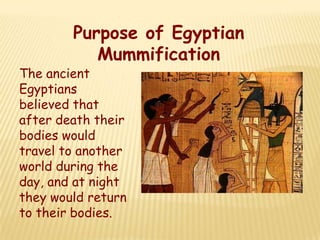
The ancient
Egyptians
believed that
after death their
bodies would
travel to another
world during the
day, and at night
they would return
to their bodies.
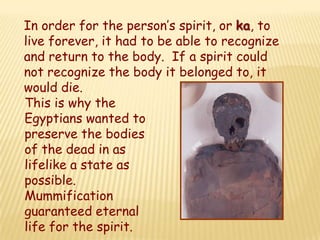
In order for the person’s spirit, or ka, to
live forever, it had to be able to recognize
and return to the body. If a spirit could
not recognize the body it belonged to, it
would die.
This is why the
Egyptians wanted to
preserve the bodies
of the dead in as
lifelike a state as
possible.
Mummification
guaranteed eternal
life for the spirit.
The Mummification
                Process
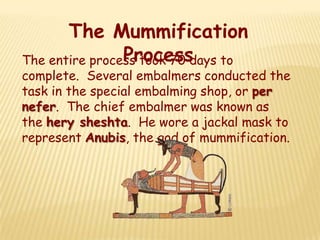
The entire process took 70 days to
complete. Several embalmers conducted the
task in the special embalming shop, or per
nefer. The chief embalmer was known as
the hery sheshta. He wore a jackal mask to
represent Anubis, the god of mummification.
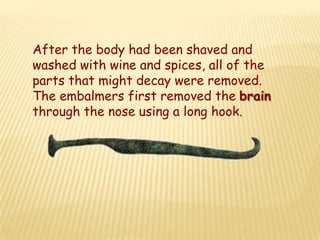
After the body had been shaved and
washed with wine and spices, all of the
parts that might decay were removed.
The embalmers first removed the brain
through the nose using a long hook.
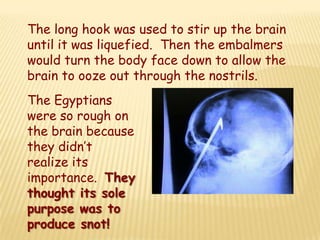
The long hook was used to stir up the brain
until it was liquefied. Then the embalmers
would turn the body face down to allow the
brain to ooze out through the nostrils.
The Egyptians
were so rough on
the brain because
they didn’t
realize its
importance. They
thought its sole
purpose was to
produce snot!
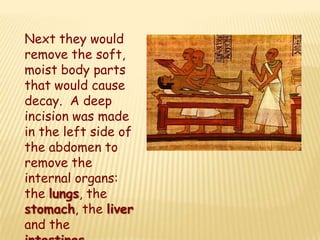
Next they would
remove the soft,
moist body parts
that would cause
decay. A deep
incision was made
in the left side of
the abdomen to
remove the
internal organs:
the lungs, the
stomach, the liver
and the
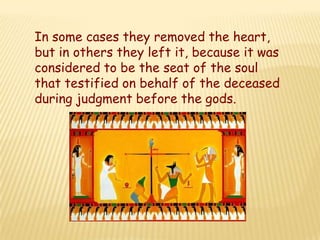
In some cases they removed the heart,
but in others they left it, because it was
considered to be the seat of the soul
that testified on behalf of the deceased
during judgment before the gods.
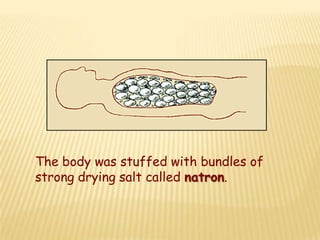
The body was stuffed with bundles of
strong drying salt called natron.
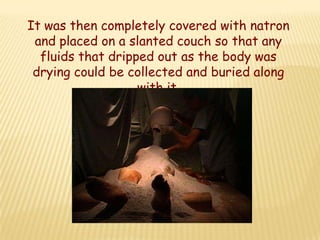
It was then completely covered with natron
 and placed on a slanted couch so that any
  fluids that dripped out as the body was
 drying could be collected and buried along
                   with it.
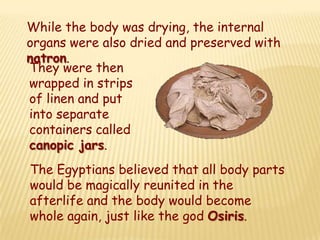
While the body was drying, the internal
organs were also dried and preserved with
natron.
They were then
wrapped in strips
of linen and put
into separate
containers called
canopic jars.
The Egyptians believed that all body parts
would be magically reunited in the
afterlife and the body would become
whole again, just like the god Osiris.
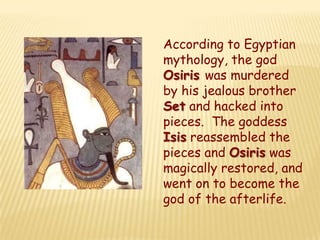
According to Egyptian
mythology, the god
Osiris was murdered
by his jealous brother
Set and hacked into
pieces. The goddess
Isis reassembled the
pieces and Osiris was
magically restored, and
went on to become the
god of the afterlife.
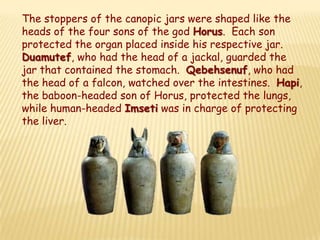
The stoppers of the canopic jars were shaped like the
heads of the four sons of the god Horus. Each son
protected the organ placed inside his respective jar.
Duamutef, who had the head of a jackal, guarded the
jar that contained the stomach. Qebehsenuf, who had
the head of a falcon, watched over the intestines. Hapi,
the baboon-headed son of Horus, protected the lungs,
while human-headed Imseti was in charge of protecting
the liver.
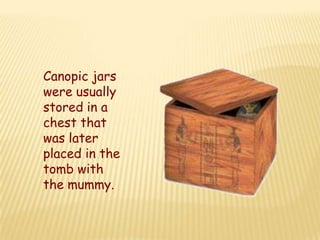
Canopic jars
were usually
stored in a
chest that
was later
placed in the
tomb with
the mummy.
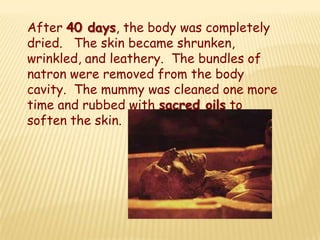
After 40 days, the body was completely
dried. The skin became shrunken,
wrinkled, and leathery. The bundles of
natron were removed from the body
cavity. The mummy was cleaned one more
time and rubbed with sacred oils to
soften the skin.
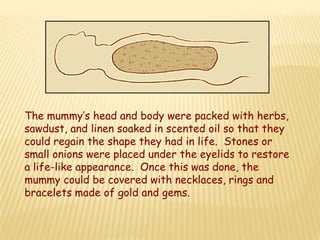
The mummy’s head and body were packed with herbs,
sawdust, and linen soaked in scented oil so that they
could regain the shape they had in life. Stones or
small onions were placed under the eyelids to restore
a life-like appearance. Once this was done, the
mummy could be covered with necklaces, rings and
bracelets made of gold and gems.
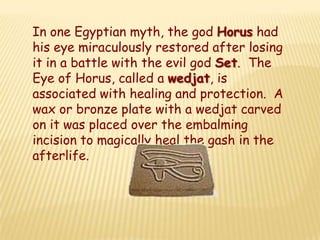
In one Egyptian myth, the god Horus had
his eye miraculously restored after losing
it in a battle with the evil god Set. The
Eye of Horus, called a wedjat, is
associated with healing and protection. A
wax or bronze plate with a wedjat carved
on it was placed over the embalming
incision to magically heal the gash in the
afterlife.
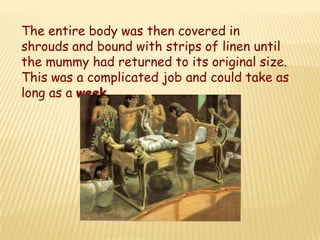
The entire body was then covered in
shrouds and bound with strips of linen until
the mummy had returned to its original size.
This was a complicated job and could take as
long as a week.
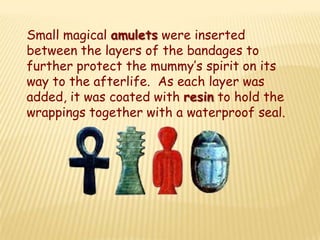
Small magical amulets were inserted
between the layers of the bandages to
further protect the mummy’s spirit on its
way to the afterlife. As each layer was
added, it was coated with resin to hold the
wrappings together with a waterproof seal.
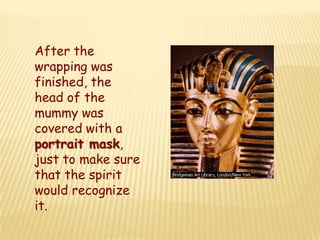
After the
wrapping was
finished, the
head of the
mummy was
covered with a
portrait mask,
just to make sure
that the spirit
would recognize
it.
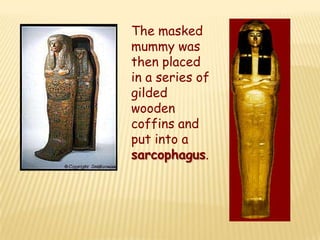
The masked
mummy was
then placed
in a series of
gilded
wooden
coffins and
put into a
sarcophagus.
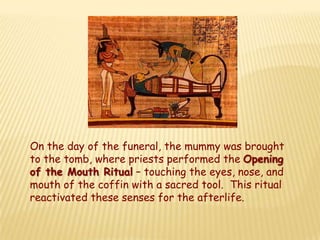
On the day of the funeral, the mummy was brought
to the tomb, where priests performed the Opening
of the Mouth Ritual – touching the eyes, nose, and
mouth of the coffin with a sacred tool. This ritual
reactivated these senses for the afterlife.
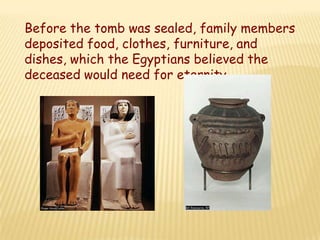
Before the tomb was sealed, family members
deposited food, clothes, furniture, and
dishes, which the Egyptians believed the
deceased would need for eternity.
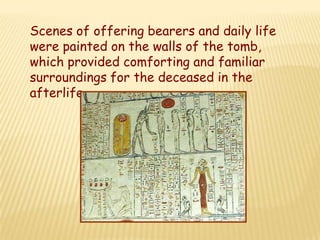
Scenes of offering bearers and daily life
were painted on the walls of the tomb,
which provided comforting and familiar
surroundings for the deceased in the
afterlife.
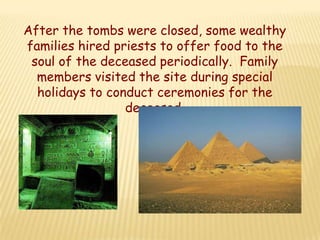
After the tombs were closed, some wealthy
families hired priests to offer food to the
 soul of the deceased periodically. Family
  members visited the site during special
  holidays to conduct ceremonies for the
                 deceased.
The End

Hum2220 1330 egyptian mummification

  • 1.
    Professor Will Adams ValenciaCollege Fall 2011 EGYPTIAN MUMMIFICATION
  • 2.
    Purpose of Egyptian Mummification The ancient Egyptians believed that after death their bodies would travel to another world during the day, and at night they would return to their bodies.
  • 3.
    In order forthe person’s spirit, or ka, to live forever, it had to be able to recognize and return to the body. If a spirit could not recognize the body it belonged to, it would die. This is why the Egyptians wanted to preserve the bodies of the dead in as lifelike a state as possible. Mummification guaranteed eternal life for the spirit.
  • 4.
    The Mummification Process The entire process took 70 days to complete. Several embalmers conducted the task in the special embalming shop, or per nefer. The chief embalmer was known as the hery sheshta. He wore a jackal mask to represent Anubis, the god of mummification.
  • 5.
    After the bodyhad been shaved and washed with wine and spices, all of the parts that might decay were removed. The embalmers first removed the brain through the nose using a long hook.
  • 6.
    The long hookwas used to stir up the brain until it was liquefied. Then the embalmers would turn the body face down to allow the brain to ooze out through the nostrils. The Egyptians were so rough on the brain because they didn’t realize its importance. They thought its sole purpose was to produce snot!
  • 7.
    Next they would removethe soft, moist body parts that would cause decay. A deep incision was made in the left side of the abdomen to remove the internal organs: the lungs, the stomach, the liver and the
  • 8.
    In some casesthey removed the heart, but in others they left it, because it was considered to be the seat of the soul that testified on behalf of the deceased during judgment before the gods.
  • 9.
    The body wasstuffed with bundles of strong drying salt called natron.
  • 10.
    It was thencompletely covered with natron and placed on a slanted couch so that any fluids that dripped out as the body was drying could be collected and buried along with it.
  • 11.
    While the bodywas drying, the internal organs were also dried and preserved with natron. They were then wrapped in strips of linen and put into separate containers called canopic jars. The Egyptians believed that all body parts would be magically reunited in the afterlife and the body would become whole again, just like the god Osiris.
  • 12.
    According to Egyptian mythology,the god Osiris was murdered by his jealous brother Set and hacked into pieces. The goddess Isis reassembled the pieces and Osiris was magically restored, and went on to become the god of the afterlife.
  • 13.
    The stoppers ofthe canopic jars were shaped like the heads of the four sons of the god Horus. Each son protected the organ placed inside his respective jar. Duamutef, who had the head of a jackal, guarded the jar that contained the stomach. Qebehsenuf, who had the head of a falcon, watched over the intestines. Hapi, the baboon-headed son of Horus, protected the lungs, while human-headed Imseti was in charge of protecting the liver.
  • 14.
    Canopic jars were usually storedin a chest that was later placed in the tomb with the mummy.
  • 15.
    After 40 days,the body was completely dried. The skin became shrunken, wrinkled, and leathery. The bundles of natron were removed from the body cavity. The mummy was cleaned one more time and rubbed with sacred oils to soften the skin.
  • 16.
    The mummy’s headand body were packed with herbs, sawdust, and linen soaked in scented oil so that they could regain the shape they had in life. Stones or small onions were placed under the eyelids to restore a life-like appearance. Once this was done, the mummy could be covered with necklaces, rings and bracelets made of gold and gems.
  • 17.
    In one Egyptianmyth, the god Horus had his eye miraculously restored after losing it in a battle with the evil god Set. The Eye of Horus, called a wedjat, is associated with healing and protection. A wax or bronze plate with a wedjat carved on it was placed over the embalming incision to magically heal the gash in the afterlife.
  • 18.
    The entire bodywas then covered in shrouds and bound with strips of linen until the mummy had returned to its original size. This was a complicated job and could take as long as a week.
  • 19.
    Small magical amuletswere inserted between the layers of the bandages to further protect the mummy’s spirit on its way to the afterlife. As each layer was added, it was coated with resin to hold the wrappings together with a waterproof seal.
  • 20.
    After the wrapping was finished,the head of the mummy was covered with a portrait mask, just to make sure that the spirit would recognize it.
  • 21.
    The masked mummy was thenplaced in a series of gilded wooden coffins and put into a sarcophagus.
  • 22.
    On the dayof the funeral, the mummy was brought to the tomb, where priests performed the Opening of the Mouth Ritual – touching the eyes, nose, and mouth of the coffin with a sacred tool. This ritual reactivated these senses for the afterlife.
  • 23.
    Before the tombwas sealed, family members deposited food, clothes, furniture, and dishes, which the Egyptians believed the deceased would need for eternity.
  • 24.
    Scenes of offeringbearers and daily life were painted on the walls of the tomb, which provided comforting and familiar surroundings for the deceased in the afterlife.
  • 25.
    After the tombswere closed, some wealthy families hired priests to offer food to the soul of the deceased periodically. Family members visited the site during special holidays to conduct ceremonies for the deceased.
  • 26.