(Chemistry-DSE-1002D: Inorganic and Physical Chemistry,
Section-I)
Coordination Chemistry: Theories of
Metal Complexes
Molecular Orbital Theory (MOT)
Section-I)
BY
Dr. Sarita D. Shinde
M.Sc., PhD
Assistant Professor in Chemistry
Vivekanand College, Kolhapur (Autonomous)
1. Introduction
2. Salient features of MOT of
octahedral complexes with sigma
Objectives
bonding such as [Ti(H2O)6]3+,
[CoF6] 3– , [Co(NH3)6]3+
3. Merits and demerits of MOT.
1. CFT gives total emphasis on ionic bonding. Even partial
covalent bonding is not considered.
2. CFT considers only metal d-orbitals. Other metal
orbitals, s- and p-orbitals not considered.
3. CFT does not consider ligand orbitals. Therefore their
interaction with metal orbitals is not explained by CFT.
Limitations of CFT
interaction with metal orbitals is not explained by CFT.
4. Pi bonding not considered by CFT.
5. CFT fails to explain charge transfer spectra.
6. Nephelauxetic effect (Cloud expansion effect) is not
explained by CFT.
7. CFT fails to explain the relative strength of ligands. For
e.g. Though H2O is neutral ligand, it is stronger ligand
than negatively charged OH-.
Molecular Orbital Theory (MOT)
MOT was proposed by Hund, Mulliken and Huckel in 1930
This theory consider metal-ligand bonding as purely ionic, purely
covalent or any intermediate case.
According to this theory atomic orbitals combine to form molecular
orbitals. To form molecular orbitals, atomic orbitals must have
i. Same symmetry
ii. Similar or comparable energy
iii. Appreciable overlap (i.e. extent of overlap should be large)
Symmetry classes of Atomic Orbitals ( Group Theoretical symbols)
Sr. No. Metal orbitals Symmetry symbols of metal
orbitals
1 s a1g
2 Px, py, pz t1u
3 dx
2
-y
2, dz
2 eg
4 Dxy, dyz, dxz t2g
a = absency of degeneracy i.e. singly degenerate
e = doubly degenerate
t = triply degenerate
u = ungerade (non-centrosymmetric) i.e. uneven
g = gerade ( centrosymmetric) i.e. even
1. Central metal ion makes available 9 orbitals for bonding
Six orbitals s, px, py, pz , dx2-y2 and dz2 orbitals for
sigma bonding.
Three orbitals dxy , dyz and dxz orbitals for pi bonding
2. Each ligand must have atleast one sigma bonding orbital.
3. Six sigma ligand orbitals are combined to form a set of
six ligand group orbitals LGOs.
Each of these having matching symmetries is
constructed so as to have effective overlap with metal
Assumptions of MOT
constructed so as to have effective overlap with metal
orbitals as shown in figure
4. Each metal orbital linearly combines with its matching
symmetry ligand orbital LGOs to form corresponding
bonding MOs and antibonding MOs.
5. If the ligand posses pi orbital along with sigma orbitals,
then pi orbitals also combine to form symmetry orbitals
which should be further able to overlap effectively with
the matching metal ion pi orbitals and form bonding and
antibonding MOs
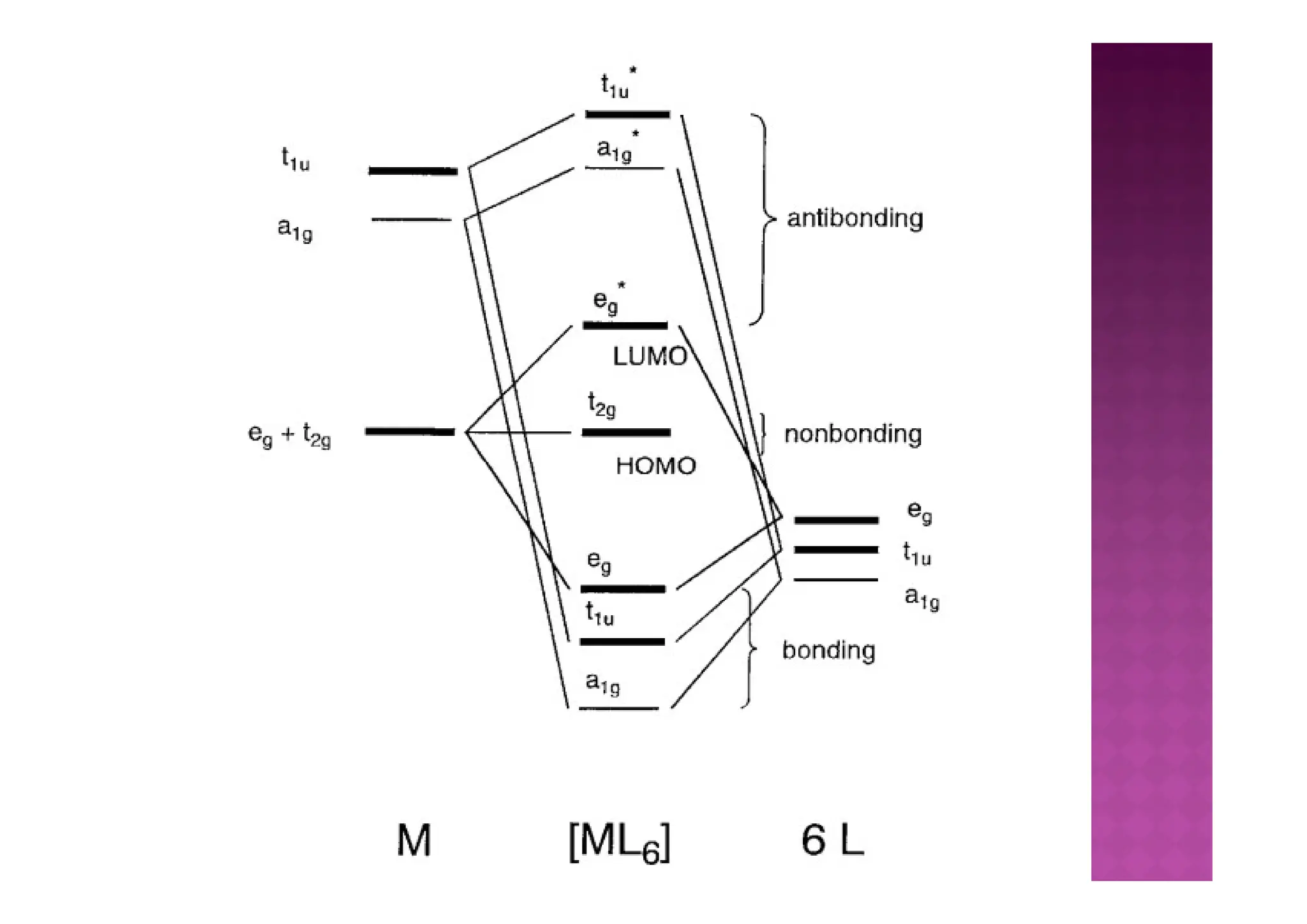
MOT of Octahedral complex with sigma bonding
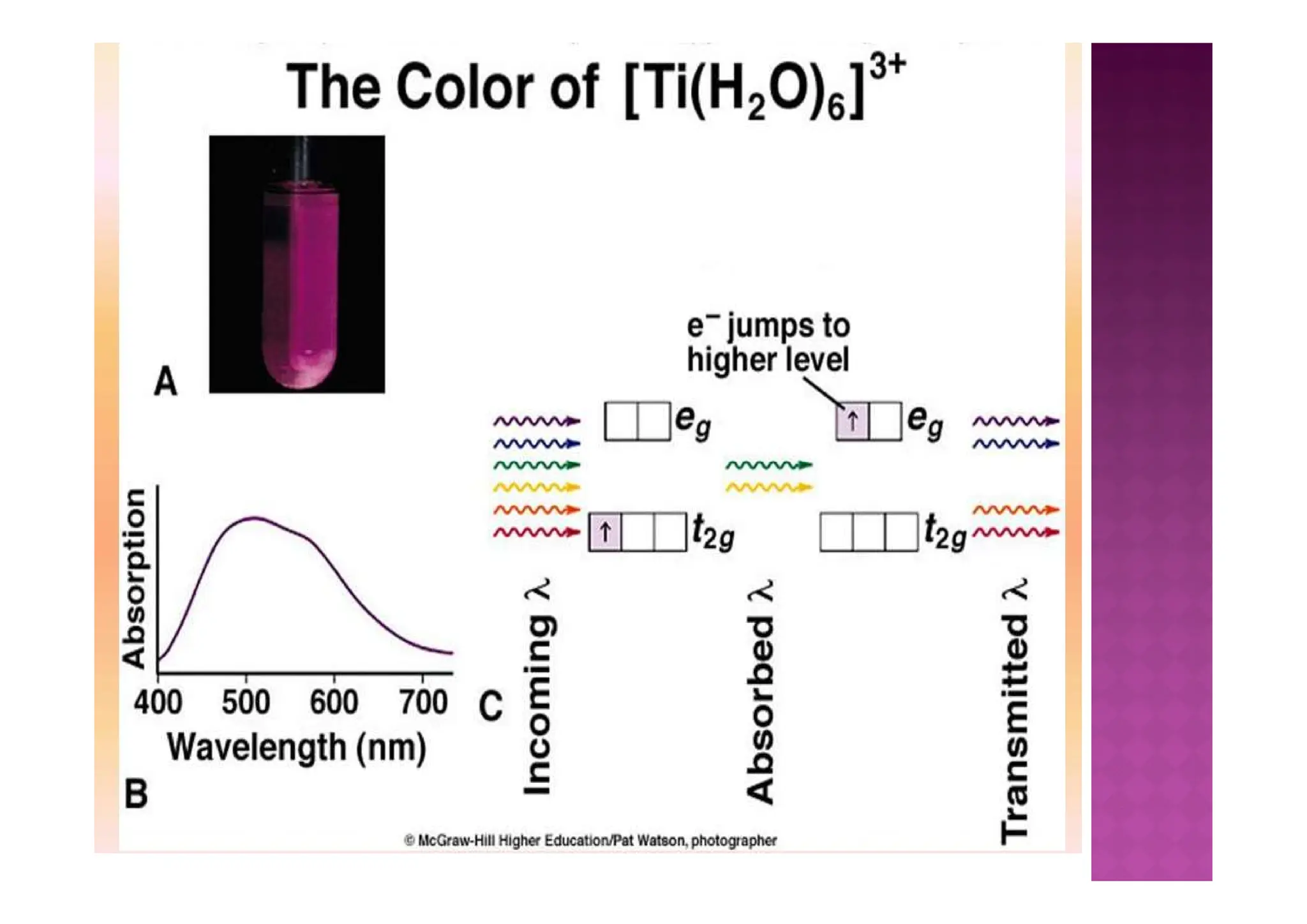
Ti (Z=22) [Ar] 4s2, 3d2
Central metal ion Ti 3+ = [Ar] 4s0, 3d1
Ligand = six H2O molecules
Formation of octahedral complex [TiH2O)6]3+
small
Formation of octahedral complex [CoF6]3-
Co (Z=27) [Ar] 4s2, 3d7
Central metal ion Co 3+ = [Ar] 4s0, 3d6
Ligand = six F-
∆o ˂ P
∆o= 155 KJ/mole
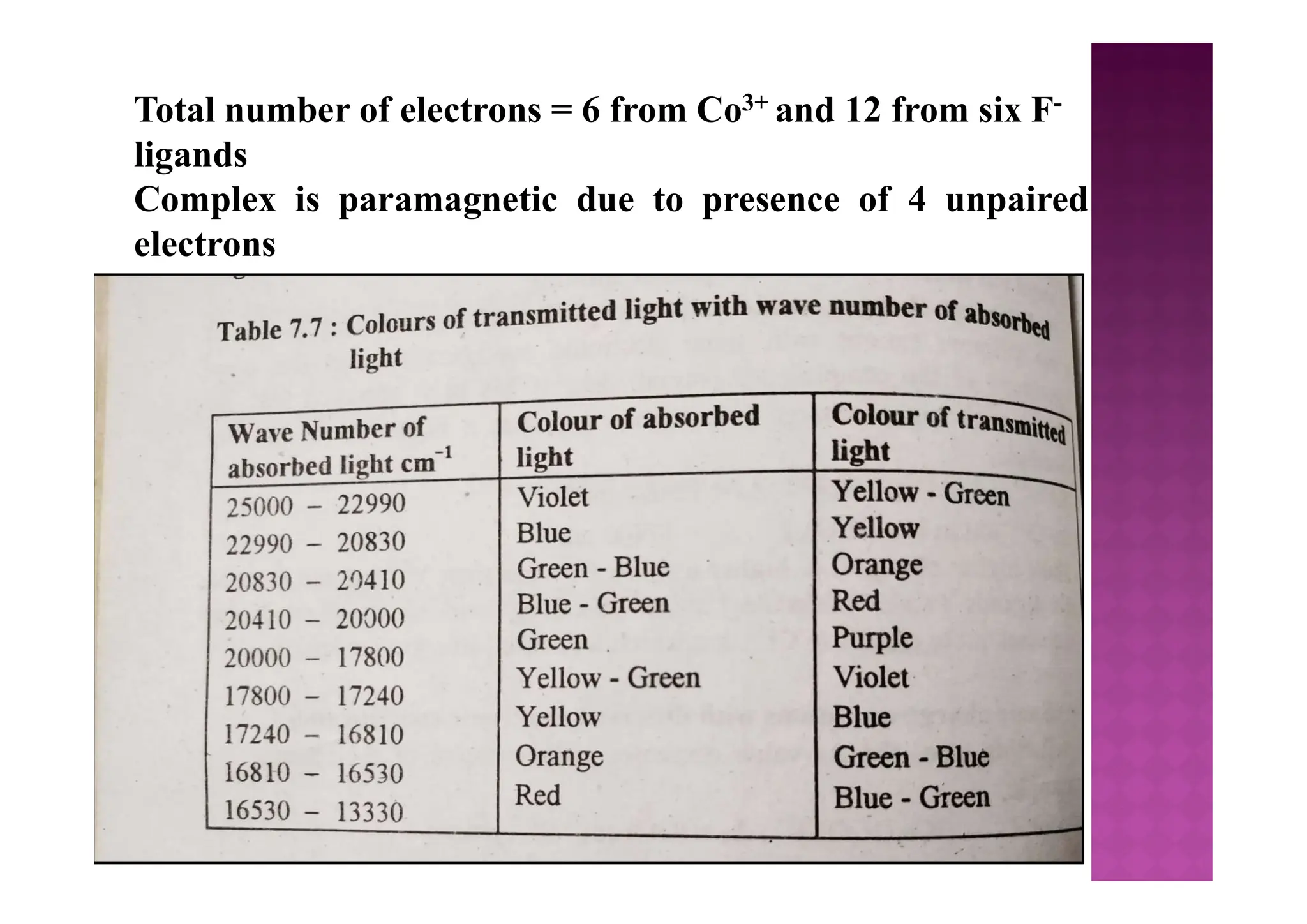
Color absorbed- orange yellow
Color transmitted- blue green
Total number of electrons = 6 from Co3+ and 12 from six F-
ligands
Complex is paramagnetic due to presence of 4 unpaired
electrons
Co (Z=27) [Ar] 4s2, 3d7
Central metal ion Co 3+ = [Ar] 4s0, 3d6
Ligand = six NH3 molecules
Formation of octahedral complex [Co(NH3)6]3+
∆o ˃ P
∆o= 296 KJ/mole
Color absorbed-
Violet
large
Violet
Color transmitted-
yellow green- orange
1. It is complete theory.
2. It has considered every possible interaction
between metal orbitals and ligand orbitals.
3. Pi bonding is explained.
4. Charge transfer spectra explained satisfactorily.
5. Nephelauexetic effect (Cloud expansion effect) is
explained.
Merits of MOT
explained.
6. Magnetic properties are explained very well.
16

The MOT - Molecular orbital theory. pdff

  • 1.
    (Chemistry-DSE-1002D: Inorganic andPhysical Chemistry, Section-I) Coordination Chemistry: Theories of Metal Complexes Molecular Orbital Theory (MOT) Section-I) BY Dr. Sarita D. Shinde M.Sc., PhD Assistant Professor in Chemistry Vivekanand College, Kolhapur (Autonomous)
  • 2.
    1. Introduction 2. Salientfeatures of MOT of octahedral complexes with sigma Objectives bonding such as [Ti(H2O)6]3+, [CoF6] 3– , [Co(NH3)6]3+ 3. Merits and demerits of MOT.
  • 3.
    1. CFT givestotal emphasis on ionic bonding. Even partial covalent bonding is not considered. 2. CFT considers only metal d-orbitals. Other metal orbitals, s- and p-orbitals not considered. 3. CFT does not consider ligand orbitals. Therefore their interaction with metal orbitals is not explained by CFT. Limitations of CFT interaction with metal orbitals is not explained by CFT. 4. Pi bonding not considered by CFT. 5. CFT fails to explain charge transfer spectra. 6. Nephelauxetic effect (Cloud expansion effect) is not explained by CFT. 7. CFT fails to explain the relative strength of ligands. For e.g. Though H2O is neutral ligand, it is stronger ligand than negatively charged OH-.
  • 4.
    Molecular Orbital Theory(MOT) MOT was proposed by Hund, Mulliken and Huckel in 1930 This theory consider metal-ligand bonding as purely ionic, purely covalent or any intermediate case. According to this theory atomic orbitals combine to form molecular orbitals. To form molecular orbitals, atomic orbitals must have i. Same symmetry ii. Similar or comparable energy iii. Appreciable overlap (i.e. extent of overlap should be large) Symmetry classes of Atomic Orbitals ( Group Theoretical symbols) Symmetry classes of Atomic Orbitals ( Group Theoretical symbols) Sr. No. Metal orbitals Symmetry symbols of metal orbitals 1 s a1g 2 Px, py, pz t1u 3 dx 2 -y 2, dz 2 eg 4 Dxy, dyz, dxz t2g a = absency of degeneracy i.e. singly degenerate e = doubly degenerate t = triply degenerate
  • 5.
    u = ungerade(non-centrosymmetric) i.e. uneven g = gerade ( centrosymmetric) i.e. even
  • 8.
    1. Central metalion makes available 9 orbitals for bonding Six orbitals s, px, py, pz , dx2-y2 and dz2 orbitals for sigma bonding. Three orbitals dxy , dyz and dxz orbitals for pi bonding 2. Each ligand must have atleast one sigma bonding orbital. 3. Six sigma ligand orbitals are combined to form a set of six ligand group orbitals LGOs. Each of these having matching symmetries is constructed so as to have effective overlap with metal Assumptions of MOT constructed so as to have effective overlap with metal orbitals as shown in figure 4. Each metal orbital linearly combines with its matching symmetry ligand orbital LGOs to form corresponding bonding MOs and antibonding MOs. 5. If the ligand posses pi orbital along with sigma orbitals, then pi orbitals also combine to form symmetry orbitals which should be further able to overlap effectively with the matching metal ion pi orbitals and form bonding and antibonding MOs
  • 9.
    MOT of Octahedralcomplex with sigma bonding Ti (Z=22) [Ar] 4s2, 3d2 Central metal ion Ti 3+ = [Ar] 4s0, 3d1 Ligand = six H2O molecules Formation of octahedral complex [TiH2O)6]3+
  • 12.
    small Formation of octahedralcomplex [CoF6]3- Co (Z=27) [Ar] 4s2, 3d7 Central metal ion Co 3+ = [Ar] 4s0, 3d6 Ligand = six F- ∆o ˂ P ∆o= 155 KJ/mole Color absorbed- orange yellow Color transmitted- blue green Color transmitted- blue green
  • 13.
    Total number ofelectrons = 6 from Co3+ and 12 from six F- ligands Complex is paramagnetic due to presence of 4 unpaired electrons
  • 14.
    Co (Z=27) [Ar]4s2, 3d7 Central metal ion Co 3+ = [Ar] 4s0, 3d6 Ligand = six NH3 molecules Formation of octahedral complex [Co(NH3)6]3+ ∆o ˃ P ∆o= 296 KJ/mole Color absorbed- Violet large Violet Color transmitted- yellow green- orange
  • 15.
    1. It iscomplete theory. 2. It has considered every possible interaction between metal orbitals and ligand orbitals. 3. Pi bonding is explained. 4. Charge transfer spectra explained satisfactorily. 5. Nephelauexetic effect (Cloud expansion effect) is explained. Merits of MOT explained. 6. Magnetic properties are explained very well.
  • 16.