Welcome
• The M O theory is more complicated than the V B
and C F theories, explains more satisfactorily the
nature of bonding involved in coordination
complexes.
• The symbols a, e and t stand for non-degenerate,
doubly degenerate and triply degenerate orbitals.
• The symmetry symbol for a particular orbital of the
metal may be different in different environments.
M O Theory of Coordination complexes
• Thus a set of P orbitals of a metal has t1u symmetry in
octahedral environment whereas it has t2 symmetry in
tetrahedral environment.
• An effective combination of atomic orbitals to form
molecular orbitals requires that
• 1. The symmetry of the combining atomic orbitals must be
the same so the additive combination of atomic orbitals
permits the maximum overlap of orbitals.
• 2.The difference in the energies of the combining orbitals is
not very large.
• 3.If two atomic orbitals are of unequal energies , then
the bonding molecular orbital would have more
characteristics of the lower energy atomic orbital and
the antibonding molecular orbital would have more
characteristics of the higher energy atomic orbital.
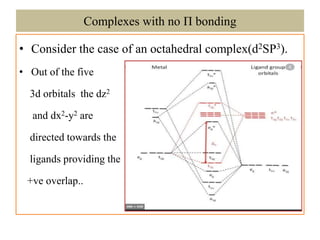
• Consider the case of an octahedral complex(d2SP3).
• Out of the five
3d orbitals the dz2
and dx2-y2 are
directed towards the
ligands providing the
+ve overlap..
Complexes with no Π bonding
• The three remaining d-orbitals dxy, dxz and dyz are
directed between the ligands and the net overlap is zero.
• The metal t2g orbitals can not form ϭ bonds.They may be
considered as non-bonding orbitals.
• S orbital transform as a1g. P orbitals as t1u.d-orbitals split
into two eg and t2g.
• The spherical 4s orbital (a1g) combines with LGOs of
t1u symmetry.
• The overlap of 4s and 4p orbitals with the ligands is
considerably better than that of the 3d orbitals.
• As a result the a1g and t1u molecular orbitals are the
lowest energy and the corresponding a1g* and t1u*
antibonding orbitals the highest in energy.
• The eg and eg* orbitals arising from the 3d orbitals are
displaced less from their bary centre.
• The t2g orbitals are non bonding in a σ only system.
They are used for Π bonding.
• Electrons may be added to most of the complex in the
order of increasing energy.
• Consider the complex [Co(NH3)6]3+ .There will be a
total of 18 electrons, 12 from lone pairs on the
nitrogen atom and 6 from the 3d6 configuration of
Co3+ ion.
• Electronic configuration will then be a1g
2, t1u
6, e1g
4,
t2g
6 .The complex is diamagnetic.
• Thus both MOT and CFT account for the magnetic
and spectral properties of octahedral complex ions by
supporting the existence of two sets of orbitals
separated by an energy gap 10Dq.
Thank you

Mo theory

  • 1.
  • 2.
    • The MO theory is more complicated than the V B and C F theories, explains more satisfactorily the nature of bonding involved in coordination complexes. • The symbols a, e and t stand for non-degenerate, doubly degenerate and triply degenerate orbitals. • The symmetry symbol for a particular orbital of the metal may be different in different environments. M O Theory of Coordination complexes
  • 3.
    • Thus aset of P orbitals of a metal has t1u symmetry in octahedral environment whereas it has t2 symmetry in tetrahedral environment. • An effective combination of atomic orbitals to form molecular orbitals requires that • 1. The symmetry of the combining atomic orbitals must be the same so the additive combination of atomic orbitals permits the maximum overlap of orbitals. • 2.The difference in the energies of the combining orbitals is not very large.
  • 4.
    • 3.If twoatomic orbitals are of unequal energies , then the bonding molecular orbital would have more characteristics of the lower energy atomic orbital and the antibonding molecular orbital would have more characteristics of the higher energy atomic orbital.
  • 5.
    • Consider thecase of an octahedral complex(d2SP3). • Out of the five 3d orbitals the dz2 and dx2-y2 are directed towards the ligands providing the +ve overlap.. Complexes with no Π bonding
  • 6.
    • The threeremaining d-orbitals dxy, dxz and dyz are directed between the ligands and the net overlap is zero. • The metal t2g orbitals can not form ϭ bonds.They may be considered as non-bonding orbitals. • S orbital transform as a1g. P orbitals as t1u.d-orbitals split into two eg and t2g.
  • 7.
    • The spherical4s orbital (a1g) combines with LGOs of t1u symmetry. • The overlap of 4s and 4p orbitals with the ligands is considerably better than that of the 3d orbitals. • As a result the a1g and t1u molecular orbitals are the lowest energy and the corresponding a1g* and t1u* antibonding orbitals the highest in energy. • The eg and eg* orbitals arising from the 3d orbitals are displaced less from their bary centre.
  • 8.
    • The t2gorbitals are non bonding in a σ only system. They are used for Π bonding. • Electrons may be added to most of the complex in the order of increasing energy. • Consider the complex [Co(NH3)6]3+ .There will be a total of 18 electrons, 12 from lone pairs on the nitrogen atom and 6 from the 3d6 configuration of Co3+ ion. • Electronic configuration will then be a1g 2, t1u 6, e1g 4, t2g 6 .The complex is diamagnetic.
  • 9.
    • Thus bothMOT and CFT account for the magnetic and spectral properties of octahedral complex ions by supporting the existence of two sets of orbitals separated by an energy gap 10Dq.
  • 10.