PRESENTATION
     OF
  CHEMISTRY
PRESENTED TO
MA’AM TAHIRA TARIQ
  PRESENTED BY
   HINA JABEEN
   ROLL NO: 120
TEACHING MATERIALS

 White board
 Duster
 Marker
 Books
GENERAL OBJECTIVES
 Enable the student to acquire
  comprehension of chemistry.
 To compare learnt knowledge with
  surrounding.
 To develop interest among student
  towards chemistry.
 Enable the student to apply the leant
  knowledge.
SPEACIFIC KNOWLEDGE
At the end of the topic student will be able to
 Sketch a Denial cell, label cathode, anode
  and direction of the flow of electron.
 Distinguish between electrolytic and
  voltaic cell.
 Identify half cell in which oxidation occur
  and half cell in which reduction occur in
  voltaic cell.
Previous knowledge
   Define electro chemical cell?

   What are the types of electro chemical
    cell, name them?

   Define electrolytic cell and voltaic cell?
INTRODUCTION
   ELECTRO CHEMICAL CELL: An arrangement
    which consist of electrodes dipped into an
    electrolyte in which chemical reaction
    uses/generates electric current .
   ELECROLYTIC CELL: The electro chemical cell
    in which a reaction occur with the help of electric
    current.
   VOLTAIC/GALVANIC CELL: The electro
    chemical cell in which a reaction generates
    electric current.
ELECTRO-CHEMICAL
       REACTION

We  discuss electrolysis of :
A) fused salt
B) Aqueous solution of salt
Electrolysis of aq. sol. of Salt
    Not so simple
    Reason

 Undergoes               REDOX reaction of H2O

•Along with redox reaction of dissolved salt
•Product -------not precisely predicted
       e.g. KNO3
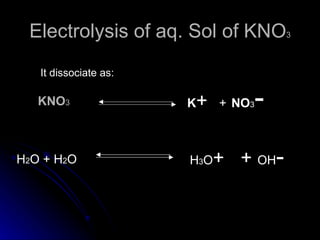
Electrolysis of aq. Sol of KNO3
   It dissociate as:

   KNO3                K+ + NO3-
H2O + H2O              H3O+   + OH-
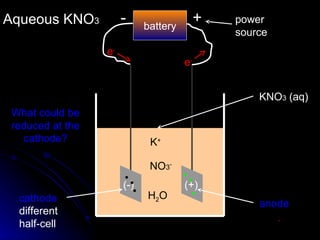
Aqueous KNO3           -     battery
                                            +   power
                                                source
                  e-
                                       e-


                                                    KNO3 (aq)
 What could be
 reduced at the
   cathode?                   K+

                              NO3-
                       (-)             (+)
  cathode                    H2O
                                                    anode
  different
                                                         -
  half-cell
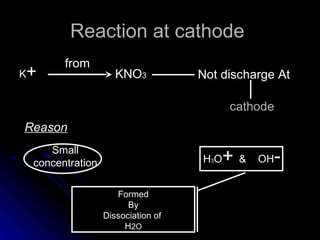
Reaction at cathode
          from
+
K                      KNO3           Not discharge At

                                            cathode
Reason
       Small
    concentration                     H3O   +&   OH-
                       Formed
                          By
                    Dissociation of
                         H2O
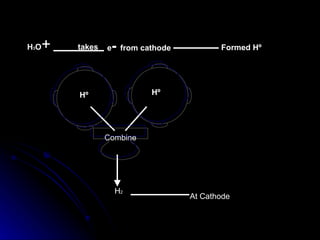
H3O   +   takes   e- from cathode          Formed Hº


          Hº                Hº


                  Combine


                      H2
                                    At Cathode
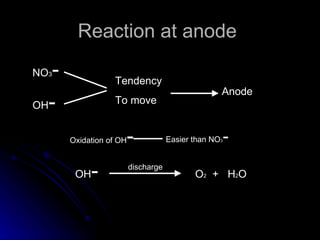
Reaction at anode
NO3   -              Tendency
                                                      Anode
OH-                  To move


                        -
          Oxidation of OH                             -
                                        Easier than NO3


           OH  -            discharge
                                               O2 + H2O
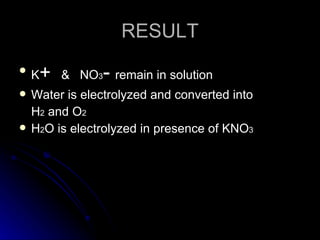
RESULT

                -
    K+ & NO3 remain in solution
   Water is electrolyzed and converted into
    H2 and O2
   H2O is electrolyzed in presence of KNO3
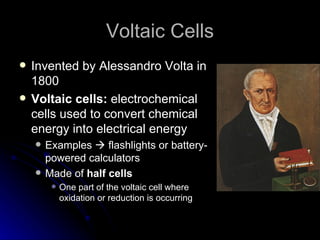
Voltaic Cells
   Invented by Alessandro Volta in
    1800
   Voltaic cells: electrochemical
    cells used to convert chemical
    energy into electrical energy
       Examples  flashlights or battery-
        powered calculators
       Made of half cells
            One part of the voltaic cell where
             oxidation or reduction is occurring
VOLTAIC CELL/GALVANIC
         CELL:

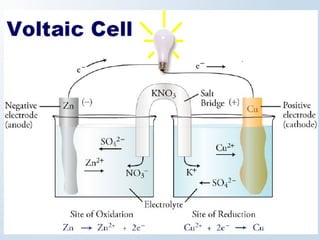
To understand the working of voltaic
  cell, take example of Daniel cell
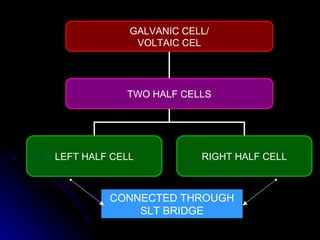
GALVANIC CELL/
              VOLTAIC CEL


            TWO HALF CELLS


LEFT HALF CELL           RIGHT HALF CELL


         CONNECTED THROUGH
             SLT BRIDGE
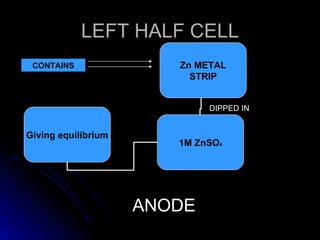
LEFT HALF CELL
 CONTAINS               Zn METAL
                          STRIP


                             DIPPED IN


Giving equilibrium
                        1M ZnSO4


                     ANODE
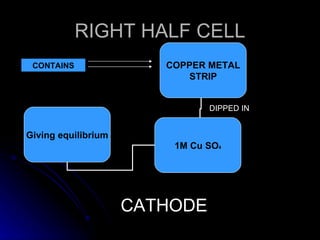
RIGHT HALF CELL
 CONTAINS               COPPER METAL
                            STRIP


                               DIPPED IN


Giving equilibrium
                         1M Cu SO4


                     CATHODE
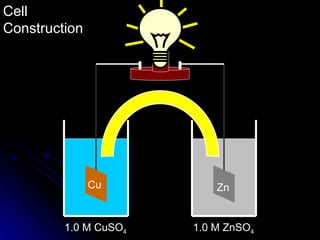
Cell
Construction


               Cu          Zn


         1.0 M CuSO4   1.0 M ZnSO4
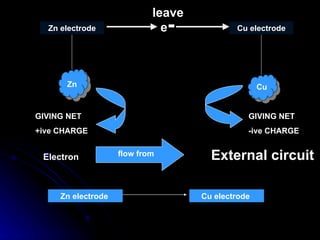
leave
  Zn electrode                e -           Cu electrode


      Zn                                           Cu


GIVING NET                                     GIVING NET
+ive CHARGE                                    -ive CHARGE


 Electron           flow from         External circuit

     Zn electrode                   Cu electrode
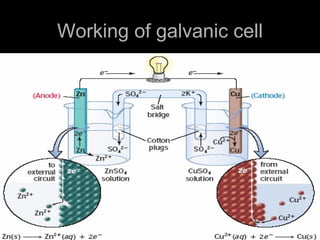
Working of galvanic cell
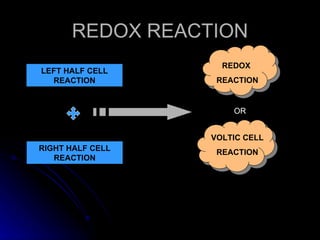
REDOX REACTION
                    REDOX
LEFT HALF CELL
  REACTION         REACTION


                      OR


                  VOLTIC CELL
RIGHT HALF CELL    REACTION
   REACTION
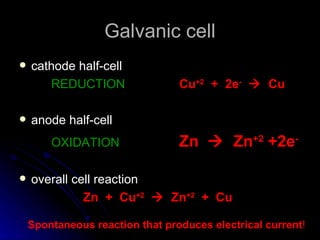
Galvanic cell
   cathode half-cell
       REDUCTION                 Cu+2 + 2e-  Cu

   anode half-cell
        OXIDATION                Zn  Zn+2 +2e-

   overall cell reaction
              Zn + Cu+2  Zn+2 + Cu

    Spontaneous reaction that produces electrical current!
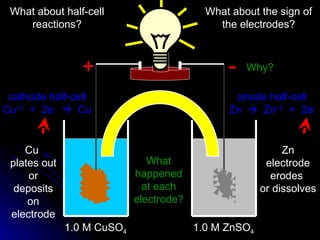
What about half-cell                      What about the sign of
    reactions?                               the electrodes?


                 +                             -   Why?

 cathode half-cell                              anode half-cell
Cu+2 + 2e-  Cu                                Zn  Zn+2 + 2e-


    Cu                                                      Zn
 plates out                    What                     electrode
     or                     happened                     erodes
  deposits        Cu          at each        Zn        or dissolves
     on                     electrode?
 electrode
              1.0 M CuSO4                1.0 M ZnSO4
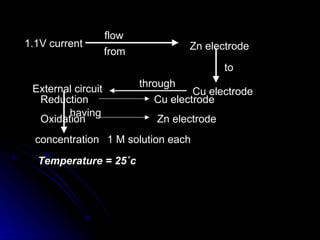
flow
1.1V current                         Zn electrode
                    from
                                             to
                           through
 External circuit                     Cu electrode
  Reduction                   Cu electrode
        having
  Oxidation                   Zn electrode
  concentration 1 M solution each

  Temperature = 25˚c
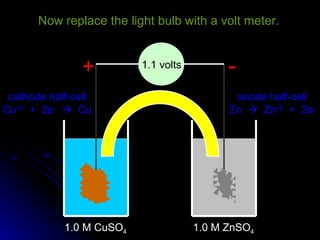
Now replace the light bulb with a volt meter.


                +         1.1 volts         -
 cathode half-cell                           anode half-cell
Cu+2 + 2e-  Cu                             Zn  Zn+2 + 2e-


                 Cu                       Zn


            1.0 M CuSO4               1.0 M ZnSO4
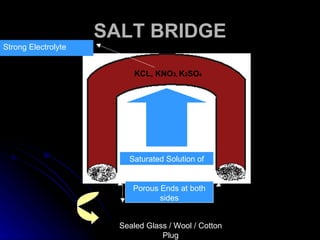
SALT BRIDGE
Strong Electrolyte


                           KCL, KNO3, K2SO4


                         Saturated Solution of


                          Porous Ends at both
                                 sides


                       Sealed Glass / Wool / Cotton
                                  Plug
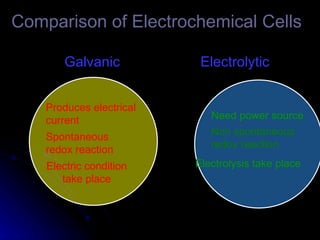
Comparison of Electrochemical Cells

        Galvanic           Electrolytic


    Produces electrical
    current                  Need power source
                             Non spontaneous
    Spontaneous
                             redox reaction
    redox reaction
    Electric condition    Electrolysis take place
       take place
QUESTIONS
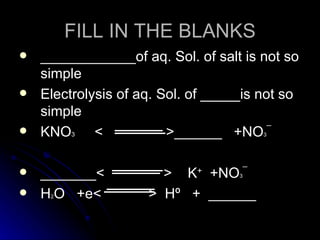
FILL IN THE BLANKS
   ____________of aq. Sol. of salt is not so
    simple
   Electrolysis of aq. Sol. of _____is not so
    simple
   KNO3 <               >______ +NO ¯  3


   _______<           > K+ +NO ¯   3


   H O +e<
     2               > Hº + ______
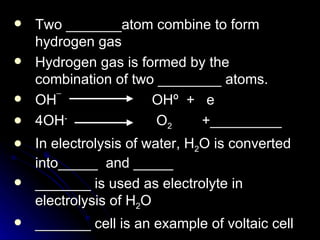
   Two _______atom combine to form
    hydrogen gas
   Hydrogen gas is formed by the
    combination of two ________ atoms.
   OH¯               OHº + e
   4OH-               O2    +_________
   In electrolysis of water, H2O is converted
    into_____ and _____
   _______ is used as electrolyte in
    electrolysis of H2O
   _______ cell is an example of voltaic cell
1.   Voltaic/galvanic cell consist of _____ half
     cell
2.   Two half cell are connected through
     ___________
3.   Right half cell contain _____ metal strip
4.   Left half cell contain _____ metal strip
5.   Cu metal strip is dipped into 1M sol. Of
     ______
6.   Zn metal strip is dipped into 1M sol. Of
     ______
7.   Sum of two half cell reaction is called
     ________ reaction
1.   Salt bridge is _____ shape
2.    Salt bridge is made up of ______ tube
3.   Tube of salt bridge is ______ at both end
4.   End of salt bridge Is made up of _____
     material
5.   _______ material hold the solution in U
     shaped
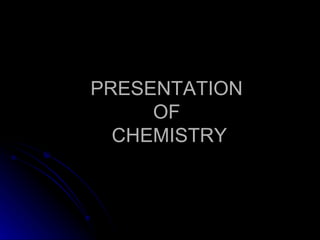
Identify the following
 Anode
 Cathode
                 +      1.1 volts    -
 Salt bridge


                  Cu                Zn

Electro chemical cells

  • 1.
    PRESENTATION OF CHEMISTRY
  • 2.
    PRESENTED TO MA’AM TAHIRATARIQ PRESENTED BY HINA JABEEN ROLL NO: 120
  • 3.
    TEACHING MATERIALS  Whiteboard  Duster  Marker  Books
  • 4.
    GENERAL OBJECTIVES  Enablethe student to acquire comprehension of chemistry.  To compare learnt knowledge with surrounding.  To develop interest among student towards chemistry.  Enable the student to apply the leant knowledge.
  • 5.
    SPEACIFIC KNOWLEDGE At theend of the topic student will be able to  Sketch a Denial cell, label cathode, anode and direction of the flow of electron.  Distinguish between electrolytic and voltaic cell.  Identify half cell in which oxidation occur and half cell in which reduction occur in voltaic cell.
  • 6.
    Previous knowledge  Define electro chemical cell?  What are the types of electro chemical cell, name them?  Define electrolytic cell and voltaic cell?
  • 7.
    INTRODUCTION  ELECTRO CHEMICAL CELL: An arrangement which consist of electrodes dipped into an electrolyte in which chemical reaction uses/generates electric current .  ELECROLYTIC CELL: The electro chemical cell in which a reaction occur with the help of electric current.  VOLTAIC/GALVANIC CELL: The electro chemical cell in which a reaction generates electric current.
  • 8.
    ELECTRO-CHEMICAL REACTION We discuss electrolysis of : A) fused salt B) Aqueous solution of salt
  • 9.
    Electrolysis of aq.sol. of Salt  Not so simple  Reason Undergoes REDOX reaction of H2O •Along with redox reaction of dissolved salt •Product -------not precisely predicted e.g. KNO3
  • 10.
    Electrolysis of aq.Sol of KNO3 It dissociate as: KNO3 K+ + NO3- H2O + H2O H3O+ + OH-
  • 11.
    Aqueous KNO3 - battery + power source e- e- KNO3 (aq) What could be reduced at the cathode? K+ NO3- (-) (+) cathode H2O anode different - half-cell
  • 12.
    Reaction at cathode from + K KNO3 Not discharge At cathode Reason Small concentration H3O +& OH- Formed By Dissociation of H2O
  • 13.
    H3O + takes e- from cathode Formed Hº Hº Hº Combine H2 At Cathode
  • 14.
    Reaction at anode NO3 - Tendency Anode OH- To move - Oxidation of OH - Easier than NO3 OH - discharge O2 + H2O
  • 15.
    RESULT  - K+ & NO3 remain in solution  Water is electrolyzed and converted into H2 and O2  H2O is electrolyzed in presence of KNO3
  • 16.
    Voltaic Cells  Invented by Alessandro Volta in 1800  Voltaic cells: electrochemical cells used to convert chemical energy into electrical energy  Examples  flashlights or battery- powered calculators  Made of half cells  One part of the voltaic cell where oxidation or reduction is occurring
  • 17.
    VOLTAIC CELL/GALVANIC CELL: To understand the working of voltaic cell, take example of Daniel cell
  • 18.
    GALVANIC CELL/ VOLTAIC CEL TWO HALF CELLS LEFT HALF CELL RIGHT HALF CELL CONNECTED THROUGH SLT BRIDGE
  • 19.
    LEFT HALF CELL CONTAINS Zn METAL STRIP DIPPED IN Giving equilibrium 1M ZnSO4 ANODE
  • 20.
    RIGHT HALF CELL CONTAINS COPPER METAL STRIP DIPPED IN Giving equilibrium 1M Cu SO4 CATHODE
  • 22.
    Cell Construction Cu Zn 1.0 M CuSO4 1.0 M ZnSO4
  • 23.
    leave Znelectrode e - Cu electrode Zn Cu GIVING NET GIVING NET +ive CHARGE -ive CHARGE Electron flow from External circuit Zn electrode Cu electrode
  • 24.
  • 25.
    REDOX REACTION REDOX LEFT HALF CELL REACTION REACTION OR VOLTIC CELL RIGHT HALF CELL REACTION REACTION
  • 26.
    Galvanic cell  cathode half-cell REDUCTION Cu+2 + 2e-  Cu  anode half-cell OXIDATION Zn  Zn+2 +2e-  overall cell reaction Zn + Cu+2  Zn+2 + Cu Spontaneous reaction that produces electrical current!
  • 27.
    What about half-cell What about the sign of reactions? the electrodes? + - Why? cathode half-cell anode half-cell Cu+2 + 2e-  Cu Zn  Zn+2 + 2e- Cu Zn plates out What electrode or happened erodes deposits Cu at each Zn or dissolves on electrode? electrode 1.0 M CuSO4 1.0 M ZnSO4
  • 28.
    flow 1.1V current Zn electrode from to through External circuit Cu electrode Reduction Cu electrode having Oxidation Zn electrode concentration 1 M solution each Temperature = 25˚c
  • 29.
    Now replace thelight bulb with a volt meter. + 1.1 volts - cathode half-cell anode half-cell Cu+2 + 2e-  Cu Zn  Zn+2 + 2e- Cu Zn 1.0 M CuSO4 1.0 M ZnSO4
  • 30.
    SALT BRIDGE Strong Electrolyte KCL, KNO3, K2SO4 Saturated Solution of Porous Ends at both sides Sealed Glass / Wool / Cotton Plug
  • 31.
    Comparison of ElectrochemicalCells Galvanic Electrolytic Produces electrical current Need power source Non spontaneous Spontaneous redox reaction redox reaction Electric condition Electrolysis take place take place
  • 32.
  • 33.
    FILL IN THEBLANKS  ____________of aq. Sol. of salt is not so simple  Electrolysis of aq. Sol. of _____is not so simple  KNO3 < >______ +NO ¯ 3  _______< > K+ +NO ¯ 3  H O +e< 2 > Hº + ______
  • 34.
    Two _______atom combine to form hydrogen gas  Hydrogen gas is formed by the combination of two ________ atoms.  OH¯ OHº + e  4OH- O2 +_________  In electrolysis of water, H2O is converted into_____ and _____  _______ is used as electrolyte in electrolysis of H2O  _______ cell is an example of voltaic cell
  • 35.
    1. Voltaic/galvanic cell consist of _____ half cell 2. Two half cell are connected through ___________ 3. Right half cell contain _____ metal strip 4. Left half cell contain _____ metal strip 5. Cu metal strip is dipped into 1M sol. Of ______ 6. Zn metal strip is dipped into 1M sol. Of ______ 7. Sum of two half cell reaction is called ________ reaction
  • 36.
    1. Salt bridge is _____ shape 2. Salt bridge is made up of ______ tube 3. Tube of salt bridge is ______ at both end 4. End of salt bridge Is made up of _____ material 5. _______ material hold the solution in U shaped

  • 37.
    Identify the following Anode  Cathode + 1.1 volts -  Salt bridge Cu Zn

Editor's Notes

  • #17 In voltaic cells, the redox reaction is spontaneous, so it doesn’t require an outside energy source.