
THE MODERN EDUCATIONAL MODALITIES
FOR FUTURE DAYS
Dr. Jagannath K Dange
Associate Professor,
Department of Post Graduate Studies and
Research in Education, Kuvempu University,
Shivamogga. drjkdange@gmail.com
Usha R G
Assistant Professor,
The Institute of Education, Onkarmal Somani
College of Education, Mysuru.
ushaprada@gmail.com
Introduction
The Education system of India is one of the unique
way of its kind in the world, more than 102.8 million
people come under this education system. In our country,
we come across the following level of education like,
elementary education, secondary education and higher
education.
Education is the only tool to change
everything in society. In present scenario, because of
Covid-19 the education is not reaching for all pupils for
several external factors. The pandemic has significantly
disrupted the education sector as well, which is a critical
determinant of a country’s economic future.
An effective means to reach all aspirants is modality
based education, this consists of organizing around the
different modalities to accommodate the needs of all
learners. Most students learn with all their modalities, but
some students may have unusual strengths and
weaknesses in particular modalities.
For example- Students strong in the visual modality
will be frustrated or confused with just verbal
explanations. Already we know that traditional teaching is
very effective compared to online teaching but now a days
its tough job to taking traditional classes because of
COVID-19 issues in our surroundings.
Also, technology handling issues in both students and
teachers. So, we can implement some other techniques or
methods or modalities in teaching-learning process.
What is Modality?
Modality is a particular mode in which
something exists or is experienced or expressed.
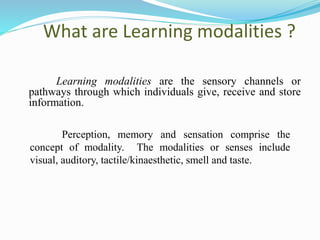
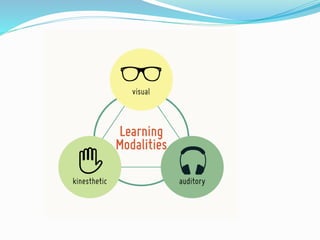
What are Learning modalities ?
Learning modalities are the sensory channels or
pathways through which individuals give, receive and store
information.
Perception, memory and sensation comprise the
concept of modality. The modalities or senses include
visual, auditory, tactile/kinaesthetic, smell and taste.
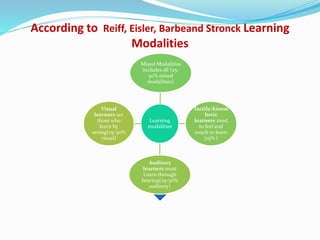
According to Reiff, Eisler, Barbeand Stronck Learning
Modalities
Learning
modalities
Mixed Modalities
includes all (25-
30% mixed
modalities)
Tactile/kinest
hetic
learners need
to feel and
touch to learn
(15% )
Auditory
learners must
Learn through
hearing(25-30%
auditory)
Visual
learners are
those who
learn by
seeing(25-30%
visual)
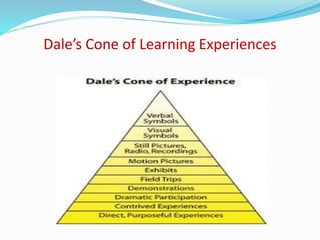
Dale’s Cone of Learning Experiences
Step Learning Experiences model
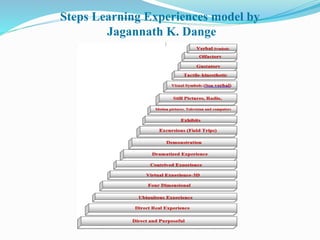
There are many experiences and audiovisual aids
which are missing in Dale’s cone of experience and to
be included by making a new model of experiences,
i.e. Step Learning Experiences model. In this model
they listed 17 experiences.
Steps Learning Experiences model by
Jagannath K. Dange
The above experiences can be utilised by
the teachers by selecting sensibly based on the
objectives to be achieved, students’ ability,
expectations of the content and availability of
resources etc., and to be used effectively in their
teaching process. The modalities would be ideal to use
the above listed experiences by the teachers in their
teaching and related processes.
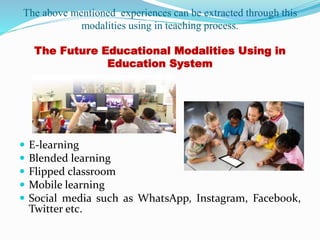
The above mentioned experiences can be extracted through this
modalities using in teaching process.
The Future Educational Modalities Using in
Education System
 E-learning
 Blended learning
 Flipped classroom
 Mobile learning
 Social media such as WhatsApp, Instagram, Facebook,
Twitter etc.
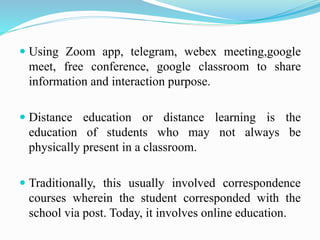
 Using Zoom app, telegram, webex meeting,google
meet, free conference, google classroom to share
information and interaction purpose.
 Distance education or distance learning is the
education of students who may not always be
physically present in a classroom.
 Traditionally, this usually involved correspondence
courses wherein the student corresponded with the
school via post. Today, it involves online education.
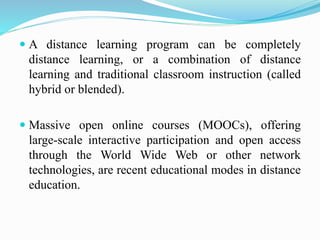
 A distance learning program can be completely
distance learning, or a combination of distance
learning and traditional classroom instruction (called
hybrid or blended).
 Massive open online courses (MOOCs), offering
large-scale interactive participation and open access
through the World Wide Web or other network
technologies, are recent educational modes in distance
education.
Conclusion
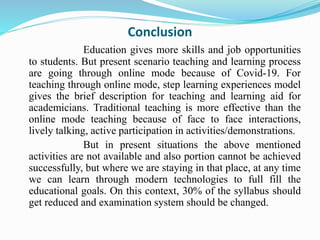
Education gives more skills and job opportunities
to students. But present scenario teaching and learning process
are going through online mode because of Covid-19. For
teaching through online mode, step learning experiences model
gives the brief description for teaching and learning aid for
academicians. Traditional teaching is more effective than the
online mode teaching because of face to face interactions,
lively talking, active participation in activities/demonstrations.
But in present situations the above mentioned
activities are not available and also portion cannot be achieved
successfully, but where we are staying in that place, at any time
we can learn through modern technologies to full fill the
educational goals. On this context, 30% of the syllabus should
get reduced and examination system should be changed.
Continuation
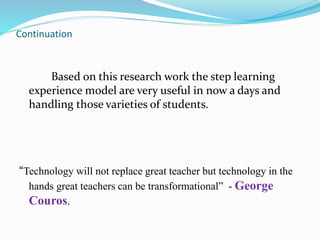
Based on this research work the step learning
experience model are very useful in now a days and
handling those varieties of students.
“Technology will not replace great teacher but technology in the
hands great teachers can be transformational” - George
Couros.
References
 Jagannath.K.Dange.(2014). “Learning and Experiences”, LAP LAMBERT Academic publications.
 Jagannath.K.Dange.(2015). “Learning and Experiences: A Step model”,The Online Journal of New
Horizons in Education, Vol 3, Issue 5, 101 – 108. Retrieved on 23rd may 2020 at
https://www.tojned.net/journals/tojned/articles/v05i03/v05i03-12.pdf.
 Jagannath.K.Dange.(2015). Learning and Experiences. PPT Retrieved on 23rd may 2020 at
https://www.slideshare.net/jkdange/step-learning-experiences-model?qid=1b799c16-0798-
477a-9d19-0e1571d0a977&v=&b=&from_search=1
 Jagannath.K.Dange.(2015). Learning and Experiences. Video Retrieved on 23rd may 2020
athttps://www.youtube.com/watch?v=XisX2UY-2V4.
 Jagannath.K.Dange. & Usha R G.(2020). “Role of Technology in Teaching –Learning Process at
Higher Education”, Future Dimensions in Higher Education: A Quantum Leap in Technology,
Proceedings of International Conference, (1st Ed.), Vol 1, 367 – 374. Jagannath.K.Dange. & Usha R
G.(2020). “e-Pedagogy Usage in Secondary School Curriculum”,e-Pedagogy for the digital age of Two
day International online Seminar Monograph, 547-550.
 Martyn, Margie.(2003). “The hybrid online model: Good practice”. Educes Quarterly: 18–23.
 PoornimaLuthra.F. &Sandy Mackenzie.(2020).“4 ways COVID-19 could change how we educate
future generations”, Brazil.
 RichaChoudhary.(2020). “COVID-19 Pandemic: Impact and strategies for education sector in India”.
Retrieved at,https://government.economictimes.indiatimes.com
Rita Raj.(2009).“Global Encyclopaedia of Educational Technology”, Global Vision Publishing House, (1st
Edn), Vol 1, 134 – 138.
 Sandeep Goyal.(2020). “FUTURE SHOCK: 25 Education trends post COVID-19”.
https://brandequity.economictimes.indiatimes.com/news/business-of-brands/future-shock-25-
education-trends-post-covid-19/75729537
THANK YOU

The modern educational modalities for future days

  • 1.
    THE MODERN EDUCATIONALMODALITIES FOR FUTURE DAYS Dr. Jagannath K Dange Associate Professor, Department of Post Graduate Studies and Research in Education, Kuvempu University, Shivamogga. drjkdange@gmail.com Usha R G Assistant Professor, The Institute of Education, Onkarmal Somani College of Education, Mysuru. ushaprada@gmail.com
  • 2.
    Introduction The Education systemof India is one of the unique way of its kind in the world, more than 102.8 million people come under this education system. In our country, we come across the following level of education like, elementary education, secondary education and higher education. Education is the only tool to change everything in society. In present scenario, because of Covid-19 the education is not reaching for all pupils for several external factors. The pandemic has significantly disrupted the education sector as well, which is a critical determinant of a country’s economic future.
  • 3.
    An effective meansto reach all aspirants is modality based education, this consists of organizing around the different modalities to accommodate the needs of all learners. Most students learn with all their modalities, but some students may have unusual strengths and weaknesses in particular modalities. For example- Students strong in the visual modality will be frustrated or confused with just verbal explanations. Already we know that traditional teaching is very effective compared to online teaching but now a days its tough job to taking traditional classes because of COVID-19 issues in our surroundings. Also, technology handling issues in both students and teachers. So, we can implement some other techniques or methods or modalities in teaching-learning process.
  • 4.
    What is Modality? Modalityis a particular mode in which something exists or is experienced or expressed.
  • 5.
    What are Learningmodalities ? Learning modalities are the sensory channels or pathways through which individuals give, receive and store information. Perception, memory and sensation comprise the concept of modality. The modalities or senses include visual, auditory, tactile/kinaesthetic, smell and taste.
  • 7.
    According to Reiff,Eisler, Barbeand Stronck Learning Modalities Learning modalities Mixed Modalities includes all (25- 30% mixed modalities) Tactile/kinest hetic learners need to feel and touch to learn (15% ) Auditory learners must Learn through hearing(25-30% auditory) Visual learners are those who learn by seeing(25-30% visual)
  • 8.
    Dale’s Cone ofLearning Experiences
  • 9.
    Step Learning Experiencesmodel There are many experiences and audiovisual aids which are missing in Dale’s cone of experience and to be included by making a new model of experiences, i.e. Step Learning Experiences model. In this model they listed 17 experiences.
  • 10.
    Steps Learning Experiencesmodel by Jagannath K. Dange
  • 11.
    The above experiencescan be utilised by the teachers by selecting sensibly based on the objectives to be achieved, students’ ability, expectations of the content and availability of resources etc., and to be used effectively in their teaching process. The modalities would be ideal to use the above listed experiences by the teachers in their teaching and related processes.
  • 12.
    The above mentionedexperiences can be extracted through this modalities using in teaching process. The Future Educational Modalities Using in Education System  E-learning  Blended learning  Flipped classroom  Mobile learning  Social media such as WhatsApp, Instagram, Facebook, Twitter etc.
  • 13.
     Using Zoomapp, telegram, webex meeting,google meet, free conference, google classroom to share information and interaction purpose.  Distance education or distance learning is the education of students who may not always be physically present in a classroom.  Traditionally, this usually involved correspondence courses wherein the student corresponded with the school via post. Today, it involves online education.
  • 14.
     A distancelearning program can be completely distance learning, or a combination of distance learning and traditional classroom instruction (called hybrid or blended).  Massive open online courses (MOOCs), offering large-scale interactive participation and open access through the World Wide Web or other network technologies, are recent educational modes in distance education.
  • 15.
    Conclusion Education gives moreskills and job opportunities to students. But present scenario teaching and learning process are going through online mode because of Covid-19. For teaching through online mode, step learning experiences model gives the brief description for teaching and learning aid for academicians. Traditional teaching is more effective than the online mode teaching because of face to face interactions, lively talking, active participation in activities/demonstrations. But in present situations the above mentioned activities are not available and also portion cannot be achieved successfully, but where we are staying in that place, at any time we can learn through modern technologies to full fill the educational goals. On this context, 30% of the syllabus should get reduced and examination system should be changed.
  • 16.
    Continuation Based on thisresearch work the step learning experience model are very useful in now a days and handling those varieties of students. “Technology will not replace great teacher but technology in the hands great teachers can be transformational” - George Couros.
  • 17.
    References  Jagannath.K.Dange.(2014). “Learningand Experiences”, LAP LAMBERT Academic publications.  Jagannath.K.Dange.(2015). “Learning and Experiences: A Step model”,The Online Journal of New Horizons in Education, Vol 3, Issue 5, 101 – 108. Retrieved on 23rd may 2020 at https://www.tojned.net/journals/tojned/articles/v05i03/v05i03-12.pdf.  Jagannath.K.Dange.(2015). Learning and Experiences. PPT Retrieved on 23rd may 2020 at https://www.slideshare.net/jkdange/step-learning-experiences-model?qid=1b799c16-0798- 477a-9d19-0e1571d0a977&v=&b=&from_search=1  Jagannath.K.Dange.(2015). Learning and Experiences. Video Retrieved on 23rd may 2020 athttps://www.youtube.com/watch?v=XisX2UY-2V4.  Jagannath.K.Dange. & Usha R G.(2020). “Role of Technology in Teaching –Learning Process at Higher Education”, Future Dimensions in Higher Education: A Quantum Leap in Technology, Proceedings of International Conference, (1st Ed.), Vol 1, 367 – 374. Jagannath.K.Dange. & Usha R G.(2020). “e-Pedagogy Usage in Secondary School Curriculum”,e-Pedagogy for the digital age of Two day International online Seminar Monograph, 547-550.  Martyn, Margie.(2003). “The hybrid online model: Good practice”. Educes Quarterly: 18–23.  PoornimaLuthra.F. &Sandy Mackenzie.(2020).“4 ways COVID-19 could change how we educate future generations”, Brazil.  RichaChoudhary.(2020). “COVID-19 Pandemic: Impact and strategies for education sector in India”. Retrieved at,https://government.economictimes.indiatimes.com Rita Raj.(2009).“Global Encyclopaedia of Educational Technology”, Global Vision Publishing House, (1st Edn), Vol 1, 134 – 138.  Sandeep Goyal.(2020). “FUTURE SHOCK: 25 Education trends post COVID-19”. https://brandequity.economictimes.indiatimes.com/news/business-of-brands/future-shock-25- education-trends-post-covid-19/75729537
  • 18.