















Technologies, Pedagogies and the
        Next Generation

      Terry Anderson, PhD and Professor
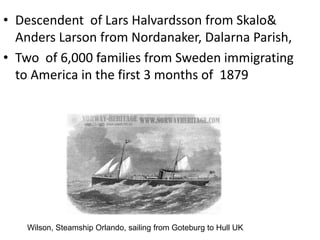
• Descendent of Lars Halvardsson from Skalo&
  Anders Larson from Nordanaker, Dalarna Parish,
• Two of 6,000 families from Sweden immigrating
  to America in the first 3 months of 1879


   Wilson, Steamship Orlando, sailing from Goteburg to Hull UK
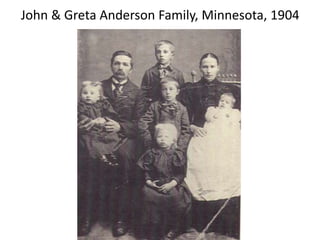
John & Greta Anderson Family, Minnesota, 1904
What if they
hadn’t left??
What if they hadn’t left??
• I would not be a typical,
unilingual, North American
What if they hadn’t left??
 From where but from Canada, could you find a
keynote speaker who finds the weather in
February, in Falun, to be quite warm and toasty??
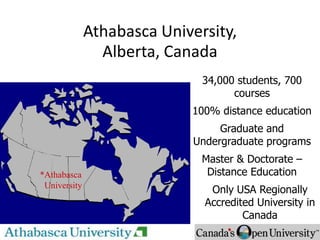
Athabasca University,
                   Alberta, Canada
                                 34,000 students, 700
                                       courses
                               100% distance education
                                     Graduate and
                                Undergraduate programs
    *   Athabasca University
                                 Master & Doctorate –
*Athabasca                        Distance Education
 University
                                   Only USA Regionally
                                  Accredited University in
                                          Canada
• “Canada is a great
  country, much too
  cold for common
  sense, inhabited by
  compassionate and
  intelligent people
  with bad haircuts”.
  – Yann Martel, Life of Pi, 2002.
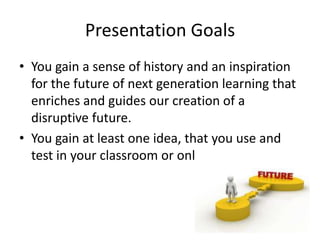
Presentation Goals
• You gain a sense of history and an inspiration
  for the future of next generation learning that
  enriches and guides our creation of a
  disruptive future.
• You gain at least one idea, that you use and
  test in your classroom or online teaching.
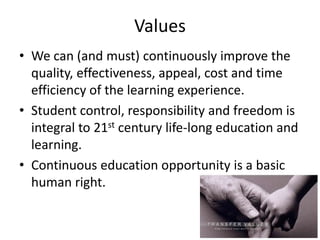
Values
• We can (and must) continuously improve the
  quality, effectiveness, appeal, cost and time
  efficiency of the learning experience.
• Student control, responsibility and freedom is
  integral to 21st century life-long education and
  learning.
• Continuous education opportunity is a basic
  human right.
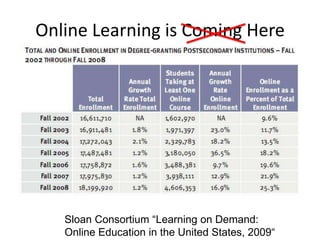
Online Learning is Coming Here


   Sloan Consortium “Learning on Demand:
   Online Education in the United States, 2009“
Why is Online learning
             Better than Sex?
• If you get tired, you can stop, save your place and pick up
  where you left off later on.
• You can finish early without feeling guilty.
• If you need more time, you can ask for an extension.
• You can get rid of any viruses you catch with a $50 program
  from McAfee.
• With a little coffee you can do it all night long.
• You don’t usually get divorced if your spouse interrupts you in
  the middle of it.
• And If you're not sure what you are doing, you can always ask
  your tutor.
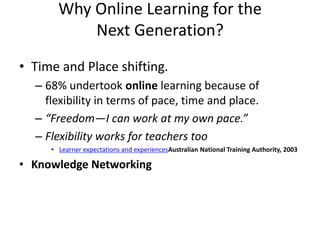
Why Online Learning for the
           Next Generation?
• Time and Place shifting.
  – 68% undertook online learning because of
    flexibility in terms of pace, time and place.
  – “Freedom—I can work at my own pace.”
  – Flexibility works for teachers too
     • Learner expectations and experiencesAustralian National Training Authority, 2003

• Knowledge Networking
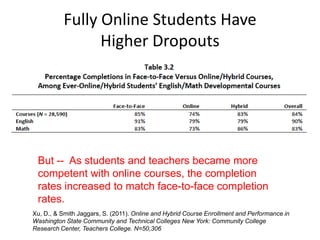
Fully Online Students Have
                Higher Dropouts


 But -- As students and teachers became more
 competent with online courses, the completion
 rates increased to match face-to-face completion
 rates.
Xu, D., & Smith Jaggars, S. (2011). Online and Hybrid Course Enrollment and Performance in
Washington State Community and Technical Colleges New York: Community College
Research Center, Teachers College. N=50,306
The Next Generation Learning Evolves
  From and With Past Generations
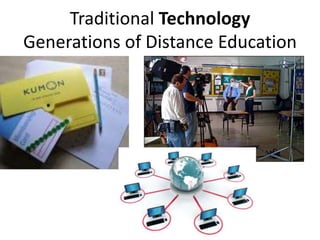
Traditional Technology
Generations of Distance Education
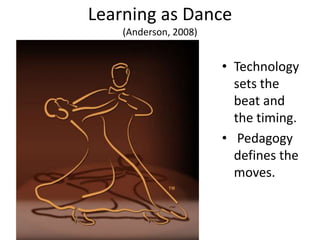
Learning as Dance
    (Anderson, 2008)


                       • Technology
                         sets the
                         beat and
                         the timing.
                       • Pedagogy
                         defines the
                         moves.
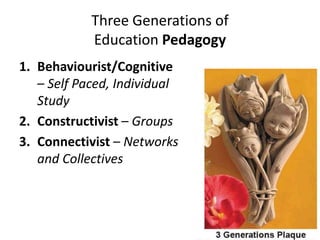
Three Generations of
            Education Pedagogy
1. Behaviourist/Cognitive
   – Self Paced, Individual
   Study
2. Constructivist – Groups
3. Connectivist – Networks
   and Collectives
1. Behavioural/Cognitive
              Pedagogies
• “tell ‘em what you’re
  gonna tell ‘em,
• tell ‘em
• then tell ‘em what you
  told ‘em”


Direct Instruction
Gagne’s Events of Instruction (1965)

1.    Gain learners' attention
2.    Inform learner of objectives
3.    Stimulate recall of previous information
4.    Present stimulus material
5.    Provide learner guidance
6.    Elicit performance
7.    Provide Feedback
8.    Assess performance
9.    Enhance transfer opportunities
 Basis of Instructional Systems Design (ISD)
Enhanced by the “cognitive
                    revolution”
•    Chunking
•    Cognitive Load
•    Working Memory
•    Multiple Representations
•    Split-attention effect
•    Variability Effect
•    Multi-media effect
      – (Sorden, 2005)

    “learning as acquiring and using conceptual and cognitive
    structures” Greeno, Collins and Resnick, 1996
Behaviourist/Cognitive –
          Knowledge As a Thing:
• Logically coherent, existing
  independent of perspective
• Largely context free
• Capable of being transmitted
• Assumes closed systems with
  discoverable relationships
  between inputs and outputs
• Readily defined through
  learning objectives
• “when tools of measurement increase their
  precision by orders of magnitude, new
  paradigms often emerge, because the new
  founded accuracy reveals anomalies that had
  gone undetected” Steve Johnson, p. 69
Learners as Media Consumers of
        that Knowledge
New Developments in
   Behavioural/Cognitive Systems

• Reflection Amplifiers
• Social Indicators
  – Global feedback
  – Digital footprints
  – Archives
  – Competition and games
• Multiple Representations
• Student modeling and adaptation - analytics
Analytics Opening and Connecting
           Black Boxes

                      Student
                      Records


                      Financial
    Registry
                      Records
    Records
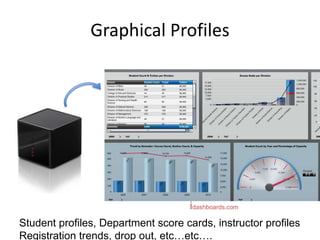
Graphical Profiles


                                     idashboards.com
Student profiles, Department score cards, instructor profiles
Registration trends, drop out, etc…etc….
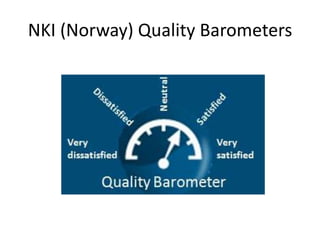
NKI (Norway) Quality Barometers
Rio Salado Community College
        Predictive Learning Analytics
• Rio Salado uses more than two dozen metrics during that first week
  to predict how well that student stands to fare over the entire
  course,
   – Has the student logged into the course home page during that first
     week?
   – Did she log in prior to the first day of class?
   – Other predictive metrics, such as whether a student is taking other
     classes at the same time, whether she has been successful in previous
     courses, and whether she is retaking the course, are culled from the
     college’s student information system.
• The predictive modeling system uses these metrics to separate
  students into three color-coded categories:
   – high-risk (red) students,
   – medium-risk (yellow) students, and
   – low-risk (green) students.

 http://www.gilfuseducationgroup.com/academic-analytics-
 new-elearning-diagnostics
Adaptivity in ubiquitous learning


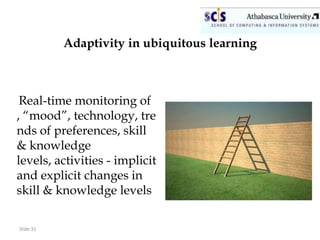
 Real-time monitoring of
, “mood”, technology, tre
nds of preferences, skill
& knowledge
levels, activities - implicit
and explicit changes in
skill & knowledge levels

Slide 31
Enhancing ‘teaching presence’ through
       Voice Annotation of essay and
            project assignments.

                                     • Phil Ice (USA)
                                         – Increased impact of feedback
                                         – Students appreciate voice
                                         – Increased amount of feedback
                                         – SAVES TIME!!
                                         – Using Adobe Acrobat

Ice, P., Curtis, R., Phillips, P., & Wells, J. (2007). Using asynchronous audio feedback to
enhance teaching presence and students‟ sense of community, 11(2), 3-25. Journal of
Asynchronous Learning Networks, 11(2), 3-25
Next generation Open Educational
             Resources (OERs)


Because it saves time and money!!!
The Cost of Content


Tom Corddry, who headed up its multimedia publishing
unit, said, “The editors overestimated the way students would
say, „This has been carefully edited! And is very authoritative!
Content:
A bargain even at 80% off??


Interactive MIT courses
MITX Announced

 Most of us like Free!
Issues in Distance
Education Series
http://aupress.ca
Why Don’t You Use, Modify and
       Post Open Content?
• Biggest problem is lack of motivation
  for teachers to use OERs ??
Many ways that technologies
enhance production and learning
        of 1st generation
Cognitive/Behaviouristpedagogy.
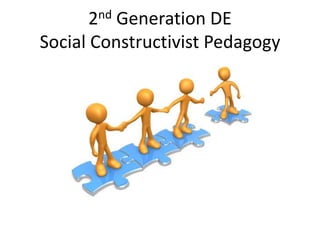
2nd Generation DE
Social Constructivist Pedagogy
Social Constructivist Learning Pedagogy
• New knowledge is built upon previous learning
• The importance of context
• Errors and contradictions are useful
• Learning is active rather than passive process,
• The importance of language and social tools
• Focus on negotiation, meta-cognition and
  evaluation to develop learners’ capacity to assess
  their own learning
• The importance of multiple perspectives – groups
    – (from Honebein, 1996; Jonassen, 1991; Kanuka& Anderson, 1999)
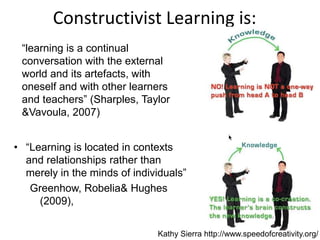
Constructivist Learning is:
 “learning is a continual
 conversation with the external
 world and its artefacts, with
 oneself and with other learners
 and teachers” (Sharples, Taylor
 &Vavoula, 2007)


• “Learning is located in contexts
  and relationships rather than
  merely in the minds of individuals”
   Greenhow, Robelia& Hughes
     (2009),


                              Kathy Sierra http://www.speedofcreativity.org/
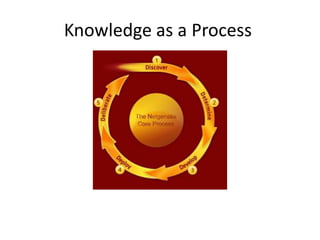
Knowledge as a Process
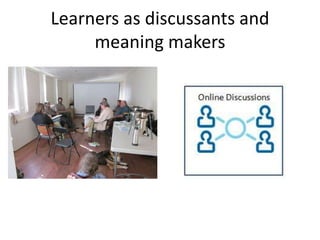
Learners as discussants and
     meaning makers
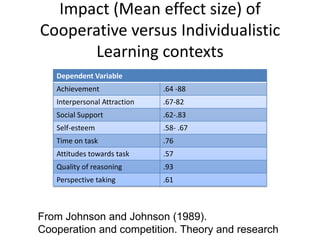
Impact (Mean effect size) of
Cooperative versus Individualistic
      Learning contexts
   Dependent Variable
   Achievement                .64 -88
   Interpersonal Attraction   .67-82
   Social Support             .62-.83
   Self-esteem                .58- .67
   Time on task               .76
   Attitudes towards task     .57
   Quality of reasoning       .93
   Perspective taking         .61


From Johnson and Johnson (1989).
Cooperation and competition. Theory and research
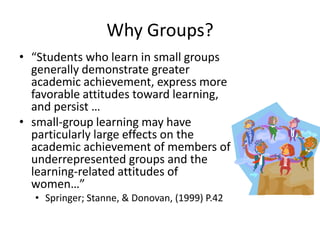
Why Groups?
• “Students who learn in small groups
  generally demonstrate greater
  academic achievement, express more
  favorable attitudes toward learning,
  and persist …
• small-group learning may have
  particularly large effects on the
  academic achievement of members of
  underrepresented groups and the
  learning-related attitudes of
  women…”
  • Springer; Stanne, & Donovan, (1999) P.42
Advances in Social Constructivist
            Learning Tools
• Collaborative tools
   – Document creation, management, versioning
   – Time lines, project management, calendars,
   – Adaptive and multi-mode notifications
• Security, trust
   – Hosting in institutional space, behind firewalls, away
     from search engines
   – Multimedia, body language
• Decision making and project management tools
• Very low-cost synchronous and asynchronous
  conversations/meetings
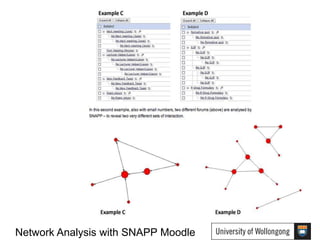
Network Analysis with SNAPP Moodle
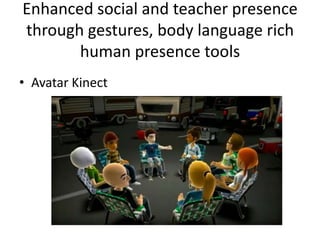
Enhanced social and teacher presence
through gestures, body language rich
       human presence tools
• Avatar Kinect
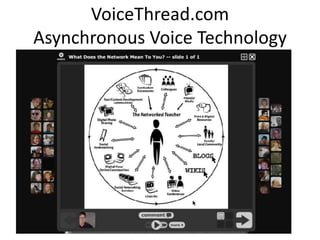
VoiceThread.com
Asynchronous Voice Technology
Problems with Groups
• Restrictions in time, space, pace, &
  relationship - NOT OPEN
• Overly confined by leader expectation
  and institutional & curriculum control
• Usually Isolated from the authentic
  world of practice
• “low tolerance of internal
  difference, sexist and ethicized
  regulation, high demand for obedience to
  its norms and exclusionary practices.”
  Cousin &Deepwell 2005
• “Pathological politeness” and fear of
  debate
• Group think (Baron, 2005)
• Poor preparation for Lifelong Learning
  beyond the course
Constructivist learning in Groups is necessary,
but not sufficient for advanced forms of
learning.
3rd Generation - Networked Learning using
         Connectivist Pedagogy
• Learning is building capacity - networks of
  information, contacts and resources that can
  be applied to real problems.
Connectivist Learning Principles
         George Siemens, 2004
• Learning is a process of connecting specialized nodes or
  information sources.
• Learning may reside in non-human appliances.
• Capacity to know is more critical than what is currently
  known.
• Nurturing and maintaining connections is needed to
  facilitate continual learning.
• Ability to see connections (built networks) between fields,
  ideas, and conceptsl.
• Currency (accurate, up-to-date knowledge)             is
  the intent of all connectivist learning activities.
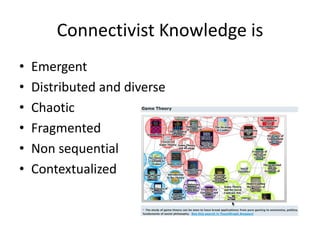
Connectivist Knowledge is
•   Emergent
•   Distributed and diverse
•   Chaotic
•   Fragmented
•   Non sequential
•   Contextualized
What is Connected Knowledge?
• Knowledge is defined by its creation through
  activities
  – Accessing information
  – Evaluating, filtering
  – Conveying ideas
  – Reformatting, mashing
  – Analyzing,
  – Collaborating (Barth 2004)
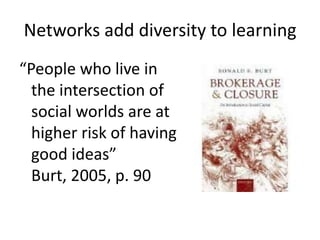
Networks add diversity to learning
“People who live in
  the intersection of
  social worlds are at
  higher risk of having
  good ideas”
  Burt, 2005, p. 90
Connectivist Learning is Emergent
• ,p. 411)
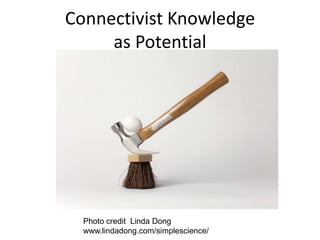
Connectivist Knowledge
     as Potential


  Photo credit Linda Dong
  www.lindadong.com/simplescience/
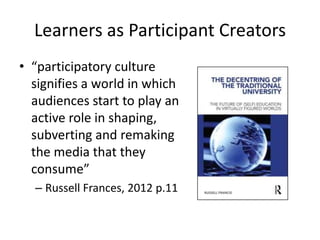
Learners as Participant Creators
• “participatory culture
  signifies a world in which
  audiences start to play an
  active role in shaping,
  subverting and remaking
  the media that they
  consume”
  – Russell Frances, 2012 p.11
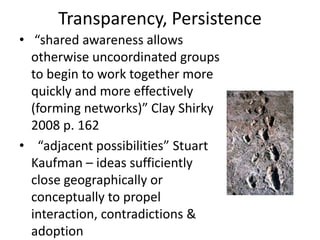
Transparency, Persistence
• “shared awareness allows
  otherwise uncoordinated groups
  to begin to work together more
  quickly and more effectively
  (forming networks)” Clay Shirky
  2008 p. 162
• “adjacent possibilities” Stuart
  Kaufman – ideas sufficiently
  close geographically or
  conceptually to propel
  interaction, contradictions &
  adoption
Connectivist learning as Gardening
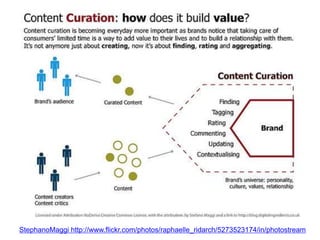
StephanoMaggi http://www.flickr.com/photos/raphaelle_ridarch/5273523174/in/photostream
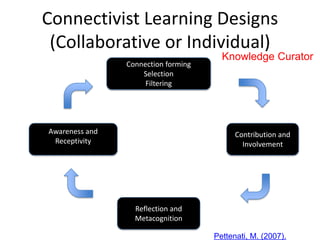
Connectivist Learning Designs
 (Collaborative or Individual)
                                       Knowledge Curator
                Connection forming
                    Selection
                     Filtering


Awareness and                              Contribution and
 Receptivity                                 Involvement


                  Reflection and
                  Metacognition

                                     Pettenati, M. (2007).
Connectivism in Practice
• Runs till this June, 2012
• Over 2,000 people enrolled
• Free!!!


 Massive Open Online Course- MOOC
 See yesterday‟s Chronicle of Higher Educ article
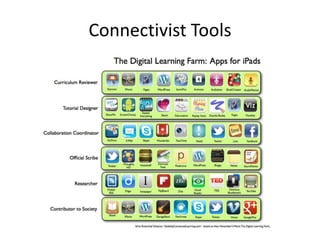
Connectivist Tools
Affordances of Connectivism
• Ability to publicly peer critique the work of
  others
• Tools that enable users to generate their own
  content
• Collective aggregation
• Rich ecology of community formations - from
  tightly defined groups or Communities of
  Practice (Wenger 1998) through to looser
  networks, sets and collectives (Dron& Anderson
  2007).
How do we Build Networks of Practice ?
• Motivation – learning plans, self and net efficacy,
  net-presence, modeling and exposure
• Structural support
  – Exposure and training
  – Teacher ownership and control of networks
  – Wireless access, mobile computing
• Cognitive skills – content + procedural, disclosure
  control
• Social connections, reciprocity
  – Creating and sustaining a spiral of social capital building
     • Nahapiet&Ghoshal (1998)
Challenges of Connectivist Learning
              Models
•   Privacy
•   Control
•   Dealing with disruptive change
•   Institutional Support
•   Sustaining motivation and
    commitment
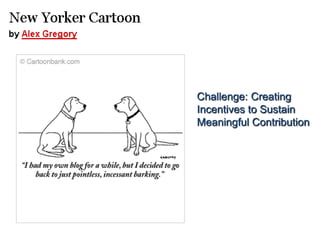
Challenge: Creating
Incentives to Sustain
Meaningful Contribution
Privacy
• What is a right to privacy for one learner is a
  restriction of freedom for another!
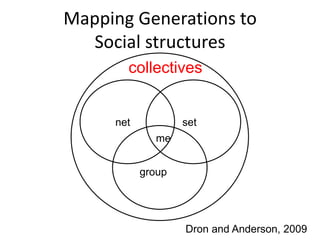
Mapping Generations to
  Social structures
       collectives


     net           set
             me


           group


                   Dron and Anderson, 2009
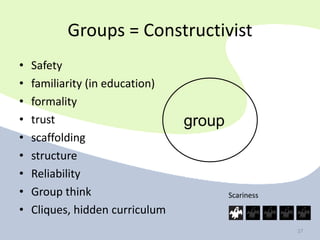
Groups = Constructivist
•   Safety
•   familiarity (in education)
•   formality
•   trust                        group
•   scaffolding
•   structure
•   Reliability
•   Group think                          Scariness
•   Cliques, hidden curriculum
                                                     27
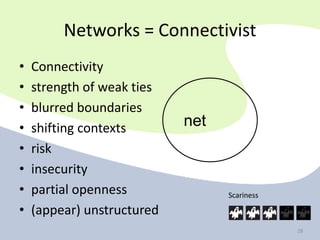
Networks = Connectivist
•   Connectivity
•   strength of weak ties
•   blurred boundaries
•   shifting contexts       net
•   risk
•   insecurity
•   partial openness              Scariness

•   (appear) unstructured
                                              28
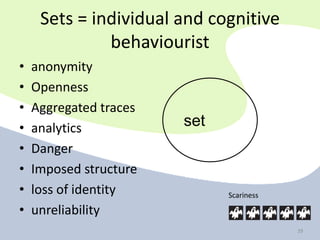
Sets = individual and cognitive
              behaviourist
•   anonymity
•   Openness
•   Aggregated traces
•   analytics           set
•   Danger
•   Imposed structure
•   loss of identity          Scariness

•   unreliability
                                          29
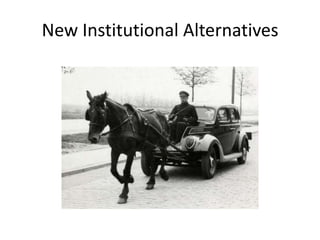
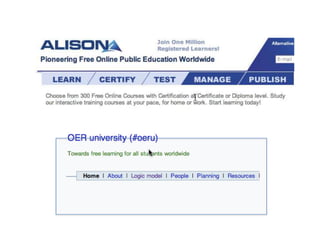
New Institutional Alternatives
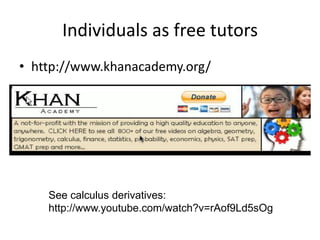
Individuals as free tutors
• http://www.khanacademy.org/


    See calculus derivatives:
    http://www.youtube.com/watch?v=rAof9Ld5sOg
3 Generations of Pedagogy
                     Summary


Anderson, T. &Dron, J. (2011) Three Generations of Distance Education Pedagogy. IRRODL
Recommendations for teachers
• Try to be even more fearless than your
  students.
• Seek out and create opportunities to
  collaborate with and learn from your global
  peers.
• Create a personal learning environment that
  works for you.
• Explore, experiment and have fun!!
Your comments and questions most
          welcomed!

     Terry Anderson terrya@athabascau.ca
                 Blog: terrya.edublogs.org
Individual vs Group Learning
• “the individual experience is somehow inferior
  to the collective that underpins Facebook’s
  recent embrace of “frictionless sharing,” the
  idea that, from now on, we have to worry only
  about things we don’t want to share;
  everything else will be shared automatically.”
  – The Death of the Cyberflâneur (2012)-
    EvgenyMorozov, NYTImes
• Charles Baudelaire (1821-1867) “settled on a word to capture the attitude
  he felt one should adopt when walking along the streets. One should
  become, he suggested, a flâneur…The defining characteristic of those
  flâneurs is that they don’t have any practical goals in mind. They aren’ t
  walking to get something, or to go somewhere, they aren’t even
  shopping…Flâneurs are standing in deliberate opposition to capitalist
  society, with its two great imperatives: to be in a hurry and to buy
  things…What the flâneurs are doing is looking”
• .”They are opening their eyes and ears to the scene around them. They are
  not treating the street as an obstacle course to be negotiated; they are
  opening themselves up to it.’ Ender Baskan
• Baudelaire put it, "to be away from home and yet to feel everywhere at
  home". To do this, they let down their guard, they empathise with
  situation they see. There's a constant risk they will be moved, saddened,
  excited - and fall in love. (


• http://enderbaskan.tumblr.com/post/12580224757
Conclusion
• Individual Behavioural/Cognitive models are useful for
  memory and conceptual knowledge acquisition.
• Constructivist models develop group skills and trust.
• Connectivist models introduce networked learning and
  are foundational for lifelong learning in complex
  contexts.
• 21 century literacies and skills demand effective use of
  all three pedagogies.
• Don’t argue quality with those from different
  generations.
Anderson &Dron(2011) 3 generations of DE Pedagogy. International
Review of Research in Distance and Open Learning (IRRODL)

Sweden keynote 2012

  • 1.
    Technologies, Pedagogies andthe Next Generation Terry Anderson, PhD and Professor
  • 2.
    • Descendent ofLars Halvardsson from Skalo& Anders Larson from Nordanaker, Dalarna Parish, • Two of 6,000 families from Sweden immigrating to America in the first 3 months of 1879 Wilson, Steamship Orlando, sailing from Goteburg to Hull UK
  • 3.
    John & GretaAnderson Family, Minnesota, 1904
  • 4.
  • 5.
    What if theyhadn’t left??
  • 6.
    What if theyhadn’t left?? • I would not be a typical, unilingual, North American
  • 7.
    What if theyhadn’t left?? From where but from Canada, could you find a keynote speaker who finds the weather in February, in Falun, to be quite warm and toasty??
  • 8.
    Athabasca University, Alberta, Canada 34,000 students, 700 courses 100% distance education Graduate and Undergraduate programs * Athabasca University Master & Doctorate – *Athabasca Distance Education University Only USA Regionally Accredited University in Canada
  • 9.
    • “Canada isa great country, much too cold for common sense, inhabited by compassionate and intelligent people with bad haircuts”. – Yann Martel, Life of Pi, 2002.
  • 10.
    Presentation Goals • Yougain a sense of history and an inspiration for the future of next generation learning that enriches and guides our creation of a disruptive future. • You gain at least one idea, that you use and test in your classroom or online teaching.
  • 11.
    Values • We can(and must) continuously improve the quality, effectiveness, appeal, cost and time efficiency of the learning experience. • Student control, responsibility and freedom is integral to 21st century life-long education and learning. • Continuous education opportunity is a basic human right.
  • 12.
    Online Learning isComing Here Sloan Consortium “Learning on Demand: Online Education in the United States, 2009“
  • 13.
    Why is Onlinelearning Better than Sex? • If you get tired, you can stop, save your place and pick up where you left off later on. • You can finish early without feeling guilty. • If you need more time, you can ask for an extension. • You can get rid of any viruses you catch with a $50 program from McAfee. • With a little coffee you can do it all night long. • You don’t usually get divorced if your spouse interrupts you in the middle of it. • And If you're not sure what you are doing, you can always ask your tutor.
  • 14.
    Why Online Learningfor the Next Generation? • Time and Place shifting. – 68% undertook online learning because of flexibility in terms of pace, time and place. – “Freedom—I can work at my own pace.” – Flexibility works for teachers too • Learner expectations and experiencesAustralian National Training Authority, 2003 • Knowledge Networking
  • 15.
    Fully Online StudentsHave Higher Dropouts But -- As students and teachers became more competent with online courses, the completion rates increased to match face-to-face completion rates. Xu, D., & Smith Jaggars, S. (2011). Online and Hybrid Course Enrollment and Performance in Washington State Community and Technical Colleges New York: Community College Research Center, Teachers College. N=50,306
  • 16.
    The Next GenerationLearning Evolves From and With Past Generations
  • 17.
  • 18.
    Learning as Dance (Anderson, 2008) • Technology sets the beat and the timing. • Pedagogy defines the moves.
  • 19.
    Three Generations of Education Pedagogy 1. Behaviourist/Cognitive – Self Paced, Individual Study 2. Constructivist – Groups 3. Connectivist – Networks and Collectives
  • 20.
    1. Behavioural/Cognitive Pedagogies • “tell ‘em what you’re gonna tell ‘em, • tell ‘em • then tell ‘em what you told ‘em” Direct Instruction
  • 21.
    Gagne’s Events ofInstruction (1965) 1. Gain learners' attention 2. Inform learner of objectives 3. Stimulate recall of previous information 4. Present stimulus material 5. Provide learner guidance 6. Elicit performance 7. Provide Feedback 8. Assess performance 9. Enhance transfer opportunities Basis of Instructional Systems Design (ISD)
  • 22.
    Enhanced by the“cognitive revolution” • Chunking • Cognitive Load • Working Memory • Multiple Representations • Split-attention effect • Variability Effect • Multi-media effect – (Sorden, 2005) “learning as acquiring and using conceptual and cognitive structures” Greeno, Collins and Resnick, 1996
  • 23.
    Behaviourist/Cognitive – Knowledge As a Thing: • Logically coherent, existing independent of perspective • Largely context free • Capable of being transmitted • Assumes closed systems with discoverable relationships between inputs and outputs • Readily defined through learning objectives
  • 24.
    • “when toolsof measurement increase their precision by orders of magnitude, new paradigms often emerge, because the new founded accuracy reveals anomalies that had gone undetected” Steve Johnson, p. 69
  • 25.
    Learners as MediaConsumers of that Knowledge
  • 26.
    New Developments in Behavioural/Cognitive Systems • Reflection Amplifiers • Social Indicators – Global feedback – Digital footprints – Archives – Competition and games • Multiple Representations • Student modeling and adaptation - analytics
  • 27.
    Analytics Opening andConnecting Black Boxes Student Records Financial Registry Records Records
  • 28.
    Graphical Profiles idashboards.com Student profiles, Department score cards, instructor profiles Registration trends, drop out, etc…etc….
  • 29.
  • 30.
    Rio Salado CommunityCollege Predictive Learning Analytics • Rio Salado uses more than two dozen metrics during that first week to predict how well that student stands to fare over the entire course, – Has the student logged into the course home page during that first week? – Did she log in prior to the first day of class? – Other predictive metrics, such as whether a student is taking other classes at the same time, whether she has been successful in previous courses, and whether she is retaking the course, are culled from the college’s student information system. • The predictive modeling system uses these metrics to separate students into three color-coded categories: – high-risk (red) students, – medium-risk (yellow) students, and – low-risk (green) students. http://www.gilfuseducationgroup.com/academic-analytics- new-elearning-diagnostics
  • 31.
    Adaptivity in ubiquitouslearning Real-time monitoring of , “mood”, technology, tre nds of preferences, skill & knowledge levels, activities - implicit and explicit changes in skill & knowledge levels Slide 31
  • 32.
    Enhancing ‘teaching presence’through Voice Annotation of essay and project assignments. • Phil Ice (USA) – Increased impact of feedback – Students appreciate voice – Increased amount of feedback – SAVES TIME!! – Using Adobe Acrobat Ice, P., Curtis, R., Phillips, P., & Wells, J. (2007). Using asynchronous audio feedback to enhance teaching presence and students‟ sense of community, 11(2), 3-25. Journal of Asynchronous Learning Networks, 11(2), 3-25
  • 33.
    Next generation OpenEducational Resources (OERs) Because it saves time and money!!!
  • 34.
    The Cost ofContent Tom Corddry, who headed up its multimedia publishing unit, said, “The editors overestimated the way students would say, „This has been carefully edited! And is very authoritative!
  • 35.
    Content: A bargain evenat 80% off?? Interactive MIT courses MITX Announced Most of us like Free!
  • 36.
    Issues in Distance EducationSeries http://aupress.ca
  • 37.
    Why Don’t YouUse, Modify and Post Open Content? • Biggest problem is lack of motivation for teachers to use OERs ??
  • 38.
    Many ways thattechnologies enhance production and learning of 1st generation Cognitive/Behaviouristpedagogy.
  • 39.
    2nd Generation DE SocialConstructivist Pedagogy
  • 40.
    Social Constructivist LearningPedagogy • New knowledge is built upon previous learning • The importance of context • Errors and contradictions are useful • Learning is active rather than passive process, • The importance of language and social tools • Focus on negotiation, meta-cognition and evaluation to develop learners’ capacity to assess their own learning • The importance of multiple perspectives – groups – (from Honebein, 1996; Jonassen, 1991; Kanuka& Anderson, 1999)
  • 41.
    Constructivist Learning is: “learning is a continual conversation with the external world and its artefacts, with oneself and with other learners and teachers” (Sharples, Taylor &Vavoula, 2007) • “Learning is located in contexts and relationships rather than merely in the minds of individuals” Greenhow, Robelia& Hughes (2009), Kathy Sierra http://www.speedofcreativity.org/
  • 42.
  • 43.
    Learners as discussantsand meaning makers
  • 44.
    Impact (Mean effectsize) of Cooperative versus Individualistic Learning contexts Dependent Variable Achievement .64 -88 Interpersonal Attraction .67-82 Social Support .62-.83 Self-esteem .58- .67 Time on task .76 Attitudes towards task .57 Quality of reasoning .93 Perspective taking .61 From Johnson and Johnson (1989). Cooperation and competition. Theory and research
  • 45.
    Why Groups? • “Studentswho learn in small groups generally demonstrate greater academic achievement, express more favorable attitudes toward learning, and persist … • small-group learning may have particularly large effects on the academic achievement of members of underrepresented groups and the learning-related attitudes of women…” • Springer; Stanne, & Donovan, (1999) P.42
  • 46.
    Advances in SocialConstructivist Learning Tools • Collaborative tools – Document creation, management, versioning – Time lines, project management, calendars, – Adaptive and multi-mode notifications • Security, trust – Hosting in institutional space, behind firewalls, away from search engines – Multimedia, body language • Decision making and project management tools • Very low-cost synchronous and asynchronous conversations/meetings
  • 47.
  • 48.
    Enhanced social andteacher presence through gestures, body language rich human presence tools • Avatar Kinect
  • 49.
  • 50.
    Problems with Groups •Restrictions in time, space, pace, & relationship - NOT OPEN • Overly confined by leader expectation and institutional & curriculum control • Usually Isolated from the authentic world of practice • “low tolerance of internal difference, sexist and ethicized regulation, high demand for obedience to its norms and exclusionary practices.” Cousin &Deepwell 2005 • “Pathological politeness” and fear of debate • Group think (Baron, 2005) • Poor preparation for Lifelong Learning beyond the course
  • 51.
    Constructivist learning inGroups is necessary, but not sufficient for advanced forms of learning.
  • 52.
    3rd Generation -Networked Learning using Connectivist Pedagogy • Learning is building capacity - networks of information, contacts and resources that can be applied to real problems.
  • 53.
    Connectivist Learning Principles George Siemens, 2004 • Learning is a process of connecting specialized nodes or information sources. • Learning may reside in non-human appliances. • Capacity to know is more critical than what is currently known. • Nurturing and maintaining connections is needed to facilitate continual learning. • Ability to see connections (built networks) between fields, ideas, and conceptsl. • Currency (accurate, up-to-date knowledge) is the intent of all connectivist learning activities.
  • 54.
    Connectivist Knowledge is • Emergent • Distributed and diverse • Chaotic • Fragmented • Non sequential • Contextualized
  • 55.
    What is ConnectedKnowledge? • Knowledge is defined by its creation through activities – Accessing information – Evaluating, filtering – Conveying ideas – Reformatting, mashing – Analyzing, – Collaborating (Barth 2004)
  • 56.
    Networks add diversityto learning “People who live in the intersection of social worlds are at higher risk of having good ideas” Burt, 2005, p. 90
  • 57.
    Connectivist Learning isEmergent • ,p. 411)
  • 58.
    Connectivist Knowledge as Potential Photo credit Linda Dong www.lindadong.com/simplescience/
  • 59.
    Learners as ParticipantCreators • “participatory culture signifies a world in which audiences start to play an active role in shaping, subverting and remaking the media that they consume” – Russell Frances, 2012 p.11
  • 60.
    Transparency, Persistence • “sharedawareness allows otherwise uncoordinated groups to begin to work together more quickly and more effectively (forming networks)” Clay Shirky 2008 p. 162 • “adjacent possibilities” Stuart Kaufman – ideas sufficiently close geographically or conceptually to propel interaction, contradictions & adoption
  • 61.
  • 62.
  • 63.
    Connectivist Learning Designs (Collaborative or Individual) Knowledge Curator Connection forming Selection Filtering Awareness and Contribution and Receptivity Involvement Reflection and Metacognition Pettenati, M. (2007).
  • 64.
    Connectivism in Practice •Runs till this June, 2012 • Over 2,000 people enrolled • Free!!! Massive Open Online Course- MOOC See yesterday‟s Chronicle of Higher Educ article
  • 65.
  • 66.
    Affordances of Connectivism •Ability to publicly peer critique the work of others • Tools that enable users to generate their own content • Collective aggregation • Rich ecology of community formations - from tightly defined groups or Communities of Practice (Wenger 1998) through to looser networks, sets and collectives (Dron& Anderson 2007).
  • 67.
    How do weBuild Networks of Practice ? • Motivation – learning plans, self and net efficacy, net-presence, modeling and exposure • Structural support – Exposure and training – Teacher ownership and control of networks – Wireless access, mobile computing • Cognitive skills – content + procedural, disclosure control • Social connections, reciprocity – Creating and sustaining a spiral of social capital building • Nahapiet&Ghoshal (1998)
  • 68.
    Challenges of ConnectivistLearning Models • Privacy • Control • Dealing with disruptive change • Institutional Support • Sustaining motivation and commitment
  • 69.
    Challenge: Creating Incentives toSustain Meaningful Contribution
  • 70.
    Privacy • What isa right to privacy for one learner is a restriction of freedom for another!
  • 71.
    Mapping Generations to Social structures collectives net set me group Dron and Anderson, 2009
  • 72.
    Groups = Constructivist • Safety • familiarity (in education) • formality • trust group • scaffolding • structure • Reliability • Group think Scariness • Cliques, hidden curriculum 27
  • 73.
    Networks = Connectivist • Connectivity • strength of weak ties • blurred boundaries • shifting contexts net • risk • insecurity • partial openness Scariness • (appear) unstructured 28
  • 74.
    Sets = individualand cognitive behaviourist • anonymity • Openness • Aggregated traces • analytics set • Danger • Imposed structure • loss of identity Scariness • unreliability 29
  • 75.
  • 77.
    Individuals as freetutors • http://www.khanacademy.org/ See calculus derivatives: http://www.youtube.com/watch?v=rAof9Ld5sOg
  • 82.
    3 Generations ofPedagogy Summary Anderson, T. &Dron, J. (2011) Three Generations of Distance Education Pedagogy. IRRODL
  • 83.
    Recommendations for teachers •Try to be even more fearless than your students. • Seek out and create opportunities to collaborate with and learn from your global peers. • Create a personal learning environment that works for you. • Explore, experiment and have fun!!
  • 84.
    Your comments andquestions most welcomed! Terry Anderson terrya@athabascau.ca Blog: terrya.edublogs.org
  • 85.
    Individual vs GroupLearning • “the individual experience is somehow inferior to the collective that underpins Facebook’s recent embrace of “frictionless sharing,” the idea that, from now on, we have to worry only about things we don’t want to share; everything else will be shared automatically.” – The Death of the Cyberflâneur (2012)- EvgenyMorozov, NYTImes
  • 86.
    • Charles Baudelaire(1821-1867) “settled on a word to capture the attitude he felt one should adopt when walking along the streets. One should become, he suggested, a flâneur…The defining characteristic of those flâneurs is that they don’t have any practical goals in mind. They aren’ t walking to get something, or to go somewhere, they aren’t even shopping…Flâneurs are standing in deliberate opposition to capitalist society, with its two great imperatives: to be in a hurry and to buy things…What the flâneurs are doing is looking” • .”They are opening their eyes and ears to the scene around them. They are not treating the street as an obstacle course to be negotiated; they are opening themselves up to it.’ Ender Baskan • Baudelaire put it, "to be away from home and yet to feel everywhere at home". To do this, they let down their guard, they empathise with situation they see. There's a constant risk they will be moved, saddened, excited - and fall in love. ( • http://enderbaskan.tumblr.com/post/12580224757
  • 87.
    Conclusion • Individual Behavioural/Cognitivemodels are useful for memory and conceptual knowledge acquisition. • Constructivist models develop group skills and trust. • Connectivist models introduce networked learning and are foundational for lifelong learning in complex contexts. • 21 century literacies and skills demand effective use of all three pedagogies. • Don’t argue quality with those from different generations. Anderson &Dron(2011) 3 generations of DE Pedagogy. International Review of Research in Distance and Open Learning (IRRODL)

Editor's Notes