
How far is far?

How fast is fast?
A light year is the
DISTANCE that light
will travel, through a
vacuum, in one year.
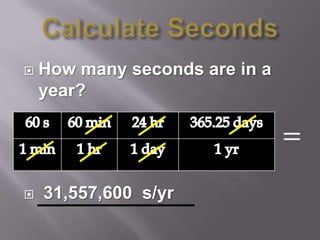
   How many seconds are in a
    year?


   31,557,600 s/yr
The Speed of Light
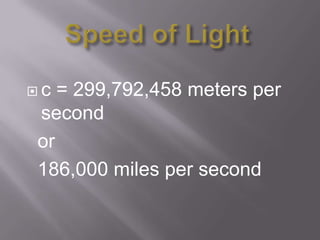
c = 299,792,458 meters per
second
or
186,000 miles per second
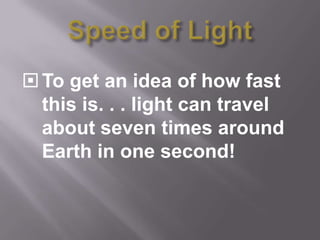
 To get an idea of how fast
  this is. . . light can travel
  about seven times around
  Earth in one second!
   One light year is approximately 5.880
    trillion miles or 9.5 trillion km.

   The symbol for light year is “ly”.
     Light years are used to
     measure the vast distances
     in space.
     In the universe, the kilometer
      measure is too small to use.
    Every time you look at
    objects in the night sky or
    the Sun, the light from
    that object is old. You are
    looking at history.
   It takes eight light minutes for light
    leaving the Sun to reach the Earth.

   To put this in perspective, if you
    could drive from the surface of the
    Sun to the surface of the Earth, it
    would take you 180 years driving
    nonstop at 60 mph.
   Sirius, in the constellation Canis
    Major, is the sky’s brightest star. It is
    easy to find on winter and spring evenings.

    When you look at Sirius, you are
    looking back in time to see how
    Sirius looked eight years ago. The
    light left the star eight years ago.

Light year cscope

  • 3.
    How far isfar? How fast is fast?
  • 4.
    A light yearis the DISTANCE that light will travel, through a vacuum, in one year.
  • 5.
    How many seconds are in a year?  31,557,600 s/yr
  • 6.
  • 7.
    c = 299,792,458meters per second or 186,000 miles per second
  • 8.
     To getan idea of how fast this is. . . light can travel about seven times around Earth in one second!
  • 9.
    One light year is approximately 5.880 trillion miles or 9.5 trillion km.  The symbol for light year is “ly”.
  • 10.
    Light years are used to measure the vast distances in space.  In the universe, the kilometer measure is too small to use.
  • 11.
    Every time you look at objects in the night sky or the Sun, the light from that object is old. You are looking at history.
  • 12.
    It takes eight light minutes for light leaving the Sun to reach the Earth.  To put this in perspective, if you could drive from the surface of the Sun to the surface of the Earth, it would take you 180 years driving nonstop at 60 mph.
  • 13.
    Sirius, in the constellation Canis Major, is the sky’s brightest star. It is easy to find on winter and spring evenings.  When you look at Sirius, you are looking back in time to see how Sirius looked eight years ago. The light left the star eight years ago.

Editor's Notes

  • #5 This is not a unit of time, but a unit of distance. Be sure that students know this.Students may not know what a vacuum is.Instruct students to record this information in their notebooks.
  • #6 Instruct students to draw a table and add numbers and units in the proper boxes. Inform them that they have to be set up so that the units will cancel. As you view this slide, units will cancel out. Without the units, students can simply multiply the numbers together.OR…Have students use a calculator to find how many seconds there are in a year. This value will calculate on most 4-function calculators.
  • #8 The fastest thing that we know of is light which travels at a speed of about 186,000 miles, or 300,000 kilometers, per second in empty space. To get an idea of how fast this is, light can travel about seven times around Earth in one second!
  • #9 The fastest thing that we know of is light which travels at a speed of about 186,000 miles, or 300,000 kilometers,per second in empty space. To get an idea of how fast this is, light can travel about seven times around Earth in one second!
  • #10 The miles value is for reference only. Students should know the abbreviation for light year (ly).
  • #11 In the universe, the kilometer measure is too small to use. For example, the distance to the next nearest big galaxy,the Andromeda Galaxy, is 21 quintillion km. That's 21,000,000,000,000,000,000 km. This is a number so large that it becomes hard to write,to relate to, and to use in calculations. Astronomers use other units of distance.
  • #12 I
  • #14 At some point, we may see the death or birth of a star long after the event occurred.