Integrate
d
Science
Process
Skills
What is it?
∙Integrated Science Processes Skills
(ISPS) are a set of complicated
activities that make up a real inquiry
method and go beyond basic
processes to offer problem-based
scientific answers.
Integrated Science Process
Skills
Integrated Science Process
Skills
Integrated Science Process
Skills
Integrated Science Process
Skills
Integrated Science Process
Skills
Integrated Science Process
Skills
Integrated Science Process
Skills
∙Organizing Data is the practice of
categorizing and classifying data to
make it more usable. In research, it is a
process of organizing collected factual
materials commonly accepted in the
scientific community as necessary to
validate research findings.
Integrated Science Process
Skills
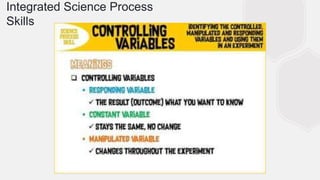
∙Identifying variables means stating the
changeable factors that can affect an
experiment. Variables are the "things" you are
measuring, collecting data (information) on, or
forming groups on, in order to conduct your
research study and answer your question(s). A
variable is a characteristic or feature that varies
or changes within a study. The opposite of a
Integrated Science Process
Skills
∙Describing relationships between
variables means explaining relationships
between variables in an experiment such as
between the independent and dependent
variables. Correlation is a statistical
technique that is used to measure and
describe a relationship between two
variables. Usually, the two variables are
Integrated Science Process
Skills
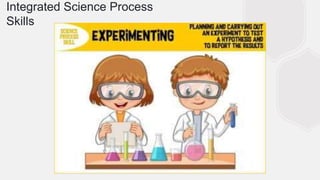
∙Designing investigations means designing an
experiment by identifying materials and
describing appropriate steps in a procedure to
test a hypothesis. Investigation designs are
plans for ensuring to get the information
needed. They are telling how to ensure that
there are no problems with testing, particularly
concerning the testing tools and how the
participants are treated.
Integrated Science Process
Skills
∙Formulating models means recognizing patterns in
data and making comparisons to familiar objects or
ideas. The aim of formulating models is to make a
particular part or feature of the world easier to
understand, define, quantify, visualize, or simulate by
referencing it to existing and usually commonly accepted
knowledge. It requires selecting and identifying relevant
aspects of a situation in the real world and then using
different types of models for different aims, such as
conceptual models to better understand, operational
models to operationalize, mathematical models to
quantify, and graphical models to visualize the subject.
Manipulative Skills
∙Psychomotor skills that enable students to:
• Use and handle science apparatus and
specimens correctly and carefully,
• Draw apparatus, specimens, and
laboratory substances accurately,
• Clean and store science apparatus and
laboratory substances correctly

Integrated Science Process Skills_2023.pptx

  • 1.
  • 2.
    What is it? ∙IntegratedScience Processes Skills (ISPS) are a set of complicated activities that make up a real inquiry method and go beyond basic processes to offer problem-based scientific answers.
  • 3.
  • 4.
  • 5.
  • 6.
  • 7.
  • 8.
  • 9.
    Integrated Science Process Skills ∙OrganizingData is the practice of categorizing and classifying data to make it more usable. In research, it is a process of organizing collected factual materials commonly accepted in the scientific community as necessary to validate research findings.
  • 10.
    Integrated Science Process Skills ∙Identifyingvariables means stating the changeable factors that can affect an experiment. Variables are the "things" you are measuring, collecting data (information) on, or forming groups on, in order to conduct your research study and answer your question(s). A variable is a characteristic or feature that varies or changes within a study. The opposite of a
  • 11.
    Integrated Science Process Skills ∙Describingrelationships between variables means explaining relationships between variables in an experiment such as between the independent and dependent variables. Correlation is a statistical technique that is used to measure and describe a relationship between two variables. Usually, the two variables are
  • 12.
    Integrated Science Process Skills ∙Designinginvestigations means designing an experiment by identifying materials and describing appropriate steps in a procedure to test a hypothesis. Investigation designs are plans for ensuring to get the information needed. They are telling how to ensure that there are no problems with testing, particularly concerning the testing tools and how the participants are treated.
  • 13.
    Integrated Science Process Skills ∙Formulatingmodels means recognizing patterns in data and making comparisons to familiar objects or ideas. The aim of formulating models is to make a particular part or feature of the world easier to understand, define, quantify, visualize, or simulate by referencing it to existing and usually commonly accepted knowledge. It requires selecting and identifying relevant aspects of a situation in the real world and then using different types of models for different aims, such as conceptual models to better understand, operational models to operationalize, mathematical models to quantify, and graphical models to visualize the subject.
  • 14.
    Manipulative Skills ∙Psychomotor skillsthat enable students to: • Use and handle science apparatus and specimens correctly and carefully, • Draw apparatus, specimens, and laboratory substances accurately, • Clean and store science apparatus and laboratory substances correctly