This paper investigates the enhancement of solar cell output power through the use of cooling and mirror reflection. Results indicate that adding mirrors increases current and output power, but decreases open circuit and maximum power voltages due to heat. Implementing cooling improves these voltages, leading to further increases in output power.
![International Journal of Power Electronics and Drive System (IJPEDS)
Vol. 8, No. 3, September 2017, pp. 1320~1326
ISSN: 2088-8694, DOI: 10.11591/ijpeds.v8i3.pp1320-1326 1320
Journal homepage: http://iaesjournal.com/online/index.php/IJPEDS
The Improvement of Solar Cell Output Power Using Cooling
and Reflection from Mirror
Budiyanto, Fadliondi
Department of Electrical Engineering, Universitas Muhammadiyah Jakarta, Indonesia
Article Info ABSTRACT
Article history:
Received Apr 17, 2017
Revised Jul 10, 2017
Accepted Jul 25, 2017
This paper explains the experimental investigation to improve the output
power of solar cell using cooling and light reflection from mirrors. The
results show that by adding mirror, the current and output power of solar cell
increase but the open circuit voltage and maximum power voltage decrease
due to heat. By adding cooling, the open circuit voltage and the maximum
power voltage are improved, so the output power also increases.
Keyword:
Cell
Cooling
Mirror
Photovoltaic
Solar Copyright ©2017 Institute of Advanced Engineering and Science.
All rights reserved.
Corresponding Author:
Fadliondi,
Department of Electrical Engineering,
Universitas Muhammadiyah Jakarta,
Jl. Cempaka Putih Tengah 27 Jakarta Indonesia 10510
Email: fadliondi@ftumj.ac.id
1. INTRODUCTION
Energy is the most important element for human being in the world to survive [1]. From morning
until night, energy is involved in every life aspect. Overall, the sources of energy are divided into 2 which are
renewable energy and non-renewable energy [2]. The renewable energy is energy that will not run out
eventhough it is continuously used for long period while non-renewable energy is energy that will round out
if it is continuously used for long period. Wind, water wave and solar energy are examples of renewable
energy. Coal, oil and natural gas are examples of non-renewable energy. Compared to other energy sources,
solar energy has many advantages. It is environmentally friendly, clean, abundant and free of noise pollution
[3], [4]. Besides that, solar energy is unlimited energy which is available everywhere and free [5]. Solar
energy must be converted into electrical energy so it can be used. The solar cell is a device that directly
converts solar energy into electrical energy through photovoltaic process and the solar cell was firstly
invented by Charles Fritts in 1883 using junction formed by coating selenium with gold but the efficiency
was only 1 % [6]. Generally, solar cells are divided into 3 types, monocrystalline, polycrystalline and thin
film where the monocrystalline solar cell has higher efficiency than polycrystalline and thin film solar
cells [7], [8]. The combination of several solar cells form solar module and the combination of several solar
modules form solar panel. Air-cooling, liquid-cooling and immersion are examples of methods to increase
the efficiency of solar cell [9], [10], [11]. The purpose of this research is to increase the output power of solar
cell using mirror reflection.](https://image.slidesharecdn.com/3531jul1717apr15721fullpap-210608021925/75/The-Improvement-of-Solar-Cell-Output-Power-Using-Cooling-and-Reflection-from-Mirror-1-2048.jpg)
![ ISSN: 2088-8694
IJPEDS Vol. 8, No. 3, September 2017 : 1320–1326
1321
2. RESEARCH METHOD
Figure 1 shows the schematic picture of solar cell and solar module. The solar module is a
combination of several solar cells parallelysor serially connected with bypass diodes or blocking
diodes [12], [13]. The shadow from trees, building, cloud, dirt and leaves may decrease the output
power [14].
(a) (b)
Figure 1. Schematic figure of (a) solar cell (b) solar module
Figure 2 shows the measurement of solar output power at the surface of earth using solarimeter. The unit
is W/m2
.
Figure 2. The measurement of solar output power
Figure 3 shows the measurement of I-V characteristic of the solar cell.
Figure 3. The measurement of solar cell
⇩⇩⇩⇩⇩⇩
………. W/m2
Solarimeter
⇩⇩⇩⇩⇩⇩
VOLTMETER
AMMETER VARIABEL
RESISTOR
SOLAR CELL
V
A](https://image.slidesharecdn.com/3531jul1717apr15721fullpap-210608021925/75/The-Improvement-of-Solar-Cell-Output-Power-Using-Cooling-and-Reflection-from-Mirror-2-2048.jpg)
![IJPEDS ISSN: 2088-8694
The Improvement of Solar Cell Output Power using Cooling and Reflection from Mirror (Budiyanto)
1322
Figure 4 shows the equivalent circuit of a solar cell. IPH is photocurrent. RSH and RS are shunt
resistor and serial resistor respectively. The ideal value for RSH is infinity so there will no be path for current
to flow, while the ideal value for RS is 0 so there will no a voltage drop before load [15]. The Equation for
equivalent circuit of solar cell is given by Equation 1. Figure 5 shows the schematic to increase the solar cell
output using reflection from mirror.
*
( )
+ (1)
Figure 4. The equivalent circuit of solar cell Figure 5. The reflection from mirror
3. RESULTS AND ANALYSIS
Figure 6 shows the solar output power by time. The horizontal and vertical axes represent time in
hour and radiation in W/m2
respectivelly. Overall, the irradiance increased from around 20 W/m2
at 2 am to
around 900 W/m2
at 12 pm and after that it decreased again to around 20 W/m2
at 10 pm. The highest
radiation was around 900 W/m2
.
Figure 6. The solar irradiance by time
Figure 7 shows the temperature by time. The horizontal and vertical axes represent time and
temperature respectively. Overall, the temperature increased from around 20 o
C at 2 am to around 35 o
C at 12
pm and after that it decreased to around 20 o
C at 10 pm. The highest temperature was around 35o
C.
⇩⇩⇩⇩⇩⇩
IPH
RSH
RS
V
→
mirror](https://image.slidesharecdn.com/3531jul1717apr15721fullpap-210608021925/75/The-Improvement-of-Solar-Cell-Output-Power-Using-Cooling-and-Reflection-from-Mirror-3-2048.jpg)
![ ISSN: 2088-8694
IJPEDS Vol. 8, No. 3, September 2017 : 1320–1326
1323
Figure 7. The temperature by time
Figure 8 shows the I-V curve of the solar cell. The horizontal and vertical axes represent voltage and
current respectively. Figure 8 shows that the short circuit current (ISC) increased from around 0.4 A to 0.6 A
when there were mirrors reflecting sunlight to the solar cell. The maximum power current (IMP) also
increased from around 0.3 A to 0.5 A. However, due to heat, the open circuit voltage (VOC) decreased from
around 0.46 V to 0.4 V. The maximum power voltage also decreased from around 0.4 V to 0.3 V. ISC is the
current due to carriers generated by light flowing through solar cell when the voltage drop across the solar
cell is 0 [16]. VOCis the maximum voltage obtained by solar cell when the current is 0 [17]. IMP and VMP are
points where the output power reaches maximum [18]. The efficiency of solar cell () is defined as ratio
between the output power peak and the input power given by Equation 2, while the fill factor (FF) is given by
Equation 3 [19], [20]. The current of solar cell is given by Equation 4 where IPH is current generated by
incoming light, ISis saturation current, q is electron charge 1.6x10⁻¹⁹
C, k is Boltzman constant 1.38x10⁻²³
J/K, T is temperature [21]. It is important to obtain solar energy near the maximum power point [22], [23].
(2)
(3)
( ) (4)
Figure 8. The I-V curve of solar cell with mirror and without cooling
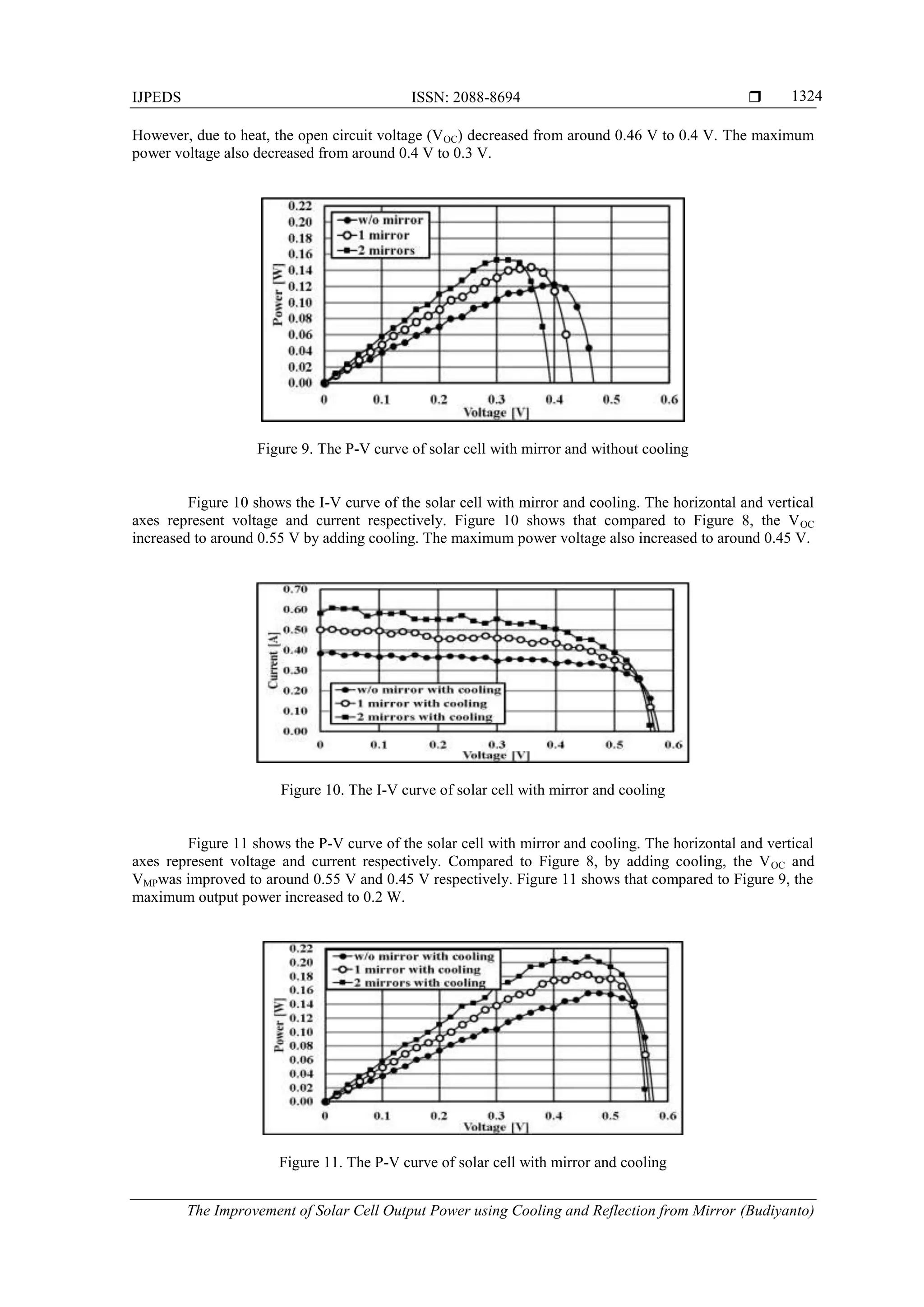
Figure 9 shows the P-V curve of the solar cell. Figure 9 shows that the maximum power (PMP)
increased from around 0.12 W to 0.16 W when there were mirrors reflecting sunlight to the solar cell.](https://image.slidesharecdn.com/3531jul1717apr15721fullpap-210608021925/75/The-Improvement-of-Solar-Cell-Output-Power-Using-Cooling-and-Reflection-from-Mirror-4-2048.jpg)
![ ISSN: 2088-8694
IJPEDS Vol. 8, No. 3, September 2017 : 1320–1326
1325
4. CONCLUSION
The effect of adding mirror and cooling to solar cell has been investigated. The results show that by
adding mirror, the current and output power of solar cell increase but the open circuit voltage and maximum
power voltage decrease due to heat. By adding cooling, the open circuit voltage and the maximum power
voltage are improved, so the output power also increases.
ACKNOWLEDGMENTS
This paper is partially funded by Hibah Penelitian Internal PAKARTI Fakultas Teknik Universitas
Muhammadiyah Jakarta nomor kontrak 77k/FT-UMJ/V/2017
REFERENCES
[1] N. A. Handayani and D. Ariyanti, "Potency of Solar Energy Applications in Indonesia", International Journal of
Renewable Energy Development, vol. 1, pp. 33-38, 2012.
[2] Y. M. Irwan, W. Z. Leow, M. Irwanto, Fareq M, S. I. S, Hassan, I. Safwati and A. R. Amelia, "Comparison of solar
panel cooling system by using dc brushless fan and dc water", Journal of Physics, 2015.
[3] Muhammad Bilal, Muhammad Naeem Arbab, Muhammad Zain Ul Abideen Afridi, Alishpa Khattak, "Increasing
the Output Power and E ciency of Solar Panel by Using Concentrator Photovoltaics (CPV)", International Journal
of Engineering Works, vol. 3, pp. 98-102, 2016.
[4] Slamet Widodo, Goib Wiranto, Mirza Nur Hidayat, "Fabrication of dye sensitized solar cells with spray coated
carbon nano tube (CNT) based counter electrodes", Energy Procedia, vol. 68, pp. 37-44, 2015.
[5] P. C. Choubey, A. Oudhia and R. Dewangan, "A review: Solar cell current scenario and future trends", Recent
Research in Science and Technology, vol. 4, pp. 99-101, 2012.
[6] Dharmendra thakur, Amit arnav, Abhishek datta, E.V.V Ramanamurthy, "A Review on Immersion System to
increase the efficiency of Solar Panels", International Journal of Advanced Research, vol. 4, pp. 312-325, 2016.
[7] Ankita Gaur and G. N. Tiwari, "Performance of Photovoltaic Modules of Different Solar Cells", Journal of Solar
Energy, vol. 2013, pp. -, 2013.
[8] Ay Gegül Ta Gç Jo Llu, Onur Ta Gk Jn and Ali Vardar, "A Power Case Study for Monocrystalline and
Polycrystalline Solar Panels in Bursa City, Turkey", International Journal of Photoenergy, vol. 2016, pp. 1-7,
2016.
[9] P G Nikhil, M Premalatha, "Performance enhancement of solar module by cooling: An experimental investigation",
international journal of energy and environment, vol. 3, pp. 73-82, 2012.
[10] K. A. Moharram, M. S. Abd-Elhady, H.A. Kandil, H. El-Sherif, "Enhancing the performance of photovoltaic panels
by water cooling", Ain Shams Engineering Journal, vol. 4, pp. 869–877, 2013.
[11] A. Aldihani, A. Aldossary, S. Mahmoud, R.K. AL-Dadah, "The Effect of Cooling on the Performance of
Photovoltaic Cells under Dusty Environmental Conditions", Energy Procedia, vol. 61, pp. 2383-2386, 2014.
[12] Pieter Bauwens and Jan Doutreloigne, "NMOS-Based Integrated Modular Bypass for Use in Solar Systems
(NIMBUS): Intelligent Bypass for Reducing Partial Shading Power Loss in Solar Panel Applications", energies,
vol. 9, pp. 1-15, 2016.
[13] Jong-Rok Lim, Yong Ki Min, Tae-Hee Jung, Jae-Hyun Ahn and Hyung-Keun Ahn, "Correlation between Reverse
Voltage Characteristics and Bypass Diode Operation with Different Shading Conditions for c-Si Photovoltaic
Module Package", Journal Of Semiconductor Technology And Science, vol. 15, pp. 577-584, 2015.
[14] R. Hariharan, M. Chakkarapani, G. Saravana Ilango, and C. Nagamani, "A Method to Detect Photovoltaic Array
Faults and Partial Shading in PV Systems", IEEE JOURNAL OF PHOTOVOLTAICS, vol. 6, pp. 1278-1285, 2016.
[15] Tanvir Ahmad, Sharmin Sobhan, Md. Faysal Nayan, "Comparative Analysis between Single Diode and Double
Diode Model of PV Cell: Concentrate Different Parameters Effect on Its Efficiency", Journal of Power and Energy
Engineering, vol. 4, pp. 32-46, 2016.
[16] Md. Imran Azim, Md. Rajibur Rahman, Md. Fayzur Rahman, "INTEGRATION OF THE OUTPUT OF A
SILICON SOLAR CELL TO THE GRID SYSTEM", European Scientific Journal, vol. 9, pp. 261-271, 2013.
[17] Ali H. AL-Hamadany, Faten Sh. Zain Al-Abideen, Jinnan H. Ali, "Effect of Angle Orientation of Flat Mirror
Concentrator on Solar Panel System Output", IOSR Journal of Computer Engineering, vol. 18, pp. 16-23, 2016.
[18] Ababacar Ndiaye, Cheikh M. F. Kébé, Pape A. Ndiaye, Abdérafi Charki, Abdessamad Kobi and Vincent Sambou ,
"Impact of dust on the photovoltaic (PV) modules characteristics after an exposition year in Sahelian environment:
The case of Senegal ", International Journal of Physical Sciences, vol. 8, pp. 1166-1173, 2013.
[19] Sathyanarayana P., Rajkiran Ballal, Lakshmi Sagar P. S., Girish Kumar, "Effect of Shading on the Performance of
Solar PV Panel", Energy and Power, vol. 5, pp. 1-4, 2015.
[20] Ali Pourakbar Saffara, Bahman Deldadeh Barani, "Thermal Effects Investigation on Electrical Properties of Silicon
Solar Cells Treated by Laser Irradiation", International Journal of Renewable Energy Development, vol. 3, pp. 184-
187, 2014.
[21] M. Azzouzi, D. Popescu, and M. Bouchahdane, "Modeling of Electrical Characteristics of Photovoltaic Cell
Considering Single-Diode Model", Journal of Clean Energy Technologies, vol. 4, pp. 414-419, 2016.](https://image.slidesharecdn.com/3531jul1717apr15721fullpap-210608021925/75/The-Improvement-of-Solar-Cell-Output-Power-Using-Cooling-and-Reflection-from-Mirror-6-2048.jpg)
![IJPEDS ISSN: 2088-8694
The Improvement of Solar Cell Output Power using Cooling and Reflection from Mirror (Budiyanto)
1326
[22] Badreddine Lahfaoui, Smail Zouggar, Mohamed Larbi Elhafyani, Mohammed Seddik, "An Experimental Study of
P&O MPPT Control for Photovoltaic Systems", International Journal of Power Electronics and Drive System, vol.
7, pp. 954-963, 2016.
[23] T. Sundar, S. Sankar, "Modeling and Simulation of Closed Loop Controlled Parallel Cascaded Buck Boost
Converter Inverter Based Solar System", International Journal of Power Electronics and Drive System, vol. 6, pp.
648-656, 2015.
BIOGRAPHIES OF AUTHORS
Budiyanto received his Doctoral degree from Universitas Indonesia. He is a lecturer at
Universitas Muhammadiyah Jakarta. His research interests are power electronics, photovoltaic
systems and renewable energy.
Fadliondi received his Master degree from Tokyo Institute of Technology. He is a lecturer at
Universitas Muhammadiyah Jakarta. His research interests are electronics material and
semiconductor devices.](https://image.slidesharecdn.com/3531jul1717apr15721fullpap-210608021925/75/The-Improvement-of-Solar-Cell-Output-Power-Using-Cooling-and-Reflection-from-Mirror-7-2048.jpg)


