Maria Elizabeth Gastal Fassa Anaclaudia Gastal Fassa Neice Müller Xavier Faria The importance of understanding the learning process when trying to improve public engagement with health research 5 a  CRE Outubro,2008
Human being wonders, thinks, and learns It is a natural part of being human to look at the world around us and wonder    to build questions It is a natural part of being human try to make sense of all we see, hear, notice    to search for answers It is a natural part of being human to learn    to harvest  data, to compare, to classify, to conclude Life is learning, we only survive if we learn    if  we research
Learning is essential to survive to make sense of the environment to be able to deal with it for the own sake of the mind functioning Stimuli are the mind’s nutrition. If a human being does not have this nutrition he/she perishes (as the child in hospitalism)
Sometimes learning does not occur This natural feature of the human being, the impulse for learning, is sometimes distorted when it is overruled  there is no space     for the own sake of the mind functioning     to make questions
Sometimes learning does not occur This natural feature of the human being, the impulse for learning, is sometimes distorted when the information is transmitted, is imposed there is no space     to make sense of the environment    to search for answers myself The human being does not learn    does not harvest  data, compare, nor classify, does not conclude
Learning is a construction learning requires  effort / willingness     it is not a neutral act a question that awakes the natural sense of wonder, the natural impulse to make sense  a question with which for some reason I identify myself Learning requires motivation / engagement
Learning / Engagement Learning requires engagement    without engagement it is only possible to repeat mechanically some algorithms  Engagement is a learning process    the engagement arises as part of the knowledge construction It is like two faces of the same coin
Teaching / Learning Traditional education   each one plays own role inside fixed rules  fixed and universal curriculum evaluation through tests  stereotyped behaviors  teacher teaches what he/she already knows student hear and answer what is expected There is no dialogue, no space for surprise, creation  Teacher pretends to teach and student pretends to learn, there is no real learning
Teaching / Learning Participatory education  (Paulo Freire / Montessori) Student builds own knowledge  Teacher organizes environment, stimuli, learning opportunities Teacher and students are learning partners and lifelong learners    Different power distribution. Different distribution of active roles. Different process’ subject.
Scientific knowledge communication / traditional culture communication Scientific knowledge communication   think about grand parents’ time classrooms conference hall front pulpits low level audience seats one person exposing his/her abstract knowledge There is not engagement, there is not knowledge building Similar to traditional education Still the most common
Scientific knowledge communication / traditional culture communication Traditional culture communication people sit in a circle at the same level opportunities for eye contact  personal experience reported through stories  emotion communicated  There is engagement and knowledge building Similar to the new participatory approach for scientific communication, as the “scientific cafés”
Teaching / Learning Human beings are not teachable  Human beings starve for learning
Amount of available information It would be impossible for each human being to make the whole path humanity walked in the knowledge evolution, to master all available information The process of building fundamental concepts, universal values of culture, not having those superimposed, is the basis for understanding any other piece of human knowledge Using the basis of the fundamental concepts and universal values for critical thinking, it is possible to make any part of this knowledge a personal property/feature through engagement and learning
What makes people engage and learn? Person must be subject in the learning/engagement process. Both are processes of subjectivity construction The process must be self-referenced, people need to have the opportunity to identify themselves with it  Engagement and learning are personal construction, they are effective only from inside, does not work from outside Engagement and learning imply incorporation, appropriation, “make it mine”
Transforming information into  personal knowledge One way to transform information in personal knowledge is acting over the information bringing it to our ground  comparing universal data with our community’s data  comparing stories with the ones we know from people around us     Researching in our community, building opinion and making decisions, choices
Difference between academic research   and engaged learning Academic research is universal, impersonal, general the number included in the research is anyone  no one sees oneself as that specific number Engaged learning self-referred, particular,    the number is myself, my students, persons with names and faces
What we are doing Working with rural teachers chosen topic: Pesticides  a teachers’ real concern  a teachers’ experiential knowledge
Methodology dialogue based on the teachers knowledge about their community and the researcher team knowledge about the universal aspects of the issue r esearch chain  research team    representative teachers     teachers in the schools    students     community every chain’s link will follow all research steps to  build a question     to create an instrument    to collect data    to analyse data    to write report Everyone will be a responsible participant that will have voice to construct a process that is cultural, sociological, political and economical
Actions resultants from teacher’s research To divulgate research’s findings and promote better practices when using pesticides these chain will develop activities interventions printed materials  videos radio programs
First question What is the profile of pesticides use in my community? To become engaged the person needs to identify him/herself with the issue. The “number” is myself, is my student… The question makes the focus self-referenced  It is important to be aware that from this general question can arise different specific questions that will be the central question of the research of one of the chain’s link.
We need to be “glocals”.  Contextualize the research to the community.
Teacher research Bridge between the global knowledge and the local context Focus on question of the community’s specific interest Turns the research from  “ general”, not referring to anyone that is next to me to an issue referred to people with faces and names    Teacher researches own reality
Research   word that scares Research is a state of mind  completely aware willing to live entirely the present willing changes, searching solutions instead of “letting it be” In some sense everybody researches  ➠  children research incessantly  Children knows how to approach father or mother “ maybe = no” and “eventually = yes”    Research gives us control over our environment
Demystifying... Every teacher  has questions searches for solutions  tries strategies  takes conclusions  researches, even not writing the report …    in the same way as mothers and cookers and everybody who loves their own work do
Demystifying... Good teachers Observe the student  Analyze his/her needs Adjust the curriculum to meet these needs     Teacher research is a natural extension of the good pedagogical practice. So, we begin where the teachers have ground
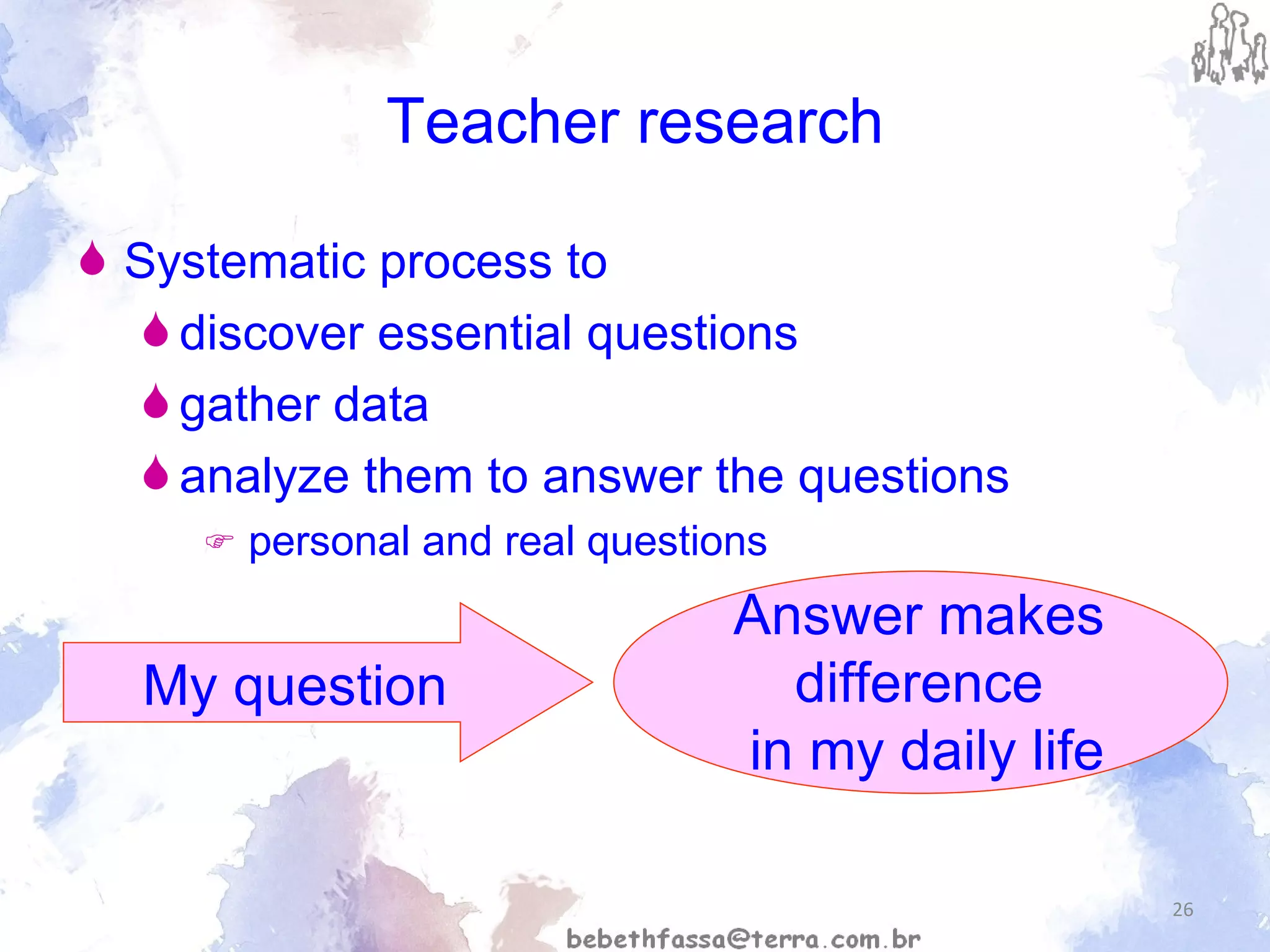
Teacher research Systematic process to discover essential questions gather data analyze them to answer the questions    personal and real questions My question Answer makes  difference  in my daily life
Teacher Research In relation to public engagement,  aims   deeper reflection  better comprehension of the reality better comprehension of the students the habit of systemic thinking the habit of writing thoughts and observations to compare and follow processes to be a learning model to the students, involving students in research
Reports on teacher research Similar to good literature Rich in anecdotes and personal stories Immediate, first-person tone Metaphors as a way to highlight key findings Stories as critical tools to illuminate deeper theories or subterranean processes  These are reports that teachers read and information they use in their classrooms!
Teacher’s interest to be a “bridge” To be heard To have voice in the decisions that affect their community To better support their community in the search for life’s quality Numbers are the base for the government decisions Quantitative reports are not useful as model, they do not promote identification    Many times stories can be completed with quantitative tables
Social interest in having teacher as “bridge” Human beings    “story tellers” learn and pass on culture through stories Attitudes are modeled only in a “personal” and meaningful context    Teachers are able to integrate research findings important for our communities in personal and meaningful contexts ➠  transforming them in stories, making them attractive for public engagement
Student research Learning through project = through research  excellent outcomes Students questions naturally personal and in the context  can be inserted in the curriculum
Teacher research/  student research Search answers through research Write reports on their process
Teacher’s research outcomes engagement of teachers and students on health research community’s use of research findings for bettering people life     best practices when using pesticides empowerment of teachers and students the generalization of an attached to reality, investigative, critical and systematic approach to other relevant issues in the community understanding about the potential impact of health research on the improvement of their life  more openness to use other scientific knowledge    Teacher’s research is a powerful tool that will bring teacher to another level of thinking and will be available to these teachers from now on to continue researching
“ Glocal” research leads to  changes in attitudes Reasons why teacher research brings changes  the teacher natural leadership the teacher and research integration in the context his/her direct relationship with his/her students The teacher will translate his/her conclusions to the community not only with numbers,  but also with the tissue of the life of the observed  with stories
“ Glocal” research leads to  changes in attitudes Reasons why student research brings changes  the question is personal and contextualized the adolescents are building attitudes and behaviors and will stand on their discoveries for this building they are open minded they have influence over their parents behavior and ideas
Education / public engagement education fosters public engagement public engagement fosters education promoting critically and systemic thinking bringing thinking to a formal level All children should fulfill their own potential  Children engagement with research and children health awareness, since very little, foster a formal level of  thinking  Leading to education equity ➠ health equity Obviously we would not see the results in short term, but these results would be incredibly worth
Thank you! Maria Elizabeth Gastal Fassa [email_address]

The importance of understanding the learning process when trying to improve public engagement with health research

  • 1.
    Maria Elizabeth GastalFassa Anaclaudia Gastal Fassa Neice Müller Xavier Faria The importance of understanding the learning process when trying to improve public engagement with health research 5 a CRE Outubro,2008
  • 2.
    Human being wonders,thinks, and learns It is a natural part of being human to look at the world around us and wonder  to build questions It is a natural part of being human try to make sense of all we see, hear, notice  to search for answers It is a natural part of being human to learn  to harvest data, to compare, to classify, to conclude Life is learning, we only survive if we learn  if we research
  • 3.
    Learning is essentialto survive to make sense of the environment to be able to deal with it for the own sake of the mind functioning Stimuli are the mind’s nutrition. If a human being does not have this nutrition he/she perishes (as the child in hospitalism)
  • 4.
    Sometimes learning doesnot occur This natural feature of the human being, the impulse for learning, is sometimes distorted when it is overruled there is no space  for the own sake of the mind functioning  to make questions
  • 5.
    Sometimes learning doesnot occur This natural feature of the human being, the impulse for learning, is sometimes distorted when the information is transmitted, is imposed there is no space  to make sense of the environment  to search for answers myself The human being does not learn  does not harvest data, compare, nor classify, does not conclude
  • 6.
    Learning is aconstruction learning requires effort / willingness  it is not a neutral act a question that awakes the natural sense of wonder, the natural impulse to make sense a question with which for some reason I identify myself Learning requires motivation / engagement
  • 7.
    Learning / EngagementLearning requires engagement  without engagement it is only possible to repeat mechanically some algorithms Engagement is a learning process  the engagement arises as part of the knowledge construction It is like two faces of the same coin
  • 8.
    Teaching / LearningTraditional education each one plays own role inside fixed rules fixed and universal curriculum evaluation through tests stereotyped behaviors teacher teaches what he/she already knows student hear and answer what is expected There is no dialogue, no space for surprise, creation Teacher pretends to teach and student pretends to learn, there is no real learning
  • 9.
    Teaching / LearningParticipatory education (Paulo Freire / Montessori) Student builds own knowledge Teacher organizes environment, stimuli, learning opportunities Teacher and students are learning partners and lifelong learners  Different power distribution. Different distribution of active roles. Different process’ subject.
  • 10.
    Scientific knowledge communication/ traditional culture communication Scientific knowledge communication think about grand parents’ time classrooms conference hall front pulpits low level audience seats one person exposing his/her abstract knowledge There is not engagement, there is not knowledge building Similar to traditional education Still the most common
  • 11.
    Scientific knowledge communication/ traditional culture communication Traditional culture communication people sit in a circle at the same level opportunities for eye contact personal experience reported through stories emotion communicated There is engagement and knowledge building Similar to the new participatory approach for scientific communication, as the “scientific cafés”
  • 12.
    Teaching / LearningHuman beings are not teachable Human beings starve for learning
  • 13.
    Amount of availableinformation It would be impossible for each human being to make the whole path humanity walked in the knowledge evolution, to master all available information The process of building fundamental concepts, universal values of culture, not having those superimposed, is the basis for understanding any other piece of human knowledge Using the basis of the fundamental concepts and universal values for critical thinking, it is possible to make any part of this knowledge a personal property/feature through engagement and learning
  • 14.
    What makes peopleengage and learn? Person must be subject in the learning/engagement process. Both are processes of subjectivity construction The process must be self-referenced, people need to have the opportunity to identify themselves with it Engagement and learning are personal construction, they are effective only from inside, does not work from outside Engagement and learning imply incorporation, appropriation, “make it mine”
  • 15.
    Transforming information into personal knowledge One way to transform information in personal knowledge is acting over the information bringing it to our ground comparing universal data with our community’s data comparing stories with the ones we know from people around us  Researching in our community, building opinion and making decisions, choices
  • 16.
    Difference between academicresearch and engaged learning Academic research is universal, impersonal, general the number included in the research is anyone no one sees oneself as that specific number Engaged learning self-referred, particular,  the number is myself, my students, persons with names and faces
  • 17.
    What we aredoing Working with rural teachers chosen topic: Pesticides a teachers’ real concern a teachers’ experiential knowledge
  • 18.
    Methodology dialogue basedon the teachers knowledge about their community and the researcher team knowledge about the universal aspects of the issue r esearch chain research team  representative teachers  teachers in the schools  students  community every chain’s link will follow all research steps to build a question  to create an instrument  to collect data  to analyse data  to write report Everyone will be a responsible participant that will have voice to construct a process that is cultural, sociological, political and economical
  • 19.
    Actions resultants fromteacher’s research To divulgate research’s findings and promote better practices when using pesticides these chain will develop activities interventions printed materials videos radio programs
  • 20.
    First question Whatis the profile of pesticides use in my community? To become engaged the person needs to identify him/herself with the issue. The “number” is myself, is my student… The question makes the focus self-referenced It is important to be aware that from this general question can arise different specific questions that will be the central question of the research of one of the chain’s link.
  • 21.
    We need tobe “glocals”. Contextualize the research to the community.
  • 22.
    Teacher research Bridgebetween the global knowledge and the local context Focus on question of the community’s specific interest Turns the research from “ general”, not referring to anyone that is next to me to an issue referred to people with faces and names  Teacher researches own reality
  • 23.
    Research word that scares Research is a state of mind completely aware willing to live entirely the present willing changes, searching solutions instead of “letting it be” In some sense everybody researches ➠ children research incessantly Children knows how to approach father or mother “ maybe = no” and “eventually = yes”  Research gives us control over our environment
  • 24.
    Demystifying... Every teacher has questions searches for solutions tries strategies takes conclusions researches, even not writing the report …  in the same way as mothers and cookers and everybody who loves their own work do
  • 25.
    Demystifying... Good teachersObserve the student Analyze his/her needs Adjust the curriculum to meet these needs  Teacher research is a natural extension of the good pedagogical practice. So, we begin where the teachers have ground
  • 26.
    Teacher research Systematicprocess to discover essential questions gather data analyze them to answer the questions  personal and real questions My question Answer makes difference in my daily life
  • 27.
    Teacher Research Inrelation to public engagement, aims deeper reflection better comprehension of the reality better comprehension of the students the habit of systemic thinking the habit of writing thoughts and observations to compare and follow processes to be a learning model to the students, involving students in research
  • 28.
    Reports on teacherresearch Similar to good literature Rich in anecdotes and personal stories Immediate, first-person tone Metaphors as a way to highlight key findings Stories as critical tools to illuminate deeper theories or subterranean processes  These are reports that teachers read and information they use in their classrooms!
  • 29.
    Teacher’s interest tobe a “bridge” To be heard To have voice in the decisions that affect their community To better support their community in the search for life’s quality Numbers are the base for the government decisions Quantitative reports are not useful as model, they do not promote identification  Many times stories can be completed with quantitative tables
  • 30.
    Social interest inhaving teacher as “bridge” Human beings  “story tellers” learn and pass on culture through stories Attitudes are modeled only in a “personal” and meaningful context  Teachers are able to integrate research findings important for our communities in personal and meaningful contexts ➠ transforming them in stories, making them attractive for public engagement
  • 31.
    Student research Learningthrough project = through research excellent outcomes Students questions naturally personal and in the context can be inserted in the curriculum
  • 32.
    Teacher research/ student research Search answers through research Write reports on their process
  • 33.
    Teacher’s research outcomesengagement of teachers and students on health research community’s use of research findings for bettering people life  best practices when using pesticides empowerment of teachers and students the generalization of an attached to reality, investigative, critical and systematic approach to other relevant issues in the community understanding about the potential impact of health research on the improvement of their life more openness to use other scientific knowledge  Teacher’s research is a powerful tool that will bring teacher to another level of thinking and will be available to these teachers from now on to continue researching
  • 34.
    “ Glocal” researchleads to changes in attitudes Reasons why teacher research brings changes the teacher natural leadership the teacher and research integration in the context his/her direct relationship with his/her students The teacher will translate his/her conclusions to the community not only with numbers, but also with the tissue of the life of the observed with stories
  • 35.
    “ Glocal” researchleads to changes in attitudes Reasons why student research brings changes the question is personal and contextualized the adolescents are building attitudes and behaviors and will stand on their discoveries for this building they are open minded they have influence over their parents behavior and ideas
  • 36.
    Education / publicengagement education fosters public engagement public engagement fosters education promoting critically and systemic thinking bringing thinking to a formal level All children should fulfill their own potential Children engagement with research and children health awareness, since very little, foster a formal level of thinking Leading to education equity ➠ health equity Obviously we would not see the results in short term, but these results would be incredibly worth
  • 37.
    Thank you! MariaElizabeth Gastal Fassa [email_address]