Chapter I:
The Learner
The Nature of the Learner

- The learner is an embodied spirit. He is the union
   of sentient body and a rational soul. His body
   experiences sensations and feels pleasure and
   pain. His soul is the principle of spiritual acts, the
   source of intellectual abstraction, self-reflection,
   and free rational volition. Body and soul exist in
   mutual dependence. (Kelly, 1965)
The Fundamental Equipment
             of the Learner

The learner has the power to see, hear, touch,
smell, taste, perceive, imagine, retain, recall,
recognize past mental acts, conceive ideas,
make judgment, reason out, feel and choose.
Five Elements of the Learner

1. Ability
   The students’ native ability dictates the
   prospects of success in purposeful activity.
   It determine their capacity to understand
   and assimilate information for their own use
   and application.
2. Aptitude
  Aptitude refers to the students’ innate
  talent or gift. It indicates a natural capacity
  to learn certain skills.
3. Interest
  Learners vary in activities that are undertaken
  due to a strong appeal or attraction.
4. Family & Cultural Background
  Students who come from different
  socioeconomic background manifest a
  wide range behaviour due
5. Attitudes
  Students have unique way of thinking and
  reacting. Confronted with the same situation
  in the learning environment each one would
  react differently depending on their personal
  characteristics.
Positive Attidudes:

a. Curiosity

b. Responsibility

c. Creativity
d. Persistence
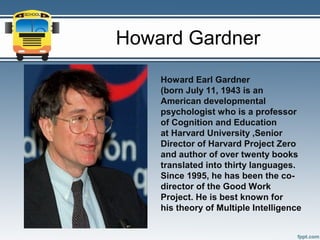
Howard Gardner
    Howard Earl Gardner
    (born July 11, 1943 is an
    American developmental
    psychologist who is a professor
    of Cognition and Education
    at Harvard University ,Senior
    Director of Harvard Project Zero
    and author of over twenty books
    translated into thirty languages.
    Since 1995, he has been the co-
    director of the Good Work
    Project. He is best known for
    his theory of Multiple Intelligence
Multiple Intelligence
1.   Verbal-Linguistic Intelligence
2.   Logical-Mathematical Intelligence
3.   Spatial Intelligence
4.   Bodily-Kinesthetic Intelligence
5.   Musical Intelligence
6.   Intrapersonal Intelligence
7.   Interpersonal Intelligence
8.   Naturalist Intelligence
9.   Existential Intelligence
THANK YOU !!! 

PRINCIPLE OF TEACHING: THE LEARNER

  • 1.
  • 2.
    The Nature ofthe Learner - The learner is an embodied spirit. He is the union of sentient body and a rational soul. His body experiences sensations and feels pleasure and pain. His soul is the principle of spiritual acts, the source of intellectual abstraction, self-reflection, and free rational volition. Body and soul exist in mutual dependence. (Kelly, 1965)
  • 3.
    The Fundamental Equipment of the Learner The learner has the power to see, hear, touch, smell, taste, perceive, imagine, retain, recall, recognize past mental acts, conceive ideas, make judgment, reason out, feel and choose.
  • 4.
    Five Elements ofthe Learner 1. Ability The students’ native ability dictates the prospects of success in purposeful activity. It determine their capacity to understand and assimilate information for their own use and application.
  • 5.
    2. Aptitude Aptitude refers to the students’ innate talent or gift. It indicates a natural capacity to learn certain skills.
  • 6.
    3. Interest Learners vary in activities that are undertaken due to a strong appeal or attraction.
  • 7.
    4. Family &Cultural Background Students who come from different socioeconomic background manifest a wide range behaviour due
  • 8.
    5. Attitudes Students have unique way of thinking and reacting. Confronted with the same situation in the learning environment each one would react differently depending on their personal characteristics.
  • 9.
    Positive Attidudes: a. Curiosity b.Responsibility c. Creativity d. Persistence
  • 10.
    Howard Gardner Howard Earl Gardner (born July 11, 1943 is an American developmental psychologist who is a professor of Cognition and Education at Harvard University ,Senior Director of Harvard Project Zero and author of over twenty books translated into thirty languages. Since 1995, he has been the co- director of the Good Work Project. He is best known for his theory of Multiple Intelligence
  • 11.
    Multiple Intelligence 1. Verbal-Linguistic Intelligence 2. Logical-Mathematical Intelligence 3. Spatial Intelligence 4. Bodily-Kinesthetic Intelligence 5. Musical Intelligence 6. Intrapersonal Intelligence 7. Interpersonal Intelligence 8. Naturalist Intelligence 9. Existential Intelligence
  • 12.