Central China Normal University
The Training Programme for Teachers’
Professional Development on Problem
Solving
April 17th, 2024
Practice exercise
We propose an initial activity…
Write it on the Post-it note and share your opinion. Keep the Post-it
for the next exercise.
Time to write: 3Min
1. What is the meaning of the concept of PROBLEM in your
experience as a teacher?
2. Identify one problem in your experience as a teacher.
The aims of the programme
• To support the development of teachers’
problem-solving skills at any stage of the
profession.
• To bridge the “theory–practice gap” in teachers’
professional development by supporting
knowledge transfer between educational theory
and classroom practice.
The Training Programme for Teachers’
Professional Development on Problem
Solving
• Is an interdisciplinary endeavor settled in a cross-segment
of three disciplines:
• Provide theoretical
background for teaching
and teachers’
competencies; teachers’
thinking; teacher education
and professional
development
Educational
Science
• Help to determine the
theoretical side of the
problem and the problem
solving process itself.
Psychology
• Concentrates on the
development of the
organization, which starts
from the problem state.
Management
Science
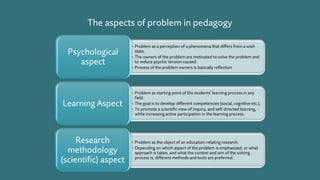
The aspects of problem in pedagogy
• Problem as a perception of a phenomena that differs from a wish
state.
• The owners of the problem are motivated to solve the problem and
to reduce psychic tension caused.
• Process of the problem owners is basically reflection
Psychological
aspect
• Problem as starting point of the students’ learning process in any
field.
• The goal is to develop different competencies (social, cognitive etc.),
• To promote a scientific view of inquiry, and self-directed learning,
while increasing active participation in the learning process.
Learning Aspect
• Problem as the object of an education-relating research.
• Depending on which aspect of the problem is emphasized, or what
approach is taken, and what the context and aim of the solving
process is, different methods and tools are preferred.
Research
methodology
(scientific) aspect
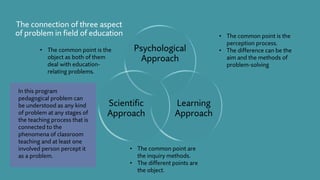
The connection of three aspect
of problem in field of education
Psychological
Approach
Learning
Approach
Scientific
Approach
• The common point is the
perception process.
• The difference can be the
aim and the methods of
problem-solving
• The common point are
the inquiry methods.
• The different points are
the object.
• The common point is the
object as both of them
deal with education-
relating problems.
In this program
pedagogical problem can
be understood as any kind
of problem at any stages of
the teaching process that is
connected to the
phenomena of classroom
teaching and at least one
involved person percept it
as a problem.
Practice exercise
• According to the information, classify your problem in one of the
three different aspects.
Psychological Learning Research methodology
(scientific)
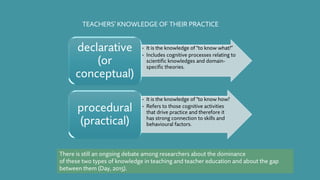
• It is the knowledge of “to know what?”
• Includes cognitive processes relating to
scientific knowledges and domain-
specific theories.
declarative
(or
conceptual)
• It is the knowledge of “to know how?
• Refers to those cognitive activities
that drive practice and therefore it
has strong connection to skills and
behavioural factors.
procedural
(practical)
TEACHERS’ KNOWLEDGE OF THEIR PRACTICE
There is still an ongoing debate among researchers about the dominance
of these two types of knowledge in teaching and teacher education and about the gap
between them (Day, 2015).
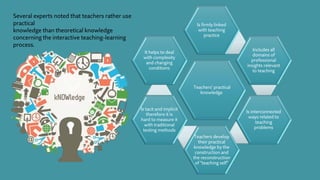
Teachers’ practical
knowledge
Is firmly linked
with teaching
practice
Includes all
domains of
professional
insights relevant
to teaching
Is interconnected
ways related to
teaching
problems
Teachers develop
their practical
knowledge by the
construction and
the reconstruction
of “teaching self”
Is tacit and implicit
therefore it is
hard to measure it
with traditional
testing methods
It helps to deal
with complexity
and changing
conditions
Several experts noted that teachers rather use
practical
knowledge than theoretical knowledge
concerning the interactive teaching-learning
process.
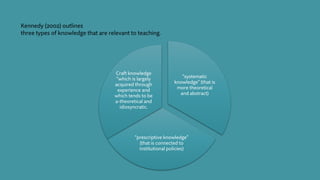
“systematic
knowledge” (that is
more theoretical
and abstract)
“prescriptive knowledge”
(that is connected to
institutional policies)
Craft knowledge
“which is largely
acquired through
experience and
which tends to be
a-theoretical and
idiosyncratic.
Kennedy (2002) outlines
three types of knowledge that are relevant to teaching.
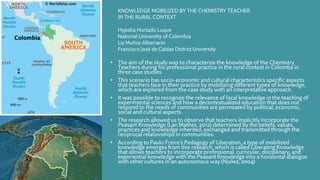
• The aim of the study was to characterize the knowledge of the Chemistry
Teachers during his professional practice in the rural context in Colomba in
three case studies.
• This scenario has socio-economic and cultural characteristics specific aspects
that teachers face in their practice by mobilizing different types of knowledge,
which are explored from the case study with an interpretative approach.
• It was possible to recognize the relevance of local knowledge in the teaching of
experimental sciences and how a decontextualized education that does not
respond to the needs of communities are permeated by political, economic,
social and cultural aspects.
• The research allowed us to observe that teachers implicitly incorporate the
Peasant Knowledge (Lan Mathez, 2012) determined by the beliefs, values,
practices and knowledge inherited, exchanged and transmitted through the
reciprocal relationships in communities.
• According to Paulo Freire’s Pedagogy of Liberation, a type of mobilized
knowledge emerges from this research, which is called Liberating Knowledge
that allows teachers to incorporate professional, curricular, disciplinary, and
experiential knowledge with the Peasant Knowledge into a horizontal dialogue
with other cultures in an autonomous way (Nuñez, 2004)
KNOWLEDGE MOBILIZED BY THE CHEMISTRY TEACHER
IN THE RURAL CONTEXT
Hypatia Hurtado Luque
National University of Colombia
Liz Muñoz Albarracín
Francisco José de Caldas District University

PPT Training Program development teaching

  • 1.
    Central China NormalUniversity The Training Programme for Teachers’ Professional Development on Problem Solving April 17th, 2024
  • 2.
    Practice exercise We proposean initial activity… Write it on the Post-it note and share your opinion. Keep the Post-it for the next exercise. Time to write: 3Min 1. What is the meaning of the concept of PROBLEM in your experience as a teacher? 2. Identify one problem in your experience as a teacher.
  • 3.
    The aims ofthe programme • To support the development of teachers’ problem-solving skills at any stage of the profession. • To bridge the “theory–practice gap” in teachers’ professional development by supporting knowledge transfer between educational theory and classroom practice.
  • 4.
    The Training Programmefor Teachers’ Professional Development on Problem Solving • Is an interdisciplinary endeavor settled in a cross-segment of three disciplines: • Provide theoretical background for teaching and teachers’ competencies; teachers’ thinking; teacher education and professional development Educational Science • Help to determine the theoretical side of the problem and the problem solving process itself. Psychology • Concentrates on the development of the organization, which starts from the problem state. Management Science
  • 5.
    The aspects ofproblem in pedagogy • Problem as a perception of a phenomena that differs from a wish state. • The owners of the problem are motivated to solve the problem and to reduce psychic tension caused. • Process of the problem owners is basically reflection Psychological aspect • Problem as starting point of the students’ learning process in any field. • The goal is to develop different competencies (social, cognitive etc.), • To promote a scientific view of inquiry, and self-directed learning, while increasing active participation in the learning process. Learning Aspect • Problem as the object of an education-relating research. • Depending on which aspect of the problem is emphasized, or what approach is taken, and what the context and aim of the solving process is, different methods and tools are preferred. Research methodology (scientific) aspect
  • 6.
    The connection ofthree aspect of problem in field of education Psychological Approach Learning Approach Scientific Approach • The common point is the perception process. • The difference can be the aim and the methods of problem-solving • The common point are the inquiry methods. • The different points are the object. • The common point is the object as both of them deal with education- relating problems. In this program pedagogical problem can be understood as any kind of problem at any stages of the teaching process that is connected to the phenomena of classroom teaching and at least one involved person percept it as a problem.
  • 7.
    Practice exercise • Accordingto the information, classify your problem in one of the three different aspects. Psychological Learning Research methodology (scientific)
  • 8.
    • It isthe knowledge of “to know what?” • Includes cognitive processes relating to scientific knowledges and domain- specific theories. declarative (or conceptual) • It is the knowledge of “to know how? • Refers to those cognitive activities that drive practice and therefore it has strong connection to skills and behavioural factors. procedural (practical) TEACHERS’ KNOWLEDGE OF THEIR PRACTICE There is still an ongoing debate among researchers about the dominance of these two types of knowledge in teaching and teacher education and about the gap between them (Day, 2015).
  • 9.
    Teachers’ practical knowledge Is firmlylinked with teaching practice Includes all domains of professional insights relevant to teaching Is interconnected ways related to teaching problems Teachers develop their practical knowledge by the construction and the reconstruction of “teaching self” Is tacit and implicit therefore it is hard to measure it with traditional testing methods It helps to deal with complexity and changing conditions Several experts noted that teachers rather use practical knowledge than theoretical knowledge concerning the interactive teaching-learning process.
  • 10.
    “systematic knowledge” (that is moretheoretical and abstract) “prescriptive knowledge” (that is connected to institutional policies) Craft knowledge “which is largely acquired through experience and which tends to be a-theoretical and idiosyncratic. Kennedy (2002) outlines three types of knowledge that are relevant to teaching.
  • 11.
    • The aimof the study was to characterize the knowledge of the Chemistry Teachers during his professional practice in the rural context in Colomba in three case studies. • This scenario has socio-economic and cultural characteristics specific aspects that teachers face in their practice by mobilizing different types of knowledge, which are explored from the case study with an interpretative approach. • It was possible to recognize the relevance of local knowledge in the teaching of experimental sciences and how a decontextualized education that does not respond to the needs of communities are permeated by political, economic, social and cultural aspects. • The research allowed us to observe that teachers implicitly incorporate the Peasant Knowledge (Lan Mathez, 2012) determined by the beliefs, values, practices and knowledge inherited, exchanged and transmitted through the reciprocal relationships in communities. • According to Paulo Freire’s Pedagogy of Liberation, a type of mobilized knowledge emerges from this research, which is called Liberating Knowledge that allows teachers to incorporate professional, curricular, disciplinary, and experiential knowledge with the Peasant Knowledge into a horizontal dialogue with other cultures in an autonomous way (Nuñez, 2004) KNOWLEDGE MOBILIZED BY THE CHEMISTRY TEACHER IN THE RURAL CONTEXT Hypatia Hurtado Luque National University of Colombia Liz Muñoz Albarracín Francisco José de Caldas District University