CORROSSION
By
Sruthi sudhakar
PG chemistry batch 2016-18
Sir Syed College,
Kannur,
Kerala
Corrossion
Destructive attack of a metal by
chemical or electrochemical reaction
with its environment
Thermodynamics of corrossion
Equilibrium between metal and environment
Corrossion tendency of metal
Qualitative picture of what can happen at a
given ph and potential
Practical situations
• Rate at which corrossion occur
• Some metals like aluminium has got tendency to react so
slowly that they meet requirement of structural metal
Kinetics is closely related to polarization
polarization
• When a net current flows through an
electrode,its not in equilibrium
• The measured potential of such an
electrode is dependent on magnitude of
external current
• The process where potential change caused
by net current from the theoretical value of
potential is polarization
Terms to remember
• Electrode reactions are assumed to induce deviations from
equilibrium due to the passage of an electrical current
through an electrochemical cell causing a change in the
electrode potential. This electrochemical phenomenon is
referred to as polarization.
• The deviation from equilibrium causes an electrical
potential difference between the polarized and the
equilibrium (unpolarized) electrode potential known as
overpotential
Causes of polarization
1. Concentration polarization
2. Activation polarization
3. IR drop
Concentration polarization
• Sometimes the mass transport within the
solution may be rate determining – in such
cases we have concentration polarization
• Also called diffusion polarization
• Concentration polarization implies either
there is a shortage of reactants at the
electrode or that an accumulation of
reaction product occurs
If copper is made cathode in a solution of dilute CuSO4 in
which the activity of cupric ion is represented by ( Cu+2 )then
the potential φ1 , in absence of external current, is given by
the Nernst equation
)log(Cu
32
0.337
)(Cu
1
log
32
0.337 2
21



nF
RT.
nF
RT.

When current flows, copper is deposited on the electrode,
thereby decreasing surface concentration of copper ions to an
activity (Cu2+ )s . The potential φ2 of the electrode becomes:
S
2
S
22 )log(Cu
32
0.337
)(Cu
1
log
32
0.337 


nF
RT.
nF
RT.

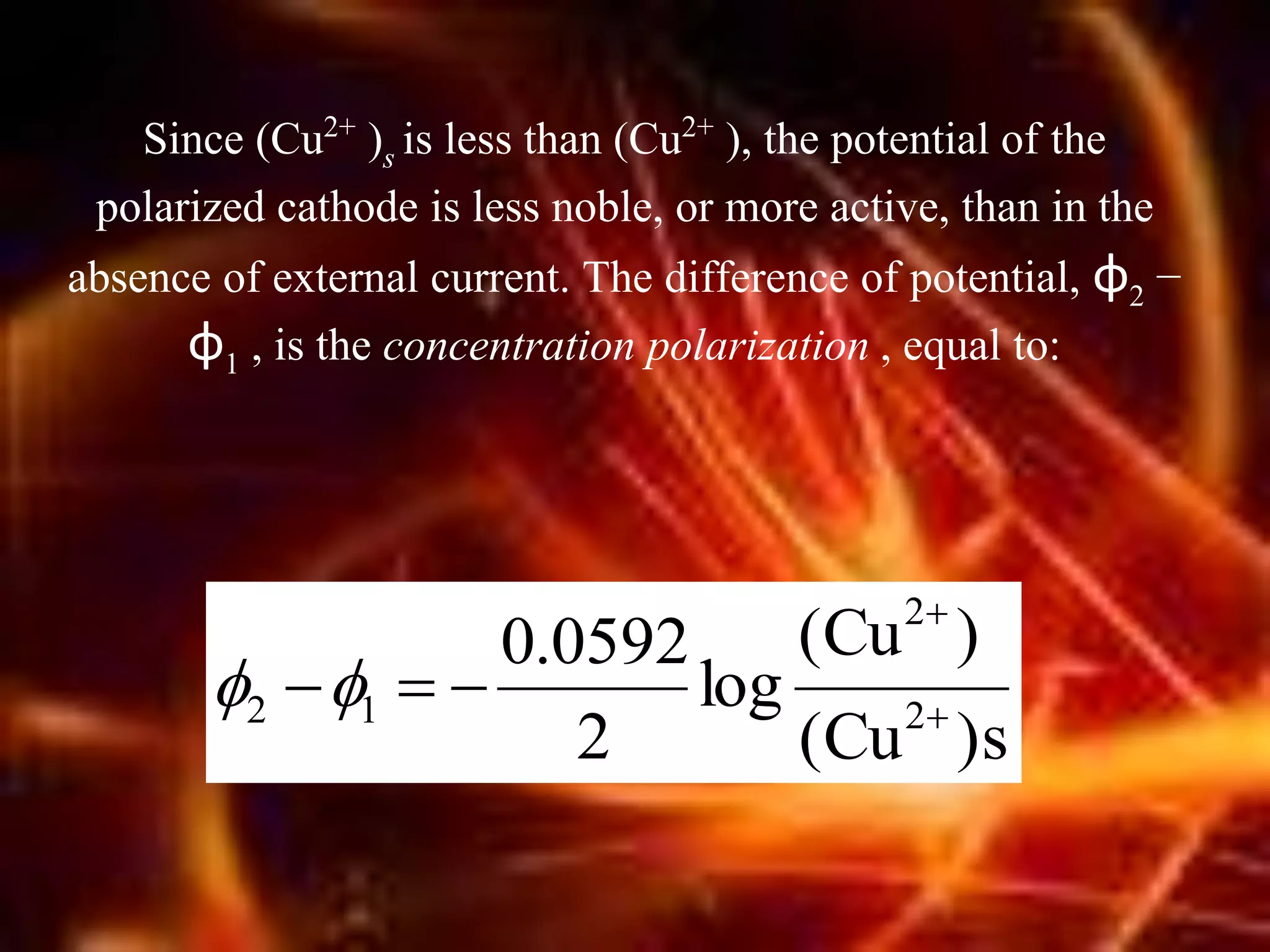
Since (Cu2+ )s is less than (Cu2+ ), the potential of the
polarized cathode is less noble, or more active, than in the
absence of external current. The difference of potential, φ2 −
φ1 , is the concentration polarization , equal to:
)s(Cu
)(Cu
log
2
0592.0
2
2
12 


 Larger the current,smaller the surface concentration of the ion and
larger the polarisation.
 Infinite concentration polarization is approached when the surface
concentration ,(Cu2+)s is zero.
 The corresponding current density is called limiting current density
 in practical situations polarisation never reaches ∞ ,another
electrode rxn gets established
For example in Cu deposition moves to that for hydrogen
evolution
2H+ + 2 e- → H2
LIMITING CURRENT DENSITY
• Fick’s Law:
• Where dn/dt is the mass transport in x direction in mol/cm2s, D
is the diffusion coefficient in cm2/s, and c is the concentration
in mol/liter
• Faraday’s law:
• Under steady state,
mass transfer rate = reaction rate
(1)10 3

dx
dc
D
dt
dn
(2)
nF
i
AnF
I
At
w

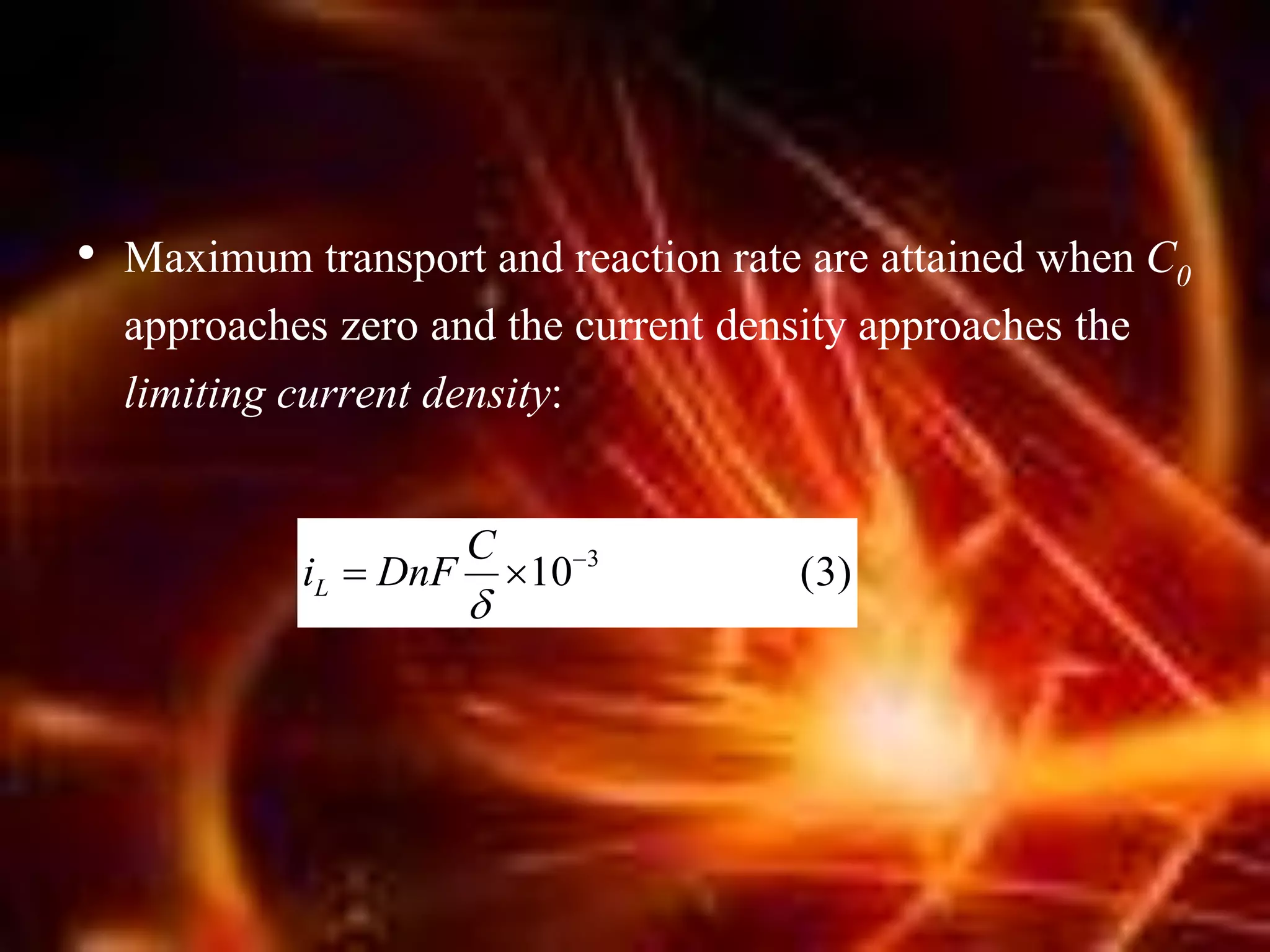
• Maximum transport and reaction rate are attained when C0
approaches zero and the current density approaches the
limiting current density:
(3)10 3


C
DnFiL
Equations (1) to (3) are valid for uncharged particles, as for
instance oxygen molecules
If charged particles are considered migration will occur in addition
to the diffusion and the previous equation must be replaced by
 where t is the transference number of all ions in solution
except the ion getting reduced
(4)10 3

t
C
DnFiL

o D is the diffusion coefficient for the ion being reduced,
o n and F have their usual signifi cance,
o δ is the thickness of the stagnant layer of electrolyte next
to the electrode surface (about 0.05 cm in an unstirred
solution),
o t is the transference number of all ions in solution except
the ion being reduced
o c is the concentration of diffusing ion in moles/ liter.
If i is the applied current we can show that













ii
i
nF
RT
DzF
ti
Cu
DzF
ti
CuCu
L
L
S
ln
)(
)()(
12Conc
2
22



Dependence of concentration polarization at
cathode on applied current density
Activation Polarization
When current flows through the anode and the cathode electrodes,
their shift in potential is partly because of activation polarization
An electrochemical reaction may consist of several steps
The slowest step determines the rate of the reaction which requires
activation energy to proceed
Subsequent shift in potential or polarization is termed activation
polarization
Due to current flow across electrode solution interface
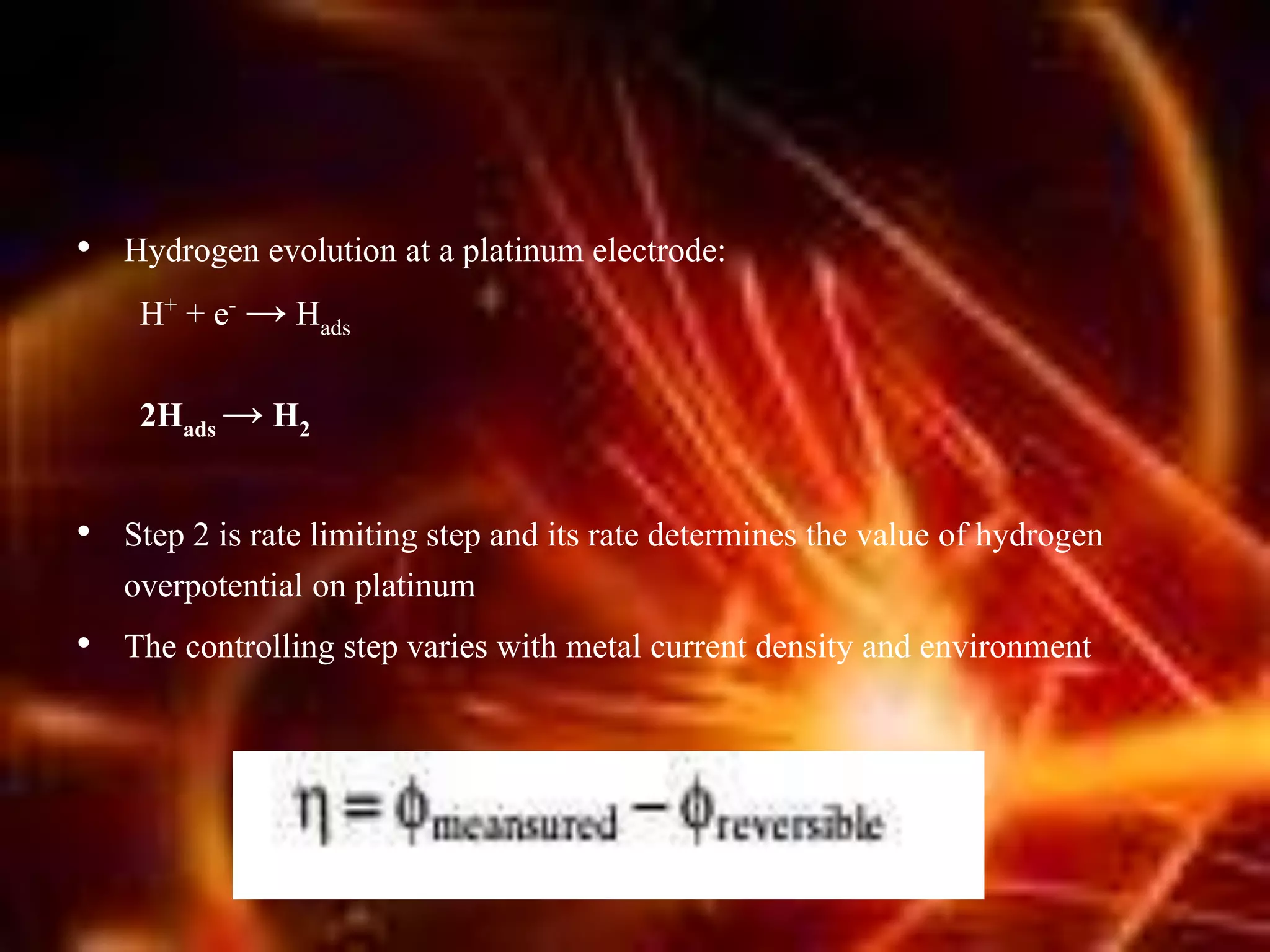
Most important example is that of hydrogen ion reduction at a
cathode, H+ + e- → ½ H2, the polarization is termed as hydrogen
overpotential
• Hydrogen evolution at a platinum electrode:
H+ + e- → Hads
2Hads → H2
• Step 2 is rate limiting step and its rate determines the value of hydrogen
overpotential on platinum
• The controlling step varies with metal current density and environment
Tafel Equation
o Activation polarization (η) increases with current density in accord
with Tafel equation:
o Larger the exchange current density smaller tafel constant and
overpotential
o The Tafel constant is given by:
oi
i
log 
nF
RT
β
α
3.2

Exchange Current Density
 At the equilibrium potential of a reaction, a
reduction and an oxidation reaction occur,
both at the same rate.
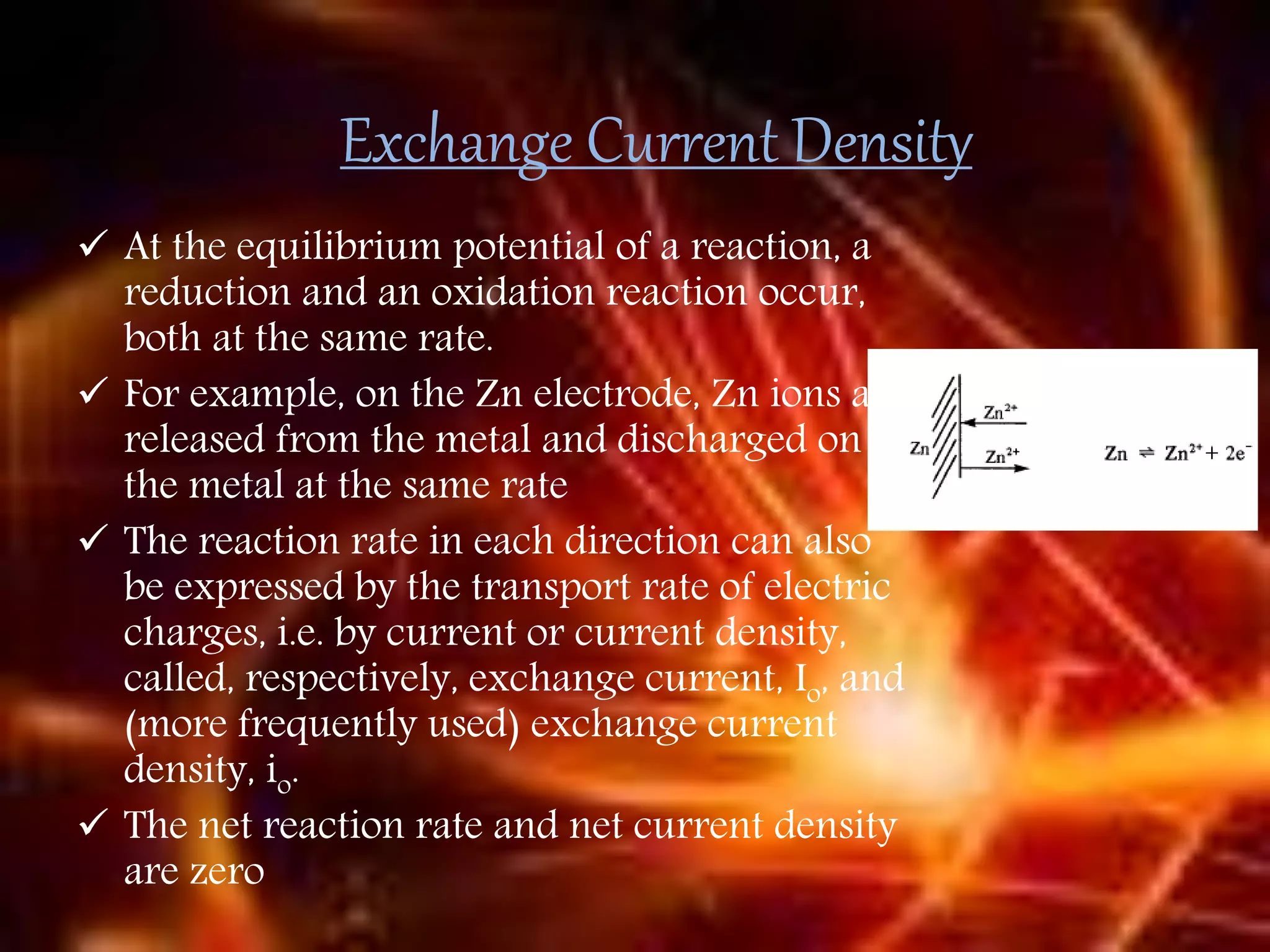
 For example, on the Zn electrode, Zn ions are
released from the metal and discharged on
the metal at the same rate
 The reaction rate in each direction can also
be expressed by the transport rate of electric
charges, i.e. by current or current density,
called, respectively, exchange current, Io, and
(more frequently used) exchange current
density, io.
 The net reaction rate and net current density
are zero
Pronounced activation polarization also occurs
with discharge of OH − at an anode
accompanied by oxygen evolution:
Activation polarization is also characteristic of metal - ion
deposition or dissolution. The value may be small for non
transition metals, such as silver, copper, and zinc, but it is larger
for the transition metals, such as iron, cobalt, nickel, and
chromium
The anion associated with the metal ion influences metal
overpotential values more than in the case of hydrogen
overpotential.
 The controlling step in the reaction is not known precisely, but, in
some cases, it is probably a slow rate of hydration of the metal ion
as it leaves the metal lattice, or dehydration of the hydrated ion as
it enters the lattice.
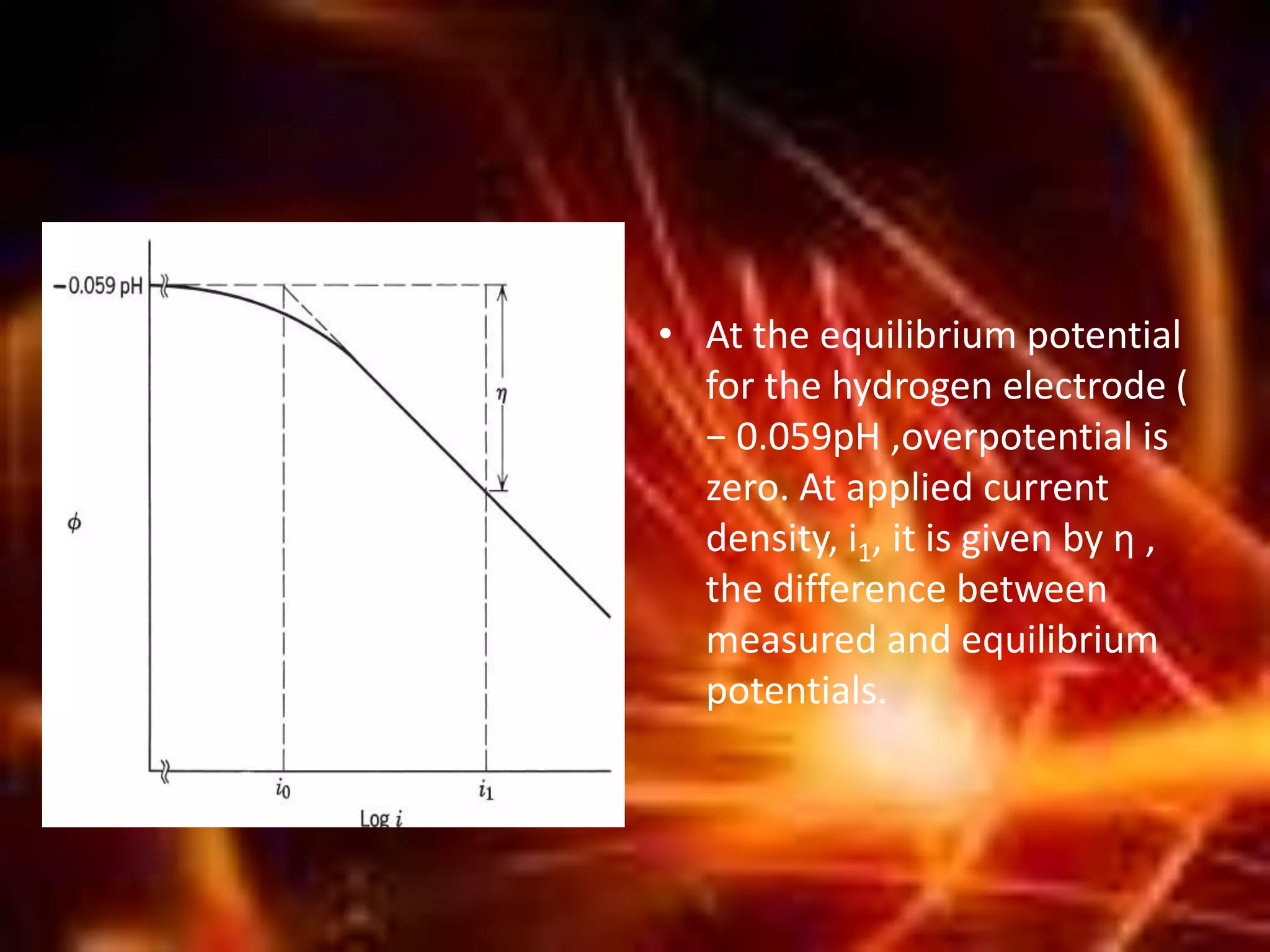
• At the equilibrium potential
for the hydrogen electrode (
− 0.059pH ,overpotential is
zero. At applied current
density, i1, it is given by η ,
the difference between
measured and equilibrium
potentials.
IR Drop
 When polarization is measured with a potentiometer and a reference electrode
combination, the measured potential includes the potential drop due to the
electrolyte resistance and possible film formation on the electrode surface
 It is the ohmic potential
 The drop in potential between the electrode and the tip of working electrode
equals iR.
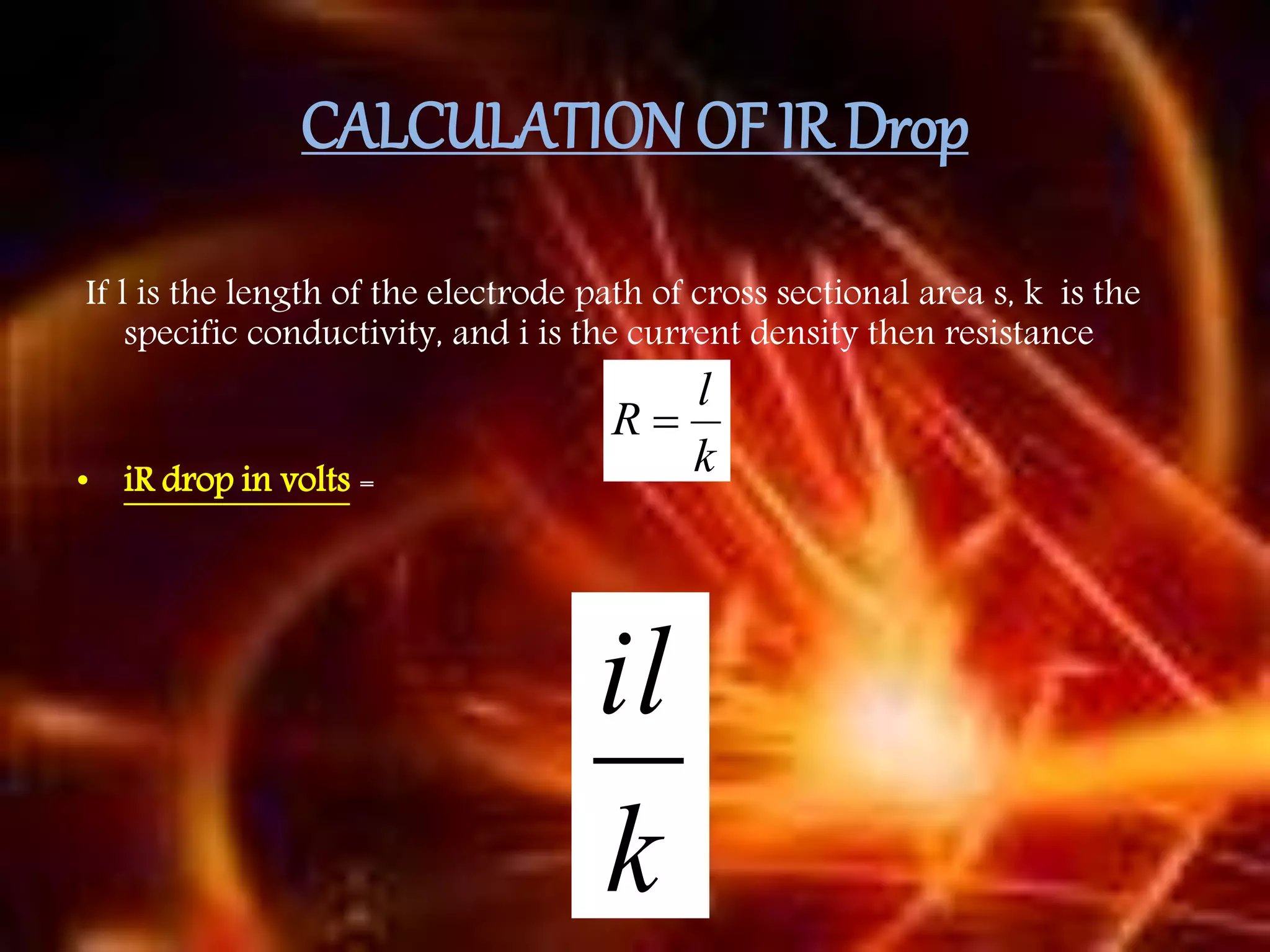
 If I is current density, and R , equal to l / κ , represents the value in ohms of
the resistance path of length l cm and specifi c conductivity κ . The product,
IR , decays simultaneously with shutting off the current, whereas
concentration polarization and activation polarization usually decay at
measurable rates.
k
il
CALCULATIONOF IR Drop
If l is the length of the electrode path of cross sectional area s, k is the
specific conductivity, and i is the current density then resistance
• iR drop in volts =
k
l
R 
k
il
k
il
Combined Polarization
A. Total polarization of an electrode is the sum of the
individual contributions,
B. If neglect IR drop or resistance polarization is neglected
then:
rcaT ηηηη 
caT ηηη 
INFLUENCE OF POLARIZATION ON
CORROSSION RATE
 The corrosion current can be calculated from the corrosion
potential and the equilibrium potential if
1. The equation expressing polarization of the anode or
cathode is known, and
2. If the anode – cathode area ratio can be estimated
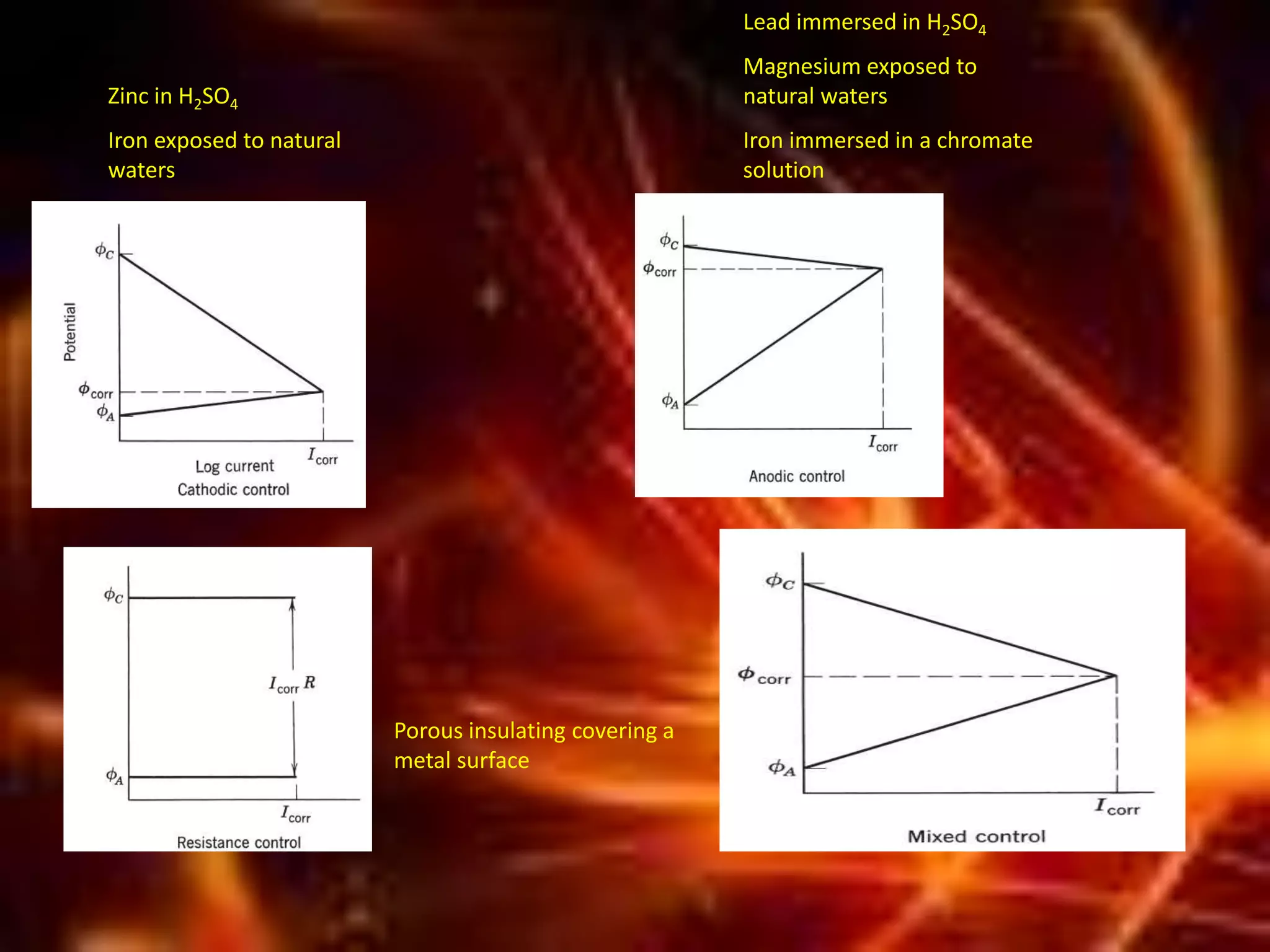
• When polarization occurs mostly at the anodes, the corrosion reaction is
said to be anodically controlled Under anodic control, the corrosion
potential is close to the thermodynamic potential of the cathode
• When polarization occurs mostly at the cathode, the corrosion rate is said
to be cathodically controlled . The corrosion potential is then near the
thermodynamic anode potential.
• Resistance control occurs when the electrolyte resistance is so high that the
resultant current is not sufficient to appreciably polarize anodes or
cathodes
• The corrosion current is then controlled by the IR drop through the
electrolyte in pores of the coating. It is common for polarization to occur in
some degree at both anodes and cathodes. This situation is described as
mixed control .
Lead immersed in H2SO4
Magnesium exposed to
natural waters
Iron immersed in a chromate
solution
Zinc in H2SO4
Iron exposed to natural
waters
Porous insulating covering a
metal surface
For all metals and alloys in any aqueous environment,
cathodic polarization always reduce the corrosion rate.
Cathodic protection is essentially the application of a
cathodic polarization to a corroding system.
For a non-passive system (e.g. steel in seawater), anodic
polarization always increases the corrosion rate. For
systems showing active-to-passive transition, anodic
polarization will increase the corrosion rate initially and
then cause a drastic reduction in the corrosion rate.
Anodic protection is essentially the application of anodic
polarization to a corroding system.
The Area Effect
 Usually cathodic reactions are slower than anodic reactions
 For a cathodic reaction to occur, there must be available sites on
the metal surface. Corrosion cells will not work when the cathodic
area is too small for surface sites
 In a galvanic cell, the anode/cathode area ratio is an important
factor for severity of corrosion attack
 A large cathode causes severe attack on a small anode
 If we cannot avoid situations for galvanic corrosion, we may
reduce thinning by making the anode material of large surface area
and cathode of smaller area.
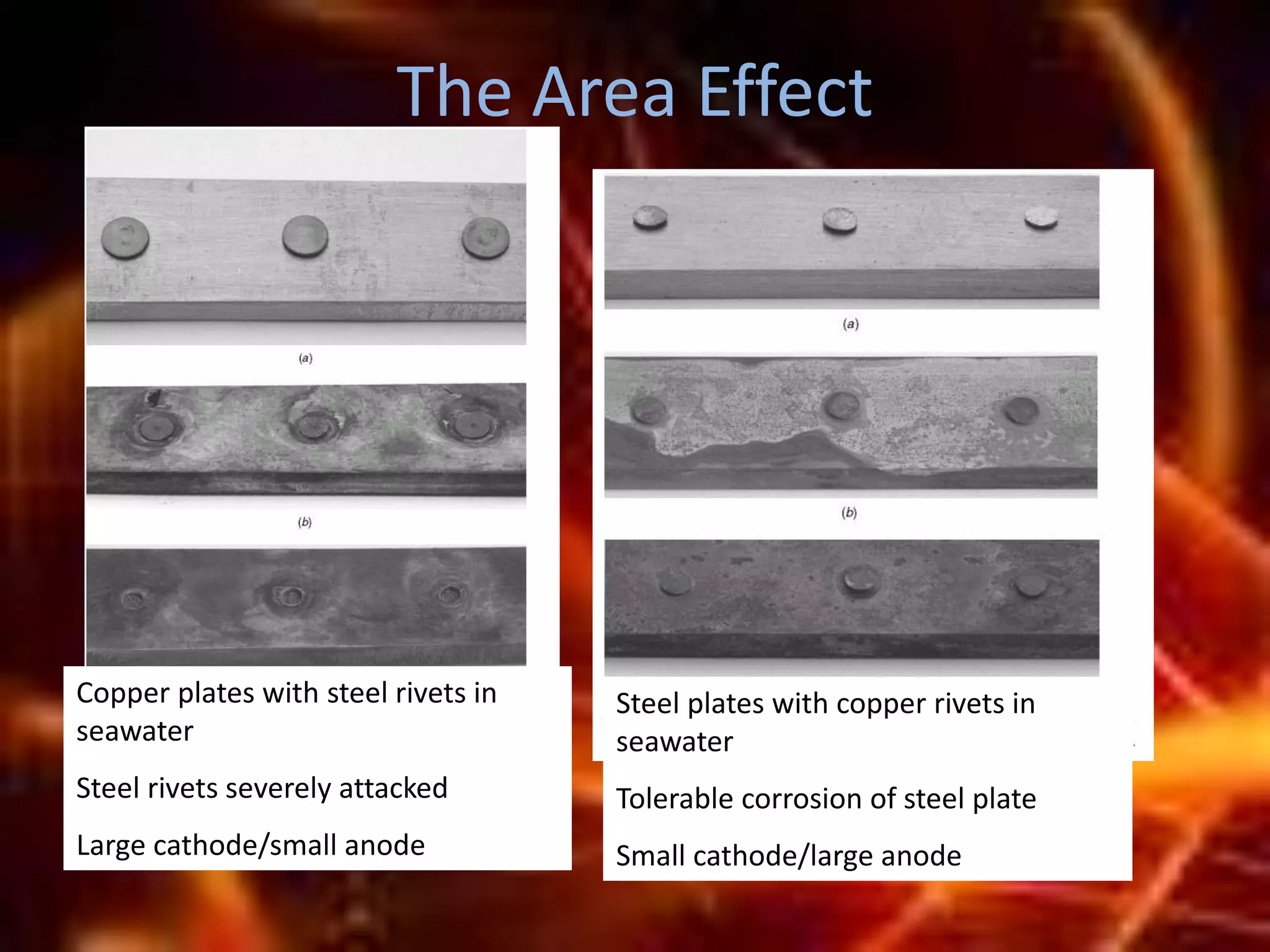
The Area Effect
Copper plates with steel rivets in
seawater
Steel rivets severely attacked
Large cathode/small anode
Steel plates with copper rivets in
seawater
Tolerable corrosion of steel plate
Small cathode/large anode
ELECTROCHEMICAL MECHANISM OF
CORROSSION BY WAGNER AND TRAUD
 Measured the corrosion rate of a dilute zinc amalgam in an acid calcium chloride
mixture and cathodic polarization of mercury in the same electrolyte.
 The current density equivalent to the corrosion rate was found to correspond to
the current density necessary to polarize mercury to the corrosion potential of the
zinc amalgam
 Mercury atoms of the amalgam composing the majority of the surface apparently
act as cathodes and zinc atoms act as anodes of corrosion cells.
 The amalgam polarizes anodically very little and limit the corrosion rate of
amalgams in nonoxidizing acids.
 A piece of platinum coupled to the amalgam considerably increases the rate of
corrosion because hydrogen is more readily evolved from a low - overpotential
cathode at the operating emf of the zinc – hydrogen electrode cell.
The very low corrosion rate and the absence of
appreciable anodic polarization - amalgams in
corresponding metal salt solutions exhibit corrosion
potentials closely approaching the reversible potential of
the alloyed component
The corrosion potential of cadmium amalgam in cdso 4
solution is closer to the thermodynamic value for cd →
cd 2+ + 2 e−
THANK YOU

Corrossion focus on polarization

  • 1.
    CORROSSION By Sruthi sudhakar PG chemistrybatch 2016-18 Sir Syed College, Kannur, Kerala
  • 4.
    Corrossion Destructive attack ofa metal by chemical or electrochemical reaction with its environment
  • 5.
    Thermodynamics of corrossion Equilibriumbetween metal and environment Corrossion tendency of metal Qualitative picture of what can happen at a given ph and potential
  • 6.
    Practical situations • Rateat which corrossion occur • Some metals like aluminium has got tendency to react so slowly that they meet requirement of structural metal
  • 7.
    Kinetics is closelyrelated to polarization
  • 8.
    polarization • When anet current flows through an electrode,its not in equilibrium • The measured potential of such an electrode is dependent on magnitude of external current • The process where potential change caused by net current from the theoretical value of potential is polarization
  • 9.
    Terms to remember •Electrode reactions are assumed to induce deviations from equilibrium due to the passage of an electrical current through an electrochemical cell causing a change in the electrode potential. This electrochemical phenomenon is referred to as polarization. • The deviation from equilibrium causes an electrical potential difference between the polarized and the equilibrium (unpolarized) electrode potential known as overpotential
  • 10.
    Causes of polarization 1.Concentration polarization 2. Activation polarization 3. IR drop
  • 11.
    Concentration polarization • Sometimesthe mass transport within the solution may be rate determining – in such cases we have concentration polarization • Also called diffusion polarization • Concentration polarization implies either there is a shortage of reactants at the electrode or that an accumulation of reaction product occurs
  • 12.
    If copper ismade cathode in a solution of dilute CuSO4 in which the activity of cupric ion is represented by ( Cu+2 )then the potential φ1 , in absence of external current, is given by the Nernst equation )log(Cu 32 0.337 )(Cu 1 log 32 0.337 2 21    nF RT. nF RT. 
  • 13.
    When current flows,copper is deposited on the electrode, thereby decreasing surface concentration of copper ions to an activity (Cu2+ )s . The potential φ2 of the electrode becomes: S 2 S 22 )log(Cu 32 0.337 )(Cu 1 log 32 0.337    nF RT. nF RT. 
  • 14.
    Since (Cu2+ )sis less than (Cu2+ ), the potential of the polarized cathode is less noble, or more active, than in the absence of external current. The difference of potential, φ2 − φ1 , is the concentration polarization , equal to: )s(Cu )(Cu log 2 0592.0 2 2 12   
  • 15.
     Larger thecurrent,smaller the surface concentration of the ion and larger the polarisation.  Infinite concentration polarization is approached when the surface concentration ,(Cu2+)s is zero.  The corresponding current density is called limiting current density  in practical situations polarisation never reaches ∞ ,another electrode rxn gets established For example in Cu deposition moves to that for hydrogen evolution 2H+ + 2 e- → H2
  • 16.
    LIMITING CURRENT DENSITY •Fick’s Law: • Where dn/dt is the mass transport in x direction in mol/cm2s, D is the diffusion coefficient in cm2/s, and c is the concentration in mol/liter • Faraday’s law: • Under steady state, mass transfer rate = reaction rate (1)10 3  dx dc D dt dn (2) nF i AnF I At w 
  • 17.
    • Maximum transportand reaction rate are attained when C0 approaches zero and the current density approaches the limiting current density: (3)10 3   C DnFiL
  • 18.
    Equations (1) to(3) are valid for uncharged particles, as for instance oxygen molecules If charged particles are considered migration will occur in addition to the diffusion and the previous equation must be replaced by  where t is the transference number of all ions in solution except the ion getting reduced (4)10 3  t C DnFiL 
  • 19.
    o D isthe diffusion coefficient for the ion being reduced, o n and F have their usual signifi cance, o δ is the thickness of the stagnant layer of electrolyte next to the electrode surface (about 0.05 cm in an unstirred solution), o t is the transference number of all ions in solution except the ion being reduced o c is the concentration of diffusing ion in moles/ liter.
  • 20.
    If i isthe applied current we can show that              ii i nF RT DzF ti Cu DzF ti CuCu L L S ln )( )()( 12Conc 2 22   
  • 21.
    Dependence of concentrationpolarization at cathode on applied current density
  • 22.
    Activation Polarization When currentflows through the anode and the cathode electrodes, their shift in potential is partly because of activation polarization An electrochemical reaction may consist of several steps The slowest step determines the rate of the reaction which requires activation energy to proceed Subsequent shift in potential or polarization is termed activation polarization Due to current flow across electrode solution interface Most important example is that of hydrogen ion reduction at a cathode, H+ + e- → ½ H2, the polarization is termed as hydrogen overpotential
  • 23.
    • Hydrogen evolutionat a platinum electrode: H+ + e- → Hads 2Hads → H2 • Step 2 is rate limiting step and its rate determines the value of hydrogen overpotential on platinum • The controlling step varies with metal current density and environment
  • 24.
    Tafel Equation o Activationpolarization (η) increases with current density in accord with Tafel equation: o Larger the exchange current density smaller tafel constant and overpotential o The Tafel constant is given by: oi i log  nF RT β α 3.2 
  • 25.
    Exchange Current Density At the equilibrium potential of a reaction, a reduction and an oxidation reaction occur, both at the same rate.  For example, on the Zn electrode, Zn ions are released from the metal and discharged on the metal at the same rate  The reaction rate in each direction can also be expressed by the transport rate of electric charges, i.e. by current or current density, called, respectively, exchange current, Io, and (more frequently used) exchange current density, io.  The net reaction rate and net current density are zero
  • 26.
    Pronounced activation polarizationalso occurs with discharge of OH − at an anode accompanied by oxygen evolution:
  • 27.
    Activation polarization isalso characteristic of metal - ion deposition or dissolution. The value may be small for non transition metals, such as silver, copper, and zinc, but it is larger for the transition metals, such as iron, cobalt, nickel, and chromium The anion associated with the metal ion influences metal overpotential values more than in the case of hydrogen overpotential.  The controlling step in the reaction is not known precisely, but, in some cases, it is probably a slow rate of hydration of the metal ion as it leaves the metal lattice, or dehydration of the hydrated ion as it enters the lattice.
  • 28.
    • At theequilibrium potential for the hydrogen electrode ( − 0.059pH ,overpotential is zero. At applied current density, i1, it is given by η , the difference between measured and equilibrium potentials.
  • 29.
    IR Drop  Whenpolarization is measured with a potentiometer and a reference electrode combination, the measured potential includes the potential drop due to the electrolyte resistance and possible film formation on the electrode surface  It is the ohmic potential  The drop in potential between the electrode and the tip of working electrode equals iR.  If I is current density, and R , equal to l / κ , represents the value in ohms of the resistance path of length l cm and specifi c conductivity κ . The product, IR , decays simultaneously with shutting off the current, whereas concentration polarization and activation polarization usually decay at measurable rates. k il
  • 30.
    CALCULATIONOF IR Drop Ifl is the length of the electrode path of cross sectional area s, k is the specific conductivity, and i is the current density then resistance • iR drop in volts = k l R  k il k il
  • 31.
    Combined Polarization A. Totalpolarization of an electrode is the sum of the individual contributions, B. If neglect IR drop or resistance polarization is neglected then: rcaT ηηηη  caT ηηη 
  • 32.
    INFLUENCE OF POLARIZATIONON CORROSSION RATE  The corrosion current can be calculated from the corrosion potential and the equilibrium potential if 1. The equation expressing polarization of the anode or cathode is known, and 2. If the anode – cathode area ratio can be estimated
  • 33.
    • When polarizationoccurs mostly at the anodes, the corrosion reaction is said to be anodically controlled Under anodic control, the corrosion potential is close to the thermodynamic potential of the cathode • When polarization occurs mostly at the cathode, the corrosion rate is said to be cathodically controlled . The corrosion potential is then near the thermodynamic anode potential. • Resistance control occurs when the electrolyte resistance is so high that the resultant current is not sufficient to appreciably polarize anodes or cathodes • The corrosion current is then controlled by the IR drop through the electrolyte in pores of the coating. It is common for polarization to occur in some degree at both anodes and cathodes. This situation is described as mixed control .
  • 34.
    Lead immersed inH2SO4 Magnesium exposed to natural waters Iron immersed in a chromate solution Zinc in H2SO4 Iron exposed to natural waters Porous insulating covering a metal surface
  • 35.
    For all metalsand alloys in any aqueous environment, cathodic polarization always reduce the corrosion rate. Cathodic protection is essentially the application of a cathodic polarization to a corroding system. For a non-passive system (e.g. steel in seawater), anodic polarization always increases the corrosion rate. For systems showing active-to-passive transition, anodic polarization will increase the corrosion rate initially and then cause a drastic reduction in the corrosion rate. Anodic protection is essentially the application of anodic polarization to a corroding system.
  • 36.
    The Area Effect Usually cathodic reactions are slower than anodic reactions  For a cathodic reaction to occur, there must be available sites on the metal surface. Corrosion cells will not work when the cathodic area is too small for surface sites  In a galvanic cell, the anode/cathode area ratio is an important factor for severity of corrosion attack  A large cathode causes severe attack on a small anode  If we cannot avoid situations for galvanic corrosion, we may reduce thinning by making the anode material of large surface area and cathode of smaller area.
  • 38.
    The Area Effect Copperplates with steel rivets in seawater Steel rivets severely attacked Large cathode/small anode Steel plates with copper rivets in seawater Tolerable corrosion of steel plate Small cathode/large anode
  • 39.
  • 40.
     Measured thecorrosion rate of a dilute zinc amalgam in an acid calcium chloride mixture and cathodic polarization of mercury in the same electrolyte.  The current density equivalent to the corrosion rate was found to correspond to the current density necessary to polarize mercury to the corrosion potential of the zinc amalgam  Mercury atoms of the amalgam composing the majority of the surface apparently act as cathodes and zinc atoms act as anodes of corrosion cells.  The amalgam polarizes anodically very little and limit the corrosion rate of amalgams in nonoxidizing acids.  A piece of platinum coupled to the amalgam considerably increases the rate of corrosion because hydrogen is more readily evolved from a low - overpotential cathode at the operating emf of the zinc – hydrogen electrode cell.
  • 41.
    The very lowcorrosion rate and the absence of appreciable anodic polarization - amalgams in corresponding metal salt solutions exhibit corrosion potentials closely approaching the reversible potential of the alloyed component The corrosion potential of cadmium amalgam in cdso 4 solution is closer to the thermodynamic value for cd → cd 2+ + 2 e−
  • 43.